


It seems like every other person is typing "electric bikes near me" into a search bar lately, and for good reason. We're all looking for smarter, greener ways to get around, and I'll tell you right now: finding a local shop for a test ride is the most important first step you can take.
Why Everyone Is Looking for Local E-Bike Shops
The hunt for a local e-bike dealer isn't just some passing fad; it's a real lifestyle change. People are fed up with eye-watering prices at the pump, the soul-crushing grind of traffic, and the environmental guilt that comes with a daily commute. An e-bike is a direct, practical, and honestly, fun solution to all of it.
This shift toward a more sustainable and affordable way of getting around is changing our cities. It's about reclaiming a bit of personal freedom—the kind you feel when you zip past a line of stopped cars, explore a new part of your city, and shrink your carbon footprint all at once.
The Numbers Behind the E-Bike Boom
This isn't just a hunch; the global electric bike market has absolutely exploded. The industry is on track to jump from around USD 54.7 billion in 2025 to a massive USD 124.6 billion by 2035.
And it's not just a far-off trend. In places like Australia, e-bike sales have been soaring, reflecting a global passion for electric mobility. You can dig into more of this incredible growth data from Future Market Insights.
This boom proves that the search for "electric bikes near me" is happening everywhere. E-bikes aren't just for a niche group of enthusiasts anymore; they've officially gone mainstream.
More Than a Bike, It’s a Local Connection
So, why the big emphasis on finding a local shop? Simple: buying an e-bike is a hands-on decision. You wouldn’t buy a car without taking it for a spin, right? The same logic applies here. A local shop gives you things an online-only store just can't compete with:
- Expert Guidance: You get to talk to real people who know these bikes inside and out. They can answer your questions and recommend something that actually works for our local hills and bike paths.
- Immediate Test Rides: Nothing—and I mean nothing—beats feeling how a bike actually handles. A test ride is the only way you'll know if the motor's power delivery feels right, the frame is a good fit, and the brakes give you confidence.
- Post-Purchase Support: What happens when you need a tune-up or something needs fixing? Having a local expert you know and trust is priceless.
The search for a local e-bike shop is about more than just convenience. It’s about building a relationship with experts who can support you through your entire e-bike journey, from the first wobbly test ride to long-term maintenance.
Alright, let’s be honest. Just typing “electric bikes near me” into Google is the bare minimum. It’s a start, but if you want to find the right shop and not just the closest one, you need to be a bit craftier with your search game. Think of it as moving from a casual browser to a serious researcher.
You'll get way better results by getting specific. Instead of that generic search, try something like "e-bike test rides in Los Angeles." Or, if you’ve been eyeing a particular brand, search for a "local Duotts dealer in Sydney." This kind of targeted search cuts right through the clutter and points you to shops that actually have what you're looking for.
Using Google Maps as Your Secret Weapon
Google Maps is your best friend here, and it's for more than just getting directions. It's an incredible tool for doing some pre-visit detective work on local e-bike shops without ever leaving your couch.
When a shop pops up, don't just glance at the address. Dig in.
- Recent Reviews: What are people saying in the last few months? Look for comments about helpful staff, solid after-sales support, or the specific bikes they bought. A steady stream of happy, recent customers is a huge green flag.
- Customer Photos: Forget the polished, professional shots. The real-deal customer photos show you what the shop actually looks like inside. You can often see their current inventory, get a peek at the workshop, or even spot smiling customers with their brand-new rides.
- "See what's in store" Feature: This is a goldmine. Some shops actually list their inventory right on their Google profile. You can see if they stock brands like Hidoes or Eleglide before you even grab your keys.
I always say a shop's online profile is its digital handshake. If they’re taking the time to keep photos fresh, reply to reviews, and share useful info, it’s a pretty good sign they care about customer experience in the real world, too.
Refining Your Search for Better Results
These search tactics aren't just for bikes, either. The same principles apply whether you're looking for an e-bike specialist or trying to find a studio near me for photoshoot. The goal is always to use online tools to find the best local spot. You're looking for shops that are more than just a place to buy a bike; you want a hub of expertise.
Here are a few more advanced searches I've used that work wonders:
- "E-bike repair shop near me with good reviews"
- "Class 2 electric bikes [Your City]"
- "[Brand Name] e-bike dealer USA"
- "E-bike servicing Melbourne"
Using phrases like these shifts your search from just finding a product to finding a partner for your e-bike adventure. Doing this homework online saves you countless hours and wasted trips to shops that don’t fit the bill.
For a deeper dive into what to look for once you've found a promising bike, our complete electric bike buying guide has you covered. A little prep work now makes your in-person visits so much more productive.
What to Feel and Check During Your Test Ride
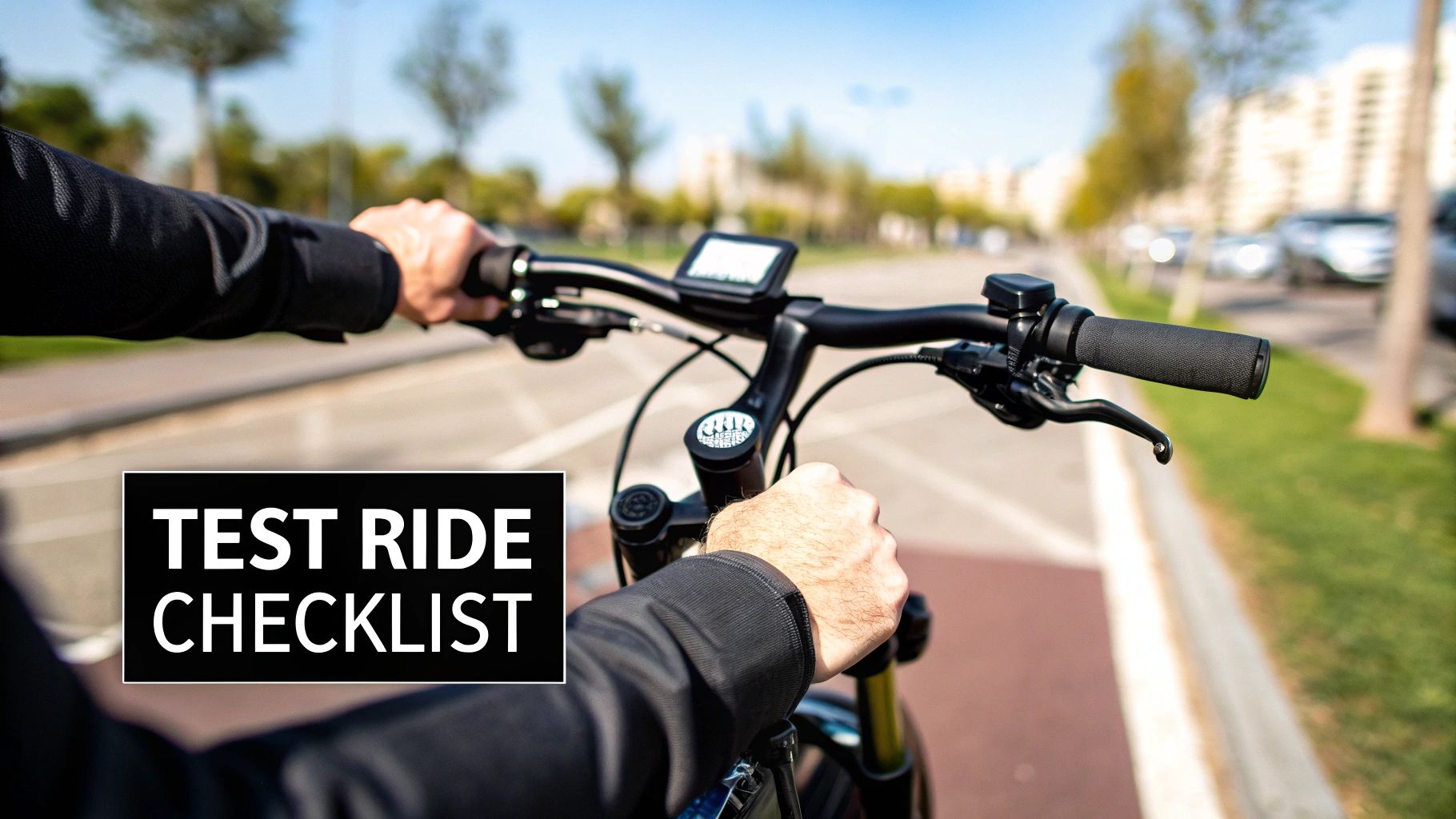
Alright, you’ve done the research, found a local shop, and now you’re standing next to a bike that just might be the one. The test ride is where the rubber literally meets the road. It’s about so much more than a quick spin around the parking lot—this is your chance to really get a feel for the bike’s personality and see if it’s a good match.
Don’t be timid here. Ask the shop staff if you can take the bike on a route that’s similar to what you’ll actually be riding. You need to know how it climbs a real hill, handles a bit of rough pavement, and carves through a few turns.
The Motor and Its Assist
The first thing you’ll notice is the electric assist. As you start pedaling, pay close attention to how that power comes on. Is it a smooth, natural-feeling boost that just makes you feel stronger? Or is it a jerky, abrupt kick that feels like someone gave you an unexpected shove?
A well-designed system, like the ones you'll find on many Hidoes or Eleglide bikes, should deliver that power seamlessly. Make sure to cycle through all the pedal-assist levels. The lowest setting should feel like a gentle tailwind, while the highest should make you feel like a superhero conquering a steep hill. This is a gut-feel test that no spec sheet can ever capture.
Handling, Balance, and Brakes
Next up, focus on the bike's balance and how it handles. E-bikes are heavier than their non-electric cousins, so feeling confident and in control is key. Weave a little bit, take some tight corners, and see how it responds. Does it feel nimble and intuitive, or are you fighting a sluggish, top-heavy machine?
Now for the brakes. Don't just gently squeeze them. Get up to a decent speed (in a safe area, of course) and give them a firm, solid pull. They should bring you to a smooth, controlled stop without any weird shuddering or squealing. Good brakes are a non-negotiable safety feature, period.
A great test ride should answer one simple question: Does this bike inspire confidence? You should feel secure, comfortable, and in complete control, whether you're navigating city traffic or cruising down a bike path.
Comfort and Ergonomics
Finally, listen to your body. How does the bike actually fit you? Are you straining to reach the handlebars, or are your elbows comfortably bent? Is the saddle supportive, or is it already causing discomfort after just a few minutes?
Little ergonomic quirks can turn into big pains on longer rides. For a deeper dive into getting the fit perfect, check out our guide on how to adjust your handlebar height for maximum comfort.
Remember, the tech inside the bike is just as critical as how it feels to ride. The battery and motor are where all the magic happens. In fact, the e-bike motor market is projected to explode from USD 12.79 billion in 2025 to USD 42.73 billion by 2034.
And while traditional chain drive systems still make up 88.9% of the market, the quality of the electronic components is what truly separates a great e-bike from a good one. These e-bike market trends show just how important it is to invest in a bike with premium, reliable parts.
Alright, you’ve test-ridden a few e-bikes and one just clicked. You’re picturing the commutes, the weekend adventures… it feels like the one.
Hold that thought. Before you pull out your wallet in a rush of excitement, it's time to put on your long-term owner hat. The questions you ask right now, in the shop, can be the difference between years of happy riding and a series of frustrating headaches. This isn't just about the price—it's about the full picture.
What's The Real Story With The Warranty?
First things first, let's talk warranty. And I don’t just mean asking, "Does it have one?" We need to get into the nitty-gritty. Think of the warranty as the manufacturer’s handshake deal with you, and you need to know exactly what that handshake promises.
Get specific with your questions:
- What exactly is covered? Most of the time, the frame will have a much longer warranty than the electronic bits. You need to know the coverage period for the battery, the motor, and the controller specifically.
- And what’s not covered? You'll almost always find that normal wear-and-tear items—things like brake pads, tires, and chains—are on you. That's standard. But also check for clauses about damage from misuse or unapproved modifications.
- Who do I call when something goes wrong? This is huge. Do you bring the bike right back here to the shop for them to handle everything? Or are you stuck on the phone with a manufacturer halfway across the country? A local shop that handles claims in-house is worth its weight in gold.
And After The Sale? Let's Talk Service And Support
The warranty will eventually run out, and some things won't be covered anyway. This is where a great local bike shop truly proves its value. Don't wait until you have a problem to find out about their service plan.
Ask about their workshop. Are their mechanics actually certified to work on the motor and battery system of the bike you're about to buy? What’s a ballpark cost for a standard tune-up or a brake service? Knowing they have the tools, the parts, and the trained hands to fix your specific bike offers incredible peace of mind.
A retailer’s commitment shouldn’t end the second you swipe your card. The best shops see the sale as the start of a relationship, not the end of a transaction. They're there to keep you on the road.
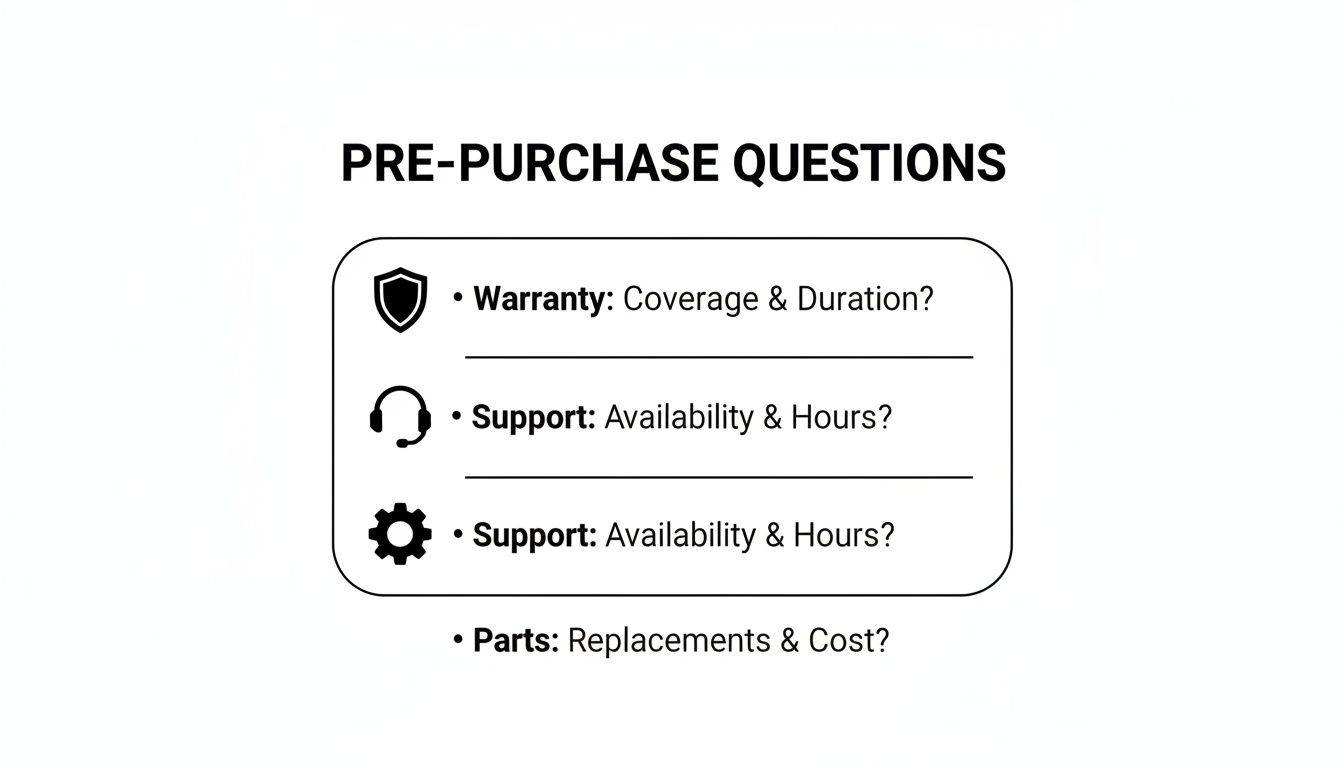
Before you make that final decision, it's smart to have a checklist of questions ready. This ensures you cover all your bases and understand exactly what you're getting into, from warranty details to long-term service.
Pre-Purchase Inquiry Checklist
| Category | Key Question | Why It Matters |
|---|---|---|
| Warranty | What are the specific warranty periods for the frame, motor, battery, and controller? | Electronic components often have shorter warranties than the frame. Knowing these details prevents future surprises. |
| Service | Are your mechanics certified to work on this specific brand's motor and electronics? | Specialized e-bike systems require specific training. You want experts, not someone learning on your bike. |
| Parts | Do you typically keep common replacement parts like brake pads, chains, and batteries in stock? | Waiting weeks for a simple part to be shipped can be incredibly frustrating. In-stock parts mean quicker repairs. |
| Repairs | What is your average turnaround time for common e-bike repairs? | This gives you a realistic expectation of how long you might be without your bike when it needs service. |
| Support | If I have a warranty issue, do I deal with you directly, or do I have to contact the manufacturer? | A shop that acts as your advocate and handles the claim process for you is a massive stress-saver. |
| Costs | Can you provide a rough estimate for a standard annual service or tune-up? | Understanding long-term maintenance costs helps you budget for ownership beyond the initial purchase price. |
Having clear answers to these questions will empower you to buy with confidence, knowing you've chosen not just a great e-bike, but also a great partner to support you for years to come.
Don't Forget Financing Options
Last but not least, let's talk about how you're going to pay for it. A quality e-bike is an investment, but there are often ways to make it more manageable.
Many shops, including ours at Punk Ride, offer financing options through partners like Affirm or Shop Pay, letting you spread the cost over time. It can make that slightly-out-of-reach, higher-quality bike a realistic option. Be sure to ask your local shop what financing plans they have available for US or Australian customers.
Staying on the Right Side of the Law: E-Bike Rules in the US & Australia
So, you’ve found a few e-bikes you love. Awesome! But before you pull the trigger, there's one crucial step that's easy to overlook: making sure your new ride is actually legal where you live.
E-bike laws can feel a bit tangled, and they definitely change depending on where you are. Taking a few minutes to understand the local rules will save you from a major headache—or a hefty fine—down the road.
The Class System in the United States
In the US, most states have adopted a three-class system to keep things simple. When you're looking at e-bikes stateside, you’ll see them labeled this way.
Class 1: These bikes give you a boost only when you're pedaling, and the assistance cuts out at 20 mph. They're the most widely accepted and are generally allowed on any path or trail that welcomes regular bikes.
Class 2: These models come with a throttle, meaning you can get a push from the motor up to 20 mph without even pedaling. They also have pedal assist, but it also caps out at 20 mph.
Class 3: These are the speed demons. They're pedal-assist only (no throttle), but they'll help you all the way up to 28 mph. Because they're faster, they often face more restrictions and might not be allowed on shared-use paths or some bike lanes.
It’s super important to check your local city and state rules, as they can have their own quirks. A good local shop is your best resource here—they'll know the regulations inside and out and will make sure you ride away on a bike that’s a perfect (and legal) fit for your town.
E-Bike Regulations in Australia
Down under in Australia, the rules are fairly consistent nationwide, similar to the EU model. Most legal e-bikes are classified as Electrically Power-Assisted Cycles (EPACs).
- Motor Power: The motor's maximum continuous power output can't exceed 250 watts.
- Speed Limit: The motor must cut out once you reach 25 km/h. You can go faster, but only under your own power.
- Pedal Assist Only: The motor is only allowed to work when you are actively pedaling. Any bike with a throttle that works independently is not considered a legal e-bike and falls into a different vehicle category.
As long as your bike meets these EPAC standards, it's treated like a regular bicycle. No license or registration is required. We dive deeper into how speed affects these rules in our guide on how fast electric bikes go. Checking these specs is just as important as asking about the warranty.
A Few Lingering Questions About Finding Your E-Bike
So, you’ve done your homework, taken a few bikes for a spin, and crunched the numbers. But if you're like most people, there are probably one or two final questions bouncing around in your head before you're ready to pull the trigger.
That’s totally normal. Buying an e-bike is a big deal! We get these questions all the time, so think of this as a final sanity check to make sure you’re feeling 100% confident about your choice.
Is It Better to Buy an Electric Bike Online or from a Local Store?
Ah, the million-dollar question. Honestly, there isn't a single correct answer here—it really comes down to what you value most. A brick-and-mortar shop is fantastic for that hands-on experience. You can see, touch, and, most importantly, ride the bike. Plus, you have a friendly face to turn to for immediate help or service down the road.
On the other hand, buying online from a retailer with a solid regional footprint can be a game-changer. You'll often find a bigger selection and better prices. For example, a company with warehouses in the US and Australia can give you the best of both worlds: the massive inventory of an online store plus the quick shipping and accessible support that feels local. It all depends on how much you want that in-person guidance.
What is a Realistic Price for a Good Entry-Level E-Bike?
The price tags on e-bikes are all over the map, which can be confusing. For a reliable, well-built starter e-bike that’ll handle your daily commute or weekend adventures without a problem, you should plan to spend between $900 and $1,800 in the US, or a similar range in Australian dollars (roughly AUD $1,300 to $2,700).
In this sweet spot, you'll find bikes with dependable motors and batteries from brands that know what they're doing. Go much cheaper, and you start making serious compromises on the most important parts—the battery, motor, and brakes. That can lead to headaches and more money spent on repairs later on.
Your first e-bike is an investment in your freedom and fun. It's always better to aim for that balance of quality and value instead of just chasing the lowest possible price.
How Important Is the Warranty on an Electric Bike?
It's not just important; it’s a deal-breaker. An e-bike isn't just a bicycle with a motor slapped on; it's a sophisticated piece of equipment. The battery, motor, and controller are the guts of the machine, and fixing them out-of-pocket can be seriously expensive.
A solid warranty is the manufacturer's promise that they believe in their product. Look for at least a one-year warranty on the main electronics and, ideally, an even longer one for the frame. Don't be shy about asking for the nitty-gritty details: What's covered? For how long? What's the process if something goes wrong? That peace of mind is priceless.
Do I Need Insurance for My Electric Bike?
This one really depends on where you're riding. In the US and Australia, standard e-bikes don't legally require insurance. But think about it—these bikes are valuable. Getting it covered for theft is a no-brainer.
Legal requirement or not, insuring your e-bike is just plain smart. You might be able to add it to your homeowner's or renter's insurance, or you can get a separate policy. It’s a small cost for protecting a pretty significant asset.
Ready to find the perfect ride with a team that has your back? At Punk Ride, we offer a massive selection of top-tier e-bikes and e-scooters from brands you can trust. With local support and expert advice, we're here to help you start your electric journey. Explore our collection today at https://www.punkride.com.
Share:
Bike Riding at Night A Practical Guide to Safe Cycling
Finding the Best Dual Motor Electric Scooter for You