


Let’s be honest, when you’re shopping for an electric scooter, you’re probably looking at top speed, battery range, and motor power. Tires? They're usually an afterthought. But here’s a little secret from someone who's spent years riding and wrenching on these things: your scooter’s tires are the single most important part of your entire setup.
They’re not just boring black rubber rings. They're what connect you to the ground, and they dictate everything—how bumpy the ride is, how far you can actually go on a charge, and how safely you can take a corner.
Why Your Scooter’s Tires Matter More Than You Think
Think of your scooter’s tires like the shoes on your feet. You wouldn't wear dress shoes to go hiking, right? And you wouldn't wear heavy work boots to go for a run. The same logic applies here. The right tire can make your scooter feel like it's gliding on air, while the wrong one can turn a dream machine into a bone-rattling nightmare.
This is a huge deal whether you're navigating the sun-drenched bike paths in California or cruising the coastal roads of Australia. Many riders get so caught up in the flashy specs that they completely forget that all that power and range is useless if your tires can't put it down on the pavement effectively. Bad tires can slash your range, make every crack in the sidewalk feel like a pothole, and, worst of all, increase your risk of a flat or a nasty spill.
Setting the Stage for Your Perfect Ride
This guide is here to cut through the confusion. We're going to break down the different types of scooter tires out there and get real about the trade-offs you'll be making with each choice. By the time you’re done reading, you’ll know exactly what you need to upgrade your ride from the ground up.
So, what are we actually talking about here? It boils down to a few key things:
- Ride Comfort: Are you after that plush, cloud-like feeling, or are you a pragmatist who just wants something that will never, ever go flat?
- Puncture Resistance: How much do you hate fixing flats? Be honest.
- Performance and Range: Want the best grip for carving corners? Or are you trying to squeeze every last mile out of your battery?
Your tires are the foundation of your entire riding experience. Getting this one component right can make a standard scooter feel premium, while the wrong choice can make a high-end scooter feel sluggish and uncomfortable.
Figuring this stuff out is the first step. It’s all about matching the tire to your life—whether that’s a dependable daily commute in Sydney or a fun weekend cruise along the Miami beachfront.
Picking Your Ride Style: Pneumatic vs. Solid Tires
When you're choosing tires for your electric scooter, you're really deciding how the whole thing is going to feel under your feet. It's a fundamental choice, but it's not as complex as it sounds. The big debate usually comes down to three main players: pneumatic (air-filled), solid, and honeycomb tires.
I like to think of it like picking shoes. Pneumatic tires are your top-of-the-line running sneakers. They're cushioned, grippy, and soak up the bumps for a really smooth, comfortable ride. But, like any high-performance gear, they're not indestructible—they can get a puncture.
On the flip side, solid tires are the steel-toed work boots of the scooter world. They are tough as nails, totally puncture-proof, and you can pretty much forget about maintenance. The trade-off? You're going to feel a lot more of the road, just like you would walking in heavy boots all day.
Tire Type Showdown: Pneumatic vs. Solid vs. Honeycomb
To make sense of it all, it helps to see the pros and cons laid out side-by-side. Every rider has different priorities, and this table should help you quickly spot which tire type lines up with what you need most.
| Feature | Pneumatic (Air-Filled) | Solid Rubber | Honeycomb (Airless) |
|---|---|---|---|
| Ride Comfort | Excellent. The air acts as a natural suspension. | Poor. You feel every bump and crack in the road. | Fair. Better than solid, but not as smooth as pneumatic. |
| Puncture Resistance | Low to Medium. Prone to flats, but tubeless helps. | Excellent. Completely immune to punctures. | Excellent. No air means no flats. |
| Traction / Grip | Excellent. Best for cornering and wet surfaces. | Fair. Can be slippery, especially in the rain. | Good. An improvement over solid, but still trails air. |
| Maintenance | High. Requires regular air pressure checks. | None. Install them and you're done. | None. No air pressure to worry about. |
| Efficiency / Range | Best. Lower rolling resistance means more range. | Lower. Higher rolling resistance can reduce range. | Good. More efficient than solid tires. |
| Weight | Lightest. | Heaviest. | Medium. Heavier than air-filled. |
Ultimately, there's no single "best" tire—just the best tire for you. If you live somewhere with perfect bike lanes and prioritize a cloud-like ride, pneumatic is a no-brainer. But if you're a daily commuter who can't afford a flat tire on the way to a big meeting, the peace of mind from a solid or honeycomb tire might be worth the trade-off in comfort.
Pneumatic Tires: The Kings of Comfort
Air-filled, or pneumatic, tires are the most common type you'll see on scooters, and for good reason. They offer fantastic shock absorption, smoothing out all those annoying cracks and rough patches in the pavement. This cushion doesn't just feel better—it actually improves your grip, giving you more confidence to lean into turns or ride on damp streets.
Within the pneumatic world, you’ve got two main styles to know.
- Tubed Tires: This is the classic setup, just like a bicycle. You have the main outer tire and a separate inner tube inside that holds the air. They're cheap and easy to find.
- Tubeless Tires: This is the more modern approach where the tire seals directly against the wheel rim, no inner tube needed. This design is a huge leap forward in reliability.
Tubeless tires are quickly becoming the standard, especially for rental scooter fleets and daily commuters across the U.S. and Australia. They are much less likely to have a sudden, dangerous "blowout." Instead, a nail in a tubeless tire usually causes a slow leak, giving you plenty of time to get home and sort it out.
Think of it this way: a puncture in a tubed tire is like a balloon popping—the air is gone in an instant. A tubeless puncture is more like a tiny hole in a Ziploc bag. The air seeps out slowly, making it a much safer and less stressful situation.
Solid and Honeycomb Tires: The Indestructible Alternatives
If the very idea of getting a flat tire on your commute gives you anxiety, then solid or honeycomb tires are your ticket to a stress-free ride. These airless designs are all about rock-solid reliability.
A solid rubber tire is exactly what it sounds like—a chunk of solid rubber. You will never, ever have to worry about punctures, check air pressure, or carry a patch kit. This makes them a go-to for riders who put reliability above all else, especially those navigating city streets littered with glass and debris.
A honeycomb tire is a smart evolution of the solid tire. It’s still airless, but it's designed with a pattern of holes or voids—like a honeycomb—running through it. The idea is to find a happy medium: you get the puncture-proof nature of a solid tire but with a bit of built-in shock absorption that solid rubber just can't offer. While they can't quite match the plush feel of pneumatics, they're a noticeable step up in comfort from fully solid tires. For riders who tackle varied terrain, you can find out more about these options in our guide to all-terrain electric scooters.
This handy chart can help you visualize the decision process based on what matters most to you.
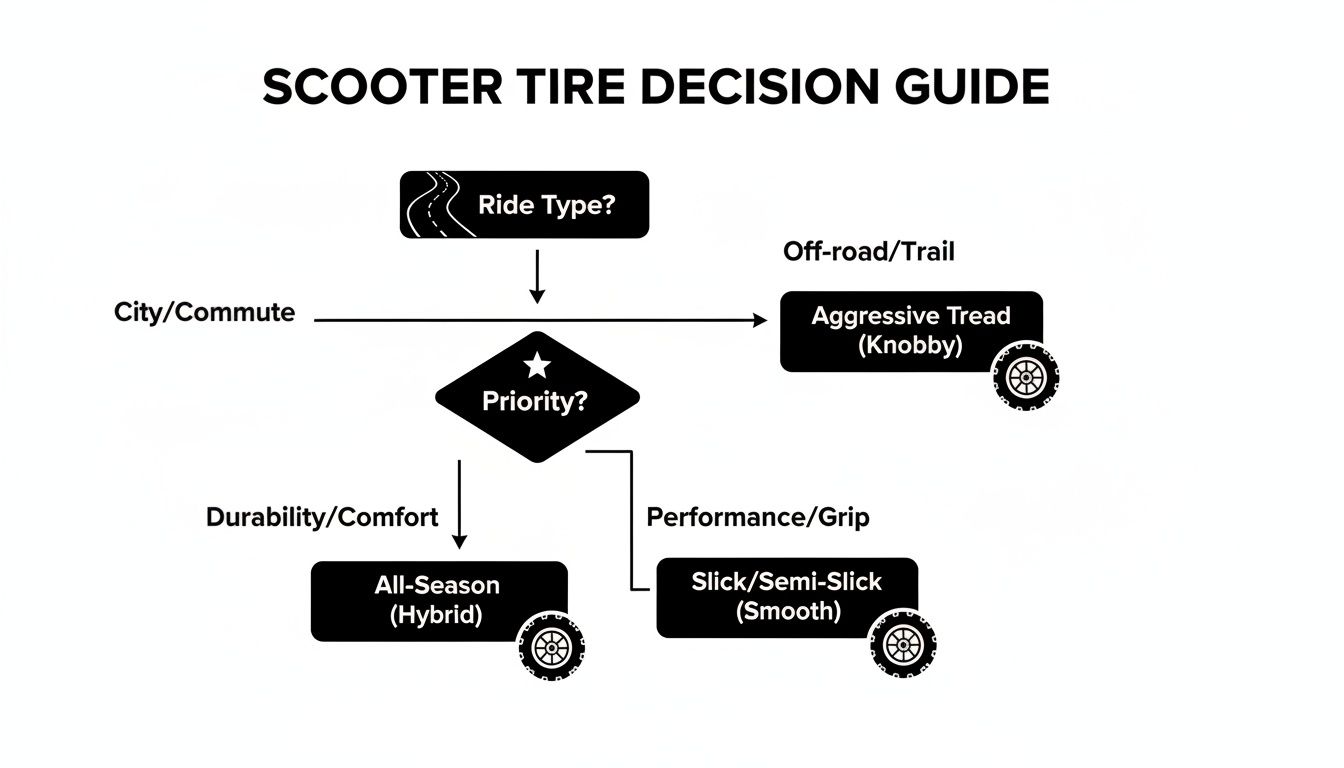
As you can see, if a buttery-smooth ride and top performance are what you're after, air-filled tires are the clear choice. But if you want a zero-maintenance, bomb-proof setup, solid options are the way to go.
The industry is constantly innovating, too. The latest data shows that tubeless tires, now standard on 75% of new models, cut dangerous blowouts by 50%—a critical improvement for shared scooter fleets that log over 500 million km globally each year. There's also a big push for sustainability, with new materials being tested to reduce environmental impact. Furthermore, new low-noise rubber compounds are cutting urban road noise by 3 dB, which is basically like cutting the perceived loudness in half.
Finding the Perfect Fit for Your Scooter
Alright, so you’ve decided on your tire type—maybe air-filled for that cushy ride or solid for zero flat-tire anxiety. Awesome! But don't pop the champagne just yet. Now you have to get the size exactly right, and this is where a lot of riders stumble.
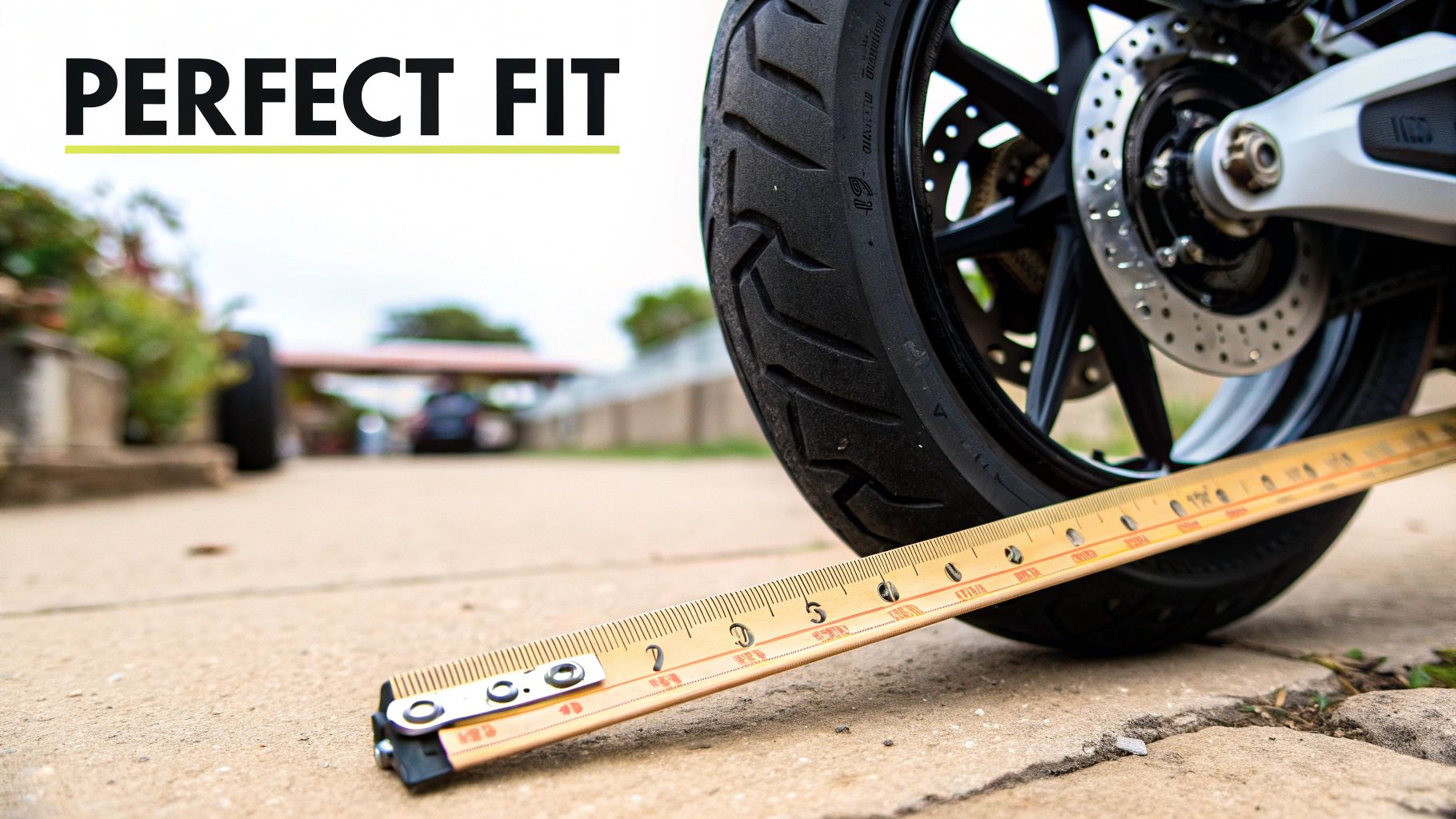
You can't just eyeball it and grab any tire that looks close. It's like buying a new pair of shoes; the style might be perfect, but if the size is wrong, you're in for a world of hurt. For tires for electric scooters, getting the size and compatibility spot-on is everything.
Decoding the Numbers on Your Tire
Ever squinted at the side of your scooter tire and noticed a string of numbers like "10 x 2.5" or "8.5 x 2"? That’s not just a random part number—it’s the secret code to finding a perfect replacement. Let’s break it down.
Most scooter tires use a super simple format: [Outer Diameter] x [Width].
- Outer Diameter (the first number): This is how tall the tire is, from top to bottom, almost always in inches. For a "10 x 2.5" tire, the 10 tells you it's a 10-inch tire.
- Tire Width (the second number): This one’s pretty self-explanatory. It’s the width of the tire from one side to the other. In our "10 x 2.5" example, the 2.5 means it's 2.5 inches wide.
That’s it! This little set of numbers is your blueprint. It’s what you’ll use to make sure you’re even looking at the right category of tires for your ride.
Why You Can't Just Mix and Match Sizes
This is one area where "close enough" is a recipe for disaster. Deviating even a little from the manufacturer's recommended size can lead to some serious headaches. It all boils down to clearance—the physical space your tire has to spin without hitting anything.
You might be tempted to put a wider tire on, say a 2.5-inch model on a scooter that came with 2-inch tires, thinking you'll get more stability. While that can be true, that beefier tire might not actually fit in the fork or swingarm.
If a tire is too wide, it will rub against the frame or brake components. This doesn’t just wear down the tire; it creates dangerous friction, kills your speed, and can lead to a sudden and dangerous failure.
The same goes for the diameter. Trying to shoehorn an 11-inch tire onto a scooter built for 10-inch wheels just isn't going to work. There’s simply no room. It will jam against the mudguard or frame, and your scooter will be completely unrideable. Always check your manufacturer’s specs first. That's the golden rule, no exceptions.
Regional Availability in the US and Australia
Here’s a practical tip that often gets overlooked: where you live matters. While big-name scooters are sold everywhere, the market for replacement tires can look very different from one place to another.
- In the US: The market is quite large, but can be fragmented. You’ll find a great selection for major brands like Segway and Hiboy, but sourcing specific sizes for less common or imported brands can sometimes be a treasure hunt.
- In Australia: The market is growing fast with the rise of e-scooter popularity in cities like Brisbane and Adelaide. However, availability can be more limited than in the US, so you may have to rely on specialty online shops or even order internationally to get what you need.
This just means that if you’re riding in the US or Australia, it’s extra important to confirm your exact tire size before you click "buy." It'll save you the pain of waiting weeks for a tire from overseas, only to discover it’s the wrong one. When in doubt, trust the numbers printed on your original tire. They're your surefire guide to a perfect, safe fit.
Balancing Comfort, Range, and Durability
Choosing the right tires for your electric scooter isn't a one-size-fits-all deal. It's really about figuring out what matters most to you on your daily rides. Every tire is a compromise, a balancing act between a smooth ride, long-lasting durability, and how far you can go on a single charge. Getting this balance right is the secret to making your scooter a perfect fit for your life.
Think of it like a slider in a video game. On one end, you've got max comfort. On the other, you've got ultimate durability. You can't have both cranked up to 100%, so the goal is to find that sweet spot that makes sense for how and where you ride.
Comfort: Your Cushion Against the Road
The first thing you'll notice when you try different tires is the ride quality. Comfort is what separates a smooth, gliding commute from a teeth-chattering, bone-jarring one.
Pneumatic (air-filled) tires are the undisputed kings of comfort. That cushion of air acts like a mini suspension system, soaking up all the cracks, bumps, and rough patches in the pavement. It feels like you're floating over the road, and for pure ride enjoyment, nothing beats it.
On the other hand, you have solid tires. They're at the complete opposite end of the spectrum. Since they're made from a solid block of rubber, they offer almost zero shock absorption. You will feel every single pebble and crack, which gets old fast on longer trips or beat-up city streets. Honeycomb tires try to split the difference, using air pockets to give a bit of cushion, but they still can't match the plush ride of a true pneumatic.
Range: How Your Tires Impact Your Battery
It might sound weird, but your tires have a huge say in how far you can travel before needing to recharge. It all comes down to a concept called rolling resistance—basically, the friction a tire creates as it rolls. The less friction, the less work your motor has to do, and the longer your battery lasts.
Pneumatic tires, as long as you keep them properly inflated, are the most efficient and have the lowest rolling resistance. They roll smoothly, letting your motor do its job without extra effort. But let the air pressure drop, and that rolling resistance goes through the roof, absolutely killing your range. To get the most out of every charge, it helps to understand all the factors at play, which you can dive into in our complete guide on how to increase electric scooter range.
Solid tires are harder and don't flex, which means they create more friction against the road. That extra drag forces your motor to work harder just to keep you moving, and you'll definitely see a drop in your scooter's maximum range.
The Takeaway: A soft, squishy tire might feel great, but that comfortable "give" creates more drag on the road. A harder tire might feel bumpier, but it rolls more freely, helping you squeeze more miles out of your battery.
This trade-off is a huge deal for scooter fleet operators. Think about it: the shared e-scooter market in the U.S. is expected to hit 2.5 million scooters by 2025. Keeping them running means dealing with tire replacements that cost a massive USD 150 million every year. This has pushed many companies toward airless honeycomb designs, which can slash maintenance costs by 40% and bring puncture incidents down to under 5%. Plus, with modern lithium-ion scooters making up 70% of sales, low-resistance tires are a no-brainer—they can boost range by up to 12%.
Durability and Puncture Resistance
For most of us, especially daily commuters, reliability is everything. A flat tire on your way to work can completely derail your morning. This is where the trade-off gets really personal.
-
Solid and Honeycomb Tires: These are the tanks of the scooter world. They are 100% puncture-proof. You can roll right over glass, nails, and whatever else is lurking on the road without a worry. That peace of mind is priceless if you ride through industrial zones or streets that aren't well-maintained.
-
Pneumatic Tires: Here lies the biggest weakness. They can get flats. While modern tubeless tires are much better at handling small punctures without a sudden blowout, they're still vulnerable. Their durability comes down to keeping them at the right pressure and having a little luck avoiding road debris.
Just imagine a rider named Alex, who commutes through an industrial park in Sydney. After getting three flats in a single month, the smooth ride of his pneumatic tires just wasn't worth the constant anxiety. He switched to solid tires. Sure, the ride was harsher, but his flat-tire stress disappeared overnight, making his daily commute something he could count on again. That’s the kind of decision every rider has to weigh for themselves.
Keeping Your Tires in Top Condition
So, you've done your homework and picked the perfect tires for your electric scooter. High five! But that’s just the start of the journey. Now it's time to learn how to keep them in great shape.
Think of tire care as your scooter's health plan. A little regular attention goes a long way, keeping your ride smooth, safe, and dependable. Trust me, it'll save you a ton of money and headaches down the road.
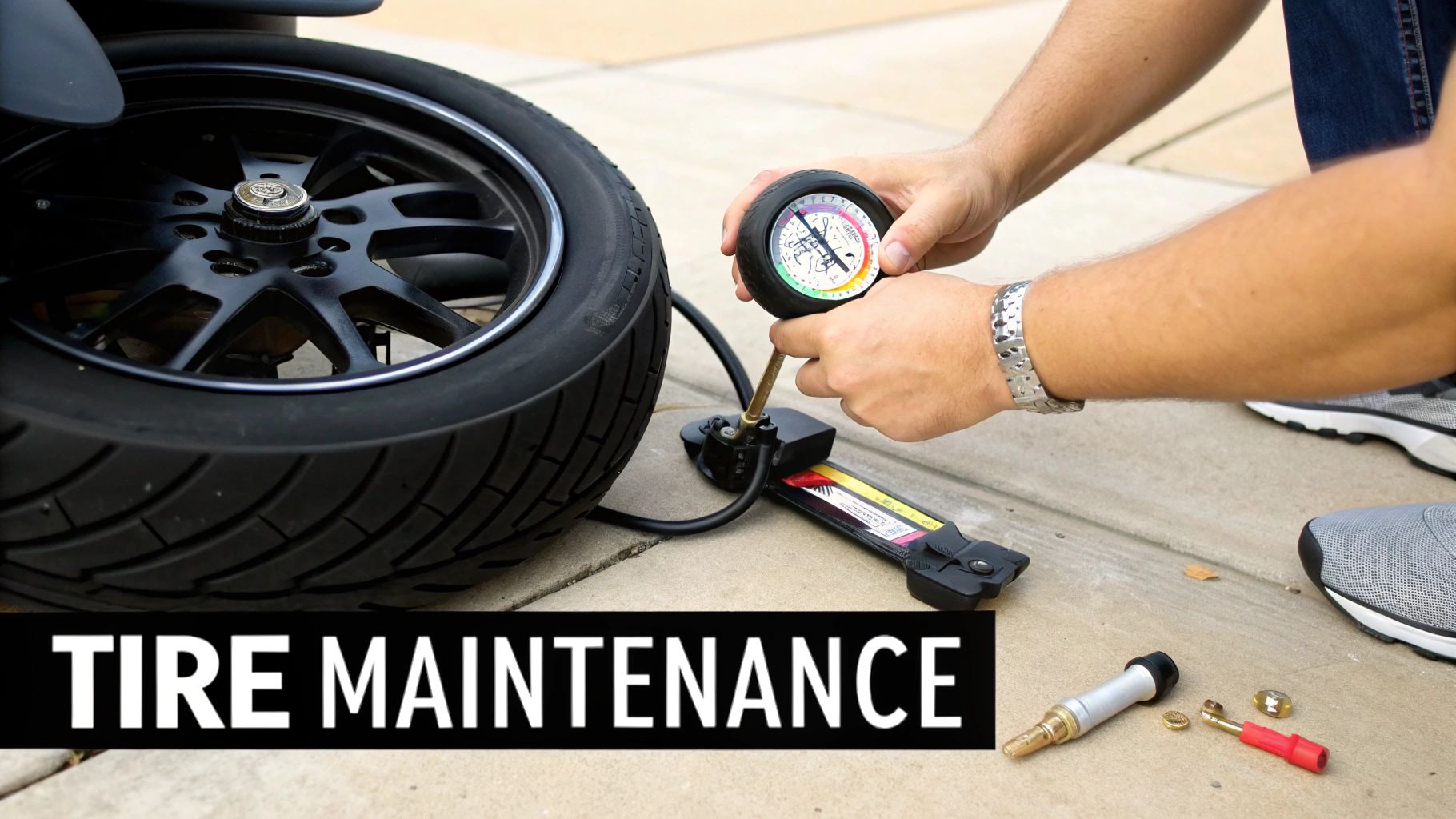
This isn’t about becoming a master mechanic overnight. We're just talking about a few simple, practical steps any rider can—and should—master. Knowing this stuff means you can handle common issues yourself instead of running to the repair shop for every little thing.
Essential Care for Pneumatic Tires
If you're rolling on air-filled tires, your number one job is managing tire pressure. Seriously, it’s the single most important factor for preventing flats and getting the best performance out of your scooter. When tires are under-inflated, they feel spongy, slow you down, and are super vulnerable to "pinch flats"—that's where the inner tube gets squeezed against the rim and pops.
How often should you check it? A good rule of thumb is at least once a week, and always before a long ride. The correct pressure, measured in PSI (Pounds per Square Inch), is almost always printed right on the side of the tire. A small, portable pump with a built-in gauge is a must-have tool for anyone with pneumatic tires.
Keeping your tires at the recommended PSI is like getting a free performance upgrade. It instantly improves your range, protects against punctures, and gives you a more responsive, stable ride. Ignoring it is the fastest way to a flat tire.
Of course, even with perfect pressure, punctures can still happen. When they do, you've got two main options: patch the inner tube or just replace the whole thing. Patching is a fantastic skill to learn for small holes, but if you've got a bigger gash or the tube is just old and worn out, a full replacement is the smarter, more reliable fix.
Keeping Solid and Honeycomb Tires Rolling
The best part about solid and honeycomb tires? No air pressure to worry about! Your maintenance routine here is all about a simple visual inspection. Once a month or so, just give your tires a good look-over.
Here's what you're looking for:
- Significant Wear: Is the tread worn smooth? If so, your grip is shot, especially on wet roads.
- Cracks or Splits: Check the sidewalls for any cracks. UV exposure and general stress can cause the rubber to break down over time.
- Chunking: Look for any pieces of rubber that have torn off. This can throw off the balance and lead to a seriously bumpy ride.
If you spot any of these issues, that's your cue to get a replacement. While these tires are puncture-proof, they aren't immortal and will eventually wear out.
A Quick Look at Tire Installation
Changing a scooter tire can range from a pretty straightforward DIY task to a full-on wrestling match. Pneumatic tires are generally the more manageable of the bunch. With a set of tire levers and a little patience, most riders can learn to swap an inner tube or replace an outer tire on their own. For a step-by-step tutorial, check out our complete guide on how to change a scooter tire.
Solid tires, on the other hand, are a different beast entirely. They have zero give, so stretching them onto a wheel rim requires serious muscle, special tools, and often some heat (like boiling them in water) just to make them pliable. It’s a notoriously tough job, and many riders wisely decide to leave it to a professional to avoid the frustration and potential damage to the wheel.
The good news is that the industry is always working to make tires more resilient. We're seeing innovations like puncture-resistant tires with Kevlar linings, which now equip 65% of new e-scooters and reduce fleet downtime by an impressive 30%. Big names like Michelin and Continental have even developed specialized EV-compatible compounds that offer 20% better grip on wet roads and a 15% longer lifespan—up to 5,000 km per tire—compared to older designs. The technology is always moving forward, making our rides better and safer.
Got Questions About E-Scooter Tires? We've Got Answers.
Diving into the world of electric scooter tires can feel a bit overwhelming, and it's totally normal to have a few questions. Getting the small details right is the difference between a good ride and a great one—not to mention a safer one. We get these questions all the time from riders, so we've put together some straight-to-the-point answers to help you out.
Whether you're trying to fix a problem, thinking about an upgrade, or just curious, this is the place to start. Let's clear up the confusion and get you rolling with confidence.
Can I Put a Wider Tire on My Electric Scooter?
This is easily one of the most common upgrade questions we hear, and the short answer is: "maybe, but you have to be super careful." A wider tire sounds great—it can give you more stability and a bigger contact patch for better grip. But it's not always a simple swap.
The big issue here is clearance. You need to make sure there’s enough room between the new, fatter tire and your scooter’s fork, swingarm, and brakes. If that new tire is rubbing against anything, you're asking for trouble. It'll wear down fast, create friction that slows you down, and could even cause a dangerous blowout. Before you buy anything, get a ruler and measure your current setup, then check your scooter’s manual for any maximum width specs.
How Often Should I Check My Tire Pressure?
If you have pneumatic (air-filled) tires, this is absolutely essential. You need to be checking your tire pressure at least once a week, and always before a long ride. Seriously, it's the single best thing you can do to avoid getting a flat.
Keeping your tires properly inflated makes your scooter perform the way it was designed to, giving you the best possible range, handling, and ride comfort. The correct PSI (Pounds per Square Inch) is almost always printed right on the side of the tire. Remember, under-inflation is the #1 cause of those nasty "pinch flats," where the rim pinches the inner tube and pops it.
Think of your tire pressure as the foundation for your entire ride. A quick weekly check with a decent gauge takes less than a minute, but it pays off big time by preventing flats and keeping your scooter running efficiently.
Are Solid Tires Really 100% Puncture Proof?
Yep, they sure are. Since solid tires are just solid rubber with no air inside, they are completely immune to flats from nails, glass, thorns, or whatever else is lurking on the road. This is their biggest advantage and why so many daily commuters swear by them for total peace of mind.
But "puncture-proof" doesn't mean "indestructible." Solid tires still wear out. They can get cracks from hitting potholes too hard or from sitting in the sun for years. We've even seen chunks break off, which makes for a seriously sketchy and bumpy ride. So, while you'll never have to patch a tube, you should still give them a once-over for damage every now and then.
This kind of reliability is a huge reason the market is growing so fast. The global electric scooter tire market has ballooned from USD 1.1 billion in 2023 and is projected to hit USD 2.75 billion by 2032. That growth is all about the soaring demand for e-scooters and the need for tough, low-maintenance parts for city riding. You can read the full research about these market trends to learn more.
Is It Hard to Change an Electric Scooter Tire Myself?
Honestly, it really depends on what kind of tire you're dealing with.
Changing a standard air-filled tire, especially if you're just swapping a punctured inner tube, is a skill most people can pick up. With a good set of tire levers, a bit of patience, and a YouTube tutorial, it's a totally doable DIY job.
Solid tires, on the other hand, are a whole different beast. They are notoriously tough to install. Because they don't flex, you have to use a ton of force to stretch them onto the wheel rim. The process usually involves boiling the tire in hot water to soften it up, using heavy-duty zip ties as clamps, and a whole lot of brute strength. Many riders try it once and then decide it’s a job worth paying a pro at a bike or scooter shop to handle.
Ready to find the perfect tires for your ride? At Punk Ride LLC, we’ve hand-picked a selection of high-performance parts and accessories for all the top electric scooter brands. Find everything you need to keep rolling at https://www.punkride.com.
Share:
Mastering changing scooter tire: Your Pro Guide
How to Adjust Handlebar Height for a Perfect Ride