


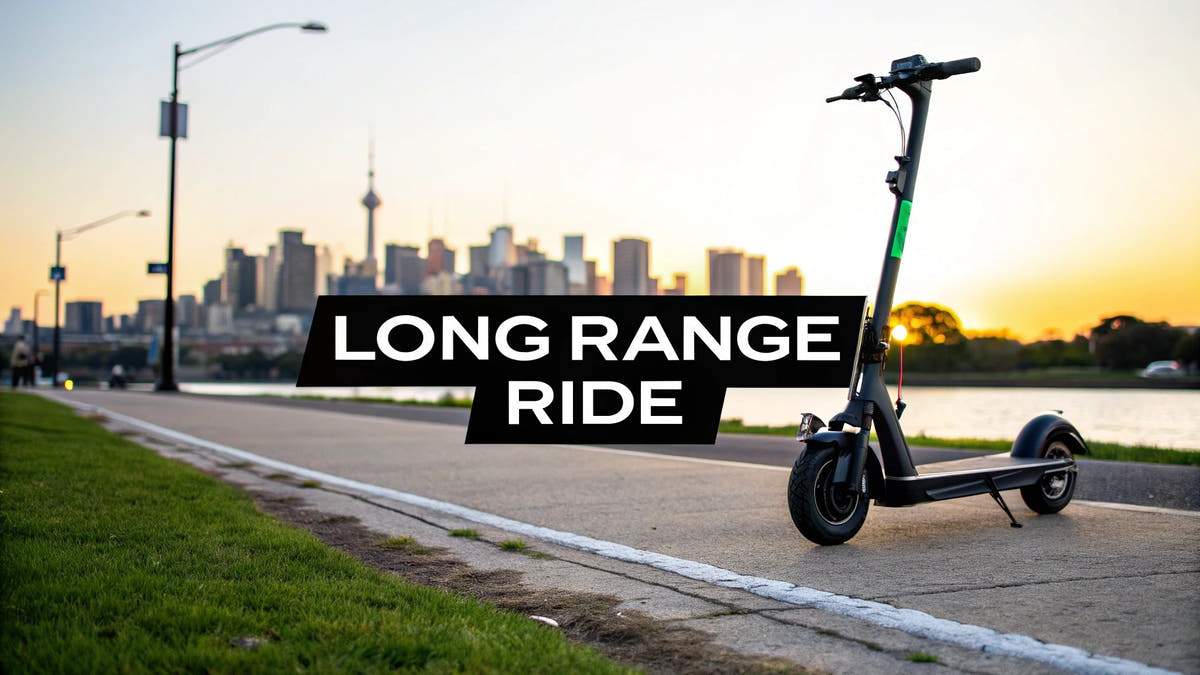
A long range electric scooter for adults is all about freedom. It’s the difference between a scooter that can handle a quick trip to the shops and one that can conquer your daily commute, plus a detour for groceries on the way home, without you ever breaking a sweat about the battery level.
Think of it like your phone. A standard battery gets you through most of the day with careful use, but a long-life battery lets you stream, browse, and call without ever glancing at the percentage. That’s the kind of confidence a long-range scooter provides.
What Long Range Really Means For An E-Scooter
So, let's cut through the marketing jargon. When we talk about "long range" in the e-scooter world, we're really talking about killing ‘range anxiety’ for good. That’s the all-too-familiar feeling in the pit of your stomach when you wonder if you have enough juice to make it home.
A true long-range model isn't just a toy for the weekend. It’s a dependable workhorse that can handle your round-trip commute, an unplanned errand, and still have power to spare. It elevates your scooter from a simple “last-mile” gadget to your main way of getting around town.
The Evolution of E-Scooter Range
It's amazing how far scooter tech has come in just a few years. The first wave of e-scooters barely had enough oomph for a short jaunt around the neighborhood. Now, the entire industry has shifted gears.
Back in 2015, you’d be lucky to find an adult e-scooter promising 10–15 miles on a charge. Jump to today, and a proper long range electric scooter for adults can boast a claimed range of 40–60+ miles. That massive leap is thanks to huge improvements in battery cells and more efficient motors.
This progress is exactly why scooters are now a serious car alternative for so many people navigating busy US and Australian cities.
Understanding The Different Range Tiers
Of course, not everyone needs a scooter that can cross a county line. The trick is to find the sweet spot that matches your daily routine.
The role of scooters is just one part of the much bigger story of personal electric transport. For a broader view of how these vehicles fit together, you can explore the evolving E-Mobility landscape and see how cities are changing.
To make things simple, we can group e-scooters into three basic tiers based on how far they can go. This table gives you a quick snapshot of what to expect.
E-Scooter Range Tiers and Who They're For
| Range Category | Advertised Distance | Best For |
|---|---|---|
| Short Range | Under 20 miles | Quick errands, "last-mile" commutes from the train station, or just casual fun. |
| Standard Range | 20-40 miles | The sweet spot for most daily commuters who need a reliable round-trip machine. |
| Long Range | Over 40 miles | Power users, people with very long commutes, or weekend adventurers who love to explore. |
Picking the right tier is key. It stops you from paying a premium for a massive battery you'll never fully use, or worse, buying a scooter that can't reliably get you where you need to go.
So, What's the Real-World Range of Your Scooter?
Ever seen a long range electric scooter for adults advertised with an incredible 50-mile range, only to have it die on you closer to 30 miles during your actual commute? Don't worry, you’re not alone. That number on the box is a "best-case scenario," tested in a lab with a super-light rider on a perfectly flat, smooth surface with zero wind. It’s not exactly the real world, is it?
A good way to think about it is like the fuel economy of a car. The sticker might claim a certain MPG, but your actual mileage always comes down to how and where you drive. Slamming the accelerator, hauling heavy stuff, and tackling steep hills will drain that tank way faster. It's the exact same story with your e-scooter.
The Two Big Players: Battery and Motor
When you cut through the marketing fluff, two specs really determine your scooter's range: battery capacity and motor power. Get a handle on these, and you'll know what a scooter is truly capable of.
First, and most importantly, is battery capacity. This is measured in Watt-hours (Wh). Think of this as the size of your scooter's "fuel tank." The bigger the number, the more juice you have to play with. A casual, lightweight scooter might have a 250Wh battery, but a serious long-distance machine will be packing 700Wh or more.
Then you have motor power, measured in Watts (W). This tells you how much oomph the motor has for acceleration and climbing hills. A beefy motor is a lot of fun, but it's also thirsty. Just like a V8 engine burns more fuel than a little four-cylinder, a powerful motor pulls more energy from the battery. A 350W motor is pretty standard for city riding, while 500W models (or even dual-motor setups) give you more punch but will reduce your maximum range.
It's all a balancing act. A huge battery (high Wh) paired with a modest motor will give you a ridiculously long, steady ride. But take that same big battery and hook it up to a high-power motor, and you'll trade some of that maximum distance for thrilling speed and acceleration.
How You Ride Changes Everything
Beyond the hardware, the way you ride has a massive impact on that advertised range. Knowing these factors helps you squeeze every last mile out of your battery and pick a scooter that truly fits your life.
Here are the main things you control:
- Rider Weight: Simple physics here. The motor has to work harder to move more weight. A 210 lb rider might see their range drop by as much as 20-25% compared to a 155 lb rider on the very same scooter.
- Terrain and Hills: Cruising on flat, smooth pavement is where your scooter is happiest and most efficient. Every single hill you climb is like putting the pedal to the metal in a car—it demands a huge surge of power and eats into your total range.
- Speed and Riding Style: This one’s a biggie. Ambling along at a steady 10 mph uses way less energy than blasting it at the 15 mph top speed. If you're constantly accelerating hard and then braking, you're draining the battery much faster than someone riding with a smooth, consistent pace.
The Stuff You Can't Control
Finally, the world around you gets a vote, too. Even the weather can have a say in how far you get on a single charge, which is a massive consideration whether you're riding through a Chicago winter or a hot Sydney summer.
These external factors can make a real difference:
- Tire Pressure: This is an easy win. Under-inflated tires create more drag, making the motor work overtime. Keeping your tires pumped up is one of the simplest things you can do to maximize your range.
- Weather: Lithium-ion batteries absolutely hate the cold. Riding in winter can temporarily slash a battery's capacity by 20-30%. A stiff headwind also acts like a constant hill, forcing your motor to burn more power just to keep you moving.
- Stop-and-Go Traffic: Constantly stopping and starting in a busy city is far less efficient than cruising down an open bike lane. Every time you accelerate from a dead stop, you're taking a big gulp of power from the battery.
Once you understand how all these pieces fit together, you can build a much more realistic picture of what to expect from any long range electric scooter for adults. A little bit of knowledge here will make you a much smarter buyer.
How to Calculate Your Personal Commuting Range
Alright, let's get practical. Instead of just crossing your fingers and hoping the advertised range is true, you can figure out a pretty accurate estimate for your own daily trips. It’s actually quite simple: start with the number on the box, then start chipping away at it based on your real-world riding conditions.
Think of it like planning a monthly budget. You start with your total income (the advertised range), then subtract all your necessary expenses—rent, bills, food (or in our case, hills, your weight, speed)—to see what you actually have left. This little exercise turns you from a hopeful buyer into an informed one who can see past the marketing and pick a scooter that will genuinely go the distance you need it to.
Start With a Simple Mental Shortcut
For a quick, back-of-the-napkin estimate, I always tell people to use the '70% Rule'. It's a lifesaver.
In normal, everyday riding—a mix of smooth flats, a few gentle slopes, and a sensible pace—you can reliably expect to get about 70% of whatever the manufacturer claims.
So, if a scooter box boasts a 50-mile range, a much more realistic number for your day-to-day use is around 35 miles (50 x 0.70). This simple mental adjustment gives you a far more practical baseline and saves you from the frustration of a dead battery halfway home.
This approach is your best defence against range anxiety. By building in this conservative buffer, you know that even on a bad day with a strong headwind or an extra errand to run, you’ll still have plenty of juice to make it back.
Applying Your Personal Deduction Percentages
To get an even more precise number, we can layer on specific deductions for each little thing that drains the battery on your ride. You just start with the advertised range and subtract a percentage for each condition that applies to you.
This flowchart gives you a great visual of how a scooter's perfect-world range gets whittled down by reality to give you the true distance you can expect.
The main takeaway is that your real-world range is always what's left after you subtract the impact of all these factors from that shiny advertised number.
Let's walk through an example. Say you're looking at a long range electric scooter for adults with a claimed range of 40 miles.
- Your Weight: You're a bit heavier than the 165 lb test rider, so let's knock off 15%. (40 miles - 6 miles = 34 miles left).
- Your Route: Your commute has a few decent hills, so we'll subtract another 25% from the original number. (34 miles - 10 miles = 24 miles left).
- The Weather: You often ride in chilly weather, which batteries hate. Let's take off another 10%. (24 miles - 4 miles = 20 miles left).
Just like that, the 40-mile scooter now has a realistic personal range closer to 20 miles. If your daily round trip is 15 miles, you're golden with a nice little buffer. But if your commute is 25 miles, you'll need to find a model with a bigger advertised range to start with.
Your Personal Range Deduction Calculator
Here's a handy table to guide you. Just find the conditions that describe your typical ride and subtract the estimated percentage from the scooter's advertised range.
| Factor | Condition | Estimated Range Deduction |
|---|---|---|
| Rider Weight | Over 200 lbs | -15% to -25% |
| Terrain | Mostly hilly or steep inclines | -20% to -30% |
| Riding Style | Aggressive, fast acceleration | -15% to -25% |
| Average Speed | Consistently at max speed | -20% to -30% |
| Tire Pressure | Noticeably under-inflated | -5% to -10% |
| Weather | Cold temperatures (below 40°F) | -15% to -25% |
| Road Surface | Rough, poorly maintained paths | -5% to -10% |
By running these simple numbers, you put the power back in your hands. You’ll be able to confidently choose a scooter that doesn’t just promise long distances but actually delivers them for your unique journey.
What to Look For When You're Riding Far
When your daily ride is more of a marathon than a sprint, the little details on your scooter suddenly become a very big deal. A massive battery is obviously where it starts, but it’s the supporting cast—the suspension, the tires, the brakes—that turns a scooter from a toy into a reliable ride for the long haul.
These are the features you can’t compromise on if you want a long range electric scooter for adults that can actually handle the real-world streets and unpredictable weather.
Think of it this way: you wouldn't pick a tiny city car with stiff seats and basic brakes for a road trip across the country. You'd want something with cruise control, comfy seats, and brakes you can trust. The same logic applies directly to your scooter.
The Foundation of a Smooth Ride
Comfort isn't just a nice-to-have on long commutes; it's an absolute necessity. Riding for 45 minutes on a scooter that rattles your teeth out is just plain exhausting and, frankly, not very safe. This is where a good suspension system and the right tires make a world of difference, especially on the less-than-perfect pavement you’ll find in most cities.
A scooter with dual suspension—meaning both front and rear—is the gold standard here. It absorbs the jolts from potholes and bumps before they travel up your arms and legs. You'll feel way less tired and have much better control of the scooter.
Tires are the other half of this equation. You'll usually find two main types:
- Pneumatic (Air-Filled) Tires: Think of these as miniature car tires. They offer the best shock absorption and work hand-in-hand with the suspension to give you the smoothest ride possible.
- Solid Tires: These are made from solid rubber or foam, which means they can never get a puncture. Awesome, right? The trade-off is a much harsher, bumpier ride that isn't ideal for covering long distances comfortably.
For a true long-range machine, the winning combo is pneumatic tires paired with dual suspension. It’s the secret sauce for comfortably tackling long, varied journeys.
Must-Have Safety for All Conditions
Covering serious ground means you're going to face all sorts of conditions—bright sunshine one minute, a dark and drizzly evening the next. Your scooter needs to be ready for anything.
Let's start with stopping power. A fast scooter needs brakes that can match its speed. Disc brakes, which work by squeezing pads onto a rotor on the wheel, are what you want. They provide fantastic stopping power, especially when it's wet, making them the go-to choice for high-performance and long-range models.
Your ability to see and be seen is just as critical as your ability to stop. A powerful front headlight and a bright, reactive rear brake light are non-negotiable, especially for commuters who may be riding at dawn or dusk.
Finally, we have to talk about the weather. A scooter with a decent IP (Ingress Protection) rating is a must. You should be looking for a rating of at least IPX4, which means it can handle water splashing from any direction. That way, a sudden downpour won't fry your electrics when you're miles from home.
How to Maximize Your Scooter's Battery Life
Your battery is the heart of your scooter. It dictates how far you can roam and how much fun you can have getting there. Looking after it isn't just a chore; it’s the secret to getting the best performance on every ride and protecting your investment for the long haul.
A few simple habits can make a massive difference. We're talking about adding miles to your daily trips and years to your scooter's life, just by tweaking how you charge, maintain, and store it.
Smart Charging Habits for a Healthy Battery
First things first, let's bust a common myth. The old advice about draining a battery completely before charging? That’s ancient history. It doesn't apply to the modern lithium-ion batteries in every long range electric scooter for adults. In fact, doing that can actually damage them over time.
Instead, the golden rule is the 20-80% rule. Your battery is happiest when its charge level stays in this sweet spot. It puts less stress on the cells and can seriously extend their overall lifespan.
Avoid charging to 100% every single night unless you have a massive trip planned for the next day. On the flip side, try not to let the battery drop below 20% too often. This one habit is probably the best thing you can do for your battery’s long-term health.
Simple Maintenance Goes a Long Way
It's not all about the charger. A little physical TLC has a huge impact on how efficiently your scooter sips power from the battery. These quick checks will keep everything running smoothly.
- Check Your Tire Pressure: This is the number one range-extender. Under-inflated tires create a ton of drag, making your motor work overtime and guzzle battery. Keep them inflated to the recommended PSI—it’s a game-changer.
- Adjust Your Brakes: If your brakes are too tight, they can rub against the wheel, creating constant resistance. Make sure your wheels spin freely when you’re not pulling the brake lever.
- Keep It Clean: A clean scooter runs better. Wiping it down stops dirt and grime from getting into moving parts, which causes friction and wastes precious energy.
The efficiency gains are incredible, especially if you're swapping a car for a scooter on your commute. A 6-mile daily ride might only use 45–50 kWh of energy over a whole year, costing as little as $9–$15 in electricity. A small petrol car doing that same trip? You'd be looking at $300–$600 in fuel.
Proper Storage and Long-Term Care
How you store your scooter, particularly when you’re not riding it for a while, is critical. Extreme hot and cold are the biggest enemies of a lithium-ion battery.
Always try to store your scooter somewhere cool and dry, out of direct sunlight. A freezing garage or a scorching car trunk are definite no-gos. If you're parking it for a few weeks or more, aim to leave the battery with a charge of around 50-60%. Storing it completely full or totally empty for long periods can cause the cells to degrade much faster.
For a deeper dive, check out our guide on how to store lithium batteries safely to make sure you're protecting your investment.
Riding Within the Law: A Guide to US & Australian E-Scooter Rules
Getting a powerful long-range electric scooter feels like unlocking a new level of freedom. But with that freedom comes responsibility, and that means knowing the rules of the road. The legal situation for e-scooters in the US and Australia can feel like a bit of a tangled mess, with laws changing from one state, and even one city, to the next.
Getting this right is crucial. What's perfectly fine in one city could land you a hefty fine in another. It's something you absolutely have to keep in mind before you start riding.
Navigating E-Scooter Laws in the USA
In the United States, there is no single federal law for e-scooters. Instead, it’s a patchwork of state and local regulations. This means what’s legal in California is very different from the rules in New York.
Here’s a quick snapshot to show the variety:
- California: Generally, you can ride your e-scooter in bike lanes or on roads with a speed limit of 25 mph or less. You need a valid driver's license, and helmets are required for riders under 18. The state-wide speed limit for scooters is 15 mph.
- New York: E-scooters are legal statewide. The speed limit is typically 15 mph, and they are allowed on roads with a speed limit of 30 mph or less, as well as in bike lanes. However, individual cities can set their own, stricter rules.
- Florida: E-scooters are treated like bicycles, meaning you can ride them in bike lanes and on streets. The maximum speed is usually 15 mph, but local municipalities have the power to regulate them further.
The crucial thing to remember is that laws can change from one town to the next. Always check the specific ordinances for your city or county before you head out. A quick search for "[Your City] e-scooter laws" is a must.
Understanding the Rules in Australia
Australia also has a state-by-state approach to e-scooter legislation, and the rules are evolving quickly. Some states have embraced personal e-scooters, while others are still in trial phases or have stricter limitations.
Here’s a look at how different states handle it:
- Queensland (QLD): One of the most progressive states. Privately owned e-scooters are legal on footpaths, shared paths, and local streets with a speed limit of 50 km/h or less. The speed limit is 12 km/h on footpaths and 25 km/h elsewhere.
- Australian Capital Territory (ACT): Similar to Queensland, personal e-scooters are permitted on footpaths and shared paths (at 15 km/h) and bicycle lanes (at 25 km/h).
- Victoria (VIC) & New South Wales (NSW): These states are more restrictive. As of late 2023, only rental e-scooters are part of ongoing trials in specific areas. Riding a private e-scooter on public roads or paths remains largely illegal, though these laws are under constant review.
These laws are always changing, so it pays to stay up-to-date. Always, always check the local transport authority website for the latest rules before you start riding.
Got Questions? We've Got Answers
Stepping into the world of long-distance e-scooting can feel like a lot to take in. It’s natural to have questions! We've rounded up the most common ones we hear from riders to give you clear, straight-to-the-point answers and get you riding with confidence.
How Much More Does a Long Range Scooter Cost?
You'll definitely see a price jump when you start looking at scooters built for serious distance. The main reason? The battery. It's hands-down the most expensive component in any electric scooter.
A basic, get-around-the-block scooter might run you $300-$500. But for a true long-range machine that can reliably deliver 40 miles or more on a single charge, you should expect to be in the $800 to $1500+ range.
But you're not just paying for a bigger battery. That higher price tag almost always comes with a beefier frame, much better suspension (a lifesaver on long rides), a stronger motor to tackle hills, and more reliable brakes. These aren't just nice-to-haves; they're essential for a scooter designed to go the extra mile.
Does Regenerative Braking Really Boost Range?
Regenerative braking is a cool feature that puts a tiny bit of juice back into your battery when you slow down, but let's be realistic—it's not a magic range extender. Think of it as a small efficiency bonus, not a game-changer.
On a typical city commute with lots of stops and starts, you might squeeze out an extra 5-10% of range. It’s a smart piece of tech that helps with overall efficiency, but it won't turn a 25-mile scooter into a 50-mile one. The real king of range will always be the battery's total capacity, measured in Watt-hours (Wh).
Can I Take My E-Scooter on Public Transportation?
This is a big one, and the answer is, frustratingly, "it depends." The rules for carrying e-scooters can be wildly different from one transit authority to the next.
As a general rule, many major transit systems, like the NYC Subway or Sydney Trains, have restrictions or outright bans on e-scooters due to their size and fire safety concerns with lithium-ion batteries. Some local bus or tram services, however, might let you on if your scooter is completely folded.
The best advice we can give? Always check the specific policy of the service you plan to use before you even leave the house. Long-range scooters are heavier and bulkier, so never just assume you'll be welcomed aboard.
Ready to find the perfect ride for your long-distance journeys? Punk Ride LLC offers a curated selection of high-performance electric scooters from top brands, designed to make your city travel effortless and eco-friendly. Explore our collection at https://www.punkride.com and start your next adventure.


Share:
E Scooter Comparison: A Practical Guide for US and Australian Riders
Electric scooter laws in florida: Your essential guide to compliance and safety