




So, you’re in the market for an electric scooter. The biggest question you’ll face right away is a classic trade-off: do you want something light and easy to carry, or a performance beast built for longer, tougher rides?
For most of us here in the US and Australia, it really boils down to that. We’re constantly weighing a scooter's carry weight against its battery range and motor power. Your final choice will depend on whether you need a nimble partner for train journeys in Sydney or a solid workhorse that can chew up San Francisco hills without breaking a sweat.
Finding Your Perfect Ride in a Crowded Market
Let's be honest, picking an electric scooter can feel like a chore. There are a million models out there, all with specs that sound like a foreign language. How do you find the one that actually fits your daily life in the United States or Australia?
This guide is here to cut through that noise. We're skipping the generic top-10 lists and focusing on what truly matters for your real-world commute. My goal is to give you a solid framework for making a smart decision, breaking down the essentials like performance, portability, running costs, and local laws. This way, you can confidently match a scooter to your lifestyle, whether you're zipping through Los Angeles traffic or cruising around Melbourne.
Core Comparison Points for US and Australian Riders
To get started, think about these four key areas. Each one involves a trade-off—improving one aspect usually means sacrificing another. For example, a scooter with a huge battery and incredible range is almost guaranteed to be a heavy beast.
- Performance: This is all about top speed, how quickly it gets going, and whether it can handle hills. If you live somewhere with inclines or need to keep up with city traffic, this is a big one.
- Portability: Simply put, how much does it weigh and how easy is it to fold? If your commute includes lugging it up stairs or onto a train, anything under 33 lbs (15 kg) will make your life a whole lot easier.
- Total Cost: Don't just look at the price tag. Think about what it costs to run—charging, maintenance, and the gear you'll need, like a good helmet and a solid lock.
- Local Regulations: This is a big one. Laws across the US and Australia are all over the place. A scooter's power and speed might be perfectly fine in one state but could get you in trouble in another.
The best e-scooter isn't the one with the flashiest specs. It's the one that fits into your daily routine without you even thinking about it. Focus on what solves your specific travel problems.
To give you a better idea of how these trade-offs play out, here’s a quick look at three common rider types and what they should be looking for.
| Rider Profile | Key Priority | Ideal Scooter Type | Example Scenario |
|---|---|---|---|
| The Urban Commuter | Range & Reliability | Mid-range commuter scooter | A 5-mile daily trip to the office in Chicago, needing good weather resistance and a solid battery. |
| The Last-Mile Traveller | Portability & Weight | Ultra-lightweight scooter | Hopping on and off the BART in San Francisco, needing a scooter that's easy to carry and store. |
| The Weekend Explorer | Power & Comfort | Performance scooter | Exploring bike paths around Sydney, requiring strong suspension and a powerful motor for varied terrain. |
Translating Tech Specs Into Real-World Performance
Staring at a spec sheet can easily make your head spin. A high wattage number looks impressive, and a massive battery seems like an obvious win, but those numbers rarely tell the whole story. To really compare e-scooters, we need to translate that technical jargon into what it actually means for your ride through US and Australian cities.
A big motor doesn't automatically equal a great scooter, just like a huge battery doesn't guarantee you'll never have to push it home. It's all about how these parts work together. The motor's power, the battery's capacity, and the brains of the operation—the electronic controller—all team up to define your real-world performance. This is what determines how it feels to tackle a steep hill or how far you can actually get on a single charge.
This section is all about looking past the marketing hype and focusing on what truly makes a difference on your daily commute.
Decoding Power and Range
Let’s get into the two big ones: motor wattage and battery capacity. A scooter's motor power is measured in watts (W), and it’s a pretty good clue to its hill-climbing muscle and get-up-and-go. Most commuter scooters you'll see in the US and Australia have a 250W to 500W motor, which is perfectly fine for zipping around flat city streets. But if your daily route involves some serious inclines, you’ll definitely want to look for something with a bit more punch.
Battery capacity, measured in Watt-hours (Wh), is basically your scooter's fuel tank. A bigger Wh number usually means more range, but it’s not quite that simple. Your own weight, the terrain you're riding on, and even a cold day can slash the manufacturer's optimistic claims. A good rule of thumb? Knock about 30% off the advertised maximum range for a more realistic estimate.
A scooter's true power isn't just about the motor; it's the whole system. A beastly motor paired with a clumsy controller will just chew through the battery and give you a jerky, unpleasant ride. It’s the balance that counts.
Getting a feel for how these things work together is the first step to making a smart choice. You can dive deeper with our detailed guide on what really affects an electric scooter's range to learn how to squeeze the most out of every charge.
Beyond the Motor: The Components That Matter
While power and range get all the glory, other parts have a huge impact on your ride quality—especially on the varied surfaces we have across North America and Australia. Picture yourself navigating uneven pavement in New York or getting caught in a sudden Melbourne downpour. This is where the small stuff really starts to matter.
- Pneumatic vs. Solid Tires: Pneumatic (air-filled) tires give you a much smoother ride because they absorb small bumps, which is a lifesaver on less-than-perfect roads. The trade-off is the dreaded puncture. Solid tires are puncture-proof, but you'll feel every single crack in the pavement.
- Disc vs. Drum Brakes: Disc brakes provide serious stopping power, especially when it’s wet, making them a much safer bet for our unpredictable weather. Drum brakes are tucked away from the elements and need less maintenance, but they don't always have the same bite.
- Suspension Systems: A decent suspension can be the difference between a comfortable cruise and a commute that rattles your teeth out. Even a simple spring on the front wheel makes a noticeable difference, while a full dual-spring setup can make you feel like you’re floating over rough patches.
The explosion in e-scooter popularity shows just how practical they are. The whole market is valued at around USD 20.35 billion and is on track to hit USD 33.61 billion by 2030. It's not just a fad; personal use accounts for over two-thirds of sales. Younger riders, especially Gen Z, are leading the charge, making up 40% of new buyers thanks to the low running costs and eco-friendly vibe.
This chart breaks down the main things riders have to balance when picking their perfect scooter: performance, portability, cost, and the local rules.
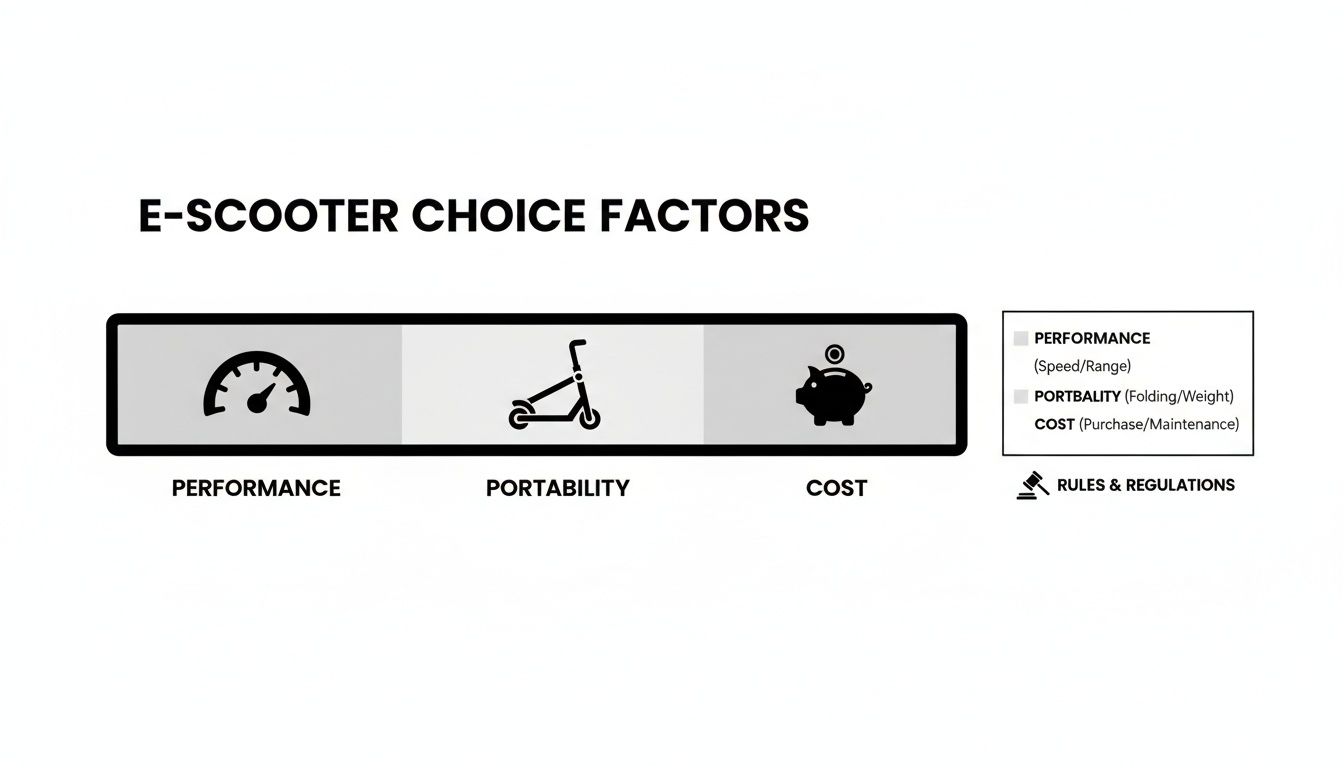
Ultimately, that infographic drives the point home: choosing a scooter is a balancing act. You have to decide what matters most for the rides you'll actually be taking.
Real-World E Scooter Spec Comparison
To see how these specs play out in the real world, let's look at three common rider profiles you'll find across the US and Australia. This isn't about one scooter being "better" than another; it's about finding the right tool for the job.
| Specification | Daily Commuter (e.g., Pure Air) | Performance Cruiser (e.g., Niu) | Ultra-Portable (e.g., Xiaomi) |
|---|---|---|---|
| Motor Power | 350-500W | 500W+ | 250-350W |
| Real-World Range | 15-25 miles (24-40 km) | 25-40+ miles (40-65+ km) | 10-15 miles (16-24 km) |
| Weight | 33-40 lbs (15-18 kg) | 44-55+ lbs (20-25+ kg) | 26-31 lbs (12-14 kg) |
| Best For | Reliable A-to-B city travel, moderate hills. | Longer commutes, hilly areas, rider comfort. | 'Last-mile' trips, carrying on public transport. |
| Key Trade-off | Heavier than ultra-portables. | Less portable, higher cost. | Limited range and power for hills. |
As you can see, the Daily Commuter offers a solid, all-around balance. The Performance Cruiser prioritizes power and comfort at the expense of being easy to carry, while the Ultra-Portable is all about convenience for short trips, sacrificing range and muscle to get there.
Which E-Scooter Profile Fits Your Lifestyle?
Here's the thing about finding the right e-scooter: the best one isn't about having the biggest motor or the most optimistic range. It’s the one that just fits into your life. A genuinely useful e-scooter comparison has to go beyond the spec sheet and look at how these machines actually handle the real world.
So, let's stop talking about abstract features and start talking about you. We've sketched out three common rider profiles we see all the time across the US and Australia. See which one sounds like you—it's the fastest way to cut through the noise and find a scooter built for your kind of journey.
The Urban Commuter
You just need to get from A to B, five days a week, without any drama. Rain or shine, your scooter is your workhorse. Your top priority is a machine that’s totally dependable, with enough juice to get you there and back without giving you "range anxiety" every afternoon. You’re not trying to win a race; you just need to win the commute.
For you, the deal-breakers are battery life, weatherproofing, and solid build quality. Look for a scooter with at least an IPX4 rating to handle unexpected downpours. You'll also want a real-world range that’s at least 20-30% more than your daily round trip. That buffer is crucial to account for cold weather, hills, and the battery slowly losing capacity over time.
- Your Sweet Spot: Models with a battery around 400-500Wh are a great place to start. Air-filled (pneumatic) tires are a must for soaking up rough city streets, and good disc brakes give you the stopping power you need in the wet.
- What to Sidestep: Don't fall for super-light models that trade battery for portability. A scooter weighing between 33-40 lbs (15-18 kg) is usually the perfect balance—sturdy enough to feel safe, but not a dead weight to carry inside.
This kind of rider is becoming the new normal. The global electric scooter sharing market hit a staggering USD 2,142.5 million in 2025, with North America and Asia-Pacific being major markets. With data showing 80% of shared rides are under 3 miles (5 km), it’s proof that people are using scooters for these exact commuter trips. You can dig deeper into these trends in this market report from Cognitive Market Research.
The Multi-Modal Traveller
Your trip isn't just a scooter ride; it's a blend of riding, walking, and jumping on public transport. You need a scooter that’s as easy to carry as it is to ride. Whether you're navigating the NYC Subway or a tram in Melbourne, your scooter is the missing link—the "last mile" solution that gets you from the station to your final stop.
Portability is everything. Every single pound matters when you’re squeezing through a crowded station or hauling it up a flight of stairs. For you, the most important comparison points are weight, the folding mechanism, and the folded size. A simple, one-click folding system is an absolute game-changer when you're in a hurry.
For the multi-modal rider, the moment of truth isn't on the road; it's on the stairs of a busy train station. A scooter that feels light in the shop can feel like a concrete block after a long day. Prioritise a low carry weight above all else.
Your target is a scooter under 31 lbs (14 kg). Yes, this means you'll give up some range and power, but the sheer convenience makes it a worthy trade-off. You won't be tackling monster hills or epic journeys, so a smaller 250-350W motor and battery will be perfectly fine for what you need.
Here’s a quick look at how the priorities shift:
| Feature | Multi-Modal Focus | Commuter Focus |
|---|---|---|
| Weight | Crucial: Under 31 lbs (14 kg) | Important: 33-40 lbs (15-18 kg) |
| Folding Speed | High Priority: Quick & simple | Secondary: Standard mechanism is fine |
| Real-World Range | 10-15 miles (16-24 km) is sufficient | 15-25 miles (24-40 km) is necessary |
| Main Advantage | Ultimate portability for mixed journeys | Reliability and all-weather performance |
The Weekend Adventurer
When the work week is done, you want a scooter that can do more than just cruise on perfect pavement. You're looking for something with a bit more grit—a ride that can handle park paths, light trails, and let you explore the countryside. Your rides are for fun, not just for getting somewhere.
For the adventurer, the comparison shifts entirely to power, suspension, and durability. A beefy motor of 500W or more is what you need to chew up hills and varied terrain without slowing to a crawl. Dual suspension is non-negotiable; it's the difference between a bone-rattling chore and a smooth, comfortable cruise that you can enjoy for hours.
You’ll want to look for models with bigger, wider pneumatic tires for better grip and stability on less-than-perfect surfaces. A rock-solid frame and a high-capacity battery are also vital to make sure your scooter can handle longer, more demanding rides away from the nearest plug socket. This kind of scooter will be heavy (think 44 lbs+ / 20 kg+) and isn't practical for a daily commute, but it's a specialist tool for a specific passion that opens up a whole new world of exploration.
So, Are These Things Even Legal? Navigating US & Australian E-Scooter Rules
Before you even start comparing models, let's talk about the elephant in the room: the law. The legal side of riding an electric scooter in the United States and Australia can feel like a total minefield, with rules that can change completely just by crossing a state or even city line.
What gets you a nod of approval in California could get you a steep fine in another state. This isn't just about staying out of trouble; it’s about making sure you buy a scooter you can actually ride. That beast of a scooter with a crazy top speed looks amazing, but if it's illegal where you live, it’s just a very expensive paperweight.
The Lowdown on US E-Scooter Law
In the United States, there's no single federal law for e-scooters. Instead, it's a patchwork of state and city regulations, which means you have to do your local homework. Many states have embraced them, creating a specific class for "motorized scooters" or "electric personal assistive mobility devices."
However, the details vary wildly. Some key differences you'll find include:
- Speed Limits: Many states, like California, cap e-scooter speeds at 15 mph (24 km/h). Others might be more or less restrictive.
- Where You Can Ride: Typically, scooters are allowed in bike lanes. Riding on sidewalks is often prohibited, especially in busy downtown areas.
- Age and Licensing: Most states require riders to be at least 16 years old. A driver's license may or may not be required depending on the state.
- Helmets: Helmet laws are inconsistent. For example, California mandates them for all riders, while other states only require them for riders under 18.
For a deep dive into the specifics, you can learn more about whether electric scooters are street legal in our detailed guide.
How E-Scooter Laws Stack Up in Australia
In Australia, the situation is similarly complex and state-dependent. For a long time, most states had very restrictive rules for private e-scooters, often limiting them to low speeds and power outputs that made most commercial models technically illegal. However, things are changing with ongoing trials of shared e-scooter schemes and updated regulations.
Here's a quick snapshot of how rules can differ by state:
- Queensland (QLD): Has some of the most progressive laws, allowing private e-scooters on many paths and local roads with a speed limit of 25 km/h (15.5 mph).
- Victoria (VIC) & Western Australia (WA): Both are running trials for shared schemes and have adapted rules that also apply to private e-scooters, typically capping speed at 25 km/h on bike paths and roads with a speed limit of 50 km/h.
- New South Wales (NSW): Remains one of the most restrictive states, where private e-scooters are generally illegal on public roads and paths, with riding confined to private property. Trials for shared schemes are ongoing.
The biggest mistake a new rider can make is assuming the rules are the same everywhere. Always check the specific state and municipal laws before you ride. A compliant scooter in Brisbane might be illegal in Sydney.
This legal maze has a direct impact on what scooter you should buy. A model that’s perfect for the streets of Los Angeles might be too powerful for certain Australian states. This is exactly why your e-scooter comparison needs to start with the law, not just the specs.
Calculating the True Cost of E Scooter Ownership
The price tag you see online is just the beginning of the story. If you want to make a truly smart e-scooter comparison, you’ve got to look past that initial number and get a handle on the total cost of ownership (TCO). This is what you’ll actually spend, covering everything from daily running costs to essential gear and the inevitable repair.
Thinking about the TCO is what separates a savvy buyer from someone who gets caught out by unexpected bills later. It helps you see your purchase not just as a cool new gadget, but as a real investment in your daily transport.
Initial Costs Beyond the Scooter
Before you even take that first glorious ride, there are a few extra things you'll need to budget for. These aren't just nice-to-haves; they're vital for your safety and for keeping your new scooter secure.
- A Quality Helmet: This one is absolutely non-negotiable. A certified helmet is the single most important bit of safety gear you can own.
- A Robust Lock: Let's face it, e-scooters are a tempting target for thieves. A high-quality D-lock or a heavy-duty chain is a must to protect your investment.
- Lights and Reflective Gear: Most scooters come with basic lights, but upgrading to brighter ones and adding some reflective gear will make you far more visible during early mornings or late evenings.
These bits and pieces can easily add another $75 to $200 to your upfront cost, so make sure you factor them into your budget right from the start.
The real value of an e-scooter isn’t just its price, but the daily savings it unlocks. By replacing expensive public transport or car journeys, a scooter can pay for itself surprisingly quickly.
Ongoing Running and Maintenance Costs
Once you're zipping around town, the day-to-day costs are thankfully tiny, but they aren't zero. The good news is they’re a fraction of what you'd be forking out for gas or a transit pass.
Your main ongoing expense is electricity. Charging a typical commuter scooter costs just a few cents each time, meaning your monthly "fuel" bill might be less than a single coffee. Where you need to plan ahead, though, is maintenance. Parts like brake pads and tires will eventually wear out. Punctures happen, and you'll need to replace an inner tube or a worn-out tyre at some point.
This low barrier to entry is a huge reason e-scooters dominate the personal electric vehicle market. They hold the lion's share of sales and are projected to grow at a blistering 25.60% CAGR compared to e-motorcycles. Their sheer accessibility and the massive variety of models—especially mid-range scooters which make up 39% of the market—make them a far more practical choice for most city dwellers. You can dive deeper into these trends and understand the e-scooter vs. e-motorcycle comparison in this report.
The Financial Showdown Scooter vs Public Transport
So, how does owning a scooter actually stack up against your current travel costs? Let's run some quick numbers.
A monthly MetroCard in New York City will set you back $132. In Sydney, an Opal card for commuting can easily cost over A$200 a month. Now, let's budget for a solid, mid-range e-scooter.
- Monthly Scooter Cost (over one year): A $600 scooter plus $150 in gear comes to $750. Spread over a year, that’s about $62.50 per month.
- Monthly Running Costs: Let's be generous and say $5 per month for electricity and a maintenance fund.
- Total Monthly Cost: You're looking at around $67.50.
The savings are immediate and pretty massive. One final thing to consider is insurance. While it's not always a legal requirement for private owners, it's a smart move for peace of mind. Check out our guide on what you need to know about electric scooter insurance to figure out if it's the right choice for you.
So, Which Scooter Is It Going To Be?
Alright, we've torn down the tech specs, waded through local laws, and now it's time to land this thing. Picking the right e-scooter isn't about finding the best one on the market—it’s about finding the one that's genuinely right for you. This is where you put it all together and make a choice that fits your real life, not just a spec sheet.
Think of this less as a final comparison and more as a quick audit of your own needs. You should have a pretty good idea of what kind of rider you are by now. The trick is to be brutally honest with yourself. A scooter that looks amazing online but can't handle your hilly commute is just an expensive paperweight.
Your Final Gut-Check List
Run through these last few questions. Answering them will either lock in your choice or save you from a bad one. This is your final sanity check before you pull the trigger.
- What does my daily ride actually look like? Get specific. How many miles? Are there hills? Is the pavement a mess? A 5-mile trek over rough roads needs a totally different machine than a smooth, 2-mile zip to the train station.
- Seriously, how important is portability? Are you really going to be lugging this thing up three flights of stairs every day? If the answer is yes, then weight might just be the most important stat, even more than range.
- Did I check the local rules? Don't just look up the state laws; find the specific rules for your city or county. Make sure the scooter you want is actually legal to ride where you plan on riding it.
- What's my true, all-in budget? The price tag on the scooter is just the start. You've got to factor in a good helmet, a beefy lock, and maybe even insurance.
When you make the right choice, it doesn't feel like a compromise. It feels like you've found the perfect tool for the job. The best scooter is the one that solves your travel problems without creating new headaches.
The Three Main Flavors of Scooters
To make this even simpler, let's boil it all down to three main types of riders. See which one sounds most like you. Figuring this out is often the last piece of the puzzle.
| Scooter Profile | Who It's For | Key Advantage | Main Drawback |
|---|---|---|---|
| The Lightweight Commuter | You're hopping on and off trains or buses and need something to cover the gaps. | Ultimate Portability: A breeze to carry and stash, making it perfect for that "last mile." | Limited Power & Range: It's going to struggle with long rides and steep hills. |
| The Long-Range Cruiser | Your scooter is your commute. You've got a decent distance to cover every day. | Reliability & Comfort: Built to go the distance with a big battery and smoother ride. | Heavier & Less Portable: Not something you want to haul up a bunch of stairs. |
| The Off-Road Adventurer | You're all about weekend fun and exploring trails, not just city streets. | Power & Durability: Tough suspension and a beastly motor for tackling rough terrain. | Impractical for Daily Commutes: Way too heavy and bulky for city life. |
Got Questions? We've Got Answers
Even after digging through all the specs, you might still have a few questions rolling around in your head. That’s totally normal. Let’s tackle some of the most common ones we get from riders, so you can feel 100% confident when you make your choice.
What’s a Realistic Range I Can Actually Expect?
Let's be honest: the range on the box is a best-case scenario. Manufacturers get those numbers by testing with a super-light rider on a perfectly smooth, flat track with no wind and a nice, warm temperature. Your reality, whether in the US or Australia, will look a bit different.
Think of the advertised range as a ceiling, not a guarantee. Here’s what really chips away at it:
- Your Weight: The more you weigh, the harder the motor has to work. Simple physics.
- Terrain: Hills are the ultimate battery killer. If your daily route is full of inclines, you could easily see your range drop by 30-40%.
- Weather: Batteries hate the cold. You'll definitely notice a shorter range during those winter months.
- Riding Style: Slamming the accelerator after every stoplight burns through juice way faster than cruising at a steady pace.
A good rule of thumb? Take the manufacturer's number and knock off about 30%. That gives you a much more realistic figure for day-to-day riding and a nice buffer so you don’t end up walking your scooter home.
Are Solid Tires Better Than Air-Filled Ones?
Ah, the classic debate. This really boils down to convenience versus comfort, and there’s no single "right" answer. It all depends on what you value most and the kind of surfaces you'll be riding on.
Pneumatic (air-filled) tires are the champions of comfort. They act like tiny suspension systems, smoothing out all the little bumps and cracks in the road. For beat-up city streets, this makes a world of difference. The catch, of course, is that they can get punctures.
Solid tires are the fit-and-forget option. They’re completely puncture-proof, which means zero maintenance and zero worries about flats. The trade-off is a much, much harsher ride. You’ll feel every single vibration and imperfection, which can get old really fast unless you're only riding on pristine surfaces.
For most of us zipping around US and Australian cities, pneumatic tires are the way to go. The massive improvement in ride quality is well worth the small risk of an occasional puncture. Your back will thank you.
How Can I Make My E-Scooter's Battery Last Longer?
The battery is the heart—and the most expensive part—of your scooter. A little TLC goes a long way in making it last for years. It's all about avoiding bad habits that stress out the battery cells.
Stick to these simple rules to keep your battery in top shape:
- Avoid Running on Empty: Try not to let the battery die completely. A good habit is to plug it in when it gets down to around 20-30%.
- Don't Leave It Plugged In: Modern chargers are smart, but it's still best to unplug your scooter once it hits 100%. Leaving it on charge for days isn't great for its long-term health.
- Store It Properly: If you're putting the scooter away for winter, store it with about 50-60% charge in a cool, dry spot. A battery stored at full or zero charge for months can lose its oomph.
Ready to find the perfect ride that matches your lifestyle and budget? The Punk Ride collection features a curated selection of top-tier brands like ISCOOTER, AOVO, and HITWAY, each chosen for its performance and reliability. Explore our full range of electric scooters and bikes today.
Share:
Change Scooter Tire: Your DIY Guide for a Quick Swap
Your Guide to the Best Long Range Electric Scooter for Adults