



When you see an electric scooter with range advertised as hitting 40 or even 50 miles, it’s easy to get excited. But hold on a second—that big number on the box often tells only half the story. The key is understanding the difference between the stated range (the best-case, lab-tested number) and the real-world range (what you'll actually get on your daily commute).
Understanding Your Scooter's True Travel Distance

Think of a scooter's advertised range like the miles-per-gallon sticker on a new car. That number comes from a perfect, controlled environment: a flat test track, no wind, and a super steady speed. It's a useful benchmark, but it doesn't account for real life—the stop-and-go traffic, the big hill on your way home, or your lead foot.
It's the exact same deal with electric scooters. Manufacturers test for maximum range under absolutely ideal conditions. We're talking a lightweight rider, perfectly smooth pavement, zero wind, and a consistent, battery-sipping speed. Your actual journey, of course, is a whole lot more demanding.
Stated Range vs Real-World Range At a Glance
The gap between these two numbers is where a lot of new riders get tripped up, wondering why their battery seems to die so much faster than they expected. It helps to see the differences side-by-side.
| Factor | Manufacturer's Stated Range (Lab Conditions) | Your Real-World Range (Actual Conditions) |
|---|---|---|
| Rider Weight | Lightweight rider, often ~165 lbs (75 kg) | Your actual weight, plus your backpack, laptop, etc. |
| Terrain | Perfectly flat, smooth test track | Hills, rough pavement, cracks, and grass |
| Speed | Slow, consistent "eco" mode speed | Your actual speed, including full-throttle bursts and stops |
| Weather | Mild temperature, no wind | Headwinds, cold weather (which drains batteries faster) |
This table isn't to say manufacturers are trying to pull a fast one. They're just providing a standardized number based on perfect conditions. Your job is to translate that into what it means for your ride.
A good rule of thumb is to expect your actual range to be about 60-70% of the advertised maximum. So, if a scooter claims a 30-mile range, you should realistically plan for 18-21 miles of reliable travel on a single charge.
This isn’t about trickery; it’s just physics. Every little thing, from your body weight to the day's weather, plays a role in how far that battery will actually take you.
Why Is There Such a Big Gap?
So, what creates this difference between the number on the box and your daily experience? It really boils down to a few key things.
- Lab-Perfect Conditions: As we covered, manufacturers use controlled tests to get consistent, comparable results. Think of it as a science experiment, not a real-world road test.
- The Daily Grind: Your commute isn't a lab. It has hills, bumpy roads, headwinds, and lots of stops and starts—all things that make the motor work harder and use more juice.
- You (and Your Stuff): The lab test almost certainly uses a rider who is lighter than the average adult, and it definitely doesn't account for that heavy backpack full of groceries or a laptop.
Once you know to look for this gap, you can make a much smarter decision. When you compare electric scooters, just remember to mentally adjust the range down a bit. That way, you'll pick a model with more than enough power for your life, without ever having to worry about getting stranded.
The Battery and Motor Powering Your Ride
If the gap between advertised and actual range is the first piece of the puzzle, the scooter's hardware is the next. Let’s get into the guts of it: think of the battery as your scooter's gas tank and the motor as its engine. These two work hand-in-hand, defining your ride's raw power and how long it can last. Getting a handle on how they work is the secret to picking a scooter that won't leave you stranded.
At the core of it all is the battery. You'll see its capacity measured in Amp-hours (Ah) or Watt-hours (Wh). The easiest way to picture this is to think of a water bottle—a bigger bottle (higher Wh) holds more water (electrical charge). The more juice it can hold, the farther you can go before needing to plug in.
It's a pretty straightforward relationship. A scooter with a 48V 15Ah battery has a bigger "fuel tank" than one with a 36V 10Ah battery, giving it the potential to go much farther. Whenever you see a scooter boasting an incredible range, you can bet a big, high-quality battery is doing the heavy lifting.
Your Scooter's Engine: The Electric Motor
While the battery is the fuel tank, the motor is the engine that puts that fuel to work. Motor power is measured in Watts (W), and it’s what gives you that zippy acceleration and the muscle to conquer hills. A gutsy 500W motor will feel worlds apart from a standard 250W one.
But here’s the trade-off. Just like a muscle car guzzles gas, a powerful motor drains the battery faster. Every time you punch the throttle or climb a steep hill, the motor demands a huge surge of power, and that takes a direct hit on your total mileage.
Think of it this way: The battery sets your potential range, but the motor—and how you ride—decides how much of that potential you actually get. Riding aggressively with a powerful motor can easily cut your real-world range in half, while smooth, steady cruising sips power.
This push for better performance is exactly why the scooter market is booming. The global electric kick scooter segment is on track to explode from USD 3.71 billion in 2024 to USD 8.62 billion by 2033. Much of that growth comes from models hitting that sweet spot of a 25-45 mile practical range, which is completely changing the game for city commuters and delivery services.
The Power Balance for Maximum Range
So, what's the magic formula? It isn't just about slapping the biggest battery or the strongest motor onto a frame. The best scooters find a sweet spot between the two, managed by a crucial bit of tech. To really get how motors fine-tune their power, understanding the basics of a motor variable speed controller shows how that energy delivery is managed for both performance and efficiency.
This controller is the scooter's brain. It makes sure the motor draws power efficiently, smoothing out acceleration and maintaining speed without needlessly draining your battery.
Of course, keeping this all working right requires some TLC. The health of your battery directly impacts its ability to hold a charge and deliver power. For some great tips on keeping it in top shape, check out our guide on how to store lithium batteries safely. At the end of the day, it's the combination of a well-matched battery and motor, smart power management, and good maintenance that creates a scooter you can rely on to go the distance.
Real-World Factors That Drain Your Battery
Alright, so we've covered the hardware basics: the battery is your fuel tank and the motor is your engine. But here’s the thing—while the tech specs give you a scooter's potential range, it's your riding habits and the world outside your door that decide what you actually get. This is where the lab-tested numbers meet the gritty reality of your daily commute.
Think of it like this: your scooter leaves the factory with a full tank, but every hill you climb, every time you gun the throttle, and every extra pound you carry is like a tiny tap draining that tank. Some taps are small drips, but others can open a floodgate. Figuring out what these "taps" are is the secret to understanding why your 40-mile scooter might only be giving you 25 miles on a typical day.
The relationship is simple: the battery sends power to the motor, and the motor turns the wheels.
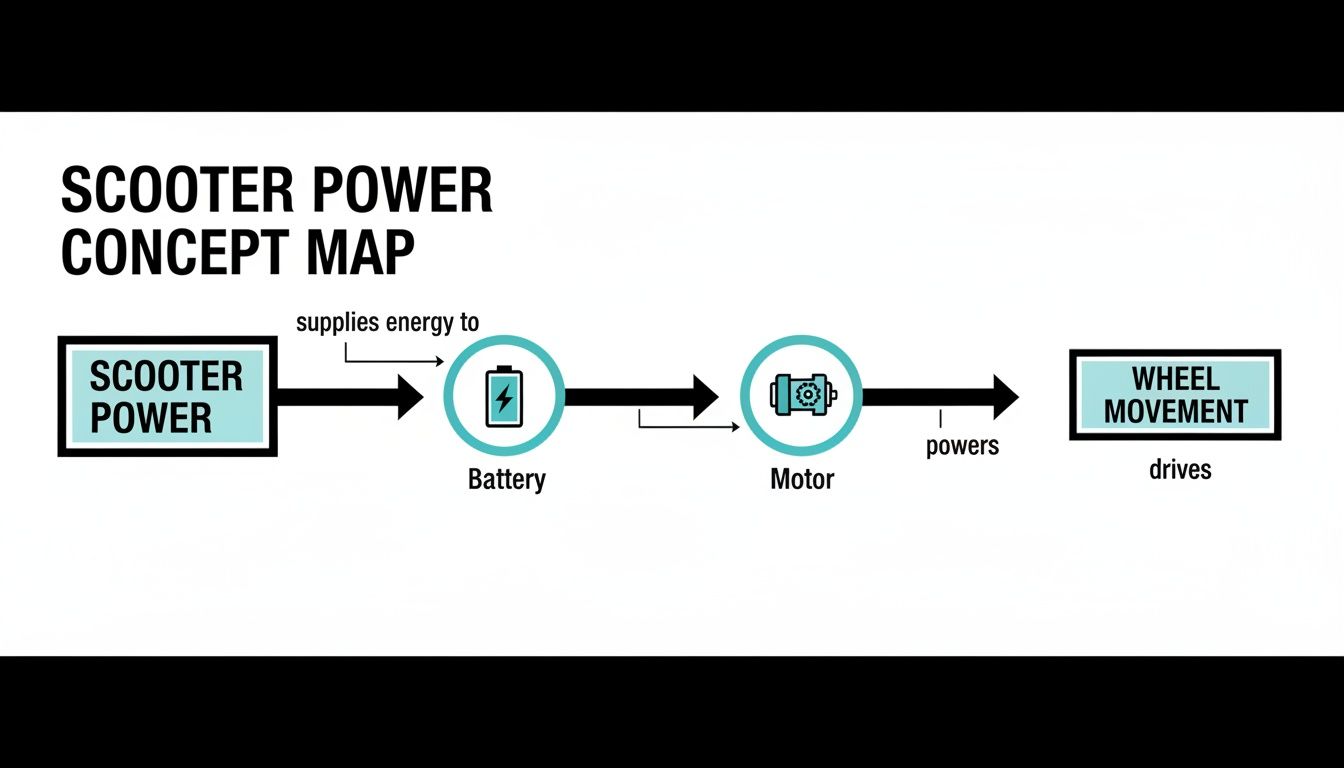
This diagram shows that every single action—from accelerating to climbing—pulls directly from your battery’s finite supply. Let's break down the biggest culprits.
Your Weight and Cargo
The single biggest factor is often the total weight you're asking the scooter to move. It’s just simple physics. The more mass the motor has to push forward, the more juice it needs to do it. A scooter tested with a 165 lb (75 kg) rider will always go farther than one carrying a 220 lb (100 kg) rider with a heavy backpack.
This extra load makes the motor work harder across the board, not just to get moving but to maintain speed. It's like the difference between carrying an empty shopping bag and one loaded with canned goods. Every pound you add chips away at your total mileage.
The Terrain You Conquer
Your daily route is a massive variable. Riding on a perfectly flat, smooth bike path is the easiest thing you can ask your scooter to do. It’s efficient and barely sips power.
But the moment you hit a hill, everything changes.
Climbing a hill is the ultimate battery killer. Think about how much harder you have to pedal a bicycle to get up a steep slope versus cruising on level ground. Your scooter’s motor feels that same strain, drawing a massive amount of power to pull you upward. A route with frequent hills can easily slash your range by 30-40% or more compared to a flat one.
Even the ground beneath your wheels matters. Rough asphalt, grass, or gravel creates way more friction than smooth pavement, forcing the motor to burn extra energy just to keep you rolling.
Your Need for Speed
How you ride makes a huge difference. While slamming the throttle from a standstill is fun, it's also a major power drain. Every "jack-rabbit" start from a stoplight demands a huge surge of electricity right from the battery.
On the flip side, smooth, gradual acceleration is much kinder to your range. The same goes for your cruising speed. Pinning the throttle and riding at top speed will drain your battery far faster than cruising at a steady, moderate pace in an "eco" mode. Sprinting always uses more energy than jogging, and it’s no different for your scooter.
It's this exact desire for more speed and distance that’s pushing the whole industry forward. People want to zip through cities like Los Angeles or Melbourne without ever thinking about gas. In fact, analysts predict the global electric scooter market will jump from USD 38.4 billion in 2025 to an incredible USD 91.1 billion by 2035. That growth is all about demand for better batteries that can deliver the 30-60 miles people want. You can find more data on this trend in a report from Future Market Insights.
Weather and Temperature
Finally, don't forget about the weather. Riding into a strong headwind is like riding up a constant, invisible hill. Your motor has to fight that resistance the entire time, using more power just to hold its speed.
Temperature is another silent range thief. Lithium-ion batteries have a sweet spot and work best in mild weather. When it gets cold, the chemical reactions inside the battery slow down, making it much less efficient at delivering power. On a freezing day, it’s not uncommon to see your range drop by as much as 50%!
These variables can feel like a lot, but they all boil down to how much work the motor has to do. Here’s a quick summary of the main things that will reduce your mileage.
Top Factors Impacting Your Real-World Range
| Factor | Impact on Range | Why It Happens |
|---|---|---|
| Rider Weight | High | More weight requires more energy to move and maintain speed. |
| Hilly Terrain | Very High | Fighting gravity is the most power-intensive thing a motor can do. |
| Aggressive Riding | High | Quick acceleration and high speeds demand huge surges of power. |
| Rough Surfaces | Medium | Increased friction from gravel or bad pavement forces the motor to work harder. |
| Headwind | Medium | The motor must overcome constant air resistance, similar to climbing a slight hill. |
| Cold Weather | Very High | Low temperatures reduce the battery's chemical efficiency, cutting its capacity. |
By keeping these real-world drains in mind, you can start to adjust your expectations and your riding style to squeeze every last bit of distance out of a single charge.
Calculating the Right Range for Your Lifestyle
Alright, so how do you actually figure out what you need? With all the advertised specs and marketing claims, picking an electric scooter with range that truly works for you can feel like guesswork. But it doesn't have to be.
The secret isn’t just grabbing the scooter with the biggest number on the box. It’s about doing a little bit of your own homework to match the machine to your real-life travels. Let's figure out the right mileage for your routine so you have enough juice for your commute, plus a little extra for, well, life.
Measure Your Daily Round Trip
First things first: map out your most common trip. For most of us, that’s the daily trek to work, school, or wherever you find yourself heading regularly.
Fire up a free tool like Google Maps and trace the exact route you’d take on your scooter from your front door to your destination and back again. Don't just pick the shortest path—think about the actual roads you'll be riding on. This gives you a solid baseline for your daily round-trip mileage. For instance, if it’s five miles to work, you’re looking at a 10-mile round trip.
Think of this number as your starting point. It's the bare minimum range you'd need on a perfectly flat road, with no wind, on a warm day. And we all know how often that happens.
The All-Important Range Buffer
This is the most important part of the whole process: adding a safety net. You should never buy a scooter whose maximum "real-world" range just barely covers your commute. That's a one-way ticket to range anxiety, where you're sweating every time you hit a hill or feel a headwind.
Instead, you need what I call a "range buffer." It's just extra mileage capacity that covers all those real-world variables that love to drain your battery.
As a rule of thumb, add a 40-50% buffer to your daily round-trip distance. This simple bit of math is your best defense against battery aging, surprise detours, hilly terrain, and days you’re lugging around a heavy backpack.
Let's see how that works. If your daily round trip is 10 miles, your ideal range calculation looks like this:
10 miles (your commute) x 1.40 (a 40% buffer) = 14 miles
This means you should be shopping for a scooter that can realistically deliver a real-world range of at least 14-15 miles on one charge. Forget the manufacturer's claim for a second; this is the number you need it to hit in your day-to-day life.
Why This Buffer Is a Game-Changer
Trust me, building this extra capacity into your decision is about more than just not getting stranded. It’s about giving yourself genuine freedom and peace of mind.
Here’s what that buffer really gets you:
- No More Range Anxiety: You can just ride without constantly glancing down at your battery indicator.
- Room for Spontaneity: Want to swing by the store on the way home or meet up with a friend? You've got the juice.
- Future-Proofing Your Scooter: All batteries degrade over time. A scooter with plenty of extra range today will still have enough for your commute in a couple of years.
- Handles the Tough Days: It's your insurance policy for those cold, windy mornings or when a traffic jam forces you to take the long way around.
By taking five minutes to calculate your actual needs and tacking on that healthy buffer, you transform from a hopeful buyer into a smart one. You'll end up with the right electric scooter with range for your lifestyle from the get-go, making every single ride a reliable, stress-free experience.
Actionable Tips to Maximize Every Charge
Alright, you know what kind of range you need. Now for the fun part: learning how to squeeze every last bit of juice out of a single charge. Getting the most from your electric scooter with range isn't about some secret hack or complicated trick. It's really just a few smart habits that, over time, make a huge difference.
These little adjustments don't just add miles to your trip today. They also keep your battery healthy for the long haul, so your scooter performs its best for years to come.
Master Your Riding Style
How you ride is probably the single biggest factor affecting your range. It’s always tempting to blast off the line when the light turns green, but those aggressive "jack-rabbit" starts are massive power hogs. Every time you slam the throttle, you’re telling the battery to dump a huge surge of electricity.
Instead, think smooth. Gently ease into your cruising speed. It's way more efficient. The same goes for stopping. Try to anticipate red lights and coast to a stop when it’s safe, rather than relying on hard, last-minute braking. You’ll conserve momentum and put way less strain on the whole system.
A steady cruising speed will always be more efficient than a ride full of sudden speed changes. Think of it like driving a car on the highway versus in stop-and-go city traffic. That smooth, consistent highway speed uses far less fuel, and the same principle applies directly to your scooter’s battery.
Become a Tire Pressure Pro
This is easily the most overlooked tip, but it's incredibly effective. Riding on underinflated tires is like trying to run through wet sand—it creates a ton of extra friction that your motor has to fight against. That means it has to work a lot harder just to keep you moving.
Keeping your tires properly inflated makes them roll with much less resistance, which can boost your scooter's efficiency by up to 10%. That’s a serious gain for something that takes two minutes to check! Just look for the recommended PSI (pounds per square inch) on the side of your tire and top it up before you head out. For a deeper dive, check out our guide on tires for electric scooters.
Smart Charging and Route Planning
How and when you charge also plays a big part in your battery’s long-term health and daily performance. It might be convenient, but leaving your scooter plugged in for days after it’s full can slowly damage the battery cells. Most scooters use simple, accessible charging solutions, and a bit of knowledge goes a long way. For example, it's worth understanding Mode 2 charging cables, which are common for charging light electric vehicles from a standard wall outlet.
Don't forget to think about your route, either. We already know that hills are the ultimate battery killers. If your map app gives you a choice between a hilly route and a flatter one, take the flat one. Even if it’s a bit longer, you’ll often save more battery life in the end.
- Avoid Steep Hills: Your motor works hardest when fighting gravity. A flat path is your battery's best friend.
- Travel Light: Every extra bit of weight in your backpack needs more energy to move. Ditch anything you don't need for the trip.
- Charge Smart: Try to avoid running your battery all the way down to 0%. The sweet spot for long-term battery health is often charging from 20% up to about 80-90%.
The push for better batteries is what’s really driving the e-scooter market forward. The market is projected to hit USD 31.44 billion by 2025 and is expected to soar to USD 81.48 billion by 2034. Why? Lighter lithium-ion batteries have cut costs by 89% since 2010 while pushing average ranges from a mere 10 miles to 40-50 miles on higher-end models. In the US alone, the average commuter can save around $1,200 a year on gas and car maintenance by making the switch.
Got Questions About Scooter Range? We’ve Got Answers.
When you're digging into the world of electric scooters, a ton of questions pop up, especially around how far they can really go. Getting a scooter with a range you can count on is the difference between a great ride and a long walk home. Let's tackle some of the most common questions I hear so you can ride with confidence.
How Much Does Cold Weather Really Kill My Scooter's Range?
Oh man, cold weather is the number one enemy of battery life. Think of your scooter's battery as a little chemical power plant—it just works better when it's cozy. When the temperature starts dropping toward freezing, the chemical reactions inside slow way down.
What that means for you is the battery can't push out its stored energy nearly as well as it does on a sunny, 75-degree day. You can pretty much count on losing 20% of your range on a chilly day, and that can jump to a whopping 50% when it's actually freezing. A good trick is to store your scooter inside where it's warm and, if you can, charge it right before you leave to give the battery a little warm-up boost.
Will My Scooter's Range Get Worse Over Time?
Yep, it sure will. But don't worry, this is a totally normal part of life for any device with a lithium-ion battery. The official term is battery degradation, but it's the same thing that happens to your phone after a couple of years of use—it just doesn't hold a charge like it used to.
Every time you run your battery down and charge it back up (a "charge cycle"), it loses a tiny, tiny fraction of its total capacity. A good quality scooter battery is usually built to keep about 80% of its original juice after 500 to 1,000 of these cycles. You can definitely slow down the aging process by being smart about how you charge.
Here's the key: avoid the extremes. Try not to run the battery completely bone-dry to 0%, and don't leave it on the charger for days after it hits 100%. The happy place for long-term battery health is floating somewhere between 20% and 90%.
Should I Buy a Scooter With More Range Than I Actually Need?
One hundred percent, yes. This is probably the single best piece of advice I can give someone buying a new scooter. Think of it as a "range buffer," and it's your best friend for peace of mind. Buying a scooter with a claimed range that's way more than your daily commute means you never have to sweat about the battery icon turning red.
This buffer covers you for all the real-world stuff:
- Spur-of-the-moment trips: Need to swing by the store on your way home? No sweat.
- Nasty conditions: A surprise headwind or a sudden cold snap won't leave you stranded.
- Future-proofing: As your battery naturally gets older, you'll still have more than enough range for your daily rides.
- Peak performance: Scooters are zippiest when the battery is full. With extra range, you get to enjoy that top-end power for longer without having to go into battery-saver mode.
Honestly, that extra capacity turns every ride into a stress-free adventure, and that alone is worth the investment.
Does Regenerative Braking Actually Add a Lot of Range?
Regenerative braking is a super cool feature. It's designed to capture the energy you'd normally waste when slowing down and feed a little bit of it back into your battery. It definitely helps, but its real-world impact is a bit more modest than the marketing might lead you to believe.
For typical city riding with lots of stops and starts, you can realistically expect regenerative braking to give you back maybe 5% to 10% in range. It’s a nice little efficiency boost, and it also saves wear and tear on your regular brakes, which is a great bonus. But it's not going to magically double your mileage.
Where it really shines is on long, gentle downhills where the scooter can coast and recapture a decent chunk of power. While it's not a total game-changer, it's a smart bit of engineering that makes for a more efficient ride.
Ready to find a ride that fits your life and finally kiss range anxiety goodbye? At Punk Ride, we’ve hand-picked a collection of high-performance electric scooters from brands that deliver the power and distance you actually need. Check out our lineup and change the way you get around.
Share:
Your Essential Guide to Electric Scooter Insurance
Electric Scooter Dual Motor: The Ultimate Explainer