


Your electric bike charger isn't just a power cord—it's the life support system for your ride. Think of it as the crucial link that funnels power from a wall socket straight into your e-bike, turning household electricity into miles of freedom. Getting to know this little black box is the single best thing you can do to protect your e-bike's most expensive part: the battery.
So, Why Is Your E-Bike Charger More Than Just a Cable?
At its core, an electric bike charger is a smart device. Its job is to take the alternating current (AC) flowing out of your wall and convert it into the direct current (DC) that your lithium-ion battery can actually use. Using the wrong charger isn't just a minor mistake; it can lead to slow charging, a shorter battery life, or even cause serious, permanent damage.
This guide is here to cut through the confusing tech-speak. We'll break down everything you need to know, from voltage and connectors to smart charging habits, using simple analogies that actually make sense. The goal is simple: to give you the confidence to make the right choices for your ride, whether you're commuting through Sydney or hitting the trails in California.
The Heart of Your E-Bike's Power System
It helps to think of your charger and battery as a perfectly matched pair. The charger controls the energy flow, making sure the battery gets the right "pressure" (voltage) and "current" (amperage). A good charger also talks to your battery's internal brain—the Battery Management System—to stop charging when it's full. This is key, as overcharging is one of the quickest ways to ruin a battery.
By the time you're done reading, you'll be able to:
- Easily spot the right electric bike chargers for your specific model.
- Finally understand what all those numbers on the label really mean.
- Pick up a few simple habits that will make your battery last for years.
- Figure out common charging problems without having to run to a bike shop.
Your e-bike’s battery is its most valuable asset, and the charger is its primary caretaker. Charging it correctly isn't just about getting back on the road faster; it's about protecting your investment for the long haul.
Nailing these basics is the first step. But proper care doesn't stop when the ride ends, especially if you're storing your bike for a while. To really get the most out of your battery, be sure to read our guide on how to store lithium batteries safely.
Alright, let's dive in and make you an expert on keeping your ride charged up and ready for anything.
Getting to Know Your Charger's Tech Specs
Ever looked at the label on your e-bike charger and felt like you were trying to read a foreign language? All those Vs, As, and Ws are actually telling you a crucial story about how your bike gets its juice. Let's break down what they mean in simple terms, so you can make sure you're treating your battery right.
Think of it like this: charging your battery is like filling a bucket with a hose. The numbers on your charger are just describing the water flow. Get the flow right, and you've got a happy, healthy battery. Get it wrong, and... well, you don't want to find out.
Voltage (V): The Water Pressure
Voltage, measured in volts (V), is basically the electrical "pressure." In our hose analogy, it's how hard the water is pushing. If the pressure is too low, the bucket will take forever to fill. But if it's too high, you could damage the bucket itself.
This is the one spec you absolutely cannot mess with. Your charger's voltage must match your battery's voltage. No exceptions. A 36V battery needs a 36V charger. A 48V battery needs a 48V charger. Simple as that.
Trying to use a lower-voltage charger won't do anything at all. But using a higher-voltage one is a recipe for disaster. You'll overwhelm the battery's sensitive management system, which can cause permanent damage or even a fire.
Pro Tip: Always double-check your charger's output voltage. A charger for a 36V battery will often say 42V on the label, while one for a 48V battery will say 54.6V. This is normal! Just make sure it’s the correct match for your battery pack.
Amperage (A): The Hose's Width
Amperage, measured in amps (A), is the current. Think of this as the width of the hose. A wider hose (higher amps) lets more water flow through at once, filling up that bucket much faster.
Most e-bikes come with a standard 2A charger right out of the box. It’s a perfectly good, safe speed that’s gentle on your battery over the long haul. But if you’re always in a hurry, you can find faster chargers rated at 3A or even 4A. A 4A charger can literally cut your charging time in half compared to a 2A model. It's a classic trade-off: speed versus potentially slower battery degradation over its lifetime.
Wattage (W): The Total Flow
Wattage, measured in watts (W), is simply the total power your charger delivers. It's the overall flow rate, which you can figure out with some quick math:
Voltage (V) x Amperage (A) = Wattage (W)
So, that standard 36V charger with a 2A output is pushing out 72 watts of power. Wattage is a great shorthand for comparing chargers at a glance—the higher the watts, the faster the charge.
To help you keep these terms straight, here's a quick cheat sheet:
E-Bike Charger Specs At a Glance
| Term | What It Means (Simple Analogy) | Why It Matters |
|---|---|---|
| Voltage (V) | The "pressure" of the electricity. | Must match your battery's voltage. Too high is dangerous; too low won't work. |
| Amperage (A) | The "flow rate" or volume of electricity. | Determines charging speed. Higher amps mean a faster charge. |
| Wattage (W) | The total power output (Volts x Amps). | A quick way to compare the overall charging power of different chargers. |
Understanding these specs helps you take better care of your battery and choose the right gear for your needs.
It's no surprise that as more people rely on e-bikes, the demand for good charging gear is booming. The global e-bike charging station market was valued at around USD 4,081.21 million in 2025 and is expected to climb to USD 6,431.37 million by 2035. This just goes to show how critical reliable charging is for all of us. You can discover more insights about the e-bike charging market and see where things are headed.
Don't Forget the Connector!
Okay, so you've nailed down the electrical specs. But there's one last piece of the puzzle: the physical plug. You have to make sure the charger's connector actually fits your bike's charging port. There isn’t one universal standard, but you’ll typically run into one of these three:
- XLR Connector: This is a beefy, three-pin plug you might find on older or heavy-duty e-bikes. It locks in place, which is a nice, secure touch.
- DC 2.1mm Barrel Connector: Probably the most common type out there. It looks just like the plug on your old laptop charger.
- RCA Connector: This single-pin plug looks like something you'd find on the back of a stereo. It’s not as common these days but still pops up on certain models.
Before you even think about buying a new charger, do yourself a favor: snap a clear photo of your bike's charging port and the tip of your current charger's cable. It’s the easiest way to visually match it and save yourself the headache of getting one that doesn't fit.
How to Find a Perfectly Compatible Charger
Picking a replacement charger for your e-bike feels a bit like trying to put diesel in a petrol car—get it wrong, and you’re looking at a costly disaster. A mismatched charger won't just fail to work; it can cook your expensive battery for good or, worse, become a serious safety hazard.
Let's walk through how to find the perfect match so every charge is safe and effective.
First thing's first: do a quick visual check. Your battery and your original charger are both covered in labels packed with critical info. Before you do anything else, pull out your phone and snap clear pictures of all of them. Trust me, this simple step can save you a world of headaches later.
Your Step-by-Step Compatibility Checklist
Nailing down the right charger is all about matching three key things: voltage, battery chemistry, and the physical connector. Getting all three right isn't just a suggestion—it's non-negotiable for the health of your ride.
Here's a quick checklist to run through:
-
Confirm the Voltage (V): This is the big one. A 36V battery absolutely requires a charger made for a 36V system, which will usually have a 42V output. Likewise, a 48V battery needs its specific charger, which often has a 54.6V output. Never, ever mix them up.
-
Verify Battery Chemistry: The vast majority of e-bikes today run on Lithium-Ion (Li-ion) batteries. Your charger has to be specifically designed for this chemistry. Trying to use a charger meant for an old-school Lead-Acid battery is a recipe for disaster.
-
Identify the Connector Plug: Take a good, hard look at the plug that actually goes into your bike's charging port. Common types include the round DC barrel plug, the multi-pin XLR, or the single-pin RCA. Compare it directly to any replacement you’re considering to make sure it’s a perfect, snug fit.
This diagram breaks down the essential electrical specs you'll be matching.
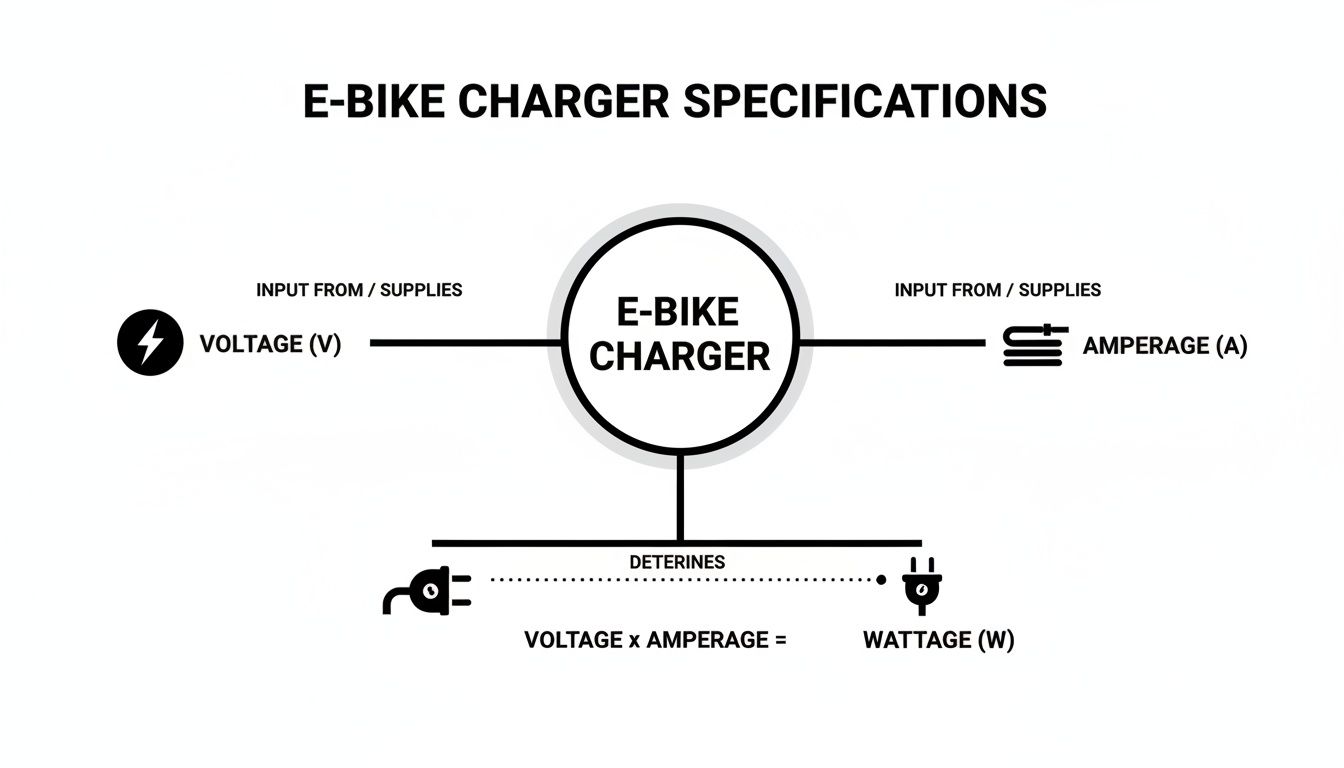
It really shows how voltage, amperage, and wattage all work together, which is why matching these numbers to your battery's needs is so critical for both performance and safety.
Brand-Specific vs. Universal Chargers
When you need a new charger, you’ll face a choice: do you hunt down an original from the manufacturer, like ENGWE or HITWAY, or grab a third-party "universal" one?
The Safest Bet: Always try to get an official replacement directly from your e-bike’s brand. It's guaranteed to be 100% compatible, and it won't mess with your warranty. This is the gold standard for safety.
But let's be realistic—sometimes an official charger just isn't available. In that case, a high-quality universal charger can work, but only if you meticulously match every single spec: voltage, chemistry, and the connector. The risk is higher because quality can be all over the place. Cheap, uncertified chargers are a massive fire hazard and should be avoided like the plague, no matter where you live.
While an e-bike setup is far simpler, this guide to EV charger installation offers some great background on the electrical principles involved. It really drives home the point that proper electrical matching is crucial for any vehicle, big or small.
At the end of the day, your goal is to find a charger that does its job safely and efficiently. By following this checklist and sticking to reputable sources, you’ll protect your investment and make sure you’re always ready to roll.
Calculating Your E-Bike's Charging Time
"So, how long is this actually going to take?" It's the one question every single e-bike rider asks. Waiting for that little green light to pop on can feel like an eternity, but a bit of quick math can give you a surprisingly solid estimate. Don't worry, you don't need a calculator.
The basic formula is pretty simple:
Battery Capacity (in Amp-hours) ÷ Charger Output (in Amps) = Charging Time (in hours)
Let's say you have a common 14Ah battery and the standard 2A charger that came with your bike. The math is just 14Ah ÷ 2A = 7 hours. This gives you a great ballpark figure for how long you'll be waiting if you're charging from a completely empty battery.
Real-World Factors That Change Everything
Of course, that simple formula is just a starting point. In the real world, a few other things can mess with your charge time. It's less of a hard-and-fast rule and more of a really good guess.
Here are the main things that can speed things up or slow them down:
- Your Starting Point: You almost never charge from a totally dead battery. If you're starting at 50%, you'll only need half the time—so about 3.5 hours in our example. Simple as that.
- Battery Age and Health: An older battery is like a seasoned athlete—it just can't perform quite like it used to. As batteries age, they lose a bit of their efficiency, so they might take a little longer to top off.
- The Temperature: Lithium-ion batteries are divas when it comes to temperature. Trying to charge in a freezing garage or a scorching hot room can slow things down, as the battery's internal brain (the BMS) works to protect itself.
This whole charging game is a big deal. The global market for electric bike chargers was pegged at USD 1.2 billion in 2024 and is expected to rocket to USD 3.5 billion by 2032. That's all thanks to the e-bike boom in places like North America and the Asia Pacific region. You can read the full research about e-bike charger market trends if you want to geek out on the industry stats.
The Trade-Off Between Standard and Fast Chargers
Most e-bikes ship with a standard 2A charger. It's the reliable workhorse—a slow and steady charge that's actually pretty gentle on your battery over the long haul. But what if you need to be back on the road, like, now?
That’s where fast chargers, typically 4A, come into the picture.
Using that same 14Ah battery, a 4A charger would literally cut your wait time in half: 14Ah ÷ 4A = 3.5 hours. That's a massive difference when you're in a hurry. But—and this is a big but—that speed comes at a price. Fast charging creates more heat, which puts more stress on the battery cells.
Doing it once in a while is no big deal. But if you rely on a fast charger every single day, you might be shortening your battery's total lifespan. If you're curious about the details, we've got a great guide on how long do ebike batteries last.
Ultimately, the right charger comes down to your lifestyle. If you're a daily commuter who plugs in overnight, a standard 2A charger is your best friend. But if you're constantly needing a quick top-up between rides, a 4A charger could be a total game-changer.
Smart Habits for a Longer Battery Life
Think of your e-bike's battery as its heart—it's powerful, expensive, and needs a little care to stay healthy. Your charger is its lifeline. Getting into a few simple, smart charging habits is probably the best thing you can do for your ride, making sure it’s reliable for years to come. It’s less of a chore and more of a quick, easy routine to protect your bike.
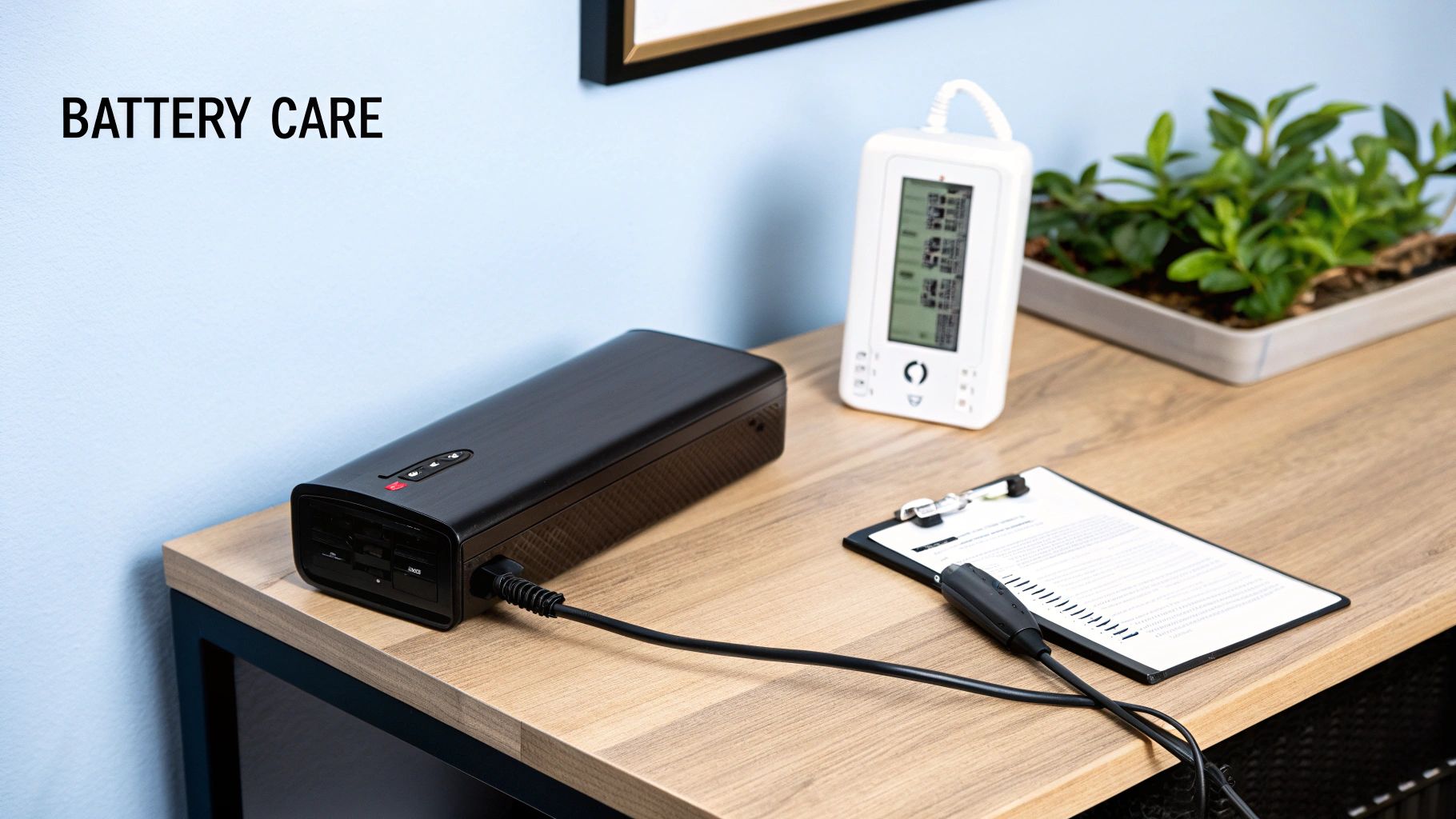
These habits aren't complicated, but trust me, they make a huge difference. These are universal truths for e-bike owners everywhere, whether you're a commuter in Melbourne or hitting the trails in California.
Everyday Charging Best Practices
For your day-to-day charging, a consistent and safe routine is everything. It's all about giving your electric bike charger and battery a stress-free environment to do their thing.
Here's a simple checklist to run through every time you plug in:
- Charge on a Hard Surface: This is a big one. Never, ever charge your battery on a carpet, couch, or near flammable stuff like curtains. Chargers get warm, and putting them on a hard surface like a concrete floor or a clear countertop lets that heat escape safely.
- Avoid Temperature Extremes: Lithium-ion batteries really don't like getting super hot or cold. Always charge your battery inside, at a comfortable room temperature—ideally between 10°C and 25°C. Trying to charge a frozen battery can wreck it for good, and a hot one is a serious safety hazard.
- Unplug When Full: Modern chargers are smart and usually shut off automatically, but it's still good practice to unplug everything once the light turns green. Leaving it plugged in for days at a time can put a tiny bit of extra strain on the battery cells, which adds up over the long haul.
You wouldn't leave your phone plugged in for a week straight, right? Treat your e-bike the same way. Just unplugging it when it's done is one of the easiest ways to protect its long-term health.
Want to get even more out of every charge? We've got a full guide to boost your electric bike battery life.
The Golden Rule for Long-Term Storage
Putting your bike away for the winter or going on a long trip? If it's going to be sitting for more than a few weeks, there’s one critical rule to follow: the 40-80% rule. Storing a battery at 100% or completely dead is the fastest way to kill its capacity.
Here’s the right way to do it:
- Get the battery to about half full. You don't have to be exact, just aim for a charge level somewhere between 40% and 80%.
- Store the battery inside in a cool, dry spot, and keep it out of direct sunlight.
- Check on it every month or two. If you see the charge has dropped below 20%, just plug it in for a bit to get it back into that happy 40-80% zone.
This simple trick keeps the battery cells stable and stress-free, which can seriously extend their lifespan. Funny enough, these principles apply to a lot of our gadgets. You'll see a lot of overlap in these tips to improve iPhone battery life, since the battery chemistry is so similar. A few good habits are all it takes to keep your bike ready for your next ride.
What to Do When Your Charger Acts Up
It’s a feeling every rider dreads: you plug in your e-bike after a long ride, and... nothing happens. The little light on the charger stays dark. But don’t panic and rush to buy a new one just yet. Most of the time, the problem is something simple you can fix in a few minutes.
Think of this as your roadside assistance guide for a charger that’s on the fritz. A few quick checks can save you a headache and some cash.
The First-Response Checklist
So, the charger light is off or the battery isn't charging. Where do you start? Let’s walk through the basics first, because it’s almost always the simple stuff.
Here’s your step-by-step diagnostic plan:
- Check Your Outlet: Seriously. Is the wall socket even working? Grab a lamp or your phone charger and plug it in to make sure you've got juice. You'd be surprised how often a tripped breaker is the real villain.
- Reseat Every Connection: Unplug everything—from the wall to the charger, and the charger to the bike—and plug it all back in again. Make sure each connection is snug and secure. A loose plug is a classic reason for a failed charge.
- Inspect Your Gear: Give the entire charger cable a once-over. Look for any cuts, frayed wires, or sharp kinks. Then, take a close look at the connector and the charging port on your battery. Are there any bent pins, or is there gunk and debris blocking the way?
A dead charger light is the most common symptom, but it rarely means the charger is toast. It’s usually just a bad connection somewhere along the line. Always check your outlet and plugs first.
Common Problems and What They Mean
Okay, you’ve checked the basics and you're still stuck. Different symptoms can point to different issues, so let's break down what your charger might be trying to tell you.
-
Problem: The charger is getting scary hot. A bit of warmth is normal, but if it's too hot to comfortably hold, unplug it immediately. This is a big red flag for an internal problem or just bad airflow. Always charge on a hard surface, not buried under a pile of laundry.
-
Problem: The light stays green and never turns red. A green light usually means "all done" or "nothing's connected." If your battery is dead but the light stays green, the charger isn't recognizing it. This almost always points back to a bad connection or a bent pin in the port.
-
Problem: The light is blinking or flashing. This is where things get a little more specific. A blinking light is often an error code. It could be telling you there's a problem with the battery, it's too hot or cold to charge, or the charger itself has an internal fault. Dig out your e-bike’s manual—it should tell you what that specific light pattern means.
The whole world is catching on to electric mobility, and the demand for reliable electric bike chargers is exploding. The market is expected to skyrocket from USD 14.33 billion in 2024 to USD 47.53 billion by 2029. If you're interested in the big picture, you can learn more about these global market findings and see what's driving this trend.
When to Throw in the Towel
Look, sometimes a charger is just done for. If you’ve tried everything and it's still dead, or you see any of these tell-tale signs, it’s time for a replacement:
- Obvious physical damage, like a cracked case or melted plastic.
- That unmistakable smell of burning electronics.
- Any buzzing, popping, or crackling sounds when it's plugged in.
- You’ve borrowed a friend’s compatible battery to test it, and it still doesn't work.
Don't mess around with a busted charger. It’s a serious fire hazard, and your safety is worth way more than the cost of a new one.
Your E-Bike Charger Questions, Answered
Even after getting the basics down, you probably still have a few lingering questions. That's totally normal. Let's tackle some of the most common things riders ask about their chargers.
Can I Just Use Any Charger With My E-Bike?
This is a big one, and the answer is a hard no. Grabbing any old charger is one of the fastest ways to fry your battery—or worse.
You absolutely have to use a charger that matches your battery's specific voltage (V), is made for its chemistry (usually Lithium-Ion), and has the right connector plug. The safest and simplest rule? Stick with the charger that came with your bike.
Is It Actually Bad To Leave My E-Bike Charging Overnight?
Modern "smart" chargers are pretty clever; they know to shut off once the battery is full. So, leaving it plugged in overnight every now and then probably won't cause a catastrophe.
But, it's not a great habit for the long-term health of your battery.
Think of it like this: keeping a battery at 100% constantly is a bit like holding a muscle in a tensed position for hours. It causes a tiny bit of stress. For the best possible lifespan, it's a good practice to unplug it soon after it's fully charged.
What's The Real Difference Between a 2A and 4A Charger?
Speed. That’s the simple answer. Think of amperage (A) like the width of a hose filling a bucket.
A 4A charger is a wider hose—it delivers power twice as fast as a standard 2A charger. This is awesome when you’re in a hurry and need to get back on the road, effectively cutting your charge time in half.
The trade-off is heat. Faster charging generates more heat, which can be a bit tougher on your battery over hundreds of cycles. For everyday, casual charging, a slow-and-steady 2A charger is gentler. Save the 4A charger for when you really need that quick boost.
How Do I Know If My Charger Is Officially Dead?
Before you rush out to buy a new one, do the simple stuff first. Check that the wall outlet actually works, make sure all the cables are plugged in tight, and give the cords a quick once-over for any obvious damage.
If you've done all that and it's still a dud, look for these tell-tale signs that it's given up the ghost:
- Obvious Physical Damage: We're talking cracks in the housing, any signs of melted plastic, or frayed wires.
- Weird Smells or Noises: A distinct "burnt electronics" smell or any buzzing and popping sounds are huge red flags. Unplug it immediately.
- Gets Scary Hot: A charger will get warm, but if it becomes too hot to comfortably hold, something is wrong.
See any of these? It’s time for a replacement. Never, ever risk using a faulty charger.
Ready to find the perfect ride or need accessories you can trust? At Punk Ride, we offer a curated selection of top e-bike and e-scooter brands to power your journey. Explore our collection today at https://www.punkride.com.
Share:
Top Guide: best step through electric bikes for comfortable commuting
Your Essential Guide to Electric Scooter Insurance