


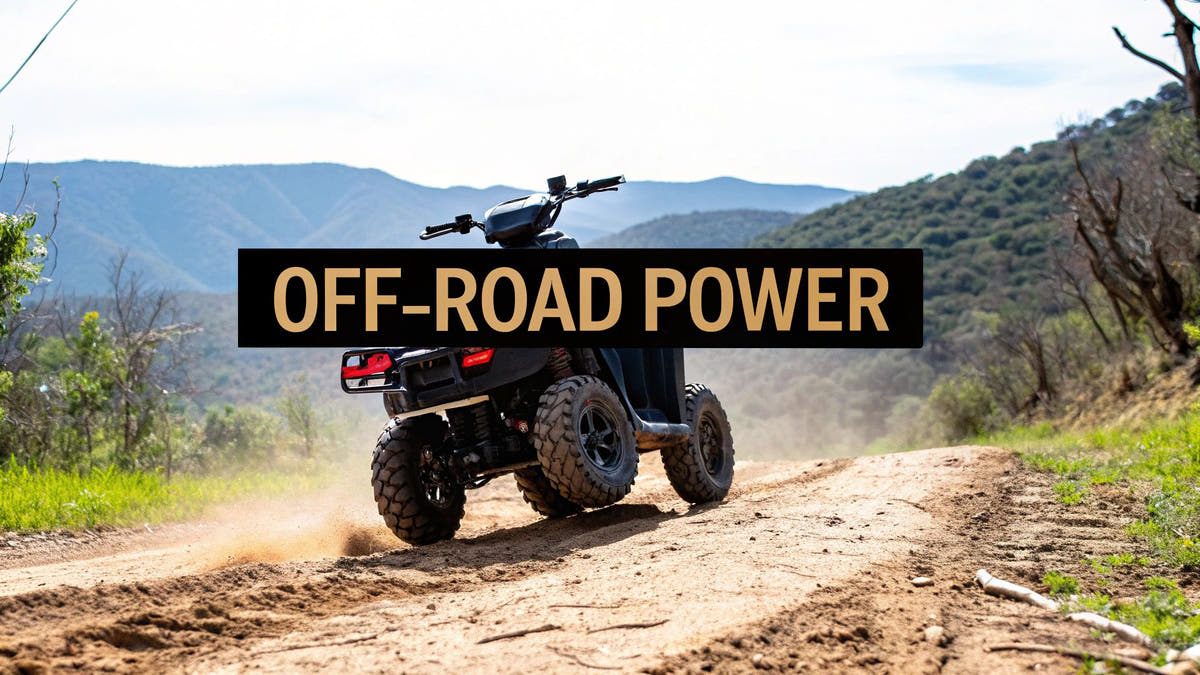
So, you're on the hunt for the best off road motor scooter? You’re not just looking for a way to get around; you're looking for a machine that can handle real adventure, far from the perfectly paved roads of the city. That's where top-tier brands like Inokim, Kaabo, and NAMI come in, building scooters designed to dominate the trail.
What Exactly Is an Off Road Motor Scooter?
Forget everything you know about standard city scooters. An off-road scooter is the 4x4 of the e-scooter world, built from the ground up to leave the pavement behind and chew up dusty trails. It's a purpose-built exploration machine designed for the wild.
Where a regular scooter would bottom out or spin its wheels, an off-road model is just getting started. It all begins with a reinforced frame that can take a beating. From there, you add high-torque motors and aggressive, knobby tires that bite into everything from loose dirt and gravel to mud and grass. This isn’t just a commuter with bigger wheels; it's a serious piece of outdoor gear.
More Than Just a Scooter
The moment you put an off-road scooter next to a standard one, the differences are glaring. These machines are all about raw capability and durability, prioritizing performance over things like being lightweight or easy to fold.
Here’s what really makes them different beasts:
- Robust Suspension Systems: Think long-travel shocks, often on both wheels. They're there to soak up big hits and keep you in control when the ground gets rough.
- Powerful Dual Motors: The best off road motor scooter models usually have a motor in each wheel. This setup delivers the massive torque needed to claw your way up steep inclines and power through nasty terrain.
- Durable, All-Terrain Tires: These aren't your smooth commuter tires. They have deep, chunky treads and a wider profile for maximum grip on unpredictable surfaces.
- High-Capacity Batteries: Exploring takes time and power. These scooters pack big batteries so you can ride for hours without constantly looking for a plug.
And make no mistake, this shift toward powerful, eco-friendly adventure vehicles is exploding. The global market for off-road e-scooters hit USD 11.47 billion in 2024 and is expected to surge to an incredible USD 50.63 billion by 2035.
Riders are swapping gas-guzzling ATVs for electric beasts that can conquer rocky paths and steep hills without the noise and fumes. North America is leading the charge, but these powerful rides are quickly becoming the go-to choice for thrill-seekers across Australia and the US. It's proof that electric power can deliver a serious adrenaline rush. You can read more about this expanding market and its future trends.
Decoding the Specs That Define Performance
When you're picking out the best off-road motor scooter, the brand name isn't nearly as important as what's under the hood—or in this case, the deck. Looking at a spec sheet can feel like you're trying to read a foreign language, but those numbers tell the real story of how your scooter will handle the trails. Let's break down what they actually mean for your ride.
Think of it like building a custom 4x4. You wouldn't just grab one off the lot; you’d get obsessed with the engine, suspension, and tires. It's the exact same logic here. The five pillars of a true adventure-ready scooter are motor power, battery range, suspension, tires, and frame durability. Nail these five, and you're set for a killer ride. Get them wrong, and you might be in for a long walk home.
This concept map really helps visualize how these elements come together to create a machine built for ruggedness, power, and freedom.

Ultimately, you can see how being Rugged, Powerful, and offering Freedom are all connected. They define a machine built not just for getting from A to B, but for genuine adventure.
Motor Power: The Engine of Adventure
Motor power, measured in watts (W), is the raw muscle behind your scooter. If you're just cruising on gentle gravel paths, a single 1000W motor might be plenty. But when you’re talking about serious off-roading—like steep, muddy hills or loose dirt—a dual-motor setup is an absolute game-changer.
With a motor in each wheel, a dual-motor scooter gives you incredible torque and all-wheel-drive traction. This is what stops your wheels from spinning out on slippery ground and gives you the grunt to climb hills that would leave single-motor scooters whimpering.
Imagine trying to push a heavy wheelbarrow up a steep, muddy hill. With one person (a single motor), you're likely to slip and slide. But with two people pushing (a dual motor), you've got double the power and stability to get the job done.
To help you decide what you need, here’s a quick rundown of what to look for in key off-road features.
Key Off-Road Scooter Features at a Glance
| Feature | Good (For Light Trails) | Better (For Serious Off-Roading) |
|---|---|---|
| Motor Power | Single 1000W-2000W Motor | Dual Motors (4000W+ total) |
| Battery Range | 30-50 km | 60-80+ km |
| Suspension | Spring or Basic Hydraulic | Advanced Hydraulic or Hybrid Systems |
| Tires | 10-11 inch Pneumatic, All-Terrain | 11-14 inch Pneumatic, Deep Knobby Treads |
| Frame Material | Standard Aluminum Alloy | Reinforced Aviation-Grade Aluminum or Steel |
This table gives you a solid starting point, whether you're a weekend warrior or planning to tackle some seriously gnarly terrain.
Battery and Range: How Far Can You Roam?
A beastly motor is pretty useless if its battery dies ten minutes into the ride. Battery capacity is measured in amp-hours (Ah) and voltage (V). Simply put, the higher these numbers are, the more juice you have in the tank, which means more miles of fun.
Riders are demanding longer adventures, and manufacturers are listening. Today's scooters are packing lithium-ion batteries that deliver impressive 50-80 km ranges, feeding motors that pump out 5000-8000W of peak power. This combo lets them tear up everything from sandy beaches to mountain trails on beefy 11-14 inch pneumatic tires.
Suspension: The Key to a Smooth Ride
Suspension is what separates a bone-rattling nightmare from a smooth, controlled shred session. Your average commuter scooter has barely any suspension, making every tiny pebble feel like a boulder. An off-road scooter, on the other hand, needs a serious system to soak up the chaos of an unpredictable trail.
Here are the suspension systems you’ll run into:
- Spring Suspension: This is a common and effective setup that uses coiled springs to absorb hits. It's super reliable and great for most moderate trails.
- Hydraulic Suspension: Using fluid-filled shocks (just like a high-end mountain bike), this system offers way better damping for a buttery-smooth ride over big bumps and drops.
- Hybrid Systems: The best off-road motor scooter models often blend spring and hydraulic components to give you the ultimate balance of comfort and trail-taming performance.
Skimp on suspension, and you’re in for a punishing ride. More importantly, you lose traction and control, which is a huge safety risk when the terrain gets technical. To see how different models compare, check out our guide on how to compare electric scooters.
Tires and Frame: The Foundation of Durability
Finally, let's talk about the two things that connect you to the trail and hold it all together: the tires and frame. Off-road tires are wider and have deep, aggressive treads (or "knobs") that dig into soft ground for maximum grip. Pneumatic (air-filled) tires are a must, as they also act as your first line of defense against small vibrations.
The frame has to be tough enough to handle the constant abuse of jumps, bumps, and rough landings. Look for frames built from high-grade aluminum alloy or even steel, with beefy, reinforced welds and a solid construction that doesn't flex. A flimsy frame just won't survive a single season of hard riding.
Matching Your Scooter to Your Terrain
Think of picking an off-road scooter like choosing the right pair of boots for a hike. You wouldn't wear thongs to climb a mountain, right? The same logic applies here. The perfect scooter for a sloppy, muddy trail is going to be completely different from one built for the hard-packed, dusty tracks of the American Southwest or the Aussie outback. It’s all about matching the machine to the mission.
Seriously, the single most important thing you can do is think about where you'll actually be riding. A scooter that's a beast in one environment might feel clumsy and underpowered in another. Once you know your turf, you can zero in on the features that will give you the best ride and, let's be honest, the most fun.

Let's dig into some common terrains and the scooter specs you'll need to dominate them.
For Muddy Woodlands and Wet Trails
If your idea of a good time involves damp forests, mucky fields, or rain-soaked paths, then traction is everything. It's your number one priority, and tire choice is completely non-negotiable.
You need tires that can dig into soft, slippery ground without getting caked in mud and turning into useless slicks. Here's your checklist:
- Deep, Knobby Treads: You're looking for aggressive, wide, and deeply grooved tires. These act like cleats on a footy boot, biting into the muck and clearing it away to keep you hooked up.
- Wider Tire Profile: A fatter tire spreads the scooter's weight over more surface area. This helps you "float" on top of the soft stuff instead of digging in and getting stuck.
- Good Fender Clearance: Mud builds up—fast. Make sure there’s plenty of room between the tire and the fender so it doesn't get jammed up and lock your wheel.
Getting the tires right is a huge deal. To really get into the weeds, you can learn more about choosing the right tires for electric scooters in our dedicated guide.
For Gravel Paths and Packed Dirt
Blasting down gravel paths, hard-packed dirt trails, or fire roads throws a different set of challenges at you. The surface is loose, unpredictable, and full of little sharp rocks. The name of the game here is a perfect balance of grip, stability, and suspension.
A scooter built for this kind of riding will feel planted and confident, soaking up all the high-frequency vibrations to keep your ride smooth and your hands on the bars. A solid suspension system is what stops the constant chatter of a gravel road from rattling your fillings out.
A quality hydraulic suspension system is a total game-changer on these surfaces. It smooths out those endless small bumps, which isn't just about comfort—it keeps your tires glued to the ground for way better control, especially when you're leaning into a turn.
You'll also want to look for scooters with a tough, rigid frame and powerful brakes, because stopping on loose gravel always takes longer than you think.
For Steep Hills and Mountainous Terrain
If your adventures involve going up and down serious hills, then motor power and torque are your new best friends. A standard, single-motor scooter is going to protest, overheat, or just plain give up on a steep, long climb. This is exactly where dual-motor scooters earn their keep.
To conquer the climbs, your scooter absolutely needs:
- High-Torque Dual Motors: A motor in each wheel gives you that raw, brute force needed to power up steep inclines without bogging down. This all-wheel-drive setup also gives you a massive traction advantage on loose, sketchy hills.
- A Large, High-Voltage Battery: Nothing drains a battery faster than climbing. A big, high-capacity battery is essential to make sure you have enough juice to get to the top and all the way back home.
- Powerful Brakes: Remember, what goes up must come down. Strong, dependable brakes—preferably hydraulic disc brakes—are critical for safely controlling your speed on those long, steep descents.
By figuring out where you'll spend most of your time, you can cut through the noise and find a scooter that's truly built for your world.
Staying Safe and Legal on the Trails
Riding off-road is an incredible rush, but let's be real—the thrill of exploring wild trails comes with a responsibility to be smart about it. When you leave the pavement, you're entering a world of unpredictable surfaces and hidden obstacles. Getting the safety and legal stuff right isn't about killing the fun; it's about making sure your adventures are awesome for all the right reasons.
Gearing Up for the Unexpected
When you’re bombing down a dirt path, the ground is a whole lot less forgiving than asphalt. Your standard commuter helmet and a prayer just aren’t going to cut it when you’re dealing with rocks, roots, and ruts. Think of your safety gear as your personal insurance policy against the bumps and tumbles that are just part of the off-road experience.
A regular city helmet is designed for a single, hard smack on a flat surface. An off-road helmet? That’s built to handle multiple hits and shield you from low-hanging branches and flying debris.
Here's the essential kit you shouldn't ride without:
- Full-Face or Motocross-Style Helmet: This is non-negotiable. It gives you that crucial chin and face protection for when a fall sends you tumbling.
- Knee and Elbow Pads: Your joints are magnets for impact in a spill. Good hard-shell pads absorb the force that could otherwise put you out of action for weeks.
- Protective Gloves: A solid pair of riding gloves does more than just stop blisters. They give you a better grip and save your palms from getting shredded if you have to bail.
- Sturdy, Over-the-Ankle Boots: Ankle sprains are way too common off-road. Boots with proper ankle support will protect you from twists and give you a much better foothold on the deck.
Your gear is the foundation of a great—and safe—ride. For a deeper dive, check out our complete guide on electric scooter safety tips for every rider.
Navigating the Legal Maze
The laws for electric scooters are already a confusing patchwork, and they get even weirder once you go off-road. The rules can be wildly different across the US and Australia—and sometimes they even change from one state, county, or council to the next. Just assuming you can ride anywhere is a fast track to a hefty fine or, even worse, getting your scooter taken away.
The golden rule of off-road riding is simple: if you don't have clear, explicit permission to be there, you probably shouldn't be. This goes for everything from your local bushland to massive private properties.
It’s on you to figure out where you can and can't legally ride. Generally, the rules break down into three main categories.
Know Your Riding Zones
-
Public Land (National Forests, State Parks, etc.): This is often the trickiest one. In the US, some Bureau of Land Management (BLM) lands or national forests have trails specifically marked for Off-Highway Vehicles (OHVs), which might include powerful e-scooters. In Australia, rules vary by state, with some state forests allowing registered vehicles on designated trails. However, many more trails are strictly for non-motorized use only (hiking, cycling). Before you even think about loading up your scooter, check the official website for that specific park or forest.
-
Private Land: If you want to ride on private land—whether it’s a farm, a forest, or a field—you absolutely need the direct permission of the landowner. Without it, you’re trespassing, and that can land you in serious legal hot water. A good tip is to look into local riding clubs, which often have agreements that grant members access to a network of private trails.
-
Designated Off-Road Parks: This is your safest and most reliable bet. These are privately owned parks built specifically for off-road vehicles. Yes, you'll have to pay an entry fee, but in return, you get purpose-built trails, safety staff on hand, and total peace of mind knowing you're 100% in the clear. A quick search for "OHV parks near me" or "off-road parks" is the best way to find them.
Before you head out to any new spot, take five minutes to search online for "[your state or territory] off-road vehicle laws" or check with the local council. That little bit of homework can save you a world of trouble and let you focus on what really matters: the trail ahead.
Essential Maintenance for Your Adventure Scooter
An off-road scooter is built tough, but it's not invincible. Think of it like a high-performance mountain bike; it takes a beating out on the trails, and a little preventative care is what keeps it running smoothly and ready for the next ride. Honestly, skipping maintenance is the quickest way to turn a fun day out into a very long walk home.
This isn't about becoming a master mechanic overnight. We’re just talking about a few simple, hands-on checks that anyone can do. Sticking to a routine protects your investment, helps you spot small issues before they snowball into big ones, and makes sure your scooter is firing on all cylinders every time you hit the dirt.

Your Pre-Ride Safety Check
Before you even think about hitting the trail, spend five minutes on a quick pre-ride check. Seriously. This habit is the single best thing you can do to prevent a ride-ending mechanical failure when you're miles from anywhere.
- Tire Pressure and Condition: This is priority number one. Under-inflated tires are a recipe for pinch flats and terrible handling. Grab a pressure gauge to check they're at the right PSI and give the sidewalls a quick look for any cuts or damage.
- Brake Function: Squeeze both brake levers. You want them to feel firm and responsive, not soft or spongy. Roll the scooter a few feet and gently apply the brakes to make sure they engage properly and stop you smoothly.
- Bolts and Fasteners: All those bumps and vibrations on the trail love to shake things loose. Do a quick visual scan of the key bolts—think handlebars, wheels, and suspension parts—to make sure everything looks tight and secure.
- Battery Charge: Sounds obvious, right? But you'd be surprised. Always double-check that you’re heading out with a full charge. There's nothing worse than that sinking feeling when the battery dies and you're a long way from home.
Post-Ride Care Routine
What you do after a ride is just as important. Mud, water, and grit are the mortal enemies of your scooter’s moving parts. A solid cleanup routine is your best defense against corrosion and long-term wear and tear.
A clean scooter is a happy scooter. Leaving mud caked all over your machine is like putting it away wet—you're just inviting rust and causing premature wear on bearings, brakes, and suspension seals.
Start with a gentle rinse from a hose. It’s important to avoid high-pressure washers, as they can force water into sensitive electronics and bearings where it doesn't belong. Use a soft brush and some bike cleaner to get the stubborn dirt off the frame, wheels, and suspension. Once it's clean, dry it off with a cloth and lube the chain, if your model has one.
This kind of durability is a huge focus for manufacturers right now. Top brands like Segway-Ninebot and Xiaomi are building machines that can hit 70 km/h and carry 200 kg payloads, using beefy fat tires and powerful motors to conquer mud and gravel. With 85% of the market running on lithium-ion batteries and a massive 66.9% of scooters being used for off-road fun, features like a high IP rating for water resistance are non-negotiable for a long-lasting machine. You can discover more insights about these market trends if you want to dig deeper. Taking care of your ride is how you ensure it lives up to those rugged specs.
Finding Your Perfect Off-Road Partner
Alright, you've got the technical specs down. Now for the fun part: picking your ride.
Think of this less like buying a product and more like finding a trail partner. There’s no single “best” off-road scooter out there. The best one is the one that fits you—your budget, your weekend plans, and how much mud you plan on kicking up.
To make it easier, let's look at a few common types of riders. See which one sounds like you, and you'll know exactly what to look for.
The Weekend Trail Explorer
You're the type who lives for Saturday mornings, escaping the concrete jungle for local forest paths and gravel tracks. You need a solid, capable machine that can handle some dirt but isn't overkill. It's all about that sweet spot between off-road grit and easy handling.
If this is you, here’s what to prioritize:
- A Solid All-Terrain Model: You don't need a monster. A good single motor (think 1000W-2000W) or a conservative dual-motor setup is perfect. Check out some of the great all-rounders from brands like Inokim and Kaabo.
- Reliable Suspension: A good spring or basic hydraulic suspension is a must. It’ll soak up the bumps on those moderately rough trails and save your knees.
- Decent Range: Look for a battery that gives you 40-60 km on a charge. That’s more than enough juice for a few hours of exploring without getting range anxiety.
The Backcountry Adrenaline Junkie
Let's be honest. You see a steep, muddy hill and your first thought is, "Challenge accepted." You live for the gnarly stuff—technical trails, steep climbs, and pushing your limits where the pavement ends. For you, there's no such thing as "too much power."
Your scooter needs to be an absolute beast. No compromises.
You're chasing the peak of off-road performance. That means a high-power, long-range machine with a beefy dual-motor system that delivers face-melting torque. It's the only way to truly conquer the most demanding terrain out there.
This is where top-tier brands like NAMI come in. They build the high-performance monsters you're looking for. You should be demanding dual motors pushing 5000W+, fully adjustable hydraulic suspension, and a massive battery that just won't quit.
The Rural Commuter and Land Owner
Your daily grind isn't on city streets. You're navigating a mix of country lanes, long gravel driveways, and grassy fields. You need a workhorse—a practical, durable scooter that can handle whatever your property throws at it. It's less about sport and more about having a rugged tool to get around.
A versatile all-terrain scooter is your perfect match. It's tough enough for unpaved paths but still nimble enough for a quick run into town. You'll want a model with a comfortable ride for longer distances, great lighting for those early mornings, and a frame that's built to take a beating day in and day out. It's the ultimate utility vehicle for life outside the city limits.
Got Questions? We've Got Answers
Still on the fence about a few things? Don't sweat it. We hear these questions all the time, so let's clear up the common points of confusion and get you ready to ride.
Can I Actually Ride an Off-Road Scooter on the Street?
This is probably the number one question we get, and the honest answer is a classic: it depends. The rules for electric scooters are a total patchwork, and what's legal in one city, state, or country can be completely different from the next.
Frankly, most of the seriously powerful off-road scooters aren't street-legal straight out of the box. Their motors are often too beefy and their top speeds blow past the legal limits for public roads. Before you even think about commuting on one, you absolutely have to check your local and state laws for electric vehicles.
What's the Secret to Climbing Hills?
When you’re staring down a steep incline, it all comes down to two things: motor power (measured in watts) and torque. High torque is the raw muscle that gets you moving from a standstill, especially when you're fighting gravity.
For any kind of serious hill-climbing, you really want a dual-motor scooter. It's a game-changer. Powering both wheels gives you way better traction and keeps the scooter planted, so you're not just spinning your back wheel in the dirt.
Think of it like this: trying to push a car up a hill by yourself (a single motor) is a struggle. But with a friend pushing alongside you (a dual motor), the job becomes a whole lot easier. You've got double the power and stability.
How Much Upkeep Are We Talking About?
Let’s be real—off-road scooters live a rough life. They get muddy, they get rattled, and they take a beating. So yeah, they need a bit more TLC than a simple commuter scooter that just cruises on clean pavement.
A little bit of regular maintenance goes a long way in keeping your scooter safe and running for years. It's not complicated, either. Just get into the habit of:
- Hosing it down after a ride: Mud and grit are the enemy. Get it off before it causes rust and wear.
- Checking your tire pressure: This is huge for performance and preventing pinch flats.
- Glancing at your brake pads: You'll chew through them faster on the trails, so keep an eye on them.
- Doing a quick bolt check: All that vibration can loosen things up. Make sure everything is still snug.
Treat it right, and it’ll treat you right.
Solid Tires or Air-Filled Tires for the Trail?
Oh, this one’s easy. For off-roading, it's air-filled (pneumatic) tires, no contest. It's not even a debate.
Pneumatic tires are your first and most important layer of suspension. They soak up all the small bumps, rocks, and roots, giving you a smoother, more controlled ride. Solid tires might be puncture-proof, but they'll shake your fillings out and have terrible grip on anything loose like dirt or gravel. They're just not safe or practical for trail riding.
Ready to find the beast that’s right for your next adventure? At Punk Ride, we’ve already done the hard work and picked out the best electric scooters and bikes from brands that know how to build for the rough stuff.


Share:
A Rider's Guide to Electric Bikes for Delivery
Top Guide: best step through electric bikes for comfortable commuting