


Trying to find a genuinely affordable electric bike can feel like a wild goose chase. In the US and Australia, a great deal isn't just about the lowest price you see today—it's about finding a bike that won't turn into a money pit of repairs tomorrow.
What Does "Affordable" Actually Mean for an E-Bike?
Let's be real: the word "affordable" is slapped on everything. But when we're talking about an electric bike, it’s more than just a low number on a price tag. A truly affordable e-bike is one that gets the job done reliably, without you having to constantly shell out for expensive fixes. It’s the difference between buying a cheap headache and a smart, value-packed ride.
The good news for those of us in the US and Australia is that the market has really grown up. A few years ago, you had to spend a fortune to get quality parts and a safety-tested electrical system. That’s not the case anymore. Finding a dependable e-bike for your daily commute or just for weekend fun is now well within reach.
Decoding the Price Tiers
To get your head around the market, it helps to think in price bands. Each level up brings a different mix of features, build quality, and performance. Knowing what you can realistically expect for your money is the secret to spotting a true bargain.
This chart gives you a quick visual breakdown of the common e-bike tiers you'll come across.
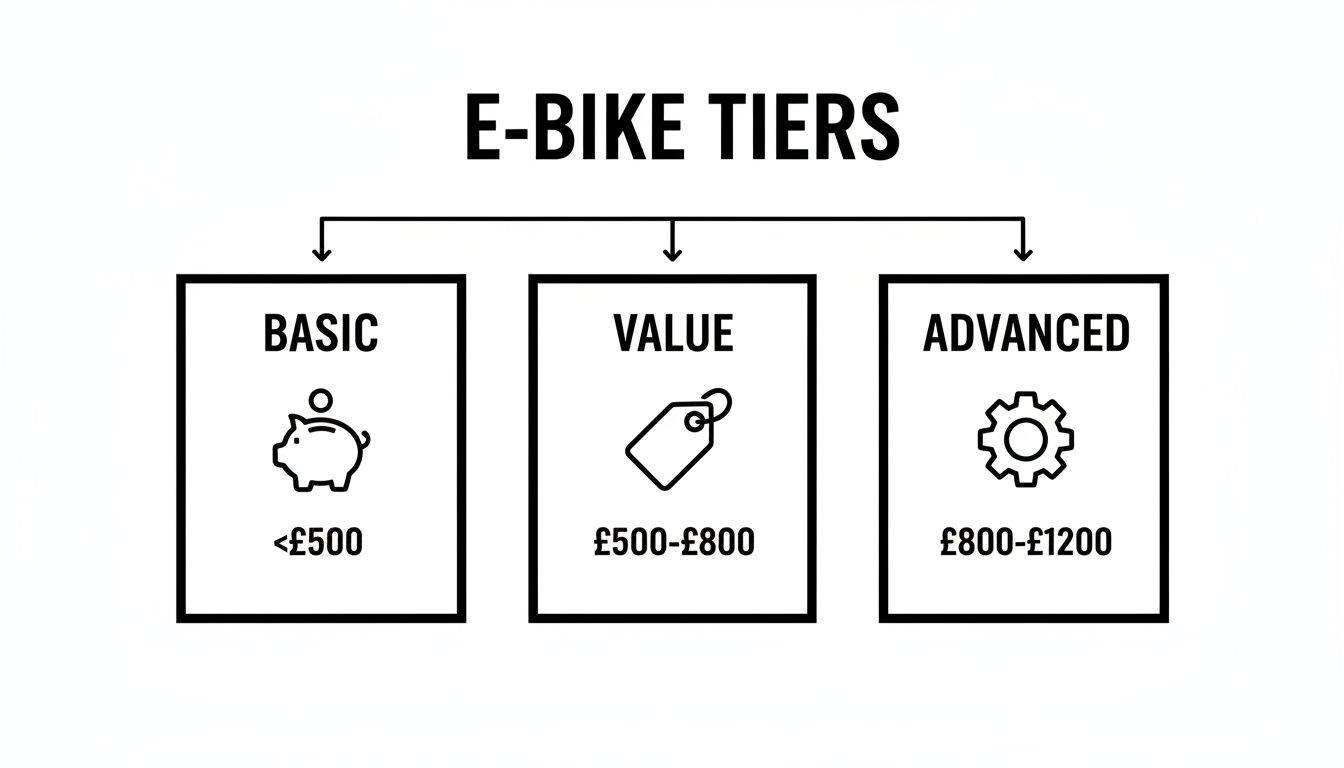
As you can see, jumping from a 'Basic' to an 'Advanced' model doesn't always mean a massive price hike, but it can make a big difference in the components and overall ride quality.
To make this even clearer, I've put together a table breaking down what your money really gets you at each price point.
Affordable E-Bike Price Tiers at a Glance
| Price Band (US/AU) | Typical Motor Power | Common Battery Range | Brake Type | Best For |
|---|---|---|---|---|
| Sub-$700 | 250W-350W (Generic) | 15-25 miles | V-Brakes | Short, flat trips and very occasional use |
| $700-$1200 | 350W-500W (Branded) | 25-40 miles | Mechanical Disc Brakes | Daily commuting and reliable everyday riding |
| $1200-$2000 | 500W-750W | 40-60+ miles | Hydraulic Disc Brakes | Longer commutes, hilly areas, and better comfort |
This "sweet spot" between $700-$1200 is where you'll often find the best bang for your buck, balancing solid performance with a sensible price.
Why Are Good E-Bikes Getting Cheaper?
The affordable e-bike scene has absolutely exploded recently, mainly because quality parts are no longer reserved for the top-shelf models. The global electric bike market was valued at USD 57.50 billion in 2025 and is on track to hit a massive USD 193.23 billion by 2034.
This isn't just a random trend. It shows a huge shift where manufacturers can now build reliable, safety-certified e-bikes at prices that were impossible a few years back. For urban commuters, this is fantastic news. You no longer have to spend thousands to get a solid, trustworthy ride. You can learn more about the e-bike market boom to see just how fast things are moving.
Key Takeaway: A truly affordable e-bike isn’t just about the initial price. It’s about finding that perfect balance of cost, quality parts, and long-term reliability that fits how you ride, saving you from headaches down the road.
What to Prioritize When Every Dollar Counts
When you’re on the hunt for an affordable electric bike, it’s all too easy to get sidetracked by flashy gadgets and long feature lists. But when you're watching your budget, the real trick is knowing where your money makes the biggest difference. It’s a bit like buying your first car – you’d go for a solid engine and reliable brakes over a top-of-the-line stereo, right? The same thinking applies here.
Your mission is to tune out the marketing hype and look at the bike's core. A fancy LCD screen is nice to have, but it’s not going to help you stop in a hurry on a slick, rain-soaked street. An extra gear might sound appealing, but it’s useless if the motor packs it in after a few months. Let's get straight to the three things that absolutely cannot be compromised on a budget-friendly e-bike.
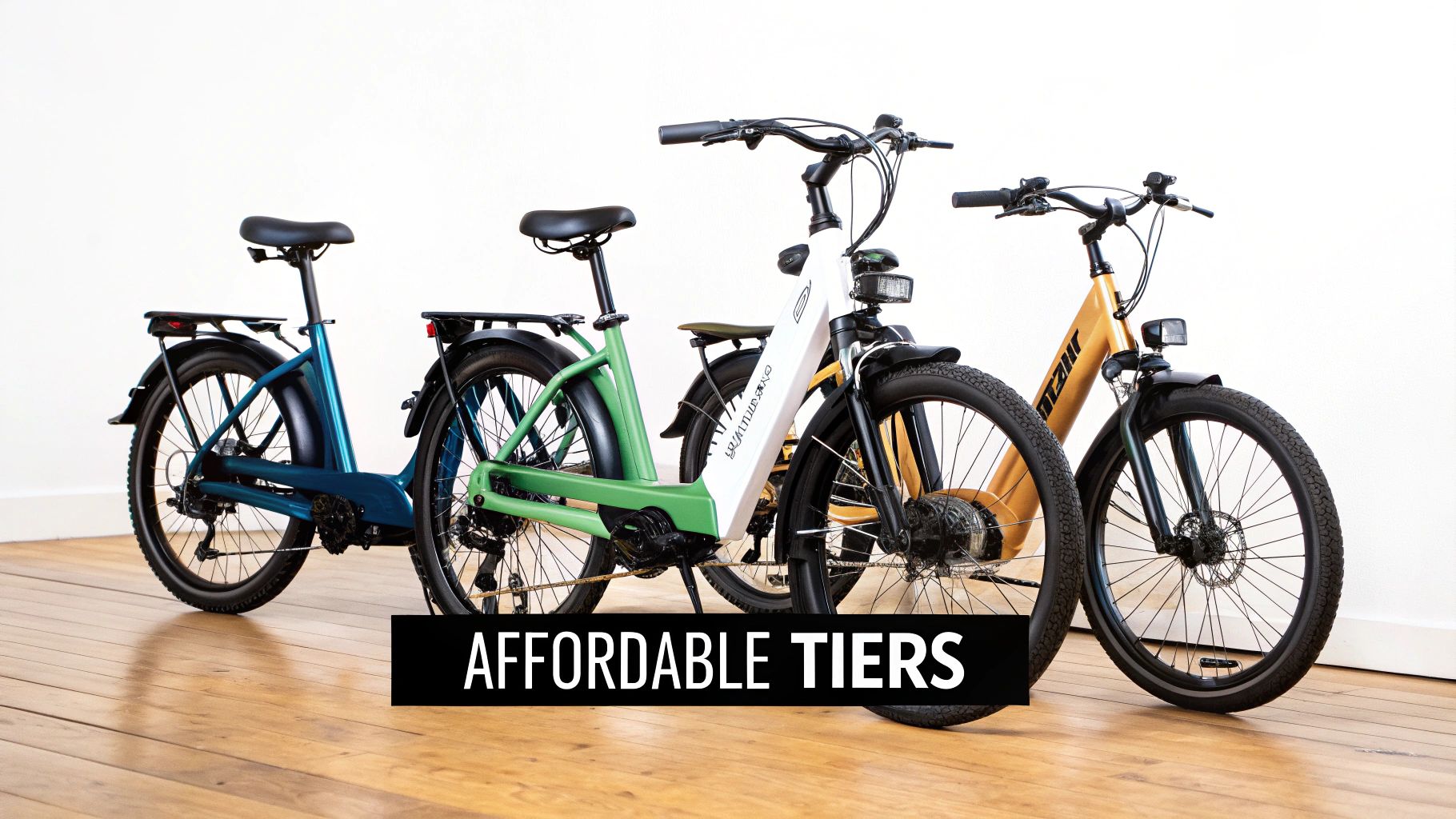
The Heart of the Bike: The Motor
The motor is what puts the "e" in e-bike, so its reliability is everything. For most city riding and daily commutes, a 350W to 500W rear hub motor is a fantastic sweet spot in the US and Australia. It provides ample power to flatten hills and give you a satisfying boost off the line at a traffic light, well within the common legal limits for e-bike classes.
On cheaper models, you'll come across a lot of generic, unbranded motors. While some can be okay, it’s a much safer bet to find a bike that uses a motor from a well-known name, like Bafang, even if it's one of their entry-level units. A brand name on the motor is a good sign of proper quality control, meaning you're getting a component that's been properly tested and built to last.
This one detail can be the difference between a ride that feels smooth and consistent, and one that's jerky or just feels weak. A dependable motor is your ticket to getting where you need to go without breaking a sweat, day in and day out.
The Fuel Tank: Battery Safety and Range
If the motor is the heart, the battery is its fuel tank. And in the world of budget e-bikes, this is where you need to pay the most attention. We’ve all seen the horror stories in the news about e-bike fires, and they almost always come down to one thing: cheap, uncertified batteries.
Crucial Tip: Never, ever buy an e-bike unless its battery and charger are clearly marked with a UL certification (for the US) or RCM mark (for Australia). These symbols are your guarantee that the electrical components meet strict safety standards. It’s the single most important thing to look for to protect yourself from dangerous faults.
Once you’ve confirmed it’s safe, think about capacity, which is measured in Watt-hours (Wh). A bigger Wh number means more juice in the tank and, generally, a longer range. For a typical daily commute, a battery around 480Wh (48V 10Ah) is a fantastic starting point. It'll give you a realistic range of 25-40 miles, depending on the terrain and how much assistance you use. Don't fall for wild, exaggerated range claims—focus on certified safety and a realistic capacity for your daily rides.
Stopping Power: Why Brakes Are a Dealbreaker
This one’s a no-brainer. Your ability to stop safely is completely non-negotiable. With affordable electric bikes, you’ll mainly see two types of brakes:
- Mechanical Disc Brakes: These are the reliable workhorses of the budget e-bike scene. They use a steel cable to squeeze brake pads onto a rotor on the wheel, offering solid stopping power in most conditions, even in the wet. They’re a huge step up from old-school rim brakes.
- Hydraulic Disc Brakes: Instead of a cable, these use fluid to create pressure. The result is a much smoother, more powerful, and more responsive feel at the lever. They’re less common on the absolute cheapest models but start appearing on bikes in the $1200+ range.
For most riders, good-quality mechanical disc brakes are perfectly adequate and a smart choice for keeping costs down. They work well, they're simple to maintain, and they get the job done. The key is to look for known brands like Tektro or Shimano, which guarantees a certain level of quality. If you can stretch your budget to a model with hydraulic brakes, it’s a fantastic upgrade, especially if your commute involves steep hills or busy traffic.
To dive deeper into specific models that nail this balance of features and price, check out our guide on the best budget electric bikes you can get your hands on right now.
Understanding the Trade-Offs of Budget E-Bikes
Let's be real: finding one of the most affordable electric bikes that actually works for you is all about give-and-take. Every great deal comes with compromises, and the trick is knowing exactly what you’re trading for that lower price tag. Think of it like booking a budget airline flight—you’ll get to your destination just fine, but you’re not getting the fancy snacks or extra legroom.
The same idea applies to e-bikes. An affordable model will absolutely get you from A to B, but manufacturers have to be smart about where they cut costs. This means you’ll notice differences in the parts, materials, and bells and whistles compared to bikes that cost two or three times as much. So, let's talk frankly about these trade-offs so you can figure out what’s a smart compromise for you and what’s a total dealbreaker.
Frame Materials and Weight
One of the first places you'll see a trade-off is the bike's frame. Most budget-friendly e-bikes are built with a steel frame. Steel is tough, reliable, and cheap to work with, which is a huge win for keeping the price down. The catch? It’s heavy. Steel bikes are always going to be noticeably heavier than their pricier cousins.
Fancier e-bikes use aluminium or even carbon fibre frames. These materials are way lighter, which makes the bike easier to pedal without the motor on, haul up a flight of stairs, or hoist onto a car rack. A heavier steel frame is a totally fine compromise if you don’t plan on lifting your bike much. But if your daily commute involves a few floors of a walk-up, that extra weight will get old, fast.
The Reality Check: A heavier bike isn't a big deal when the motor's doing the work. The real test comes when you have to lift it. A typical steel-frame e-bike can easily weigh over 55 lbs, while a lighter aluminium one might be closer to 45 lbs.
Battery Range and Longevity
To hit that sweet, low price point, manufacturers often spec batteries with a smaller capacity, which is measured in Watt-hours (Wh). A budget e-bike might have a 360Wh or 480Wh battery, giving you a realistic range of 20-40 miles. For comparison, a premium bike might rock a 625Wh or 750Wh battery, pushing its range well past 60 miles.
This is the classic trade-off: are you cool with charging your bike more often to save a chunk of cash upfront?
- Shorter Commutes: If you’re just zipping around town and your daily ride is under 10 miles, a smaller battery is more than enough. Just plug it in every couple of nights.
- Longer Journeys: If you have a long commute or love epic weekend adventures, a smaller battery could give you "range anxiety"—that nagging feeling you might not make it home on one charge.
It’s not just about range, either. The quality of the individual cells inside the battery can vary. While all batteries sold in the US and Australia have to pass safety standards, high-end models often use cells from big names like Samsung or LG. These can sometimes offer a longer overall lifespan before they start to lose their ability to hold a full charge.
Suspension and Ride Comfort
Suspension forks are what soak up the bumps and cracks in the road, giving you a much smoother ride. The thing is, good suspension systems are expensive. That's why many of the most affordable electric bikes either have a very basic spring-based suspension fork or none at all (what we call a "rigid" fork).
A basic suspension fork will take the sting out of bigger bumps, but it won’t feel nearly as smooth or controlled as a high-end air-sprung fork. A rigid fork, on the other hand, is the lightest and most efficient option for smooth roads, but you will feel every single pothole and crack in the pavement right through your handlebars. For well-maintained city streets, a rigid fork is a perfectly sensible way to save money. But if your route involves cobblestones or rough trails, even a basic suspension fork is a feature worth having.
How to Buy an Affordable E-Bike with Confidence
Jumping into the online marketplace to find a great, affordable e-bike can feel a bit like wading into a jungle. It's packed with fantastic deals, sure, but there are also plenty of traps waiting for an unwary buyer. The key to coming out with a brilliant bike—and not a costly mistake—is knowing where to look and what to look for. You don't have to go it alone; a clear roadmap makes all the difference.
The online world really offers a few different paths for buying an e-bike. Each one has its own set of pros and cons, and understanding them is the first step toward making a purchase you'll be happy with for years to come.
Where to Shop for Your E-Bike
When you start your search, you'll generally run into three types of sellers. Figuring out which one fits your style will help narrow down the options right away.
- Direct-to-Consumer (DTC) Brands: These are the brands that sell straight from their own websites. The biggest upside here is usually the price—by cutting out the middleman, they can pass the savings on to you. The catch? You can't test ride the bike before you commit.
- Massive Online Retailers: Think Amazon or eBay. You’ll find a dizzying selection and some very competitive prices, but the quality can be all over the map. Vetting the individual seller is absolutely crucial here, as getting decent customer support can be a roll of the dice.
- Curated Shops: These are the specialists (like us at Punk Ride) who carefully select a range of bikes from various trusted brands. The real benefit here is that someone has already done the initial quality check for you, saving you time and dramatically reducing the risk of ending up with a dud.
No matter which route you take, one simple factor can save you a world of headaches down the line: local warehousing.
Pro Tip: Always, always prioritize sellers that have warehouses in the US or Australia. This almost guarantees faster, more reliable shipping and, more importantly, much easier access to customer support and spare parts if you ever need them.
Your Pre-Purchase Vetting Checklist
Before you even think about clicking that ‘buy’ button, run through this simple checklist. Think of it as your safety net against scams and shoddy products. Taking just ten minutes to do this can honestly save you hundreds of dollars and a mountain of frustration.
- Read the Reviews Critically: Don't just glance at the star rating. Dive into the 1-star and 3-star reviews to find common complaints. Are people repeatedly mentioning flimsy parts, poor battery life, or non-existent customer service? These are huge red flags.
- Scrutinise the Warranty: A solid warranty is a great sign that the seller stands behind their product. Look for at least a one-year warranty on the frame and the key electrical bits like the motor and battery. If the warranty information is vague or missing, that's a dealbreaker.
- Check for Contact Information: Is there a clear phone number, email address, or physical address for their US/Australian operations? If a seller is hard to get in touch with before you buy, just imagine how difficult it will be when you actually have a problem.
- Confirm Safety Certifications: As we've covered, seeing that UL (US) or RCM (AU) mark on the battery and charger is non-negotiable for your safety. Reputable sellers will display these certifications proudly in their product descriptions.
As you're learning the ropes, it’s a good idea to look at specific brands and retailers, like Eunorau E-Bikes, just to see what's out there and compare their offerings.
This growing focus on reliability and safety is part of a much bigger trend. People are more environmentally conscious than ever, and that's a huge reason the affordable e-bike market is exploding globally. Research actually projects the e-bike market will grow by over 15% in the coming years, with green thinking as the main catalyst. You can discover more insights about e-bike market growth to see how this is shaping the whole industry.
For an even deeper dive into the buying process, our complete electric bike buying guide has a ton more detailed advice.
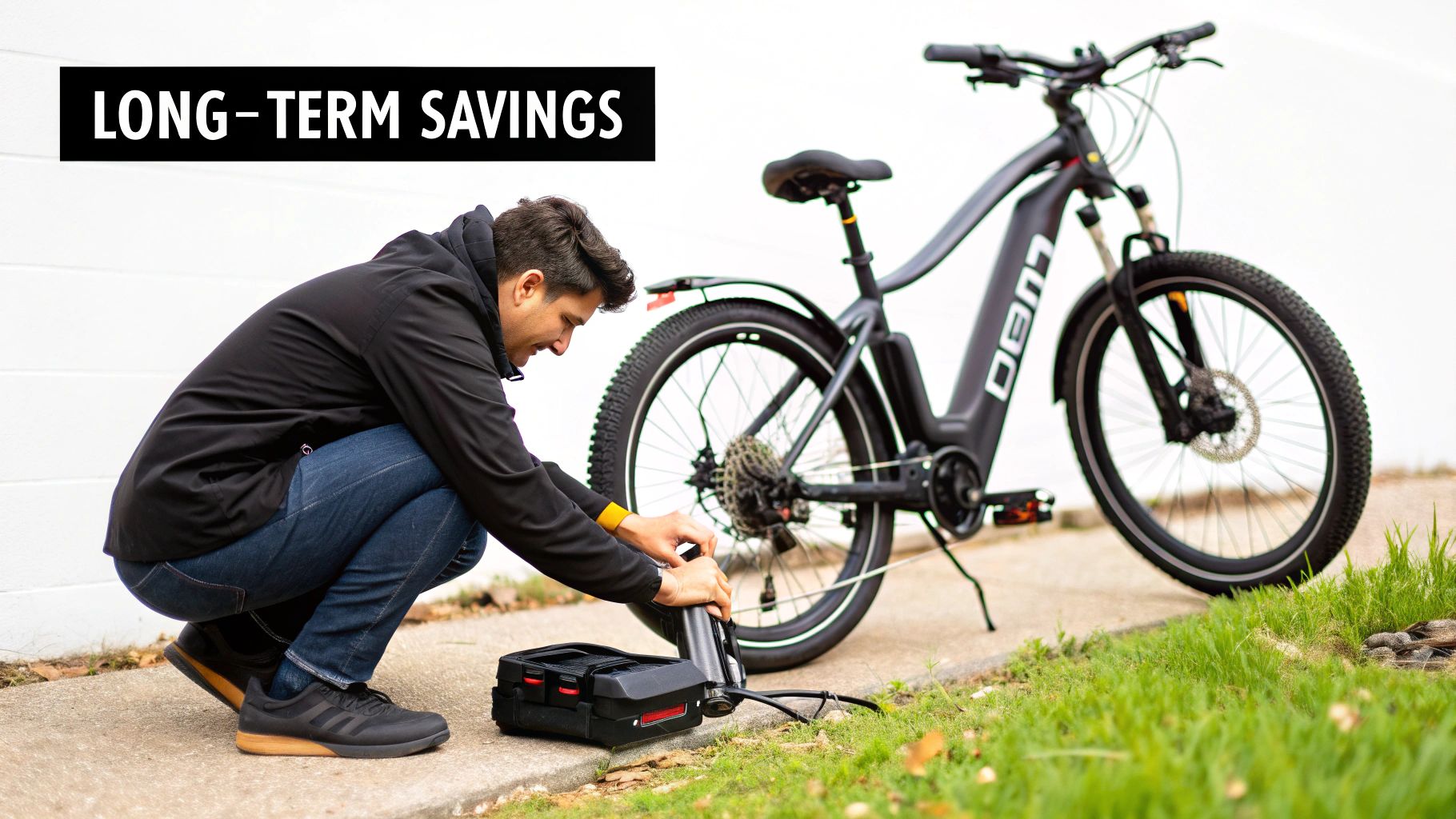
Keeping Your E-Bike Affordable in the Long Run
The sticker price is just the start of the story. The real cost of an e-bike isn’t what you pay on day one—it’s the total cost over years of ownership. To make sure your great deal stays a great deal, you’ve got to think long-term.
Luckily, this isn't about becoming a master bike mechanic overnight. It’s about building a few simple habits that stop tiny issues from snowballing into big, expensive repairs. The initial purchase gets you in the game; smart ownership is how you win it.
Mastering Basic DIY Maintenance
You really don't need a pro workshop to keep your e-bike running smoothly. A few minutes of basic care each month can save you a fortune and dramatically extend the life of your bike's most important parts. This is, without a doubt, the number one way to keep costs down.
Let's start with the heart of the bike: the battery. How you charge it makes a huge difference. Try to avoid leaving it plugged in overnight every single time, and don't make a habit of running it completely flat. Extreme temperatures are its enemy, so a freezing garage in winter or a sun-baked car in summer will seriously shorten its lifespan. For a deeper dive, you can learn more about electric bike battery care and best practices.
Beyond the battery, a little old-school bike maintenance goes a very long way.
- Keep Your Drivetrain Clean and Lubed: A gritty, dry chain doesn't just sound awful; it actively wears out your expensive gears. A quick wipe and re-lube every few weeks is a five-minute job that costs pennies.
- Check Tyre Pressure Weekly: Soft tyres are a drag. They make the motor work harder, drain your battery faster, and are the main reason people get punctures. Pumping them up to the right PSI is the easiest win you'll get.
- Inspect Your Brakes: Take a quick look at your brake pads every now and then. If they look thin, swap them out. It’s a simple DIY task that keeps you safe and saves your brake discs from costly damage.
The Hidden Value of a Good Warranty
When you're staring at spec sheets, the warranty section is easy to gloss over. Don't. A good warranty is the manufacturer telling you they believe in their own product. It’s your financial safety net if a key component decides to give up unexpectedly.
A strong warranty is one of the clearest signs of a quality budget e-bike. You should be looking for at least a one-year guarantee on the big-ticket items: the motor, battery, and controller. Anything less should set off alarm bells.
This is a huge reason why buying from a trusted, curated seller is so important. They've already vetted the bikes for reliability and are far more likely to offer models with solid warranties and actually help you if something goes wrong. Trying to chase a warranty claim with some random seller on a giant marketplace can be a complete nightmare.
Why Spare Parts Availability Matters
Finally, think about the road ahead. Even the most babied e-bike will eventually need a new part—a brake lever gets bent, a display screen cracks, a charging port gets wobbly. For budget e-bikes, knowing you can actually get those parts is everything.
Some obscure, no-name bikes are effectively disposable. If one unique electronic part fails and you can't find a replacement, your bike is little more than an expensive paperweight.
Before you commit, do a quick Google search for the brand's name plus "spare parts." If you find a dedicated parts shop on their website or see them stocked by reputable retailers, that's a brilliant sign. It means your bike is built to be repaired, not replaced, turning a good purchase into a genuinely smart, long-term investment.
Your Top Questions About Affordable E-Bikes, Answered
Even after doing all your homework, a few last-minute questions can creep in and make you second-guess your decision. That's totally normal, especially when you're trying to find a great deal.
So, let's tackle the big ones. Think of this as our final chat before you head to the checkout, making sure you feel 100% confident in the bike you choose.
Are Electric Bikes Under $700 Safe?
They can be, but you have to be extra careful at this price point. Honestly, your main job here is to become a safety-certification detective.
Look for sellers who are upfront about their certifications. In the US, the UL mark on the battery and charger is your non-negotiable proof that they’ve passed essential safety tests. For Australia, it's the RCM mark. Don't even consider a bike without the appropriate certification.
You'll have to focus on the absolute basics: a frame that feels solid, brakes that work (even if they're simple mechanical ones), and a motor that isn't from a totally anonymous source. Be really wary of those too-good-to-be-true deals from random sellers on giant online marketplaces. Read reviews like a hawk, looking for comments on how the bike has held up after a few months of real-world use. You’re giving up performance, not safety.
What’s the Real Difference Between a $1000 and a $2500 E-Bike?
When you jump from $1000 to $2500, you’re paying for a serious upgrade in component quality, a drop in overall weight, and a much nicer ride feel.
A $2500 bike will almost certainly have a lighter aluminium frame, much more powerful hydraulic disc brakes, and a smooth, quiet motor from a big name like Bosch or Shimano. The battery will have better cells from a top-tier brand, giving you more range and a longer lifespan.
Your $1000 ride will likely have a heavier steel frame, reliable (but less powerful) mechanical brakes, and a generic hub motor that gets the job done.
The Bottom Line: Both will get you from A to B with a smile. But the pricier bike delivers a more refined, responsive, and durable experience. You’ll really feel that difference on longer rides or hilly terrain.
How Much Maintenance Does a Cheap E-Bike Need?
It needs regular, simple maintenance—just like any bike—but you’ll want to pay a bit more attention to the electrical bits.
The most important thing is looking after the battery. Don't store it in a freezing garage or a boiling hot shed, and try not to let it sit completely dead for weeks. That's the key to a long life.
Beyond that, it’s the usual stuff:
- Keep your chain clean and lubed. It prevents things from wearing out too fast.
- Check your tyre pressure at least once a week. It makes pedalling easier and helps avoid flats.
- Glance at your brake pads every month or so to check for wear.
Because the parts on budget bikes aren't as robust, you might find yourself tweaking things a little more often. The good news? These are all super simple tasks you can learn to do yourself, which will save you a fortune on bike shop bills.
Can I Actually Use a Budget E-Bike for a Long Daily Commute?
You bet! You just need to be realistic and match the bike's specs to your route. The number one thing to check is the battery's range.
Here’s a good rule of thumb: take whatever range the manufacturer claims and knock off about 20-30%. That’s your real-world number.
So, if your round-trip commute is 15 miles, a bike that claims a 25-30 mile range is a safe bet. It gives you a buffer for windy days or that one killer hill. For longer commutes, things like basic front suspension start to make a real difference for comfort. And trust me, a removable battery is a godsend—it means you can charge it at your desk instead of hauling your bike into the office.
Ready to find an electric ride that fits your budget and your life? At Punk Ride, we've curated a selection of the best value electric bikes and scooters from trusted brands, all backed by our local warehouses for fast shipping and reliable support.
Explore our collection of affordable electric rides at Punk Ride today!
Share:
Your Guide to the Best Electric Bike for Delivery
The Ultimate Torque Sensor Ebike Guide for US and Australian Riders