


A torque sensor ebike is all about giving you power exactly when you need it, based on how hard you're actually pedaling. It creates a ride that feels incredibly natural and intuitive. Think of it less like an on/off switch for a motor and more like a dimmer, smoothly adding power to your own efforts and making you feel like you've suddenly developed superhuman legs.
What Is a Torque Sensor Ebike and Why Does It Matter
Let's cut right through the technical talk. Imagine your ebike has a brain. A more basic ebike uses a cadence sensor, which is like a simple light switch. It knows if you're pedaling, but not how hard. As soon as it sees the pedals turning, it flicks the motor on to a pre-set level. This can feel a bit sudden, almost jerky.
A torque sensor ebike, however, is a whole lot smarter. It’s that dimmer switch we mentioned. It's constantly measuring the actual force—the torque—you’re putting into the pedals.
Pedal gently, and you get a small, subtle boost. Really put your back into it to get up a steep hill, and the motor instantly responds with a powerful surge to help you out. It's this real-time, proportional response that makes the ride feel so incredibly smooth and connected.
The Feel of an Intuitive Ride
This responsive system is really what separates a good ebike from a great one. It’s the difference between feeling like you’re just along for the ride and feeling like you and the bike are working together perfectly. For daily commuters across the US and Australia, that difference is a game-changer.
Here’s why it matters on your journey:
- Predictable Power: Weaving through stop-and-go traffic in cities like New York or Sydney demands precise control. A torque sensor gives you exactly that, getting rid of those unexpected power surges.
- Hill Climbing Heroics: Those inclines you used to dread? They become fun challenges. The bike matches your effort, giving you just the right amount of help without making you feel like you're cheating.
- Extended Range: This is a big one. Because the motor only gives you the power you actually need, it's way more efficient. That often means you can go a lot further on a single charge compared to a basic cadence system.
- Engaging Exercise: You still get a solid workout. The bike amplifies your effort, but it doesn't do all the work for you. You’re still very much in control and getting the health benefits of cycling.
The core benefit of a torque sensor is that it makes an electric bike feel like a traditional bicycle, just better. It enhances your own power rather than simply taking over, keeping you connected to the ride.
This kind of smart technology is a huge part of why e-bikes are booming. The global market is growing like crazy as more people look for better ways to get around. You can dig into the numbers and market trends over at Grand View Research. Ultimately, it’s all about creating a smarter, more efficient, and way more enjoyable ride.
How Torque Sensors Create a Smarter Ebike Ride
Imagine having a perfect dance partner, one who anticipates your every move. That's what riding an e-bike with a torque sensor feels like. When you push harder to tackle a steep hill, the bike instantly responds with more power. Ease off as you cruise along a flat road, and the motor dials it back.
It’s not magic, but it’s an incredibly smart and seamless conversation between you and your bike. This constant feedback loop creates that smooth, almost "bionic" feeling that torque sensor e-bikes are famous for. The system doesn't just know that you're pedaling; it knows exactly how hard you're pushing.
Measuring Your Every Move
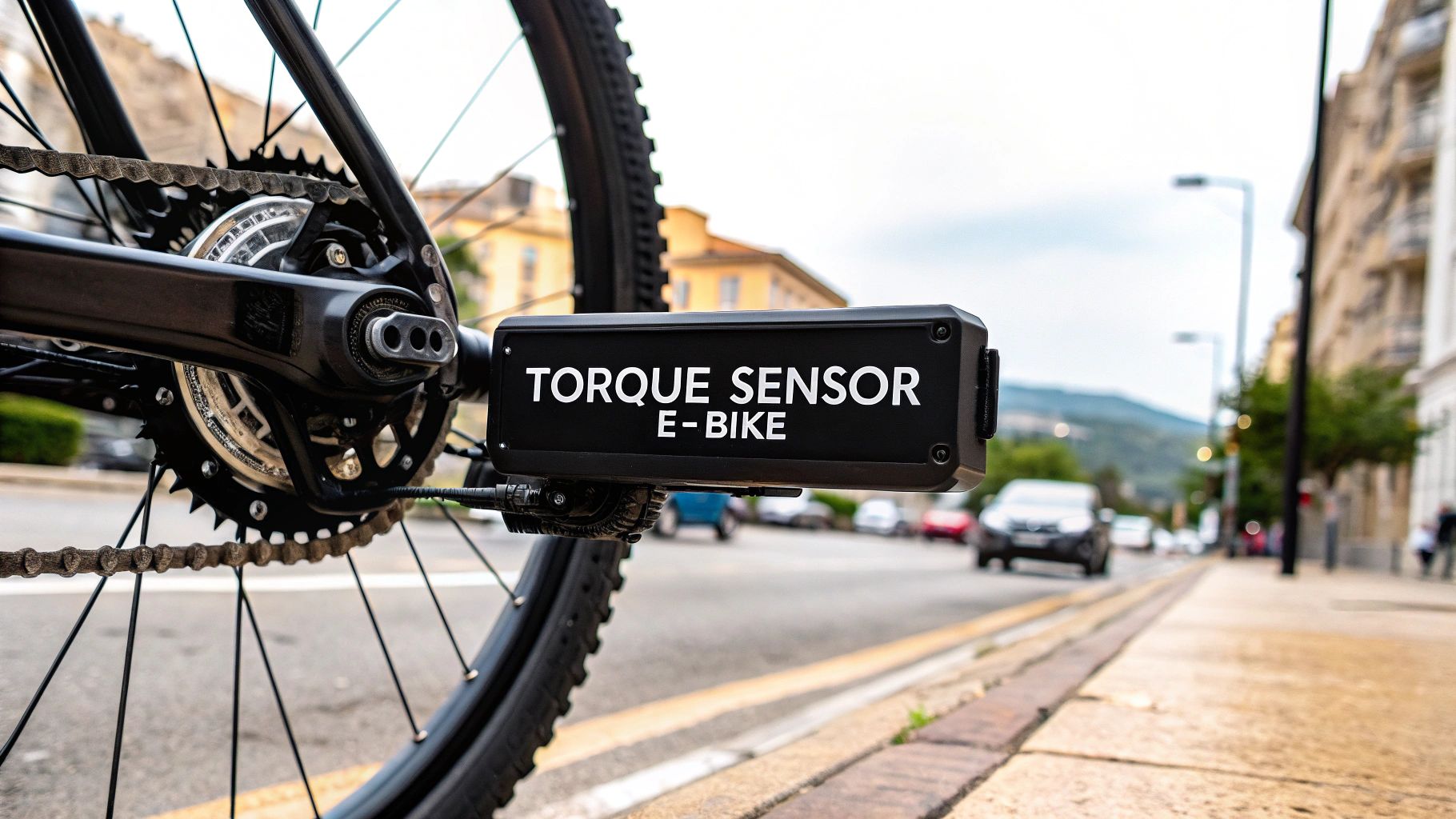
So, how does the bike read your mind? It all comes down to the torque sensor, which constantly measures the force you put on the pedals. These sensors are usually hidden away in the bottom bracket (where your pedal cranks attach to the frame) or sometimes near the rear wheel's axle.
No matter where it's located, the sensor's job is to convert your physical effort into a precise electrical signal. This signal gets zapped over to the e-bike's controller—the bike's brain—hundreds of times a second. The controller then tells the motor exactly how much juice to deliver.
It's amazing how fast this happens. A high-quality torque sensor can take up to 1,000 measurements per pedal stroke. This is what makes the power feel so instant and natural, like the bike is just an extension of your own legs.
This whole process ensures the motor's help is perfectly matched to your effort. Pedal lightly, and you get a gentle boost. Really stomp on the pedals to get ahead of traffic, and the motor kicks in with a powerful surge. It’s this responsive, intuitive feel that makes hills and busy streets feel so effortless and controlled.
The Different Flavours of Torque Sensing
Not all torque sensors are built the same way, but they all achieve a similar goal. They mostly differ in where they're placed on the bike.
- Bottom Bracket Sensors: This is the most common setup you'll find, especially on bikes with mid-drive motors. Tucked right into the frame where the cranks spin, they directly measure the force you're putting down. Their central location gives a super accurate reading of your effort.
- Rear Hub Sensors: Some hub-drive e-bikes place the sensor in the rear axle. These work by measuring the twisting force (or torque) being applied through the drivetrain to the rear wheel.
While the engineering behind them varies a bit, the result for you, the rider, is the same: a smarter, more natural-feeling ride. To really get why this is such a big deal, it helps to understand how it stacks up against other systems. You can learn more about how ebike pedal assist works in our detailed guide. It'll give you the full picture on why a torque sensor ebike offers such a next-level experience.
The Great Debate: Torque vs. Cadence Sensors
When you’re picking out an e-bike, the sensor is a massive deal. It’s the brain of the bike, and it completely dictates how the motor responds to you. You’re essentially choosing between two totally different ride philosophies: one is like hitting cruise control, and the other feels like the bike is a natural extension of your own power.
This diagram breaks down how a torque sensor creates that direct link between your effort and the motor's kick.
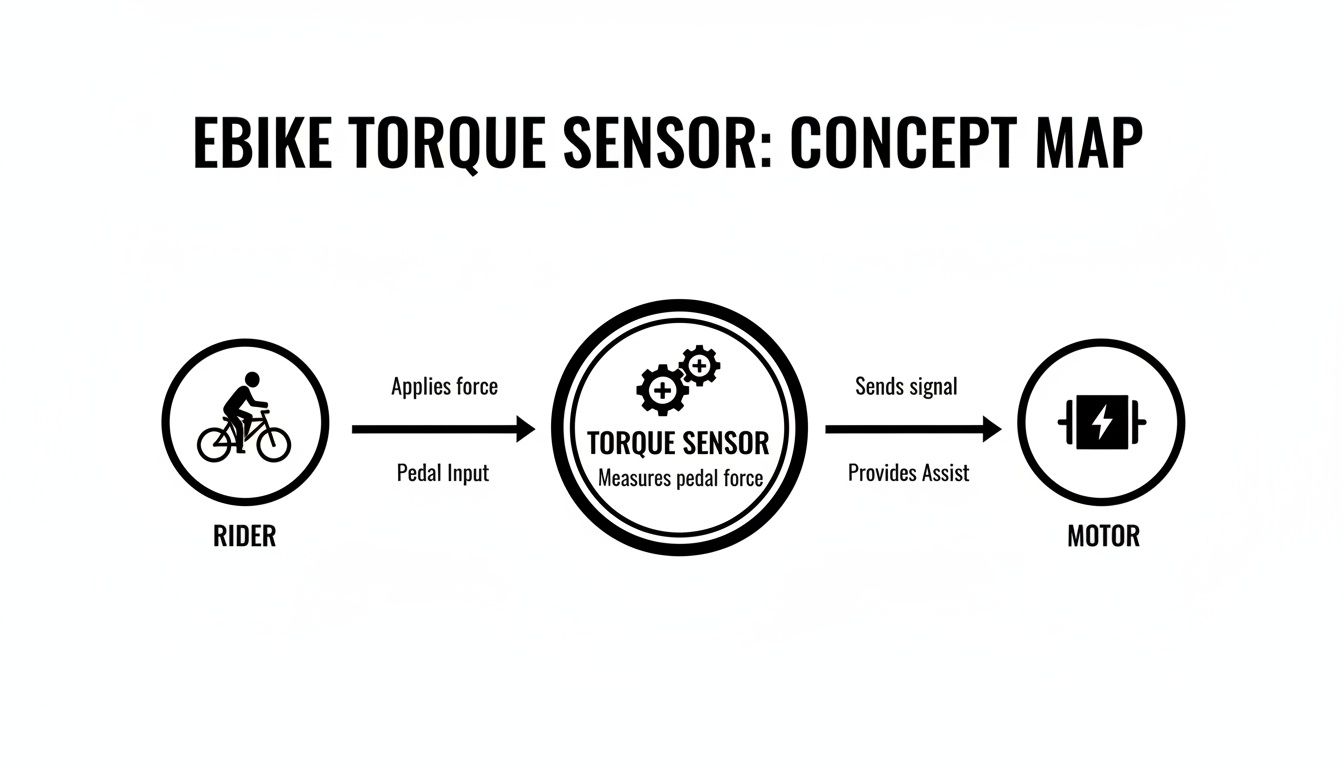
It all starts with you. Your force on the pedals gets measured, sending a signal to the motor and creating this awesome, seamless loop of power.
Cadence Sensors: The On/Off Switch
Think of a cadence sensor as a simple on/off switch. It only cares about one thing: are the pedals moving? The moment they are, it signals the motor to kick in at a preset power level tied to your assistance setting.
This is fine if you're after a super relaxed, low-effort ride. You can just ghost-pedal—spinning the pedals gently—and the motor does all the heavy lifting to keep you cruising. But that simplicity is also its biggest flaw. It's the reason for that abrupt surge of power that feels jerky and unnatural, especially when you're starting on a hill or trying to maneuver in a tight spot.
Torque Sensors: The Dimmer Switch
A torque sensor ebike, on the other hand, is a whole different ballgame. It's much more sophisticated. Instead of just knowing if you're pedaling, it knows how hard you're pedaling. This is a game-changer. The sensor measures the force you're putting in and tells the motor to match it proportionally.
This translates into some huge real-world benefits that you'll notice immediately:
- Intuitive Power Delivery: The motor's assistance feels incredibly natural, like you just woke up with superhuman legs. Push harder on the pedals to tackle a hill, and the motor gives you more juice. Ease up on a flat, and it backs off with you.
- Superior Control and Safety: Navigating a crowded Melbourne bike lane requires precision. A torque sensor lets you make tiny, subtle speed adjustments, getting rid of those jerky, lurching starts you get with a cadence sensor.
- Better Battery Efficiency: Because the motor isn't just dumping power at a fixed rate, you end up using a lot less battery. It only gives you what you need, when you need it. This can seriously extend your range, which is a massive plus for long commutes or weekend trips.
To truly see how these two sensor types stack up in the real world, let's break down some common riding situations. The difference in feel is night and day.
Ride Feel Breakdown: Torque vs. Cadence
| Riding Scenario | Torque Sensor Experience | Cadence Sensor Experience |
|---|---|---|
| Starting on a Steep Hill | Smooth, immediate power. The bike assists as you press, making takeoffs feel controlled and effortless. | Can be jerky. The motor kicks in abruptly once the pedals make a rotation, potentially causing a lurch forward. |
| Navigating Tight Spaces | Excellent. You can "feather" the pedals for precise, low-speed control, like when filtering through traffic. | Challenging. The on/off power delivery makes it hard to maintain a slow, steady pace without lurching. |
| Cruising on Flat Ground | Feels like riding a normal bike, but with a consistent tailwind. Your effort directly translates to speed. | Easy and relaxed. You can pedal lightly at a comfortable cadence and let the motor do the work to maintain speed. |
| Climbing a Long, Gradual Hill | Engages your muscles. The bike rewards your hard work with more power, giving you a real sense of accomplishment. | Less engaging. The motor provides a constant level of assist, so you just spin the pedals and let it carry you up. |
| Sudden Acceleration | Instantaneous response. The moment you push harder, the motor ramps up, giving you a quick and powerful boost. | Delayed response. There's a slight lag as the sensor waits to detect pedal rotation before the motor engages fully. |
Ultimately, the choice comes down to what you want from your ride.
For a deeper dive, it helps to understand cycling cadence, since it's at the core of how these systems operate. A cadence sensor is all about pedal speed, while a torque sensor is all about your force. For most riders navigating busy urban environments, the precise, intuitive feel of a torque sensor makes for a much safer and more enjoyable experience.
Real World Benefits for US and Australian Riders

The technical stuff is all well and good, but what does a torque sensor ebike actually mean for your day-to-day life? For riders across the US and Australia, it all comes down to a smarter, safer, and just plain more enjoyable ride.
Think about tackling one of those monster hills in a city like San Francisco or Brisbane. With a torque sensor, that climb suddenly feels manageable, not terrifying. The bike gives you power that perfectly matches how hard you’re pushing, turning what used to be a lung-buster into a really satisfying workout. It’s less like a motor is just yanking you up the hill and more like you’ve suddenly been given bionic legs.
Taming the Urban Jungle
Stop-and-go city traffic is where this tech really proves its worth. Weaving through the busy streets of Chicago or the bike lanes in Perth means making constant little adjustments. A torque sensor’s intuitive feel lets you filter through that congestion with total confidence.
You won't get any of those sudden lurches or unexpected power surges when you pull away from a red light. That predictability doesn't just feel better—it makes for a much safer ride in crowded spots. It turns a stressful commute into something smooth and controlled.
The real magic of a torque sensor is how it makes you forget you're on an ebike. It simply feels like a great bicycle that responds instantly to your intentions, whether you're accelerating away from an intersection or cruising along a bike path.
This natural ride feel is just as great on weekend adventures. When you’re out exploring trails in the Rockies or coastal paths along the Great Ocean Road, that precise control helps you handle uneven ground like a pro. This is a huge deal on trails where pedal-assisted mountain bikes have become the norm. The e-mountain bike market has exploded, mostly because torque sensing tech keeps that natural feel that serious riders expect. You can dig into more data on this trend and its impact on the market.
Practical Perks You'll Notice Immediately
Beyond just how it feels to ride, a torque sensor ebike has some solid advantages you'll appreciate on every single trip. These perks make a real difference, whether you're commuting every day or just riding for fun.
- Improved Battery Range: The motor only works as hard as you do, so it sips power instead of guzzling it, especially on mixed terrain. This efficiency boost almost always means you get more miles out of a single charge.
- A More Engaging Workout: Since the bike's assistance is proportional to your effort, you’re always part of the equation. This guarantees you’re getting a proper workout, helping you stay active on your commute or weekend spin.
- Increased Safety and Control: The power delivery is so predictable and smooth that you feel completely in command. You'll have way more confidence, especially when you're moving slowly or trying to get around obstacles.
This mix of efficiency, intuitive control, and an engaging ride makes a torque sensor ebike a fantastic choice for any modern rider in the US or Australia. It’s a smarter way to ride, hitting that sweet spot between your own power and electric assistance. To get a better idea of how this all plays out on the road, check out our guide on how fast electric bikes can go.
Finding Your Perfect Torque Sensor Ebike
So, you're sold on the amazing, intuitive feel of a torque sensor. Awesome choice. Now for the fun part: finding the perfect e-bike that has one. This is about more than just picking a color; it's about seeing how all the parts come together to create that "just right" ride.
The first thing you’ll notice is that the best torque sensors are almost always found on bikes with mid-drive motors. There's a good reason this combo is considered the gold standard in the e-bike world. By placing the motor right at the pedals, it can directly leverage the bike's gears, just like you do.
This setup lets the motor spin at its happiest, most efficient RPM. The result? A ride that feels powerful, incredibly responsive, and perfectly balanced. It's the secret sauce that makes these bikes climb hills like a goat and feel so much like a traditional, high-performance bicycle.
Decoding the Spec Sheet
When you start comparing different e-bikes, the spec sheets can feel like they're written in another language. Let's cut through the noise and focus on one of the most important numbers you'll see: Newton-meters (Nm) of torque.
Think of Nm as the motor's raw "grunt" or pulling power. It's the force that gets you going from a dead stop and helps you conquer steep hills. More Nm means more muscle when you really need it.
- 30-40 Nm: Perfect for cruising around town on mostly flat ground or tackling small, rolling hills. This is great for a relaxed ride.
- 50-70 Nm: This is the sweet spot for a lot of riders, especially urban commuters. It gives you plenty of juice to fly up moderate to steep hills without a problem.
- 80+ Nm: Now you're in high-performance territory. If you live somewhere with seriously challenging hills or love hitting rugged trails, this is the kind of power that puts a huge smile on your face.
A key thing to remember is that while Nm tells you how much power is on tap, the torque sensor is the smart controller that decides how smoothly that power is delivered. It's the magic pairing of both that makes for a truly premium experience.
Spotting a Quality System
Beyond just looking at the motor type and torque rating, keep an eye out for systems from well-known brands like Bosch, Shimano, or Brose. These guys have been in the game for years, constantly tweaking and refining their motors and sensors to feel incredibly polished and reliable.
This demand for a better-feeling ride is what's fueling some serious growth in the industry. The e-bike motor market, which goes hand-in-hand with torque sensor tech, was valued at USD 12.79 billion in 2025 and is expected to explode to USD 42.73 billion by 2034. Mid-drive motors are a huge piece of that pie, largely because riders want that seamless power for climbing and a more natural feel. You can read more about the growth of the e-bike motor market if you want to geek out on the trends.
At the end of the day, finding the right torque sensor ebike is all about matching the bike's capabilities to your own riding style. Knowing what to look for on the spec sheet will help you find that perfect match, whether you're a daily commuter or a weekend warrior. For a closer look at motor types, check out our guide to the best mid-drive electric bikes.
Got Questions About Torque Sensors? We've Got Answers.
Even after diving into the details, you might have a few things you're still wondering about. That's totally normal. Let's run through some of the most common questions we hear about torque sensors to make sure you feel 100% confident.
Is an E-bike with a Torque Sensor Harder to Ride?
Not a chance. It’s actually the complete opposite. A torque sensor e-bike is way more intuitive and natural to ride than a bike with a basic cadence sensor.
Think of it like this: the motor’s help matches exactly how hard you’re pushing on the pedals. It feels just like riding a normal bike, only you’ve got this amazing, invisible tailwind giving you a boost. You won't get any of those weird, sudden lurches of power you sometimes feel on other e-bikes. It’s just smooth, predictable control from the second you start pedaling, which makes for a much safer and more enjoyable ride, especially if you're new to e-bikes or weaving through city traffic.
Do Torque Sensors Drain the Battery Faster?
This is a big myth! The truth is, torque sensors are way more efficient and can actually help you get more miles out of a single charge.
A cadence sensor is pretty simple—if you’re pedaling, the motor is on at a set level, even if you’re just coasting on a flat road and don't really need the help. That’s a huge waste of battery. A torque sensor is much smarter. It only gives you the power you’re asking for, right when you ask for it. By cutting out all that wasted energy, it can seriously extend your e-bike’s range.
Are E-bikes with Torque Sensors More Expensive?
Okay, you got us there. Generally, e-bikes with torque sensors do cost a bit more. The tech is more sophisticated, and the parts are trickier to make and build into the bike's system.
But you're getting what you pay for. That extra cost buys you a massively better riding experience—smoother, more efficient, and with way more control. It just feels right. The good news is that as the technology gets more popular, we're seeing it pop up on more and more bikes at prices that are easier on the wallet.
Can I Add a Torque Sensor to My Current E-bike?
While it’s technically possible for some bikes, swapping out a cadence sensor for a torque sensor is almost always a complicated and pricey undertaking.
You’re not just changing the sensor. You’d likely need a new bottom bracket, a new controller (the bike’s brain), and maybe even a new display to get everything to talk to each other properly.
Honestly, for almost everyone, it’s much simpler, cheaper, and more reliable to just buy an e-bike that was built with a torque sensor from the start. That way, you know every component is designed to work together perfectly.
This saves you from the potential nightmare of a custom job and guarantees you get that dialed-in performance you're looking for.
Ready to feel the difference a truly intuitive e-bike can make? At Punk Ride, we’ve hand-picked a lineup of awesome, high-performance e-bikes built to make your city rides and weekend trips incredible. Find your perfect ride today at https://www.punkride.com.
Share:
Finding the Most Affordable Electric Bikes That Last
E Scooter Insurance Your Complete Guide to Staying Covered