


Picking an electric bike for delivery is one of the savviest decisions you can make, whether you're a solo courier or a business owner. Think of it as the ultimate upgrade: it merges the get-up-and-go of a scooter with the low costs and nimble nature of a regular bike. This isn't just about going green—it’s a straight-up strategic business move.
Why E-Bikes Are a Secret Weapon for Urban Delivery
In the world of last-mile delivery, every minute saved and every dollar not spent goes straight to your bottom line. An electric bike built for delivery is way more than just an eco-friendly substitute for a van or moped. It's a real competitive advantage, purpose-built for the chaos of city logistics.
Picture your riders breezing past a sea of red taillights, turning what would be a frustrating traffic jam into more completed deliveries. That's just a normal Tuesday for an e-bike courier. They're not just dodging traffic; they're dodging fuel costs, parking tickets, and the wallet-draining maintenance that comes with gas-powered vehicles. The outcome? A leaner, quicker operation that crams more drops into every single hour.
The Shift from Recreation to Professional Tool
E-bikes have come a long way from their beginnings as weekend toys. The professional-grade models you see today are tough, reliable workhorses, built to take the punishment of daily commercial use. This change mirrors a bigger shift in how cities move goods, with businesses across Australia and the US grabbing onto smarter, faster, and cheaper ways to keep up with customer demand.
And this isn't just a flash in the pan. The numbers tell a pretty clear story.
The global market for electric delivery bikes was already valued at a massive $2.841 billion back in 2025, and it’s still on the up. This explosion is powered by the e-commerce boom and the very real need for sustainable last-mile solutions.
In fact, studies have shown that e-bikes can slash delivery times by up to 30% compared to cars in jammed city centers. Even better, the running costs are often 50-70% lower than a typical motorcycle. You can dig into the numbers yourself and explore the full research on the electric delivery bike market's growth.
Gaining a Competitive Edge
When you bring e-bikes into your operation, you’re doing more than just moving boxes. You're making a conscious effort to improve ecommerce customer experience and build your business on faster, greener deliveries. This one decision gives you several serious perks:
- Serious Agility: You can zip down narrow streets, use bike lanes, and take shortcuts that are off-limits to vans and cars.
- Lower Running Costs: Forget about fuel, registration, and pricey parking permits.
- Boosted Productivity: Fit more deliveries into each shift, which means more money in your pocket or more revenue for your business.
- A Better Brand Image: Showing you care about sustainability is a big win with today's eco-conscious customers.
Choosing Your Delivery Workhorse
Picking the right electric bike for delivery is a lot like choosing the right tool for a job. You wouldn't bring a sports car to a furniture move, right? The same logic applies here. A standard, off-the-shelf e-bike just isn't built to handle the daily grind of commercial delivery work.
Let's break down the main contenders. Think of these as different classes of vehicles, each designed for a specific kind of delivery, a particular terrain, and a certain amount of cargo.
This simple decision tree can help you figure out if an e-bike is even the right move for your business in the first place. It all comes down to city congestion, delivery speed, and of course, cost.
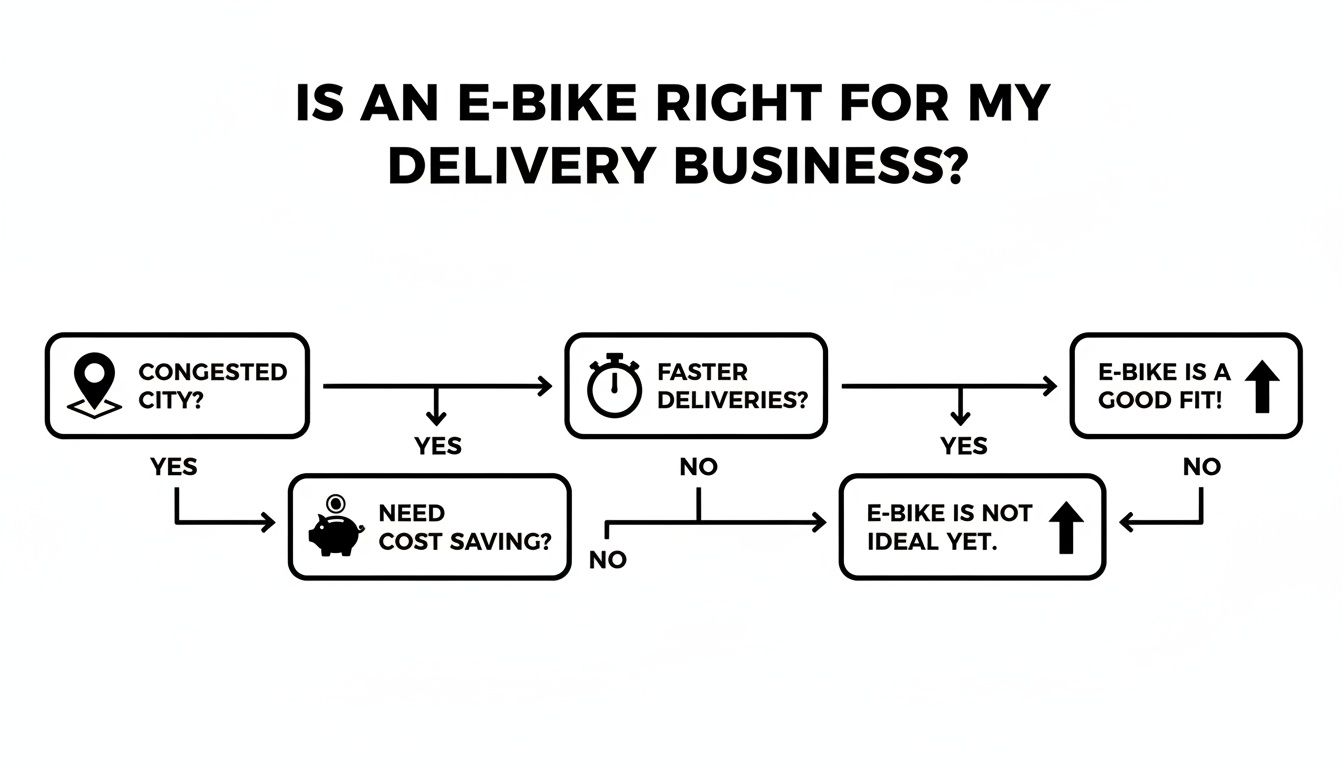
As you can see, if you're navigating a dense urban jungle and need to boost efficiency while slashing operational costs, an e-bike isn't just an option—it's a game-changer.
Dedicated Cargo E-Bikes: The Heavy Lifters
Cargo e-bikes are the undisputed champions of hauling serious weight. These are the work vans of the e-bike world, built from the ground up with one job in mind: carrying a ton of stuff. Their frames are incredibly beefy, often designed with a low center of gravity for better stability, and come with racks or boxes built right in.
You'll generally see two main flavors:
- Long-John or Bakfiets style: These bikes have a big cargo box or platform sitting between the handlebars and the front wheel. This makes it super easy to keep an eye on your payload.
- Rear-Loaders: These are designed with an extended, reinforced rear rack that can handle massive boxes, multiple large bags, or whatever else you need to strap down.
Because they’re purpose-built for this kind of work, it's not uncommon for them to handle payloads of 330 lbs (over 150kg!) or more. This makes them perfect for groceries, bulky packages, or even catering trays. The only trade-off is their size—they can be a bit unwieldy in tight alleys and are heavier to muscle around when you're not riding.
Versatile Long-Tail Bikes: The All-Rounders
If a full-blown cargo bike seems like overkill for your needs, then a long-tail bike is your perfect middle ground. Think of these as the trusty station wagons of the e-bike family. They get their name from an extended rear frame—the "long tail"—which gives you tons of space for big pannier bags, delivery boxes, or a sturdy rack platform.
A long-tail bike hits that sweet spot between cargo capacity and nimbleness. It handles more like a traditional bicycle than a beastly cargo hauler, which makes it a lot less intimidating for most riders.
Their agility is a huge plus. They can weave through traffic and zip around tight corners far more easily than their larger cousins, making them a fantastic choice for fast-paced food delivery or courier services with medium-sized parcels. While they won't carry as much as a dedicated cargo bike, they have more than enough muscle for the vast majority of urban delivery jobs. If you're planning on pushing the weight limits, it's a good idea to check out our guide on the best e-bike for heavy riders to see why frame design and strength are so critical.
Practical Conversion Kits: The Custom Rigs
Finally, we have the DIY approach: slapping a conversion kit on a standard bicycle to turn it into an electric workhorse. This route gives you the most flexibility and can be the friendliest on your wallet, especially if you've already got a solid bike with a tough frame.
A typical kit comes with a motor (either in the wheel hub or at the pedals), a battery, a controller, and a throttle or pedal-assist sensor. The beauty here is that you get to pick and choose the parts that fit your exact needs—maybe a high-torque motor for a hilly route or a monster battery for insane range. The catch? You'll need some mechanical know-how to get it all installed correctly, and the finished product might not feel as polished or be as bombproof as a factory-built delivery machine. Still, it's a great path for tinkerers who want a truly custom electric bike for delivery.
Getting to Grips with E-Bike Specs for Delivery
Let's be honest, tech specs can look like a different language. But when you’re picking out an electric bike for delivery, a few key numbers are the difference between a dependable workhorse and a bike that’s going to cost you money and headaches. I'm going to cut through the jargon and show you what actually matters for your bottom line.
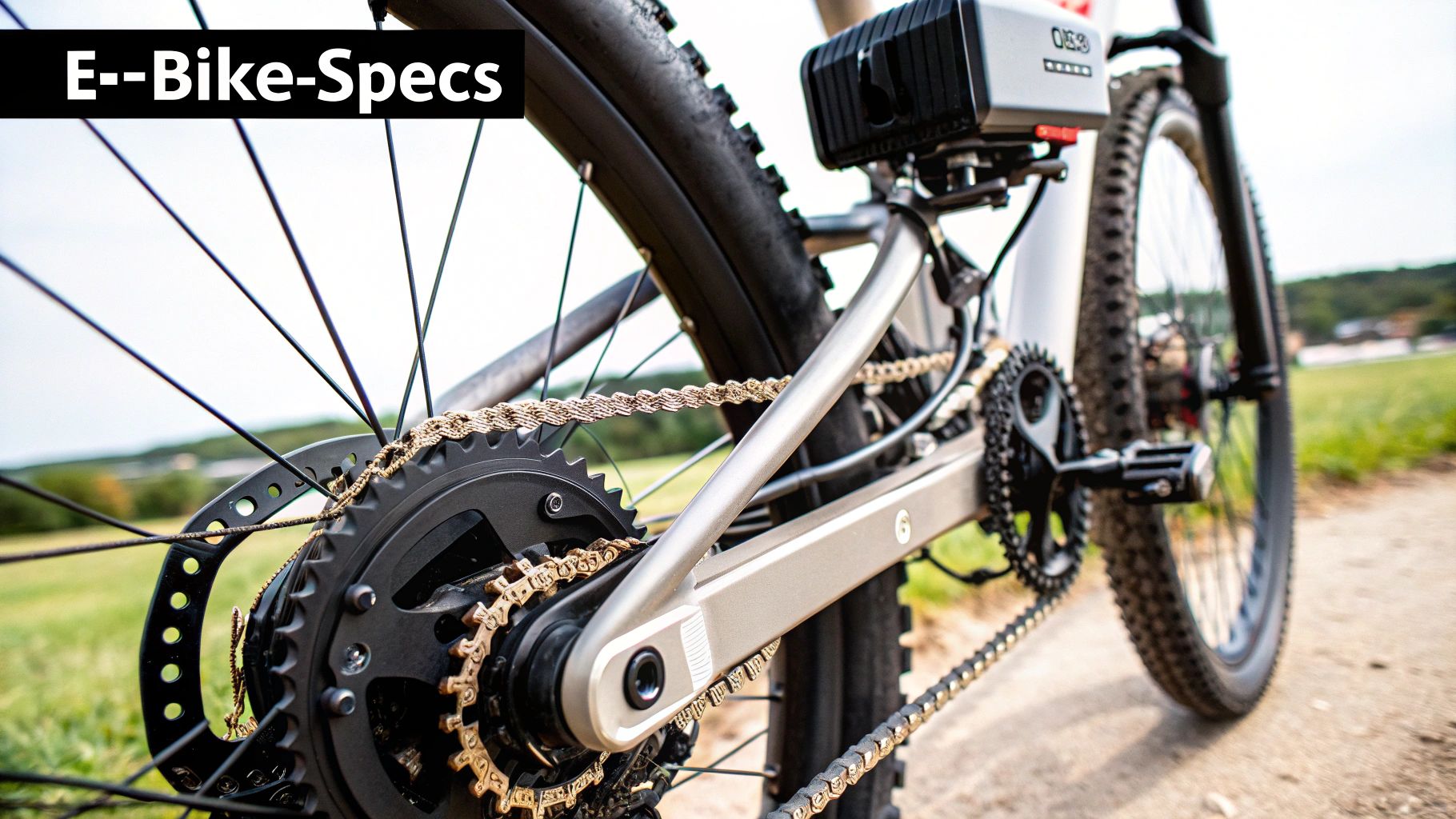
Think of these specs as the vital signs of your new business partner. Get them right, and you're looking at less downtime, safer rides, and more cash in your pocket at the end of every shift.
Battery Power and Real-World Range
The first question on everyone's mind is always range. And for good reason. That big number you see on the box? It’s a best-case scenario—think feather-light rider, zero wind, and perfectly flat roads. For delivery work, you need to think in terms of actual range.
A bike's range comes down to its battery capacity, which is measured in Watt-hours (Wh). Simply put, a higher Wh number means more juice in the tank. For a full day of hustling, you should be looking for a battery with at least 500Wh. If you're tackling long shifts or a city full of hills, 750Wh or more is where you want to be.
Just remember, every package you add, every hill you climb, and every traffic light you stop for sips a little more power. A good rule of thumb is to take the advertised range and knock 30-40% off to get a realistic estimate for a loaded delivery bike. This way, you won’t get caught pedaling a dead, heavy bike back to the shop.
The Heart of the Machine: Motor Power
The motor is what puts the "e" in e-bike. You'll generally run into two types, and choosing the right one can completely change how you handle your route.
-
Hub Motors: Tucked into the center of a wheel (front or rear), these are the straightforward, reliable, and usually more budget-friendly option. Their one weakness? They can start to struggle on long, steep climbs, especially when you're hauling a heavy load.
-
Mid-Drive Motors: These are mounted right where the pedals are, sending power directly through the chain and gears. This setup is way more efficient, feels more natural to ride, and is the undisputed king of the hill. It lets the motor use the bike’s gears just like you do, giving it massive leverage when the going gets tough.
For delivery work in a city with any kind of incline, a mid-drive motor is almost always the right call. Its ability to power up hills without breaking a sweat means you can take on any delivery route with total confidence.
Want to get deeper into the nuts and bolts of it all? You can learn more about the benefits of mid-drive electric bikes in our detailed guide. It really breaks down why this tech is such a game-changer for pros.
Frame Strength and Payload Capacity
Your delivery bike is a tool, and it has to be built tough. The frame is its skeleton, and its payload capacity—the total weight it can safely carry, rider and cargo included—is a number you can't ignore.
Your average consumer e-bike might top out around 220-265 lbs. That's not going to cut it. A proper electric bike for delivery needs a payload capacity of at least 330 lbs, and you'll see the real heavy-duty cargo models push past 400 lbs. This isn't just about what the bike can move; it's about doing it safely, day in and day out, without putting dangerous stress on the frame and wheels.
A tough, purpose-built frame is your best defense against a business-killing breakdown. A cracked frame isn't a repair; it's a replacement. Don't cheap out here.
Essential Stopping Power: Brakes
When you’re weaving through city traffic with a heavy load, being able to stop on a dime is everything. Seriously, this is non-negotiable.
You'll mainly see two kinds of brakes:
- Mechanical Disc Brakes: These work with a steel cable, like on a traditional bike. They get the job done and are simple to maintain.
- Hydraulic Disc Brakes: These use brake fluid in a sealed line, like in a car. The difference is night and day. They give you way more stopping power with less effort, finer control, and perform reliably in any weather, especially rain.
For a delivery e-bike, hydraulic disc brakes are a must-have. That extra power and control you get, especially coming down a hill with a full order, is a safety feature that pays for itself a thousand times over. It’s what lets you stop safely for you, your cargo, and everyone else on the street.
Key Spec Checklist for a Delivery E-Bike
Here's a quick reference guide to keep in your back pocket when you're comparing bikes. Focusing on these specs will help you pick a real workhorse that won't let you down.
| Specification | What to Look For | Why It Matters for Delivery |
|---|---|---|
| Payload Capacity | 330 lbs+ (ideally 400 lbs+ for heavy loads) | Ensures the frame and components can safely handle you, your gear, and a full load of cargo without risk of failure. |
| Battery Capacity | Minimum 500Wh, 750Wh+ is ideal | More Watt-hours (Wh) means longer range. This is your "fuel tank" for getting through a full shift without running out of power. |
| Motor Type | Mid-Drive Motor | Offers superior torque and efficiency for climbing hills with cargo, providing a more natural riding feel and less strain on the motor. |
| Brakes | Hydraulic Disc Brakes | Provides powerful, reliable stopping in all weather conditions. It's a critical safety feature for heavy loads and unpredictable city traffic. |
| Frame Material | Aluminum or Steel Alloy | Look for reinforced, purpose-built frames designed for cargo. Durability is key to avoiding downtime and costly repairs. |
| Tires | Puncture-resistant, wider tires (2.0"+) | Reduces the chance of flats (a major time-waster) and provides better stability and cushioning when carrying heavy loads. |
Choosing the right bike comes down to matching these core components to the demands of your job. A bike with a strong frame, a powerful mid-drive motor, a big battery, and reliable hydraulic brakes is a recipe for a successful and profitable delivery operation.
Mastering Your Cargo and Customizations
A great electric delivery bike is more than just a frame and a motor—it's a whole system. The real magic happens when you move past the stock setup and start tailoring your ride for the actual demands of your work. Getting your cargo and accessories dialled in is what transforms a good e-bike into a delivery powerhouse.
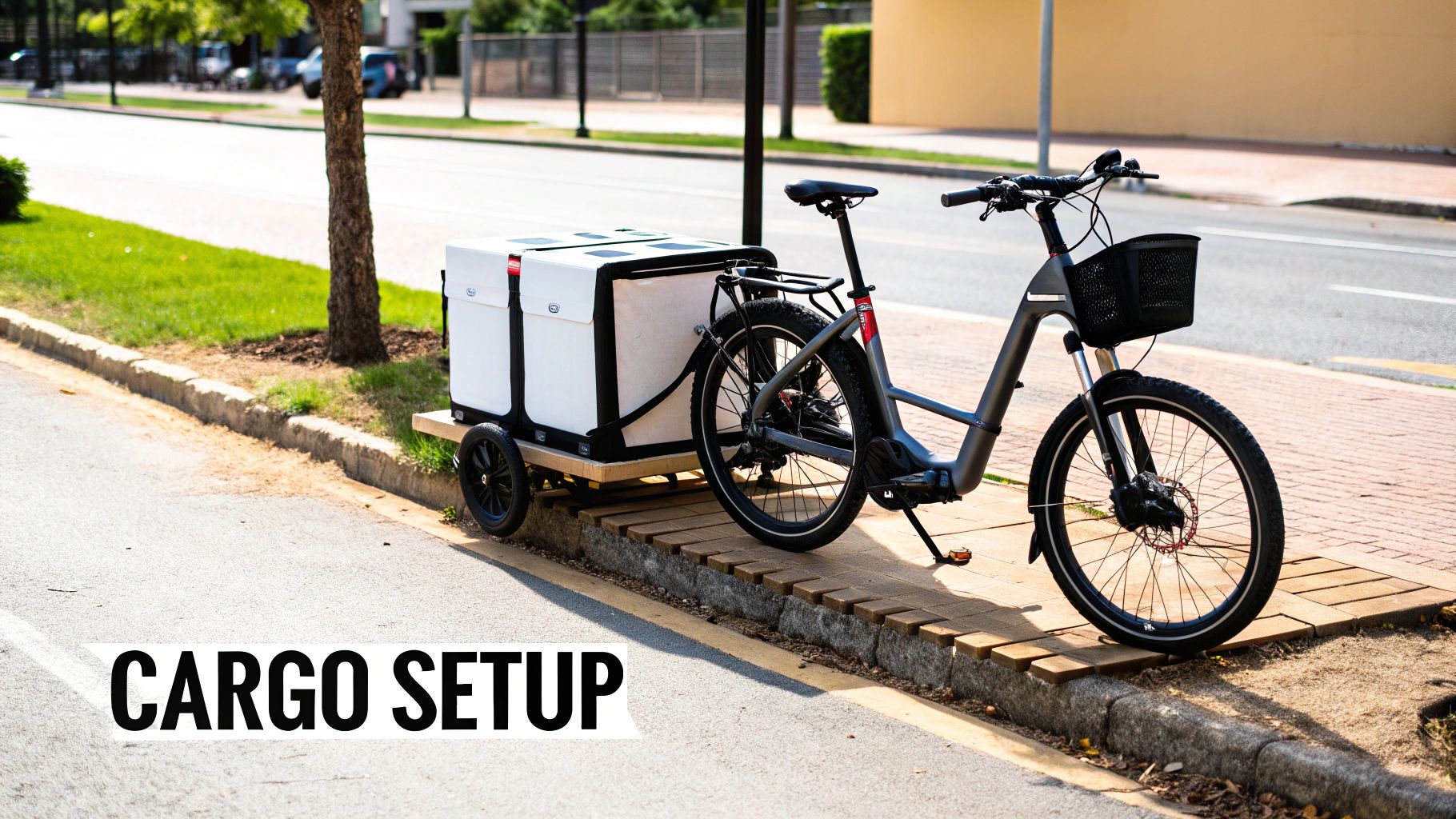
Think of it as building a modular platform that can handle anything you throw at it, whether it's a quick sandwich drop-off or a massive grocery haul. Let’s get into the essential gear that will make your job faster, safer, and ultimately, more profitable.
Building Your Foundation with Racks and Bags
First things first: you need a solid base for your goods. A standard backpack just isn't going to cut it for professional delivery. You need dedicated on-bike storage that distributes weight correctly and keeps everything secure.
Racks are the skeleton of this system.
- Front Racks: A sturdy front rack or basket is your go-to for smaller, lighter stuff you need to grab quickly—think small parcels or a single food order. Keeping weight up front keeps it in your line of sight, but be careful not to overload it, as it can make steering a bit wonky.
- Rear Racks: This is your workhorse. A tough, high-capacity rear rack is absolutely non-negotiable. It’s where you'll mount bigger boxes, multiple bags, or panniers.
With your racks sorted, it's time to add the containers. For food delivery, insulated bags are a must to keep hot food hot and cold stuff chilled; happy customers mean better tips. If you're delivering parcels, a set of waterproof panniers or even a secure, lockable box on the rear rack will protect packages from both bad weather and potential theft.
The Art of Weight Distribution
Loading up your electric bike for delivery is more than just strapping things down—it's a science. Getting the weight distribution right is crucial for safe handling and stability, especially when you're weaving through busy city streets. An unbalanced bike is a wobbly, dangerous bike.
Think of your bike like a set of scales. You're constantly trying to keep it balanced, both front-to-back and side-to-side. A lopsided load makes steering feel heavy and unpredictable, which is the last thing you want in traffic.
Stick to these simple rules for a much safer ride:
- Keep Weight Low: Always put the heaviest items as low to the ground as possible. This drops the bike's center of gravity, making it way more stable and easier to handle in turns.
- Center the Load: Try to keep the bulk of the weight centered over the wheels, not hanging way off the back end. This is exactly what a long-tail bike's extended frame is designed to do.
- Balance Side to Side: If you're running two panniers, do your best to split the weight evenly between them. An uneven side load will make the bike constantly pull to one side, forcing you to fight the handlebars all day.
Scaling Your Setup from Simple to Pro
The good news is you don't have to buy every accessory on day one. Most riders start with a basic but effective setup and add to it as their delivery jobs get bigger and more varied. This modular approach lets you adapt your bike without a massive upfront investment.
Here’s a pretty typical upgrade path:
- The Starter Kit: Begin with a high-quality rear rack and a big insulated delivery bag. This simple combo can handle the vast majority of food orders and small package deliveries.
- The Expansion Phase: Next, add a front basket for some extra room and a set of large, waterproof panniers. This setup lets you take on multiple orders at once or easily manage larger grocery runs.
- The Professional Rig: For maximum hauling power, you could upgrade to a front-loading cargo bike or add a trailer to your long-tail. This turns your e-bike into a legitimate van replacement, ready to carry hundreds of pounds. In fact, one study found some e-cargo bikes can haul up to a mind-boggling 1,000 pounds, which shows just how capable these machines are for city logistics.
By mastering your cargo setup, you create a flexible and efficient tool that will boost your earning potential and keep you safe while you're out there making it happen.
Staying on the Right Side of the Law in the US and Australia
When you’re using an e-bike for deliveries, you’re more than just a rider—you’re a professional on wheels. Getting a handle on the rules of the road isn't just about dodging fines; it’s about making sure your business runs smoothly and legally.
The laws across the US and Australia can be a patchwork, differing by state and even by city. Think of it this way: getting the rules right is like having a clear, open road. Getting them wrong? That's a surefire recipe for a major pile-up for your business.
What E-Bike "Class" Are You Riding?
In the United States, e-bikes are often sorted into a three-class system to define how they operate. This system is key, as it determines where you can legally ride.
- Class 1: The motor provides pedal-assist only (no throttle) and cuts out at 20 mph.
- Class 2: Has a throttle and a motor that cuts out at 20 mph.
- Class 3: Is pedal-assist only (no throttle) with a motor that cuts out at 28 mph. Often requires the rider to be 16 or older.
In Australia, the rules are simpler. A legal e-bike (or "pedalec") must have a motor with a maximum continuous power output of 250 watts that cuts off at 25 km/h (15.5 mph). Throttles are allowed, but only to assist up to 6 km/h (3.7 mph). Any bike exceeding these limits is considered a motor vehicle and requires registration and a license.
How Rules Change from State to State
The three-class system has been adopted by many US states, but not all. This is where it gets tricky. In New York City, for instance, throttle-based e-bikes were once banned but are now legal for delivery workers. In California, Class 3 e-bikes have certain access restrictions on bike paths.
Similarly, in Australia, while the 250W rule is a national standard, states have their own road rules regarding helmet laws and where e-bikes can be ridden.
The bottom line for any delivery pro is simple: always, always check the local rules for the specific state and city you're working in. A bike that’s perfectly fine on the streets of Los Angeles might get you a ticket in Melbourne.
Don't Skip on Commercial Insurance
This is the one thing people always forget, and it’s a huge mistake. Your personal insurance or home policy will not cover you when you're working. Period.
You're a commercial operator, and you need commercial-grade insurance. Here’s what you should be looking for:
- Public Liability Insurance: This is non-negotiable. It protects you if you accidentally injure someone or damage their property while on a delivery.
- Product Insurance: If you’re hauling valuable goods, you'll want this to cover any damage or theft.
- Personal Accident Insurance: This helps cover your bills if you get injured and can't work for a while.
Riding without the right insurance is like playing Russian roulette with your finances. One bad accident could sink your entire operation. For a deeper look at the legal ins and outs, check out our guide on whether electric bikes are street legal. It’s packed with extra info every pro rider should know.
Calculating Your Return on Investment
Let’s be honest, switching to an electric bike for delivery is a big move. But it’s more than just a practical upgrade—it's a serious financial play. So, let's break it down and run the numbers to see how quickly that bike will pay for itself and start fattening your wallet.
The math is actually pretty simple. You take the initial cost of the bike and all your essential gear, then you start subtracting all the cash you're no longer bleeding on your old delivery method. If you're coming from a car or a moped, those savings pile up faster than you’d think.
Tallying Up the Costs and Savings
First, let's get the upfront cost out of the way. This is your initial investment: the price of the e-bike itself, plus the must-have accessories like a beast of a lock, a good helmet, and your cargo setup (think racks, bags, or boxes).
Now for the fun part—watching the savings roll in. Think about all the money pits that disappear when you ditch a gas-guzzler:
- No More Fuel: This is the big one. Gas prices are a rollercoaster, but the cost to charge your e-bike is pocket change. It's a huge win.
- Zero Parking Fees: Stop feeding the meter and paying for those pricey city parking permits.
- Lower Insurance: Getting commercial insurance for an e-bike is usually way, way cheaper than insuring a car or van for the same job.
- Cheaper Maintenance: Kiss oil changes, engine headaches, and complicated repairs goodbye. E-bike maintenance is straightforward and a whole lot lighter on the bank account.
When you switch to an electric bike, you're trading a laundry list of unpredictable, recurring expenses for one fixed upfront cost and a tiny electricity bill. Your monthly budget instantly becomes more stable and predictable.
Factoring in Increased Earning Potential
The ROI isn't just about what you save; it's also about what you stand to earn. An electric bike for delivery is a pure productivity tool. You'll spend way less time gridlocked in traffic and more time actually completing deliveries. More drops per hour equals more money in your pocket, period.
The global impact is massive. E-bikes can slash delivery costs by as much as 60% compared to vans. As modern batteries push ranges past 60 miles, these bikes have become legitimate workhorses for a full day's grind. This shift is happening everywhere, especially in North America and the Asia Pacific region, which already accounts for over 76.6% of the entire e-bike market. If you want a bigger picture, you can learn more about the e-bike market's massive impact.
To really squeeze every drop of efficiency out of your day, you have to think smart. Understanding concepts like route optimization can be a game-changer. Shaving just a few minutes off each delivery adds up to extra runs and a bigger paycheck at the end of the week.
Scaling from One Bike to a Full Fleet
For business owners, the ROI gets even more exciting when you start thinking bigger. Expanding from a single e-bike to a small fleet unlocks huge operational advantages.
Imagine standardizing your whole fleet with the same e-bike model. Suddenly, maintenance is a walk in the park. Your mechanics only have to master one system, and you can stock a single set of common spare parts like brake pads, chains, and tires. This move drastically cuts down on downtime—and a bike sitting in the shop is a bike that isn't making you money.
A standardized fleet simplifies everything from rider training to daily check-ins, making your entire delivery operation leaner, meaner, and more profitable.
Got a Few More Questions? We've Got Answers.
Alright, let's tackle some of the real-world questions that pop up when you're thinking about using an e-bike to make a living. These are the details that matter day in and day out, and we hear them all the time.
So, Can I Actually Ride This Thing in the Rain?
Yes, absolutely. Any e-bike built for serious delivery work is designed to shrug off bad weather. The key is to look for bikes with solid water resistance, especially for the motor and battery pack.
But honestly, the bike is only half the battle. You’ll want full-coverage fenders to stop that gritty road spray from soaking you and your deliveries. And non-negotiable on my list? Hydraulic disc brakes. They provide consistent, reliable stopping power when everything's wet, which is a huge safety factor.
Don't forget about yourself and the cargo, either. Good waterproof bags and a solid rain jacket are just as important as the bike itself.
How Much Upkeep Are We Talking About?
A delivery e-bike isn't your casual weekend cruiser; it's a workhorse. And like any tool you rely on, it needs a bit of regular care to stay in the game.
I tell every rider to get into the habit of a quick pre-flight check every morning: squeeze the tires, test the brakes, glance at the chain. Then, once a week, give it a proper clean and lube.
Think of it like this: spending 10-15 minutes on maintenance each week can save you from a multi-hour, business-stopping breakdown. It’s the cheapest insurance you can buy for your uptime.
What's the Best Way to Stop My E-Bike from Getting Stolen?
Bike theft is no joke, especially when your ride is your livelihood. Your best defense is to make your bike an inconvenient target. That means using two different, high-quality locks.
Start with a beefy D-lock or a heavy-duty chain to secure the frame to something solid and unmovable. Then, use a second cable lock to loop through your wheels. Thieves are often looking for a quick grab, and this setup makes them think twice.
And a pro tip: never, ever leave your battery on the bike if you're stepping away for more than a minute. Pop it off and take it with you. For ultimate security, tucking a small GPS tracker somewhere on the frame is a smart move that can save you from a world of hurt.
Ready to find the perfect electric workhorse for your delivery hustle? The expert team at Punk Ride has curated a selection of the toughest, most reliable e-bikes built to handle the daily grind. Explore our collection and gear up for a more efficient and profitable ride today.
Share:
Choosing an Electric Bike Rain Cover Your Ultimate Guide
Finding the Most Affordable Electric Bikes That Last