


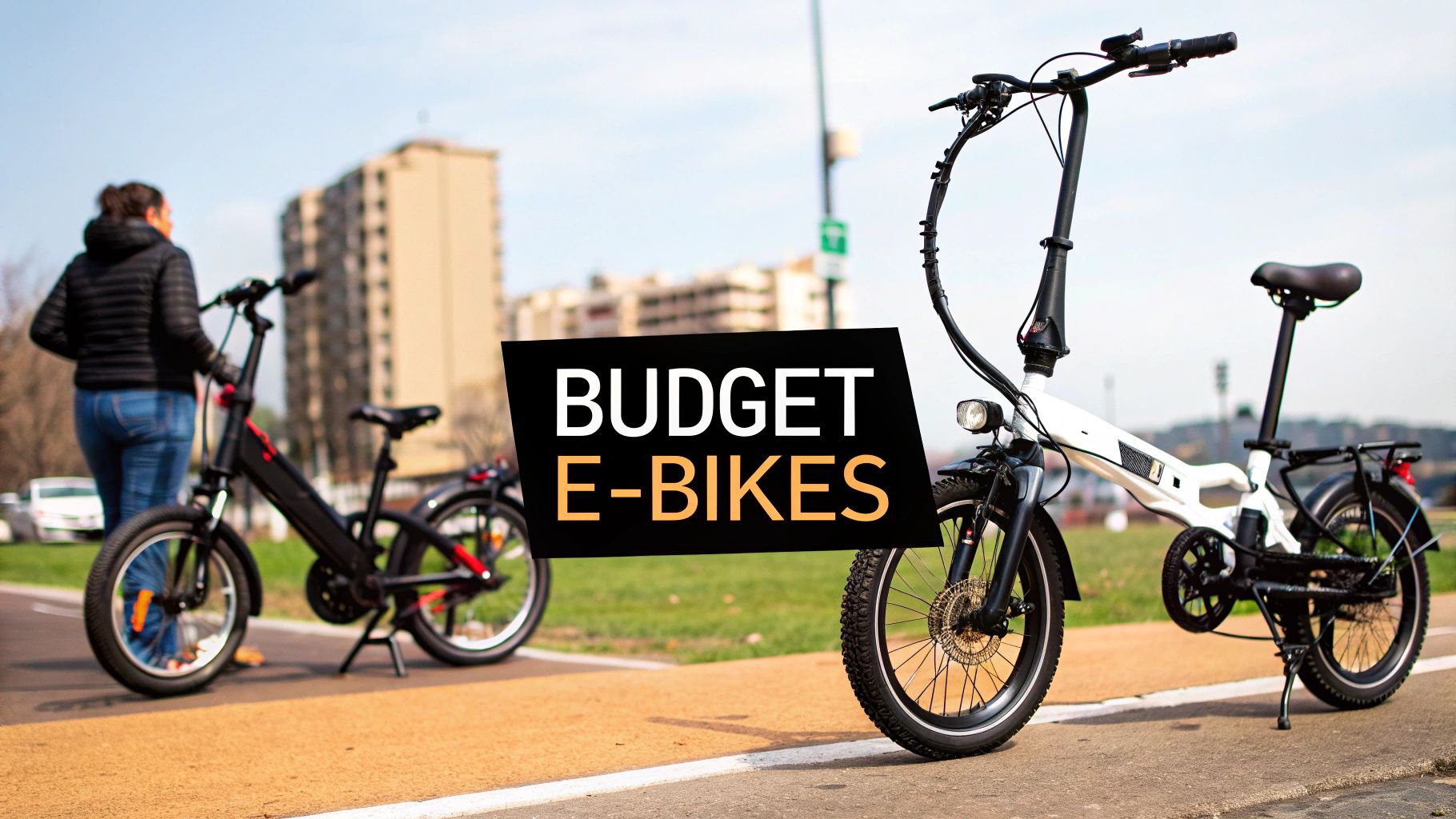
So, you're on the hunt for a great electric bike that won't break the bank? It's a smart move. Finding the best budget electric bikes is all about hitting that sweet spot between cost and quality. From what we've seen, that magic number typically falls somewhere between $900 and $1,800 USD. In this range, you get a reliable, safe, and genuinely fun ride without the serious safety risks that come with super cheap models.
Your Guide To Affordable Electric Bikes
Let's cut through the noise and find you the perfect affordable e-bike. We get it—you want all the benefits of electric power without draining your savings account. This guide is your roadmap to the world of budget-friendly e-bikes, tailored specifically for the US and Australia, where commuting needs and local laws really matter.
We'll break down what "budget" actually means today, walk you through the essential features you absolutely shouldn't compromise on, and pit some top contenders against each other to help you make a choice you'll be happy with for years to come.
Our mission here is simple: to help you find a dependable e-bike that fits your life and your wallet. We want to help turn that daily commute or weekend spin into the best part of your day.
What To Expect From This Guide
Think of this as your one-stop shop for everything you need to know. We're covering it all, from the nitty-gritty tech specs to the real-world experience of owning a budget e-bike.
Here's a quick peek at what's inside:
- Defining 'Budget': We’ll lay out clear price brackets for the US and Australia, so you know exactly what your money should get you at each level.
- Core Features Explained: We'll dive into the non-negotiables—think motors, battery range, and brakes—so you know what to look for and what to avoid.
- Model Comparisons: A no-fluff comparison of popular models, highlighting which ones shine for city commuting versus which are better for relaxed leisure rides.
- Smart Buying Tips: Real advice on where to shop, what to inspect before you buy, and how to tell a genuine bargain from a dud.
Why Choosing the Right Budget E-Bike Matters
Let's be honest, the market for affordable e-bikes can feel like the Wild West. You'll see tons of ultra-cheap options, especially on big online marketplaces for under $700, but they often cut corners where it counts most: battery safety, brake quality, and frame integrity. They might seem like a steal at first, but they can quickly become unreliable or, worse, unsafe for daily riding.
A common mistake is getting fixated on the upfront price. The real value of an e-bike is in its long-term reliability, proper safety certifications, and whether you can actually get spare parts for it. Spending a little more now often saves a ton of money and frustration down the line.
This is exactly why getting your head around the key trade-offs is crucial. Once you know which features are essential, you can sidestep the common traps and pick a bike that will be a joy to ride for years.
For an even deeper look into the nitty-gritty of picking the right bike, our guide on how to choose an ebike has you covered.
What To Expect From a Budget E-Bike
So, what actually makes a great budget e-bike? It's not just about finding the cheapest price tag. Knowing what you’re getting for your money is the key to snagging a bike that delivers real value without cutting corners where it counts.
When we talk about "budget" e-bikes in the US and Australia, we’re generally looking at the under $1,500 USD or $2,200 AUD mark. This is the sweet spot. In this range, you can find a reliable, safe, and surprisingly well-equipped bike that’s perfect for your daily commute or just some weekend fun.
If you see prices dipping much lower, especially under $700, that's when you should start asking questions about battery safety and the overall build quality.
Common Components and Performance
At this price point, you’re not getting a high-end racing machine, and that’s okay. What you should expect is a solid workhorse that gets the job done without any fuss. The trick is knowing what you're looking at and how it affects your ride.
Almost every budget e-bike you'll find uses a rear hub motor. These are built right into the center of the rear wheel, unlike the pricey mid-drive motors you see on premium models. They give you a simple, effective "push" from behind, which is great for getting up to speed and handling most hills you'll encounter in the city.
These motors are almost always paired with a cadence sensor. This system is pretty straightforward: it turns the motor on when it senses you're pedalling. It can feel a little bit like a switch—power on, power off—which might feel a bit jerky at first. But, it's a proven, cost-effective system that works just fine for most urban rides.
The real trade-off isn't about raw power; it's about how the power feels. A hub motor will get you from A to B, no problem. It just lacks that smooth, intuitive feel of a torque-sensing mid-drive system that perfectly matches your own effort.
Battery and Real-World Range
The battery is easily the most expensive part of an e-bike, and it's where some brands try to save a few dollars. For a decent budget model, look for a battery with a capacity of at least 400-500 Watt-hours (Wh).
This will give you a real-world range of about 25 to 45 miles (40-72 km) on a single charge. Of course, this depends on things like hills, how much you weigh, and which assistance level you’re using.
Be really wary of bikes that are vague about their battery specs or use unbranded cells. You absolutely want a quality battery from a known manufacturer using cells from brands like Samsung, LG, or Panasonic. It’s a huge deal for both safety and the lifespan of your bike.
Here's a quick rundown of other key parts you'll likely see:
- Brakes: Most bikes in this category come with mechanical disc brakes. They offer solid stopping power in any weather, but you’ll need to adjust them more often than their fancy hydraulic cousins.
- Drivetrain: You'll typically find entry-level components from trusted names like Shimano. These parts are reliable for everyday use but might need a tune-up more regularly than high-end gear.
- Display: The screen will probably be a simple LCD showing the essentials: your speed, battery level, and current assist mode. No fancy GPS, but it gives you all the crucial info at a glance.
The Value Proposition
At the end of the day, a good budget e-bike is all about smart trade-offs. You're swapping the silky-smooth power delivery of a mid-drive motor for the affordability of a hub drive. You're trading the set-and-forget convenience of hydraulic brakes for the solid, reliable performance of mechanical ones.
Knowing what these differences mean in the real world is what separates a smart buy from a frustrating one. A well-chosen budget e-bike gives you an incredible amount of freedom and fun for a fraction of the cost, making it a fantastic way to get into the world of electric cycling.
The E-Bike Essentials You Can't Afford to Skimp On
When you’re hunting for a great deal on an electric bike, it’s easy to get lost in the specs. But knowing where your money truly counts is the secret to getting a bike you'll actually love to ride. Some features are simply non-negotiable—they’re the foundation of a safe, reliable, and fun e-bike.
Let’s be honest, the demand for affordable, green transportation has gone through the roof. The e-bike market is now a massive USD 61.89 billion industry, and a huge slice of that pie comes from budget-friendly models. People everywhere want a cheaper, easier way to get around. So, let’s talk about what really matters when you’re on a budget.
The Heart of the Machine: Motor and Battery
Think of the motor and battery as the engine and fuel tank of your e-bike. They're the core of the whole experience. On most affordable bikes, you’ll find a rear hub motor. It gives you a nice, solid push from behind that feels a bit like an invisible hand helping you along.
Motor power can be a confusing topic in the US and Australia. Unlike the strict 250W limit in Europe, you'll see motors advertised with much higher wattages, like 500W or even 750W. While more power can be fun, it’s crucial to check your local state and territory laws, as they dictate legal power outputs and whether throttles are allowed.
The battery, though? That’s where you need to pay close attention. It's the most expensive part of the bike, and it’s where sneaky manufacturers often cut corners.
- Capacity is Your Friend: Don't settle for anything less than 400-500 Watt-hours (Wh). A smaller battery will have you constantly worrying about making it home, which sucks all the fun out of a ride.
- Brand-Name Cells are a Must: A battery is only as good as the cells inside. Make sure they come from a reputable brand like Samsung, LG, or Panasonic. Cheap, unbranded cells degrade quickly and can even be a fire hazard. It's not worth the risk.
- Look for Safety Marks: In the US, the gold standard is UL 2849 certification. This is a tough, comprehensive safety standard for the entire e-bike electrical system. In Australia, look for compliance with the RCM (Regulatory Compliance Mark). Don’t buy a bike without these assurances.
It's a classic rookie mistake: obsessing over motor power while completely ignoring the battery. A beefy motor is useless if its power source is unreliable or unsafe. The two have to work together perfectly.
Getting a good battery is only half the battle; you also have to take care of it. For a masterclass in making your power pack last, check out our guide on how long e-bike batteries last.
Stopping Power: Brakes You Can Trust
This one’s a no-brainer. You have to be able to stop, period. E-bikes are heavier and faster than regular bikes, so they need much stronger brakes, especially when you’re navigating unpredictable city traffic.
On budget e-bikes, you'll mainly see two types of disc brakes:
- Mechanical Disc Brakes: These are the workhorses of the budget e-bike world. They provide solid, reliable stopping power in any weather. The only downside is that you'll need to adjust the cables occasionally to keep them feeling sharp.
- Hydraulic Disc Brakes: Once reserved for high-end bikes, these are now popping up on top-tier budget models. They offer incredible stopping power with just a light squeeze of the lever and are self-adjusting, so they’re virtually maintenance-free.
If you can stretch your budget to a model with hydraulic brakes, do it. The extra safety and lower maintenance are a huge win. If not, a quality set of mechanical disc brakes from a trusted name like Shimano or Tektro will still serve you well.
The Right Frame for Your Lifestyle
The frame is what makes a bike feel like your bike. It dictates comfort, fit, and how you’ll use it. You don’t need a feather-light carbon fibre frame, but you do need one that fits your life.
- Folding Frames: The commuter's best friend. Perfect if you need to hop on a train or stash your bike under your desk at work.
- Step-Through Frames: Awesome for accessibility. They make getting on and off a breeze, which is great for city errands, casual rides, or if you have limited mobility.
- Hybrid Frames: The classic "diamond" shape is a fantastic all-rounder. It strikes a great balance between a comfortable riding position and pedalling efficiency, making it perfect for both daily commutes and weekend adventures.
Look for a frame made from 6061 aluminium. It’s the industry standard for a reason—it’s strong, relatively lightweight, and doesn't break the bank. It gives you a durable bike that’s still easy to handle.
Alright, let’s dive into what really matters: how these budget e-bikes actually stack up against each other in the real world. Forget about declaring one single "winner"—that's not how it works. The goal here is to find the right bike for the right person. We're going to put some of the best budget electric bikes we see head-to-head, focusing on the practical stuff that'll make a difference in your day-to-day, especially if you're riding in the US or Australia.
A great budget e-bike is all about balance. It's a game of trade-offs between the motor, the brakes, and the frame to create a specific kind of ride. This diagram breaks down how those core components work together.
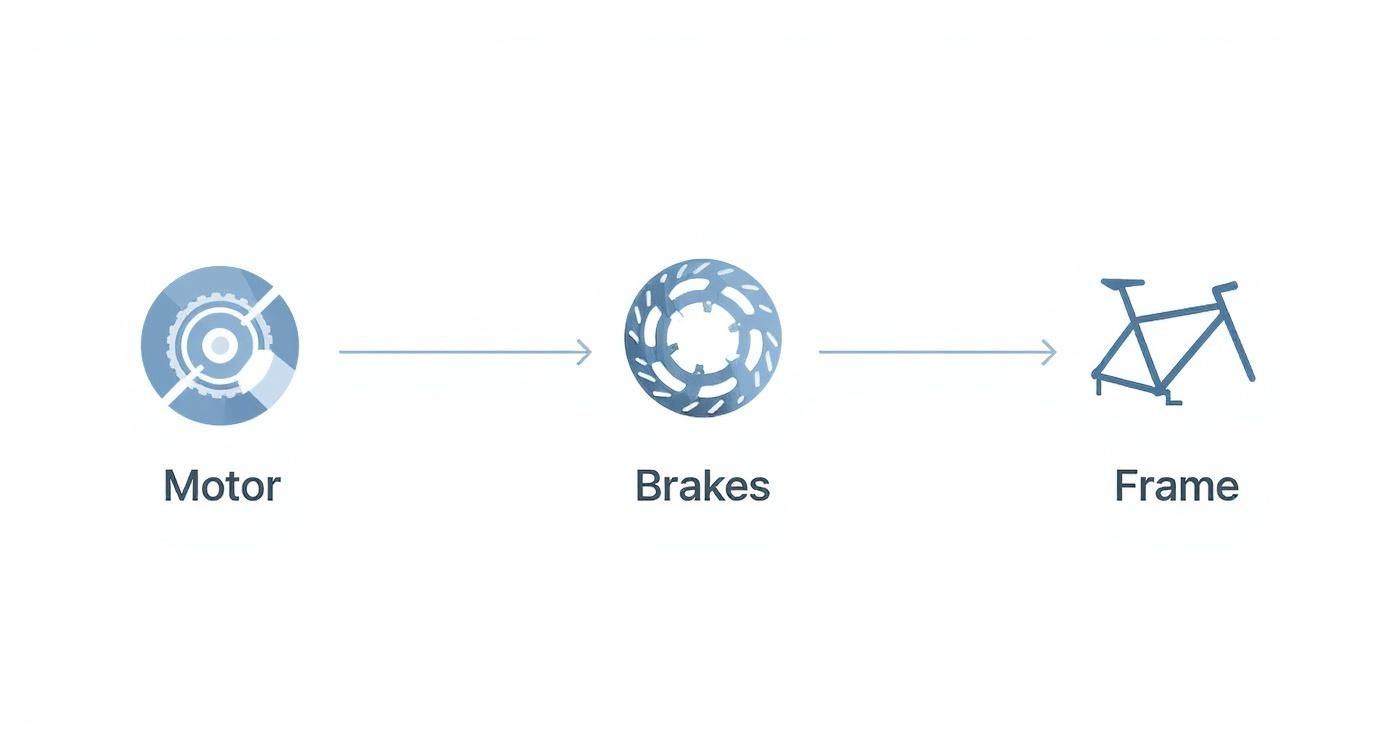
Think of it as a chain reaction. A powerful motor needs reliable brakes, and both need a frame that can handle the job. When a manufacturer gets this balance right, you get a cohesive and enjoyable ride. Let's see how this plays out with a few common scenarios.
The Urban Commuter Face-Off
For most people, an e-bike is their secret weapon for conquering the daily commute. So, let’s look at two classic commuter archetypes from the Punk Ride lineup: the super-portable folding e-bike versus the do-it-all hybrid e-bike.
Scenario 1: The Multi-Modal Commuter
Picture this: your commute involves jumping on a train and then zipping through the city to your office. You need something light, compact, and ready to go in seconds. This is where a folding bike like the HITWAY BK5 really comes into its own.
- Portability: Its biggest selling point is that it folds down in a flash. You can carry it onto a train, pop it in a car boot, or tuck it under your desk. No more stressing about bike thieves or finding a place to lock it up.
- Agility: Those smaller wheels make it incredibly nimble. It’s perfect for navigating crowded city streets and weaving through traffic jams.
Of course, that portability comes with compromises. The smaller frame and wheels can feel a bit twitchy at higher speeds, and you'll definitely feel the bumps from potholes more than you would on a bike with larger wheels.
Scenario 2: The Direct-Route Rider
Now, let's imagine your commute is a straight five-to-ten-mile shot from your front door to the office. You don't need to fold it, but you want a ride that’s comfortable and stable. For this job, a hybrid model like the Eleglide T1 Step-Thru is the clear winner.
- Comfort: With its upright riding position, front suspension, and larger wheels, it just soaks up rough patches in the road. It makes for a much smoother and more pleasant journey.
- Stability: The longer wheelbase gives it a solid, planted feel. You’ll feel much more confident on fast downhills or on a blustery day.
The obvious downside is its bulk. It's heavier and more awkward to handle, so you'll need a dedicated spot to store it at home and at work.
Look, the choice isn't about which bike is "better." It's about which bike solves your problem. The HITWAY BK5 is all about convenience for a mixed-mode commute, while the Eleglide T1 is built for pure ride quality on a dedicated bike journey.
Leisure Rider Showdown
Not everyone is buying an e-bike for the 9-to-5 grind. For all the weekend explorers and casual cruisers out there, the priorities shift. Now we're talking about range, comfort, and just how easy the bike is to live with.
This is a category that has absolutely exploded. We've seen massive growth in North America and Australia, where better cycling infrastructure and a desire for outdoor recreation have convinced a lot of people to go electric. The US electric bike market is projected to surpass $1.6 billion by 2028, and get this—budget models make up a significant chunk of all sales. In places like California, Colorado, and major Australian cities, sales of e-bikes under $1,500 have shot up, helped by increasing urban density and a focus on healthier lifestyles. You can find more insights about the European e-bike market share here.
The All-Day Adventurer
If you're someone who loves long, lazy rides along bike paths or quiet country roads, then battery range is everything. You'll need a bike with a beefy battery, something around 500Wh or more, to avoid the dreaded "range anxiety." This is exactly what models like the TOUROLL J1 are built for.
Its bigger battery means you can just relax and enjoy the ride without constantly staring at the battery meter. These bikes also tend to have more robust frames and components designed to handle longer distances in comfort.
The Casual Cruiser
What if your perfect ride is a relaxed trip to a local café or a gentle spin through the park? In that case, a step-through cruiser is your best friend. Here, the name of the game is accessibility and comfort. The CYSUM CM600, with its low frame that's a breeze to hop on and off, is a perfect example.
The whole design is focused on a relaxed, upright posture that’s easy on your back and gives you a great view. The power is usually delivered smoothly and gently, making for a predictable and just plain fun ride.
By matching the bike's strengths to what you actually want to do—whether that's tackling a hectic city commute or enjoying a peaceful weekend ride—you’ll find one of the best budget electric bikes that feels like it was made just for you. The trick is to be honest about your real needs and focus on the features that will make your rides better.
Budget E-Bike Model Comparison
To make things even clearer, let's put some of the top contenders side-by-side. This table breaks down our recommended models based on what they do best, helping you match the bike to your specific needs as a US or Australian rider.
| Model (Punk Ride Inventory) | Price Range ($USD) | Motor Type & Power | Battery Range (Claimed vs. Real-World) | Brake Type | Best For (Use Case) |
|---|---|---|---|---|---|
| HITWAY BK5 | $500 - $650 | Rear Hub, 250-350W | Claimed: 45 miles / Real: 15-25 miles | Mechanical Disc | The multi-modal commuter needing ultimate portability. |
| Eleglide T1 Step-Thru | $900 - $1,100 | Rear Hub, 250-500W | Claimed: 62 miles / Real: 35-50 miles | Mechanical Disc | The dedicated commuter who values comfort and stability. |
| TOUROLL J1 | $850 - $1,000 | Rear Hub, 250-500W | Claimed: 62 miles / Real: 40-55 miles | Mechanical Disc | The long-distance leisure rider and weekend adventurer. |
| CYSUM CM600 | $700 - $850 | Rear Hub, 250-500W | Claimed: 50 miles / Real: 25-40 miles | Mechanical Disc | The casual cruiser looking for easy access and a relaxed ride. |
As you can see, even within a tight budget, the options are surprisingly diverse. A bike like the HITWAY BK5 is a fantastic problem-solver for a very specific commute, while the TOUROLL J1 offers the freedom to explore for hours. It all comes down to choosing the right tool for the job.
How To Make a Smart E-Bike Purchase
Alright, you've done your homework and have a shortlist of bikes that look promising. Now for the exciting part: actually buying one. This isn't just about hitting a "buy now" button; it's about making sure the final step is a smooth one and that the bike you get is the right one for you.
A few smart checks at this stage can save you a world of headaches down the road. Let’s walk through what to look for when you're ready to pull the trigger.
The Power of the Test Ride
You can read all the reviews in the world, but nothing beats swinging a leg over the bike and taking it for a spin. If you get the chance to test ride a model on your list, absolutely do it. This is where you find out what the spec sheet can't tell you.
While you're riding, zero in on these things:
- Fit and Comfort: How does it actually feel? Think about your reach to the handlebars and the saddle height. You want to feel comfortable and in control, not stretched out or cramped up.
- Motor Engagement: Pay attention to how the pedal assist kicks in. Budget bikes often use cadence sensors, which can sometimes feel a bit jerky. Does the power delivery feel smooth and predictable to you?
- Brake Performance: Give the brakes a solid squeeze. An e-bike is heavier than a standard bike, so you need brakes that feel responsive and can bring you to a stop confidently without a massive effort.
A test ride is your reality check. It confirms if a bike that looks great on paper actually feels great on the pavement.
Buying Online Versus In-Store
Choosing between an online retailer and your local bike shop usually boils down to price versus service. Online stores like Punk Ride can offer some killer deals because they don’t have the same overheads. The trade-off? You lose the hands-on experience and immediate help you get from a brick-and-mortar store.
If you’re buying online, you have to be your own quality control. Here’s what to look for:
- Check the Warranty: Don't even consider a bike without at least a solid one-year warranty on the frame and the main electrical bits. Make sure you know what's covered and what the claims process looks like.
- Read the Return Policy: What’s the plan if the bike shows up damaged, or it’s just not what you hoped for? A clear, fair return policy is your safety net.
- Scour for Reviews: Look beyond reviews of the bike itself and see what people say about the company's customer service. Fast, helpful support is a godsend when you need it.
It's a classic mistake to focus only on the price tag. The real value is a combination of the price, warranty, return policy, and customer support. Paying a little more for a bike from a reputable seller with great service is almost always the smarter long-term move.
Understanding US & Australian E-Bike Laws
For riders in the US and Australia, the main thing to watch out for is local laws. Power limits, speed caps, and throttle regulations can be wildly different from one state or territory to the next.
In the USA, many states use a 3-class system (Class 1, 2, and 3) to define e-bikes, which dictates maximum assisted speed and whether a throttle is allowed. In Australia, the national standard for a 'pedalec' is a 250W motor with assistance cutting out at 25km/h, but some states have different rules. Always double-check what’s legal in your area before you buy. The North American market has exploded, with sales growing at a CAGR of 12.4% since 2020. Budget e-bikes, which typically cost around $950, now make up almost 35% of all e-bike sales in the US. You can learn more about the expanding e-bike market here.
Your First Maintenance Checks
When that big box finally arrives, resist the urge to just jump on and go. A few quick checks will make sure your first ride is a safe one.
- Check Tire Pressure: Get a pump and inflate the tires to the recommended PSI, which you'll find printed right on the tire's sidewall.
- Inspect All Bolts: Go around the bike and make sure every bolt is snug. Pay special attention to the handlebars, seat post, and wheels.
- Test the Brakes: Give the brake levers a good squeeze. They should feel firm, not spongy, and stop the wheels effectively.
- Bed-In Your Brakes: This is a pro tip. On your first couple of rides, find a safe spot to do several hard, controlled stops from a decent speed. This "bedding in" process transfers a bit of the brake pad material to the rotor and massively boosts your stopping power.
Making this pre-ride check a habit will keep your e-bike happy and reliable for years. Once you're all set, you can start thinking about kitting it out. Check out our guide on the best electric bike accessories to find the perfect gear.
Got Questions About Budget E-Bikes? We've Got Answers.
Jumping into the world of electric bikes is exciting, but it's natural to have a few questions, especially when you're trying to find a great deal. It’s smart to be curious. A little bit of know-how can make all the difference between buying a bike you love and one that just gathers dust.
Let's tackle some of the most common things people wonder about when shopping for an affordable e-bike.
How Long Will My E-Bike Battery Actually Last?
This is a big one. The battery is the powerhouse of your bike, and you want it to last. Realistically, you can expect the battery on a decent budget e-bike to keep you rolling for three to five years, which usually works out to somewhere between 500 and 1,000 full charge cycles. A "charge cycle" is just a fancy way of saying you've drained it from 100% down to 0% and charged it back up.
But here's the secret: how you treat your battery has a huge impact on its lifespan. You can easily squeeze more life out of it with a few simple habits.
- Mind the Temperature: Your battery hates extremes. Don't leave it in a freezing garage all winter or let it bake in the sun on a hot day. Heat and cold are its worst enemies.
- Don't Run It Empty: Try not to let the charge dip below 20% too often. Lithium-ion batteries are much happier when they're not pushed to their limits.
- Store It Smart: If you're putting the bike away for a few weeks, store the battery with a bit of juice in it—somewhere between 40% and 60% is the sweet spot. Storing it completely full or totally dead for a long time is a surefire way to wear it out faster.
Nail these basics, and you'll get the most out of your investment for years to come.
Are Cheaper Electric Bikes Safe and Reliable?
This is probably the most critical question, and the answer is a confident yes—as long as you know what to look for. A well-made budget e-bike is perfectly safe for your daily commute or weekend adventures. The trick is spotting the difference between a good value bike and a dangerously cheap one.
Your absolute top priority should be safety certifications. For riders in the US, the gold standard is UL 2849 certification. This is a tough, independent test that covers the entire electrical system. In Australia, you should look for the RCM mark, which shows it meets local electrical safety standards.
A huge mistake people make is thinking all budget e-bikes are created equal. They're not. A bike with a certified battery using cells from a reputable brand like LG or Samsung is in a completely different universe than some no-name model with zero safety marks. That certification is your best protection against scary stuff like electrical faults and fires.
Beyond the electronics, reliability really just boils down to basic bike care. Keep a close eye on your brakes and tires. Check the tire pressure once a week and give your brake pads a quick look for wear. A simple five-minute check before you head out is the best way to catch a small problem before it turns into a big one.
Can I Upgrade a Budget E-Bike Later On?
You sure can! That's actually one of the coolest things about starting with a solid budget e-bike—it’s a great platform to build on. While the core guts of the bike are pretty much set in stone, there are tons of parts you can swap out to make your ride more comfortable and capable.
Think of it as personalizing your bike so it fits you, not the other way around.
Easy and Awesome Upgrades:
- Saddle: This is upgrade #1 for a reason. Finding a saddle that actually fits your body can completely change how you feel about riding.
- Pedals: Swapping the stock plastic pedals for a set of grippy metal ones gives you a much more secure footing, especially when it's wet out.
- Tires: Tired of getting flats? A set of puncture-resistant tires from a brand like Schwalbe is worth its weight in gold.
- Grips: If your hands go numb on longer rides, a pair of ergonomic grips can be a total game-changer for comfort.
The "Probably Not Worth It" Upgrades:
- Motor and Battery: These are the heart and soul of the bike's electric system. The frame was built specifically for them, so trying to swap them out is usually impossible or just not practical.
- Controller: This is the bike's electronic brain, and it's tied directly to the motor and display. It’s not something you can just upgrade.
The best bang for your buck comes from upgrading the "contact points"—the parts of the bike your body touches. These small tweaks let your bike evolve with you, making it an even better fit down the road.
At Punk Ride, we’re all about helping you find an e-bike that’s not just affordable but also safe, dependable, and a blast to ride. Check out our hand-picked collection of the best budget electric bikes to get your adventure started. Find your perfect ride at Punk Ride.
Share:
e bike commute: Your guide to faster, greener travel
Your Guide to Sustainable Transportation Solutions