


A folding e-bike is a game-changer for anyone who has to get around a city. Think of it as the perfect blend: you get the get-up-and-go of an electric motor, the simple joy of a regular bike, and a frame that folds down small enough to tuck away almost anywhere. It's your secret weapon for beating city traffic, making that train connection, or just keeping your ride safe and sound under your desk at work.
This isn't just about a new way to get from A to B; it's about turning a daily grind into a part of the day you actually look forward to.
Swap Your Stressful Commute for a Smarter Ride
Imagine this: you're cruising past a long line of unmoving cars, a smile on your face. You get to the office, fold your bike in about 30 seconds, and walk in feeling refreshed and on time. That’s the reality a folding e-bike brings to the table. It’s less of a gadget and more of a complete overhaul for your daily routine.
Meet Alex, a Modern Commuter
Let’s talk about Alex. She's a professional living in London, and her old commute was a daily nightmare of crowded Tube trains and delayed buses. The whole thing was a stressful mix of walking, waiting, and getting squished on public transport. She’d often get to work already feeling worn out.
Switching to a folding electric bike changed everything for her. Now, Alex zips from her front door to the main station, folds her bike, and carries it right onto the train—no problem. After her stop, she just unfolds it and enjoys a breezy ride for the last mile to her office. She gets there earlier, feeling energized instead of exhausted.
Why Commuters Are Making the Switch
Alex’s story is becoming more and more common across the UK and Europe. People are fundamentally rethinking how they navigate their cities, and the numbers back it up. The global market for folding e-bikes shot up from $1.4 billion in 2023 and is expected to hit $3.2 billion by 2032.
With over 55% of the world's population now living in urban areas, it’s no wonder people are looking for better solutions. Commuters are swapping their cars and transit passes for these compact powerhouses that can fold down to the size of a suitcase. You can explore more market growth insights from DataIntelo.
So, what's driving the switch? It boils down to a few key things:
- Time Savings: You can finally dodge the gridlock and stop worrying about train delays. Your schedule is your schedule again.
- Cost Efficiency: Say goodbye to outrageous fuel prices, parking fees, and monthly transit passes. The savings add up fast.
- Unbeatable Flexibility: These bikes solve the "last mile" problem. Seamlessly connect your ride with a train, bus, or even the boot of a car.
- Health and Wellness: You get a bit of low-impact exercise built into your day, but with the motor's help, you won't show up to work a sweaty mess.
- Eco-Friendly Travel: It feels good to know you're cutting down on your carbon footprint and helping make your city's air a little cleaner.
It's this blend of pure practicality and newfound freedom that makes a folding e-bike the ultimate sidekick for any city commuter.
How to Read E-Bike Specs Like a Pro
Jumping into the technical specs of a folding electric bike for commuters can feel like trying to decipher a secret code. You're hit with a wall of terms like watts, amp-hours, and Newton-meters. It’s easy to get overwhelmed. But trust me, getting a handle on these key details is the secret to finding a bike that feels like it was built just for you.
Think of the spec sheet as the bike’s resume. The motor is its raw strength for tackling hills, the battery is its endurance for the long haul, and the folding mechanism is its cleverness for fitting into your life. Once you know what you’re looking at, you can see past the marketing and really understand how a bike will handle your daily grind.
Your Engine: The Motor
The motor is the heart and soul of your e-bike. It’s what gives you that magical boost when you need it most. You’ll usually see motor power listed in watts (W), which is a decent starting point but doesn’t tell the whole story. For those of us in the UK and EU, most street-legal e-bikes come with a 250W motor, which is more than enough punch for zipping around town and handling everyday slopes.
The real game-changer, though, is torque, which is measured in Newton-meters (Nm). Think of torque as the bike's "get-up-and-go" power. It’s what helps you accelerate from a dead stop and what really powers you up those nasty inclines.
- Low Torque (30-40 Nm): Perfect for cruising on flat city streets and gentle hills. These motors are usually lighter and sip battery power more efficiently.
- High Torque (50+ Nm): This is your hill-climbing hero. If your commute feels more like a mountain stage, higher torque will make the difference between spinning up a hill with ease and grinding your way to the top.
It’s not just about raw power, but how that power is delivered. Most modern e-bikes use a torque sensor that cleverly measures how hard you’re pedaling and matches the motor's output in a really smooth, natural way. It feels less like you're riding a machine and more like you've suddenly got bionic legs. For a deeper look at different motors, our guide on how to choose an e-bike has all the details.
Your Fuel Tank: The Battery
If the motor is the muscle, the battery is the stamina. Its capacity is what dictates how far you can ride on a single charge—a massive deal for any commuter. My advice? Don't get fixated on the advertised range in miles or kilometers. Instead, look for the battery’s capacity in Watt-hours (Wh).
Watt-hours (Wh) is the gold standard for comparing battery life. It's a simple calculation: a battery's volts (V) multiplied by its amp-hours (Ah). Nine times out of ten, a bigger Wh number means more juice in the tank.
Your average commuter folding e-bike will have a battery somewhere between 300Wh and 500Wh. For a short, flat ride to the office, 300Wh will likely do the trick. But if you've got a longer trek, face a brutal headwind, or love riding on the highest assist setting, aiming for 400Wh or more gives you a much-needed buffer and peace of mind.
The Portability Puzzle: Weight and Folding
When it comes to a folding electric bike, it's all about portability. Two specs trump almost everything else: the bike's total weight and its folding mechanism. A bike that weighs 18kg (around 40 lbs) might seem manageable, but you'll feel every single one of those kilos when you’re hauling it up a few flights of stairs. Lighter models, some of which get down to a feathery 12.5 kg, make that train-to-office-to-home lifestyle so much easier.
The fold is just as important. A good folding bike should be:
- Quick: You need to be able to fold or unfold it in less than 30 seconds. You don't want to be that person holding up the train.
- Intuitive: The process should be dead simple, without a bunch of confusing latches or a multi-step sequence you need a manual for.
- Secure: Once it's folded, it needs to stay folded. Look for strong magnets or solid mechanical clasps that keep it from popping open while you're carrying it.
- Compact: Always check the folded dimensions. Will it actually fit under your desk, in the boot of your car, or in that tiny luggage space on the train?
The market for these handy bikes is exploding. It's projected to grow by USD 264.9 million between 2024-2029, expanding at a massive 10.3% CAGR. This boom is driven by cool innovations like powerful, lightweight lithium batteries that can push a bike over 100 km, and brands engineering bikes to conquer steep 20% urban inclines. With congestion charges in cities like London and an ever-growing network of cycle lanes in places like Amsterdam and Copenhagen, it’s no wonder these bikes are taking off. You can read more about these market trends and their impact here. By getting a feel for these specs, you're set to find the perfect ride for your commute.
Finding the Right Bike for Your Daily Journey
Your commute is unique. It has its own quirks, challenges, and rhythms. So, it only makes sense that the bike you choose should be a perfect fit for your specific journey, not just a generic "best" model.
The real trick is to stop thinking about the bike in a vacuum and start picturing how it will fit into your daily life. Is it going to be a seamless part of your routine, or a clunky hassle? Let’s walk through a few common commuter scenarios to see which one sounds most like you.
Are You a Multi-Modal Traveler?
Does your commute look like a patchwork of different transport methods? Maybe you bike to the train, hop on for a few stops, then bike the rest of the way to the office. If that’s you, then you’re a multi-modal commuter, and portability is king.
You can't be fumbling with a clunky, confusing folding mechanism when your train is pulling into the station. For you, the top features are a lightning-fast fold and a super-compact size. You'll want a bike that you can collapse in under 20 seconds flat, one that tucks away neatly without taking up a ton of space.
Are You an Apartment Dweller?
If your commute ends with a final boss battle against three flights of stairs, you know exactly what I'm talking about. For apartment dwellers, every single kilogram matters. A bike that feels manageable on the street can suddenly feel like it’s made of lead when you’re hauling it upstairs after a long day.
Your search should start and end with weight. Prioritize bikes with lightweight frames, like those made from aluminum alloy or even carbon fiber if your budget allows. Try to find something under 18 kg (40 lbs). A heavy bike that never leaves your apartment because it’s a pain to carry is no help at all.
This simple decision tree can help you figure out what to focus on based on your route and needs.
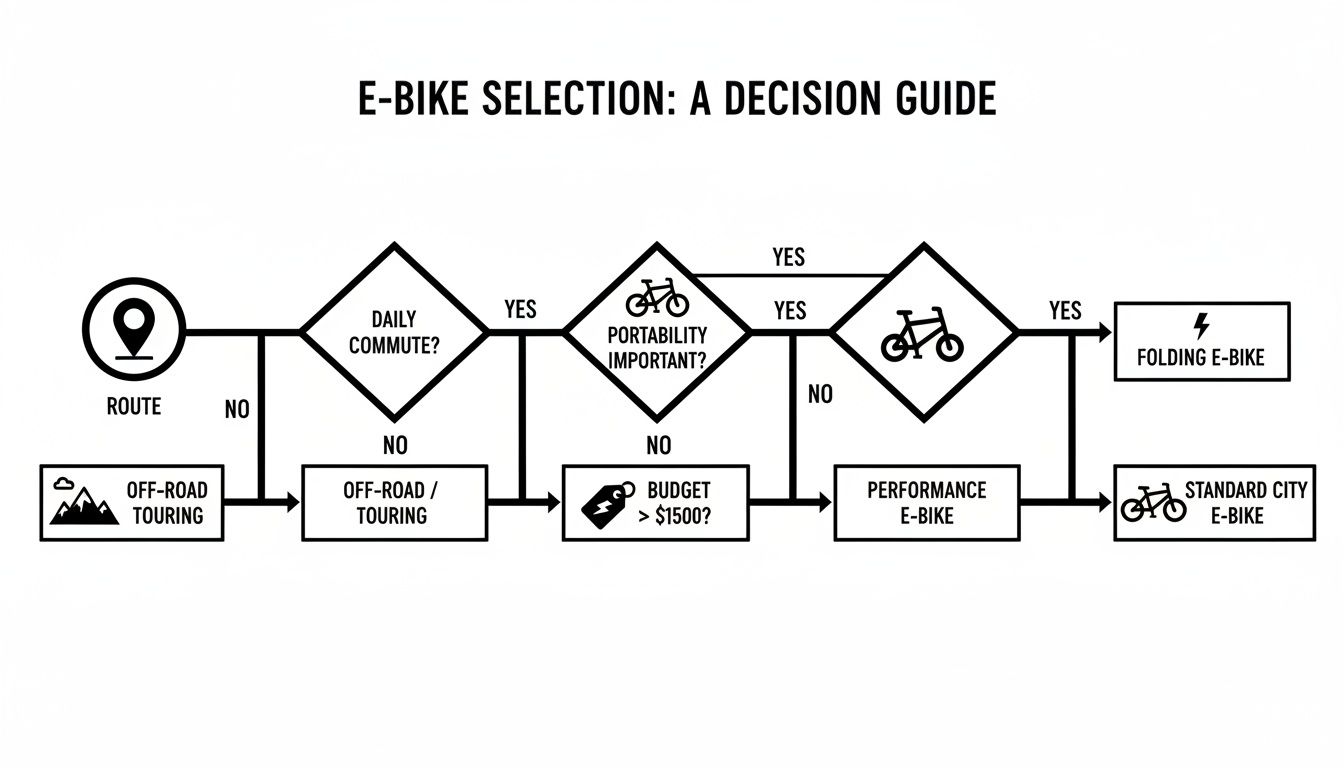
As the guide shows, once you identify your biggest headache—whether it’s distance, stairs, or storage—you can quickly narrow down the features that will make your ride perfect.
Are You a Long-Distance Rider?
Maybe your trip doesn't involve trains or stairs, but it's a marathon. If you’re putting in serious miles across town every day, your priorities shift from portability to pure stamina. For you, it's all about the battery.
Look for a bike with a beefy battery, measured in Watt-hours (Wh). You’ll want something in the 400Wh or higher range to make sure you can get there and back without constantly worrying about your battery dying. This is especially true if you have hills or headwinds to deal with. A higher load capacity is also a nice bonus for carrying your laptop, a change of clothes, and lunch without weighing the bike down.
The right bike should feel like a natural extension of your life. The secret is matching its features to your daily hurdles, whether that's a flight of stairs, a crowded train, or a long-haul route.
It's no surprise that this market is exploding—these bikes solve real problems for real people. The folding e-bike market, valued at USD 239.19 million in 2025, is expected to more than double to USD 489.23 million by 2032, growing at a 10.7% CAGR. For the 70% of us living in dense urban areas, these bikes can slash commute times by up to 40%. Models from brands like HITWAY or DUOTTS, which can be folded in seconds and offer a 252Wh battery for a 55 km range, are ideal for that "last mile" from the tube station to the office.
Of course, folding e-bikes are just one piece of the puzzle. It's worth exploring the different types of electric bikes, such as the Volcon Grunt and Runt, to get a feel for everything else that’s out there in the world of electric mobility.
Getting to Grips with UK & EU E-Bike Laws
There’s nothing quite like the freedom of zipping through the city on your folding e-bike. To keep that feeling going, you’ve got to know the rules of the road. Luckily, the regulations for e-bikes across the UK and the EU are pretty straightforward. They’re designed to treat e-bikes just like regular bicycles, which is great news—it means no license, no registration, and no insurance needed.
The magic term you need to know is Electrically Assisted Pedal Cycle, or EAPC. Think of it as the legal gold standard. If your folding e-bike fits into this category, you can ride it anywhere a normal bike can go.
The Two Golden Rules of EAPCs
So, what exactly makes a folding e-bike street-legal over here? It really just comes down to two simple, non-negotiable rules.
First, the motor can only give you a boost when you’re actually pedaling. That means no "twist-and-go" throttles that let you zoom off from a standstill without any effort. Second, the motor has to play by the power and speed limits.
Let's break that down:
- Maximum Motor Power: The motor's continuous power can't be more than 250 watts. Trust me, that’s plenty of juice to flatten out hills and get you ahead of traffic at the lights.
- Maximum Assisted Speed: The motor has to stop helping you once you hit 15.5 mph (25 km/h). You can absolutely go faster than that, but any speed beyond that point has to come from your own leg power or a friendly downhill slope.
Any bike that goes beyond these limits—say, one with a 500W motor or a throttle that works above 4 mph—gets bumped into the moped or motorcycle category. That changes everything. You’d suddenly need a driver's license, insurance, a proper helmet, and full vehicle registration. Sticking to the EAPC rules is what keeps your e-bike journey simple and fun. For a deeper dive, check out our guide on whether electric bikes are street legal.
Staying Safe and Seen on the Road
Being legal is one thing, but being safe is another entirely. While the law might not force adults to wear one, a helmet is probably the smartest accessory any rider can have. Today's helmets are light, breezy, and can make a world of difference in an accident.
Being seen is just as critical, especially if you’re commuting at dawn, dusk, or after dark. Getting the right lights and reflectors isn't just a good idea—it's the law.
In the UK, any bike ridden at night must have a white front light and a red rear light. It also needs a red rear reflector and four amber pedal reflectors (one on the front and back of each pedal). This isn't just a friendly suggestion; it's a legal requirement for your safety and everyone else's.
Don't stop at the legal minimums. Think about adding reflective strips to your jacket, backpack, or even the bike frame. The more you stand out, the more space drivers will give you.
Mastering Your Presence in Traffic
Riding a folding electric bike for commuters in the city means you need to be a bit defensive and communicate clearly. That little boost from the motor means you're often moving faster than a traditional cyclist, so being predictable is key.
Here are a few tips to help you ride with confidence:
- Claim Your Lane: Don't hug the curb. Riding about a meter out makes you far more visible to drivers and helps you dodge drains, potholes, and the dreaded opening car door. It’s called taking the "primary position," and it's your right as a cyclist.
- Signal Like You Mean It: Use clear, obvious hand signals well before you plan to turn or change lanes. Try to make eye contact with drivers to make sure they’ve seen you and know what you're about to do.
- Read the Road Ahead: Always be looking ahead, trying to anticipate what drivers, pedestrians, and other cyclists are going to do next. The smooth kick from your e-bike helps you keep up with city traffic, making it easier to hold your own in the lane.
By understanding the rules and riding smart, you can make sure every trip is not just a blast, but also perfectly safe and legal.
Simple Maintenance to Keep Your E-Bike Rolling
Think of your folding e-bike as a trusty companion. Like any good partnership, a little regular attention goes a long way. The good news? You don't need a pro mechanic's toolkit or years of experience to handle the basics.
A few simple checks are all it takes to keep your ride reliable, safe, and ready to go. You'll thank yourself later when you avoid a costly, unexpected trip to the bike shop.
This isn't about complicated repairs; it's about smart, preventative care. Spending just a few minutes here and there helps you spot small issues before they become big headaches, ensuring every ride feels as smooth as the first.
Your Quick Weekly Checkup
Get into this five-minute habit, and your bike will love you for it. Before you head out for the week, just give your bike a quick once-over. It’s the easiest way to make sure everything is dialled in for the commutes ahead.
- Tyre Pressure: Properly inflated tyres are a game-changer. They help you roll faster, protect you from flats, and squeeze every last drop of range from your battery. Check the sidewall for the recommended PSI and top them off with a pump that has a gauge.
- Brake Check: Give both brake levers a firm squeeze. They should feel solid, not squishy, and bring the wheel to a dead stop long before the lever hits your handlebar. This is a non-negotiable safety check. Do it every time.
- Quick Wipe-Down: A quick wipe with a rag, especially after a wet ride, does more than just keep your bike looking sharp. It stops grime from building up in nasty places and makes it easier to see if anything looks off.
It’s all about building a little muscle memory. Soon enough, these checks will become second nature, keeping your folding electric bike for commuters in fantastic shape.
Monthly Maintenance Must-Dos
Once a month, it's a good idea to spend a little extra time on the parts that do the most work.
A clean, lubed chain isn't just about a quiet, smooth ride—it literally extends the life of your whole drivetrain. A gritty, neglected chain is the fastest way to wear out expensive parts.
Here’s a super simple monthly routine:
- Clean the Chain: Grab a rag and some degreaser and wipe off all the gunk. A dirty chain grinds away at your gears and just kills performance.
- Lube the Chain: Apply a single drop of bike-specific chain lube to each link. Pedal backwards a few times to work it in, then take a clean rag and wipe off all the excess. Too much lube just attracts more dirt!
- Check Bolts and Fittings: Gently make sure the key bolts are snug—think handlebars, seat post, and those all-important folding mechanisms. No need to crank down on them, just a quick check to ensure nothing has rattled loose.
The Secret to a Long-Lasting Battery
Your battery is the heart of your e-bike, and how you treat it is the single biggest factor in its long-term health. Good charging habits are everything.
The biggest mistake people make is constantly draining the battery to zero or leaving it plugged in for days on end. The key is to avoid stress.
For daily commuting, try to keep the charge level between 20% and 80%. This is the battery’s happy place, and staying within that range puts way less strain on the cells. If you really want to dive deep, you can learn more about extending your electric bike battery life here: https://www.punkride.com/blogs/news-advice/electric-bike-battery-life. Follow these tips, and your e-bike will be your reliable ride for years to come.
Your Pre-Purchase Commuter Checklist
Alright, let's put it all together. You've done the research, and now it's time to make a final decision that will genuinely change your daily commute for the better. This isn't just about picking the bike with the fanciest specs on paper; it's about finding the right partner for your specific journey.
A great folding electric bike for commuters should feel like an extension of you, not a hassle. Before you pull the trigger, take a moment to run through these final questions. A few minutes of honest assessment now will save you a ton of headaches later and ensure you get a bike you truly love to ride.
The Commuter Litmus Test
Think of this as your personal sanity check. Grab a pen and paper (or your notes app) and really think through these points. Your answers will shine a light on what features you absolutely need versus what's just nice to have.
-
The Carry Test: Seriously, can I lift this thing? Imagine carrying it up a few flights of stairs after a long day at work or hoisting it onto a crowded train during rush hour. Be brutally honest with yourself. If you can, try lifting something of a similar weight to get a real feel for it.
-
The Space Test: Will it actually fit? Get out the measuring tape. Measure that nook under your desk, the spot in your apartment hallway, or the boot of your car. Don't eyeball it! Knowing the bike's folded dimensions is key to making sure it fits seamlessly into your life.
-
The Range Test: Can this battery handle my round trip, with power to spare? Tally up your daily mileage and then tack on a 20% safety margin. That extra juice covers you for strong headwinds, unexpected hills, or those days when you're just not feeling the burn and want to lean on the motor more.
One thing people often forget is where the bike will live at home. Since you're looking at a folding bike, chances are space is a premium. It's a great idea to look into some clever bike storage ideas for small spaces before you even buy.
Getting Started Pro Tips
Once you've brought your new ride home, a little prep work will make those first few commutes a breeze.
- Lock It Right: Don't skimp here. Get a high-quality D-lock or a beefy chain. The golden rule is to always lock the bike's frame to something solid that can't be moved.
- Essential Gear: A helmet is non-negotiable. So are lights—even for daytime riding, they make you much more visible. A portable pump, a small multi-tool, and a patch kit are absolute lifesavers that will get you out of a jam.
By asking yourself the tough questions now and getting your gear sorted, you can buy with total confidence. You're not just getting a new bike; you're getting a faster, cheaper, and way more enjoyable way to get around town.
Got Questions? We've Got Answers
Even after digging into the details, you probably have a few things you're still wondering about. That's totally normal. Here are some of the most common questions we hear from commuters thinking about making the switch to a folding e-bike.
Are Folding E-Bikes a Pain to Maintain?
Not in the slightest! If you can handle the basics of a regular bike, you're already 90% of the way there. It's the same routine: keep your tires pumped, give your brake pads a glance now and then, and make sure the chain is clean and lubed.
The "e" part just adds one new habit: smart battery care. Try not to let it die completely, keep it out of extreme temperatures (like a freezing garage or a hot car boot), and only use the charger that came with it. It's simple stuff you can easily manage at home.
What's a Realistic Battery Range for Commuting?
Take the range you see on the box with a grain of salt—it's usually tested in a lab under perfect, flat-ground, no-wind conditions. Out in the real world, your mileage will vary based on your weight, how many hills you climb, and how much you lean on that pedal-assist.
A much better indicator is the battery's Watt-hour (Wh) rating. Think of it like the size of your fuel tank; a bigger number means more juice. To be safe, I always tell people to knock 20-30% off the advertised max range for a realistic estimate. That way, you're never sweating about whether you'll make it home.
Can I Ride My Folding E-Bike in the Rain?
You bet. Modern folding e-bikes are built to handle a downpour. The important bits, like the motor and battery, are sealed up to keep water out, so a rainy ride to the office is no problem.
That said, "water-resistant" doesn't mean "submarine." It's still a bad idea to ride through massive puddles or blast your bike with a pressure washer. A good habit is to give your bike a quick wipe-down after a wet ride, especially the chain, to keep rust away.
Is a Heavier Folding E-Bike a Better E-Bike?
Not always. In fact, for commuters, the opposite is usually true. A heavier bike might pack a bigger battery or have a super-tough frame, but that weight is a real killer when it comes to portability. Every single kilo matters when you're lugging it up a flight of stairs or lifting it onto a train.
Your mission is to find that perfect balance. Something like the ADO Air Carbon is incredibly light at just 12.5kg, which is amazing for a mixed commute. At the other end of the spectrum, some beefier models can top 30kg. Your best bet is to find the lightest bike that still ticks all your boxes for range and sturdiness.
Ready to completely change how you get to work? Check out the hand-picked selection of folding electric bikes at Punk Ride and find the one that’ll make your commute the best part of your day. Find your perfect ride at https://www.punkride.com.
Share:
How Fast Do Electric Bikes Go And What Are The Rules
Your Essential Electric Bike Buying Guide