


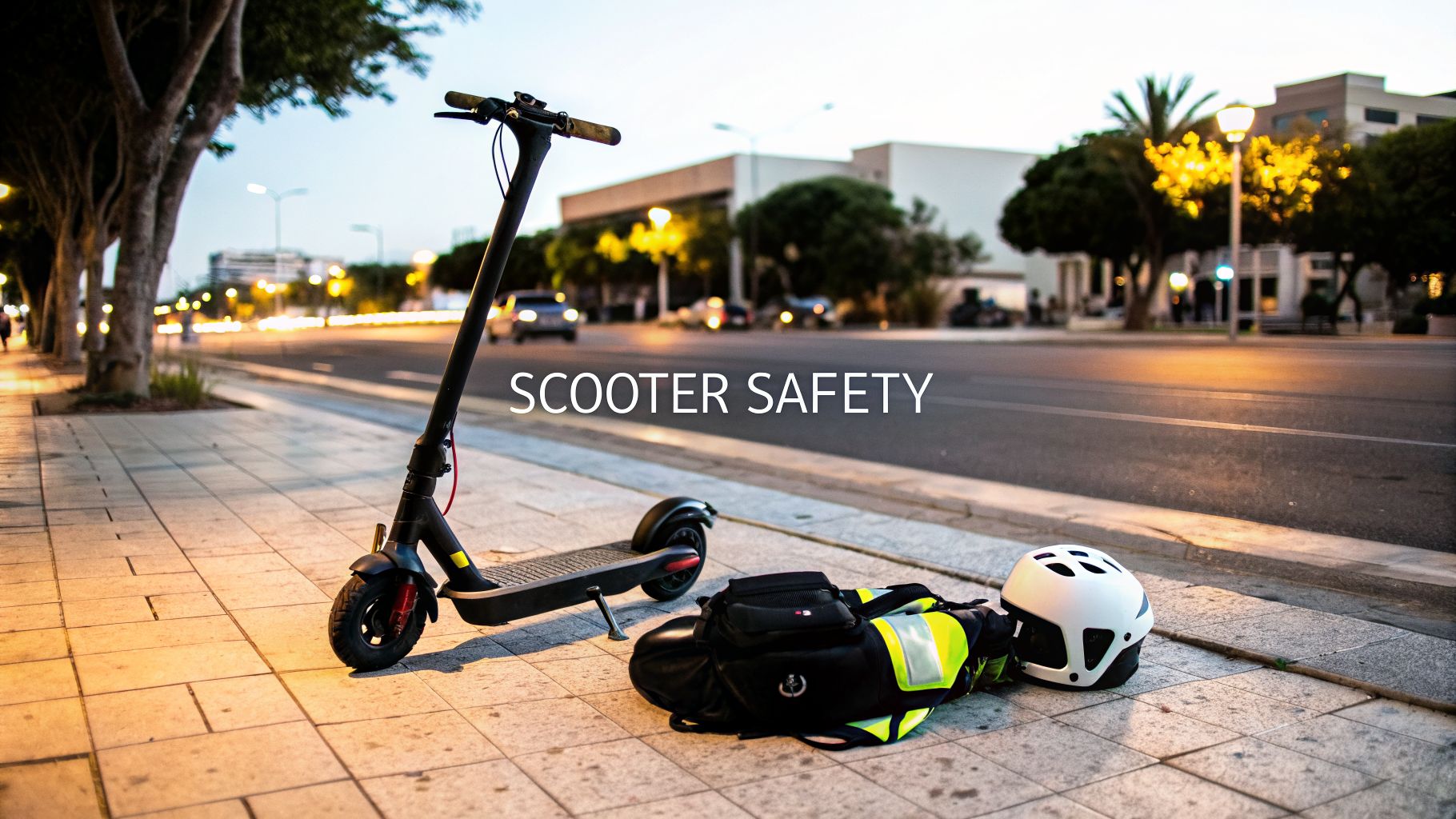
Sejamos realistas — quando compra uma nova trotinete elétrica, a última coisa em que pensa é numa palestra sobre segurança. Só quer sentir o vento e partir. Mas pense no seu equipamento menos como um conjunto de regras e mais como a sua armadura pessoal. É a única coisa que o separa do chão, garantindo que um simples desequilíbrio não acaba com o seu dia (ou semana).
A Sua Lista de Verificação Essencial de Segurança para E-Scooter

Antes sequer de pensar em acelerar, precisa de um ritual pré-passeio. Isto não é ser paranoico; é ser inteligente. Quer esteja a zigzaguear pelo trânsito de Londres, a passear pela ensolarada Gold Coast, ou simplesmente a circular pelo seu bairro, o equipamento certo é o seu melhor amigo.
Olhe, ninguém gosta de ser uma estatística, mas os números não mentem. À medida que as trotinetes se tornaram mais populares, também aumentaram os acidentes. Estamos a falar de mais de 360.000 visitas a urgências só nos EUA entre 2021 e 2023 por causas relacionadas com trotinetes elétricas. Na Austrália, cidades como Brisbane registaram aumentos significativos nas admissões hospitalares relacionadas com trotinetes. É um número preocupante e um lembrete poderoso para levar isto a sério.
Os Componentes Essenciais da Segurança do Condutor
A melhor forma de manter-se seguro é com uma abordagem em camadas. O seu capacete é a estrela principal, sem dúvida, mas precisa de um conjunto de apoio sólido. Para simplificar, dividimos os itens absolutamente essenciais para cada passeio.
Equipar-se corretamente é a forma mais eficaz de reduzir o risco de lesões graves. Transforma a sua mentalidade de simplesmente andar para andar com responsabilidade, dando-lhe a confiança para lidar com ambientes urbanos imprevisíveis.
Para começar, aqui está um resumo rápido e direto do equipamento indispensável que precisa na sua coleção. Pense nesta tabela como o seu guia para montar o kit de segurança perfeito.
Equipamento Essencial de Segurança para E-Scooter de Relance
| Equipamento | Propósito Principal | Característica Principal a Procurar |
|---|---|---|
| Capacete | Protege a sua cabeça contra impactos e previne lesões cerebrais graves. | Certificação oficial de segurança (ex.: CPSC, AS/NZS 2063) e um ajuste adequado. |
| Proteções | Protege joelhos, cotovelos e pulsos contra fracturas e arranhões na estrada. | Exterior rígido com espuma absorvente de impactos e tiras seguras. |
| Luzes & Reflectores | Aumenta a sua visibilidade para condutores, ciclistas e peões. | Luzes dianteiras e traseiras brilhantes com múltiplos modos; roupa ou fita refletora. |
| Luvas | Protege as mãos durante uma queda e melhora a aderência no guiador. | Palmas almofadadas e material durável, resistente à abrasão. |
Cada peça desempenha um papel fundamental. Um capacete protege o seu cérebro, as proteções salvaguardam as suas articulações, as luzes fazem com que seja visto, e as luvas mantêm as suas mãos intactas enquanto lhe dão uma melhor aderência. Juntos, criam um sistema completo que lhe permite pedalar com intensidade e manter-se seguro.
Vamos Falar de Capacetes: O Melhor Amigo do Seu Cérebro

Olhe, se vai comprar apenas um equipamento de segurança, este é. Um capacete é uma escolha óbvia. É a única coisa que fica entre a sua cabeça e o pavimento duro, um buraco repentino ou aquele carro que não o viu. Não queremos dramatizar — é a diferença entre um dia mau e uma lesão que muda a vida.
Quando cai, a física entra em ação, e não é bonita. A sua trotinete para, mas o seu corpo continua em movimento. O trabalho do capacete é absorver e distribuir a força dessa paragem súbita, protegendo o seu cérebro do impacto brutal.
Sem essa camada protetora, toda essa energia vai diretamente para o seu crânio. Não estamos a falar apenas de alguns arranhões; estamos a falar de concussões, fraturas e traumas cerebrais graves que podem arruinar a sua vida num instante.
Decifrando o Código dos Padrões de Segurança para Capacetes
Quando estiver a comprar um capacete, verá pequenos autocolantes com códigos como CPSC ou AS/NZS 2063. Estes não são apenas decoração — são a sua prova de que o capacete pode realmente proteger o seu crânio. Saber o que significam é fundamental para escolher um que funcione.
- CPSC (Consumer Product Safety Commission): Este é o padrão de excelência nos Estados Unidos. Se um capacete tem este selo, significa que passou por testes exigentes para impactos esperados numa queda de trotinete ou bicicleta.
- AS/NZS 2063: Este é o padrão obrigatório para capacetes de bicicleta na Austrália e Nova Zelândia. É um requisito legal para capacetes vendidos lá e garante que cumprem critérios rigorosos de segurança adequados para uso em trotinetes elétricas.
Ser certificado significa que o capacete foi submetido a testes rigorosos de queda, resistência das correias e mais. A sério, nunca compre um capacete que não tenha uma destas certificações. É um risco que simplesmente não pode correr.
Obtenha Proteção de Nível Superior com MIPS
Para além das certificações básicas, alguns capacetes oferecem uma proteção ainda mais avançada. A mais conhecida é o MIPS (Multi-directional Impact Protection System). Então, o que é exatamente?
Pense em como cai. Raramente é uma pancada direta e limpa na cabeça. Normalmente cai em ângulo, o que cria um movimento de torção perigoso. Essa força rotacional pode fazer o seu cérebro deslocar-se dentro do crânio, sendo uma das principais causas de concussões.
Um capacete com MIPS tem uma camada especial de baixa fricção no interior. Quando bate no chão em ângulo, essa camada permite que a sua cabeça deslize apenas um pouco (10-15mm) dentro do capacete. Esse pequeno movimento redireciona as forças rotacionais nocivas para longe do seu cérebro.
Esta tecnologia mudou completamente o jogo na segurança da cabeça. De facto, a sua eficácia é uma das principais razões pelas quais o mercado global de capacetes para trotinetes elétricas está projetado para atingir um incrível 1.024,9 milhões de dólares até 2025 — um aumento de 21% desde 2021. Os capacetes com MIPS lideram esta tendência, pois podem reduzir o cisalhamento cerebral em até 40%.
Com lesões na cabeça a representar mais de 40% com acidentes graves de trotinetes elétricas e o uso obrigatório de capacete para condutores em muitos estados australianos, a prova está nos números.
Escolher um capacete MIPS é um investimento na tua segurança, especialmente se andas todos os dias pelas ruas movimentadas da cidade. Para uma lista completa das nossas melhores escolhas, consulta o nosso guia sobre o melhor capacete para a tua trotinete elétrica. O teu cérebro vale a pena — protegê-lo com o melhor equipamento que encontrares é uma decisão da qual nunca te vais arrepender.
Não Fiques Só Pelo Capacete
Um capacete é, sem dúvida, o teu equipamento número um. Mas sejamos realistas — quando caíres, o chão não vai só atrás da tua cabeça. Mesmo uma queda a baixa velocidade pode causar arranhões graves, entorses ou até ossos partidos nos cotovelos, joelhos e mãos. São estes os tipos de lesões que podem afastar-te da trotinete durante semanas.
Pensa assim: o teu capacete é a tua estrela, mas não pode ganhar o jogo sozinho. Precisa de uma equipa completa em campo. Isso significa proteger o corpo todo e garantir que és visível para todos os outros.
Armadura Corporal Que Realmente É Confortável de Usar
Já lá vão os dias das proteções de plástico pesadas e rígidas que pareciam saídas de um torneio medieval. O equipamento de segurança para utilizadores de trotinetes hoje em dia é sobre proteção avançada que é tão confortável que vais esquecer que estás a usar — até ao momento em que precisares.
Então, o que deves procurar?
- Proteções para Joelhos e Cotovelos: São os teus melhores aliados para evitar rótulas partidas ou cotovelos fracturados. As boas têm uma capa exterior resistente que desliza no alcatrão, além de uma camada interior macia que absorve o impacto.
- Proteções de Pulso: É natural estender as mãos quando caímos. As proteções de pulso usam uma tala rígida para impedir que o pulso se dobre para trás no impacto, poupando-te entorses e fracturas muito dolorosas.
- Luvas de Proteção: Estas fazem mais do que apenas proteger as tuas palmas de ficarem rasgadas. Luvas acolchoadas também amortecem as vibrações da estrada e dão-te uma melhor aderência, o que significa mais controlo sobre a tua condução.
O que realmente mudou o jogo para as proteções modernas é um material chamado D3OIsto é incrível — é macio e flexível enquanto estás a andar, mas no momento em que sofre um impacto, bloqueia instantaneamente e endurece para absorver a força. Basicamente, é uma armadura flexível que fica resistente exatamente quando precisas.
O teu superpoder? Ser visto.
Proteger-se num acidente é uma coisa, mas evitar o acidente é o verdadeiro objetivo. É aqui que entra o equipamento de visibilidade. No meio da selva de betão, ser visto não é apenas uma boa ideia; é uma tática de sobrevivência. Isto é especialmente verdade ao amanhecer, ao anoitecer e durante a noite, que é quando a maioria dos acidentes acontece.
Pode ser o condutor mais talentoso do bairro, mas não pode fazer nada contra um condutor que nunca o viu. O equipamento de alta visibilidade torna-o impossível de ignorar. Passa de ser parte do cenário a um farol brilhante e impossível de ignorar na estrada.
E os números não mentem. O mercado de equipamento protetor para trotinetes está a crescer a uma taxa de 6.18% todos os anos, principalmente porque os condutores finalmente estão a perceber a importância. Com um impressionante 60% das lesões em trotinetes elétricas atingem os nossos braços e pernas, a necessidade de proteções e luvas é clara como água.
Na verdade, usar luvas resistentes à abrasão pode reduzir lesões nas mãos em quedas em 55%, e as proteções com D3O podem absorver 90% mais energia de impacto. Um estudo dos EUA de 2024 descobriu até que os condutores que usaram equipamento completo reduziram as idas ao hospital em 65%. Pode explorar mais destas estatísticas em o mercado crescente de equipamento de segurança para trotinetes.
Ilumine-se
As luzes incorporadas na sua trotinete são um bom começo, mas pode — e deve — fazer mais. O seu objetivo é criar uma "bolha de luz" à sua volta.
- Roupas Cores Vivas: Durante o dia, nada supera um casaco amarelo néon ou laranja fluorescente.
- Material Reflector: À noite, o material refletor é o seu melhor amigo. Coloque fita refletora no seu capacete, na sua mochila e até no quadro da sua trotinete. Um simples colete refletor pode ser a diferença entre desaparecer na noite e aparecer nos faróis de um carro.
- Luzes Vestíveis: Pense em adquirir um capacete com luzes incorporadas ou até mesmo um pequeno pisca-clipes para a sua jaqueta ou mochila. Quanto mais pontos de luz tiver, mais fácil será para os outros repararem em si.
E enquanto pensa em proteção total, não se esqueça dos seus olhos. É sempre inteligente ter estratégias sólidas de proteção ocular para evitar que o vento, insetos e poeira da estrada prejudiquem a sua visão enquanto está em movimento.
Como Escolher Equipamento Que Realmente Sirva
Sejamos realistas: ter uma caixa com o melhor equipamento de segurança do mercado não significa absolutamente nada se não lhe servir corretamente. É como ter um cinto de segurança num carro que está frouxamente colocado sobre o ombro — pode parecer que está a fazer o seu trabalho, mas não vai proteger em caso de acidente. O mesmo se aplica ao seu equipamento para trotinetes; um capacete que balança na cabeça ou uma joelheira que escorrega pela perna dão-lhe uma falsa sensação de segurança e quase nenhuma proteção real quando realmente precisa.
Acertar no ajuste é o que distingue o equipamento que funciona do que é apenas para mostrar. Uma peça mal ajustada desloca-se no impacto, expondo exatamente o local que deveria proteger. Este é o seu guia prático para garantir que cada peça do seu equipamento de segurança assenta como se fosse feita para si.
Acertar no Ajuste Perfeito do Capacete
O seu capacete é, sem dúvida, o seu equipamento mais importante. Acertar no ajuste não é apenas uma sugestão; é obrigatório. Um ajuste frouxo pode ser tão perigoso quanto não usar capacete nenhum. Aqui está como medir e acertar sempre.
Primeiro, tem de encontrar o seu tamanho. Pegue numa fita métrica flexível — daquelas que encontra num kit de costura — e envolva-a na parte mais larga da sua cabeça. Normalmente, isso é cerca de 2,5 cm acima das sobrancelhas e das orelhas. Não a aperte demasiado; apenas envolva confortavelmente. Anote essa medida em centímetros e polegadas, pois as diferentes marcas usam regras de tamanhos diferentes.
Assim que tiver um capacete dentro da sua gama de tamanho, experimente-o. Deve sentir-se justo em toda a cabeça, sem pontos de pressão estranhos.
- O Teste do Abanar: Coloque o capacete, mas ainda não aperte a correia. Balance a cabeça de um lado para o outro e depois faça um movimento de sim com a cabeça. O capacete deve manter-se no lugar. Se balançar ou deslocar-se, é demasiado grande.
- A Regra da Sobrancelha: O seu capacete deve assentar nivelado na cabeça, não inclinado para trás como um boné de basebol. A borda frontal deve ficar cerca de dois dedos acima das suas sobrancelhas, garantindo que a testa está coberta.
- A Regra das Duas Dedos para a Correia: Agora, aperte e ajuste a correia do queixo. Deve conseguir colocar um ou dois dedos entre a correia e o seu queixo. Tem de estar apertada o suficiente para que, ao abrir a boca bem aberta, sinta o capacete a puxar um pouco para baixo.
Quando está bem ajustado, um capacete sente-se como uma extensão segura da sua cabeça, não apenas um chapéu pousado por cima.
Garantir que as suas proteções ficam no lugar
As suas proteções para os joelhos, cotovelos e pulsos são a sua primeira linha de defesa contra arranhões graves e fracturas. Mas são totalmente inúteis se estiverem constantemente a escorregar do lugar. O objetivo aqui é um ajuste justo que lhe permita mover-se livremente sem cortar a circulação.
Quando experimenta as proteções, estas devem sentir-se seguras mas não dolorosamente apertadas. Dobre os cotovelos e os joelhos, imitando os movimentos que faz ao andar de bicicleta. As proteções não devem beliscar a sua pele nem atrapalhar os seus movimentos. O mais importante é que fiquem no lugar. Se escorregarem com um pequeno movimento, precisa de um tamanho menor ou de um design diferente com alças melhores.
Um erro comum é comprar proteções demasiado grandes, pensando que serão mais confortáveis. Na realidade, uma proteção solta vai simplesmente escorregar durante uma queda, deixando as suas articulações completamente expostas ao impacto. Opte sempre por um ajuste justo em vez de folgado.
Para além do capacete, deve também considerar todos os outros requisitos de Equipamento de Proteção Individual essenciais para se manter protegido da cabeça aos pés. Garantir que cada peça assenta bem é uma parte fundamental de uma estratégia eficaz de segurança, especialmente em locais como a Austrália, onde os padrões para equipamento de proteção são dos mais rigorosos do mundo.
Guia de Equipamento para Utilizadores Diários vs. Recreativos
O equipamento que realmente precisa depende muito do seu estilo de condução. Alguém que serpenteia no trânsito da hora de ponta todos os dias tem prioridades diferentes de quem desfruta de um passeio descontraído no parque ao fim de semana. Este gráfico prático ajuda-o a perceber no que deve focar-se consoante o seu estilo de condução.

Como pode ver, embora todos precisem do básico, os utilizadores diários devem apostar seriamente em características de alta visibilidade e resistência ao impacto de topo para lidar com o caos do ambiente urbano.
Para o ajudar a escolher com sabedoria, aqui está uma comparação simples de como as suas prioridades devem mudar consoante os seus hábitos de condução.
| Característica do Equipamento | Prioridade para Utilizadores Diários | Prioridade para Utilizadores Recreativos |
|---|---|---|
| Certificação do Capacete | Capacete equipado com MIPS para proteção adicional no trânsito. | Certificação CPSC ou AS/NZS 2063 é suficiente. |
| Visibilidade | Crítico. Luzes integradas, refletividade 360 graus. | Importante. Cores vivas e alguns elementos refletores. |
| Proteções | Tecnologia D3O ou similar de endurecimento ao impacto para uso frequente. | Proteções rígidas padrão oferecem proteção adequada. |
| Luvas | Luvas com dedos completos e proteção para o escafoide. | Luvas almofadadas sem dedos para conforto e proteção básica. |
| Durabilidade | Elevado. O equipamento deve resistir ao uso diário e a todas as condições meteorológicas. | Moderado. O equipamento será usado com menos frequência. |
No fim, quer seja um utilizador assíduo ou um utilizador de fim de semana, o equipamento certo é o que se adapta a si e à sua condução. Use isto como ponto de partida para montar um kit que lhe dê verdadeira confiança na estrada.
Qual é a situação das leis para trotinetes elétricas em 2026?
Subir para a sua trotinete elétrica é uma das melhores sensações, mas perceber as leis locais? Nem por isso. As regras estão sempre a mudar, e o que é aceitável em Brisbane pode levar a uma multa em Sydney. Isto não é só para evitar uma multa — é para conhecer as regras básicas para poder andar em segurança e sem estar sempre a olhar para trás.
Pense assim: cada país e estado tem o seu próprio conjunto de "regras de trânsito" para trotinetes. Esta selva legal é exatamente a razão pela qual saber que equipamento de segurança para trotinetes elétricas precisa é tão importante.
Os EUA e a Austrália: um quebra-cabeças estado a estado
Os Estados Unidos são a definição de um mosaico legal. Não existe uma lei federal única, por isso é uma confusão decidida pelos estados e cidades. Na Califórnia, por exemplo, precisa de carta de condução, e qualquer pessoa com menos de 18 anos tem de usar capacete. Também está praticamente limitado a ciclovias ou ruas com limite de velocidade de 25 mph ou menos.
Depois tem a Florida, que basicamente trata as trotinetes elétricas como bicicletas. Não é necessária licença, e não existe uma lei estadual de capacete para utilizadores com mais de 16 anos. Esta abordagem laissez-faire gerou, na verdade, um grande movimento da comunidade para que os utilizadores se equipem voluntariamente.
A Austrália está numa situação semelhante, com regras que mudam drasticamente de estado para estado. As trotinetes elétricas são legais e comuns em Queensland e no ACT (com limites de velocidade rigorosos e leis de capacete), mas em estados como Nova Gales do Sul, estão em grande parte restritas a propriedades privadas. A conclusão? Tem de verificar as leis locais antes de andar. Na maioria dos estados onde são legais, como Queensland, é obrigatório usar um capacete de bicicleta aprovado em todos os momentos.
É bastante simples: os governos estão a tentar recuperar o atraso. O boom da micromobilidade aconteceu tão rapidamente que agora estão a tentar estabelecer um padrão mínimo de segurança, e o equipamento de proteção é sempre a primeira coisa de que falam.
Esta pressa em regulamentar deu início a uma enorme indústria de equipamentos de segurança. O mercado de equipamentos de segurança para veículos de duas rodas explodiu para 8,3 mil milhões de dólares até 2025, principalmente devido às novas regras sobre luzes e equipamentos de proteção. Depois de a Florida atualizar as suas leis, registou um aumento de 35% no número de utilizadores que compram equipamento de segurança. Estas regras tentam apenas acompanhar as vendas de trotinetes, que se prevê que atinjam impressionantes 70 milhões por ano até 2030. Pode ver mais detalhadamente os dados sobre como as regulamentações estão a impulsionar o mercado de segurança para veículos de duas rodas aqui.
Para uma explicação completa, consulte o nosso guia sobre como navegar nas leis dos trotinetes elétricos.
Tem dúvidas sobre equipamento de segurança? Nós temos respostas
Ainda está indeciso sobre algumas coisas? Não se preocupe, não é o único. Recebemos perguntas sobre segurança em trotinetes o tempo todo, por isso vamos responder a algumas das dúvidas mais comuns.
Um capacete de bicicleta serve ou preciso de um capacete especial para trotinetes elétricas?
Para a maioria das pessoas que apenas circulam pela cidade, um capacete de bicicleta padrão é suficiente. Apenas certifique-se de que tem um autocolante certificado CPSC (para os EUA) ou AS/NZS 2063 (para Austrália/Nova Zelândia) no interior. Estes são feitos para suportar os tipos de impactos que se esperam nas velocidades típicas dos trotinetes e são frequentemente exigidos por lei.
Mas se estiver a conduzir uma trotinete potente que realmente anda depressa, precisa de elevar o seu nível. Embora não seja uma certificação comum, procurar capacetes testados para velocidades de impacto mais elevadas, como os comercializados para bicicletas elétricas, é uma decisão inteligente que lhe dá mais tranquilidade quando está a voar.
Com que Frequência Devo Substituir o Meu Capacete?
Este é muito importante. Deve substituir o seu capacete após qualquer acidente ou impacto forte, mesmo que pareça estar em perfeito estado por fora. A magia acontece no forro de espuma, que foi concebido para comprimir e absorver um único impacto. Depois disso, o seu poder de proteção desaparece. É como o airbag de um carro—funciona uma vez e depois é descartado.
Mesmo que nunca tenha um acidente, os materiais do seu capacete degradam-se com o tempo. A exposição à luz solar, ao suor e ao próprio ar deteriora a espuma e o plástico. Por isso, a maioria dos fabricantes recomenda trocar o capacete a cada 3-5 anos.
"Um capacete foi concebido para se sacrificar para salvar a sua cabeça. Depois de cumprir a sua função—mesmo numa queda ligeira—as suas capacidades de proteção ficam comprometidas. Nunca arrisque usar um capacete que já tenha sofrido um impacto."
Qual é o Equipamento de Segurança Mais Esquecido?
Sem dúvida, são as luvas. Pense nisto: qual é a primeira coisa que faz quando cai? Estende as mãos. É puro instinto. Fazer isso sem luvas pode significar arranhar as palmas das mãos com abrasões, sofrer cortes profundos ou até partir ossos nas mãos e pulsos.
Um bom par de luvas com palmas almofadadas absorve o impacto e a abrasão. Além disso, proporcionam-lhe uma melhor aderência no guiador e reduzem as vibrações, o que o torna um condutor mais seguro e confiante.
Falando de proteção, também vale a pena pensar em como está financeiramente protegido caso aconteça um acidente. Pode querer saber mais sobre seguro para trotinetes elétricas e o que cobre.
As Luzes São Realmente Necessárias Durante o Dia?
Sim. Cem por cento, sim. As luzes diurnas (DRLs) tornam-no muito mais visível, especialmente para condutores que estão subconscientemente à procura de formas do tamanho de um carro, e não de trotinetes.
Uma luz intermitente, mesmo no dia mais claro, foi concebida para captar o olhar humano de uma forma que um objeto estático simplesmente não consegue. É uma das melhores formas de impedir que alguém avance à sua frente porque "simplesmente não o viu."
Na Punk Ride, a nossa missão é mantê-lo a andar em segurança. Quando estiver pronto para se equipar para a sua próxima aventura, confira a nossa seleção cuidadosamente escolhida de veículos elétricos de alto desempenho e acessórios em https://www.punkride.com.
Partilhar:
Abandone o Automóvel: 10 Alternativas Inteligentes à Propriedade de Carro em 2026
Bicicletas Elétricas com Cestos O Seu Guia de Deslocação para 2026