


Let's be honest, the daily commute can be the worst part of the day. But what if it wasn't? What if, instead of being a source of stress, it was something you actually looked forward to? That's the promise of an e bike commute. It’s not just about getting to work; it’s about completely changing how you get there.
Think of it as the perfect blend of a traditional bike's health perks and the get-up-and-go of electric power. You show up to the office feeling energized and clear-headed, not drained from battling traffic or cramming onto a packed train.
Tired of Traffic Rethink Your Daily Commute
Picture this: You’re cruising down the bike lane, a cool breeze on your face, while everyone else is stuck in a gridlocked sea of cars. This isn't some fantasy; it's what daily life looks like for a fast-growing number of e-bike commuters.
When you trade your car keys or transit pass for an electric bike, you're not just changing your mode of transport—you're reclaiming your time and your sanity. That dead time spent inching forward in traffic becomes active, enjoyable, and often, a much quicker way to get from A to B. For anyone living in a busy city in Australia or the US, where congestion is a constant headache, an e-bike is a game-changer.
A Smarter Way to Travel
Some people think an e-bike is "cheating," but that's completely missing the point. It's not about avoiding exercise; it’s about making cycling a realistic choice for everyday trips, no matter your fitness level or how many hills are on your route.
The pedal-assist motor is your secret weapon, kicking in just when you need it. It flattens out those daunting inclines and makes a 5-mile ride feel like a walk in the park. This means you can ride in your work clothes without showing up a sweaty mess, and you won't even notice the extra weight of your laptop bag.
The real-world benefits are hard to ignore:
- Feel Better, Work Better: Starting your day with some light, stress-free activity does wonders for your physical and mental health.
- Keep Your Money: Forget about the crippling cost of gas, parking, or that monthly transit pass. An e-bike's running costs are laughably low in comparison.
- Breathe Easier: Every trip you take on your e-bike is one less car on the road, which means cleaner air for everyone in your city.
To really see the difference, let's break it down.
E-Bike Commute vs Traditional Commute At a Glance
Here's a quick look at how an e-bike stacks up against the usual suspects when it comes to the daily grind.
| Factor | Car Commute | Public Transport | E-Bike Commute |
|---|---|---|---|
| Cost | High (fuel, insurance, parking, maintenance) | Moderate (tickets, monthly passes) | Very Low (electricity, minimal maintenance) |
| Time | Unpredictable (traffic jams, accidents) | Predictable, but with waiting and transfers | Highly predictable and often faster for short-to-medium distances |
| Stress | High (traffic, road rage, parking hunt) | High (crowds, delays, missed connections) | Low (enjoyable ride, sense of freedom) |
| Health | Sedentary, contributes to stress | Mostly sedentary, involves walking to/from stations | Active, provides consistent, low-impact exercise |
| Environment | High carbon footprint, air/noise pollution | Lower footprint than cars, but still uses energy | Zero emissions, quiet, and eco-friendly |
As you can see, the e-bike doesn't just compete—it often comes out way ahead, offering a balanced, efficient, and genuinely enjoyable way to travel.
The E-Bike Commuting Movement
This isn't just a handful of early adopters; it's a full-blown movement. The growth has been nothing short of explosive, with a staggering 130 million e-bikes sold worldwide between 2020 and 2023.
While Europe has seen massive adoption, the trend is rapidly accelerating in the US and Australia. In the United States, e-bike sales jumped by a staggering 240% between 2019 and 2021, and in 2022 alone, Americans bought around 1.1 million e-bikes. This isn't a niche trend; it's a massive shift in how people choose to move around their cities. If you're curious, you can dive into more e-bike commuting facts and figures to see just how big this change really is.
How to Choose the Right E-Bike for Your Commute
Picking out the right e-bike can seem a bit overwhelming at first, but it's really not that complicated. Let's forget about brand names for a minute and focus on what actually matters: the core features that make an e-bike a fantastic commuting partner. The whole idea is to find a bike that fits your route and your routine like a glove.
Think of it this way—you wouldn't buy a tiny sports car to haul a family of five around. It's the same logic here. The perfect e-bike for a flat, 3-mile ride across town is totally different from one built for a hilly, 10-mile trek through the countryside. Let's break down the must-haves so you can choose wisely.
Decoding the Motor: Hub vs Mid-Drive
The motor is the heart of your e-bike, and its location completely changes the feel of the ride. You'll mainly come across two types, and each has its own distinct personality.
- Hub-Drive Motors: You'll find these tucked into the center of either the front or rear wheel. They work by "pushing" or "pulling" you along. They’re usually more affordable and dead simple to maintain, which makes them a brilliant choice for newcomers or anyone with a mostly flat commute.
- Mid-Drive Motors: These are mounted right in the middle of the bike frame where the pedals are, sending power directly through the chain. This setup feels way more natural, almost like you’ve suddenly developed superhuman legs. They are absolute champions on hills because they use the bike's own gears to get the best torque for climbing.
Bottom line? If your daily ride involves some serious inclines, a mid-drive motor is almost always the way to go. But if your route is pretty level, a solid hub-drive will do the job perfectly and keep a bit more cash in your pocket.
Battery Power and Your Commuting Range
Think of your e-bike's battery as its fuel tank. The capacity, measured in Watt-hours (Wh), tells you how far you can go before needing a recharge. But don't just take the advertised maximum range at face value—real-world factors like hills, wind, your own weight, and how much power you're using will have a big impact.
A great rule of thumb is to pick a battery that can handle your round-trip commute at least 1.5 times over. This gives you a nice cushion for unexpected detours, windy days, or times you just feel like flying up a hill on the highest setting.
So, if your round trip is 10 miles, you should be looking for a bike with a realistic range of at least 15-20 miles. This simple bit of math helps you avoid "range anxiety," which is that nagging fear that your battery will die halfway home. When you're looking at electric bikes for urban commuting, that extra juice is pure peace of mind.
This little infographic perfectly captures how an e-bike can be the answer for anyone sick of being stuck in traffic.
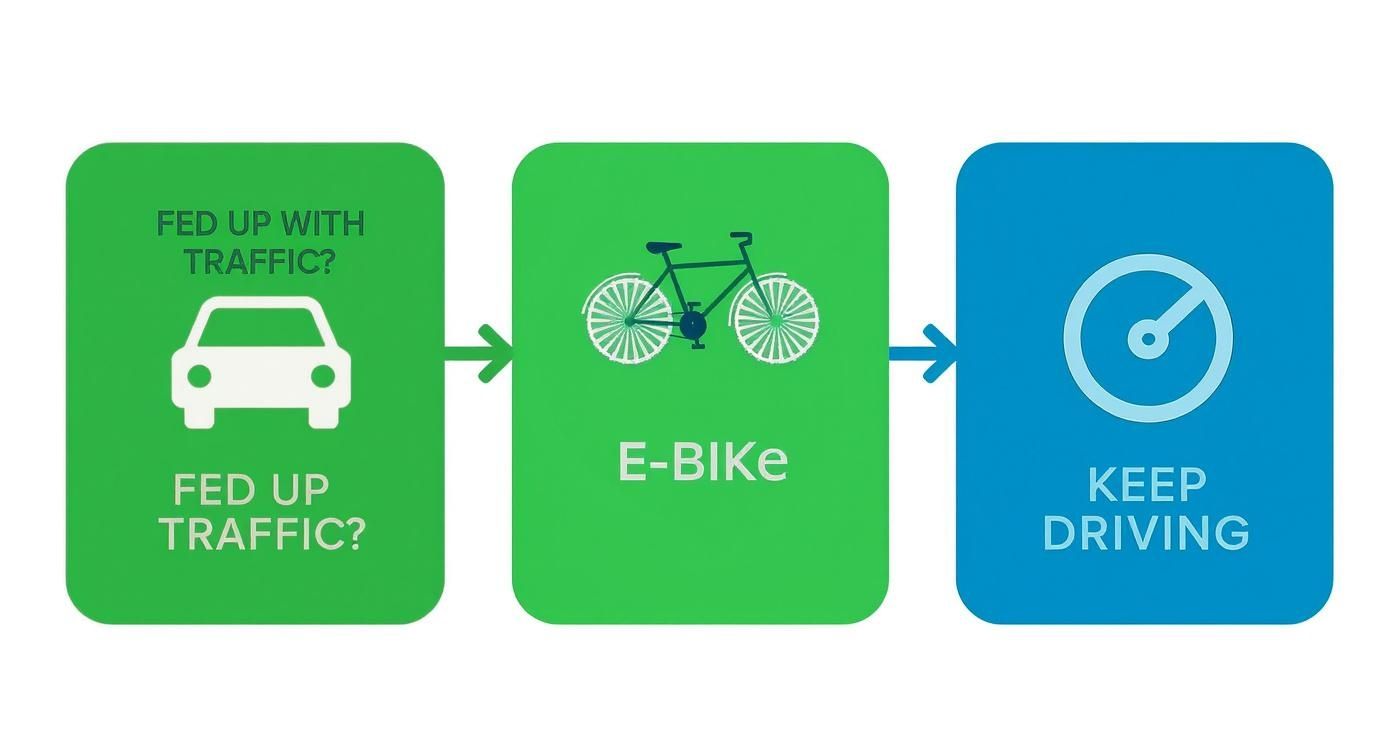
It really shows the choice commuters have: stick with the daily grind of traffic, or embrace the freedom of an e-bike.
Essential Features for the Everyday Rider
A proper commuter e-bike isn't just a motor and a battery slapped onto a frame. It's kitted out with practical, common-sense features that make your daily ride safer and a whole lot easier. These aren't just fancy extras—they're what you need for a smooth, no-fuss journey.
Ideally, you want a bike that comes with these things already built-in:
- Fenders (Mudguards): An absolute must-have for unpredictable weather. They'll keep all the road grime and puddle spray off your work clothes on those damp mornings.
- Integrated Lights: Having front and rear lights powered by the bike's main battery is a game-changer. You'll never have to worry about them dying on you. It's a non-negotiable safety feature for early morning or evening rides.
- Pannier Rack: A sturdy rear rack is your best friend for carrying your laptop, a change of clothes, or groceries in pannier bags. It gets the weight off your back and onto the bike, which is far more comfortable.
- Comfortable Riding Position: Look for bikes with an upright or relaxed frame. This posture is much easier on your back and neck and gives you a commanding view of the traffic around you.
Getting a bike with all this included from the start means it’s ready for the demands of a daily e bike commute right out of the box. It’ll save you a ton of time and money trying to add it all on later.
Planning Your First E-Bike Journey
Alright, so you've got your shiny new e-bike. Now for the fun part: actually riding it to work. A little bit of prep work here isn't about being rigid; it’s about making that first ride feel less like a stressful mission and more like the awesome, easy-breezy experience it should be.
The best thing about an e bike commute? The fastest car route is rarely the best bike route. You can ditch the congested main roads and discover a whole new side of your city through quieter streets, greenways, and dedicated bike paths you never knew existed.
Finding Your Perfect Path
Your phone is your secret weapon here. But don't just plug your destination into your usual car navigation app—you need one that thinks like a cyclist. The goal is to find apps that actively hunt for dedicated cycle lanes, low-traffic streets, and even smooth off-road shortcuts.
For anyone riding in the US and Australia, tools like Google Maps (with its cycling layer) and dedicated apps like Komoot are fantastic for getting around dense urban areas without having to wrestle with traffic.
When you're picking an app, make sure it has these features:
- Bike-Specific Routing: The app should prioritize bike lanes and quiet roads, not just spit out the shortest path for a car.
- Elevation Profiles: This is a lifesaver. It shows you the hills on your route. Your e-bike will flatten them out, of course, but it’s still nice to know what’s coming.
- Surface Type Information: Some apps even tell you if a path is paved, gravel, or something else entirely, so you can avoid any bumpy surprises.
Once you’ve found a route you like the look of, save it. Having it locked in means you can just relax and enjoy the ride without any second-guessing.
Timing is Everything
One of the greatest joys of e-biking is cruising past a line of stopped cars. But you can make your ride even better by being smart about when you leave. If you have any flexibility in your schedule, leaving just 15-20 minutes before or after the absolute peak of rush hour is a total game-changer.
You’ll find the roads and bike lanes are way less crowded. It’s the difference between a frantic race and a peaceful solo ride.
Don't just plan your route; plan your departure. A slight adjustment to your schedule can completely change the character of your ride, making it safer, faster, and far more enjoyable.
Do a Weekend Test Run
Seriously, don't skip this step. The best way to feel totally confident on your first real commute is to do a full dress rehearsal. Pick a Saturday or Sunday morning when traffic is light and there’s zero pressure to be on time.
This trial run is incredibly valuable. It helps you:
- Time Your Trip Accurately: You’ll get a real sense of how long it takes, so you're not a sweaty, panicked mess on Monday morning.
- Identify Potential Hazards: You can scout out tricky intersections, spot massive potholes, or figure out a confusing turn without a car right on your tail.
- Build Confidence: Just knowing the route inside and out makes the first official ride feel so much less intimidating. You'll feel like a pro from day one.
Think of it this way: the practice run turns your first e bike commute from a nerve-wracking leap into the unknown into a well-rehearsed adventure. You'll know exactly where you're going, freeing you up to just enjoy the wind in your hair.
Staying Safe and Legal on US and Australian Roads
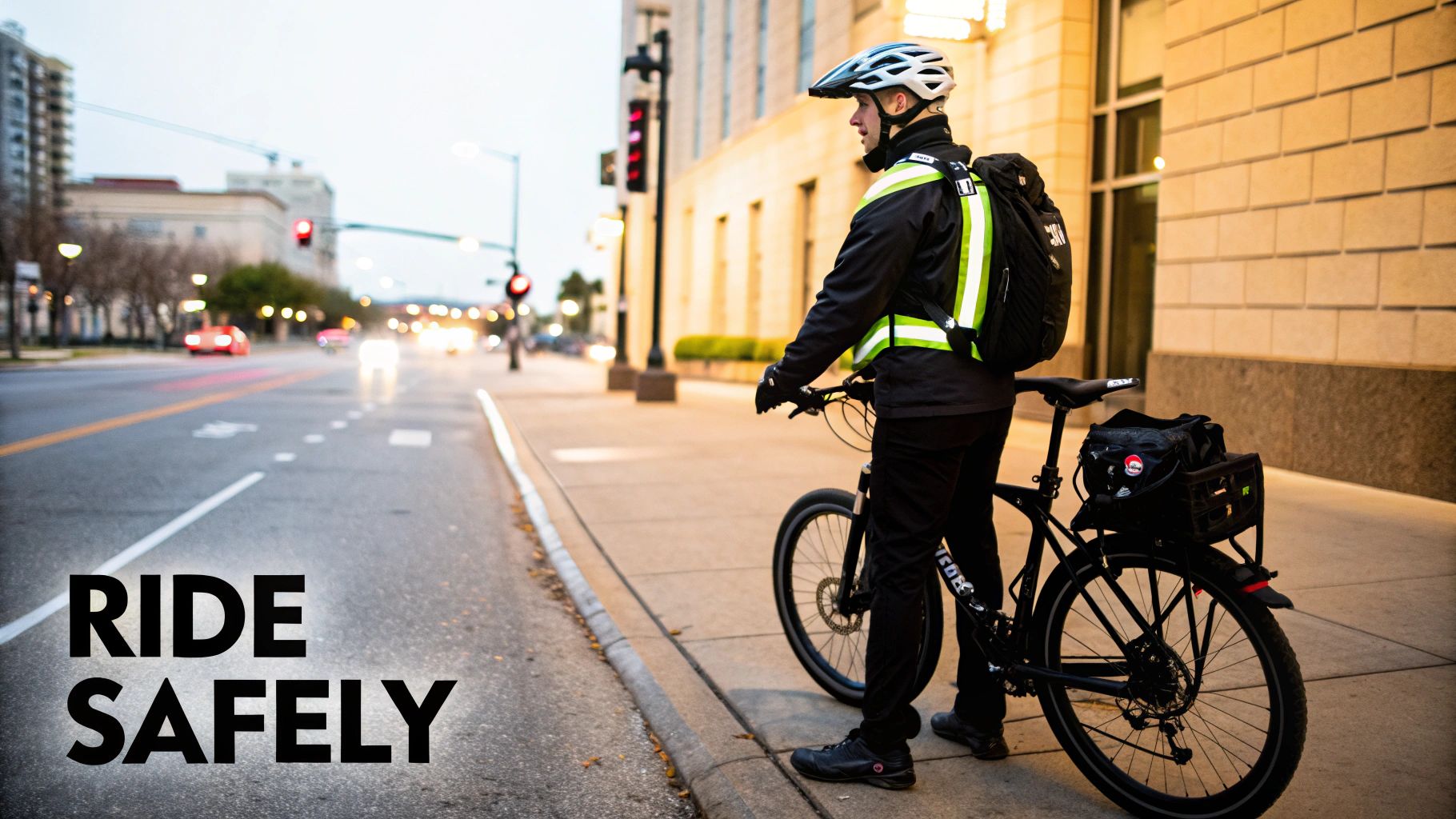
Riding with confidence is about more than just having a great bike. It’s about knowing the rules of the road and feeling secure every time you hop on. Your commute should be something you look forward to, not a source of stress, and getting a handle on the local laws is the first step to making that happen.
Unlike the fairly uniform rules in Europe, e-bike laws in the US and Australia can vary significantly. In the US, regulations change from state to state, while in Australia, laws are set at the state and territory level.
Understanding the Rules: The Class System
The key to understanding US e-bike law is the 3-Class system, which is now used by most states to categorize e-bikes.
- Class 1: The motor provides pedal assist only and cuts out at 20 mph.
- Class 2: Has a throttle and can be propelled without pedaling, but the motor still cuts out at 20 mph.
- Class 3: Is pedal-assist only (no throttle) but provides assistance up to 28 mph.
In Australia, the rules are simpler. A legal e-bike's motor must be 250 watts or less and cut out at 25 km/h (15.5 mph). Some bikes with throttles are allowed, but the power must cut off at 6 km/h. It's crucial to check your local state or territory's specific regulations before you ride. To get a better handle on a common type, check out our guide on the Class 2 ebike.
Gearing Up for a Safer Ride
While helmet laws vary by state and age, your personal safety is everything. The right gear isn’t just about protecting you in a spill; it’s about making you seen and boosting your confidence in traffic.
Think of your safety gear as your personal forcefield on the road. It’s your first line of defense when you’re navigating busy streets with cars, buses, and pedestrians.
Here's what should be on your essential checklist:
- A Quality Helmet: This is non-negotiable. A modern, well-fitting helmet is the single most important piece of safety gear you will ever own.
- High-Visibility Clothing: Bright colours for daytime riding and reflective materials for night make a world of difference. A simple reflective vest can make you pop, helping drivers spot you from much further away.
- Bright Lights: Most states require a white front light and a red rear reflector or light for night riding. Adding extra flashing lights for dawn, dusk, and rainy days is a brilliant way to grab extra attention.
Riding Defensively in the Urban Jungle
Being a safe rider is as much about your mindset as it is your equipment. Defensive riding is all about anticipating what others might do and putting yourself in the best position to avoid trouble. It’s a constant state of awareness.
The golden rule of city riding? Assume you're invisible. Ride in a way that keeps you safe even if a driver doesn't see you. That sometimes means taking the lane to prevent being squeezed against the curb.
Mastering a few key habits will completely change your commute for the better:
- Be Predictable: Use clear hand signals well before you turn. Avoid sudden movements. Ride in a straight, steady line.
- Stay Alert: Always be scanning ahead. Watch for car doors swinging open, people stepping off the curb, and cars pulling out of junctions.
- Make Eye Contact: Whenever you can, lock eyes with drivers at intersections. It’s the best way to confirm they’ve actually seen you before you proceed.
This proactive approach to safety is a huge part of why e-bike commuting is taking off so rapidly. As more people adopt e-bikes, a stronger cycling culture built on mutual respect and awareness makes the roads safer for everyone.
Mastering Your E-Bike's Battery and Maintenance
Let's be real—the last thing you want is for your e-bike to feel like a chore. The great news? It doesn't have to be. Keeping your ride in peak condition is way easier than you think. If you just focus on two things—the battery and a few quick mechanical checks—your e bike commute will stay fun and reliable for thousands of miles.
Think of your battery as the heart of your bike. A little TLC goes a seriously long way in keeping it healthy, which saves you a ton of cash and headaches in the long run. It really just comes down to building a few good habits.
Smart Charging for a Longer Battery Life
Your e-bike's lithium-ion battery is a sophisticated piece of equipment, and it loves to be treated right. You wouldn't drain your phone to 0% every single day, right? The same logic applies here. Try to avoid running your battery completely flat, as it puts unnecessary stress on the cells.
Another simple win is keeping it out of extreme temperatures. Leaving your battery to freeze in a garage or bake in a hot car is a surefire way to kill its performance and shorten its life. Whenever you can, just bring it inside and let it hang out at room temperature.
Here are my go-to charging tips:
- Follow the 20-80 Rule: For daily rides, try to keep your charge level somewhere between 20% and 80%. This is the battery's happy place, minimizing strain and dramatically extending its lifespan. Save those 100% charges for the days you know you'll need every last drop of range.
- Give It a Breather: After a ride, let your battery cool down for about 30 minutes before you plug it in. Do the same thing after it’s finished charging—let it rest a bit before you head out.
- Stick with the Original Charger: It might be tempting to use another charger in a pinch, but don't. The charger that came with your bike is specifically designed for its voltage and safety needs. A mismatch can be risky for the battery and even your home.
Want to geek out on the science behind all this? We've got a full guide on maximizing your electric bike battery life that’s packed with even more pro tips.
The 'ABC' Quick Check Before You Ride
Okay, battery handled. Now for the bike itself. You don't need to be a pro mechanic to spot potential problems. The "ABC Quick Check" is a simple routine that takes less than a minute but can make all the difference in having a safe, smooth ride.
This little pre-ride ritual is your best defense against unexpected trouble. It confirms your bike's most critical parts are ready to go before you hit the road, giving you some serious peace of mind.
It’s as easy as it sounds:
- A is for Air: Give your tires a good squeeze. They should feel firm, not soft. Properly inflated tires roll smoother, are far less likely to get a flat, and help you squeeze more range out of every charge. The recommended pressure (PSI) is printed right on the tire’s sidewall.
- B is for Brakes: Pull both brake levers. Do they feel firm and responsive? They shouldn't feel spongy or pull all the way to the handlebar. Roll the bike forward a few feet and test each brake to make sure it brings you to a clean stop.
- C is for Chain: Glance down at your chain. You want to see a clean, lightly-oiled chain, not something caked in dirt or covered in rust. A happy chain means a quieter, more efficient ride and less wear and tear on your drivetrain.
Making the ABC check a habit before every e bike commute is the single best thing you can do to catch small issues before they turn into major roadside headaches.
The Real-World Savings of Your E-Bike Commute
Beyond the sheer fun of the ride, the numbers behind an e-bike commute are genuinely convincing. Trading in your car keys or transit pass for an electric bike is more than just a lifestyle upgrade—it's a seriously smart money move that pays dividends with every single trip. And the savings go way beyond just what you’d spend on gas or a train ticket.
When you leave the car at home, you’re also leaving behind a whole cascade of hidden costs. Think about it: monthly fuel bills, insurance payments, pricey parking permits, and those surprise repair costs that always seem to pop up at the worst times. Over a year, that adds up to a huge slice of your income. An e-bike, by contrast, costs just pennies to charge and is surprisingly light on maintenance.
Let’s Talk Hard Numbers
To put it in concrete terms, fully charging an e-bike battery in the US usually costs between 10 to 30 cents. That tiny amount of electricity can easily power you for 30 miles or more. Now, compare that to what it costs to drive a car the same distance. The difference is pretty stark.
But the savings don't stop at the pump. E-bikes help you sidestep a ton of other expenses that really add up:
- Parking Fees: Working in a city center? You could be saving thousands of dollars every year on parking alone.
- Insurance and Registration: In most US states, Class 1 and 2 e-bikes don't require registration or costly motor insurance.
- State & Federal Incentives: Many areas in the US and Australia now offer rebates or tax credits for purchasing an e-bike, sweetening the deal even further.
- Depreciation: Cars lose a chunk of their value the second you drive them off the lot. E-bikes hold their value much better over time.
This isn't just a local trend; it's a global shift. As mentioned, the average American who swaps a car for an e-bike saves an estimated $2,000 to $3,000 annually. With over a million e-bikes sold there in 2022, it's obvious people are catching on. For a deeper dive into these numbers, you can find some great e-bike statistics and insights on BoltBikers.com.
To see how this all stacks up over a year, let's compare the costs side-by-side.
Annual Commuting Cost Breakdown
Here’s a rough estimate of what you might spend annually commuting by car versus an e-bike in a typical US city. The figures can vary, of course, but this gives you a clear picture of the potential savings.
| Expense Category | Car (Annual Cost) | E-Bike (Annual Cost) |
|---|---|---|
| Fuel / Electricity | $2,000 | $60 |
| Insurance | $1,500 | $100 (optional) |
| Registration / Fees | $300 | $0 |
| Maintenance / Repairs | $800 | $150 |
| Parking / Tolls | $1,500 | $0 |
| Depreciation | $3,000 | $250 |
| Total Estimated Cost | $9,100 | $560 |
The difference is impossible to ignore. Even with variations in your specific situation, the financial argument for switching to an e-bike for your daily commute is incredibly strong.
More Than Just Money in Your Pocket
The true value of an e bike commute isn't just about what you save in dollars and cents. One of the biggest returns you'll get is your time. Sailing past gridlocked traffic means your travel time is suddenly predictable, and often, a lot shorter.
Think about it: an extra 30 minutes saved each day adds up to over 120 hours a year. That's three full work weeks of your life that you get back from the soul-crushing stress of rush hour.
And finally, you get the environmental payoff. Every ride shrinks your personal carbon footprint, which means cleaner air and quieter, more pleasant streets for everyone. Choosing an e-bike is a small, daily action that makes a real, tangible difference. This triple win—for your wallet, your schedule, and the planet—makes the switch an investment that truly keeps on giving.
Got Questions About Your E-Bike Commute? We've Got Answers.
Alright, so you're thinking about making the switch. It's an exciting idea, but let's be real—you probably have a few practical questions bouncing around your head before you dive in. That's totally normal.
Think of this as a little FAQ session where we tackle the common "what ifs" that pop up for new e-bike commuters. Getting these sorted will help you roll out with confidence.
Do I Actually Need Insurance for This Thing?
This is a big one, especially in the US and Australia. For a standard e-bike that falls within legal limits (like Class 1-2 in the US), the short answer is no, you're not legally required to have motor vehicle insurance.
But here’s the thing: what’s legal and what’s smart aren't always the same.
I can't recommend theft and liability insurance enough. Your home or renters insurance might cover a little bit, but dedicated e-bike insurance is usually much more robust. It's a real lifesaver if your bike gets swiped from a public rack.
Can I Ride My E-Bike if It's Pouring Rain?
You bet! Any commuter e-bike worth its salt is built to handle the weather. The important bits—your motor and battery—are sealed up tight to keep water out. Riding through a typical downpour is no problem at all.
Just use common sense and try not to ride through a lake-sized puddle. Honestly, the bigger challenge in the rain isn't your bike's health, it's yours! Good waterproof gear is a must, keep your lights blazing, and give yourself extra room to stop. Wet roads are slippery.
How Do I Keep My E-Bike from Getting Stolen?
E-bikes are an investment, and thieves know it. So, you need a rock-solid locking strategy. Don't cheap out here—grab a heavy-duty U-lock or chain with a high security rating. It’s your best line of defense.
Here's a simple routine I always follow:
- Frame First, Always: Lock the main frame of your bike to something that can't be moved, like a dedicated bike rack. Never, ever lock just the wheel.
- Double Down: Use a second, lighter cable lock to snake through your wheels (especially if they're quick-release) and attach it back to your main lock.
- Take the Power: If your battery pops off easily, take it with you. An e-bike without its battery is a much less attractive target for an opportunistic thief.
What Happens if the Battery Dies on Me?
First off, don't panic. It's not like the bike just seizes up. It simply becomes a regular, non-electric bike. You can still pedal your way home.
It'll definitely feel heavier and be more of a workout, especially if you hit a hill. This is exactly why a little planning goes a long way with an e bike commute. Learn your bike's real-world range, top it up regularly, and don't ride on the highest assist level the whole time unless you really need it. That way, you’ll always have juice to get where you're going.
Ready to transform your daily travel? At Punk Ride LLC, we offer a curated selection of high-performance e-bikes and e-scooters from top brands like ENGWE, AOVO, and DUOTTS, designed to make your commute faster, greener, and more fun. Find your perfect ride and join the urban mobility movement today at https://www.punkride.com.
Share:
what is pedal assist ebike: a simple guide
Best Budget Electric Bikes: Finding Your Perfect Ride in the US & Australia