


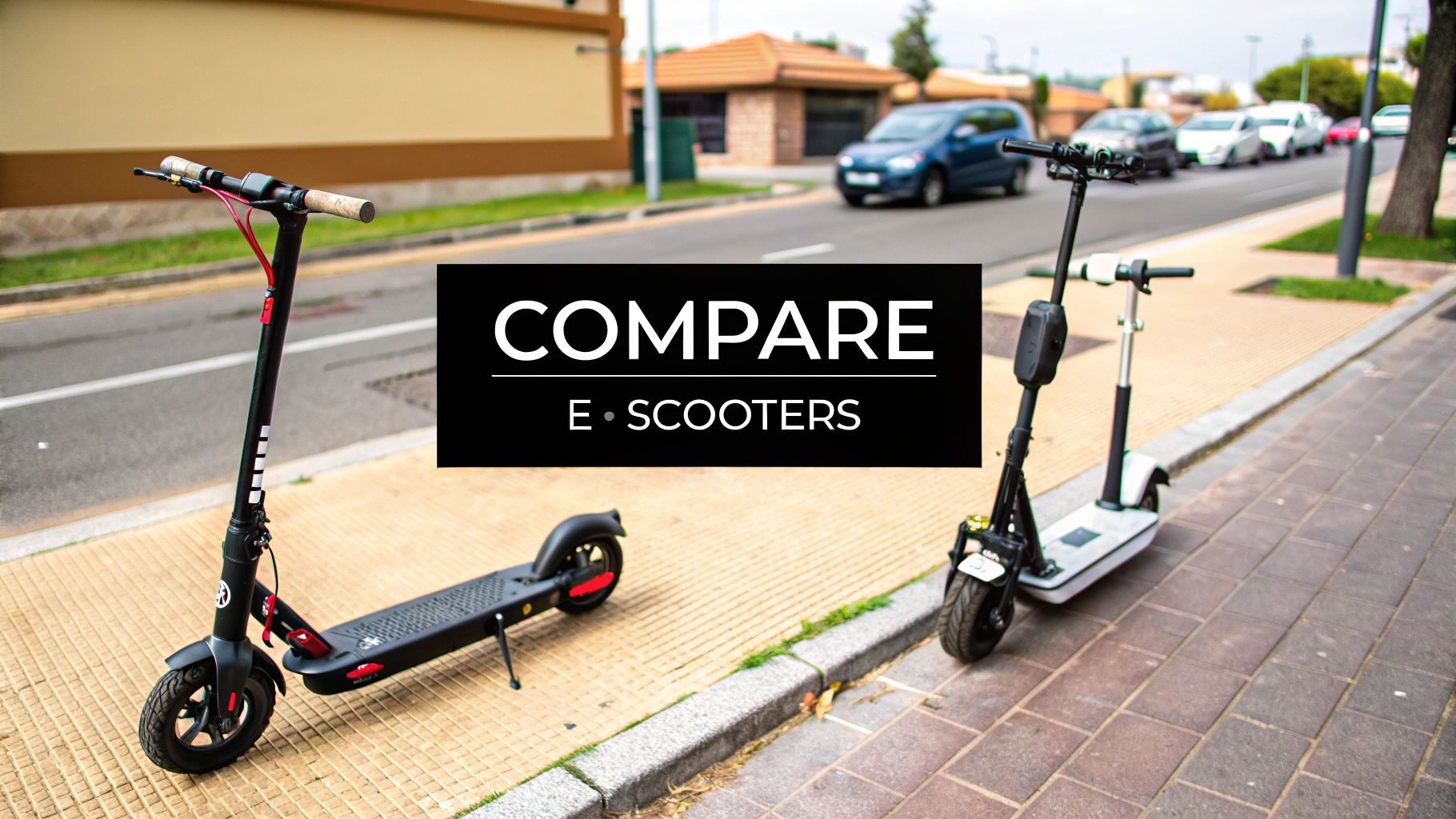
So, you’re trying to figure out which e-scooter to buy. The first step isn’t to look at specs—it’s to look at yourself. How are you actually going to use this thing?
Are you a daily commuter, a weekend explorer, or a performance junkie? A commuter needs to think about portability, range, and weather resistance. On the other hand, if you're all about performance, you'll care a lot more about motor power, suspension, and high-quality brakes. Your own needs are what make certain specs matter more than others.
Your Quick Guide to Comparing E Scooters
It's easy to get lost in a sea of options and tech-speak. Let's cut through all that noise. This guide will give you a simple way to compare electric scooters without getting bogged down in details that don't apply to you. The whole point is to figure out your rider profile and match it with features that’ll genuinely improve your daily rides.
Think of this as your starting point. It’s a roadmap for asking the right questions before you start obsessing over motor watts or battery types. How you plan to ride is the single most important factor.
Define Your Rider Profile
So, who are you? The daily commuter who needs something for that last mile from the train? The weekend warrior looking to cruise around town? Or the adrenaline chaser who just wants to go fast? Each of these riders has completely different priorities.
This little flowchart is a great way to visualize how your main needs—like your commute, local hills, and speed cravings—should steer your search.
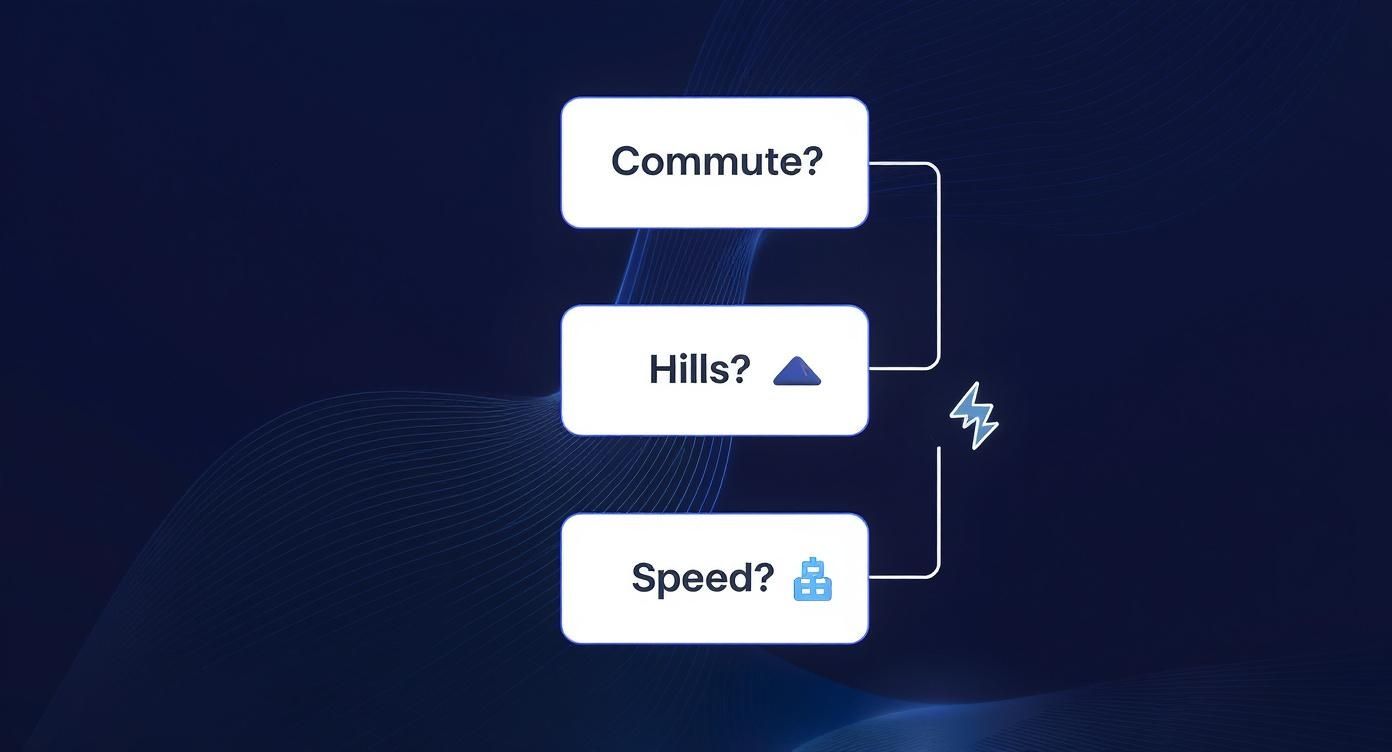
As you can see, a commuter who deals with a lot of hills needs to focus on motor power. But if your ride is short and flat, you might find that portability is way more important.
By answering these basic questions first, you can instantly shrink your list of potential scooters and focus only on the models that actually make sense for you. It’s a much smarter way to shop and will give you the confidence that you’re making the right call.
Decoding E-Scooter Specs: What Really Matters
A scooter's spec sheet can look like a foreign language. All those numbers and acronyms are supposed to help you compare e-scooters, but most of the time, they just create more confusion. Let's cut through the jargon and translate what those specs actually mean for your ride.
Getting a handle on these core specs is how you move past the marketing hype and see what a scooter is truly made of. Once you know what to look for, you can glance at any model and instantly know if it's got the guts, legs, and safety features you need.
E-Scooter Spec Sheet Cheat Sheet
To make things easier, here’s a quick-glance table breaking down the most important specs. Think of it as your pocket translator for scooter tech.
| Specification | What It Means for Your Ride | What to Look For |
|---|---|---|
| Motor Power (W) | Your scooter's muscle. Affects acceleration and ability to climb hills. | 500W+ for zippy urban commuting and moderate hills. 1000W+ for serious performance. |
| Battery (Wh) | The fuel tank. A bigger number means more juice and longer rides. | 350Wh+ for daily commutes. 500Wh+ for longer trips without range anxiety. |
| Brakes | Your most critical safety feature. Determines how quickly you can stop. | Disc brakes offer the best performance. Drum brakes are a solid, low-maintenance second. |
| Suspension | The shock absorbers. Smooths out bumps for a more comfortable ride. | Dual spring/hydraulic suspension is ideal for rough city streets. |
| Tires | Your connection to the road. Impacts ride comfort and maintenance. | Pneumatic (air-filled) for comfort. Solid for zero flats but a harsher ride. |
| IP Rating | Weather-proofing. Shows how well the scooter handles dust and water. | IP54 is a good minimum for commuting. Higher is better for rainy climates. |
This table gives you the basics, but let's dive a little deeper into the specs that will make or break your riding experience.
Motor Power and What It Really Means
The first number everyone gravitates to is the motor wattage. And yeah, a bigger number usually means more power, but it's not all about raw speed. It’s better to think of motor power as torque—the oomph that gets you off the line and pulls you up a steep hill.
- 250W-350W: This is your standard, entry-level commuter power. It's perfectly fine for zipping around on flat city streets, but it’s going to gasp for air on any real incline, especially if you're a heavier rider.
- 500W-800W: Now we're talking. This is the sweet spot for most urban riders. A 500W motor gives you a real kick in acceleration and can tackle moderate hills without slowing to a pathetic crawl.
- 1000W+ (Dual Motors): Welcome to performance territory. Dual motors mean you have power going to both wheels, which translates to incredible acceleration, higher top speeds, and the kind of hill-climbing ability that makes you feel unstoppable.
A common mistake is getting fixated on peak power. Always look for the nominal (or continuous) power rating. That's the power the motor can actually sustain, while peak power is just a short, temporary burst.
This desire for more capable scooters is a big part of why the global electric scooter market is exploding. It was valued at around USD 28.36 billion in 2024 and is expected to rocket to USD 81.48 billion by 2034, all thanks to city dwellers looking for smarter, more powerful ways to get around. You can check out more on this trend at Precedence Research.
Battery Life: The Secret to Real-World Range
Battery specs are easily the most confusing, but they’re absolutely essential for figuring out how far a scooter can really go. The range advertised by the manufacturer? Take that with a huge grain of salt—it’s always based on perfect, ideal conditions.
The two numbers you need to care about are Amp-hours (Ah) and Watt-hours (Wh). Ah measures the battery's capacity, but Wh gives you the best overall picture of its total energy. You can calculate it by multiplying the battery's voltage (V) by its Amp-hours (Ah).
Simply put, a higher Wh number almost always equals more real-world range. For a full breakdown, have a look at our guide on understanding and extending your electric scooter range. And remember, your weight, the hills you climb, and even how aggressively you ride will all chip away at that max distance.
Brakes, Suspension, and Tires: Your Safety Trio
Having power is great, but being able to stop is non-negotiable. The brakes are arguably the most important safety feature on your scooter.
- Disc Brakes: These are the best of the best. They provide powerful, reliable stopping in any weather, wet or dry. If you care about performance and safety, this is what you want.
- Drum Brakes: Tucked away inside the wheel hub, these are super low-maintenance and work reliably in the wet. Their stopping power is a notch below discs, but they're still a great option.
- Regenerative Brakes: This system uses the motor itself to slow you down, putting a tiny bit of juice back into the battery. It's a nice feature, but it should always be paired with a proper mechanical brake.
Suspension and tires are the duo that dictates your ride comfort. Pneumatic (air-filled) tires are fantastic because they soak up small bumps and give you a cushioned ride, but the trade-off is the risk of a flat. Solid tires, on the other hand, are totally puncture-proof but will make you feel every single crack in the pavement.
A good suspension system, whether it’s spring-based or hydraulic, can make a world of difference and even make solid tires feel more forgiving. If you’re riding on typical city streets, a combination of pneumatic tires and dual suspension is the gold standard for a buttery-smooth ride. Lastly, always check the IP rating (like IP54). This tells you how well-sealed the scooter is against dust and water—an absolute must-have if you're a commuter in Australia or the US.
Comparing Scooters for Different Rider Lifestyles
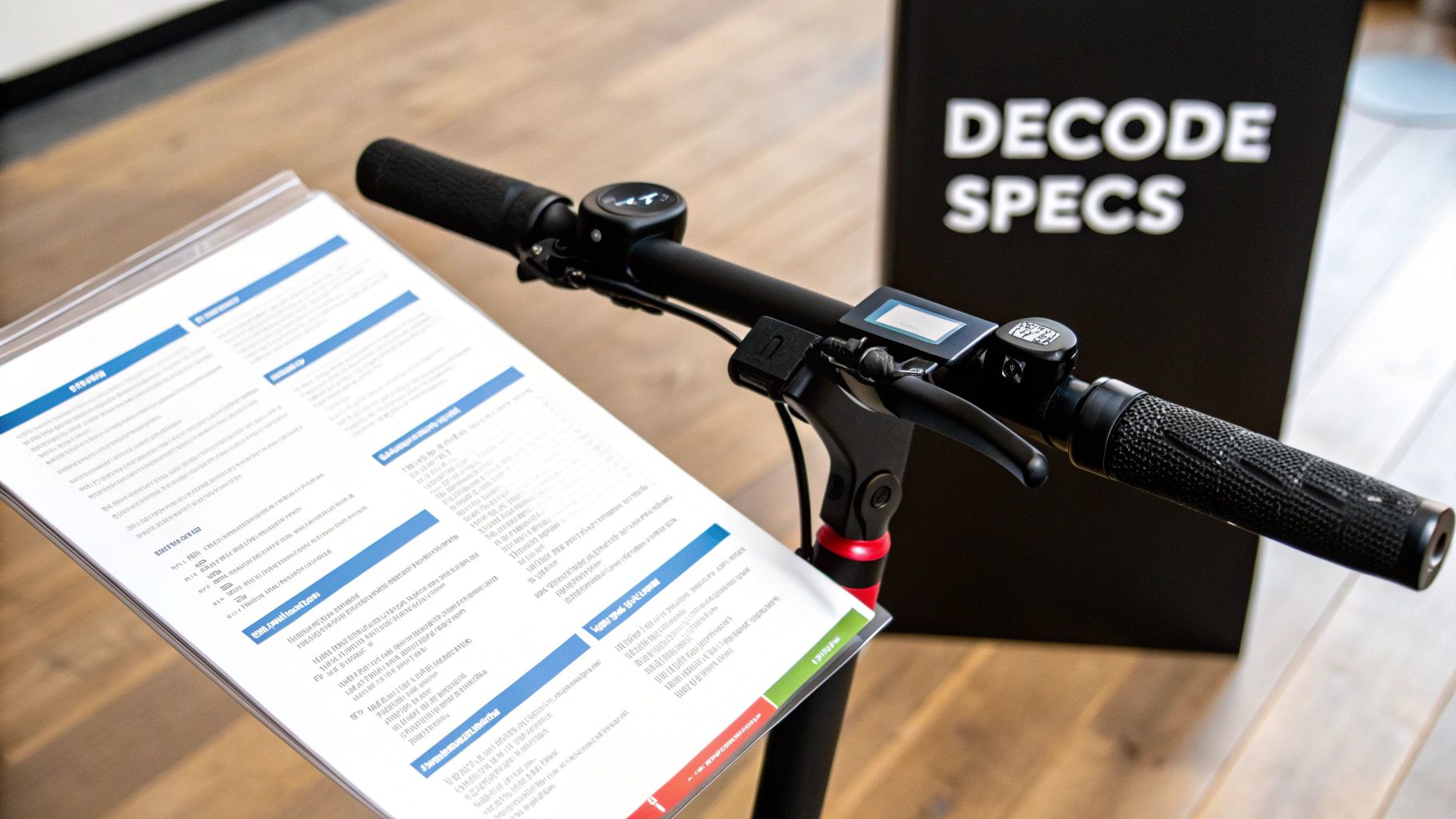
Let's be honest: the idea of a single "best" electric scooter is total fiction. The only scooter that matters is the one that fits your life perfectly, and that’s a different machine for every single person. This is where we need to move past the spec sheets and start looking at how these scooters actually perform in the real world.
By thinking about how different people ride, we can start to see why some features are mission-critical and others are just fluff. It’s all about matching the scooter to your daily grind, whether that's a sunny commute through Sydney or a weekend blast along a California boardwalk.
The Daily Urban Commuter
If you're relying on a scooter to get you to work and back every day, "reliability" isn't just a buzzword—it's everything. You need a workhorse that can handle the Monday-to-Friday slog without a single complaint. It has to navigate unpredictable city streets and handle the varied climates across the US and Australia.
When you're comparing scooters for your daily commute, three things should be at the top of your list: portability, range, and build quality. You need a scooter you can actually carry onto a train or into the office, one that won't die halfway home, and one that won't conk out unexpectedly.
Let's imagine two typical commuter options:
- Scooter A (The Urban Dasher): This thing is light, coming in at just 12 kg. It has a decent IP54 water resistance rating and gives you about 25 km of real-world range. Best of all, it's got solid tires, so you'll never have to worry about a puncture making you late for a meeting.
- Scooter B (The Road Warrior): This one's a bit of a beast at 18 kg, but you get a much smoother ride thanks to its air-filled tires and front suspension. It also has a superior IP65 rating and a solid 40 km range, though that extra weight can be a pain if you're using public transport.
So, who wins? For a commuter with a short, pretty direct ride, the Urban Dasher is a no-brainer. It’s light and puncture-proof. But if your commute is longer and involves some rougher roads, the comfort and better weather sealing of the Road Warrior might just be worth lugging around the extra weight. We get into even more detail in our guide to the best commuter electric scooters.
The Performance Enthusiast
This rider isn't just trying to get from A to B—they're in it for the pure fun of it. The performance junkie is all about speed, insane acceleration, and the power to destroy any hill that gets in their way. Their shopping list looks completely different from the daily commuter's.
For this kind of rider, it's all about beefy dual motors, sophisticated suspension, and brakes that can stop you on a dime. Portability gets thrown out the window in favor of raw power, which is why these scooters are often heavy, over-engineered machines built to take a beating.
A key thing that sets performance models apart is the use of dual motors. When you have a motor in each wheel, you get mind-blowing acceleration and grip that completely transforms the scooter from a simple commuter tool into a serious recreational vehicle.
Let's pit two performance models against each other:
- Scooter C (The Speed Demon): We're talking dual 1000W motors, a top speed of 60 km/h, and full hydraulic disc brakes. Its aggressive setup is built for pure speed, but the stiff suspension can feel pretty harsh on anything but perfect pavement.
- Scooter D (The All-Terrain Beast): This one has slightly smaller dual 800W motors but makes up for it with advanced hydraulic suspension and big, knobby off-road tires. The top speed is a touch lower at 55 km/h, but it delivers a far smoother ride across all sorts of terrain.
The Speed Demon is the clear winner for anyone who sticks to smooth roads and just wants to go as fast as possible. But the All-Terrain Beast is the better choice for the enthusiast who wants to explore bike paths, park trails, and rougher roads without sacrificing that exhilarating power.
The Last-Mile Navigator
The last-mile navigator uses their scooter to close the gaps in their journey. This is the person hopping off the train and needing a quick, easy way to get to the office, or zipping from the car park to the front door. For them, every single kilogram is a big deal.
Portability is king here. That means the scooter must be lightweight, fold down into a tiny package, and have a folding mechanism that’s quick and painless. Power and range take a backseat, since the trips are usually short and on flat, urban ground.
Here are two solid contenders for the last-mile crown:
- Scooter E (The Featherweight): At only 10 kg, this scooter is ridiculously easy to carry. It folds down into a super compact shape you can tuck under your desk or carry in one hand. The trade-off is a small motor and battery, giving you a modest 15 km range.
- Scooter F (The Quick-Fold): This one is a little heavier at 14 kg, but it has a brilliant one-second folding mechanism. It also packs a slightly bigger battery for a 20 km range and even includes a small spring suspension for a bit of extra comfort.
The Featherweight is perfect for someone whose biggest challenge is lugging the scooter up stairs or through a crowded station. But the Quick-Fold is a fantastic alternative for those who want a slightly more comfortable ride and an even faster transition from riding to carrying. Making the right choice means your scooter becomes a seamless part of your daily travels, not a clunky burden.
Riding on the Right Side of the Law: E-Scooter Rules in the US and Australia
It’s one thing to own a beast of an electric scooter, but it’s a whole other ball game to ride it legally. When you’re weighing your options, the laws in your neck of the woods are just as critical as the motor specs or battery life. After all, a top-tier scooter isn't much use if it's permanently grounded.
The rules for e-scooters are all over the map, changing dramatically from one city to the next. What's a normal commute in California could get you a steep fine in another state. This patchwork of regulations is a classic case of lawmakers playing catch-up with technology that’s exploded in popularity.
The United States: A Maze of State and City Laws
In the U.S., there’s no single federal law for e-scooters. Instead, you're faced with a confusing mess of state and city-level rules, which makes it crucial to check what’s what in your specific location.
Some states, like California, have set statewide guidelines that treat e-scooters a lot like bicycles. You can usually ride in bike lanes with a speed limit around 15 mph (24 km/h), and anyone under 18 needs a helmet. But even then, cities can add their own, stricter rules on top of that.
On the other hand, many states just leave it all up to individual cities, creating total legal chaos. Take New York City, for instance—e-scooters and e-bikes only became legal in 2020, and the rules change depending on which borough you're in. This hyper-local approach means you need to check the laws for your state, your county, and your city.
The key takeaway for US riders is to always check local regulations. A quick search for "[Your City] electric scooter laws" is the best way to ensure you're riding legally and safely.
Australia: A State-by-State System
Australia's e-scooter laws are also handled at the state and territory level, leading to a wide variety of rules across the country. What's legal in one capital city might be completely restricted in another.
- Queensland (Brisbane): This state has been a leader in e-scooter adoption. E-scooters are legal on footpaths and shared paths with a speed limit of 12 km/h, and on local streets and bike lanes with a speed limit of 25 km/h.
- Australian Capital Territory (Canberra): Similar to Queensland, e-scooters are permitted on footpaths and shared paths at 15 km/h and on bicycle paths and residential streets at 25 km/h.
- Victoria and New South Wales: These states have traditionally had much stricter rules, often limiting private e-scooters to private property only, similar to the UK. However, both are running rental e-scooter trials, which could pave the way for changes to private ownership rules in the future.
This jumble of laws really hammers home the point: do your homework locally. For a closer look at the specifics, you might want to check out our guide on whether electric scooters are street legal.
The global takeover is real, though. E-scooters are completely dominating the market, making up a massive 53.02% (USD 38.66 billion) of the entire scooter market in 2024. It’s a clear sign that riders are moving on from the old-school models. You can dig into more details about this commanding market share on GlobeNewswire.
How to Master Your Test Ride
You can spend hours staring at spec sheets, but a ten-minute spin will tell you more than all that research combined. Numbers on a page are one thing, but how a scooter actually feels under your feet is something you can only learn by riding it. This is your chance to turn a simple joyride into the final, decisive step when you compare e scooters.
This isn't just about checking if the motor runs. It's about getting a feel for the little details that make a huge difference in your daily life. We're talking about everything from the responsiveness of the throttle to the satisfying click of the folding latch. A little structure goes a long way here, so you don’t forget anything important.
The Initial Feel and Comfort
Before you even think about hitting the throttle, just stand on the scooter. Does the deck give your feet enough room to breathe? Can you shift your stance without feeling like you’re on a tightrope? Comfort is the foundation of confident riding.
Now, grab the handlebars. Do they sit at a natural height, or are you hunched over or reaching up like you're stretching? The height and width of the handlebars dictate your control and how tired you'll get on longer trips. If it feels off now, imagine how it'll feel 30 minutes into your commute.
The real goal of a test ride is to figure out the scooter's personality. Is it twitchy and aggressive, or is it smooth and predictable? Finding a match for your own riding style and environment is what this is all about.
Testing Performance and Handling
Alright, here comes the fun part. Gently squeeze the throttle and pay close attention to how the scooter accelerates. Does it ramp up smoothly, or does it lurch forward like an angry bull? A jerky throttle is a real pain in stop-and-go city traffic and can even be a bit sketchy.
Find a safe, open area to test the brakes. And I don't mean just coasting to a stop—give them a firm, deliberate squeeze. You want to feel a strong, confident "bite" that brings you to a halt without locking up the wheels. If it has dual brakes, test them individually to understand how the scooter reacts in an emergency stop.
Once you’ve got a feel for it, try carving a few turns. Does the scooter feel planted and stable, or is it wobbly and nervous? This is where you can truly feel the impact of the tire type, wheelbase, and overall geometry. It's a sneak peek into how it will handle real-world corners and obstacles.
Practicality and Real-World Use
A great ride is only half the story. The scooter has to actually fit into your daily routine. Locate the folding mechanism and give it a try. Is it a slick one-latch system, or a frustrating puzzle you have to solve every time? Picture yourself doing that on a crowded train platform during rush hour.
Next, lift it. Once it's folded, pick it up. Can you realistically carry this thing up a flight of stairs or for a short distance? The weight listed on a spec sheet feels a lot different when you’re the one holding it.
Finally, if you can, try to ride over a few different surfaces. Go from smooth pavement to a slightly rougher patch or even over a small crack. This is the only real way to test the suspension. A scooter that feels like a dream on a polished shop floor can feel like a jackhammer on a typical city street.
E-Scooter Test Ride Evaluation Checklist
To make sure you don't miss a thing, use this checklist to guide your evaluation. It helps you move beyond a simple "I like it" and forces you to think critically about each component.
| Evaluation Area | What to Check | Notes / Rating (1-5) |
|---|---|---|
| Comfort & Ergonomics | Deck size, handlebar height/width, grip comfort. | |
| Acceleration | Smoothness, responsiveness, any jerky movements. | |
| Braking | Stopping power, brake feel (mushy vs. firm), wheel lock-up. | |
| Handling & Stability | Turning radius, stability in turns, overall balance. | |
| Suspension | How it handles bumps, cracks, and uneven surfaces. | |
| Portability | Ease of folding/unfolding, actual carry weight, latch security. | |
| Controls & Display | Readability of the display in sunlight, ease of using controls. | |
| Build Quality | Noises (rattles/creaks), stem wobble, overall solid feel. |
Taking a few moments to fill this out right after your ride will solidify your impressions. Running through these checks systematically is what turns a hopeful guess into a well-informed decision.
Making Your Final Purchase Decision
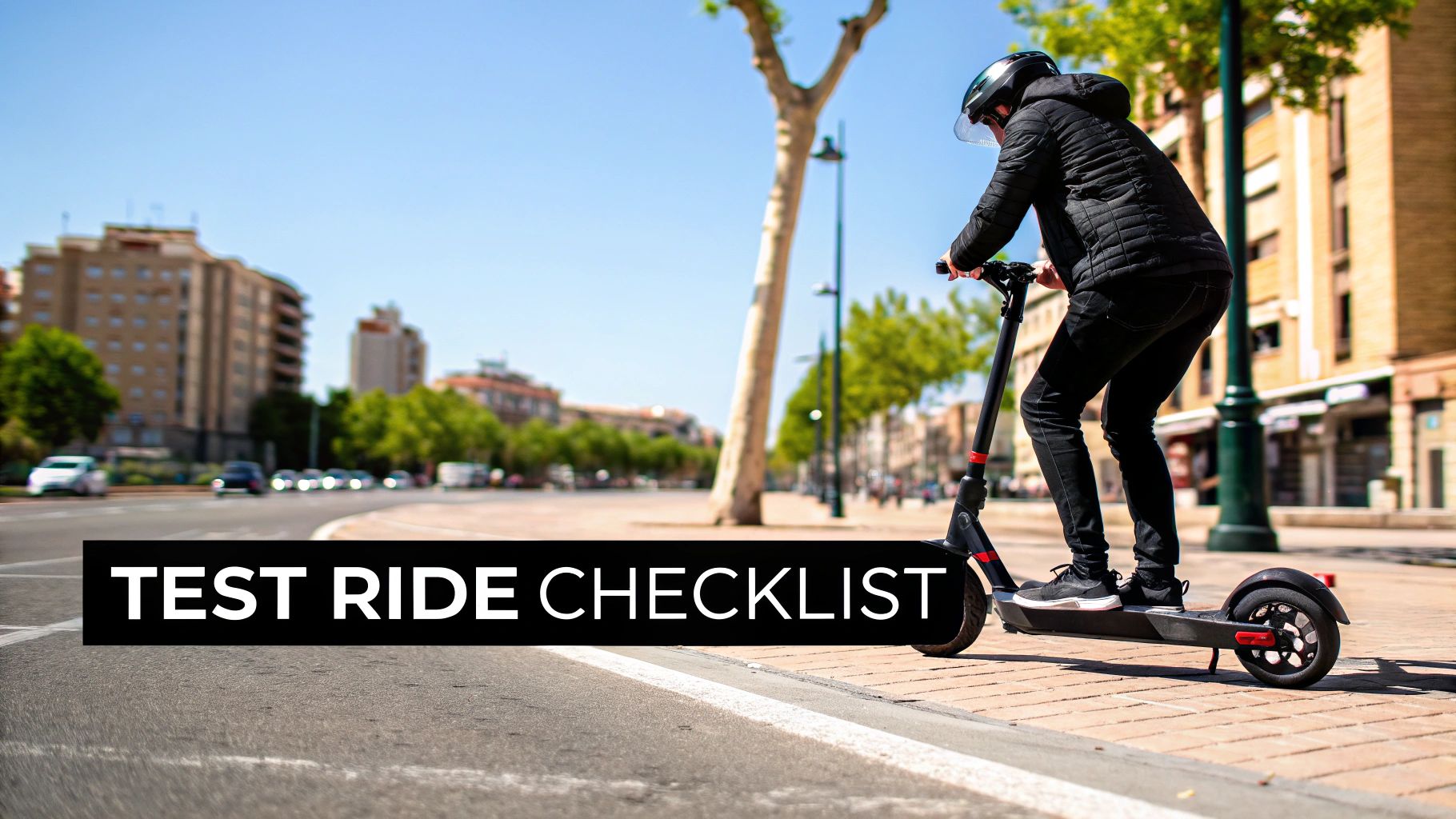
Alright, you've crunched the numbers, maybe even taken a test ride, and now you’re down to the final contenders. This is the last hurdle: pulling the trigger. It’s time to bring all your research together for one final reality check to make sure the scooter you’ve picked isn't just good on a spec sheet, but actually fits your life.
This is the step that separates a decent purchase from one you'll rave about for years. By running through these last few points, you can buy with total confidence, knowing you've found the right ride.
Your Final Decision Checklist
Think of this as your pre-flight check before you hit "buy." Run your top pick through these questions to avoid any nasty surprises down the road.
-
Does It Actually Meet Your Range Needs?
Forget the advertised range for a second and think about your real daily round trip. You have to account for hills, your own weight, and the fact that you shouldn't be draining the battery to 0% every single day. A solid rule of thumb is to pick a scooter with at least 30-40% more advertised range than you think you need. -
Can It Handle Your Local Terrain?
A scooter that feels quick on a flat, smooth path might feel like it's crawling up the hills in your neighborhood. Be brutally honest about the inclines you'll be tackling. If your area is steep, you'll want a motor that's at least 500W to avoid that painfully slow climb home. -
Is It Legal Where You Live?
This one is a big deal and absolutely non-negotiable. Re-check your local laws one last time, whether you're in a US state with specific city ordinances or an Australian state with its own set of rules. Make sure the scooter’s speed and power are compliant to sidestep any fines or legal trouble.
Your final check shouldn't just be about specs; it's about picturing the scooter in your day-to-day life. Can you realistically carry it up your apartment stairs? Does the warranty cover you for a reasonable period? This practical mindset ensures a happy ownership experience.
After-Sales Support and Long-Term Value
Buying a scooter is an investment, and what happens after you buy is just as crucial as the specs. Before you commit, get a feel for the brand’s reputation for customer service and whether you can even get spare parts.
- Warranty: What's covered and for how long? A 12-month warranty on the major parts is a pretty good sign that the company stands by its product.
- Parts Availability: Can you easily find and buy new tires, brake pads, or a replacement battery? A scooter is just a fancy paperweight if you can't get the parts to fix it.
- Support: Is there a real human you can contact if things go sideways? Look for a reliable support line—email, phone, or even a local service center.
Thinking about these things now gives you major peace of mind later. When you finally compare e scooters using these real-world filters, the best choice usually becomes obvious, setting you up for miles of hassle-free riding.
Got Questions? We've Got Answers
So you've compared a few e-scooters, narrowed it down, but still have some nagging questions. Totally normal. Think of this as the final check-in before you pull the trigger, where we tackle those last-minute thoughts that spec sheets don't always answer.
These are the practical, real-world concerns that pop up right before you're ready to buy. Getting them sorted is the last step to becoming a confident owner who's ready to roll.
How Long Does An E-Scooter Battery Really Last?
When people ask about battery life, they're usually asking two things: how far can I go on one charge, and how long until I need a new battery? The second part—the battery's total lifespan—is pretty straightforward. Most modern e-scooters use lithium-ion batteries good for 300 to 500 charge cycles.
What's a "charge cycle"? It's one full drain from 100% to 0% and back up again. If you ride daily and burn through a full charge each time, you can expect that battery to last you anywhere from one to three years before its performance starts to noticeably dip.
What IP Rating Is Good Enough For Rain?
This is a huge one, especially if you're commuting in a region that gets its fair share of rain or humidity. The scooter's IP (Ingress Protection) rating is your guide here. It has two numbers, but for rain, you only need to care about the second one.
- IPX4: This is your baseline. It means the scooter can handle water splashes from any direction. Good for a light drizzle, but I wouldn't push it.
- IPX5: Now we're talking. This gives you solid protection against low-pressure water jets, meaning it can handle a proper, steady rain shower without flinching.
- IPX6/IPX7: You won't see these often, but they're basically weatherproof. They can take on powerful water jets or even a quick dunk.
For most daily riders who might get caught in the rain, an IP54 or IP55 rating is the sweet spot. It offers a great balance of real-world water resistance and is common enough to find on a lot of great models.
Are More Expensive Scooters Actually Worth The Money?
Ah, the million-dollar question. The short answer is yes, but with a big "if"—if you'll actually benefit from the upgrades. Paying more doesn't just get you a flashier logo; it gets you real, tangible improvements in how the scooter rides, feels, and lasts.
A bigger price tag usually buys you a sturdier frame, a beefier motor that eats hills for breakfast, a larger battery for more freedom, and way better components like hydraulic disc brakes and dual suspension. These aren't just frills—they directly boost your safety, comfort, and the scooter's overall lifespan.
Look, if you're just zipping a few blocks on smooth, flat bike paths on sunny days, a budget scooter will do the job. But if you're a daily commuter, a weekend warrior, or someone who just wants a rock-solid ride, investing in a better-built machine is a decision you won't regret.
Ready to find the perfect ride that matches your lifestyle? At Punk Ride LLC, we offer a massive selection of top-tier electric scooters from the best brands in the business. Explore our collection and start your urban adventure today.
Share:
Finding the Best Electric Scooter for Commuting
Best Helmet for Ebike: Ultimate Safety & Tech Guide