


So, what’s the best helmet for an ebike? The short answer is one that’s actually made for an ebike. Look for a helmet certified to a specific standard like NTA 8776 (common in the EU) or designed for the higher speeds and different impact forces you’ll encounter. In the U.S., look for the CPSC sticker as a baseline, but know that some helmets go above and beyond for ebike speeds. A standard bike helmet just isn't built for the job, because the steady, higher speeds of an ebike generate way more kinetic energy in a crash. Honestly, investing in an ebike-specific helmet is the single most important safety decision you can make.
Why Your Ebike Demands a Better Helmet
Ever found yourself wondering if that old, dusty bike helmet hanging in the garage is good enough for your shiny new ebike? Let's cut to the chase: probably not. While it might look the part, a standard cycling helmet was designed for a world of purely human-powered pedaling. An ebike completely rewrites the physics of your ride.
The single biggest game-changer is speed. An ebike doesn't just make hills disappear; it lets you cruise at higher average speeds for your entire trip. Holding a steady 20 mph (or even up to 28 mph on a Class 3 ebike in the U.S.) is a breeze, whereas on a regular bike, that's often a full-on sprint you can only maintain for a few minutes. This sustained velocity completely changes the safety game.
The Simple Physics of Speed and Force
It all boils down to a concept you probably remember from high school physics: kinetic energy. This is the energy your body has when it’s in motion, and it doesn't just go up a little with speed—it increases exponentially.
Think of it this way: a fall at 20 mph doesn't just carry a bit more force than a fall at 10 mph. It carries four times the impact energy. That’s a massive difference.
This means your helmet has to absorb a much bigger shock to protect your brain. A standard bike helmet is tested for the kind of lower-speed tumbles common in traditional cycling. An ebike helmet, on the other hand, is built from the ground up with this extra energy in mind, often using denser foam and a tougher shell to handle the forces you’d face at ebike speeds.
"A crash at 25 mph, common on many Class 3 ebikes, doesn’t just feel a bit worse than one at 15 mph—it hits with exponentially more force. That kind of energy requires more than a basic lid."
This Isn't Just a Helmet, It's a Growing Market
The need for better protection isn't just something a few safety nerds are talking about; it's driving serious growth and innovation in the industry. The global bicycle helmet market was valued at USD 741 million in 2024 and is expected to rocket past USD 1,022 million by 2032. This boom is happening because of growing safety awareness and new regulations, which shows a clear demand for gear made specifically for electric mobility. Learn more about the e-bike helmet market trends
For riders like us, this market growth is great news. It means companies are pouring money into R&D to create better, safer helmets with features that actually matter.
- Greater Head Coverage: You'll notice many ebike helmets extend lower down the back of the head and around the temples, offering much better protection for those vulnerable spots.
- Higher Impact Ratings: They're built to pass tougher safety standards that reflect the reality of ebike speeds.
- Integrated Safety Features: Many of our favorite models now come with built-in lights and visors, addressing the real-world needs of ebike commuters who are out in all conditions.
At the end of the day, picking the right helmet for your ebike isn't about blindly following a rulebook. It’s about understanding that you're dealing with a different kind of risk and getting the right gear for the job. Your old helmet was designed for a different sport; your ebike deserves protection built for the ride you're on today.
Decoding Ebike Helmet Safety Standards
All those letters and numbers printed on a helmet’s sticker can feel like a secret code. But once you know what they mean, you're empowered to pick a helmet that offers real protection, not just a plastic shell. Think of these certifications as a helmet's resume—they prove it has passed grueling tests designed for real-world crashes.
When you're riding an ebike, especially in the U.S. and Australia, not all certifications are created equal. The simple truth is that the sustained higher speeds of ebikes generate way more force in an accident compared to a traditional bike.
The Baseline Standards: CPSC and AS/NZS 2063
In the United States, the legal minimum for any bicycle helmet is the CPSC (Consumer Product Safety Commission) standard. In Australia and New Zealand, it's AS/NZS 2063. These are solid, reliable certifications that prove a helmet can handle the impacts common in traditional, non-powered cycling. Any helmet sold for cycling has to pass these tests.
But here’s the catch: their testing is based on the average speeds of a regular cyclist, which are often a lot lower than what you can easily hold on an ebike. While a CPSC or AS/NZS certified helmet is always better than no helmet at all, it simply wasn't engineered for the unique physics of an electric ride.
This diagram shows you exactly what I mean. More speed means a much bigger impact.
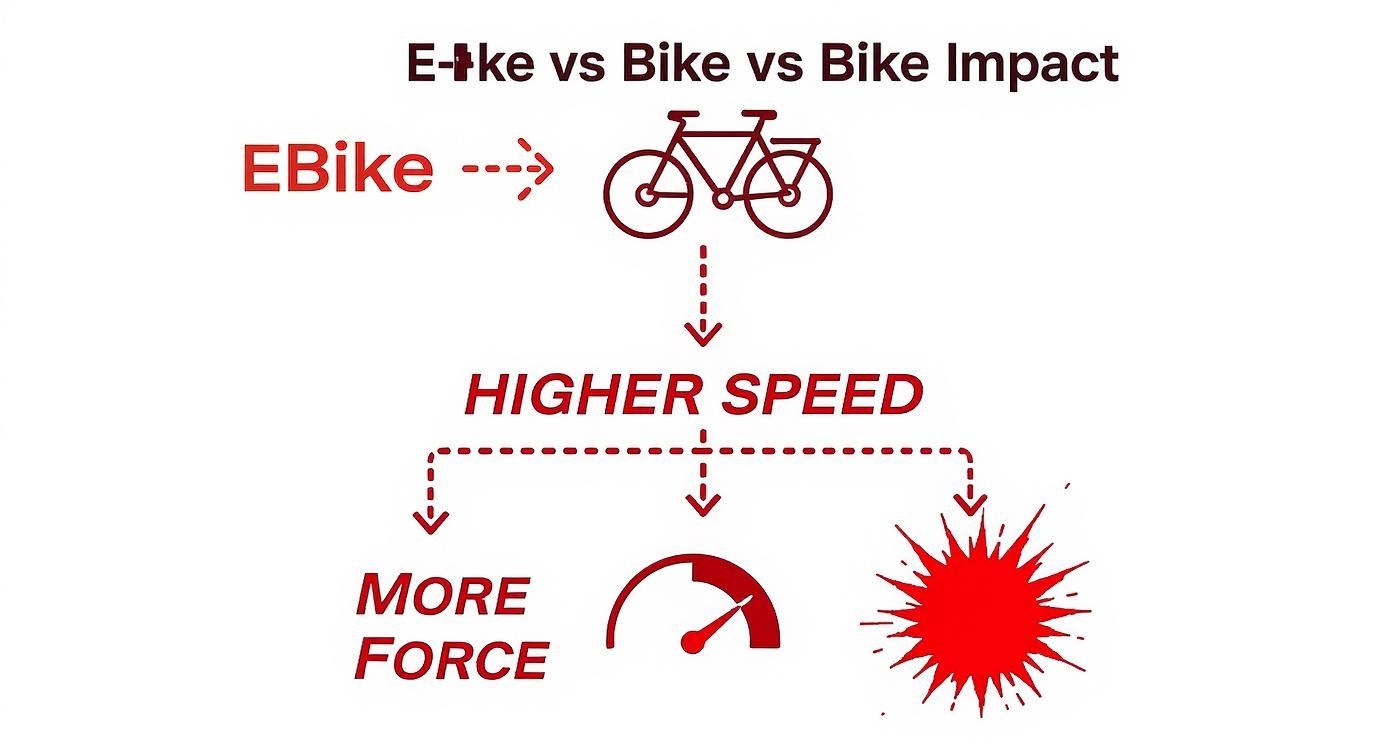
The key thing to see here is that the relationship isn't one-to-one. A small jump in speed results in a much bigger, more dangerous amount of energy in a crash.
The Gold Standard for Ebikes: NTA 8776
This is where the game changes. Recognizing this safety gap, the Netherlands developed NTA 8776, the world's first safety standard created specifically for speed pedelecs and ebikes. While it's a European standard, it has become the global benchmark for ebike safety, and many helmets sold in the US and Australia are now certified to it. When you see this certification, you know you're looking at a helmet built for the reality of zipping around town on electric power.
A helmet meeting the NTA 8776 standard is tested to withstand impact forces at speeds up to 28 mph (45 km/h). That's a huge leap from the testing speeds for standard CPSC helmets. This isn't just a minor tweak; it's a fundamental upgrade in protection.
So what does that actually mean for you, the rider? An NTA 8776-certified helmet gives you two massive advantages:
- Beefed-Up Impact Absorption: It's made with denser foam and a more robust construction to soak up the higher kinetic energy of an ebike crash.
- More Head Coverage: The standard demands more protection around the temples and the back of the head—vulnerable spots that are more likely to hit the pavement in a higher-speed fall.
Honestly, choosing a helmet with the NTA 8776 sticker is your best bet for ensuring your gear actually matches your bike's performance.
Navigating Ebike Helmet Laws
It's really important to remember that helmet laws can be a confusing patchwork of local and national rules. In Australia, helmets are mandatory for all cyclists, including ebike riders. In the United States, regulations change from state to state and often depend on the ebike class and the rider's age. For faster Class 3 ebikes (up to 28 mph), helmet laws are more common.
Because the laws vary so wildly, safety isn't about just squeaking by the legal minimum. Because you can cruise at your top speed for longer, an NTA 8776 helmet is still the smartest choice for any ebike rider. You can check out our guide on electric bike laws by state to get a clearer picture of what's required where you ride.
At the end of the day, learning these standards isn't just about ticking a legal box. It’s about making a smart, informed decision to protect yourself. When you're hunting for the best helmet for your ebike, looking for that NTA 8776 certification is a non-negotiable first step toward riding with true peace of mind.
The Tech That Actually Protects You
When you pick up a modern ebike helmet, you're not just holding a plastic shell with some foam inside. You’re holding a seriously engineered piece of gear designed to protect your brain from some pretty complex forces. While the basic foam handles a straight-on hit—think dropping a bowling ball—the most dangerous part of a real-world crash is almost always the spin.
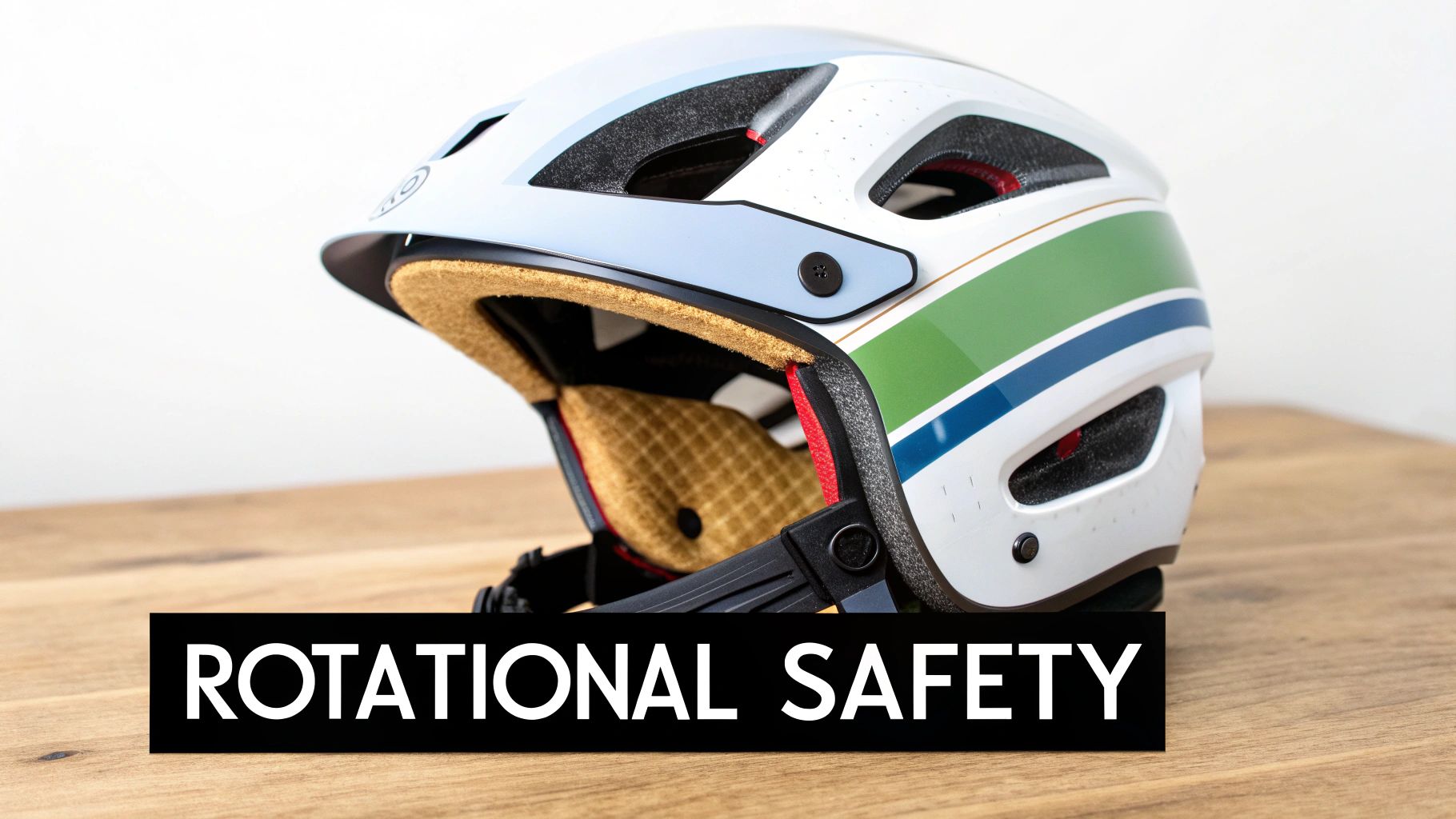
Let's be real: you almost never fall perfectly straight down on the top of your head. You hit the pavement at an angle. That angled impact creates a nasty twisting force on your head, causing your brain to slosh and shear inside your skull. That's the stuff concussions and serious brain injuries are made of.
So, How Do We Fight That Twist?
To deal with these rotational forces, helmet designers came up with rotational impact protection systems. The whole point of these systems is to let the helmet rotate just a tiny bit, independently from your head, when you hit the ground at an angle. This subtle movement helps redirect and absorb those damaging forces before they can jolt your brain.
Here’s an easy way to picture it. Think of the helmet having two layers: the hard outer shell and an inner liner that cradles your head. These systems create a "slip-plane" between them.
When you crash, the outer shell of the helmet can slide a few critical millimeters over that inner liner. It’s a tiny bit of movement that mimics your brain's own natural protective fluid, soaking up the rotational energy that would otherwise get transferred straight to you.
This technology is a total game-changer, especially for us ebike riders. We’re often moving faster and in traffic, which means an angled impact isn’t just possible—it’s the most likely scenario in a crash.
The Names You Need to Know
While the science is similar, you’ll see a few different brand names on the box when you’re shopping for the best helmet for ebike. Each one has a slightly different take on solving the same problem.
-
MIPS (Multi-directional Impact Protection System): This is the one you’ll see most often. It’s a thin, low-friction plastic liner (usually yellow) inside the helmet that allows for 10-15 millimeters of slip in any direction. Simple, but incredibly effective.
-
WaveCel: This looks completely different—like a wavy, plastic honeycomb filling the inside of the helmet. Instead of just sliding, WaveCel is built to flex, crumple, and glide. It absorbs energy in three stages, working to both slow down a direct hit and redirect those nasty rotational forces.
-
SPIN (Shearing Pad INside): This system uses special silicone-injected pads that sit right against your head. During a crash, these pads can shear and move in any direction, creating that crucial slip-plane effect to help diffuse the twisting forces.
Even though they look different, they're all tackling the same critical issue. Study after study has shown that helmets with this kind of tech can seriously reduce the strain on your brain in an angled crash. For any ebike rider, choosing a helmet with one of these systems isn't just a feature—it's a smart investment in your brain's future.
How to Find a Perfect and Comfortable Fit
Let’s be honest. The most advanced, tricked-out helmet on the planet is worthless if it's collecting dust in your closet. And the number one reason a helmet gets left behind? A lousy fit. A bad fit isn't just annoying—it completely undermines the helmet's ability to protect you when it counts.
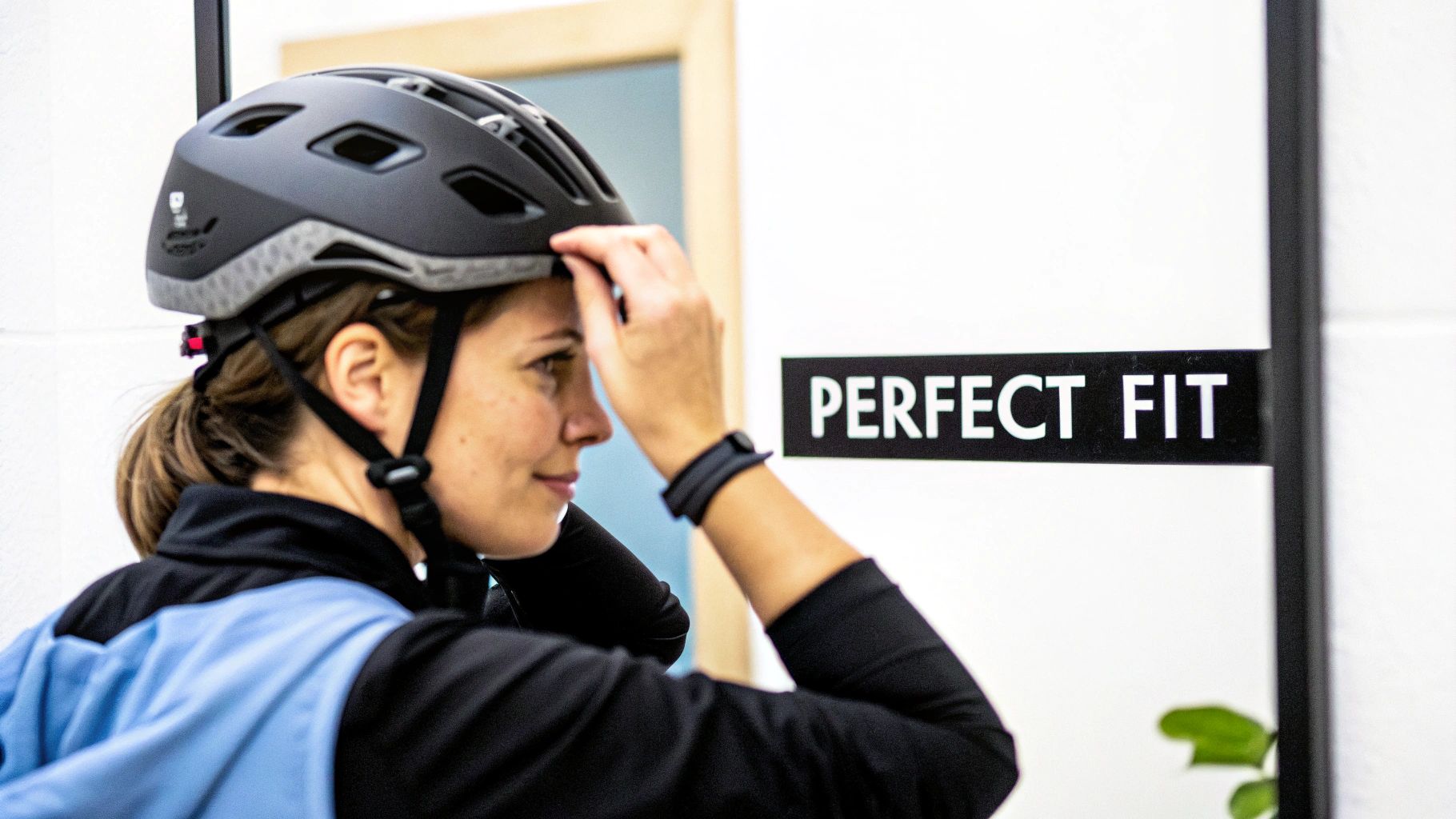
Think of a proper helmet fit like a custom cradle for your head. If you take a spill, it has to stay put to absorb and redirect all that nasty impact energy. Too loose, and it'll shift or fly right off. Too tight, and it’ll create painful pressure points that make you want to end your ride early.
Step 1: Start with the Right Measurement
Guessing your size is a surefire way to get a helmet that feels awful. The good news is that finding your starting point is super easy and takes less than a minute. All you need is a soft tape measure.
- Find Your Starting Point: Wrap the tape measure around the widest part of your head. For most people, that's about an inch (or two finger-widths) above your eyebrows and ears.
- Get the Number: Keep the tape level and snug, but don't yank it tight. Note the measurement in centimetres, since that's what most helmet brands use for their sizing.
- Check the Sizing Chart: Now you can confidently check your number against any helmet's sizing chart. Never assume a "Medium" in one brand is the same in another—they all run a little different.
Step 2: Fine-Tune the Fit for Maximum Safety
Once you’ve got a helmet that matches your measurement, it's time to dial in that perfect fit. Most modern helmets make this a breeze with a simple retention system, usually a small dial at the back.
Pop the helmet on your head so it sits level—not tilted back like a halo or pulled down over your eyebrows. Gently turn the dial until the helmet feels snug all the way around, with no uncomfortable pressure points.
A well-fitted helmet should be snug enough that when you shake your head from side to side, it doesn't wobble or slide around. It should feel like a firm, reassuring hug for your head.
Next, tackle the straps. The side straps should form a clean "V" shape that meets just below your earlobes. When you buckle the chin strap, you should be able to fit no more than one or two fingers between the strap and your chin. It needs to be tight enough to keep the helmet in place, but not so tight you feel like you're being choked out. We cover a few more tips in our guide on the best helmet for an electric scooter, and the same principles apply here.
Step 3: Don't Forget About Comfort and Ventilation
At the end of the day, the best helmet is the one you completely forget you're wearing. Comfort and safety are totally linked, because a helmet that feels good is a helmet you'll actually wear. A huge part of that comfort comes down to ventilation.
- Airflow is Key: You're not always working up a massive sweat on an ebike, but good airflow is still crucial to keep from overheating. Look for helmets with smart vent placement designed to channel air over your head.
- Padding Matters: The internal pads should feel soft, not scratchy. Most are removable and washable, which is a fantastic feature for keeping your helmet from getting funky.
Ultimately, comfort and safety are two sides of the same coin. A helmet that fits like a glove and keeps you cool is a helmet that will be on your head for every single ride, ready to do its job if you ever need it to.
Must-Have Features for Ebike Commuters
Once you've nailed down the safety ratings and got the fit just right, it's time to look at the features that can genuinely change your daily ride. We're not talking about gimmicks here; these are practical, real-world upgrades that solve the unique headaches ebike commuters face every day.

Think about it. On an ebike, you're moving faster than most cyclists, zipping through traffic, and often riding in less-than-perfect light. The right features can make a world of difference in how you see, how you're seen, and how comfortable you are out there.
See and Be Seen with Integrated Lighting
If there's one feature that's an absolute game-changer, it's integrated LED lighting. Putting lights high up on your head makes you ridiculously more visible to drivers than the standard lights mounted low on your bike frame, which can easily get lost in the sea of car headlights and traffic.
A bright white light on the front helps you pop in a driver's rear-view mirror, while a red light on the back grabs the attention of anyone coming up behind you. For city riding, this elevated position is a massive safety boost, especially when navigating busy junctions.
This isn't just a niche idea anymore. LED helmets are set to grab nearly 29.9% of the e-bike accessories market revenue by 2025. That kind of growth shows just how much riders value the real-world safety of being seen, especially on those dark morning and evening commutes. With the whole electric bike helmet market projected to hit USD 2.8 billion by 2032, it's clear these features are becoming the new standard.
The Clear Advantage of an Integrated Visor
Riding an ebike means dealing with higher speeds. And higher speeds mean more wind, more dust, more rain, and the occasional bug making a beeline for your eye. An integrated visor is the perfect fix. It acts as a shield, letting you keep your eyes on the road without wincing or getting distracted.
It's a much slicker solution than trying to cram a pair of sunglasses under your helmet straps. A built-in visor is there when you need it and flips up out of the way when you don't. This is a huge win for anyone who wears prescription glasses, as a good visor will fit right over them without any fuss.
For a daily commuter, a visor turns a windy, gritty ride into a calm, focused journey. It’s one of those things you'll wonder how you ever rode without.
This simple addition makes a massive difference to your ride quality, protecting your vision and cutting down on fatigue.
Small Details That Make a Big Difference
Beyond the big-ticket items like lights and visors, a few other thoughtful touches can take a helmet from good to great. These are the details that prove a helmet was designed by people who actually ride every day.
- Magnetic Buckles: Fiddling with a classic clip buckle with gloves on is a special kind of frustration. A magnetic buckle, like the ones from Fidlock, practically fastens itself, letting you clip in securely with just one hand. Easy.
- Reflective Accents: Active lights are great, but don't forget passive visibility. Reflective decals and straps are your best friend after dark. They catch and bounce back car headlights, making you glow from every angle.
- Ponytail Compatibility: A simple one, but crucial for riders with long hair. A helmet with a big gap in the rear retention system lets a ponytail pass through, so you get a secure, comfortable fit without your hair getting painfully bunched up.
These commuter-focused features, paired with the right safety tech, create a helmet that not only saves your skull in a crash but makes every single ride better. For more ways to upgrade your setup, check out our guide on the best electric bike accessories.
Are Smart Helmets the Future of Riding?
Ever thought your helmet could do more than just protect your head? Well, welcome to the world of smart helmets, where high-tech connectivity meets rider safety. This isn't just a gimmick; it's a genuine shift in how we view our most essential piece of gear.
Think about it: getting turn-by-turn directions whispered in your ear, taking a call without pulling over, or catching up on a podcast, all without ever touching your phone. Helmets with built-in Bluetooth make that happen, letting you keep your hands firmly on the bars and your eyes on the road.
A New Layer of Active Safety
But it's not all about convenience. These smart features bring a whole new level of active safety to your ride. Many come with a small remote you can mount on your handlebars to control turn signals on the back of the helmet. Suddenly, you're a lot more visible and predictable to the cars behind you.
And then there's fall detection. If you take a nasty spill, sensors in the helmet can detect the impact and automatically fire off a text to your emergency contacts, complete with your location. For anyone who rides alone, that feature is a potential lifesaver.
These aren't just flashy gadgets. They're thoughtfully designed safety systems that cut down on distractions while giving you a backup plan for when things go wrong.
It’s no surprise that riders are catching on. The smart helmet market is exploding, valued at USD 892.2 million in 2024 and expected to jump to a massive USD 2,314.6 million by 2030. That's a growth rate of 17.5% a year, which tells you just how much people want this blend of safety and smarts. You can discover more insights about the smart helmet market on Grandviewresearch.com.
So, Is a Smart Helmet Right for You?
Honestly, if you're a daily commuter who relies on your phone and wants the absolute latest in safety tech, it’s a no-brainer. These helmets make your ride safer, smoother, and just plain better.
They represent a real leap forward, moving helmets from being purely reactive protection to a proactive part of your safety system. For the modern urban rider, a smart helmet isn't just an accessory—it's becoming an essential tool.
Got Questions About Ebike Helmets? We've Got Answers.
Alright, we've waded through the tech, the safety ratings, and all the jargon. But you probably still have a few nagging questions bouncing around in your head. Let's tackle the most common ones so you can feel 100% solid about your choice.
How Often Should I Replace My Ebike Helmet?
This is a big one. The hard-and-fast rule is this: replace your helmet after any crash. Period. Even if it just looks a little scuffed up, the internal foam structure is likely compromised and won't protect you the next time. Think of it as a one-and-done safety device.
If you've managed to keep it crash-free, the clock is still ticking. Most folks in the know, including the manufacturers themselves, recommend a new lid every 3-5 years. Why? Because the materials—glues, plastics, and that crucial foam liner—break down over time from sweat, UV rays, and just general wear and tear.
Are More Expensive Ebike Helmets Actually Safer?
Not necessarily. A hefty price tag often gets you extra bells and whistles—think more vents for a breezier ride, lighter materials, or fancy integrated tech. But when it comes to the core job of protecting your brain, the safety certification is what counts.
A helmet with an NTA 8776 certification has passed the tests, whether it costs $50 or $250. The good news is that amazing tech like MIPS, which used to be a premium-only feature, is now found on helmets across all price points. You don't have to break the bank to get top-tier protection.
Can I Just Use a Motorcycle Helmet on My Ebike?
Technically, you could, but you really, really shouldn't. While a motorcycle helmet offers a massive amount of protection, it's the wrong tool for the job. They're heavy, incredibly hot (they're not designed for pedaling!), and they seriously limit your hearing and peripheral vision—two things you absolutely need to stay aware of your surroundings.
Motorcycle helmets are built to handle highway-speed impacts, making them total overkill for an ebike. Using one can actually make you less safe by cutting off your senses. Stick with a helmet designed for the speeds and dynamics of e-biking.
Getting the right helmet is the last, most important piece of the puzzle for a safe and awesome ride.
Here at Punk Ride, our whole deal is making sure you're protected without cramping your style. We build gear that keeps you safe while you're out there carving your own path. Check out our full lineup of electric rides and gear to get your setup dialed in. Find your next ride at https://www.punkride.com.
Share:
How to Compare E Scooters The Ultimate Buyer's Guide
Inflating Bike Tires A No-Nonsense Guide