


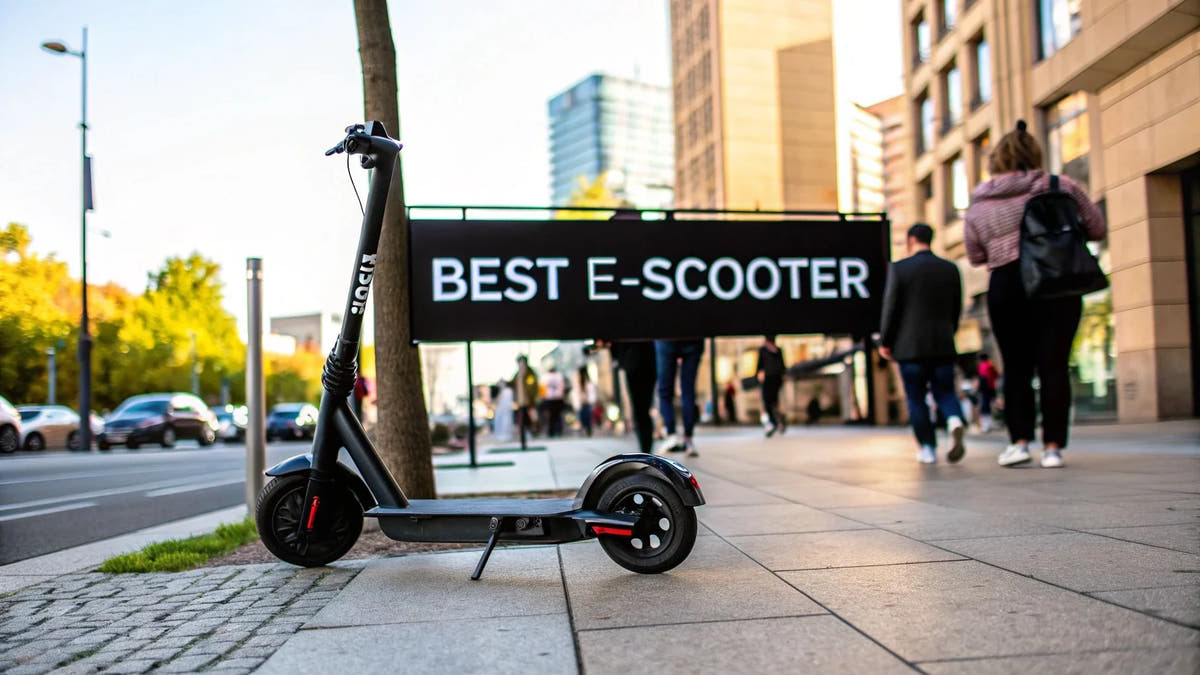
When people ask me for the "best electric scooter," my answer is always the same: it’s the one that fits your specific commute like a glove. It's all about finding that sweet spot between range, power, and portability. Brands like Hiboy and Segway are often in the mix, and for good reason—they build solid, reliable scooters perfect for daily travel, especially if you're riding in the US or Australia.
Why Your Daily Journey Needs an Upgrade
Picture this: you glide past a long line of cars stuck in traffic, you’re not worried about a delayed train, and the thought of gas prices doesn't even cross your mind. That’s not a fantasy; it’s just a normal morning with an electric scooter. This guide is here to help you find the best electric scooter for commuting, turning that daily grind into a part of the day you actually look forward to.
We're going to skip the confusing tech-speak and get straight to what matters for a real commuter. Forget memorizing specs—we'll show you what they actually mean for your ride.
What This Guide Covers
This isn't just a list of popular models. It's a deep dive into everything you need to know to make a smart choice, with a special focus on what US and Australian riders need. We’ll get into:
- The Essentials: We'll break down things like range, motor power, and battery life in simple terms.
- The Practical Stuff: We’ll look at how things like a scooter's weight and folding mechanism can make or break a commute that involves a train or bus.
- The Local Rules: We’ll give you a clear, no-nonsense look at the laws you need to know to ride legally and safely.
There's a reason you're seeing more and more electric scooters on the streets. As cities get more crowded and battery tech gets way better, people are catching on. The global market hit a massive USD 28.36 billion in 2024 and it's only getting bigger. All that growth means better scooters and more options for you. If you're curious, you can read more about the electric scooter market trends to see where things are headed.
Think of us as your experienced buddy in the scooter world. Our only goal is to help you pick a ride that genuinely makes your life easier, saving you time, money, and a whole lot of stress. Let’s find the scooter that’s going to completely change your commute.
What Scooter Specs Actually Matter for Commuters?
So you've decided an electric scooter is for you, and you start browsing. Almost immediately, you're hit with a wall of technical jargon: watts, amp-hours, IP ratings, and a bunch of other terms that sound like they belong in an engineering textbook. It’s overwhelming.
Let's cut through all that noise. I'll translate the most important specs into what they actually mean for your daily ride to work. Think of it like buying a car—you wouldn't just look at the paint colour, you'd want to know about its fuel efficiency and engine power. Same deal here. Getting these few key specs right is the difference between finding your perfect commuting partner and buying a scooter that dies halfway home.
A well-chosen scooter doesn't just get you from A to B; it fundamentally improves your day. It’s a chain reaction: you save time, which saves you money, and both of those things dramatically cut down on stress.

This simple idea is at the heart of why a good commuter scooter is such a game-changer for your quality of life.
To make this easier, here's a quick cheat sheet that connects the dots between the technical numbers and what you'll actually feel on the road.
Commuter Scooter Spec Cheat Sheet
| Key Spec | What It Means for Your Commute | Ideal for Short & Flat Routes | Ideal for Long & Hilly Routes |
|---|---|---|---|
| Range (miles/km) | How far you can go before needing to recharge. Your "fuel tank." | 10-15 miles (16-24 km) is plenty. | 25+ miles (40+ km) for peace of mind. |
| Motor Power (W) | Your scooter's "engine." Governs acceleration and hill-climbing ability. | 250-350W will do the job. | 500W or more is a must-have. |
| Suspension | The shock absorbers. The key to a smooth, comfortable ride over bumps. | Not essential, but nice to have. | Front and/or rear suspension is critical. |
| Tires | Your connection to the road. Determines ride quality and grip. | Solid tires are fine (no flats!). | Pneumatic (air-filled) for comfort. |
| Weight (lbs/kg) | How heavy it is to carry. A huge deal if you use public transport. | Under 30 lbs (13.5 kg) is great. | Can be heavier (40+ lbs) for more power. |
This table should give you a solid starting point for figuring out what to prioritize based on your specific daily journey. Now, let's break these down a bit more.
Your Scooter's Fuel Tank: The Battery and Range
The first question every commuter asks is, "Will this thing get me to work and back on a single charge?" That’s range, and it’s arguably the most critical spec of all.
But here’s a pro tip: take the manufacturer’s advertised range with a grain of salt. Those numbers are usually based on a feather-light rider on a perfectly flat road with a tailwind. That's not the real world.
A good rule of thumb? Take the advertised max range and knock off about 30% to get a realistic estimate. That gives you a buffer for hills, stop-and-go riding, and the weight of your backpack.
A scooter's range comes down to its battery capacity, measured in watt-hours (Wh). Think of Wh as the size of the fuel tank. An entry-level scooter might have a 250-350 Wh battery, but serious long-range models can pack over 700 Wh. Don’t just look at the advertised miles—check the Wh to know what you’re really getting.
The Engine Under the Hood: Motor Power
Next up is motor power, measured in watts (W). This is your scooter's engine, and it directly controls your acceleration and, most importantly, your ability to climb hills. A basic 250W or 350W motor is perfectly fine if your city is pancake-flat. But the moment you face a slight incline, you'll feel it struggle.
If your commute involves any real hills, you'll want to look for a motor with at least 500W of power. Anything less, and you might find yourself walking up the steeper parts. Some performance scooters even feature dual motors (one in each wheel), giving you awesome torque to fly up hills and rocket away from traffic lights. If you want to see how various models compare, you can explore this electric scooter comparison guide for a deeper dive.
Comfort is King: Suspension and Tires
Let's be honest, city streets are rarely smooth. You're going to hit potholes, cracks, and maybe even the odd cobblestone patch. This is where suspension and your tire type become your best friends, saving your knees and making the ride enjoyable instead of a bone-rattling chore.
- Tires: You've got two main choices here. Solid tires are great because they're puncture-proof, but they offer a very harsh, bumpy ride. Pneumatic (air-filled) tires, just like on a bike, are the way to go for comfort. They absorb so much of the road vibration, making them the better choice for most commuters, even with the tiny risk of a flat.
- Suspension: This is a total game-changer. While basic scooters often have none, a good commuter model should have at least front or rear suspension. The best of the best will have dual suspension (front and rear), which smooths out just about any bump the city can throw at you.
Practicality for the Daily Grind: Weight and Portability
Finally, don't forget about the "off-scooter" experience. If your commute involves hopping on a train or carrying it up a few flights of stairs to your office, the scooter’s weight and folding mechanism suddenly become incredibly important. A scooter that weighs over 44 lbs (around 20 kg) feels a lot heavier than you'd think after carrying it for more than a minute.
Look for a scooter that you can comfortably lift and a folding mechanism that is quick, easy, and secure. You want to be able to fold it up in seconds without a fight. These practical details are just as crucial as power or range because they determine how well the scooter truly fits into the rhythm of your daily life.
What Kind of Commuter Are You?
Let’s get one thing straight: there's no single "best" electric scooter for everyone. The best scooter is the one that fits your daily grind. Every commute has its own personality—its own challenges, quirks, and demands.
The secret is to figure out what kind of rider you are. Once you nail that down, the options suddenly become a lot clearer. You'll know exactly what features matter and which ones are just expensive dead weight for your specific needs.
We've broken down commuters into three main groups. See which one sounds like you.

The Last-Mile Dasher
Do you jump from a train to a bus, then need something to close that final gap to the office? If your commute is a mix-and-match of public transport and a short solo ride, you’re a Last-Mile Dasher.
For you, one word is king: portability. Your scooter has to be an accessory, not a burden.
- Your Main Goal: Find something light and easy to fold. We're talking scooters under 30 lbs (about 13.5 kg) that you can tuck under your arm to run up a flight of stairs or carry onto a packed train. A quick, no-fuss folding mechanism is a must.
- What to Look For: Sleek, compact designs are your friend. Don't worry too much about massive range; a 10-mile capacity is plenty for those short sprints.
- What to Skip: Forget about heavy-duty suspension or huge batteries. They just add pounds and dollars you don’t need to spend.
This need for convenience is a huge part of why the global electric scooter market is projected to hit an incredible USD 321.59 billion by 2034. Foldable models are leading the charge, especially in North America, because they solve this exact problem.
The Urban Explorer
You’re not just covering the last mile—your scooter is the whole journey. You ride from your front door straight to your destination, typically 3-8 miles (5-13 km) each way. You’re weaving through city streets, dodging potholes, and you need a ride that’s dependable day in and day out.
You’re an Urban Explorer, and you need a solid all-rounder.
- Your Main Goal: A perfect balance of range, comfort, and power. You'll want a real-world range of at least 15-20 miles (24-32 km) to get you there and back without any "range anxiety."
- What to Look For: Air-filled (pneumatic) tires are a game-changer for smoothing out rough city pavement. Look for at least front suspension and a motor between 350W and 500W—that’s the sweet spot for keeping up with traffic and tackling gentle hills.
- What to Skip: You can safely ignore the monster 1000W dual-motor scooters. A well-built, reliable single-motor machine is more than enough for city life and will save you money and weight.
Still on the fence about which two-wheeled ride is right? Our article comparing an electric bike vs scooter for commuting can help you sort it out.
The Power Commuter
Long distances? Steep hills? You’re not intimidated. Your commute is a serious trek, maybe over 10 miles (16 km) each way, with terrain that makes other scooters give up. Your e-scooter isn't just a gadget; it's your primary vehicle.
As a Power Commuter, you’re all about performance and rock-solid durability.
You're not buying a toy; you're looking for a legitimate car replacement. That means you need to be thinking about a powerful motor, a beefy battery, and top-tier safety features.
Here's what your checklist should look like:
- Serious Motor Power: Don't even look at anything under 500W. A dual-motor setup is often your best bet, giving you the raw torque to fly up hills without slowing to a crawl.
- Go-the-Distance Range: You need a big battery. Aim for a real-world range of 25 miles (40 km) or more. Peace of mind is priceless when you’re far from home.
- Next-Level Comfort: On long rides, comfort isn't a luxury; it's a safety feature. Dual suspension and big 10-inch pneumatic tires are non-negotiable for soaking up bumps and keeping you fresh.
- Serious Stopping Power: More speed means you need better brakes. Look for dual braking systems, especially disc or hydraulic brakes, for the most reliable control when you need it most.
Alright, let's talk about the least fun—but most important—part of owning an e-scooter: the rules. You've probably found a scooter that ticks all your boxes, but before you click "buy," you need to know if you can actually ride it where you live.
Navigating e-scooter laws can feel like a maze. They change constantly and can be wildly different from one country, state, or even city to the next. What's allowed in California might get you a fine in New South Wales. This isn't a legal textbook, but it’s a quick rundown to get you started so you can ride safely and without looking over your shoulder.
https://www.youtube.com/embed/_c0Le1S9CgU
The US: A State-by-State Puzzle
In the United States, there’s no single federal law for e-scooters. It’s a state-by-state, and sometimes even city-by-city, affair. This means you have to check your local rules.
- California: Generally treats e-scooters like bikes. You can ride them in bike lanes, the speed limit is typically 15 mph, and riders under 18 need a helmet.
- New York: E-scooters are legal statewide, with a top speed of 15 mph. However, individual cities can have their own rules, so always check what’s allowed in your specific borough or town.
- Florida: Has very permissive laws, basically allowing scooters to be ridden anywhere a bicycle can go.
The key takeaway for US riders is that "local" is the magic word. State laws provide a baseline, but your city or county might have its own specific rules about helmets, speed limits, or where you can ride.
Australia: A Tale of Different Territories
Like the US, Australia’s e-scooter laws vary significantly depending on the state or territory. Some areas have fully embraced them, while others are still in trial phases.
- Queensland (QLD): One of the most scooter-friendly states. Private e-scooters are legal on most local streets and paths, with speed limits of 12 km/h on footpaths and 25 km/h on bike paths and local roads.
- Australian Capital Territory (ACT): Similar to Queensland, the ACT allows personal mobility devices on footpaths and shared paths at 15 km/h and on bicycle paths and residential streets at up to 25 km/h.
- New South Wales (NSW): The rules here are much stricter. It is currently illegal to ride a privately-owned e-scooter on any public road or related area. Only rental e-scooters within specific trial areas are permitted.
Quick Notes on the UK and EU
While this guide focuses on the US and Australia, it's worth noting the different approach in Europe.
- United Kingdom: The legal situation is complex. Riding a privately owned e-scooter on public roads is still technically illegal. Only government-approved rental scooters are permitted in specific trial zones.
- European Union: Rules vary by country. Nations like Germany and France have established legal frameworks allowing e-scooters with certain speed and equipment requirements, making them a common sight in many cities.
The rules are always in flux. For a deeper dive, you can learn more about whether electric scooters are street legal in our dedicated guide.
Honestly, the best thing you can do is a quick Google search for "[your city] e-scooter laws." It's the fastest way to get the latest, most accurate info so you can start your commute with confidence.
Alright, you’ve done the hard work. You’ve crunched the numbers on range, figured out your commuter profile, and even waded through the local legal stuff. Now, it’s time for one last sanity check before you hit that "buy" button.
Think of this as your final pre-flight inspection. It’s easy to get star-struck by a high top speed or a slick design, but the best commuter scooter is the one that nails the boring, everyday stuff without a hitch. This little checklist pulls together everything we've talked about into a few straight-to-the-point questions.
The "Will It Actually Work for Me?" Check
First things first, let's get real about your daily grind. Be brutally honest here—a little wishful thinking can lead to a lot of frustration down the road.
- What's my real-world round-trip distance? Figure out your daily mileage and then immediately add a 30% buffer. Seriously. That scooter advertised with a 20-mile range will probably give you closer to 14 miles when you factor in hills, wind, and your own riding style.
- Am I dealing with hills? If your commute looks anything like San Francisco, you absolutely need a motor with at least 500W of power. Anything less, and you'll be chugging up inclines at a snail's pace... or just getting off to walk.
- Will I have to lug this thing around? Picture it: stairs at your apartment, a flight to the office, or hopping on the train. A scooter over 40 lbs (18 kg) gets surprisingly heavy, fast.
- How bad are my streets? If you're navigating a minefield of potholes and cracked pavement, you'll be begging for pneumatic (air-filled) tires and suspension. Trust me, a bone-rattling ride is fun for about five minutes. Every day? Not so much.
The "What Happens After I Buy It?" Check
The thrill of a new scooter wears off quickly if getting help or a spare part feels like a full-time job. This is where the long-term ownership experience comes in, and it's just as important as the specs.
The good news is, the whole e-scooter scene is blowing up. The global scooter sharing market is projected to hit USD 2.14 billion by 2025, and that boom means manufacturers are stepping up their game to provide better support for private owners like you. You can actually discover more insights about the scooter sharing market to see how this trend benefits everyone.
Before you pull the trigger, spend five minutes digging into the brand itself. A solid scooter from a company that actually answers the phone is worth way more than a top-spec machine from a ghost brand.
Here are the last few practical questions to tick off:
- What's the warranty situation? You want to see at least a one-year warranty covering the important bits, like the battery and motor. Don't just glance at it—read the fine print.
- Can I actually reach customer support? Is there a phone number? An email? See what other riders say in reviews. A company that's impossible to contact before you buy will be a nightmare when you have a problem.
- Can I get spare parts? Your scooter is a paperweight if you can't find a replacement tire or brake pads. Make sure the manufacturer or a trusted retailer like Punk Ride keeps common parts in stock. This is the secret to keeping your ride on the road for years, not months.
Simple Maintenance to Keep Your Scooter Rolling
You've got a great piece of kit there, a real game-changer for your daily commute. And just like a car or a bike, a little bit of love goes a long way. Spending just a few minutes a week on some basic checks will keep your scooter reliable, safe, and riding like it's brand new.

Think of it as a quick pre-ride ritual. This simple routine protects your investment and makes sure every trip is a good one, saving you from much bigger headaches later on.
Your Easy Weekly Check-Up
Don't worry, you don't need a full mechanic's toolkit for this. We're talking about a quick, five-minute scan to spot any little issues before they grow into real problems. This is how your best electric scooter for commuting stays that way.
Here’s your simple checklist:
- Tire Pressure is Everything: If you have air-filled (pneumatic) tires, this is your number one job. The right pressure means fewer flats, a smoother ride, and even better battery range. Just find the recommended PSI on the side of the tire and use a standard bike pump to top them up.
- Brake Check: Give the brake levers a good squeeze. They should feel firm, not mushy. Then, give the scooter a little push forward and hit the brakes—you want to feel a sharp, confident stop.
- A Quick Tighten: Grab the handlebars and give them a gentle wiggle. Do the same for the folding mechanism. Everything should feel solid, with no rattles or wobbles. Road vibrations can slowly loosen things over time, so a quick check is always smart.
Caring for Your Scooter's Heart: The Battery
Your scooter's battery is its most important—and expensive—part. Taking good care of it is the secret to a long and happy life, often 500 to 1,000 charge cycles or even more. You don't need to be a tech wizard; just follow a couple of golden rules.
The sweet spot for long-term battery health is keeping its charge between 20% and 80%. Try to avoid draining it all the way to 0% or leaving it plugged in at 100% for days on end.
Stick to these simple habits:
- Charge After Riding: It’s much healthier for the battery to be topped up after a ride than to be left sitting on empty.
- Use the Right Charger: This is a big one. Always, always use the charger that came with your scooter. An off-brand one might have the wrong voltage and could seriously damage your battery.
- Avoid Extreme Temps: Don't leave your scooter to bake in the hot sun or freeze in the winter cold. Extreme temperatures are a battery killer. If you have to park it outside, try to bring the battery indoors to charge at room temperature.
Got Questions? We've Got Answers.
Alright, so you've got your list narrowed down, but a few nagging questions are probably still bouncing around in your head. It's totally normal. Let's tackle some of the most common ones I hear so you can make that final decision with total confidence.
How Long Does an E-Scooter Battery Actually Last?
This is the big one, and it's a two-part answer. First, there's how far you can go on a single charge, but second—and more important for the long haul—is the battery's total lifespan.
Think of it like this: a quality lithium-ion battery in a scooter is good for about 500 to 1,000 full charge cycles. A "cycle" isn't just plugging it in; it’s one full drain from 100% down to 0%. So, if you only use 50% of your battery on your daily commute and then top it off at night, that only counts as half a cycle.
For the average daily commuter, this works out to a solid 3 to 5 years of service before you'd start to see a noticeable dip in performance.
Can I Ride My Scooter in the Rain?
Short answer: they're water-resistant, not waterproof. To know how resistant, you need to look for the IP (Ingress Protection) rating. It's a two-digit code, but for rain, you only need to worry about the second number.
For commuting, look for a minimum of IPX4. That means it can shrug off splashes from any direction, so hitting a puddle or getting caught in a light shower isn't a death sentence. Something with an IPX6 rating is even better, giving you more protection against stronger jets of water.
Just remember, no e-scooter is a submarine. It's always smart to avoid torrential downpours and never, ever fully submerge it. Water damage is the one thing that warranties almost never cover.
Is Learning to Ride Hard?
Not at all! This is one of the best parts about scooters—they're incredibly easy to pick up. If you ever rode a kick scooter as a kid, you’re practically a pro already.
Honestly, most people get the hang of it in the first 10 to 15 minutes. Find an empty parking lot or a park with some open space. Get a feel for the throttle, practice some smooth, gentle stops, and make a few wide turns. You'll be zipping around confidently before you know it, and your commute will feel less like a chore and more like a bit of fun.
Ready to turn your daily commute into the best part of your day? Punk Ride has a hand-picked selection of awesome brands like ISCOOTER, AOVO, and more, all supported by our local warehouses in the USA, UK, and Germany.
Find your perfect ride today at https://www.punkride.com.


Share:
Your Guide to an Electric Bike for Commuting
How to Compare E Scooters The Ultimate Buyer's Guide