


The best ebike for trail riding is whatever bike best fits the trails you actually ride. For flowy singletrack, a versatile trail ebike with 130-150mm of suspension travel is your sweet spot. But if you're chasing adrenaline on steep, technical descents in places like Moab or the Blue Derby, you'll want the beefy confidence of an enduro ebike with 160mm or more of travel.
It's all about matching the bike's personality to your own brand of adventure.
Finding Your Perfect Trail Ebike
Jumping into the world of electric mountain bikes can feel like you’re suddenly trying to read a foreign language. All at once you’re hit with terms like "travel," "torque," and "geometry," and it's easy to get analysis paralysis. But don't sweat it. Finding the right e-MTB is way simpler than it looks once you break it down.
Think of it like picking shoes for a hike. You wouldn't grab flimsy trainers to scale a rocky peak in the Sierras, and you wouldn't lace up heavy-duty boots for a casual park walk. The same logic applies here—the goal is to match the bike's features to the dirt you plan to shred.
Let's cut through the jargon. This guide will be your translator, turning all that tech-speak into real, practical advice so you can find a bike that's a blast to ride.
Start With Your Riding Style
Before you even look at a single bike spec, get real with yourself about where and how you ride. This one honest answer will instantly shrink your list of options and save you from dropping cash on features you'll never use.
So, what does your ideal day on the trail look like?
- Flowing Forest Loops: We’re talking smooth, winding singletrack with some fun climbs and descents that don't get too rowdy.
- All-Mountain Adventures: You want a bit of everything—grinding up long climbs, flying down fast descents, and navigating some chunky, technical sections.
- Aggressive Descents: Your happy place is pointing the bike downhill on steep, rocky, root-infested tracks where high-speed control is everything.
Choosing the right bike is about enhancing the fun. The perfect e-MTB feels like a natural extension of you, giving you the confidence to push your limits and explore further than ever before.
And you're not alone. The electric mountain bike scene is exploding, with the global market estimated at USD 8.08 billion in 2024 and projected to hit a massive USD 13.89 billion by 2030. It's all fueled by a shared love for getting out there.
Matching the Ebike to the Trail
Knowing your style makes choosing a category much easier. A hardtail ebike (that's one with only front suspension) could be perfect for smoother trails, giving you a more direct, connected feel. For bigger, rougher adventures, a full-suspension rig is non-negotiable—it soaks up bumps like a champ, giving you way more traction and control when things get hairy.
This ultimate guide to off-road electric bikes is a great resource if you want to dig deeper into all the options out there.
You’ll also want to get familiar with core concepts, like motor types. A mid-drive motor, for example, powers the bike right at the pedals, which is incredibly efficient and natural-feeling, especially on steep climbs. They are the go-to for serious trail riding, and you can learn more about them at https://www.punkride.com/blogs/news-advice/best-mid-drive-electric-bike.
Quick Guide: Which Trail Ebike Is Right for You?
Still trying to connect the dots? This table should help you quickly match your trail ambitions to the right kind of ebike.
| Trail Type | Primary Ebike Category | Key Feature to Look For |
|---|---|---|
| Gentle Fire Roads & Smooth Paths | Hardtail e-MTB | 100-120mm front suspension fork |
| Flowing Singletrack & Rolling Hills | Trail e-MTB | 130-150mm full suspension |
| Steep Climbs & Technical Descents | All-Mountain e-MTB | 150-160mm full suspension, powerful brakes |
| Bike Parks & Aggressive Downhill | Enduro e-MTB | 160-180mm full suspension, slack geometry |
Use this as a starting point. It’s a simple way to make sure you're looking at bikes that are actually built for the kind of fun you want to have.
What's Under the Hood? Ebike Motors and Batteries Explained
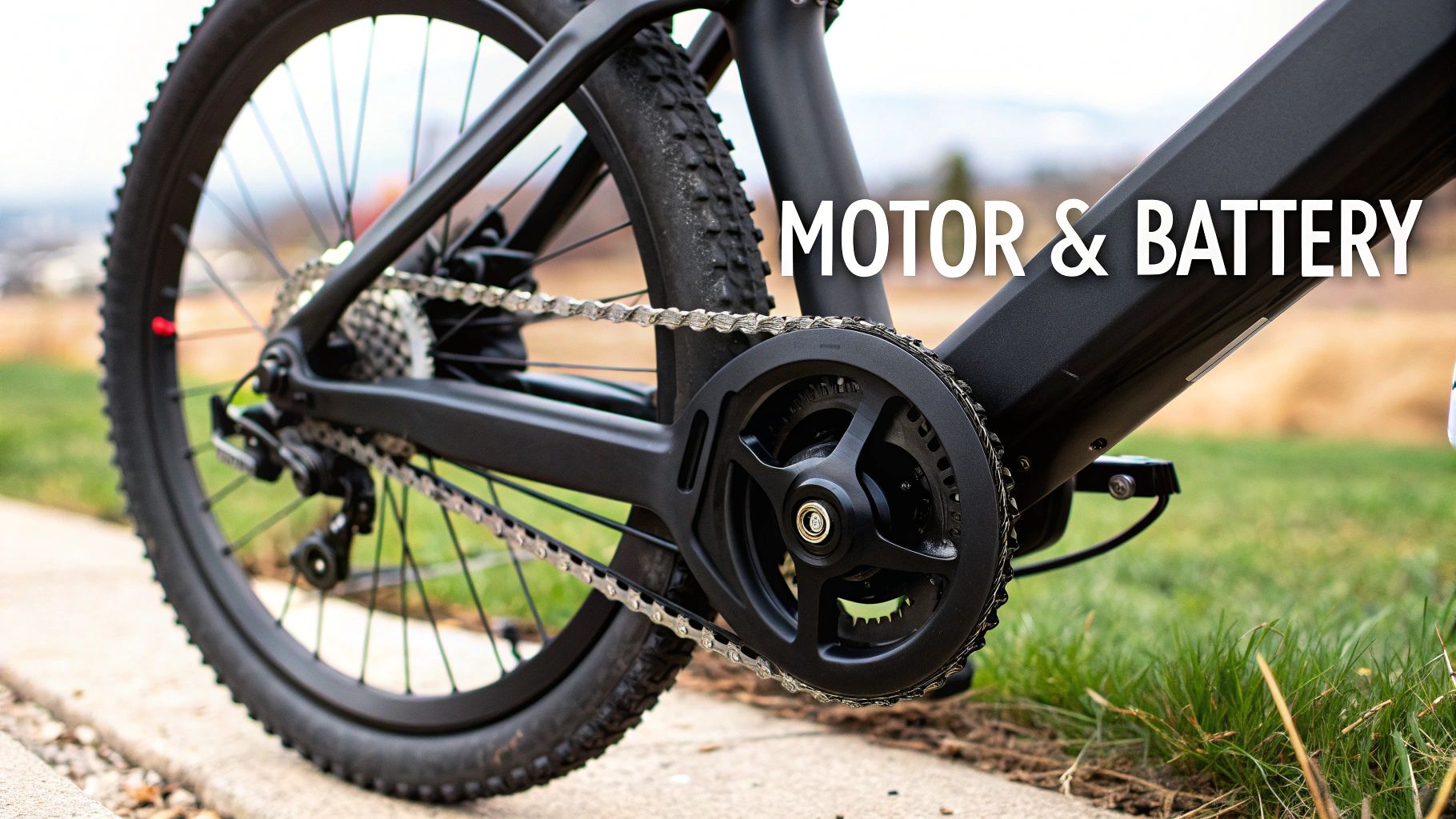
If you think of the frame and suspension as the skeleton of your trail ebike, then the motor and battery are its heart and lungs. This is the powerhouse that transforms a leg-shredding climb into a grin-inducing challenge. It’s what stretches a quick after-work loop into an all-day epic.
Getting a handle on these components is the single most important step in finding a trail ebike that actually works for you. The spec sheets can look like a foreign language, but they tell a simple story about how the bike will perform when the dirt gets steep. Let's cut through the marketing jargon.
Mid-Drive vs. Hub-Drive: An Easy Choice for the Trail
First things first, you need to know where the motor is located. For real trail riding, this is less of a choice and more of a foregone conclusion, but it's crucial to understand why.
-
Mid-Drive Motors: These guys are mounted right down by your pedals, at the bike's bottom bracket. The genius here is that the motor drives the chain, just like your legs do. This means it can take full advantage of the bike's gears, delivering efficient power whether you're slowly grinding up a rocky pitch or flying down a smooth fire road. That natural feel and smart power delivery make it the undisputed champ for trail riding.
-
Hub-Drive Motors: As the name suggests, this motor lives inside the hub of the rear wheel. It basically just pushes the wheel directly. While they're perfectly fine for city bikes and cruising on flat paths, they tend to feel clunky on technical trails. They can't use the bike's gears, which means they can bog down on steep climbs, and the extra weight on the wheel can mess with how your suspension works.
For anyone serious about hitting the trails, a mid-drive motor is the only way to go. Its ability to work with the gears gives you the torque and control you need to tackle whatever the trail throws at you. The boom in high-performance e-MTBs is all thanks to this technology, which is why you'll see motors in the 250W to 750W range dominating the US and Australian markets.
Let's Talk Torque and Grunt
Okay, so you've narrowed it down to a mid-drive. The next spec you’ll see is torque, measured in Newton-meters (Nm).
Don't let the term scare you. Torque is just the motor's raw grunt—its rotational force. This is what gets you moving from a dead stop on a steep incline or plows you through a thick patch of mud. The higher the Nm, the more oomph you'll feel. For proper trail riding, you want a motor with at least 60Nm of torque, while the real powerhouses are putting out 85Nm or even more.
Think of it like this: A motor with 85Nm of torque is like having a buddy give you a strong, steady shove up the hill. A motor with 50Nm is more like a gentle nudge. You'll definitely want the shove.
Battery Capacity: Your Ticket to Ride Farther
If the motor is the heart, the battery is the fuel tank. Its capacity is measured in Watt-hours (Wh), and it’s a simple equation: a bigger Wh number means a bigger fuel tank and a longer ride.
Most trail ebikes today come with batteries somewhere between 500Wh and 750Wh, and some monsters are now pushing past 900Wh. A 500Wh battery is fine for shorter jaunts of an hour or two. But if your goal is to get lost (in a good way) on all-day adventures, you'll be much happier with 625Wh or more.
Just remember, your actual range depends on more than just the battery size. Your weight, the terrain, and which assist mode you're using all play a huge role. For a deep dive, check out our guide on how to maximize your electric bike battery life. It’s all about finding that sweet spot between your riding dreams, the bike's weight, and your budget.
Getting a Grip: Why Suspension, Brakes, and Geometry Are Everything
All that power from the motor and battery is worthless if you can't stay in control. Seriously. A beast of a motor won't do you any good if you’re white-knuckling it down every hill, praying you don't go flying off the trail.
This is where the real magic of a great trail ebike happens. It's not just about the "e" part; it's about the bike itself. We're talking about the holy trinity of trail riding: suspension, brakes, and geometry. These three things work together to keep you glued to the dirt, comfortable, and confidently in charge.
Let’s pull back the curtain and see what makes these components tick.
Suspension: Your Ticket to a Smoother Ride
Think of suspension as your bike's ability to swallow bumps. It’s what keeps your tires stuck to the ground instead of bouncing off every root and rock, which is exactly where you get your grip and control. For trail ebikes, you've got two main flavors.
-
Hardtail: This is a bike with suspension only in the front fork. It's a simpler, lighter setup that feels incredibly connected to the trail. Hardtails are perfect for tamer, flowy singletrack and for riders who want to feel every bit of the terrain. They’re also a bit easier on the wallet.
-
Full-Suspension: Now we're talking. This is the undisputed king of rough trails. With a suspension fork up front and a shock absorber in the back, both wheels can move independently to soak up hits. The result? Insane traction when you're climbing up chunky stuff and a magic-carpet-like feel when you're bombing back down.
The big number you'll hear thrown around is suspension travel—basically, how much the suspension can compress. More travel equals a bigger appetite for bumps. A shorter-travel bike (around 120-130mm) will feel snappy and efficient, while a long-travel beast (160mm+) is built to plow through the gnarliest rock gardens without even flinching.
Brakes: Because Stopping Is Not Optional
Here's a simple fact: ebikes are heavier and faster than their analog cousins. That means you need brakes that can handle the extra muscle. When you're pointed downhill on a trail full of loose dirt and surprise switchbacks, weak brakes are a recipe for disaster.
This is why hydraulic disc brakes are an absolute must-have. Don't even consider anything else.
Unlike old-school brakes that use a cable, hydraulic systems use fluid, kind of like the brakes in your car. This gives you way more stopping power with a lot less effort at the lever. You get incredible control with just one or two fingers, which is a lifesaver on long descents when your hands start to get tired.
When you’re flying down a trail, the last thing you want to question is whether you can stop. Powerful, reliable hydraulic disc brakes provide the confidence you need to push your limits safely.
Pay attention to the size of the rotors (the metal discs). Look for big ones, usually 180mm or even 200mm. A larger rotor gives you more braking leverage and does a much better job of shedding heat, which prevents your brakes from feeling weak and spongy on those long, steep runs.
Geometry: The Secret Sauce of a Great Bike
Geometry sounds like a term that should have stayed in high school math class, but on a trail bike, it’s everything. It’s the collection of angles and tube lengths that define the bike's personality and how it feels to ride. Two key measurements tell most of the story.
-
Head Tube Angle: This is the angle of the front fork. A "slacker" angle (a smaller number, like 64-65 degrees) kicks the front wheel further out in front of you. This makes the bike feel incredibly stable and confidence-inspiring when you're pointed down something steep and fast. Think of it as the bike's "chill" factor.
-
Seat Tube Angle: This is the angle of the tube your seat is attached to. A "steeper" angle (a bigger number, like 76-78 degrees) moves your hips more directly over the pedals. This is a huge deal on an ebike because it puts you in a powerful position for climbing and helps keep the front wheel from wandering or lifting off the ground on really steep sections.
The sweet spot is a bike with modern, balanced geometry—slack enough to give you courage on the descents but steep enough in the seat to make climbing feel like you've got superpowers.
Matching the Right Ebike to Your Trail
https://www.youtube.com/embed/dN4TapTk5No
Alright, so you’ve got a solid grasp of the core components—motors, batteries, frames, all that good stuff. Now comes the really fun part: figuring out how all that tech translates to the actual dirt you'll be shredding. Honestly, finding the best ebike for trail riding is less about specs and more about being real with yourself about where and how you want to ride.
Think of it this way: you wouldn't bring a tiny framing hammer to a demolition job. Different tools for different tasks, right? The same idea applies here. Not all trail ebikes are created equal, and picking the right category of e-MTB is the secret to unlocking more fun, building your confidence, and feeling totally in sync with your bike.
Let's break down the main flavors of electric mountain bikes so you can see which one is practically screaming your name.
The All-Rounder Trail Ebike
This is your Swiss Army knife, the jack-of-all-trades that’s happy pretty much anywhere you point it. A classic Trail ebike typically rocks 130mm to 150mm of full suspension travel. That’s the sweet spot—enough cushion to soak up chunky, root-filled sections without feeling like a monster truck on smoother, flowy trails.
The geometry is perfectly balanced between aggressive and relaxed, which makes it a surprisingly good climber that’s still an absolute riot on the way back down. If your ideal ride involves exploring new trail networks, ripping around forest loops, and tackling a mix of moderate climbs and descents, this is your bike. It’s the ultimate do-it-all machine for the rider who wants a taste of everything.
The Gravity-Focused Enduro Ebike
If your riding philosophy is "the steeper and rougher, the better," then you're speaking the language of Enduro. These bikes are built for one thing: smashing downhills with absolute authority. We're talking beefy frames, a whopping 160mm to 180mm of suspension travel, and super slack, confidence-inspiring geometry. An Enduro ebike is all about staying stable and in control when gravity is doing its best to throw you off.
Everything on these bikes is bigger, stronger, and built to take a beating, from the massive brake rotors to the tough, grippy tires. On an Enduro rig, the motor has one primary job: get you back to the top of the next gnarly descent with as little effort as possible. If you live for bike park laps or spend your weekends hunting for the scariest black-diamond trails, an Enduro bike will feel like coming home.
The Efficient Hardtail E-MTB
Don't mistake simplicity for a lack of capability. A hardtail e-MTB, with its front suspension fork (usually 100-130mm) and rigid rear end, delivers a snappy, connected, and incredibly efficient ride. It's the perfect tool for smoother singletrack, fast-rolling gravel paths, and forest service roads where the added weight and complexity of a rear shock just aren't necessary.
This little decision tree can help you visualize whether a hardtail or full-suspension bike is the right call for the trails you ride most.
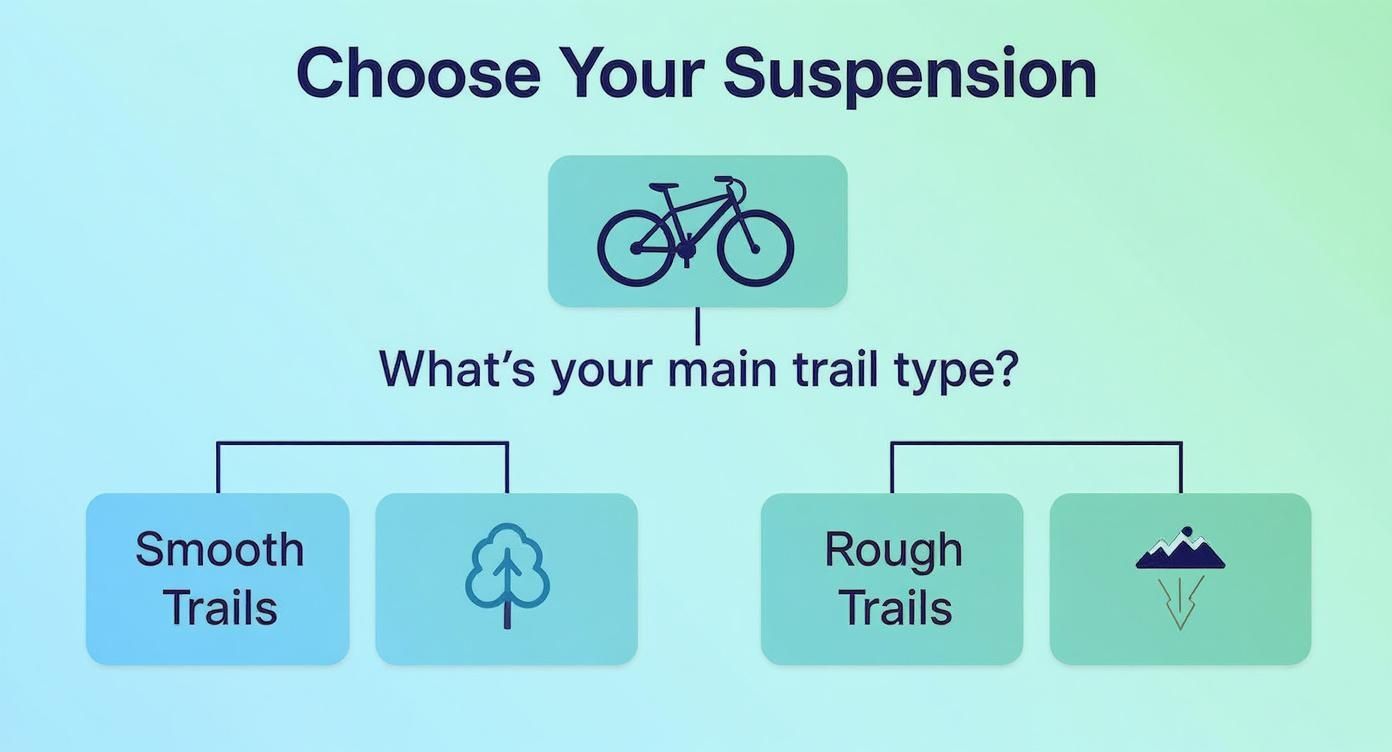
The big takeaway? For less gnarly terrain, a hardtail’s efficiency and lower maintenance can be a huge win.
Plus, riding a hardtail forces you to become a better rider by picking smarter lines. They're often lighter and more affordable, too, which makes them a killer entry point into the sport. This blend of value and performance is a huge reason why mountain and trekking ebikes are the biggest slice of the global market, making up over 25% of all sales. Within that, the hardtail is king, holding a massive 58.3% market share, according to this electric mountain bike market analysis.
Choosing your category is all about matching the bike's personality to your own. A trail bike wants to explore, an enduro bike lives for the descent, and a hardtail thrives on pure speed and efficiency.
If your adventures might include a little sand or snow along with the usual dirt, checking out bikes with wider tires can be a brilliant move. Our fat tire electric bike reviews can give you the lowdown on how those burly machines handle different surfaces.
To pull it all together, here’s a quick-glance table comparing the different e-MTB styles.
E-MTB Category Breakdown
This table compares the main electric mountain bike categories to help you match the right style to your riding.
| Ebike Category | Typical Suspension Travel | Best For... | Key Strength |
|---|---|---|---|
| Hardtail | 100-130mm (front only) | Smoother singletrack, gravel paths, fire roads, and general fitness riding | Efficiency, low maintenance, value |
| Trail | 130-150mm (full) | A wide variety of terrain, from flowy loops to technical climbs/descents | All-around versatility, balance |
| Enduro | 160-180mm (full) | Steep, aggressive descents, bike parks, and the most technical trails | Downhill stability and control |
At the end of the day, picking the right category ensures you get a bike that doesn't just work, but feels like it was made just for you and the trails you love.
Getting Your Sizing and Setup Right
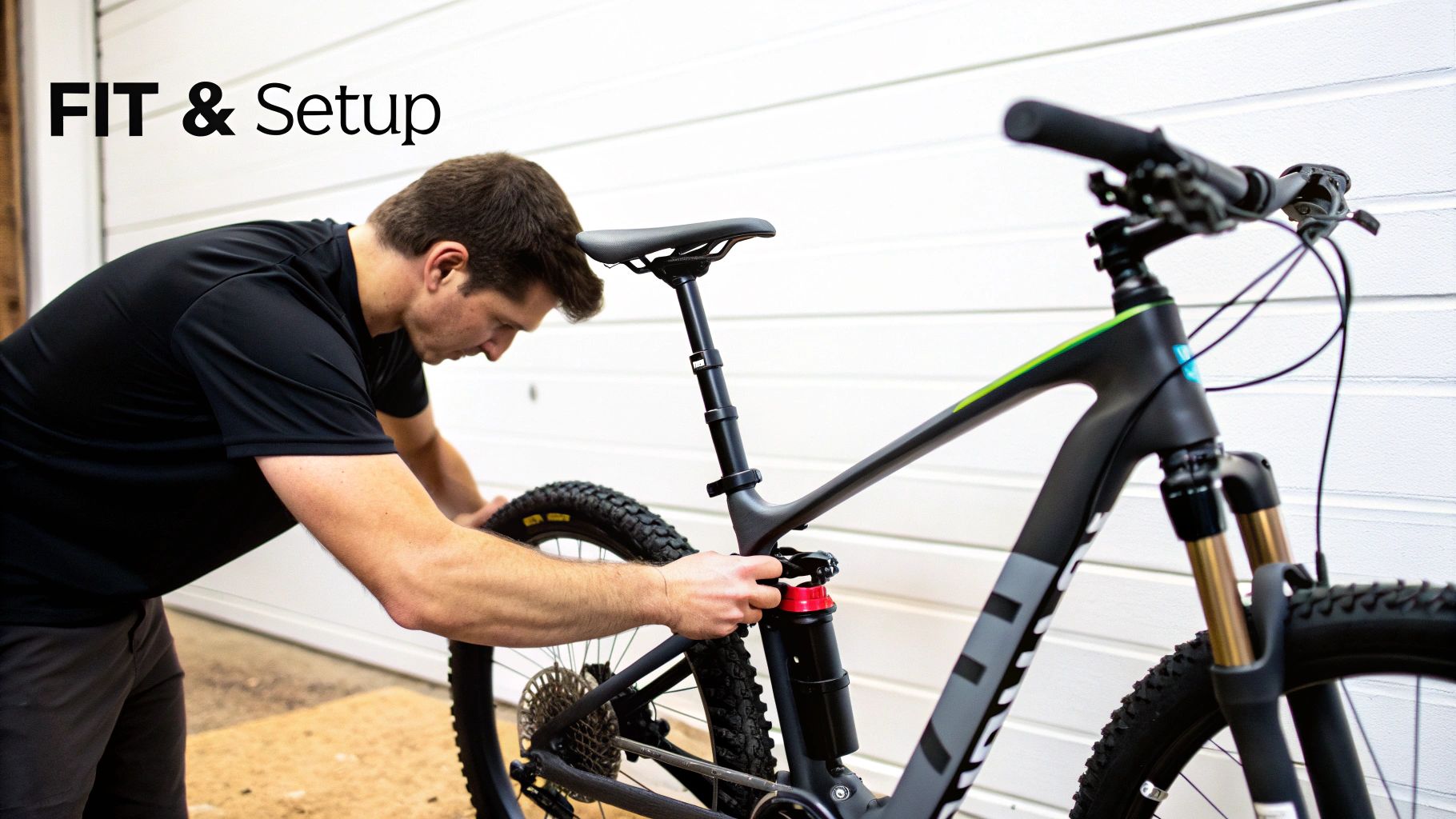
Finding the perfect bike is a huge win, but your work isn’t done just yet. The real magic happens when you transform that off-the-shelf bike into something that feels like an extension of your own body. It’s like buying a great suit—it's not truly yours until it's tailored.
A proper fit isn't just about avoiding a sore back. It's the key to unlocking control, confidence, and power on the trail. Getting your sizing and setup dialed in is what turns a good bike into the best ebike for trail riding for you.
Cracking the Code of Sizing Charts
Your first stop is always the manufacturer's sizing chart. These usually match your height to a frame size (Small, Medium, Large, etc.), and they’re a decent starting point. But don't treat them as the absolute truth.
Here’s the thing: human bodies aren't built to a template. Two people who are six feet tall can have wildly different leg and torso lengths. That's why I always tell people to look at the reach number on the geometry chart—it’s the horizontal distance from where you stand over the pedals to the handlebars. It gives you a much better feel for how stretched out you'll be.
Honestly, the ultimate test is always a test ride. Numbers on a screen can't tell you how a bike feels. A quick spin around the block can reveal more about fit than hours of online research ever will.
Simple Adjustments for a Perfect Fit
Once you’ve got the right size frame, a few simple tweaks can make all the difference. You don’t need to be a pro mechanic to nail these basics, but they’re absolutely crucial.
Here’s a quick rundown of what to adjust first:
-
Saddle Height: This is the most important one for pedaling power. A great starting point is to sit on the saddle and put your heel on the pedal at its lowest point. Your leg should be almost completely straight. This gives you that perfect, slightly bent knee when you’re actually pedaling.
-
Brake Lever Position: Your levers should be angled down so your wrists are straight when you're in your attack position. You shouldn't have to awkwardly bend your wrist up or down to grab them.
-
Brake Lever Reach: Most modern brakes have a tiny dial or screw to adjust how far the lever sits from the handlebar. Set it so you can comfortably hook your index finger around it and pull with authority.
These little changes mean you have maximum control and won't get tired as fast, letting you just focus on the fun part—the trail.
Essential Gear for Every Trail Rider
Okay, your bike is dialed. Now it's time to gear yourself up. Having the right kit isn't about looking cool; it’s about staying safe and being ready for whatever the trail throws at you.
You don't need a truckload of stuff, but these are the non-negotiables:
- A Quality Helmet: This is not optional. Seriously. Look for a modern trail-specific helmet that gives you good coverage, especially around the back of your head.
- Gloves: A good pair of full-finger gloves will save your palms from getting shredded in a crash and dramatically improve your grip.
- Hydration: Whether you use a water bottle or a hydration pack, always bring more water than you think you'll need. Always.
- Basic Repair Kit: At the bare minimum, carry a spare tube, tire levers, and a multi-tool. Knowing how to fix a flat will save you from a very long, sad walk back to the car.
Getting your setup and gear right from the start gives you the confidence to push your limits, explore further, and just have a better time out there.
Know the Rules: Trail Etiquette and Local Laws
Riding an ebike on the trails isn't just about sending it down a dirt path—it comes with a responsibility to the land and the people you share it with. If we want to keep access to the amazing places we love to ride, we all have to be good ambassadors for the sport.
This is a big deal, especially in places like the US and Australia where the rules can feel like a patchwork quilt, changing from one park to the next. The biggest piece of this puzzle is the ebike class system.
Cracking the Code: Ebike Classes in the US
In the States, ebikes are generally broken down into three classes, and which one you have determines where you’re allowed to ride.
- Class 1: This is your classic pedal-assist. The motor only kicks in when you're pedaling, and it cuts out at 20 mph (32 km/h). These are the most widely accepted eMTBs on trails that also allow regular mountain bikes.
- Class 2: These bikes have a throttle. You can get a boost up to 20 mph (32 km/h) without even pedaling. Because of that throttle, they're often lumped in with motorized vehicles and banned from non-motorized singletrack.
- Class 3: Think of this as a speedier commuter. It’s pedal-assist only, but the motor keeps helping you all the way up to 28 mph (45 km/h). Their speed makes them a no-go for most dirt trails; they're meant for roads and bike paths.
When it comes to trail riding in the US, a Class 1 ebike is your golden ticket. It'll give you the most access, hands down. But remember, the final say always comes from the local land manager. What's cool in a national forest might get you a ticket in the state park next door, so always, always check the local rules before you head out. In Australia, the rules are generally simpler, with a nationwide limit of 250W and a 25 km/h pedal-assist cut-off, but it's still vital to check local trail signage.
The Unwritten Rules of the Trail
Beyond the official signs and regulations, there’s an unwritten code of conduct that keeps the trails a friendly place for everyone. It’s on us e-bikers to lead by example.
Trail etiquette boils down to one simple idea: be a good human. Respect the trail, respect the animals, and respect everyone else out there. A simple "howdy" or "g'day" and a smile can make all the difference.
Keep these simple principles in mind:
- Who Goes First? The rider heading uphill has the right of way—they're working the hardest! Bikers should always yield to hikers and horses, too. A quick heads-up and a slow pass are all it takes.
- Leave No Trace: Simple. If you pack it in, you pack it out. And please, stay off the trails when they're a muddy mess. Tearing up wet singletrack ruins it for everyone and creates a ton of work for trail crews.
- Chill on the Speed: Yeah, your ebike can fly, but that doesn't mean you should be going full-send around every corner. Keep your speed under control, especially on blind turns where you could run into someone unexpectedly.
Common Questions About Trail Ebikes
Alright, even after you've got the main details down, a few questions always seem to pop up as you get closer to pulling the trigger. Think of this as the final once-over to knock out any last-minute doubts and give you that solid "I got this" feeling before you commit.
Let's dive into some of the questions we hear all the time.
How Much Maintenance Does a Trail Ebike Need?
Great question. The simple answer is that an ebike needs all the same TLC as a regular mountain bike, plus a little extra care for the electrical system. You're still on the hook for checking your tire pressure, keeping the chain clean and lubed, and making sure your suspension feels right.
The biggest thing to remember is that the motor's extra torque can wear out drivetrain parts like your chain and cassette a bit quicker. This just means staying on top of your cleaning and inspection schedule is even more crucial. For the e-bike specific stuff, it's pretty straightforward: follow the manual for battery charging and make sure all the electrical connections stay clean and dry, especially after a mucky ride.
What Is the Real-World Battery Range I Can Expect?
This is the ultimate "it depends" question, but I can definitely give you a realistic ballpark. The range you see advertised online is almost always based on a featherlight rider on a perfectly flat road in eco mode. Out on real trails with actual hills? That number changes fast.
Expect a 500Wh to 750Wh battery to comfortably last for a typical 2-4 hour trail ride. Things like monster climbs, a heavier rider, or leaning on that "Turbo" mode will obviously chew through your battery a lot faster.
The trick is to ride smart. Use the lower assist modes for the cruisy, flat sections and save the full-blast power for when you really need it on those lung-busting climbs. That way, you’ll always have enough juice in the tank to get you home.
Is a Carbon Fiber Frame Worth the Extra Cost?
Ah, the classic carbon vs. aluminum debate. It really boils down to your budget and what you're trying to get out of the bike. Carbon frames are definitely lighter and can be shaped to be super stiff for razor-sharp handling while also dampening trail vibrations for a smoother feel. It's top-tier stuff.
But here’s the thing—modern aluminum frames are incredibly good, offering about 95% of the performance for a fraction of the cost. For most of us who are just out there to have a good time, a well-made aluminum frame is the sweet spot between durability, performance, and price. If you're chasing podiums and have the cash to splash, carbon is an awesome upgrade.
And since you're investing in an amazing new bike, you'll want to keep it safe. Theft is a real concern, so it's smart to look into a comprehensive UK guide to secure bike storage solutions. A little prevention goes a long way.
At Punk Ride LLC, our whole mission is to get you on the perfect bike for your kind of adventure. Swing by and check out our hand-picked collection of high-performance ebikes and gear to get your journey started. Find your perfect trail companion today at https://www.punkride.com.
Share:
Electric Bike Laws Florida: A Simple Guide for Riders
Your Guide to Electric Scooters Insurance