


You're standing at the kerb after work, looking at a station that's close enough to walk to but far enough away to make the journey annoying. A kick-style electric scooter could cover the gap quickly, yet the questions arrive immediately. Is it legal on this route? Will the battery cope with the hill? Can you stop safely on wet pavement? Would a seat make more sense?
Those are the right questions. Ride on scooters for adults aren't one uniform product category, and the fastest model on a product page may be a poor match for a commuter, an apartment dweller, or someone riding through traffic. The sensible choice depends on the route, rider, weather, storage space, braking system, battery design, and local rules.
Why Adult Ride On Scooters Matter in 2026
Adult scooters have moved well beyond the novelty phase. In 2019, approximately 66,000 shared e-scooters operated across 88 cities in 21 countries, showing that shared services had already reached international scale. In the United States and Canada, micromobility trips reached at least 130 million in 2022, around 40% higher than in 2018, according to research on the growth of shared micromobility.
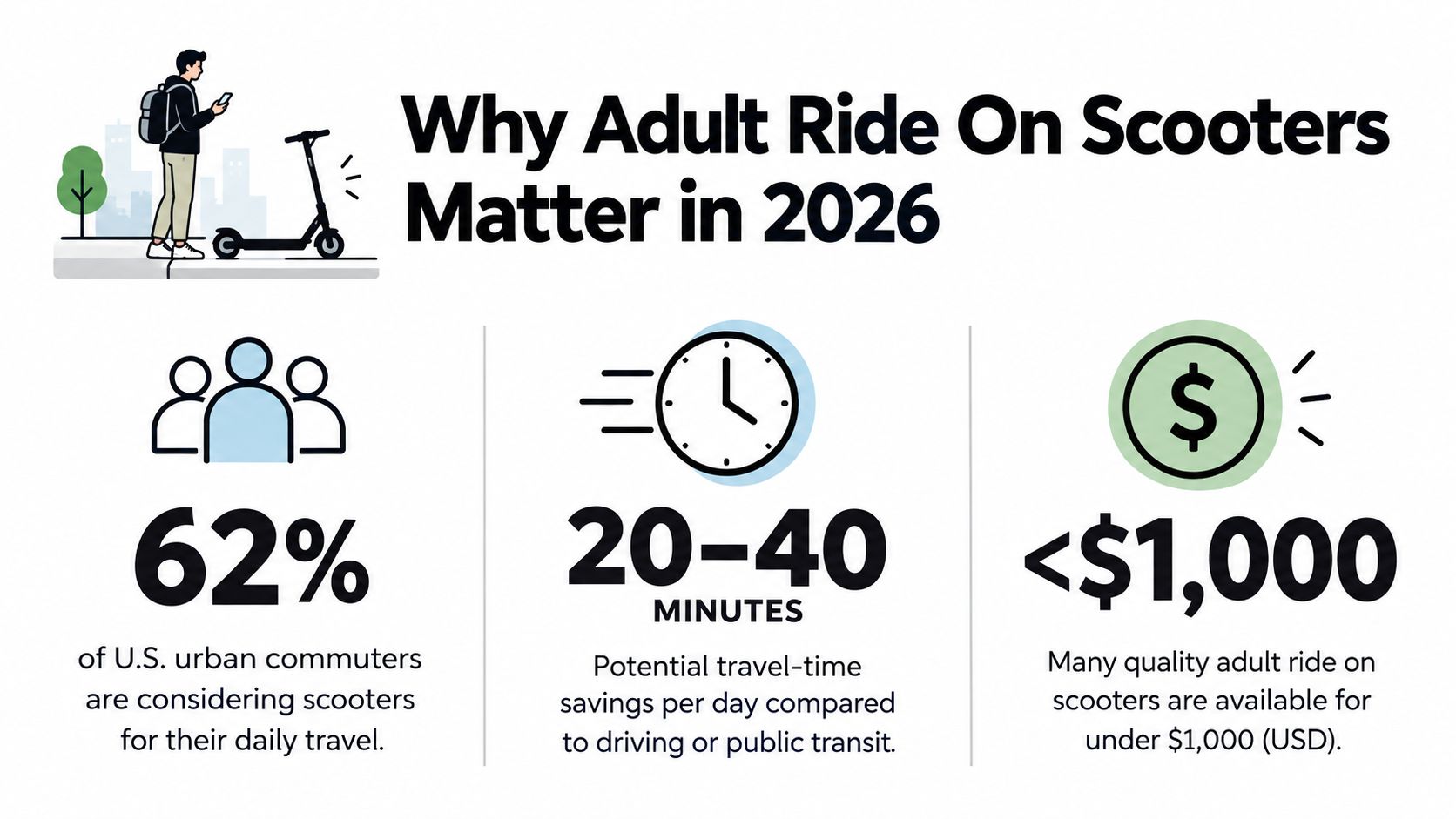
That growth matters because it changes how you should evaluate a scooter. You are not just buying a recreational device. You are choosing a form of short-distance transport that may connect your home to a station, replace a car journey, or make a compact urban trip easier. Shared-service figures don't include privately owned scooters, but they do show that demand exists across Europe, North and South America, and other regions.
Match the vehicle to the journey
A commuter travelling on smooth cycle infrastructure has different needs from someone crossing broken pavement or carrying a scooter upstairs. A seated design may suit a rider who values comfort, while a folding kick scooter may suit someone combining riding with a train journey.
This guide focuses on the decisions that cause the most confusion:
- Vehicle type: Kick, seated, off-road, and commuter scooters behave differently.
- Useful specifications: Range, motor output, tyres, weight, braking, and battery design all affect daily use.
- Safety: Stopping ability, visibility, surface quality, and rider behaviour matter as much as speed.
- Law: UK, EU, US, and Australian rules don't treat every scooter the same.
- Ownership: Charging, storage, maintenance, and battery disposal shape the experience after purchase.
The central idea is simple. Choose the scooter for your actual street, not for a generic specification sheet.
The Four Types of Ride On Scooters for Adults
Start by ignoring marketing names and identify the scooter's physical role. Most adult models fit one of four practical categories.
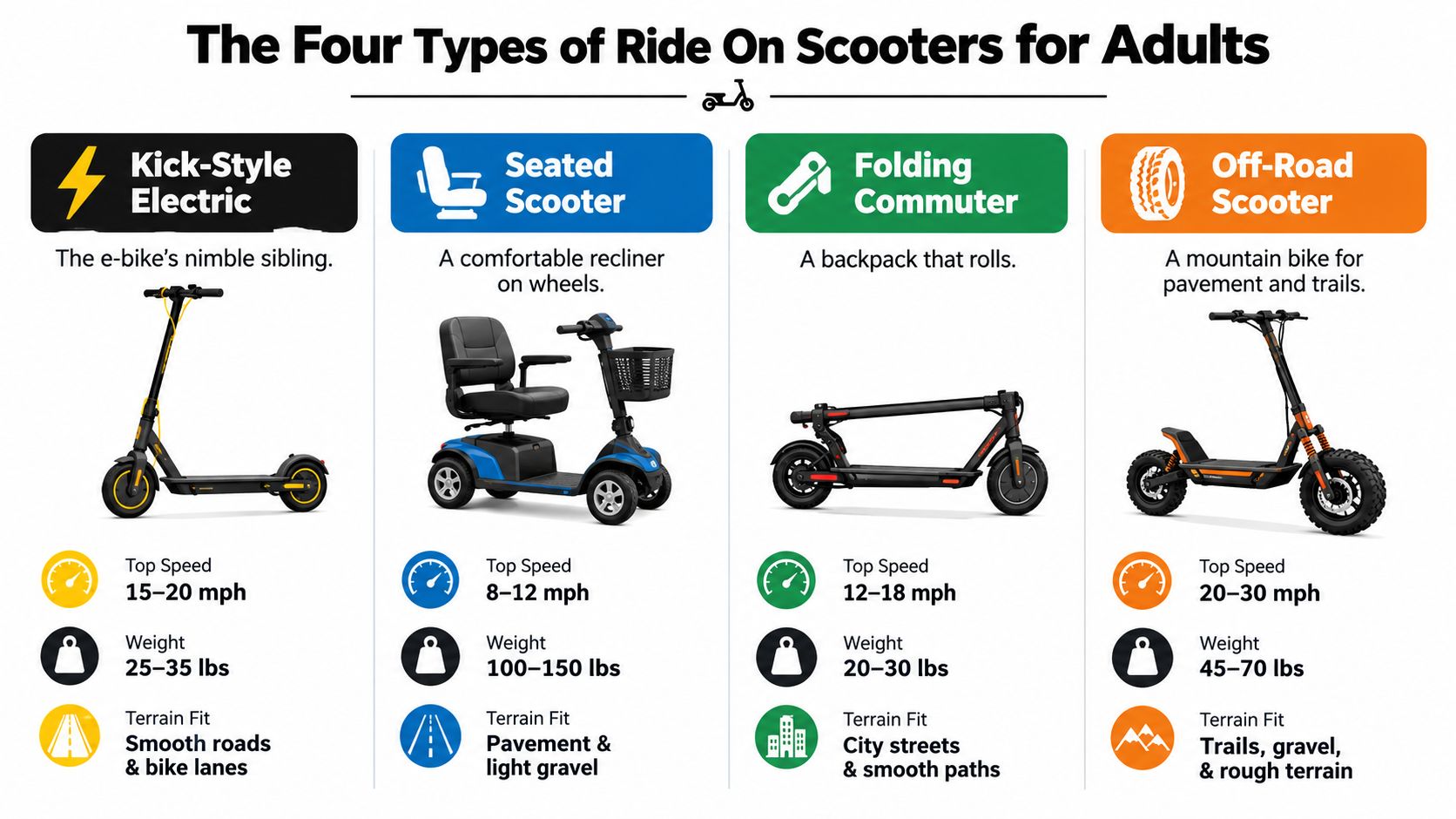
Kick-style electric scooters
A kick-style electric scooter is the nimble sibling of an e-bike. You stand on a deck, steer with handlebars, and usually control the motor with a thumb throttle or twist control. It's often the easiest category to store and carry, especially when the stem folds.
The trade-off is comfort. Small wheels react sharply to potholes, drain covers, loose gravel, and broken kerbs. Long hills can also become tiring, particularly for a heavier rider or a scooter with modest continuous motor output. This is the natural choice for short urban journeys where portability matters more than a chair-like ride.
Seated scooters
A seated scooter feels closer to a small moped or a sit-on lawn mower than to a conventional kick scooter. The seat reduces pressure on your legs and may make longer trips easier, but the frame, seat, larger deck, and stronger components add bulk.
Choose this layout if comfort is a priority, you have room for storage, and you don't need to carry the vehicle often. Check the legal classification carefully, because a seat doesn't automatically determine whether a scooter is permitted on public roads.
Off-road scooters
Off-road models borrow ideas from electric mountain bikes. They may use chunkier tyres, suspension, stronger frames, and more powerful drivetrains to handle gravel, tracks, and damaged surfaces.
That capability comes with penalties. They're heavier, less convenient in shops or trains, and their tyres and suspension can increase rolling resistance. Battery consumption can rise quickly on rough ground, hills, and repeated acceleration. An off-road scooter is sensible for private land or suitable trails, not as an automatic upgrade for a smooth city commute.
Folding commuter hybrids
A commuter hybrid tries to blend the useful parts of the other categories. It may have sealed electronics, integrated lights, a foldable stem, moderate suspension, and a deck that works for mixed transport.
This is usually the compromise category. It won't be as light as a minimalist kick scooter, as comfortable as a seated model, or as capable as a dedicated off-road machine. It often makes the most sense for a rider who needs one vehicle for station connections, errands, and ordinary paved routes.
Practical rule: If you carry the scooter regularly, weight matters first. If you rarely carry it, tyre comfort, braking, and stability deserve more attention.
Key Specs That Actually Matter When You Buy
A specification only becomes useful when you translate it into a consequence. A claimed range isn't the distance you'll necessarily achieve on a cold morning with a heavy rider, hills, headwinds, tyre pressure issues, and stop-start traffic. A large motor number doesn't guarantee easy hill climbing if the controller, battery, rider weight, and thermal management don't support it.
Read the range claim cautiously
Use the advertised range as a comparison reference, not a promise. Your usable distance depends on rider mass, gradient, temperature, wind, tyre pressure, acceleration habits, and how often the motor works hard. Leave a practical reserve rather than planning a route that uses every advertised kilometre.
Separate motor output from speed
Continuous power describes sustained work more usefully than a peak figure. A scooter with stronger continuous output may hold speed better on a hill, while a high peak number may mainly describe short acceleration. Top speed matters less than the speed you can legally and safely use on your route.
The maximum rider weight also affects more than structural strength. It can influence acceleration, hill performance, braking demand, and usable range. Check whether the stated limit includes luggage, a backpack, or work equipment.
Don't overlook the physical parts
Tyre diameter affects how easily the scooter rolls over surface changes. Larger pneumatic tyres generally offer a calmer ride than tiny solid wheels, though they need pressure checks and can puncture. Suspension can improve comfort, but it doesn't make poor road positioning or excessive speed safe.
An IP rating can indicate resistance to water and dust, but it isn't a licence to ride through deep water. Displays should remain readable in daylight, controls should be reachable without taking your attention from the road, and lights should be visible rather than treated as decorative accessories.
| Spec | What it really controls | What to look for as an adult |
|---|---|---|
| Range | How far the battery may carry you under stated conditions | Compare models using your rider weight, hills, weather, and return journey |
| Continuous motor output | Sustained hill and load performance | Look for clear continuous and peak figures, not one impressive number |
| Maximum load | Structural capacity and performance under load | Include clothing, luggage, and accessories |
| Top speed | Potential travel speed and legal compatibility | Choose a controllable mode that fits local rules and shared paths |
| Tyre design | Grip, comfort, puncture exposure, and surface tolerance | Match tyre size and construction to your pavement and weather |
| Braking system | Stopping control and heat management | Prefer independent braking, predictable lever feel, and accessible controls |
| Battery documentation | Protection, compliance, and charger compatibility | Verify certification instead of trusting a printed label |
A good buyer can explain every important number in terms of a real journey. If a specification doesn't change your route, comfort, safety, storage, or maintenance routine, it probably shouldn't dominate your decision.
Brakes, Tyres and the Physics of Stopping
A scooter's most important performance feature may be the one you use for the shortest time. Acceleration gets attention in product videos, but braking determines what happens when a pedestrian steps into your path, a car turns across a lane, or a wet drain cover appears at the wrong moment.
A British Columbia pilot regulation provides a useful benchmark. A compliant scooter must stop from 24 km/h within 9 m after brake application on clean, level pavement, while a later version specifies 25 km/h and a 7.5 m maximum, as described in this experimental analysis of braking performance. That measurement excludes your reaction time, so the total distance from seeing danger to stopping is longer.
Speed changes the workload
Kinetic energy rises with the square of speed. Increasing speed from 15 to 25 km/h creates roughly 2.8 times as much energy for the brakes and tyres to dissipate, according to the same braking performance research. That's why a scooter capable of much more than ordinary urban speeds needs substantially stronger braking, tyres, frame control, and rider discipline.
Most adult scooters combine several braking methods:
- Electronic regenerative braking: Uses the motor to slow the scooter and may recover a small amount of energy. It should supplement, not replace, a dependable physical brake.
- Drum braking: Enclosed and relatively protected from weather, with predictable maintenance needs.
- Mechanical or hydraulic disc braking: Can offer strong stopping performance, but setup, pad condition, rotor alignment, and lever feel matter.
The best system isn't merely the one with the largest disc. Look for independent dual braking, progressive lever modulation, and a control that doesn't grab suddenly. Tyre tread and pressure matter just as much. An underinflated tyre can feel vague, while an overinflated tyre may offer less comfort and grip on rough surfaces.
Before buying, ask to test the brake at low speed in a safe area. Read more about matching tyre construction and maintenance to your scooter in this guide to tyres for electric scooters.
Battery Safety and Charging Habits
Battery capacity is only one part of ownership. The more important question is whether the battery pack, charger, wiring, enclosure, and management electronics work together as a safety system.
Thermal runaway is the critical failure process to understand. A damaged, defective, overcharged, or overheated lithium-ion cell can begin self-heating, and that process can escalate into fire or explosion. A battery-management system should provide protection against overcharge, over-discharge, overcurrent, and excessive temperature, but those protections can't make a crushed or swollen pack safe.
Certification needs verification
A 2025 UC Davis inventory of 164 electric micromobility devices found that 64% displayed verifiable UL or EN safety certification, while 22% lacked accreditation and 14% carried labels that couldn't be verified, according to the UC Davis electric micromobility inventory.
Treat a certification mark as a question, not a conclusion. Ask for documentation that matches the actual battery and target market. Check that the charger is designed for the pack, the battery is mechanically secure, and replacement parts come from a credible source.
Independent NIST testing used a 281 Wh scooter battery and found that smoke and battery off-gassing could rise before sustained visible flames. 76% of smoke-alarm activations occurred before sustained flaming, which supports early detection and working alarms in the charging area.
Build a routine around the apartment
Charge on a hard, stable surface in a dry, ventilated place away from exits, curtains, paper, furniture, and other combustible materials. Use the matched charger, inspect the cable and connector, and don't repeatedly recharge a pack showing swelling, impact damage, unusual heat, odour, or hissing.
Florida riders need to take heat and humidity seriously, especially when storing a scooter in a hot garage or vehicle. UK and German riders should avoid leaving a cold-soaked battery in an unheated space and immediately charging it while it's still very cold. Let the pack return to a suitable indoor temperature, keep it dry, and follow the manufacturer's storage guidance. A practical guide to how to store lithium batteries safely can help turn those principles into a repeatable routine.
When a battery reaches the end of its useful life, don't put it in general household waste. Use a specialist resource covering how to recycle lithium batteries safely and ask your local authority or retailer about accepted collection routes.
UK, EU, US and Australian Rules at a Glance
A scooter can be mechanically excellent and still be the wrong purchase for your public route. The legal category depends on the country, region, vehicle design, maximum capability, and where you ride.
England and the UK trial framework
In England's rental e-scooter trials, an adult rider needs a provisional or full UK driving licence with category Q entitlement. Trial scooters can travel at up to 15.5 mph, although a local trial area may set a lower limit. They can be used on permitted public roads and cycle lanes or tracks, but not on pavements.
The Department for Transport defines the trial vehicle through technical limits as well. It has no motor other than an electric motor, a maximum continuous power rating of 500 W, no pedals capable of propelling it, a maximum speed of 15.5 mph, and a permitted maximum weight of 55 kg. Seated variants can fall within the definition. Privately owned scooters remain outside the trial framework and generally can't be ridden legally on public roads, cycle lanes, or pavements. Check the official England e-scooter trial guidance before treating a product page as permission to ride.
The EU and local implementation
EU member states don't operate under one simple scooter rulebook. National and local authorities may set different requirements for speed, equipment, registration, insurance, and permitted roads. The European Commission notes that e-scooters generally need longer braking distances than bicycles, while cited pedestrian and cyclist research found 15 km/h perceived as a safer maximum interaction speed, as discussed in the braking research linked earlier.
Use national transport guidance and municipal rules before riding. A model legal in one European city may not be legal in another.
The United States
US rules are usually determined by state and local law rather than one nationwide riding standard. Check the state code, city transport page, pavement rules, helmet requirements, speed limits, and any registration or insurance provisions that apply to your route. The federal safety conversation still matters, because the US Consumer Product Safety Commission's e-scooter guidance documents injury trends and recommends devices and batteries designed, manufactured, and certified to applicable voluntary safety standards.
Australia
Western Australia permits compliant eRideables to travel at up to 25 km/h on bicycle paths, shared paths, local roads, and bicycle lanes where safe. The limit falls to 10 km/h on footpaths and pedestrian crossings, and riders must wear an approved bicycle, skateboard, or motorcycle helmet, according to Western Australian eRideable guidance.
Victoria uses a hard capability threshold. A scooter capable of no more than 25 km/h is treated as a low-speed device and doesn't require a licence, registration, or insurance. A scooter capable of exceeding 25 km/h is considered an unregistered motor vehicle, as explained by the Transport Accident Commission.
For a practical UK overview, consult this guide to electric scooter laws. Then use this decision path:
- Identify your country and local authority.
- Check whether private scooters are permitted on your intended route.
- Compare the scooter's designed maximum speed and continuous power with local thresholds.
- Confirm licence, helmet, insurance, lighting, and equipment requirements.
- Only then compare range, comfort, and motor performance.
Real-World Safety Beyond the Helmet
“Asking whether scooters are safe” is too broad to produce a useful answer. Risk changes with rider age, traffic exposure, road design, speed, weather, alcohol or substance use, and whether a motor vehicle is involved.
The US Consumer Product Safety Commission reported that e-scooter emergency-department visits rose from approximately 7,700 in 2017 to 14,500 in 2018 and 27,700 in 2019. Across micromobility products, including e-scooters, e-bikes, and hoverboards, there were about 133,000 emergency-room visits from 2017 through 2019, according to the CPSC injury study and safety announcement.
What the injury data does and doesn't say
From 2017 to 2021, US micromobility injuries rose 127% to an estimated 77,200 cases, while reported deaths increased from 5 to 48. E-scooters accounted for 68 deaths, and consumer-owned scooters represented 56% of emergency-room visits, compared with 44% involving rental scooters, in the same CPSC material.
Those figures justify serious safety habits, but they don't prove that the scooter alone determines injury severity. A 2025 Rutgers analysis of nearly 14,000 micromobility injuries treated in emergency departments during 2021 and 2022 found that about 15% of injured users were hospitalized. Severity was associated with older age, male sex, motor-vehicle involvement, and alcohol or substance use, while injured e-scooter riders weren't more likely to suffer severe injuries than bicycle or e-bike users, according to the Rutgers comparison of e-scooter, e-bike, and bicycle injuries.
European crash research covering seven cities found e-scooter injury risk 2.5 to 10 times lower than e-cycling in its dataset, although the researchers cautioned that exposure and location affect comparisons.
Use a rider-fit matrix
- Older or inexperienced rider: Start with a lower-speed mode, practise braking and turning away from traffic, and choose a stable deck and predictable controls.
- Busy urban road: Protected lanes, clear sightlines, lighting, and traffic calming matter more than buying the heaviest scooter.
- Wet or damaged pavement: Reduce speed, increase following distance, avoid painted surfaces and standing water, and use tyres with suitable tread.
- Motor-vehicle exposure: Assume drivers may not see you. Choose routes that reduce crossings and high-speed interactions.
- Alcohol or substances: Don't ride. Balance, reaction time, and judgement are exactly what you need to control a small-wheeled vehicle.
A heavier scooter may feel planted, but it can't remove a blind junction, a distracted driver, or a wet surface from your route.
Buying Checklist and Frequently Asked Questions
Use this short routine before committing:
- Purpose: Decide whether you need a kick, seated, off-road, or commuter design.
- Route: Check hills, surface quality, traffic, storage, and local law.
- Hardware: Verify rider capacity, independent brakes, tyre design, lights, controls, and water resistance.
- Battery: Confirm the matched charger, management protections, and verifiable certification.
- First week: Practise in a quiet area, check tyre pressure, test both brakes and lights, fit a helmet, and review local rules.
- Seasonal care: Store batteries appropriately in cold UK or German conditions, protect packs from Florida heat, and treat wet-weather grip as a reason to slow down.
FAQ: Helmet requirements vary. Helmets are required in Western Australia and many US states, and remain sensible elsewhere. Low-speed devices generally don't require insurance, but higher-capability Australian scooters can fall under motor-vehicle rules. Battery life depends on the pack and use, so don't rely on a universal cycle figure. Rain suitability depends on the actual IP rating and manufacturer guidance, not marketing copy.
Punk Ride LLC offers adult electric scooters across kick-style, commuter, and seated formats, with options such as the iScooter DX5 and iENYRID M4 PRO S+ listed for different riding needs. Visit Punk Ride LLC to compare available models, then match the specifications to your route, local rules, braking needs, and battery-storage routine.

Share:
How Long Do E Scooters Last and What Affects It