


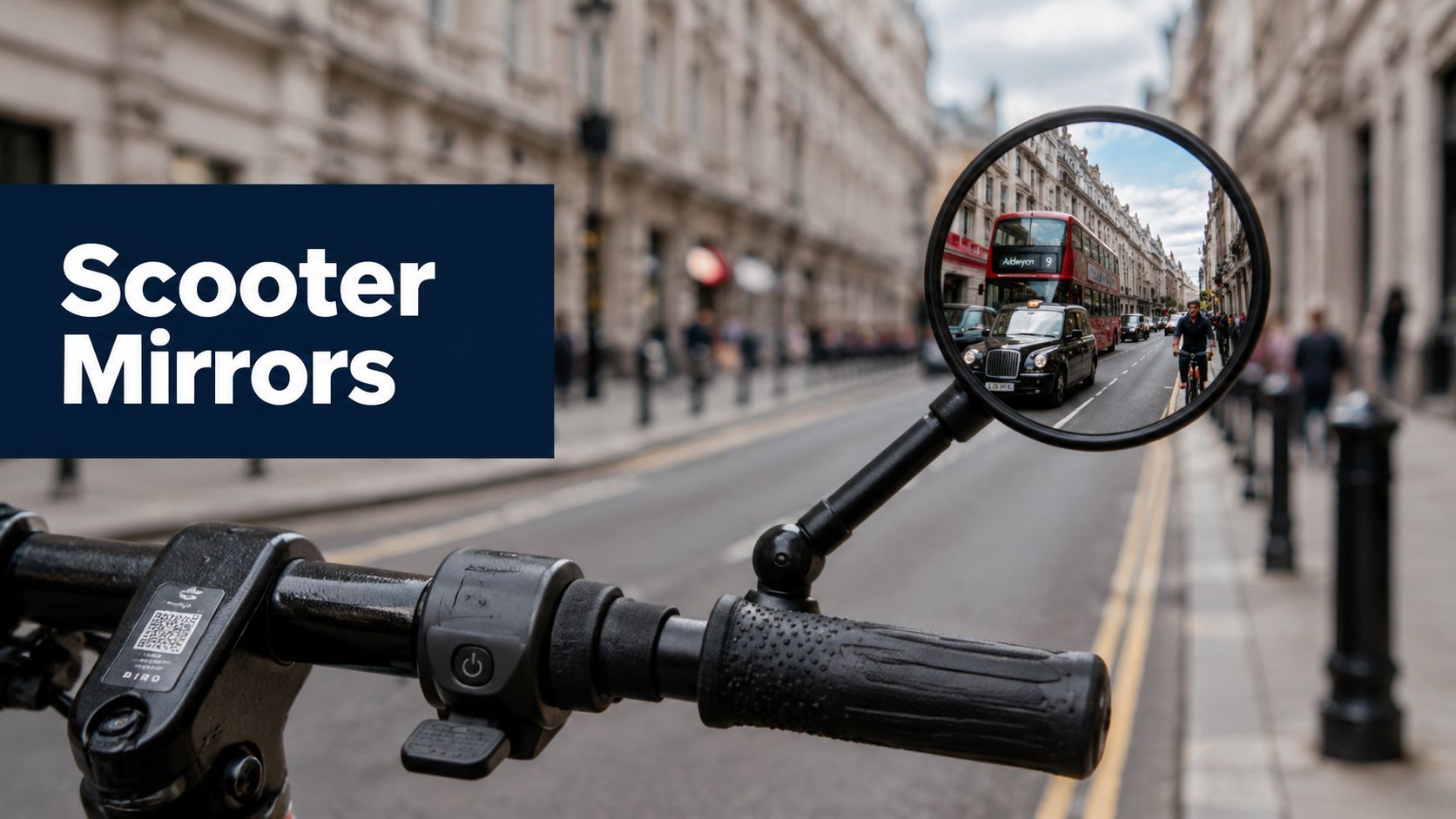
You're rolling through a busy high street, one eye on the potholes, one eye on the bus lane, and then it happens. You drift slightly right to avoid a drain cover, glance over your shoulder, and a car is already there. Not touching you, not honking, just suddenly far closer than you thought. That's the kind of moment that makes your stomach drop.
Most e-scooter riders in the UK and across Europe have had some version of that scare. It's rarely dramatic enough to become a story. It's just a reminder that on a scooter, your view behind you is weak unless you build it on purpose. Turning your head helps, but it also pulls your line off course, especially on rough tarmac, painted cycle lanes, or wet tram-adjacent streets.
That's why electric scooter mirrors stop feeling optional once you've spent enough time commuting in real traffic. They're a small part, but they solve a big problem. They give you a way to keep track of what's coming up behind without constantly twisting around like a nervous owl.
That Heart-Stopping Moment in Traffic You Know Too Well
A scooter feels agile right up until you need information you don't have. A rider can brake hard, dodge a van door, or thread through a narrow gap, but none of that matters much if the blind spot behind your shoulder is a mystery.

In London, Berlin, Paris, or any dense city, that problem shows up constantly. You're checking for cyclists coming faster than expected, a moped slipping through, a delivery van trying to overtake before a pinch point, or a car edging into the lane you thought was yours. A quick shoulder check is still part of safe riding, but relying on that alone gets tiring and messy.
Why this tiny accessory matters more than it looks
A good mirror changes the ride before anything goes wrong. You stop making random guesses about what's behind you. You know whether that engine sound is still two lengths back or already on your flank.
That's one reason mirrors sit inside a much bigger transport trend now. The global rear-view mirror market is projected to reach USD 13,672.07 million by 2033, growing at a CAGR of 5.00% from 2025, according to this rear-view mirror market summary. That projection covers more than scooters, of course, but it reflects something riders already feel on the street. Mirrors have moved from basic hardware into a broader safety and technology category tied to urban mobility.
A mirror won't make you invincible. It does make surprises less likely.
What commuting experience teaches quickly
The riders who dismiss mirrors usually imagine a relaxed park path or a short hop on an empty side street. The riders who swear by them are usually the ones mixing with buses, taxis, bike traffic, and impatient drivers.
Three situations make mirrors pay for themselves fast:
- Lane positioning near parked cars means you often need to hold a safer line away from doors while still monitoring overtakes.
- Shared cycle infrastructure gets chaotic when faster bikes, slower riders, and scooters all compress into the same strip of road.
- Junction filtering demands rear awareness, not just front awareness, because traffic closes gaps quickly.
If you've had one near-miss that left you replaying the moment later, you already understand why electric scooter mirrors matter.
Why Mirrors Are Your Most Underrated Safety Upgrade
The obvious benefit is that mirrors help eliminate blind spots, and that's the right place to start. Product guidance for electric scooter mirrors also points to wide-angle designs, including one example using a 15.5 cm HD glass mirror, which reflects how the market has shifted toward mirrors as real safety gear rather than throwaway accessories. That point is covered in this electric scooter mirror guide.
The less obvious benefit is mental. Mirrors reduce workload.
They calm the constant background stress
Without mirrors, urban riding becomes a string of tiny checks. Head turn. Correct your line. Listen for an engine. Second guess yourself. Head turn again. That constant loop eats attention you should be spending on road surface, pedestrians, light changes, and drivers doing strange things.
With a decent mirror setup, you build a live picture of the space behind you. Not perfect, not complete, but enough to make cleaner decisions. That means:
- You hold a steadier line because you're not twisting your shoulders every few seconds.
- You time merges better because you can see whether there's a real gap or just wishful thinking.
- You feel less rushed when a vehicle approaches from behind, because you've already noticed it.
That's also why mirrors fit naturally alongside broader electric scooter safety tips from Punk Ride. They don't replace road sense. They support it.
Wide view beats pretty design
A lot of riders buy the mirror that looks sleek in product photos and regret it after one rough commute. Tiny flat mirrors often look cleaner on the bars, but they can leave you squinting at a narrow slice of road and your own elbow.
What tends to work better is a mirror that prioritises usable view over style. A wider lens gives you more context. You want to spot the cyclist, the car, and the closing gap, not admire a neat bit of anodised hardware.
Practical rule: If a mirror gives you a sharp image but only of your jacket sleeve, it's decorative, not useful.
The real upgrade is predictability
The best riders in traffic are predictable. Drivers and cyclists can work around you if your line is stable and your movements make sense. Mirrors help with that because you don't need to weave, hesitate, or make a sudden shoulder-led wobble before every slight position change.
That's why I'd rank electric scooter mirrors above a lot of flashier upgrades. More power is fun. Better tyres are important. A mirror changes how calmly you ride every single day.
Are E-Scooter Mirrors Required in the UK and EU
At this point, most buying guides become useless. They'll tell you mirrors are “essential” and then skip the one question riders typically have. Do the rules require them?
The honest answer is frustrating but simple. Rules for e-scooter mirrors vary significantly. In some regions they are not explicitly required, while in others, e-bike rules may apply. That gap leaves plenty of riders unsure whether a mirror is legally necessary, merely sensible, or irrelevant until after they've already bought one. That issue is summed up well in this discussion of e-scooter mirror legality and rule variation.

What UK riders should keep in mind
In the UK, the first complication is that private e-scooter use on public roads remains a legal grey area compared with rental schemes and other vehicle classes. That alone makes mirror advice messy, because accessory requirements matter less if the scooter itself may not be permitted in the way many riders assume.
For practical road use, though, the question still matters. A mirror may not be explicitly listed for many e-scooter contexts, but visibility and safe control are never bad ideas, especially in mixed traffic. If you want a broader view of the road-use side of this, Punk Ride has a useful explainer on whether electric scooters are street legal.
Germany, France, and the wider EU
Across the EU, there's no single mirror answer that works everywhere. National rules differ. Local enforcement differs. Municipal interpretations can differ too.
A practical way to think about it is this:
- Germany often has more clearly defined technical expectations for road-going mobility devices, but that doesn't automatically mean a universal mirror rule for every scooter setup.
- France can be strict on how personal mobility devices are used in public space, yet mirror expectations may still depend on classification and local application.
- Other EU countries may treat e-scooters closer to bicycles in some contexts and closer to a distinct vehicle class in others.
That last point matters a lot. If local authorities or product classifications lean toward bicycle-style rules, a mirror might be treated differently than riders expect. If the scooter is seen as a separate category, the answer may change again.
What riders get wrong when they read regulations
People usually search for one sentence that says “mirror required” or “mirror not required.” Real life isn't that tidy.
A smarter checklist is:
- How is your scooter classified locally
- Where are you riding
- Are local rules separate from national rules
- Does your use resemble bicycle use, moped use, or approved rental use
If the law is unclear, buy for safe road use first and legal certainty second. You can remove a mirror later. You can't add rear awareness in the middle of a close pass.
My practical UK and EU view
For most riders mixing with traffic, I'd treat electric scooter mirrors as strongly recommended even where not explicitly mandatory. If you're on private land, in a controlled campus setting, or only riding short low-speed local trips, you may decide otherwise. But for commuting in real streets, a mirror is one of the few accessories that solves a problem you'll face every week.
Choosing the Right Mirror for Your Scooter and Style
Not all mirrors fail in the same way. Some shake so badly they turn into abstract art. Some sit too low and show your knees. Some stick out so far that every bike rack, hallway, and narrow gate becomes annoying.
The right choice depends less on brand hype and more on how and where you ride.
The three main styles riders usually consider
Clamp-on mirrors are the most common starting point. They attach to the handlebar or tiller and usually offer plenty of adjustment. They're easy to fit, easy to remove, and widely available. Their weakness is vibration and bulk. If the clamp doesn't match properly, they can rotate or droop.
Bar-end mirrors usually look cleaner and can give a nice sightline, especially on wider bars. They can also make the scooter broader at exactly the point where you notice width most, which matters if you filter through tight spaces or carry the scooter indoors.
Helmet-mounted mirrors have loyal fans and equally strong critics. The big advantage is that the mirror moves with your head. The downside is that some riders never get used to the floating image, and others find it fussy in wind or rain.
E-Scooter Mirror Type Comparison
| Mirror Type | Best For | Pros | Cons |
|---|---|---|---|
| Clamp-on | Commuters who want easy installation | Flexible positioning, common fit options, easy to swap | Can slip under vibration, may add clutter near controls |
| Bar-end | Riders who want a cleaner cockpit view | Good sightline, often less blocked by hands | Increases overall width, can be vulnerable when parking |
| Helmet-mounted | Riders changing scooters often | Moves with your gaze, no handlebar fit issues | Takes time to adapt, some riders dislike the visual feel |
Width matters more than many buyers expect
This is the trade-off most product pages barely mention. Better visibility often means more physical width. In a city flat, narrow hallway, packed bike room, or crowded cycle lane, that's not a small detail.
If you regularly:
- Filter through traffic, wide mirrors can become a nuisance.
- Store the scooter indoors, protruding mirrors snag on doorways and bags.
- Carry the scooter on trains or into lifts, compact mirrors are easier to live with.
But going too compact is how riders end up with mirrors they never use. If the mirror image is tiny, blocked, or badly placed, you'll stop trusting it.
What usually works best in daily commuting
For most UK and EU riders, a compact but adjustable clamp-on or a modest bar-end mirror tends to strike the best balance. Look for a model that sits high enough to see past your shoulder and doesn't force the bars too wide.
This is also the one place I'd mention retailer fit options. Punk Ride lists scooter and e-bike accessory options including side mirrors, which is useful if you're trying to compare formats rather than guess from generic marketplace photos alone. Still, the right pick comes down to cockpit fit, your riding posture, and where the scooter lives when you're not riding it.
A mirror that's slightly ugly but always readable beats a stylish mirror you stop checking after three rides.
Installing and Adjusting Your Mirrors for the Perfect View
Most mirror complaints come from setup, not from the mirror itself. Riders fit them in five minutes, eyeball the angle while standing beside the scooter, and then wonder why the image is useless on the road.
A mirror needs to match your actual riding posture. Not showroom posture. Not standing-in-the-kitchen posture. The position you use when your hands are on the grips, shoulders relaxed, and eyes forward.

Start with fit before angle
Effective electric scooter mirrors are typically convex and positioned at the rider's eye line. Common hardware also uses multi-axis adjustment and clamp sizes around 22 to 25 mm, which matters because a poor clamp match can lead to movement under vibration. Manufacturers also recommend mounting the bracket, hand-tightening, then fine-adjusting and re-tightening after a short test ride to prevent loosening. That guidance appears in this electric scooter mirror setup and specification guide.
The first job is simple. Check whether the clamp matches your bar or tiller area. If it doesn't, no amount of tightening will save it for long.
A setup routine that actually works
Use this order and you'll avoid most of the usual frustration:
-
Mount loosely at first
Tight enough that the mirror won't flop, loose enough that you can still move it without fighting the hardware. -
Sit on the scooter in riding position
This is the part riders skip. Your eye line changes once your elbows bend and your weight settles. -
Angle for the lane behind, not your rear tyre
You want a slice of your shoulder as a reference, but not half the mirror wasted on your jacket. -
Do a slow test ride
A smooth car park, quiet street, or empty path is enough to reveal whether vibration blurs the image or the angle is off. -
Re-tighten after the test
Mirrors often settle slightly after the first few minutes of riding.
For a visual walkthrough, this video gives a useful reference point:
Common setup mistakes
Some mistakes keep repeating because they feel harmless until the road gets busy.
-
Mirror mounted too low
You end up looking down instead of across, which takes your attention further off the road. -
Over-tightened from the start
That sounds sensible, but it often leads to awkward angle compromises because the rider stops adjusting once it gets annoying. -
No post-ride check
Vibration changes things. One ride over rough paving can undo a “perfect” setup. -
Trusting the mirror alone
A mirror helps with awareness. It does not replace a shoulder check before moving laterally.
If you want a good refresher on that last point, BDISchool's blind spot guide explains the basic habit clearly, and the principle carries over well to scooters.
Small adjustments beat constant fiddling
If your bars or stem height feel off, fix that first. Mirror angle only makes sense once your normal posture is settled, which is why a guide on adjusting handlebar height can help before you blame the mirror.
The goal isn't a perfect cinematic rear view. It's a reliable glance that tells you what matters, quickly, every time.
Your Final Checklist for Buying E-Scooter Mirrors
By the time you're ready to buy, it helps to ignore most of the marketing language and ask a few blunt questions. Does it fit properly. Can you see behind you. Will it stay put on rough streets. Will it make the scooter irritating to live with every day.
The shortlist I'd use
-
Convex lens first
A convex mirror usually gives a more useful rearward view than a flat one. You sacrifice some perceived size, but you gain awareness. -
Strong mounting with real adjustment
Look for multi-axis movement, not just one hinge. If the mirror can't be fine-tuned to your posture, it won't earn your trust. -
Reasonable width
More view is good. Turning the scooter into a coat rack isn't. Think about filtering, doorways, storage, and train travel. -
Readable image in normal riding posture
If you need to duck, shrug, or stare down to use it, keep looking.
What to avoid
A few warning signs usually mean disappointment:
- Tiny decorative mirrors that look neat online but show almost nothing useful
- Weak clamps that rely on brute-force tightening instead of proper fit
- Overly complex folding mechanisms that introduce wobble where you want stability
- Mirror placements blocked by your own hands or elbows
Buy the mirror you'll actually glance at in traffic, not the one that looks best in a product render.
The buying decision in one sentence
For UK and EU commuting, the best electric scooter mirrors are the ones that give you a stable, quick rear view without making the scooter awkward in spaces you move through every day.
A mirror won't solve every risk on the road. It will make you calmer, smoother, and harder to surprise. That's enough to matter.
If you're comparing scooters, e-bikes, and practical accessories for urban riding, Punk Ride LLC is worth a look. The shop covers electric rides and related gear for riders in markets including the UK and Germany, which makes it a useful starting point if you want to build a commuter setup around how you ride, not just how a product page says you should.
Share:
Scooter for Beach: Your 2026 Buyer's Guide
Ebike Water Bottle Holder: Your UK & EU Fit Guide for 2026