


Ever found yourself staring down a monster hill and wishing you had a secret weapon? Or maybe you'd love to bike to work but don't want to show up looking like you just ran a marathon. If that sounds familiar, let me introduce you to your new best friend: the pedal assist bike.
What Is A Pedal Assist Bike, Anyway?
At its core, a pedal assist bike is an e-bike that gives you a little extra oomph, but only when you're actually pedaling. There's no throttle to twist like on a scooter. You pedal, the motor kicks in and helps you out. Stop pedaling, and the motor stops too. It's that beautifully simple.
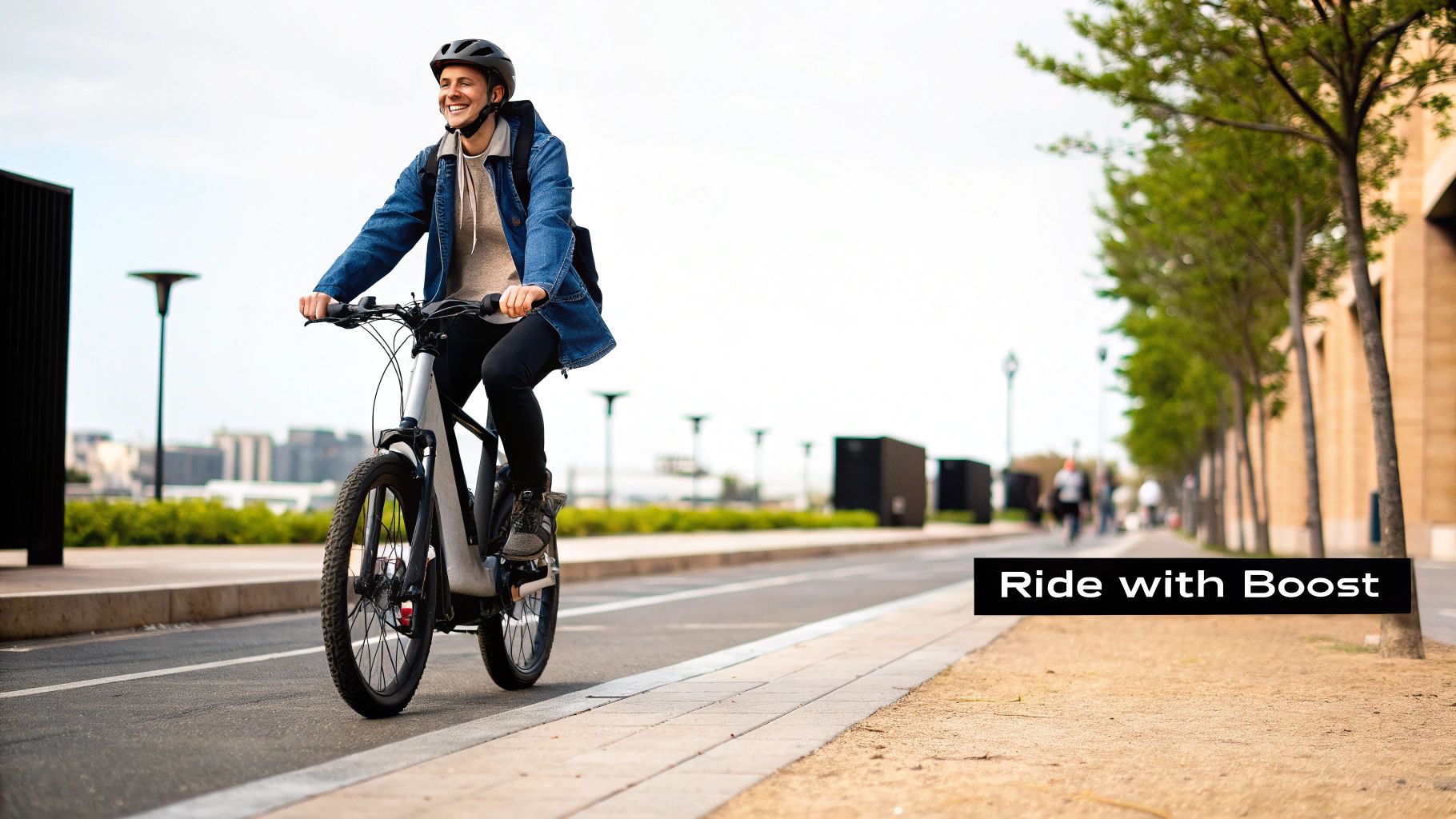
Think of it as having superhuman legs or a permanent tailwind pushing you along. It flattens hills, shrinks long distances, and keeps the fun in your ride without taking away the exercise.
This intuitive, natural feel is exactly why these bikes—often called "pedelecs"—are taking over globally. The numbers don't lie. Pedal-assist models absolutely dominate the e-bike world, accounting for a massive 73.9% of the market share. People just love that it still feels like you're the one riding the bike, just a stronger, faster version of you.
How Is It Different From Other Bikes?
So, what really sets a pedal assist bike apart from a throttle e-bike or your trusty old ten-speed? It all comes down to how you power the ride. A pedal assist bike keeps you in the game, blending your effort with a bit of electric magic.
This system is so common that it defines entire legal categories of e-bikes, particularly in the US. If you want to dive deeper into the rules of the road, check out our guide on what a Class 1 e-bike is.
A pedal assist bike doesn’t replace your effort; it rewards it. Every push on the pedal is met with a smooth, electric boost, making the ride feel less like a chore and more like you've suddenly gained superhuman cycling strength.
To make things crystal clear, let's break down the key differences between the main types of bikes you'll see out there.
Bike Types At A Glance
This quick comparison table should help you see exactly where pedal assist fits in.
| Feature | Pedal Assist Bike | Throttle E-Bike | Regular Bicycle |
|---|---|---|---|
| Motor Activation | Activates only when you pedal | Activates with a throttle grip/button | No motor; 100% human-powered |
| Riding Feel | Natural cycling, amplified | More like a moped or scooter | Traditional, manual cycling effort |
| Exercise Level | Moderate to high (adjustable) | Low to none (throttle-only) | High |
| Typical Use | Commuting, fitness, recreation | Commuting, leisure, accessibility | Fitness, sport, transport |
Ultimately, the choice comes down to the experience you're after. If you want to stay active but make riding easier and more accessible, pedal assist is a fantastic way to go.
So, How Does Pedal Assist Actually Work?
Ever hop on a pedal-assist bike and wonder how it just knows what you need? It’s not magic, but it sure feels like it. That seamless, intuitive boost isn't just a simple on/off switch; it’s a smart system designed to work with you, making it feel like you suddenly have bionic legs.
The whole experience comes down to how the bike's motor knows when to kick in and, just as importantly, how much power to give you.
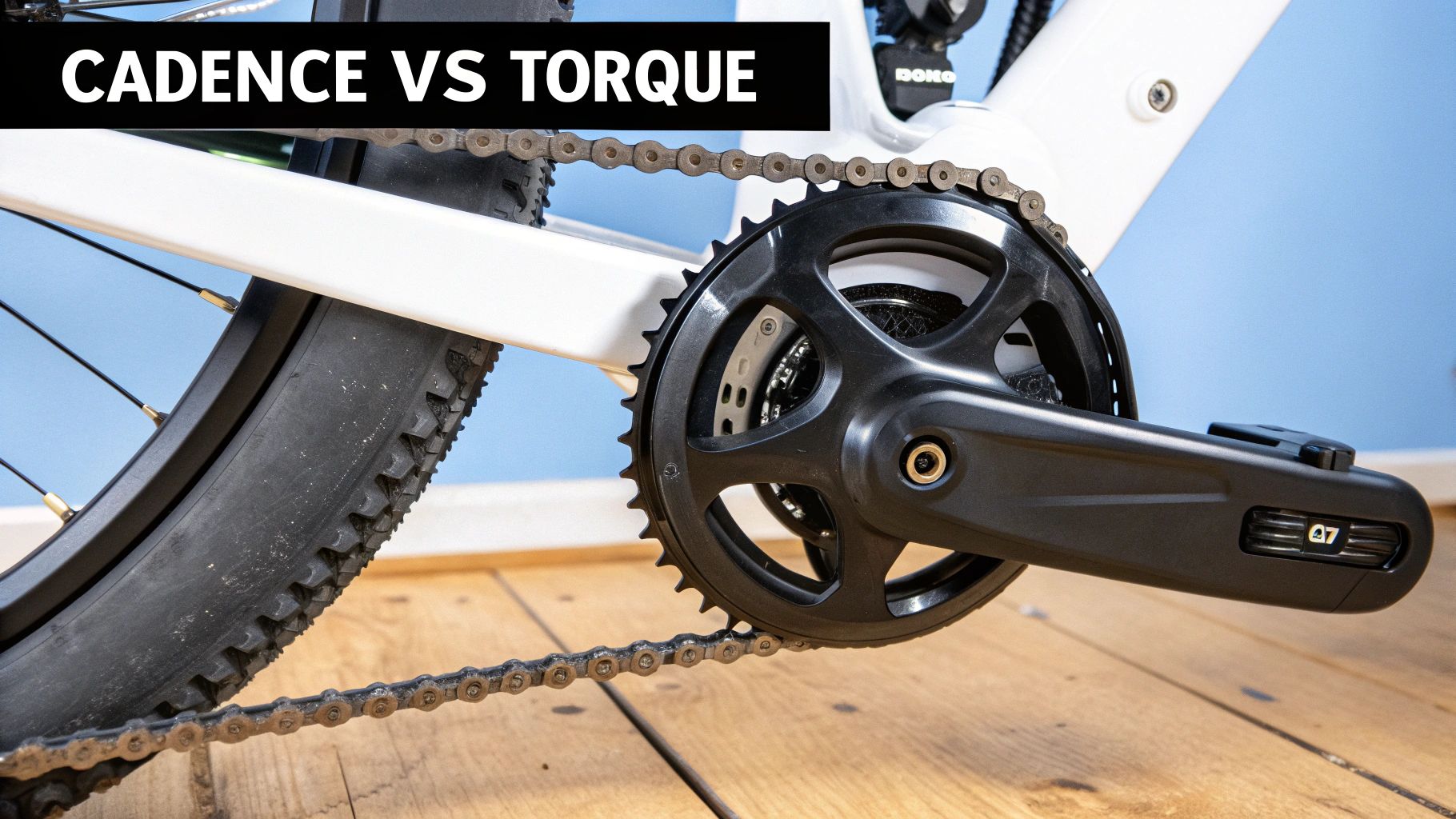
This "brain" is a sensor that reads your pedaling and tells the motor how to respond. The type of sensor your bike has completely changes the feel of the ride.
The Two Types Of Pedal Assist Sensors
In the world of pedal assist, there are two main players: cadence sensors and torque sensors. They both get the job done—giving you a motorized boost—but they go about it in totally different ways. Nailing down this difference is a huge step in picking the right e-bike for you.
A cadence sensor is the more straightforward of the two. Think of it like a light switch. As soon as it detects that you're turning the pedals, it signals the motor to turn on and deliver a preset amount of power based on your assist level. It doesn't really care how hard you're pedaling; as long as those cranks are moving, you get the juice.
On the other hand, a torque sensor is way more advanced—it’s more like a dimmer switch. This clever bit of tech measures the actual force you’re putting into the pedals. Pedal lightly, and you get a gentle nudge. Really start hammering to get up a steep hill, and the motor instantly matches your effort with a powerful surge.
A torque sensor makes the motor feel like a natural extension of your own legs. The help you get is directly proportional to how hard you're working, which makes for a super smooth, intuitive ride where you always feel in control.
Assist Levels: Your Personal Power Dial
Besides the sensor, every pedal-assist e-bike gives you control over how much help you get. You'll usually find a little display on your handlebars that lets you cycle through different assistance levels. This is where you fine-tune the ride to your mood and the terrain.
Most bikes have a few common settings:
- Eco Mode: This gives you the smallest boost. It's perfect for maximizing your battery range on long, flat rides or when you still want a good workout.
- Tour/Normal Mode: The perfect middle ground. You get a noticeable push that helps with rolling hills and daily commutes, all without draining your battery too fast. This is the go-to for most riders.
- Turbo/Sport Mode: Time to unleash the beast. This mode gives you everything the motor’s got, flattening steep hills and giving you that thrilling, instant acceleration. It eats up the most battery, but man, is it fun.
Figuring out which level to use is all part of the ride. Getting a feel for these systems is the first step, and if you want to dive deeper, check out our full guide on how to choose an ebike. It’s all about tailoring the experience to exactly what you need, right when you need it.
Pedal Assist Versus Throttle E-Bikes
So, you're looking at e-bikes and see "pedal-assist" and "throttle" thrown around. This is one of the biggest forks in the road for a new rider, and it's not just about tech specs—it's about the entire vibe of your ride. The two systems create completely different experiences, so figuring out which one fits you is step one to finding the perfect bike.
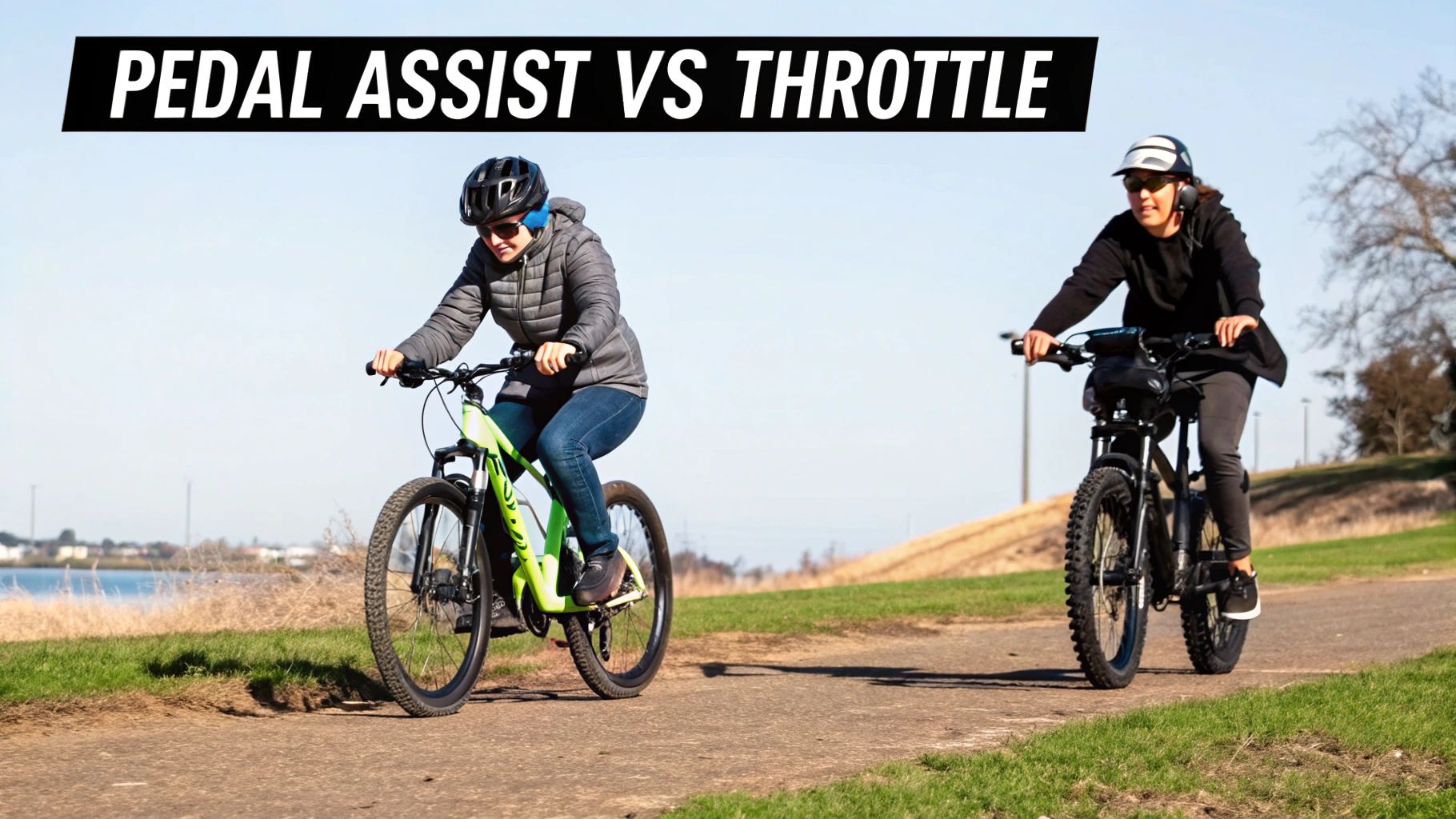
Think of a pedal-assist system as your riding partner. It feels natural, just like riding a regular bike, but suddenly you have superhuman legs. The motor kicks in to match your effort, making you feel stronger and faster without taking over.
A throttle, on the other hand, is pure power on demand. Push a button or twist the grip, and you're off—no pedaling required. It's more like a quiet, electric scooter.
The Riding Experience And Feel
The real difference is how involved you are. With a pedal-assist bike, you’re always in the game. You have to pedal to get the motor going, which keeps you moving and connected to the ride. It’s a team effort between you and your bike.
A throttle gives you a different kind of freedom. It’s awesome for those times when you just don’t feel like pedaling, like getting a jump on traffic at a stoplight or just cruising that last block home when you're wiped out.
Some bikes actually have both systems, giving you the best of both worlds. These are usually called Class 2 e-bikes, and you can get the full rundown in our guide to Class 2 e-bikes.
A throttle is like an "on" switch for the motor—instant go. Pedal-assist is more like a volume knob for your own power, turning your effort up to 11.
Legal And Practical Considerations
Where you live has a huge impact on which type of e-bike you'll see on the streets. In the United States, for example, e-bike laws vary widely by state and often use a class system (Class 1, 2, and 3) that allows for higher speeds and even full throttle control. As a result, throttle-equipped bikes are very popular there.
In contrast, markets like Australia, the UK, and the EU have stricter rules that are largely built around the pedal-assist model. There, the motor must cut off at 25 km/h (15.5 mph) and only provide assistance when you are actively pedaling.
This legal stuff directly shapes the market. Places with stricter rules naturally have more pedal-assist bikes. But in areas with looser regulations, like parts of the US, you'll see a lot more throttle-equipped bikes. This even affects things like battery sizes and prices you see from the big brands.
Here’s a quick breakdown of other practical differences:
- Battery Efficiency: Pedal-assist is way more efficient. Since you’re sharing the workload, the motor doesn't have to do all the heavy lifting, which means you can squeeze a lot more range out of a single charge.
- Fitness Benefits: If you're riding to stay active, pedal-assist is the obvious choice. You’re guaranteed to be pedaling, so you get a solid workout every single time you head out.
- Simplicity: For riders with limited mobility or those who just want the easiest possible ride, a throttle can be a game-changer. It gets you moving without any pedaling effort at all.
Navigating Pedal Assist Bike Laws In The US And Australia
One of the most important things to understand before buying a pedal-assist bike is the set of rules in your area. Unlike the fairly uniform regulations in Europe, the laws in the United States and Australia can be a bit more complex, with rules often changing from state to state.
The key is to understand the local regulations to ensure you can ride freely and safely, avoiding the need for a license, insurance, or special registration.
The Key Rules For US And Australian Riders
In the United States, many states have adopted a three-class system to define e-bikes, which helps clarify where and how you can ride them.
The core idea is this: the class system separates bikes based on their top assisted speed and whether they have a throttle. This determines if they can be used on bike paths, trails, or just on the road.
Here’s a common breakdown of the US e-bike classes:
- Class 1: A pedal-assist only bike (no throttle) with a motor that stops assisting once you hit 20 mph. These are often allowed on bike paths and multi-use trails.
- Class 2: A throttle-assisted e-bike where the motor can power the bike up to 20 mph without you pedaling. They also offer pedal assist.
- Class 3: A pedal-assist only bike that can reach speeds up to 28 mph. These are typically restricted to roads and are often for commuters. Riders may also be required to be at least 16 years old.
In Australia, the rules are more unified and closer to the European model. An e-bike is legal if it meets the "electrically power-assisted cycle" (EPAC) standard. This means:
- The motor's power must not exceed 250 watts.
- The electric assistance must cut out at 25 km/h (15.5 mph).
- The motor must be activated by pedaling (pedal-assist); throttles that work without pedaling are generally not permitted.
Since laws can vary, especially at the state and local levels, it’s always a smart move to check the specific regulations for your city and state before you start riding.
How To Choose Your Perfect Pedal Assist Bike
Ready to find the right e-bike for you? Picking the perfect pedal assist bike isn't about grabbing the most expensive one off the rack. It’s about finding the one that actually fits your life.
Think about it: the ideal bike for someone weaving through city traffic is a world away from what a weekend trail warrior needs. A little bit of thought upfront will help you land a bike you'll be happy with for years.
First things first, what are you really going to use it for? Is this for your daily grind, navigating busy streets and bike lanes? Or are you picturing long, breezy rides down scenic country roads? Your answer here pretty much dictates everything else.
A city commuter, for instance, will probably want something light and nimble. Something you can easily zip through traffic on or even carry up a flight of stairs. But if you're all about those long-distance recreational rides, a bigger battery for maximum range is going to be way more important.
Hub vs. Mid-Drive: Where's the Motor?
One of the biggest decisions you'll make is where the motor is located. This choice drastically changes how the bike feels when you're riding it.
- Hub-Drive Motors: You'll find these in the center of the front or rear wheel, and they're common on more budget-friendly bikes. They give you a feeling of being "pushed" or "pulled" along. Rear-hub motors are super common and give you great traction, making them a solid all-around choice for general commuting.
- Mid-Drive Motors: These are placed right in the middle of the bike at the pedals. Because they send power directly to the chain, the ride feels incredibly natural—almost like you just suddenly have superhuman legs. They're fantastic for climbing hills since they take advantage of the bike's existing gears.
Battery Range and Frame Style
Think of your bike's battery as its gas tank. Range is everything. Manufacturers will give you an estimate, maybe 20-80 miles, but your actual mileage will vary based on the assist level you use, how hilly your route is, and even your own weight. Figure out your longest typical ride and pick a battery that can crush it with juice to spare.
The frame style is just as crucial, as it directly impacts your comfort and how easy the bike is to use.
A step-through frame is a game-changer for city riding. With its low top tube, hopping on and off is a breeze, which you'll appreciate after the tenth red light. The traditional step-over frame (with the high crossbar) provides a stiffer, more rigid feel, which is often better for tackling rugged, off-road terrain.
When you start digging into the details of components like the drivetrain, it helps to understand how all the pieces fit together, including things like the proper ebike chain length. It's a testament to their growing popularity that the market for these bikes is exploding. In fact, the pedal-assist electric bike market is projected to hit USD 1.06 billion by 2030. That’s a whole lot of people discovering a better way to ride. You can dive deeper into the pedal assist bike market growth on researchandmarkets.com.
And last but not least, don't overlook the accessories! Racks for your bags, mudguards for those rainy days, and built-in lights aren't just fancy extras. They're what turn your e-bike from a fun toy into a seriously practical machine.
Got Questions About Pedal Assist? We've Got Answers
Even after getting the rundown on sensors, motors, and bike laws, a few questions always seem to stick. That's totally normal when you're diving into something new. This last section is all about tackling those common head-scratchers so you can hit the road feeling like a pro.
Let's get into the stuff we hear all the time from riders just like you.
Can I Still Get a Good Workout?
Absolutely. This is probably the biggest myth we need to bust about the pedal assist bike. It's not a moped; you're always part of the action. Think of it less as an effort-eraser and more as an exercise-enhancer.
You’re the one pedaling, and you have total control over how much help you get. Want to really feel the burn? Just keep the bike in a low 'Eco' mode or even turn the assist off completely. But when you get to that monster hill that usually defeats you, you can crank it up to 'Turbo' and conquer it without having to get off and walk.
Honestly, this flexibility is what gets people riding more often and for way longer, which adds up to some serious health wins over time.
How Far Can I Go On a Single Charge?
This is the classic "it depends" question. The range on a pedal assist bike can swing wildly, but you're typically looking at somewhere between 20 to 80 miles (32 to 130 km) on a full battery.
So, what does it depend on? A few key things:
- Battery Size: A bigger battery (measured in Watt-hours, or Wh) is like a bigger gas tank. More juice means more miles.
- How You Ride: If you're blasting around in 'Turbo' mode all day, you'll drain the battery way faster than if you cruise in 'Eco'.
- The Terrain: It takes a lot more power to climb steep hills than it does to ride on a flat bike path.
- Total Weight: The more weight the bike has to carry (you plus any gear), the harder the motor works, and the shorter the range.
This flowchart is a great way to think about how your main reason for riding—whether it's for your daily commute, weekend trail adventures, or just cruising around town—should guide your choice.
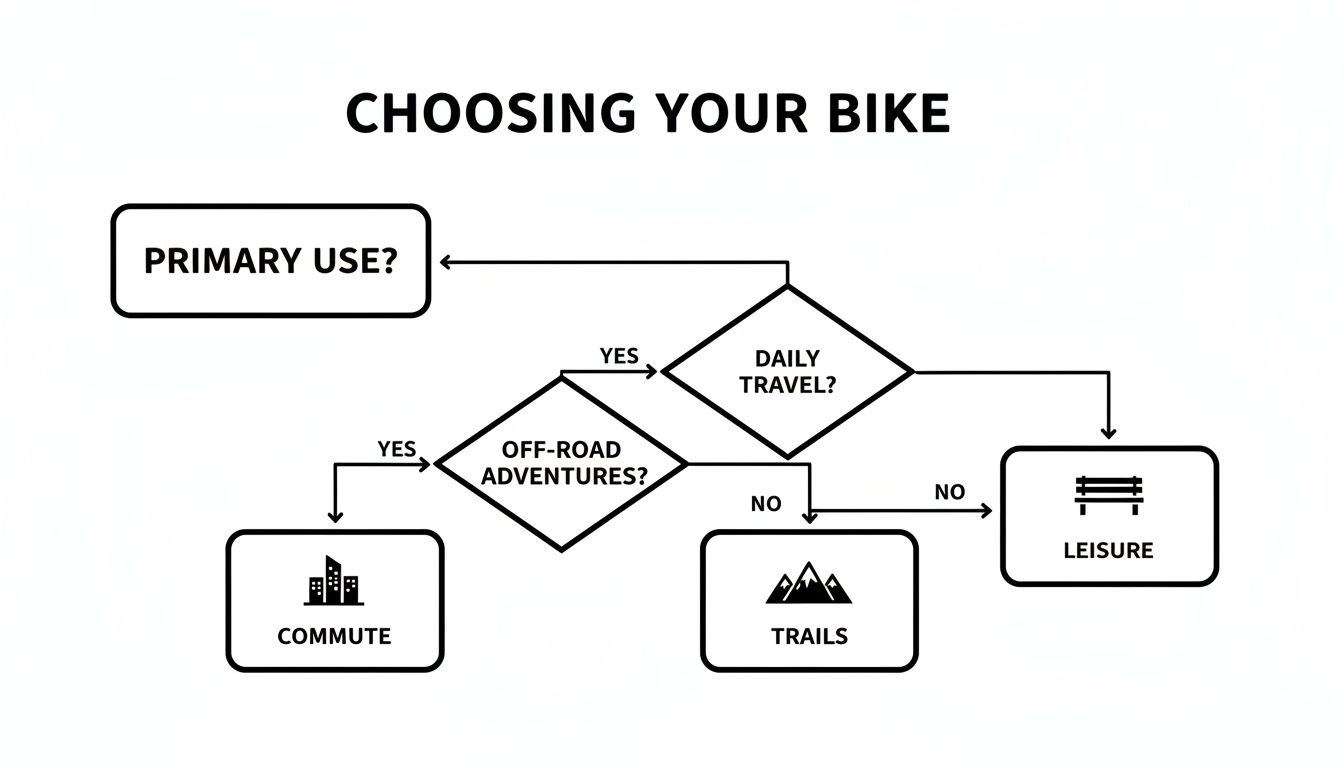
The big takeaway here is that you'll have a much better time if you match the bike's features, like its battery range and frame style, to what you actually plan to do with it.
Is Maintenance a Hassle Compared to a Regular Bike?
Good news on this front. Keeping a pedal assist bike in shape is about 90% the same as taking care of a regular bike. All the basics you already know still apply.
You’ll still need to keep an eye on your tire pressure, keep the chain clean and lubed, and make sure your brakes are working properly. The electrical parts are built to be pretty much set-and-forget. The only extra tasks are charging the battery and just making sure the electrical connections look clean and snug. We usually suggest a yearly tune-up with a pro to check on the motor and get any software updates.
What Happens If the Battery Dies Mid-Ride?
Don't panic! If you run out of juice while you're out, you are not getting stranded. Your e-bike just turns back into a regular, human-powered bike.
Once the battery is drained, the motor simply stops helping you. The bike still works perfectly fine, but it’s all you from that point on. You just pedal it home like any other bike.
Just remember, e-bikes are heavier than their standard cousins because of the motor and battery. Pedaling without any help will take a bit more muscle, especially on hills, but it's totally manageable. It’s just you and a slightly heavier bike.
Ready to find out what all the hype is about? Whether it’s for your commute or weekend fun, a pedal assist bike can completely change your ride. Punk Ride has a handpicked lineup of top-notch electric bikes that fit your vibe and your needs. Check out our collection and find your perfect match at https://www.punkride.com.
Share:
Electric scooter laws in florida: Your essential guide to compliance and safety
Finding the Best Lock for E Scooter Security