


So, you're looking to get a little more juice out of your electric bike. You can feel it, right? That sense that the bike has more to give, but something is holding it back. You're not wrong. From simple software tweaks to full-on hardware swaps, there are a few ways to unlock that hidden speed.
Let's get into what’s really going on and how you can safely get more performance.
So, Why Is My E-Bike So Slow?
If you've ever hit that invisible wall where the motor assist just cuts out, you've met your bike's speed limiter. In the US, e-bikes are often electronically capped right out of the box, typically at 20 mph (32 km/h) for Class 1 and Class 2, or 28 mph (45 km/h) for Class 3. In Australia, the standard limit is 25 km/h. This isn't because the motor can't handle it; it's all about legal compliance.
That speed cap is what keeps your e-bike classified within a specific legal framework. This is the golden ticket that lets you ride in many places without needing a license or registration. The moment you "derestrict" it to go faster, you're technically pushing it into a new vehicle class, which comes with a whole different set of rules.
Before we start tinkering, it helps to know the three main paths to more speed:
- Firmware Tuning: This is the digital route—getting into the bike's brain (the controller) and telling it to ignore that pre-set speed limit.
- Hardware Upgrades: This involves getting your hands dirty and swapping parts like the battery or motor for something with more oomph.
- Smart Maintenance: You'd be surprised what a little TLC can do. Simple, often-free adjustments can cut down on drag and make your bike run more efficiently.
This visual guide breaks down the main ways you can approach getting more speed from your e-bike.
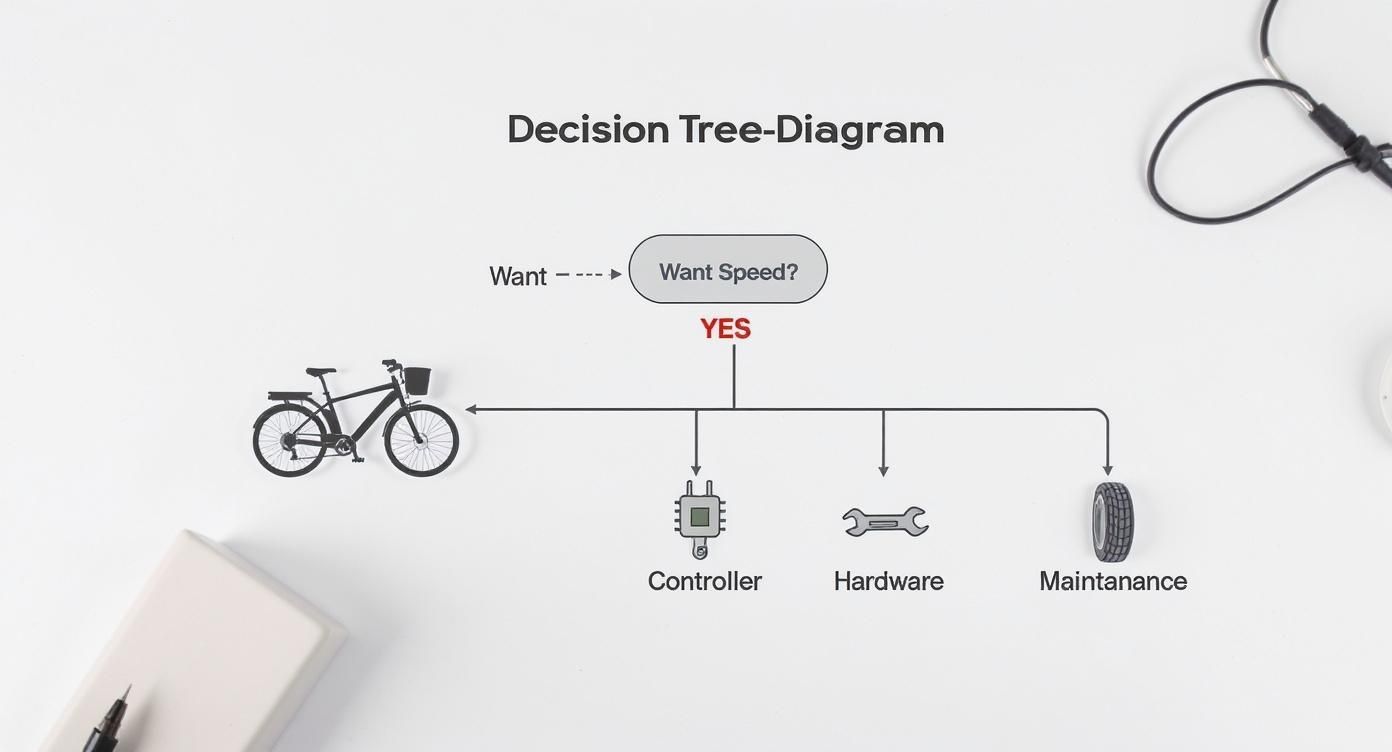
As you can see, the path you choose depends on how much you're willing to spend, how technical you want to get, and how you plan to use your bike.
The Elephant in the Room: Regulations and Rider Demand
Government rules are the main reason your bike comes with a speed cap. While the US and Australia have their own classifications, there's a growing global appetite for faster rides. This has led to a boom in powerful e-bikes and conversion kits that can easily surpass standard limits.
The demand is real. The global e-bike market was valued at around USD 2.62 billion in 2024 and is expected to hit USD 6 billion by 2035. People want to go faster, and the market is responding with more powerful options.
To get a better handle on how these rules shape the bike you buy, our guide on what is a Class 1 e-bike is a great place to start. For those who want to dig deeper into market trends, Market Research Future has some fascinating insights.
Here's a common myth busted: it's not always the motor size that caps your speed. The real boss is the controller. The motor often has plenty more power in reserve, but the software is programmed to hold it back to stay street-legal.
Before you jump into a specific method, it's a good idea to weigh your options. This table gives a quick overview of what to expect from each approach.
Comparing E-Bike Speed Enhancement Methods
| Method | Potential Speed Gain | Complexity & Cost | Legality (US/AU) |
|---|---|---|---|
| Controller Tuning | 5-10 mph+ | Low to Moderate; can be free or cost up to $200 for a tuning kit. | Voids warranty; may be illegal for public road use depending on state/territory laws. |
| Hardware Upgrades | 10-20 mph+ | High; costs can run from $600 to $2000+ for a new motor/battery. | Illegal for public road use if it exceeds legal limits; requires significant technical skill. |
| Maintenance & Tweaks | 1-3 mph | Low; mostly free or requires basic, inexpensive tools. | Completely legal and recommended. |
As you can see, the methods that give you the biggest speed boost also carry the most significant legal risks and costs. Always start with smart maintenance—it's free, legal, and makes your bike better regardless. If you decide to go further, be fully aware of the implications.
Unlocking Speed in Your E-Bike Controller
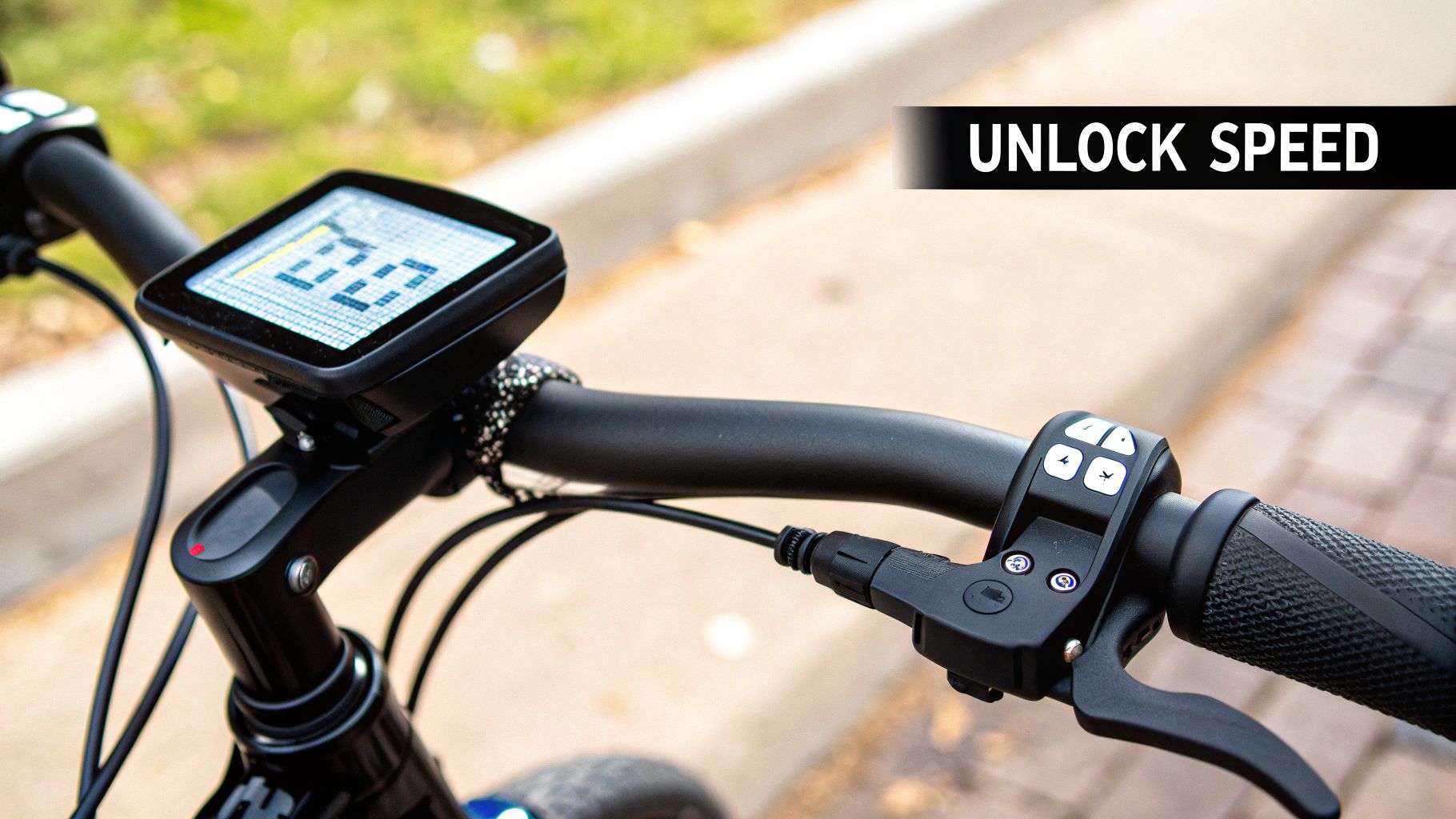
Your e-bike's controller is basically its brain. It's the little box of electronics managing everything, especially how much power flows to the motor and, more importantly for us, enforcing those pesky speed limits you see in the US and Australia.
The good news? This brain can often be tricked or even reprogrammed to let you tap into a little more speed. This whole process is usually called "derestricting," and it's the most straightforward way to go faster without reaching for your wallet to buy new hardware. It's all done in the software.
The Easy Way: Playing with Display Settings
The simplest trick in the book is to dive into the settings on your handlebar display. Many e-bikes figure out your speed by counting how many times a magnet on your wheel's spoke passes a sensor on the frame. The controller then uses your wheel size to calculate how fast you're actually going.
Here's where the hack comes in. If you can get into the settings and tell the controller your wheels are smaller than they are, you can fool it. For instance, say you're running on 28-inch wheels but you change the setting to 20 inches. The controller will now think you're going much slower than you are, and it won't cut the motor assist until you're well past the old speed limit. It’s a pretty clever workaround for a quick boost.
Some bikes make it even easier. Dig around in the "P-settings" or advanced menu, and you might just find a "top speed" or "speed limit" setting you can simply increase. It’s not always there, but it’s definitely the first thing you should check for.
Heads Up: Messing with your controller settings is a surefire way to void your manufacturer's warranty. It also means your bike may no longer fit the legal e-bike classifications in your area, so you should only use it on private land.
Getting Technical: Flashing New Firmware
If you're a bit more comfortable getting your hands dirty (digitally, at least), reprogramming the firmware is the next level up. This is a popular route for owners of bikes with common motor systems like Bafang or Bosch. It involves physically connecting your bike's controller to a computer with a programming cable and using special software to rewrite its core instructions.
Going this route gives you way more control. You can directly change the speed limit, fine-tune the power delivery curves for smoother acceleration, and even customize how the different pedal-assist levels feel. It’s a more permanent and powerful solution than just fudging the wheel size.
Before you dive headfirst into this, keep a few things in mind:
- Do your homework. Every motor and controller combo is different. Hit the forums and YouTube to find a guide that’s specific to your exact setup.
- Get the right gear. You can't just use any old USB cable. You'll need a programming cable made specifically for your bike's system.
- Always back up! Before you change a single line of code, save the original factory firmware file. This is your "undo" button if things go sideways.
Whether you're just tweaking a setting on the display or going all-in with a full firmware flash, fiddling with the controller is the most effective first step you can take to make your e-bike faster.
Getting Serious with Hardware Upgrades
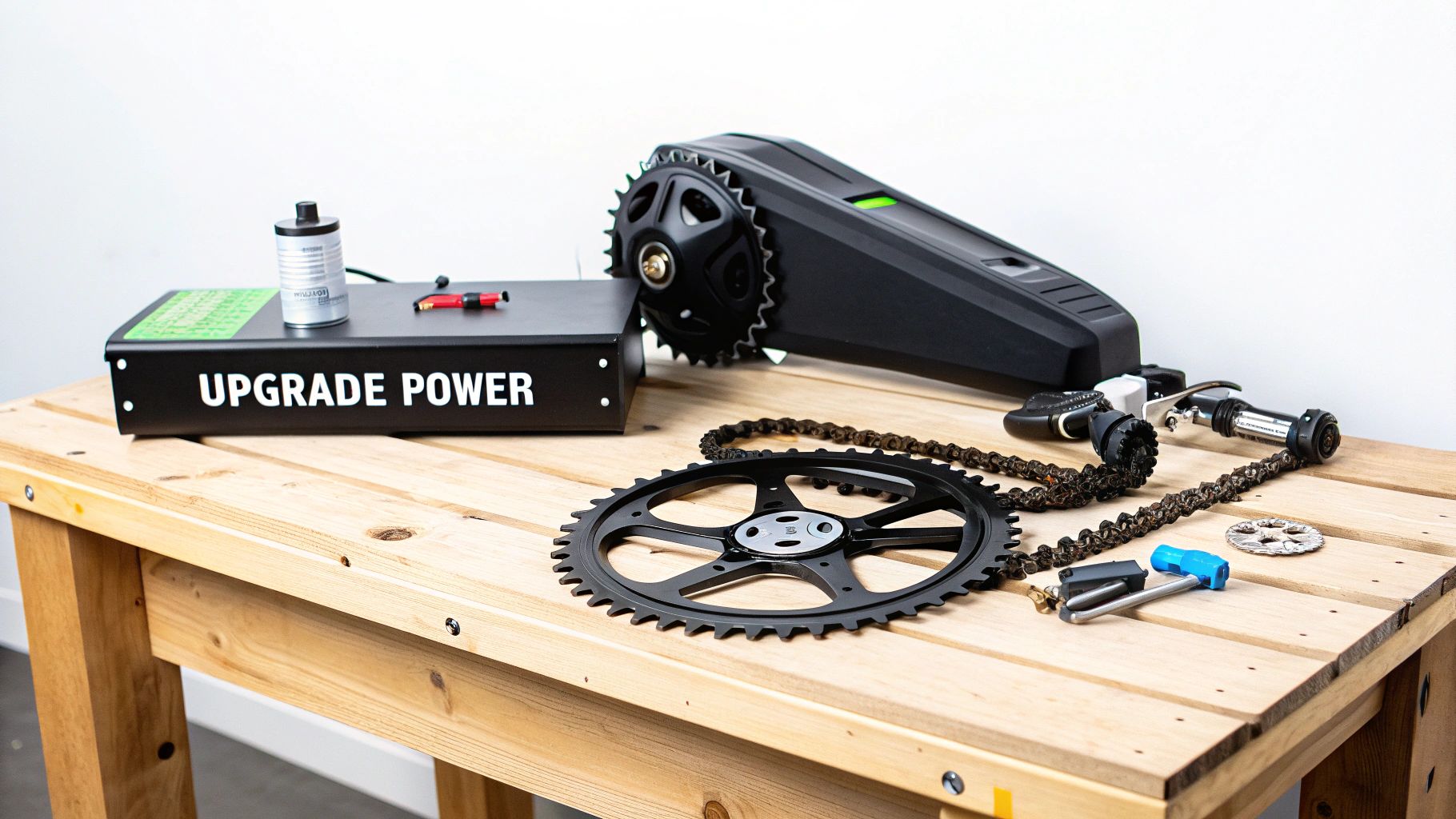
So, you've tweaked the firmware, unlocked your controller, and you're still hungry for more speed. I get it. This is where the real fun begins—getting your hands dirty with hardware upgrades.
If software tuning is like telling your engine to work a little harder, upgrading your hardware is like dropping a whole new engine in. The difference isn't just noticeable; it's a total game-changer.
Power Up with a Higher Voltage Battery
This is one of the most direct routes to a faster e-bike. The logic is beautifully simple: higher voltage equals a higher motor RPM (revolutions per minute). A motor that spins faster makes your bike go faster. End of story.
A popular move is jumping from a standard 36-volt (36V) or 48V battery to a 52V or even a 72V pack. That one upgrade alone can easily tack on several miles per hour to your top speed, and you'll feel the difference immediately.
Hold on, though! Before you rush out and buy a new battery, you absolutely must confirm your controller can handle the extra juice. Pumping 52 volts into a controller designed for 48 is the fastest way to fry your electronics and end your ride. Always, always check for compatibility first.
This thirst for speed is already shaping the industry. Just look at the rise of high-performance e-bikes in the US, which often come factory-equipped with beefier systems. These bikes are built to hit speeds well over 28 mph (45 km/h), proving that plenty of riders want more performance right out of the box. According to Precedence Research, this trend is a major driver in the e-bike market's growth.
Swap in a Stronger Motor
If the battery is the fuel, the motor is the heart of your machine. The stock motors on many e-bikes are designed to meet regulations, not to deliver thrills. Upgrading from a 500W motor to a 750W or even a 1000W+ motor will give you a night-and-day improvement in both takeoff and top-end speed.
You’ve got two main choices here:
- Hub Motors: These live in the center of your front or rear wheel. They're generally easier to install, but some riders find the power delivery less intuitive.
- Mid-Drive Motors: These are mounted down by your pedals and drive the chain directly. This setup lets the motor use your bike's gears, giving you incredible torque for blasting up hills.
A stronger motor doesn't just make you faster on a flat road; it helps you hold that speed when battling a headwind or tackling a steep incline. For a deep dive, our guide on the best mid-drive electric bikes breaks down why they're the go-to choice for serious performance builds.
https://www.punkride.com/blogs/news-advice/best-mid-drive-electric-bike
Improve Your Gearing with a Larger Chainring
Don't forget the simple stuff! After upgrading your motor and battery, you might find yourself hitting 25+ mph and feeling your legs spin uselessly. We call this "ghost pedaling," and it means you've officially run out of gears.
The fix is surprisingly simple and affordable: install a larger chainring up front. A bigger chainring gives you a harder gear to push against, letting you contribute your own leg power at those higher speeds. It’s a small change that ensures you’re still riding your e-bike, not just hanging on for the ride.
So, you’ve maxed out what software can do and you're still craving more speed. This is where the real fun begins: upgrading your e-bike’s hardware. We’re talking about giving your bike a new heart and soul by swapping out the battery and motor.
If you’re serious about making your electric bike faster, a more powerful motor and a battery that can keep up with it are non-negotiable.
Let's start with the battery. It’s easy to just think about range, but for pure speed, voltage is king. A higher voltage battery acts like a firehose, pushing more power to your motor. More power in means more RPMs out, and that translates directly to a higher top speed.
You also need to look at the continuous discharge rate, measured in amps. This tells you how much power the battery can consistently deliver without getting dangerously hot. A battery with a high discharge rate ensures your motor isn't starved for power when you're accelerating hard or holding a high speed.
Mid-Drive vs Hub Motors for Speed
When it comes to motors, the big debate is between mid-drives and hub motors. While you see hub motors everywhere, my money is on a mid-drive for any serious performance build.
-
Mid-Drive Motors: These guys are mounted right at the bike’s crankshaft. This is a game-changer because it lets the motor use your bike's existing gears. Think of it like a car's transmission—you get incredible torque for climbing hills and much better efficiency at different speeds.
-
Hub Motors: These are built into the wheel hub (front or rear). They're simple, often quieter, and get the job done. But they're stuck in a single "gear," which means they can struggle with efficiency on steep hills or during aggressive acceleration.
For pure, sustained speed, a mid-drive’s ability to work with your gearing gives it a massive edge.
Don't just chase the biggest numbers. A killer motor is useless if your battery can't feed it, and a super-high-voltage battery will fry a motor that isn't built for it. The goal is a balanced, reliable system where every part works together.
This synergy is what the entire e-bike industry is built on. The demand for faster bikes is pushing huge advancements in battery and motor tech. We're seeing powerful 750W mid-drive motors and high-density lithium-ion batteries become the new normal in the US market, letting riders go faster and farther than ever before. You can see these trends playing out in market reports from places like Grand View Research.
Just remember, a more powerful setup is also a thirstier one. It's going to drain your battery faster, which will affect your range. To make sure you're not left stranded, it's a good idea to brush up on managing your electric bike's battery life.
Ultimately, getting the right motor and battery combo will completely transform your ride, giving you that raw power and speed you’ve been chasing.
Maintenance Tweaks for Free Speed
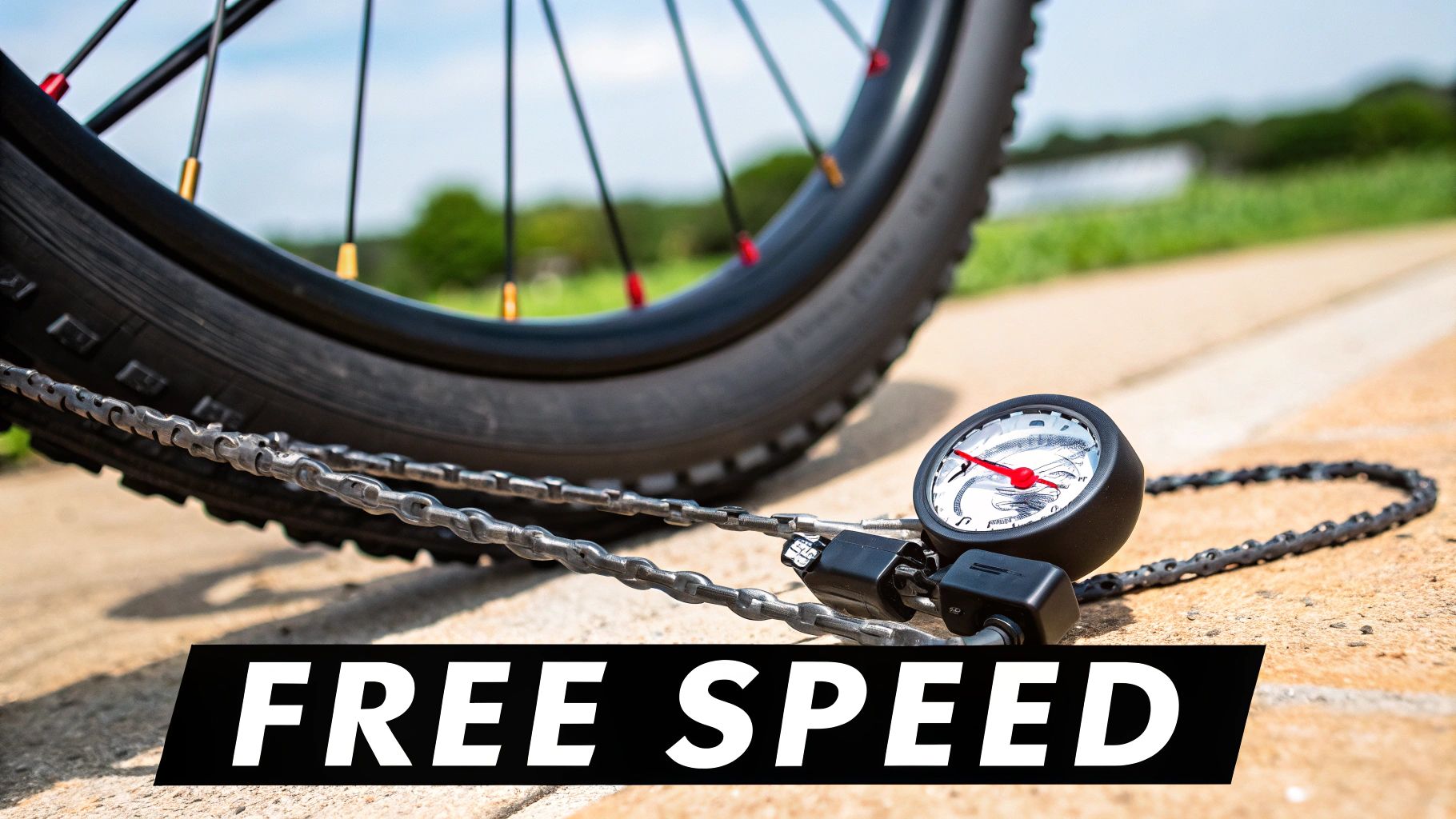
Before you even think about messing with firmware or pulling out your credit card for new parts, there's a ton of "free speed" just waiting to be unlocked. It all comes down to some basic bike care. Honestly, these simple habits are the easiest and safest ways to get more zip out of your ride without spending a dime.
The biggest bang-for-your-buck change is also the simplest: your tires. Underinflated tires are like little speed brakes, creating a surprising amount of drag with every single rotation. All that extra rolling resistance makes your motor and your legs work way harder just to keep moving.
Seriously, just pump your tires up to the correct pressure—you'll find the recommended range printed right on the sidewall. Your bike will feel instantly quicker. It’s the closest thing to a magic button for e-bike performance. A firm tire rolls efficiently, meaning more battery power goes into moving you forward instead of fighting against mushy rubber.
The Power of a Clean Drivetrain
Okay, tires are sorted. Next up is your drivetrain. We're talking about the chain, chainring, cassette, and derailleurs. Every speck of grit and old, gunky lube clinging to these parts creates friction, and friction is the enemy of speed. It silently steals watts from your motor and your legs.
A dirty, dry chain simply can't transfer power smoothly to the back wheel. You lose efficiency, and it makes for clunky, slow gear shifts.
Giving your chain a regular clean and lube pays off big time. It’s basic maintenance, but it makes a world of difference in your speed and how the bike feels. A happy drivetrain means every ounce of power gets put to good use. Plus, it’ll make your expensive components last a whole lot longer, saving you cash down the road.
You'd be amazed at the difference a clean bike makes. It's not just about looks; it's about performance. A clean chain on a properly inflated set of tyres is the foundation of an efficient, and therefore faster, electric bike.
Become More Aerodynamic
Finally, let's talk about the biggest thing slowing you down: you. Once you get above 15 mph, wind resistance becomes the main force you’re fighting. The good news is that you can gain a couple of miles per hour just by changing how you sit on the bike.
Instead of sitting bolt upright like a parachute, try tucking in a bit. Lower your torso, bend your elbows, and get into a more athletic position. This simple change shrinks your frontal area, letting you slice through the air instead of plowing through it. It’s a totally free technique that makes a real, noticeable difference when you’re trying to eke out a little more top-end speed.
Got Questions About Making Your E-Bike Faster? Let's Talk.
So, you’ve read about the firmware tricks, the hardware swaps, and the maintenance secrets. It's natural that a few big questions are probably rattling around in your head. Getting these answers right is super important for keeping yourself safe, staying on the right side of the law, and not turning your expensive e-bike into a paperweight.
We've heard all the common questions over the years. Let's dive in and clear things up so you can decide if tuning your ride is really for you.
Is It Actually Legal to Make My E-Bike Faster?
This is the big one, and the answer depends heavily on where you live. In the US, e-bike laws vary by state. Most states use a three-class system where Class 1 and 2 bikes are limited to 20 mph (32 km/h) and Class 3 to 28 mph (45 km/h). In Australia, the national standard limits motor assistance to 25 km/h.
The second you modify your bike to exceed these speeds, it may no longer be legally classified as an e-bike. It could be considered an unregistered motor vehicle, which would require a license, registration, and insurance to ride on public roads. While it's not illegal to own a de-restricted e-bike, riding it on public roads, paths, or trails is likely against the law. You're pretty much limited to private land where you have the owner's explicit permission.
Will Messing with My E-Bike Kill the Warranty?
You can bet on it. Manufacturers build and test their bikes to work safely within very specific limits. When you start unlocking controllers or beefing up motors, you're pushing everything way past what it was designed to handle.
Pretty much any change you make to the core electronics—the controller, battery, or motor—is going to be a massive red flag for the manufacturer. If a component fails after you've been tinkering, they'll almost certainly void the warranty. You'll be on the hook for all the repair costs yourself.
Before you plug anything in or get the tools out, ask yourself if a few extra miles per hour is worth giving up that warranty. On a new or pricey bike, that's a big gamble.
What's the Safest Way to Get More Speed?
Honestly, the safest way to go faster has nothing to do with hacking the electronics. It’s all about making your bike more efficient. These are the tricks that give you a boost without voiding your warranty or compromising the bike's safety systems.
Before you even think about software, try these:
- Pump Up Your Tyres: Seriously. Just inflating your tyres to the recommended PSI on the sidewall is the biggest "free speed" upgrade you can make. It slashes rolling resistance instantly.
- Clean That Drivetrain: A gritty, grimy chain and gears waste a ton of your energy. A clean, well-lubed drivetrain transfers your power smoothly, so less effort is lost to friction.
- Get Aero: Wind is your biggest enemy at speed. Just tucking in a bit and lowering your profile makes a huge difference. You'll be amazed how much faster you can go just by getting out of the wind.
These are the first things any experienced rider does. They're 100% safe, legal, and cost next to nothing.
Do I Need Better Brakes If I Make My Bike Faster?
Yes. A thousand times, yes. This is not the place to cut corners. The brakes that came on your bike were designed to stop you from its legal top speed. Once you start going faster, your stopping distance gets longer—a lot longer.
Upgrading your brakes isn't a suggestion; it's a critical safety requirement. If you're running mechanical discs, switching to a good set of hydraulic disc brakes will be a night-and-day difference. You might also want to look into getting larger brake rotors. They give you more stopping power and handle heat better, which means less brake fade on long descents. Never, ever outride your brakes.
At Punk Ride LLC, we're all about high-performance electric rides that look as good as they feel. Whether you're upgrading your commute or heading out on an adventure, our handpicked selection of e-bikes and scooters from top brands like ENGWE, DUOTTS, and HIDOES has you covered. Check out the collection and find your next ride at https://www.punkride.com.
Share:
How to Fold Scooter: The Easy Way
Mastering Ebike Tyre Repair Without the Stress