


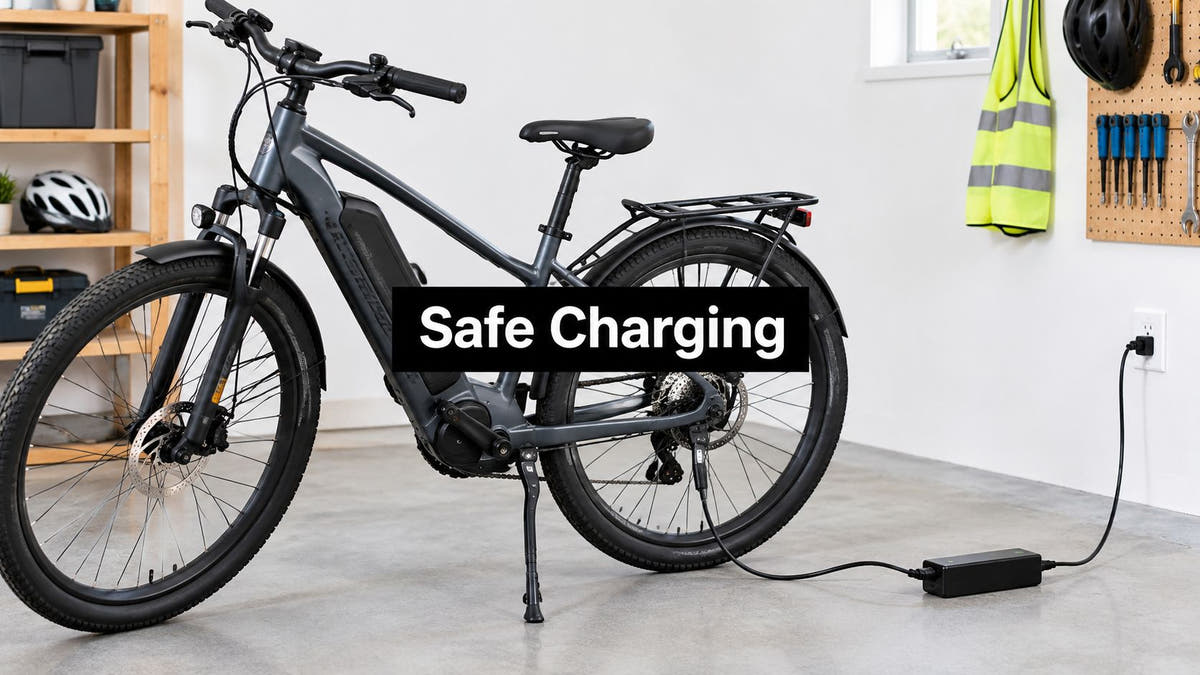
You've just rolled home from a wet commute, parked your e-bike in the hallway, and reached for the charger without looking at the battery. That reflex is convenient, but it's exactly when riders miss cracked casings, damp contacts, heat damage, or a charger that doesn't belong to the bike.
Learning how to charge an electric bike battery safely starts before the plug reaches the wall. The charger, battery, electrical system, charging location, and your timing all matter. Treat charging like a short pre-ride inspection, not an automatic overnight chore, and you'll remove the risky shortcuts that cause the most trouble.
Why Safe Charging Starts Before You Plug In
Safe charging starts with the complete charging system specified for your electric bike, including the manufacturer-supplied or manufacturer-approved charger, the compatible battery, and the instructions for that exact model. UL Solutions explains that charger compatibility matters because certification evaluates the combined electrical drivetrain, battery, and charger system under UL 2849, rather than treating each part as an isolated accessory. Read the UL Solutions guidance on e-bike and micromobility safety before mixing components from different brands.
Start with three checks.
- Inspect the battery. Look for cracks, swelling, loose parts, liquid, discoloration, or an unusual smell.
- Inspect the charger and cable. Check the casing, cable insulation, connector, and pins for damage, corrosion, dirt, or overheating.
- Inspect the charging area. The surface should be stable, dry, and nonflammable, with combustible materials and escape routes well clear.
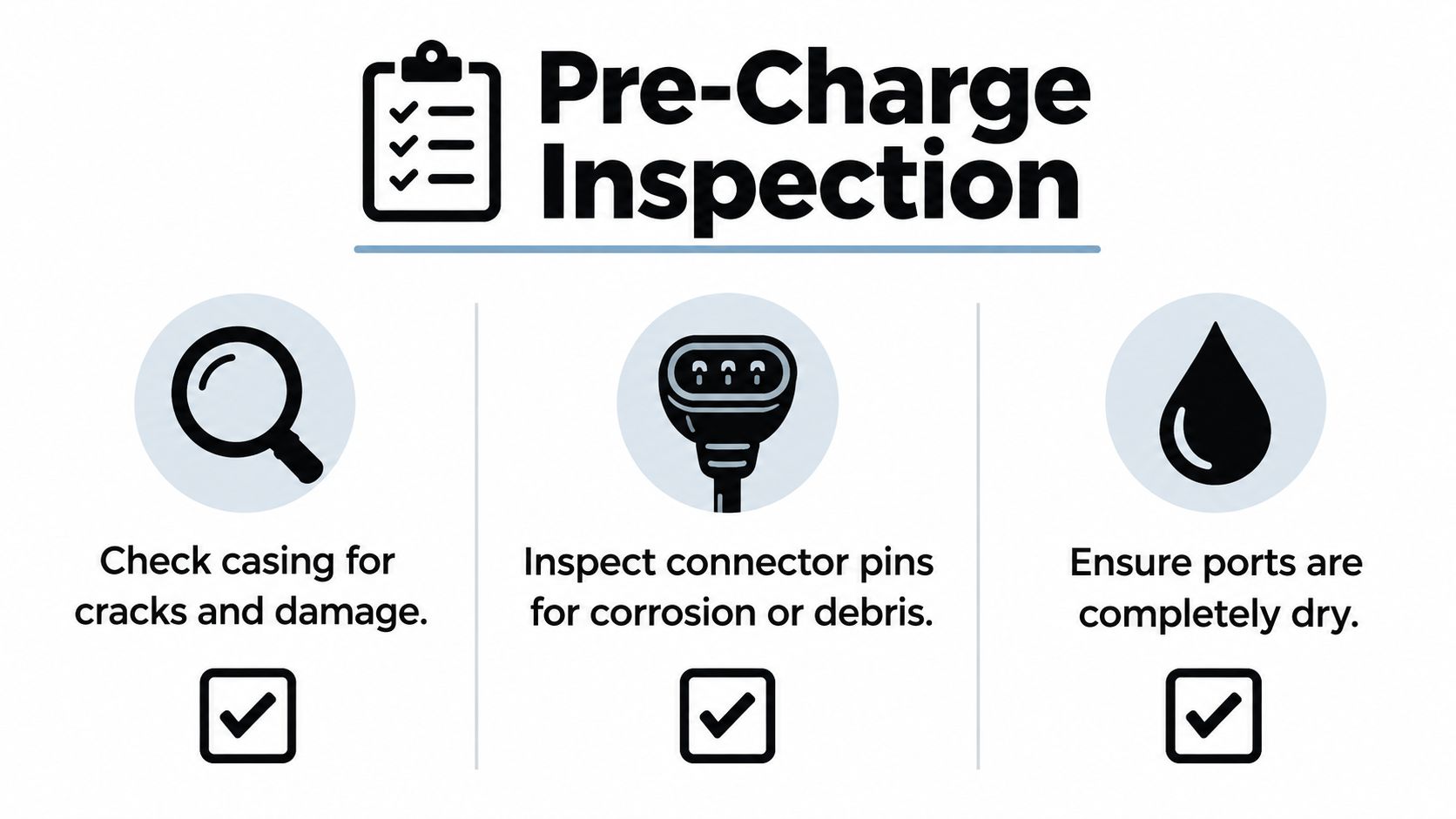
A wet ride doesn't automatically make charging unsafe, but a wet connector does. Wipe the battery and contacts with a suitable dry cloth and let moisture evaporate before connecting anything. Don't force a connector, scrape contacts with metal, or spray cleaner into the port.
Practical rule: If you can't confidently identify the battery, charger, and model-specific instructions as one matched system, don't plug it in.
Keep the same discipline during ordinary maintenance. Cleaning contacts gently, checking mounting points, and noticing casing damage early are useful routine e-bike upkeep tips that support safer charging without turning every ride into a workshop session. For charger-specific considerations, Punk Ride's guide to electric bike chargers is another useful reference.
A compatible plug isn't proof of compatibility. Two chargers can look identical while having different output characteristics, connector polarity, or battery chemistry requirements. The complete system matters because the battery-management system, charger, controller, and cells must work together.
The Charging Sequence That Protects Your Battery
The safest routine is boring, repeatable, and easy to interrupt. Whether the battery stays inside the frame or comes out in a removable shell, use the same order every time.
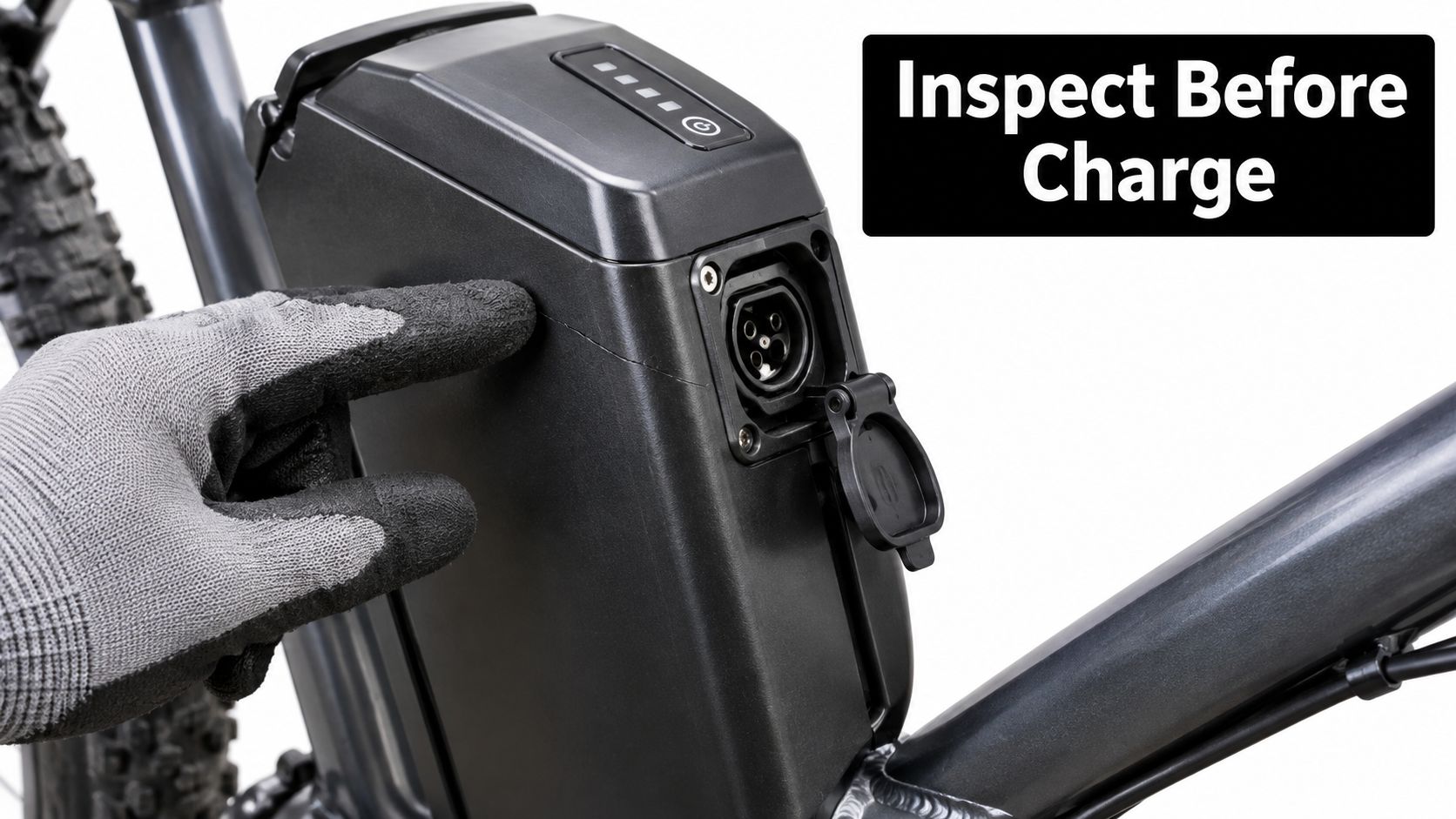
Inspect, position, and connect
First, turn the bike off and inspect the battery casing, charging port, charger body, cable, and connector. Stop immediately if you see swelling, cracks, liquid, darkened plastic, corrosion, smoke residue, or a damaged cable. A pack with a defect doesn't get a second chance because it still powers the motor.
Next, place the bike or removable battery on a hard, stable, dry, nonflammable surface. Keep it away from beds, sofas, carpets, heaters, curtains, cardboard, stored clothing, and doors that form part of an escape route. A garage or carport can work when it's dry, ventilated, and protected from extreme temperatures. A bedroom is a poor charging location because people sleep there and soft furnishings provide fuel if something fails.
Connect the approved charger to the battery or bike first, then connect the charger directly to a suitable wall outlet. Don't use an extension lead or power strip for this routine. Check the indicator lights, but follow the model's manual rather than guessing what a colour means.
UL 2849 evaluates the integrated battery, charger, and electrical drive system, including protection against shock, overcharge, excessive current, and unsafe temperature conditions, as described in the CPSC letter on UL 2849 and related standards. That protection depends on a compatible system, not merely a connector that fits.
Monitor the charge and stop at full
Stay awake and close enough to notice a change in sound, smell, temperature, or indicator status. A battery may become warm during charging, but it shouldn't become unusually hot, swell, hiss, leak, or smell strange. Disconnect the charger as soon as the full-charge indicator appears, then remove the charger from the wall and the battery according to the manufacturer's instructions.
Don't leave it charging while you sleep, leave home, or lose track of time. If you need a clearer understanding of how the pack's electronics regulate charging, Punk Ride's explanation of the e-bike battery management system is a useful companion read. The same deliberate sequence applies to other rechargeable vehicle batteries, and this Caddie Wheel charging guide offers a practical comparison for charging equipment and battery care.
If anything abnormal happens, stop charging rather than troubleshooting live. Don't swap in another adapter to see whether the first one caused the problem. Isolate the issue and contact the manufacturer or a qualified repair professional.
Timing, Temperature, and Where You Actually Plug In
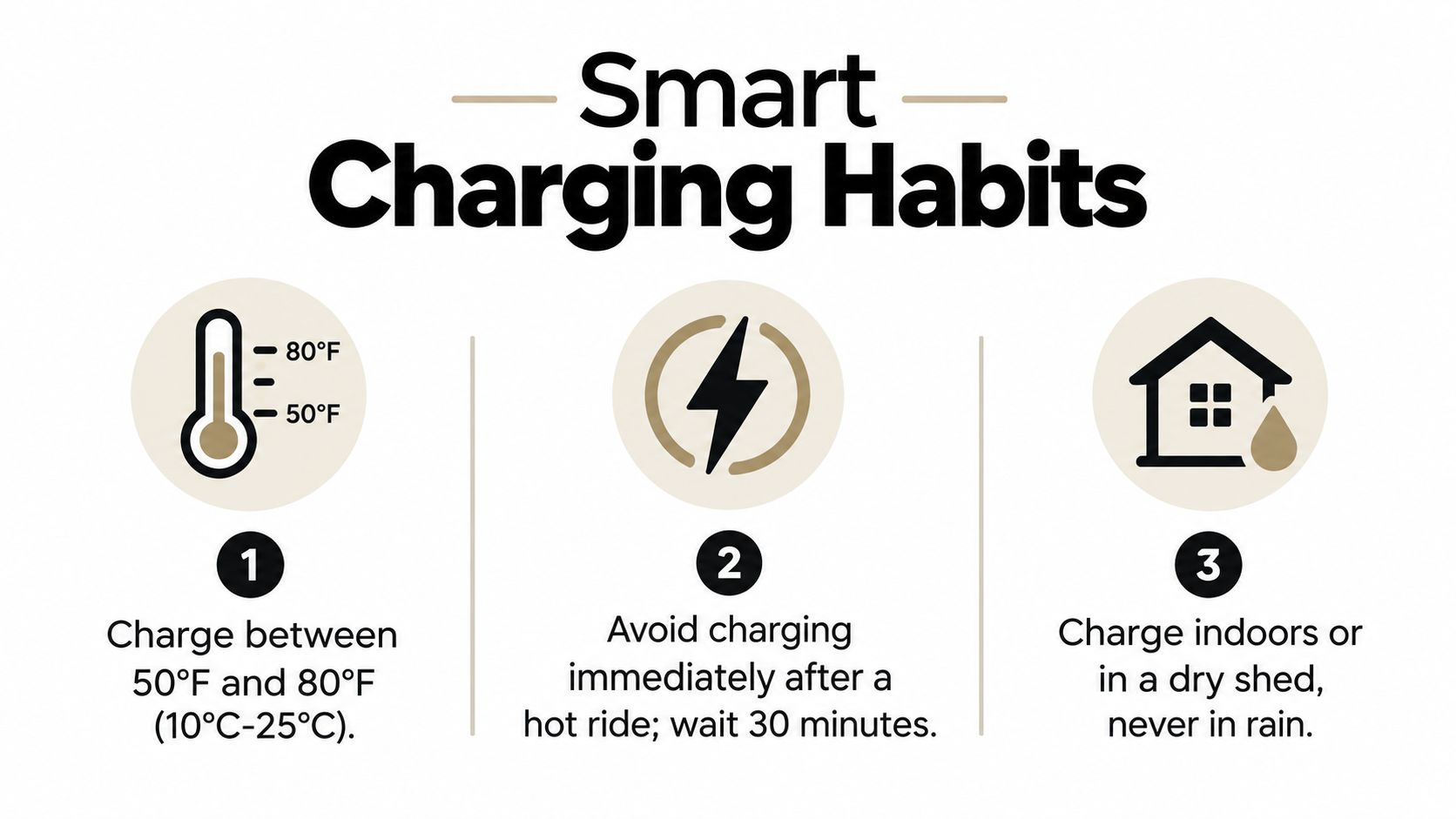
Charging immediately after every ride is a bad blanket rule. A battery that's mildly warm from normal use may need time to return toward room temperature. A pack that's too hot to hold comfortably, unusually hot in one area, or giving off an odour isn't in the normal category.
London Fire Brigade advises allowing a battery to cool after use, keeping it on a hard, flat surface, and protecting it from extreme heat and cold. Queensland Fire and Emergency Services similarly recommends charging in a well-ventilated place, such as a garage or carport, on concrete, ceramic tile, or another non-combustible surface. Let the pack cool naturally. Don't put it in a freezer, against a radiator, or under a pile of clothing.
Choose the least dangerous location
The National Fire Protection Association identifies outdoors, away from structures or enclosures and out of direct sunlight, as the safest practical location when conditions allow. In a UK or EU flat, that may not be realistic, so choose the safest indoor alternative: a dry, ventilated, uncluttered spot with a nonflammable surface and no blocked exit.
Never charge in rain or where water can reach the connector. Don't charge beside a cooker, portable heater, boiler, or sunny window. If the battery has been stored in a cold shed, bring it into a dry indoor area and allow it to come back toward room temperature before charging. The same principle applies in hot climates. A sealed, sun-heated garage can be worse than a shaded, ventilated charging area.
Supervise the risk
The scale of the problem is visible in New York City. The Fire Department reported 13 e-bike fires in 2019, the first year it tracked them, and more than 250 e-bike and e-scooter fires across 2022 and 2023. Those incidents caused five deaths and dozens of injuries, according to NFPA's e-bike safety information. NFPA also notes that broad national or international fire-rate statistics aren't available, so these figures don't mean every charging event is dangerous. They do show why location and supervision deserve serious attention.
Charge when you're awake and able to respond. Unplug when full. Keep the battery away from beds, sofas, heaters, and exits. For storage advice for the period between rides, see Punk Ride's guide to storing lithium batteries safely.
Charging Myths That Put Riders at Risk
Myth one, a matching plug makes a charger safe. UK government guidance says an e-bike battery should be charged only with the charger supplied with the cycle or an authorised replacement from the manufacturer. That rule matters because a borrowed charger, generic adapter, or laptop charger may fit while still being unsuitable for the battery system. Follow the specified charging time, unplug when full, and never cover the charger or battery pack, since trapped heat can cause overheating and fire. Read the UK battery safety guidance for e-cycle users.
Myth two, overnight charging is harmless because the charger stops by itself. Protective controls do not give you a response plan if something goes wrong while you sleep. Charge while you are awake, and stop when the battery reaches full charge. A charger that shuts off correctly still leaves a failing cable, abnormal noise, smoke, or rising heat for someone to notice.
Myth three, an extension lead solves a difficult layout. Fire safety agencies advise against extension cords and power strips for e-bike charging. Do not run a cable under a rug, through a doorway, or across a busy hallway. Move the bike or use a suitable wall outlet instead of building a makeshift charging station.
Myth four, a slightly puffy pack is still usable because it still gives range. Swelling changes the pack's physical condition, so stop charging and stop riding it. Do not press the casing flat, puncture it, open it, or test it with another charger.
Under UK statutory guidance, safety mechanisms must prevent thermal runaway even during foreseeable misuse, which a damaged or mismatched pack cannot promise.
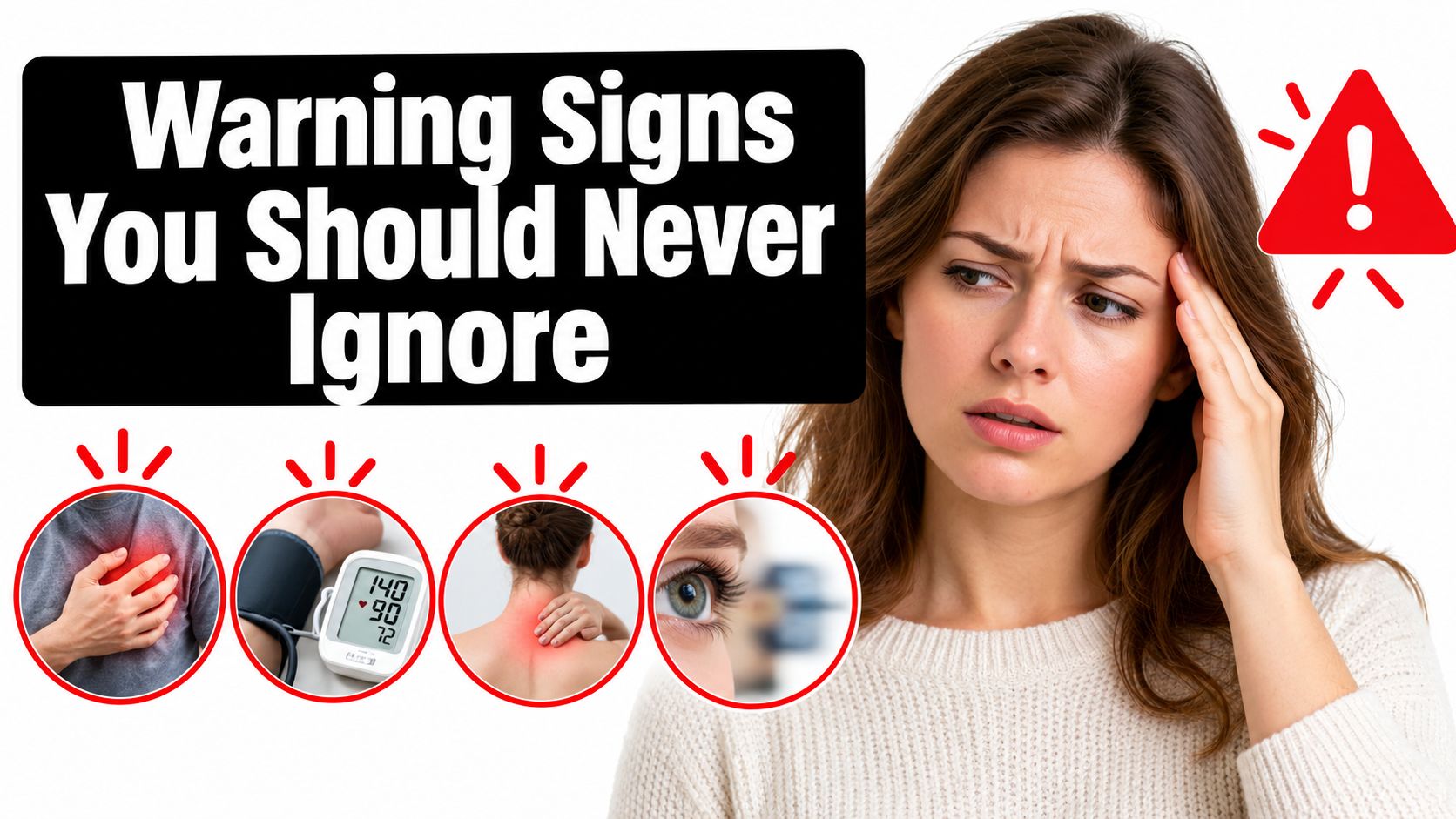
Warning Signs You Should Never Ignore
A warm battery after a demanding ride is different from a pack that's unusually hot, bulging, leaking, discoloured, or producing an unfamiliar odour. Riders often get into trouble by treating the first visible change as cosmetic. It isn't cosmetic when the casing no longer sits flat or a connector has darkened.
UL identifies swelling or bulging, unusual overheating, strange smells, crash damage, smoke, and fire as warning signs associated with a higher risk of thermal runaway, as reported in London Fire Brigade's e-bike charging guidance.
Use a stop rule
Stop charging immediately if you notice:
- Swelling or bulging: Disconnect only if you can do so without touching a dangerously hot or smoking component. Otherwise move away and call emergency services if there is immediate danger.
- Smoke, fire, hissing, or rapid heating: Evacuate people and pets. Don't handle the pack and don't use water unless emergency responders direct you.
- Liquid, a strong smell, or discolouration: Isolate the bike or pack from combustible materials only when it's safe, then contact the manufacturer or a qualified repair service.
- Crash or drop damage: Don't charge the battery to test it. A casing can hide internal cell damage even when the bike still turns on.
- A damaged charger or cable: Remove it from service. Don't tape over a split cable or bend a connector back into shape.
A battery that has been dropped, crushed, modified, reworked, or opened needs professional assessment. The right response is not “try another charger.” It's isolation, documentation of what happened, and advice from the manufacturer or a competent repair shop. A general home battery health check can help explain what a professional inspection looks for, but it doesn't replace model-specific assessment of a damaged e-bike pack.
CPSC warned in 2026 that some hazardous battery incidents occurred while batteries weren't charging and the e-bike was merely stored. Unplugging at full charge reduces exposure to charging faults, but it can't make a damaged battery safe. Keep watching the pack after a crash or visible change, even if you haven't connected the charger.
Charge Cycles, Partial Top-Ups, and Long-Term Habits
You don't need to run a lithium-ion battery completely flat before charging it. Partial top-ups are a sensible everyday habit, especially for commuters who need dependable range the next morning. The practical target is simple: charge when the battery needs it, avoid leaving it full unnecessarily, and don't turn a routine top-up into an overnight event.
For a long break, follow the storage charge level and temperature guidance in the bike's manual. Keep the battery in a dry, moderate indoor environment rather than an uninsulated shed, freezing garage, or hot vehicle. Check it periodically without connecting a charger to a pack that shows swelling, leakage, damage, or another warning sign.
The battery-management system handles important protective functions, but riders still control the conditions around it. UK statutory guidelines require an e-bike or conversion-kit lithium-ion battery to contain safety mechanisms capable of preventing thermal runaway during normal operation and reasonably foreseeable misuse, as explained in the UK statutory guidance on lithium-ion battery safety for e-bikes.
A workable weekly rhythm looks like this:
- After a normal ride: Let a warm pack cool in a clear, dry place before charging.
- Before charging: Inspect the casing, contacts, cable, and connector.
- During charging: Stay awake, keep the area clear, and watch for abnormal heat or smell.
- After charging: Disconnect at full and put the charger away safely.
- Before a long break: Follow the manufacturer's storage instructions and keep the battery protected from temperature extremes.
That routine is enough. You don't need to become a battery engineer, but you do need to respect the system's limits.
Your Charging Routine and the Habits Worth Keeping
Print this short checklist and keep it near the charging spot:
- Use the supplied or authorised charger for that exact bike and battery.
- Inspect before connecting. Reject swelling, cracks, liquid, odour, smoke, and crash damage.
- Charge on a hard, dry, nonflammable surface away from beds, sofas, heaters, clutter, and exits.
- Connect correctly and supervise while the battery charges.
- Unplug when full. Never make overnight charging your normal routine.
- Stop immediately when something changes. Don't test a damaged pack with another charger.
For Australian riders, Fire and Rescue NSW gives the same central advice: use only the supplied charger or approved charging equipment compatible with the battery's specifications, as stated in its e-bike and light electric vehicle charging guidance.
Charging should be a deliberate setup, not a reflex. Once the surface, charger, battery condition, temperature, and supervision are right, the routine becomes quick and calm.
Punk Ride LLC offers electric bikes, scooters, chargers, and related urban mobility products from brands including ISCOOTER, AOVO, DUOTTS, HITWAY, and ENGWE, with warehouses in the UK and Germany and headquarters in Florida. Visit Punk Ride LLC to explore compatible equipment and keep your charging setup matched to your ride.

Share:
Water Proof Scooter: What IP Ratings Actually Mean
Electric Bike Throttle Not Working: A Practical Fix Guide