


In Great Britain, police recorded 1,312 collisions involving e-scooters in 2024, compared with 1,292 in 2023, according to the UK Department for Transport e-scooter factsheet for 2024. That number changes how a heavier adult should shop. Payload isn't a comfort spec you check last. It's the safety margin that decides whether the brakes, tyres, deck, and folding hinge still work properly when you're fully dressed, carrying a bag, and braking downhill on wet pavement.
Minimum Specs for a Heavy-Duty Foldable Scooter
Start with a screening sheet, not a brand name. If a foldable electric scooter for heavy adults can't state all six figures below clearly, I wouldn't shortlist it yet.
| Specification | Minimum to look for | Why it matters |
|---|---|---|
| Rated payload | 100 kg or more, fully laden | Load passes through frame, hinge, and brakes |
| Brakes | Two independent systems | Each system must stop the rider on its own |
| Tyres | 10 inch or larger, pneumatic or tubeless | Small tyres lose grip and overheat under load |
| Deck and fold joint | Wide deck, locking hinge with no play | Hinge takes load during braking and kerb impacts |
| Motor rating | Continuous rating stated | Peak wattage alone overstates usable power |
| Rated top speed | Within local legal limits | Speed rating must match where you can ride |
What the 100 kg line actually means
Treat 100 kg fully laden as a screening benchmark, not a legal requirement for a privately owned scooter. It gives you a clean first cut. Below it, don't negotiate with yourself because the fold looks neat or the price looks friendly.
Fully laden means you plus shoes, coat, helmet, backpack, lock, charger, shopping, and anything strapped to the bars. Riders who check only bare body weight against the rating lose their margin before they've left the hallway. That margin matters because extra mass changes braking distance, tyre loading, acceleration, handling, and stress through the frame and folding hinge.
Practical rule: a missing payload, brake, or tyre figure isn't a neutral gap. Treat it as unverified until the seller puts it in writing.
Why load is structural, not cosmetic
The safety backdrop is blunt. The U.S. Consumer Product Safety Commission analysis covering 2017 to 2022 estimated 360,800 emergency-department-treated injuries involving micromobility products, including e-scooters, e-bikes, and hoverboards. E-scooters alone accounted for an estimated 169,300 emergency-department-treated injuries during that six-year period, and the e-scooter estimate reached 51,700 injuries in 2022, 22% higher than in 2021.
Those figures don't prove one scooter is safe and another isn't. They explain why you shouldn't buy on motor wattage, colour, or folded size while guessing about structure. A hinge that feels tight in a showroom still takes repeated load during braking, acceleration, and kerb drops. Small solid tyres can feel sketchy fast under a heavier rider because they offer less grip and less cushioning than larger pneumatic or tubeless tyres.
Motor claims need the same scepticism. A stated continuous motor rating tells you more than a peak number splashed across a listing, because peak output is a short burst, not the power you'll use climbing in traffic. If you're comparing stronger models, our guide to high-powered electric scooters and what the ratings mean helps separate usable output from headline wattage.
Shortlist only models that state payload, both brake systems, tyre size and type, deck dimensions, continuous motor output, and rated speed. If one figure is missing, email the seller. Don't assume it passes.
Model Types Compared for Heavier Riders
Type labels are useful, but they don't carry you. Use this table to match the scooter's shape to your route, then check the individual model's payload and brakes.
| Type | Tyres and ride | Load and stability | Best fit |
|---|---|---|---|
| Folding commuter | Small to medium tyres, lightest frame | Lower stability margin, depends on rated payload | Short mixed trips, transit links |
| Folding performance | Larger tyres, dual brakes, sturdier deck | Higher payload and stability margin | Hills and longer daily commutes |
| Fat-tyre folding | Wide pneumatic tyres, cushioned ride | Stable at moderate speed, heavier to carry | Broken pavement and mixed terrain |
| Off-road | Large knobby tyres, stronger suspension | Stable but heavy, folding often limited | Trails, not daily carrying |
Matching the type to your week
Folding ease and load margin usually pull against each other. A light commuter folds quickly for a train or office cupboard, but smaller tyres and a slimmer deck can leave a heavier rider with less room to brace under braking. It suits short, flatter trips where you're carrying it often and riding gently.
A folding performance model is the better starting point for daily hills or longer distances. Larger tyres roll over cracks with less drama, and dual brakes give you proper control when traffic stops suddenly. You'll pay for that with extra weight on stairs, so check the folded lift before you fall for the spec sheet.
Fat-tyre models earn their place on broken pavement, gravel edges, and rough kerb transitions. The tyre volume softens impacts that would rattle a narrow commuter tyre. Off-road scooters go further on trails, but many fold only in a technical sense. If you can't lift it into a car boot without help, it isn't a practical folding scooter for your life.
Don't let the category do the maths for you. An independent 2024 electric-scooter dimensions guide identified 265 to 330 pounds as the typical weight-capacity range for heavier-duty scooter categories, which shows how wide the spread can be even among models sold as heavy duty. A label can't replace the rating printed for that exact version.
Our e-scooter comparison guide lays models side by side, but I'd still make the final call the boring way. Pick the type for your route first. Then keep only the models whose payload, brakes, and tyres clear your minimums.
How to Check Payload and Braking Claims Before You Buy
Don't test a seller's claim with your first emergency stop. Run this routine while you can still walk away.
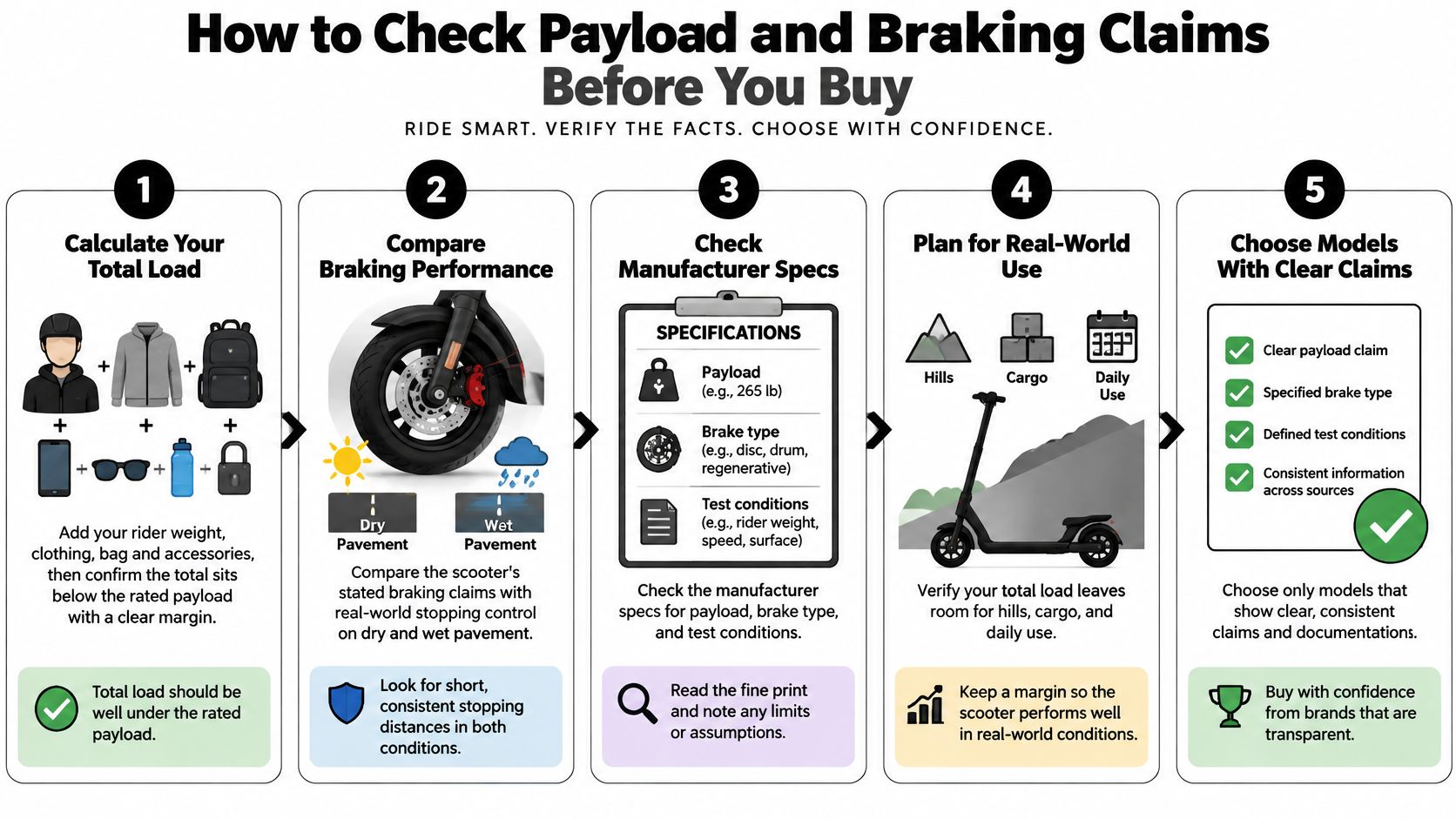
- Add up your real riding load. Weigh yourself dressed, then add your bag, lock, helmet, charger, and regular cargo. The common slip is comparing bare body weight with the rating and pretending winter clothes and a laptop weigh nothing.
- Ask whether payload was tested fully laden. A rider-only figure can hide weak brakes, deck flex, or hinge stress once cargo joins the trip. Get the test conditions, not just the headline number.
- Confirm two independent brakes. Look for a mechanical friction brake paired with another independent system, so one failure doesn't leave you coasting. Sellers sometimes describe one lever and electronic assistance as if that's the same redundancy. It isn't.
- Request stopping-test results at load. UK government trial guidance for e-scooters specifies a minimum payload capacity of 100 kg and braking tests with a rider between 70 kg and 100 kg. Combined braking must achieve at least 3.5 m/s² deceleration or stop within 7 m from 15.5 mph, and each independent system must separately achieve at least 1.5 m/s² or stop within 15 m.
- Inspect the fold joint before the first ride. Lock the stem, grip the bars, and push side to side and front to back. Look for play, cracks, bent hardware, or a latch that doesn't seat fully. Tiny wobble on day one usually becomes annoying movement after weeks of kerbs and braking.
- Check tyre pressure and your pump. Find the pressure range on the sidewall or in the manual, then confirm your pump and gauge can reach and read it accurately. Underinflated tyres squirm, overheat, and invite pinch flats under heavier loads.
What a passing answer looks like
A credible spec sheet names the payload, the test rider or load, both brake types, and the documented stopping result. It also shows the fold lock design clearly enough that you can inspect it in photos or in person.
If the seller can't explain how the scooter stops at maximum load, the payload claim hasn't earned your trust yet.
Vague replies are useful information too. They tell you to keep shopping.
Stability, Braking and Safety Margin Under Extra Weight
A standing scooter doesn't stop like a bicycle, and pretending otherwise gets people hurt. The OECD/ITF safer micromobility technical report puts the practical maximum deceleration for standing e-scooters at approximately 5 m/s², compared with about 6.7 m/s² for seated e-scooters and 7.5 m/s² for bicycles. The standing rider's higher position raises the risk of pitching forward, so there's less usable braking before control becomes the problem.
Mass helps until it doesn't
Vehicle mass can steady a scooter. The same OECD/ITF analysis summarises research finding that, with the same wheel size, heavier scooters can be more stable, and a 31.5 kg scooter demonstrated better braking performance than an 11.3 kg scooter. A flimsy ultralight frame isn't automatically safer just because it's easier to carry upstairs.
But don't turn that into a simple rule that heavier is better. Rider plus scooter mass raises collision energy, and the outcome still depends on tyre diameter, brake design, centre-of-mass location, and the surface under you. A heavy scooter on tiny tyres with grabby brakes can still be a handful. A sturdier frame with large pneumatic or tubeless tyres, low and rearward mass placement, and progressive dual braking gives you a better combination.
Range and hill claims also need discounting as combined mass and gradient rise. Ask what rider mass, temperature, tyre pressure, and terrain produced the advertised figure. If the seller won't say, plan your battery needs conservatively and don't judge hill ability from a flat-ground top speed.
Payload is a margin, not a pass mark
Most buying guides treat maximum weight as pass or fail. Real riding is messier. Braking shifts your weight forward, unloads the rear wheel, and can increase the chance of a skid if you're turning at the same time. Deck space, suspension behaviour, tyre grip, and fold-joint stiffness all change how secure that moment feels.
Dakota News Now reporting on Consumer Reports and e-scooter safety describes independent trauma research covering 38,440 records that found e-scooter riders had substantially higher adjusted risks of traumatic brain injury, internal-organ injury, and vascular trauma than motorcycle riders. That doesn't establish that heavier riders are more likely to suffer those injuries. It does kill the lazy idea that any scooter rated for your weight is equally protective in a crash.
Buy for headroom: choose a tested payload that comfortably exceeds you, your clothing, your luggage, and your accessories combined.
High motor wattage doesn't compensate for weak brakes, small tyres, or a narrow deck. Power gets you moving. Margin helps you stop, turn, and stay upright when the road does something rude.
Scenario checks that matter
- Hills: Brake early, keep speed low before the descent steepens, and leave extra space. Don't discover brake fade, wheel lock, or hinge flex halfway down with a junction waiting.
- Wet pavement: Slow down before paint, metal covers, leaves, or polished stone, and avoid braking mid-lean. Straighten the scooter first, then brake progressively.
- Kerbs and broken edges: Approach straight and slowly with tyres properly inflated. Glancing blows twist small wheels and punish the fold joint, especially under heavier loads.
- Emergency braking: Practise in a quiet car park on private land where permitted. Apply both brakes progressively, bend your knees, keep your weight back, and brace through a wide deck rather than stiffening your arms.
- Loaded bag: Re-test braking after adding your usual cargo. A backpack raises and shifts mass, and a handlebar bag can make steering feel heavier exactly when you need a quick correction.
Wear a certified helmet and gloves every ride. For a foldable electric scooter for heavy adults, protective gear isn't an accessory bundle. It's part of the safety margin you can't engineer into the deck after purchase.
Where Private Scooters Are Legal in the UK and EU
A scooter that's legal to buy isn't automatically legal to ride on your street. Drop that assumption before you compare payloads.
The UK position for private owners
The UK government's electric scooter rules state that a privately owned electric scooter cannot legally be ridden in public places: roads, pavements, cycle lanes, parks, and other publicly accessible areas. The only permitted location is private land where the owner has granted permission. Illegal public use can bring a fine, penalty points on your driving licence, and seizure of the scooter.
A high payload rating changes none of that. A foldable frame rated well above your weight still has no public-road status, and a sensible top speed or cautious riding style won't create one either. Legality turns on the vehicle's approved class.
Rental schemes are the trap for heavier riders doing research. UK guidance for e-scooter trial users gives rental e-scooters in official trial areas a maximum permitted speed of 15.5 mph, with some local areas setting a lower limit, and allows them on roads other than motorways and in cycle lanes inside approved zones. That permission belongs to the authorised rental scooter in that area. It doesn't transfer to anything you buy privately.
If your plan is a lawful UK commute, read our guidance on choosing an electric scooter for daily commuting alongside the current rules before spending anything. The legal route may point you toward a rental trial, private land use, or a different vehicle entirely.
EU and Australia checks
The EU sets rules country by country. A model accepted in one member state can face different limits in the next, so verify before you cross a border or buy on the strength of "EU-legal" marketing. Confirm the national vehicle category, any registration or insurance duty, where riding is permitted, and whether that exact model carries the required approval. A seller's claim about European legality is a prompt to run those checks yourself.
Australia demands the same state-level caution. Australian product safety guidance on e-micromobility devices states that most states and territories permit only certain e-bikes on public roads and paths, with common requirements of a maximum continuous motor rating of 250 watts and power assistance capped at 25 km/h. Road rules sit with individual states and territories, so check the state where you'll ride rather than trusting a national summary.
Wherever you ride, legality follows the vehicle's approved category and equipment. Riders who find a scooter can't be legalised on their route sometimes look at other vehicle classes, and street-legal cart guidance from Solana EV shows how the requirements shift for low-speed vehicles and carts. The same principle applies to scooters: impressive specs mean nothing if the class can't legally use the road.
If you can't confirm a legal public route, keep the scooter to private land with permission and choose it on load, braking, and durability alone.
Confirm These Specs Before You Buy
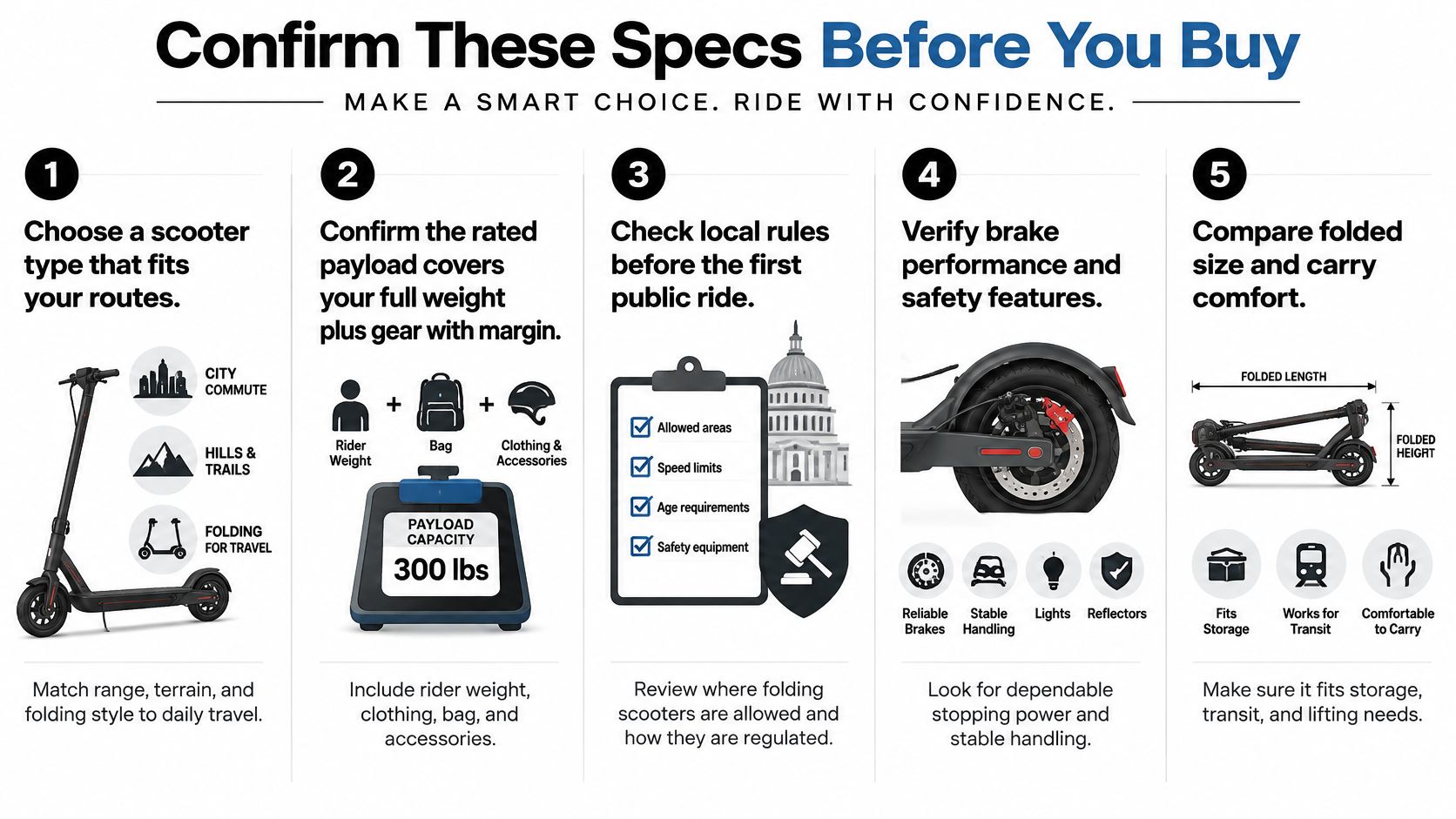
Make the decision in this order. Choose the type that fits your routes, confirm the payload covers your full load with margin, verify braking evidence, then check that your intended route is legal.
Work through real listings
A 2024 independent scooter comparison from Unagi listed the foldable Gotrax Flex at $349, 46 pounds, and a maximum payload of 264 pounds. On paper, that payload clears the 100 kg screening line, so it merits closer questions. It doesn't earn a purchase until you have written stopping-test data, tyre details, and clear fold-joint information for the exact version being sold.
Now apply the same test in the opposite direction. The LADPED LP07 Folding Electric Scooter is rated 350W with a 36V 10.5Ah battery, and its maximum load is 50 kg. Whatever its folding convenience, that load rating rules it out for a heavy adult immediately. Don't let battery size distract you from a structural limit that low.
Email the seller for four things before ordering:
- Payload test conditions: Who or what was loaded, and was cargo included?
- Brake evidence: What are both systems, and what stopping result was recorded at maximum load?
- Fold-joint details: How does it lock, how do you inspect it, and what play is acceptable?
- Legal fit: What approval or documentation supports use where you plan to ride?
Apply that written-answer test to our product pages too. Buy only when the specs cover your weight plus gear and the legal route checks out. If either answer is fuzzy, waiting is cheaper than owning the wrong scooter.
Ready to compare folding, fat-tyre, commuter, off-road, and performance models with payload, brakes, tyres, and folded size in view? Visit Punk Ride LLC to work through the current electric scooter range, check each listing against your fully laden weight, and contact us for the written spec details you need before you buy.


Share:
Electric Bikes Reviews 2026: How to Pick the Right One