


You've got several bike listings open, and every one seems to promise effortless hills, generous range and a bargain price. Then you notice that one range claim uses gentle assistance, another doesn't mention rider weight, and the cheapest bike gives you almost nothing to go on about its replacement battery.
That's where useful electric bikes reviews should earn their keep. Treat every headline as something to test, compare bikes under matching conditions, and put long-term battery health ahead of a tempting discount. For UK and EU riders especially, the right purchase also has to match the legal configuration you'll ride.
Which E-Bike Type Fits Your Riding
E-bike categories and their trade-offs
| Category | Best for | Main trade-off | Check before buying |
|---|---|---|---|
| Folding e-bike | Trains, flats, car boots | Smaller wheels and potentially less stability at speed | Fold lock strength and weight |
| Step-through | Easy mounting, skirts, short trips | Lower frame, usually less rigid | Frame height and rack capacity |
| City and commuter | Daily road commutes on mixed surfaces | Can be heavier than a compact folder | Lights, mudguards and rack fittings |
| Fat tyre | Gravel, sand, winter roads, comfort | Heavier with more rolling resistance on tarmac | Tyre pressure range and brake power |
| Cargo | Shopping, child seats, courier work | Heavy with a longer braking distance under load | Stated payload rating |
| Off-road | Trails and steep hills | Heavier, with pricier brakes and suspension | Frame fit and tyre tread |
Our e-bike categories include Adult Bikes, City & Commuter Bikes, Folding Bikes, Fat Tyre Bikes, Off-Road Bikes and Cargo Bikes. These labels help narrow the search, but several can describe the same bike.
A folder earns its place when storage is the problem. Our ENGWE range includes the T14 and Engine Pro 2.0 folding models, but folding doesn't automatically mean easy carrying. Check the hinge latch, folded dimensions and whether you can lift the bike without grabbing cables or loose parts.
Choose for the awkward part of your journey
The ENGWE L20 illustrates the step-through alternative. An easy mount helps with skirts, restricted movement and frequent stops, although the open frame can sacrifice rigidity compared with a well-braced diamond frame. Try mounting with luggage fitted, not just with an empty rack.
City and commuter bikes deserve attention for their practical fittings rather than their appearance. Full mudguards, a usable rack and lights you can operate with gloves often matter more on a wet commute than extra suspension.
Fat tyres can add cushioning and useful flotation on loose surfaces, but tread and pressure still determine grip. Don't assume that a wide tyre guarantees traction on wet winter tarmac.
Practical rule: Buy for the stretch you dread, not the stretch that photographs well.
Cargo buyers should check both the bike's total payload and the rack's separate limit before adding shopping or a child seat. Off-road buyers need suitable geometry, tread and serviceable suspension, not just a rugged-looking frame.
Write down the worst riding day you face each week. Choose the category that handles that journey, including its stairs, stops, luggage and weather.
Current Price Bands for Popular Models
Listed sale prices for popular Punk Ride models
| Model | Category | Colours |
|---|---|---|
| AOVOPRO EB60, from £279.00 | Electric bike | Not specified |
| ENGWE M20 Single-Battery, £839.00 | Electric bike | Green, White, Black |
| ENGWE M20 Dual-Battery, £979.00 | Electric bike | Green, White, Black |
| ENGWE L20 Boost Step-Thru, £1,099.00 | Step-through electric bike | Green, Black |
| ENGWE Engine Pro 2.0, from £1,299.00 | Electric bike | Black, Green, Blue |
| ENGWE E26 Fat-Tire, £1,299.00 | Fat-tyre electric bike | Yellow, Black, Green |
| HIDOES ET1 Electric Bike Tricycle, £1,889.00 | Electric tricycle | Not specified |
These prices form useful shopping bands: under £300, around £800 to £1,100, and from £1,200 upward. They are price brackets, not quality grades. A tricycle and a folding commuter serve different needs, so their prices do not make a meaningful value ranking on their own.
For wider market context, eBike24's reporting of ZIV market figures puts the average German e-bike purchase price for 2025 at €2,550. That is a separate-currency market benchmark, not a direct comparison with these UK listings.
What the discount doesn't tell you
Below about £400, check the battery capacity, brake specification and motor documentation before judging the price. That is a buying precaution, not evidence that every lower-priced bike has poor components.
Compare the parts you will rely on over time:
- Battery energy: Check watt-hours, not just the amp-hour figure.
- Warranty terms: Read battery coverage separately from frame and electrical-component coverage.
- Included equipment: Check whether lights, mudguards, a charger and a rack are included.
- Repair access: Make sure brake pads, tyres and replacement electrical parts are identifiable.
The E26 comes in High-Step or Step-Thru styles, so choose the frame as carefully as the colour. For the M20, compare the single- and dual-battery configurations against your route and charging access. More battery capacity can add weight and cost, so the higher-priced option only makes sense if its extra capacity suits your use.
The sale price is one part of ownership. Battery condition over time, warranty coverage and the availability of replacement parts can matter more than a discount at checkout. Prices and configurations can change, so check the selected model and included accessories on the product page before buying.
Range, Motor Power and Payload Numbers That Matter
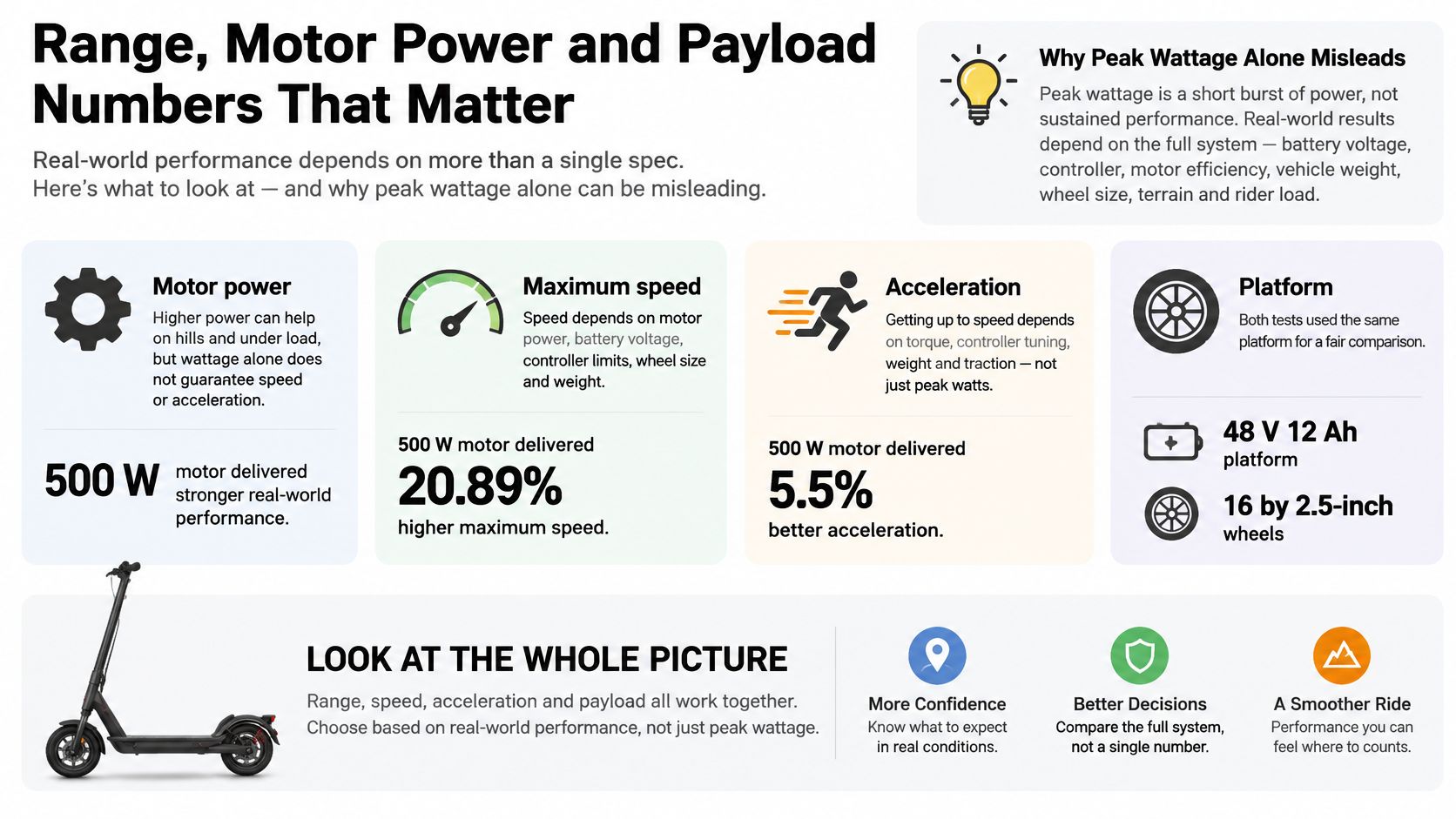
A 500 W rating can mean higher speed, but it does not guarantee more distance per charge. In a comparison published by the International Journal of Engineering, Science and Technology, a 500 W motor achieved 20.89% higher maximum speed and 5.5% higher average speed than a 350 W motor, while operating duration was 16.51% shorter. Both used a 48 V 12 Ah platform with 16 × 2.5-inch wheels. The comparison tested rider loads from 60 to 100 kg.
The reported gain was in average speed, not acceleration. Keep those measures separate when judging a review.
Measured results from the motor comparison and a separate rider-weight study
| Test | Condition | Measured result |
|---|---|---|
| Motor comparison | 500 W vs 350 W, 48 V 12 Ah, 60 to 100 kg | 500 W had 20.89% higher maximum speed, 5.5% higher average speed and 16.51% shorter duration |
| Motor comparison | 350 W on the same platform | 13.08% average mileage advantage, 35.5% less current and 37.3% less electrical power |
| Rider load | About 60 kg, 48 V 14 Ah, 500 W motor | 24.32 km, 9.52 A average current |
| Rider load | About 80 kg, same bike | 19.76 km, an 18.7% reduction, and 23.15 A average current |
The first two rows come from the motor comparison. The rider-load results come from a separate battery and rider-weight study, which specifies a 48 V 14 Ah battery, about 672 Wh before losses. These are different test setups, so treat their figures as separate evidence, not one controlled comparison.
Make range claims comparable
Payload changes the result. Rider, work bag, lock and groceries all count, so a range figure from an unloaded ride won't directly predict your commute. There's no reliable universal discount to apply.
For a useful comparison, look for these test conditions:
- Rider plus load mass: Include luggage and fitted cargo equipment.
- Assist mode: State the setting and whether it changed during the ride.
- Tyre pressure: Measure it with a gauge.
- Route gradient: Separate sustained climbs from mostly flat riding.
- Temperature: Record conditions so repeat tests can be compared.
- Battery capacity and voltage: Identify the pack used.
Motor placement and gearing also affect how power reaches the wheel. This guide to e-bike mid-motors explains what to consider alongside a motor's rating.
In this comparison, 500 W favoured speed and higher performance demands; 350 W favoured mileage and lower electrical consumption. Neither result alone establishes whether a bike is suitable for public roads. Check the permitted configuration for your location, and compare range and power only when payload, assist mode and legal limits are held constant.
Battery Life Beyond the Advertised Range
A first-month range figure tells you what a battery can do while it's new. It doesn't tell you whether the pack will remain useful, whether its protection controls work properly, or whether replacing it will make financial sense.
Laboratory testing described by the European Commission's Joint Research Centre monitored four commercial e-bike batteries for up to 500 charge-discharge cycles, tracking capacity, resistance, power and round-trip efficiency. Three lost less than 10% capacity after 400 cycles, while the remaining battery deteriorated sharply from around 200 cycles following repeated overdischarge in a series-connected cell group.
That's a stronger reason to investigate pack design than to chase the largest capacity printed on a listing.
Look beyond the cells' headline capacity
A battery-management system should protect against damaging operating conditions, including overdischarge. Cell matching matters because a weak group can constrain the pack; thermal management matters because battery performance and ageing depend on operating conditions.
Ask for documentation instead of accepting a vague claim that the battery is premium. Check the battery and supplied charger's relevant certification, and don't substitute a charger just because its connector fits.
- Protection details: Ask how the battery-management system handles low voltage and abnormal temperatures.
- Warranty coverage: Request the length in years or charge cycles and any capacity-retention conditions.
- Replacement support: Establish the exact compatible battery, its price and its availability.
- Charging information: Look for charging time, approved charger details and clear storage guidance.
Separate wear from a difficult ride
Apply the same test controls to repeated rides over the ownership period. Keep a simple log of route, assistance, load, conditions and charging behaviour, then compare like with like.
Wind, colder weather, low tyre pressure or heavier luggage can reduce range without proving permanent capacity loss. If performance stays lower under matching conditions, that's a better reason to investigate battery health.
Our electric-bike battery-life guide provides further context for ownership and care.
A cheaper bike isn't cheaper to own if an unavailable replacement battery ends its useful life.
The laboratory sample was small. Treat its findings as a testing framework, not a failure-rate estimate for all batteries or any named bike in this guide.
Best E-Bikes by Rider Need
Start with a candidate that solves your practical problem, then try to disqualify it. These are shopping starting points, not claims that each model has passed an independent road, range or compliance test.
Different frame layouts are easier to judge side by side.
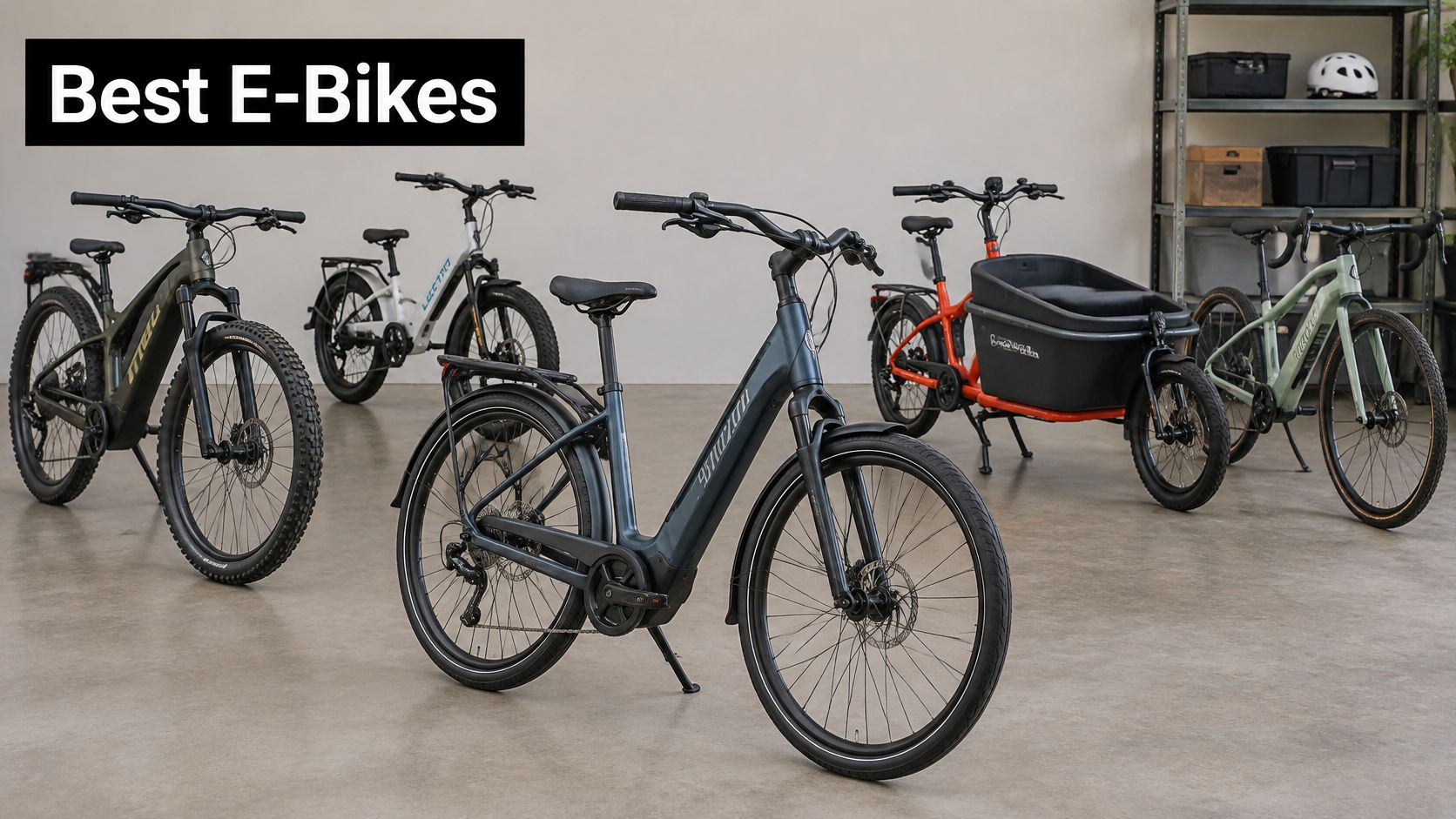
Daily urban commuting
The ENGWE M20 Dual-Battery at £979.00 is a candidate when charging opportunities are limited and you want battery headroom. Our listing offers Green, White and Black.
Don't turn the extra battery into an assumed real-world distance. Check the tested configuration, how the batteries operate and whether your workplace or home gives you somewhere suitable to charge.
For shorter trips and a tighter budget, the M20 Single-Battery at £839.00 is the alternative. I'd compare the practical burden of carrying extra battery capacity against the inconvenience of more frequent charging.
Trains, stairs and flat storage
Consider the ENGWE Engine Pro 2.0, from £1,299.00, when folding is essential. Before buying, rehearse the whole transfer: fold it, secure it, lift it and work out where you'll stand with it.
Check your train operator's carriage rules and the space available at home. A folded bike that fits a cupboard but is awkward on stairs may solve only half the problem.
Easy mounting and frequent stops
The ENGWE L20 Boost Step-Thru at £1,099.00 is the starting point for riders who want an accessible frame, including those riding in skirts. Try stepping through with your usual clothes and footwear.
Pay attention to saddle adjustment, handlebar reach and whether you can put a foot down comfortably. Easy mounting doesn't compensate for a riding position that puts too much weight on your wrists.
Watch any demonstration with those fit and handling checks in mind, rather than treating a smooth riding clip as proof of suitability.
Weekend gravel and winter journeys
The ENGWE E26 Fat-Tire at £1,299.00 deserves a look for mixed surfaces and comfort-focused riding. Choose between its frame styles based on mounting needs, then confirm tyre-pressure guidance and brake performance.
Ask how it handles wet stopping and low-speed turns, not just how it feels rolling straight ahead. Wide tyres won't rescue unsuitable tread or poor braking technique.
Cargo and family duties
For a dedicated load-carrying starting point, look at a NAKTO cargo design in our range and verify its exact payload and child-seat compatibility. A rack's appearance isn't permission to carry a passenger.
We also sell DUOTTS F26, N26 and C29 families, but don't assume those names establish cargo suitability or road legality. Verify the individual model's continuous motor rating against your local road limit, along with its rack rating and braking capability.
The right bike is the one whose range holds up on your worst week, not the one with the best review score.
Legal Checks and Final Shortlist
Tick off legality before comparing performance. A listing can describe an appealing bike without establishing that its supplied configuration qualifies for ordinary bicycle use where you live.
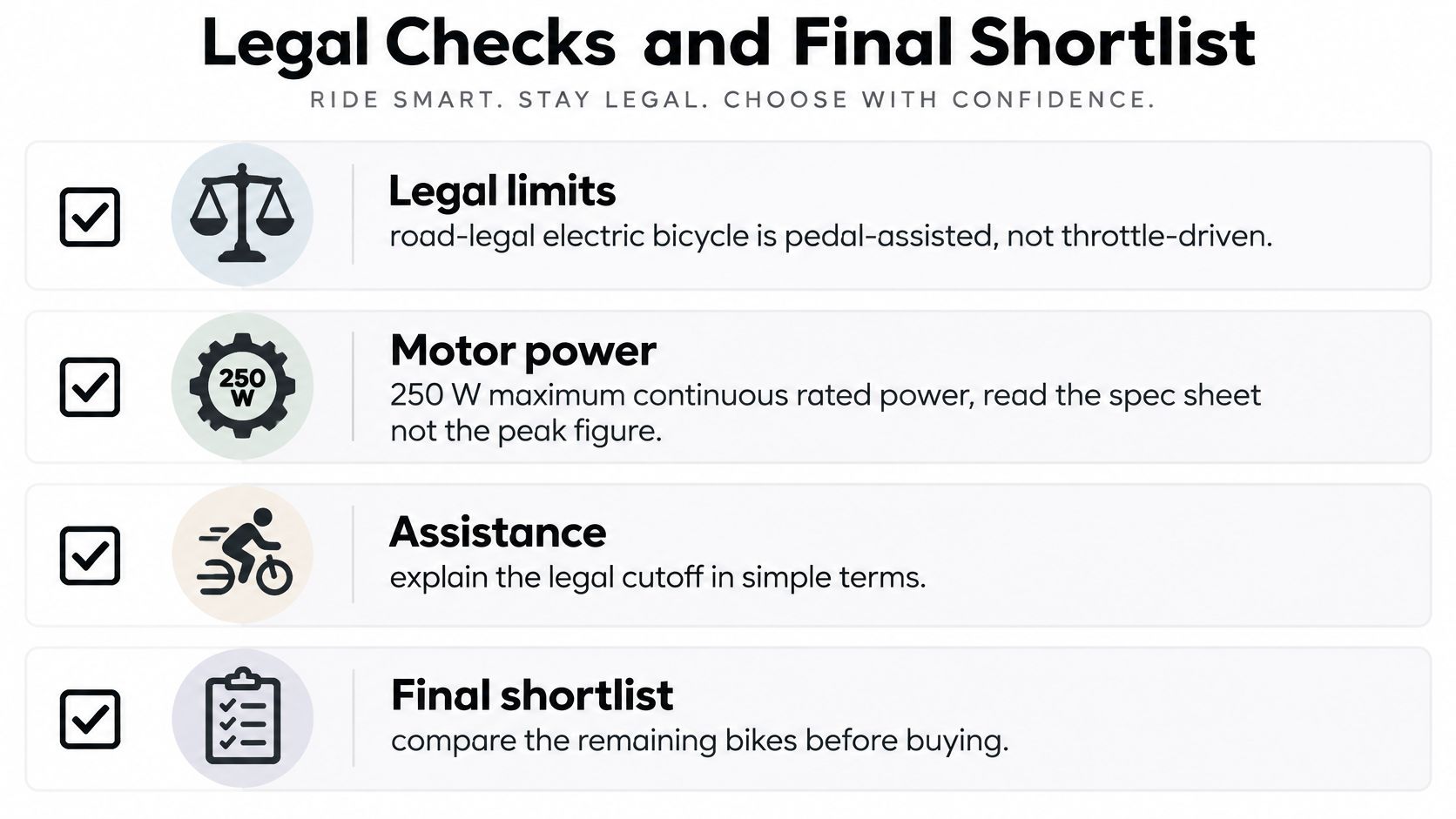
For the EU-style EPAC framework, the Australian Government's electric-bike importer guide identifies pedal assistance, maximum continuous rated power of 250 W and assistance cutting out at 25 km/h. The continuous rating matters more for this check than a headline peak-power claim.
Check the configuration you'll receive
Confirm that assistance depends on pedalling and that any throttle function is permitted locally. Don't assume a selector labelled road mode establishes compliance, or that UK, EU and Australian throttle provisions are interchangeable.
For a concrete Australian example, Victoria's electric-bike guidance permits walk assistance up to 6 km/h, rather than throttle propulsion. Verify the rules for the actual country, state and route you'll use, including bike paths and footpaths.
US buyers need a different starting point: the Bureau of Land Management's e-bike FAQ distinguishes Class 1 pedal assistance to 20 mph, Class 2 motor propulsion to 20 mph and Class 3 pedal assistance to 28 mph. Use our electric-bike laws by state guide to organise your checks, then confirm current state and local requirements.
Keep the legal checks beside your shortlist while comparing listings.
Battery and charger documentation belong in this decision too. The CAA's review of e-bike regulation and safety gaps highlights risks associated with uncertified lithium-ion batteries and speed modifications.
Removing restrictions or fitting an uncertified replacement battery changes the risk profile and may affect legality, warranty, insurance and fire safety. Get written answers about the supplied configuration rather than relying on an informal assurance.
Reduce the shortlist to bikes you can justify
- Match the difficult journey. Choose the category that handles your worst riding day, including storage and carrying.
- Estimate realistic range. Start with a documented test under similar conditions, then allow for your load, hills, cold and assistance use. Don't invent a universal deduction.
- Price battery ownership. Compare warranty length, coverage conditions and replacement cost.
- Build the complete price. Add the lights, lock, rack and other equipment you need. Our website offers free delivery on all orders.
- Compare the finalists. Put your remaining models side by side on usable range, battery support and total cost.
If you're collecting feedback from a household or riding group, a HolaQR review QR code can provide a convenient route to your shared assessment form. Ask riders about the same route and configuration so their comments remain useful.
Our store lists 871 products, including over 100 e-bikes and over 100 e-scooters, so filtering matters more than browsing endlessly. Open the category table today and write down the models that pass every shortlist check.
Punk Ride LLC offers electric bikes, electric scooters and accessories, including folding, commuter, fat-tyre and cargo options, with free delivery on all orders. Visit Punk Ride LLC to compare your shortlisted models, confirm their current specifications and prices, and choose for your actual journey rather than the headline claim.


Share:
Fastest Electric Scooters Tested: Speeds, Limits and Picks
Foldable Electric Scooter for Heavy Adults: 2026 Guide