


You step out with the scooter because the bus is late and the office is only a short hop. The deck looks fine. You push off, the front wheel hits a painted line you barely saw, and the bars twitch. Most new riders get caught there, on a normal commute, not on a fast road.
Riding an electric scooter is now a first-and-last-mile habit in UK trial cities, across the EU, and in US and Australian towns. Shared riders in Portland took more than 1 million trips in 2024, with a median distance of approximately 0.85 miles, according to the Portland Bureau of Transportation. Those hops are short. They're also where potholes, kerbs and wet paint do the damage.
I'll walk the checks, the starts, the stops, and the rules that decide whether that hop is even legal. If a part feels loose, you walk it. If the surface looks shiny, you slow down before you reach it.
Check the Scooter Before Every Ride
You grab the scooter from the hallway, step on, and it wobbles on the first turn because the folding latch never clicked shut. That's a classic early fall. A five-minute look beats a trip to urgent care.
Treat every trip as a controlled-risk procedure, the way a clinical review of e-scooter injuries frames it. In one emergency-department study, 170 riders were treated after crashes, and 73.5% of incidents involved rental scooters. Helmet nonuse was significantly associated with cranial trauma. A broader review of surveillance studies estimated approximately 20–25 emergency-department visits per 100,000 trips, though reporting methods vary a lot between studies. Speed, darkness, alcohol and unfamiliar controls stack on each other. A short trip is not a safe trip by default.
What a pass looks like
Work top to bottom, then don't ride if any red flag shows.
| Check | Good sign | Red flag |
|---|---|---|
| Tyres | Firm when pressed, no cuts or bulges | Soft, cracked or flat spot |
| Folding joint and stem | Locks with a click, no play | Wobble or loose clamp |
| Front brake | Stops the wheel before you squeeze hard | Lever soft or loose |
| Rear brake | Responds straight away | Delayed or grabbing |
| Throttle | Returns to zero as soon as you let go | Sticks or creeps forward |
| Lights | Front and rear both work | Flickering or dead |
| Battery | Seated and locked, cover secure | Rattles or sits off-centre |
Press each tyre with a thumb. Spin the wheel and look for a flat spot. Close the latch until you hear the click, then try to twist the stem. Squeeze each brake while the scooter is still. Tap the throttle and let go. It must spring back to zero with no creep. Switch the lights on. Seat the battery until the cover sits flush.
If you're still building the habit, the same eyes-ahead, machine-first mindset in safer riding with Lendrum's Driving School transfers well to a standing deck. For bolts, tyres and charge health between rides, use a simple electric scooter maintenance routine so the hallway check isn't the first time you notice a fault.
Start the first rides at low speed in an open area. Practise progressive braking. Skip alcohol, skip darkness, and stay out of fast traffic while the controls are still new. Wet painted markings and metal covers give less grip, which is why speed comes off before a turn, not in it. If any red flag shows up, walk the scooter home. Don't "just test it" to the corner.
How to Mount, Start and Dismount Safely
Practise this on grass or an empty car park until it feels boring. Boring is what you want. The scooter should never leave while you're still half on it.
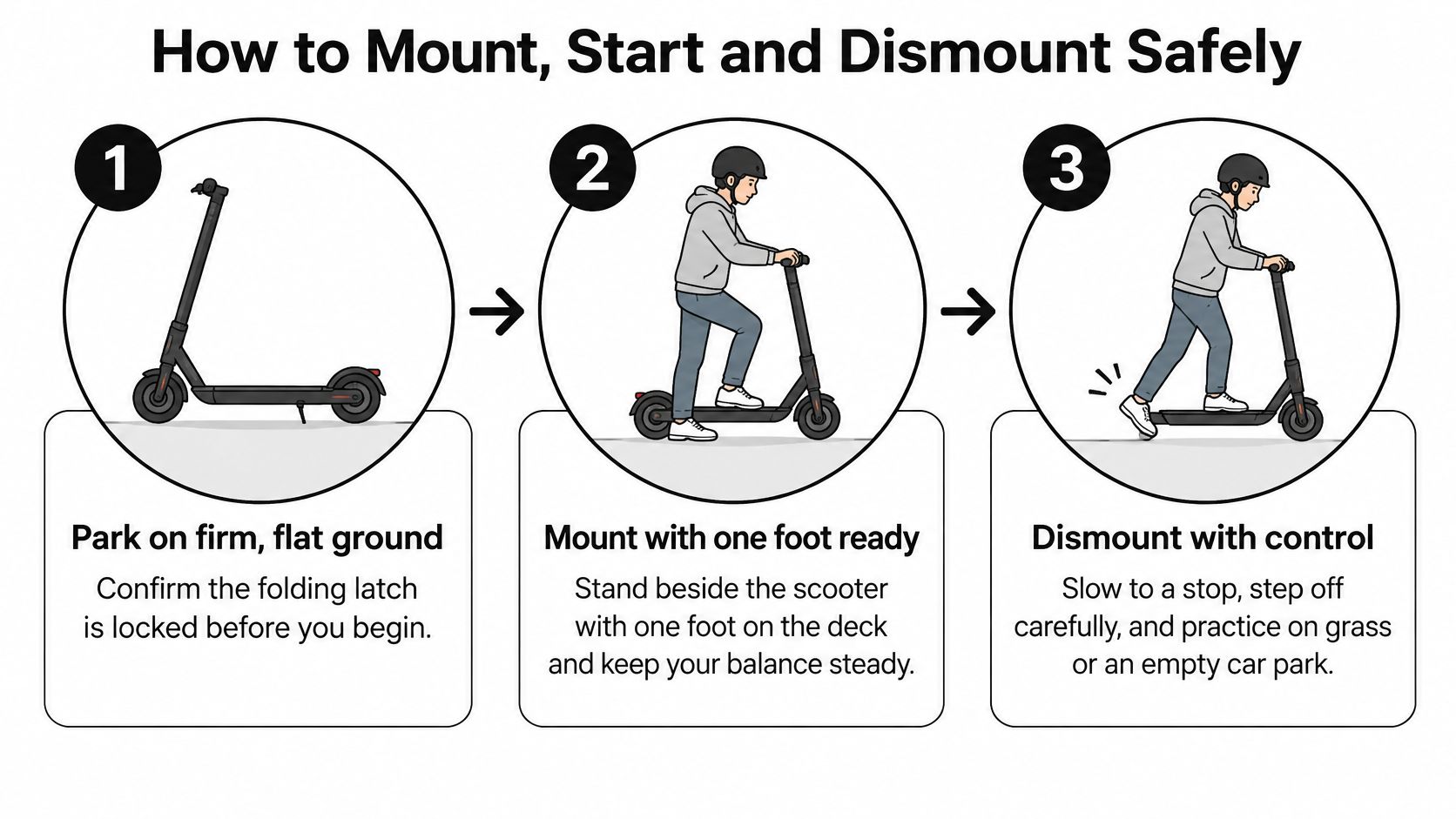
- Park on firm, flat ground and confirm the folding latch is locked. A slope or a half-shut joint rolls the deck out from under you before you've even pushed off.
- Stand beside the scooter with one foot on the deck just behind the stem and the other on the ground. That planted foot is your brake and your balance until the scooter is moving.
- Hold both grips, push off with the ground foot, then place it on the deck. Two hands stop the bars from snapping sideways as soon as the wheel turns.
- Keep feet centred, knees soft and eyes up on the path ahead, not down at the deck. Looking at your shoes pulls the bars the same way and you drift.
- Press the throttle gently to walking pace on a clear stretch, never a sudden full press from standstill. A jolt from zero is how the front wheel runs away from your hips.
- To stop, release the throttle, squeeze both brakes evenly and keep one foot down. Even pressure keeps the scooter straight instead of pivoting on one wheel.
- To dismount, brake to a full stop, step off with one foot, then the other, and hold the stem until it's parked. Letting go while it's still rolling is how it falls into a kerb or a parked car.
The slip that dumps you sideways
The usual mess is starting while one foot is still on the ground, so the scooter drifts sideways and the planted foot gets dragged. Push, then both feet up. Don't blend the two.
Practical rule: Five clean starts and stops in a row, on flat ground, before you point the scooter at any road.
If the fifth one wobbles, stay in the car park. Another five minutes here is cheaper than a wrist on the first junction.
Accelerating and Braking Without Losing Control
Top speed is the wrong thing to chase on week one. Throttle and brake control decide whether you stay upright when a car door opens or a drain cover appears. A lot of new riders learn braking by locking a wheel and sliding. You can skip that lesson.
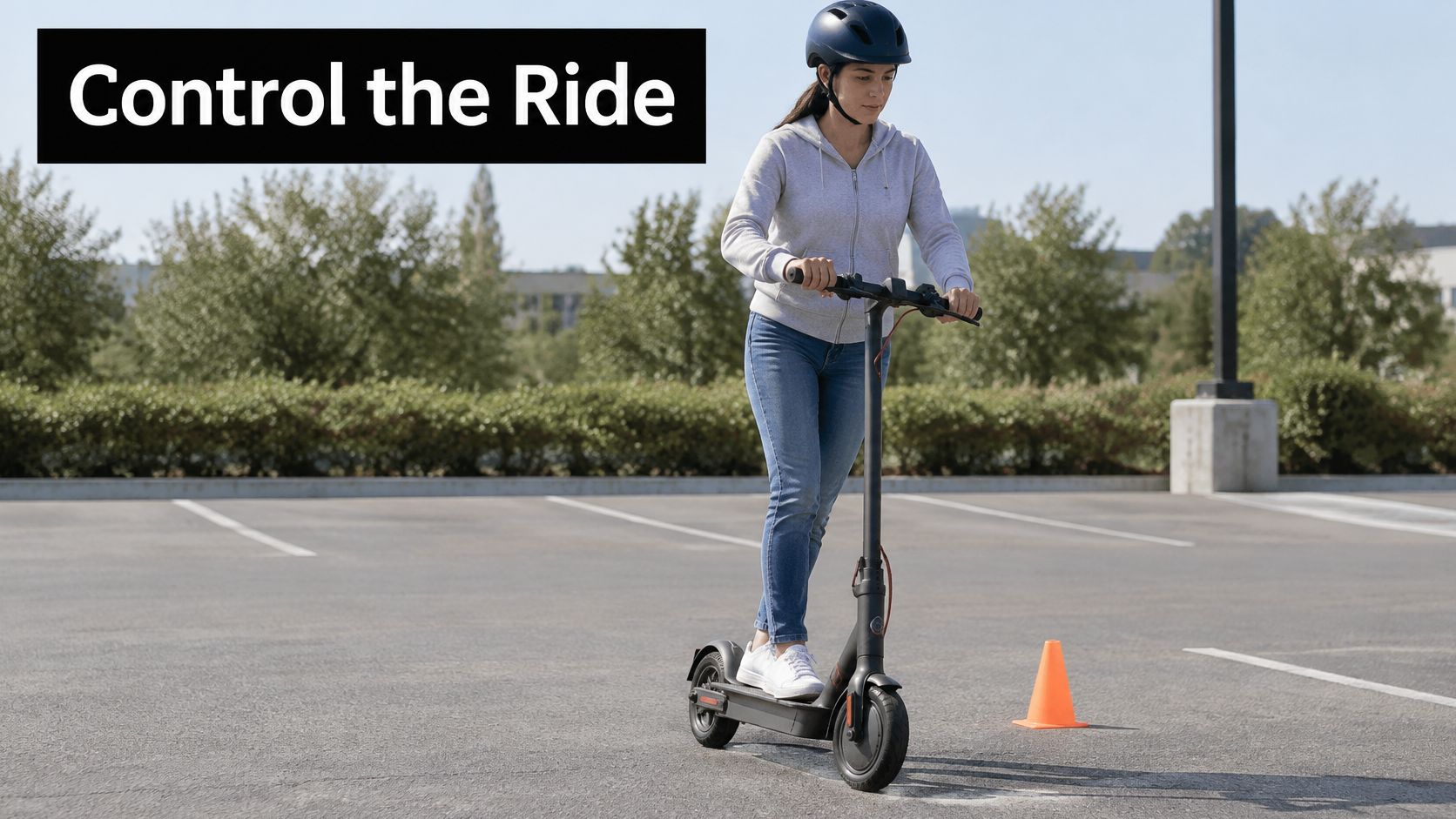
A steady ramp, not a jolt
Roll the throttle on like you're turning a tap, not punching a button. From a standstill, a sudden full press pitches your weight backward and the bars go light. Build to walking pace, hold it, then add a little more only when both feet are planted and the path is clear. If the scooter surges more than you asked, let go. A healthy throttle returns to zero on its own.
Both brakes, early
Squeeze the front and rear together. Start with a light touch, then add pressure as the scooter slows. Yanking one lever, especially the rear on its own, is the habit that locks a wheel. On a damp surface that lock becomes a skid, and a skid on paint is how people go down beside a junction they meant to stop before.
Brake before the corner, the bump or the junction. Once you're already in it, you're steering and slowing at the same time, and the small tyre doesn't have grip to spare. Painted lines and metal covers belong with the turning and bump work, so treat them as a reason to brake earlier on the straight, not as a surprise mid-turn.
A straight line drill
Mark about 20 metres of clear, dry tarmac.
- Ride at walking pace along a straight line you can see.
- Brake to a full stop inside a marked zone, both levers, no skid.
- Repeat a notch faster, one step at a time, and stop in the same zone.
You're done with this drill when you can stop smoothly from walking speed and brake in a straight line without the rear stepping out. If it steps out, you squeezed too late or too hard on one lever. Reset to the light touch.
This short clip shows the same idea, a smooth roll-on and an early, even stop, which is worth watching once before you mark out the line.
Turning, Balance and Handling Bumps
A lot of the crashes that hurt riders don't involve another vehicle at all. Great Britain's 2025 e-scooter factsheet recorded 1,377 reported collisions involving e-scooters, including 384 single-scooter collisions, 1,477 casualties and 10 deaths, with 484 casualties estimated to be seriously injured, in the Department for Transport factsheet. Loss of control on a bad surface is a real share of that, not a footnote.
A scooter turns because you steer the handlebar. Leaning your body like a bicycle, while the bars stay straight, just shifts your weight off the narrow deck. Drop speed before the turn. If you brake in the middle of it, the wheel tucks.
Habits that keep the deck under you
- Soft knees: They soak the hit so the bars don't get ripped from your hands.
- Eyes on the path: Look through the turn to where you want the wheel, not at the deck.
- Weight centred: Feet side by side, not perched on the back edge.
- Hands ready: A firm grip before the bump, not a death grip that locks your elbows.
Potholes, wet patches, kerb transitions, rails and cracks are the usual triggers. For a bump or a crack, approach slowly and straight on, not at an angle, with knees bent so the deck can rise under you. For a kerb, take it square and slow. An angled kerb flicks the front wheel and the stem follows.
Painted lines and manhole covers can slide without warning once they're wet. Ride slower over them, and don't turn or brake hard while the tyre is on the slick patch.
A course you can actually finish
Set this in an empty car park.
- Ride a figure of eight at walking pace, steering the bars, speed already low.
- Slalom cones about 3 metres apart, still slow, eyes up.
- Roll over a row of cones at walking pace, knees soft, then repeat a notch faster.
You want to turn at walking pace and cross a small bump without bracing the handlebar rigid. If your elbows lock, you're fighting the scooter. Soften them and do the figure of eight again.
A helmet can change what a fall does to your head. It won't stop the fall, the wrist fracture or the slide that starts on a wet line.
Traffic, Legal Rules and Night Riding
Owning a scooter and being allowed to ride it on public land are different questions. In the UK, the government electric scooter rules say privately owned electric scooters remain illegal on public land, including roads, pavements, cycleways and parks. Legal public-road use is limited to scooters rented through official government-approved trial schemes. Those rental scooters may be used on public roads and cycle lanes, but not on pavements or motorways. The standard maximum speed is 15.5 mph, and some trial areas set lower limits. Buying one does not authorise the ride.
| Category | Speed rule | Power or other rule |
|---|---|---|
| UK rental scooter in a trial scheme | 15.5 mph maximum | Some trial areas set lower limits |
| UK privately owned scooter | Not legal on public land | Purchase does not authorise roads, pavements, cycleways or parks |
| EU pedal-assist e-bike | Assistance must stop above 25 km/h | Rated motor 250 W or less |
Read each row as a gate. A UK rental in a trial can be on the road or a cycle lane, never the pavement or a motorway, and never faster than the local cap. A private scooter you bought online still can't join that commute on public land. For an EU pedal-assist e-bike, assistance has to cut out above 25 km/h and the continuous rated motor has to stay at 250 W or less. If it keeps assisting above that speed, or the motor is rated higher, national vehicle, registration, insurance or licensing rules can apply. Check both figures on the spec sheet, not the marketing line.
If the commute is in Australia
Western Australia sets 10 km/h on footpaths and pedestrian crossings, and 25 km/h on bicycle paths, shared paths, bicycle lanes where riding is permitted, and roads limited to 50 km/h. An eRideable also must not be capable of exceeding 25 km/h on level ground, per the Road Safety Commission. Victoria requires a device maximum of 25 km/h on level ground, one person only, and a riding limit of no more than 20 km/h. Hire operators need a council agreement, so a legal-looking scooter can still be unlawful in an area with no authorised hire, according to Transport Victoria. US cities write their own rules. Don't assume a Florida pavement rule matches a Portland bike lane.
Ride only where the local rule allows. Stay out of the door zone of parked cars. At junctions, make eye contact before you move. Never use the pavement as a shortcut in the UK. If the only way through is a pavement or a motorway, that route is not legal for a rental or a private scooter.
At night you need a working front white light and a rear red light, plus high-visibility clothing. Skip unlit routes where you can't see the surface. A ticket for the wrong place or the wrong speed follows you. If you're sorting a citation, license protection guidance for ticketed drivers is a useful US reference for how traffic law lands on a licence. For the UK and EU split in plain language, start with electric scooter laws before you plan the route.
Gear Up and Plan Your First Confident Ride
Most injured riders in the trauma data weren't wearing a helmet. In a four-year trauma-centre series of 1,337 injured e-scooter riders, only 13.7% wore helmets. Head injuries occurred in 24% of helmeted patients versus 46.8% of unhelmeted patients, an absolute reduction of 22.8 percentage points, reported in a trauma surgery review. A separate scoping review of 16 studies found only 4.5% of injured riders were helmeted, while 67.5% were unhelmeted.

Pick a helmet that matches the riding environment and the local standard. Then fit it so it can't migrate when you brake.
- Sit it level and low on the forehead, not tipped back.
- Tighten the side straps into a stable triangle under each ear.
- Fasten the chin strap so the helmet doesn't shift when you brake hard.
- Replace it after a significant impact, or if the shell or liner is damaged.
Gloves, closed-toe shoes and something bright or reflective finish the kit. None of that replaces speed control. A loose helmet, or one worn backward, protects less than you think, and a slow commute still produces head impacts. More on lights, gloves and what to skip is in this electric scooter safety gear note.
Book one quiet practice session this week. Finish five clean starts and stops. Only then take a short, quiet route you already know.
That's the whole first week. Checks, a car park, both brakes, and a helmet that stays put. The road can wait until those feel ordinary.
Punk Ride LLC sells electric bikes, electric scooters, kids' ride-on toys and accessories, with warehouses in the UK and Germany and headquarters in Florida, so a commuter setup is easy to match to the routes you're allowed to ride. If you're choosing a deck and the helmet, lights and lock that go with a careful first week, visit Punk Ride LLC and pick the kit you'll practise on before you join traffic.
Share:
Pedal Assist Bike Reviews: Specs, Range and Buying Tips