


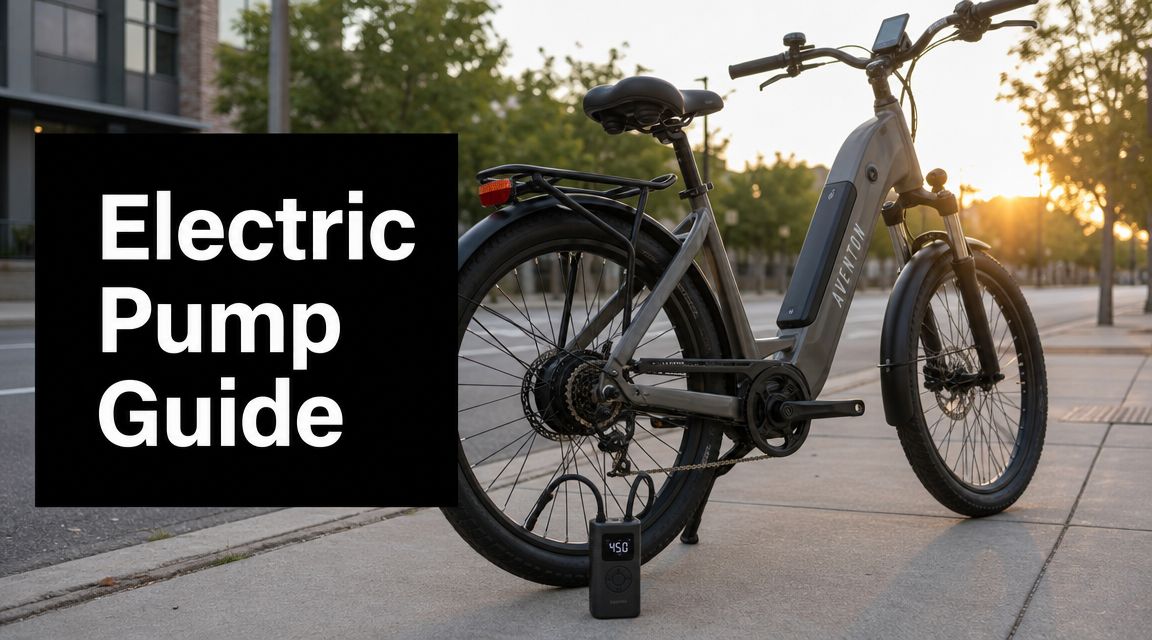
A flat tyre before work has a special way of ruining your mood. You're already watching the clock, the road's wet, your gloves are damp, and now your e-bike feels like it's dragging through treacle.
That's where a small electric bike pump starts to make a lot of sense. Not as a flashy gadget. As a commuter tool that saves time, keeps your hands cleaner, and gets you moving again without the usual wrestling match with a mini hand pump.
That Sinking Feeling A Modern Fix for Urban Flats
If you ride through London, Manchester, Berlin, Amsterdam, or any city where bike lanes collect grit and glass, you already know the scenario. The tyre feels soft on the last stretch home. You hope it'll survive until morning. It doesn't.

An electric bike pump fixes the part of puncture repair people hate most. You still need to patch, plug, or swap the tube. But once that's done, you press a button instead of crouching by the kerb pumping furiously while buses spray road water past your ankles.
That convenience matters on a commuter bike because you're not dressing for a sportive. You're carrying a laptop, a lock, maybe shopping, and you just want the bike ride to be boring in the best possible way. If you also ride enough to care about mobility and recovery, the same practical mindset usually carries over to off-bike habits too. Good fitness exercises can help with everyday riding comfort, but on flat-tyre mornings, convenience beats grit every time.
Reliable enough for real commutes
The honest answer is yes, with limits. Independent testing discussed by Outside found even strong performers are still small-capacity tools. In that testing, the Trek Air Rush inflated a 700c x 30 mm tyre to 60 PSI about 4 times per charge, while the Prestacycle Prestaflator GO managed about 5 times, and the author explicitly said it wouldn't replace a hand pump for them on its own in every situation (Outside's electric mini pump testing).
Practical rule: For daily urban riding, an electric bike pump is excellent as a fast rescue tool. For longer rides, group rides, or helping more than one person, treat battery capacity seriously.
That's the gap most spec sheets gloss over. They tell you maximum pressure. They don't answer the rainy Tuesday question: will it get me rolling again, right now?
If your flat is only part of the problem, it also helps to know the repair side well. This guide to e-bike tyre repair basics is worth keeping bookmarked alongside your pump choice.
What Is an Electric Bike Pump Exactly
An electric bike pump is basically a miniature smart air compressor built for bikes and scooters instead of car tyres. It's small enough to carry in a jacket pocket, top-tube bag, pannier, or backpack, but it does the same core job as a larger inflator. It pushes air into the tyre until the pressure reaches your chosen setting.

What's inside the little box
Most of these pumps work around the same set of parts:
- A small motor that powers the pump
- A piston or compression chamber that pushes the air
- A rechargeable battery so you don't need mains power at the roadside
- A digital display so you can set a target pressure
- A pressure sensor that checks the tyre pressure as it inflates
That last part is what makes these pumps feel much nicer than old-school portable inflators. You're not guessing. You set the pressure, attach the pump, start inflation, and many models stop on their own when they reach the target.
How it feels different from a car inflator
A car inflator usually lives in a boot or garage. An electric bike pump is built around portability first. The body is smaller, the battery is smaller, and the airflow is tuned for bike and scooter tyres rather than large car tyres.
That's why they've become so useful for urban riders. They're not trying to be workshop compressors. They're trying to be good enough to carry every day.
Think of it as the gap between a full-size umbrella and the small one you actually carry. The smaller tool isn't perfect in every condition, but it's the one that's with you when the weather turns.
Why commuters like them so quickly
A good electric bike pump solves three common annoyances at once:
- It reduces effort. You're not hand-pumping a tyre while wearing work clothes.
- It simplifies pressure checks. The display gives you a live reading.
- It cuts faff. No single-use cartridges, no frantic pumping, no wondering if you're underinflated.
The best way to think about it is simple. It's not magic. It's compressed air with a battery and a brain, shrunk down enough to earn a permanent place in your carry kit.
Decoding the Specs PSI Valves and Battery Life
Once you start shopping, every box seems to shout the same things. High PSI. Multiple modes. Tiny size. USB charging. None of that helps much until you translate it into commuting reality.

PSI matters, but not in the way many people think
PSI is tyre pressure. It tells you how much air is inside the tyre. Higher isn't automatically better. What matters is whether the pump can reach the pressure your tyre needs.
Independent review testing found the best modern mini electric pumps could fully inflate a flat 700C x 28 mm road tyre to 70 psi or a 40 mm gravel tyre to 45 psi in about 1 minute, and most delivered 3 to 4 full inflations on one charge before the battery ran out (independent electric bike pump review testing).
For an urban rider, that tells you something useful. These pumps are capable enough for many common commuter tyres. But they're still limited by battery size, so the pressure target and the tyre volume both matter.
Valves are a compatibility check, not a minor detail
Before buying any electric bike pump, check your valve type.
| Valve type | What it usually looks like | Common use |
|---|---|---|
| Presta | Narrow metal valve, often with a small threaded tip | Many bicycles, including road and hybrid bikes |
| Schrader | Wider valve, similar to a car tyre valve | Many e-bikes, city bikes, and scooters |
Some riders in the UK and EU will also come across Dunlop valves, especially on older city bikes or region-specific setups. The important bit isn't memorising valve history. It's making sure the pump includes the right adapter or hose.
If you're not sure what you've got, this guide to a bike Presta valve adapter makes identification much easier.
Battery life is better measured in tyres, not tech jargon
Battery specs can be misleading because raw battery numbers don't tell you how many usable inflations you'll get in practice. A compact pump might have enough charge for one rider's week of top-offs, but only a couple of proper roadside rescues on a heavier tyre.
A better way to judge battery life is to ask:
- How many full inflations can it do on my tyre type
- How long does one inflation take
- Can it still perform after sitting in my bag for days
- Will I remember to recharge it
A commuter doesn't need the biggest number on the box. A commuter needs a pump that works after a week in a pannier and gets one tyre back to rideable pressure without drama.
That's the useful lens for UK and EU commuting. You're dealing with mixed weather, stop-start riding, heavier bikes, and often tyres that are larger than pure road tyres. Spec sheets matter. Real use matters more.
How to Choose the Right Electric Pump for Your Ride
Buying the right electric bike pump is mostly about one trade-off. Smaller pumps are easier to carry. Larger pumps usually do more useful work per charge. If you get that part right, the rest becomes easier.

Cycling Weekly's 2026 testing framed this clearly. The lightest “nano” pumps weighed about 97 to 130 g and typically used 300 mAh batteries, while larger mini or off-bike units reached 120 to 150 psi but weighed about 120 to 430 g (Cycling Weekly electric bike pump group test).
Pick your category honestly
If your rides are short, predictable, and close to home, a tiny emergency-first pump makes sense. It disappears into your bag and gives you a fast rescue option for a straightforward puncture.
If you ride a heavier e-bike, use larger tyres, commute longer distances, or want one pump for multiple bikes in the household, a slightly larger unit is usually the smarter buy.
Here's the quick split:
-
Nano pump
Best if carry weight and pocketability matter most. Good for solo commuting and occasional emergencies. -
Mid-size portable pump
Better if you want a stronger all-rounder for e-bike tyres, regular top-ups, and less anxiety about battery reserve. -
Larger mini or off-bike pump
Better for home, office, car, or garage use when portability matters less than capacity and higher-pressure support.
A practical look at the pump in use often helps more than any product page. This video is a decent visual reference before you buy.
The features that actually matter in bad weather
Urban commuters in the UK and northern Europe should care less about novelty features and more about usability when cold, wet, or rushed.
Look for these:
- Auto shutoff. This matters when you're inflating at the roadside and don't want to hover over the display.
- A clear screen. Small screens become annoying fast in dim light or rain.
- A hose option. Direct-mount designs can be awkward on cramped wheel setups.
- Solid valve fit. A bad connection wastes air and tests your patience.
- USB charging you already use. Fewer special cables means fewer excuses not to recharge it.
The best electric bike pump is the one you'll keep charged, keep with you, and trust when you're late.
What doesn't deserve top billing
Some things sound impressive but don't predict commuter happiness very well.
A sky-high maximum PSI figure doesn't always mean the pump suits your tyres better. Nor does a flashy casing. For most urban riders, reliability, ease of use, and sensible carry size beat inflated marketing.
A final tip. If you commute on an e-scooter as well as an e-bike, check access around the valve before you buy. Some pumps fit the valve type but are awkward in tight wheel spaces unless the hose or adapter is well designed.
Using and Maintaining Your New Pump
The first time you use an electric bike pump, the process is simple. The trick is doing it in the right order so you don't lose air or misread the pressure.
How to use it without making a mess of the valve
Start by checking which valve you have and fitting the correct head or adapter. Attach the pump firmly, but don't force the threads. A sloppy connection is one of the fastest ways to lose pressure and convince yourself the pump is weaker than it really is.
Then set your target pressure on the display before starting inflation. Once the number is in, switch it on and let it run until it reaches the setting or shuts off.
A straightforward routine looks like this:
- Inspect the tyre first. If there's still glass, a thorn, or a damaged tube, inflation won't solve much.
- Attach carefully. Keep the pump straight so you don't stress the valve.
- Set the pressure. Match the tyre's needs, not a random high number.
- Inflate and listen. These pumps aren't silent. Some noise is normal.
- Remove the pump cleanly. Unscrew or disconnect briskly to reduce air loss.
If you're new to tyre pressure in general, this guide on inflating bike tyres properly is a useful refresher.
Why inflation time changes so much
Inflation speed depends heavily on tyre volume and target pressure. Cycling Weekly reported that some compact pumps could inflate a road tyre to 60 psi in roughly 30 to 60 seconds, while higher-capacity models could handle around six fills at 60 psi (Cycling Weekly inflation performance summary).
That's why a pump can feel fast on a narrow commuter tyre and much slower on a larger-volume e-bike tyre. The pump isn't necessarily struggling. It's just moving a small amount of air into a bigger space.
The maintenance habits that matter
You don't need a complicated care routine. You do need consistency.
- Keep it charged. A dead pump is just a paperweight with a screen.
- Store it somewhere dry. Wet bags and road spray aren't ideal for connectors.
- Check the hose and threads. Wear shows up there first.
- Avoid extreme heat or deep cold for long periods. Batteries hate both.
- Test it at home occasionally. Don't wait for a roadside emergency to find out something's loose.
That last habit is the one most riders skip. It's also the one that makes the pump feel dependable instead of experimental.
Common Questions from Urban Riders
Can I use an electric bike pump on an e-scooter
Usually yes, as long as the valve is compatible and the pump can physically access it. On some scooters, the awkward part isn't pressure. It's the cramped space around the wheel. A hose or right adapter often matters more than raw pump power.
Is it safe to leave it in a pannier all year
It's better to avoid treating it like a permanent forgotten tool. Short-term carry is fine for normal commuting, but batteries don't love extreme temperatures or long stretches without charging. If your bike lives outside or in a freezing shed, bring the pump indoors when you can.
How accurate is the built-in pressure reading
For everyday commuting, the built-in reading is usually good enough to get you back on the road and keep your tyres in a sensible range. If you're fussy about exact pressure, compare it with a separate gauge at home and learn whether your pump reads a bit high or low.
Is it loud
Yes, most electric bike pumps make enough noise that you'll notice it. That's normal. In a city street setting it isn't usually a big issue, but in a quiet hallway or shared office bike room, you probably won't be subtle.
Can it replace a floor pump at home
For some riders, maybe. For many commuters, not really. It's a great portable tool and a handy top-up option, but a proper floor pump still wins for convenience, repeated use, and zero battery anxiety.
If you're upgrading your everyday ride kit, Punk Ride LLC is a solid place to explore electric bikes, scooters, and urban mobility gear built for real-world commuting in the UK, EU, US, and beyond.
Share:
Electric Bike Looks Like Dirt Bike: 2026 Guide
Electric Bike Pump: Your 2026 Guide for US & AU Riders