


Getting into e-bikes is like getting a cheat code for cycling. It’s that little bit of superpower you need to flatten hills, crush your commute, and just ride farther than you ever thought you could. Think of it as your favorite bike, but with a built-in, invisible tailwind that kicks in right when you need it.
This guide is here to help you cut through all the technical jargon and show you what really matters.
Welcome to the World of E-Bikes
Ever wished you could fly past morning traffic without getting all sweaty? Or maybe you've looked at a steep hill and thought, "Nope, not today." That’s exactly the problem e-bikes solve, and it’s why millions of people are getting hooked. It’s not about ditching pedaling altogether; it’s about making it better.
An e-bike simply blends your own pedal power with a small, quiet electric motor. The result? You can ride further and faster with way less effort than on a regular bike. It completely changes the game for commuting, weekend fun, or for anyone who just wants to get out and move more.
At the end of the day, an e-bike is a simple team-up. You’ve got a motor, a battery, and a controller all working in sync to give you that awesome boost. This simple partnership makes cycling fun and accessible to pretty much everyone, no matter your fitness level.
Why Is Everyone Suddenly Talking About E-Bikes?
This e-bike boom isn't just a fleeting trend—it’s a real shift in how we get around. The numbers are wild. Just imagine that first ride where you feel that little push and suddenly you're cruising. That's the feeling driving this whole thing.
The global e-bike market was valued at USD 34.2 billion in 2024. It’s expected to jump to USD 37.66 billion in 2025 and is projected to hit an incredible USD 98.68 billion by 2035. You can dig into these stats over on marketresearchfuture.com.
So, what's behind this massive growth? It boils down to a few key perks that new riders love:
- Hills Feel Flat: Those intimidating climbs that used to be a deal-breaker? They suddenly become no big deal, opening up a ton of new routes.
- Go the Extra Mile (or Ten): You can ride so much farther without feeling wiped out. That 5-mile trip can easily become a 15-mile adventure.
- A Greener Commute: For shorter trips, an e-bike is a fantastic, eco-friendly way to leave the car at home and shrink your carbon footprint.
- Fitness Without the Pain: You're still exercising and getting a great workout, but the assist takes the pressure off your joints. It's exercise you can actually stick with.
Brands like ENGWE and HITWAY are really leading the charge, making solid, easy-to-use bikes that are perfect for beginners. As you get started, just remember an e-bike isn't just a bike—it's your new key to freedom, fitness, and a whole lot of fun.
Finding Your Perfect E-Bike Match
Choosing your first e-bike shouldn't feel like a final exam. Forget getting bogged down in technical jargon for a minute. The best place to start is by asking a simple question: "How do I actually want to ride this thing?" Your day-to-day life is the best compass for pointing you toward the right bike.
Let's walk through the main styles out there, using some real-world examples. This should help you picture exactly which bike will slide right into your routine, making every trip a whole lot easier and way more fun.
This simple chart is a great way to see how an e-bike can transform a daily commute.
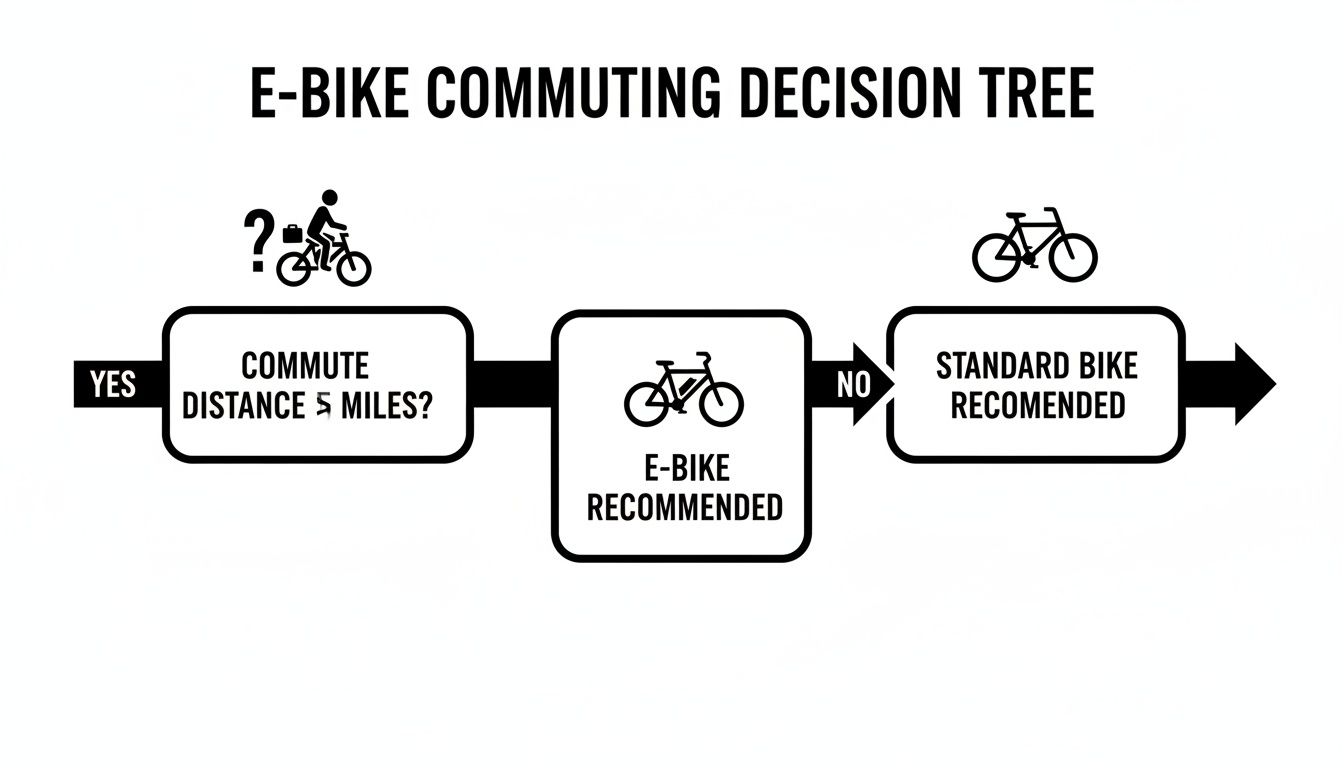
As the flowchart shows, that little electric boost is often the one thing that makes cycling to work feel practical and genuinely appealing.
The Urban Commuter E-Bike
Tired of staring at the back of a bus in morning traffic? The commuter e-bike is your new best friend for getting around the city. These bikes are purpose-built for zipping around on paved roads efficiently and comfortably.
You'll usually find them kitted out with fenders to handle wet roads, built-in lights so you can see and be seen, and a rear rack ready for your laptop bag or some groceries. Think of it as the sensible, reliable sedan of the e-bike world—designed to get you there on time and without breaking a sweat.
The Compact Folding E-Bike
Live in a small apartment or need to mix your cycle with a train ride? This is where the folding e-bike shines. It's a marvel of smart design. Brands like ONESPORT have perfected models that collapse in seconds, so you can easily carry one upstairs, tuck it under your desk, or hop on the subway.
They are the ultimate tool for what’s called a "multi-modal" commute. That just means you might ride to the station, fold the bike up for the train journey, and then unfold it to ride the last stretch to the office. It offers incredible flexibility in a tiny package.
The real magic of a folding e-bike is how it just removes problems. Suddenly, storage isn't an issue, and combining your ride with other transport is totally seamless. It’s all about making your entire journey, not just part of it, work better.
The Adventurous Mountain E-Bike
If you find yourself daydreaming about hitting the trails on the weekend, an electric mountain bike (e-MTB) will completely change the game. These bikes, like the ones from CYSUM, are built tough. They come with rugged frames, powerful motors to help you grind up steep hills, and beefy suspension to soak up all the bumps.
An e-MTB doesn't do the hard work for you, it just empowers you to do more of it. You’ll be able to tackle longer, more demanding trails and spend less time gasping for air on the climbs and more time enjoying the thrill of the descent. It's the perfect partner for exploring those forests and hills that once seemed a bit too intimidating.
The Practical Cargo E-Bike
Need to haul a week's worth of groceries, do the school run, or carry tools across town? Say hello to the cargo e-bike—your two-wheeled workhorse. These bikes are designed with longer, stronger frames and heavy-duty racks to carry surprisingly heavy loads with ease.
The electric motor is the secret sauce here, giving you the torque you need to get a heavy load moving without feeling like you're in a leg-press competition. For families and even some small businesses, a cargo e-bike can genuinely replace a second car for local trips, saving you a fortune and shrinking your carbon footprint.
To help you decide, here’s a quick-glance table to match your needs to the right bike.
Which E-Bike Style Is Right for You?
This quick comparison is designed to help you choose the perfect e-bike based on your primary needs and riding style.
| E-Bike Type | Best For | Key Features | Example Scenario |
|---|---|---|---|
| Commuter | Daily city travel and errands | Fenders, integrated lights, rear rack | Riding 5 miles to the office, rain or shine. |
| Folding | Small spaces and mixed commutes | Compact folding frame, lightweight | Taking the train into New York and cycling the last mile. |
| Mountain | Off-road trails and rugged terrain | Robust frame, suspension, powerful motor | Exploring trail networks in the Rockies on a Saturday. |
| Cargo | Hauling groceries, kids, or goods | Long frame, large carrying capacity | Doing the weekly shop or taking your child to school. |
Still weighing your options? No problem. For an even deeper look into each category, check out our complete electric bike buying guide.
A Look Under the Hood: Your E-Bike’s Core Components
Alright, you've got an idea of the e-bike style that fits you. Now, let’s get into the fun stuff—the tech that makes it all happen. It might seem intimidating, but the parts that give an e-bike its zip are actually pretty simple to understand.
Knowing the basics is the key to decoding a bike's spec sheet and feeling confident you're getting good value for your money. Think of it like this: you don’t have to be a mechanic to drive a car, but knowing what the engine does makes you a smarter owner. Same deal here. We'll walk through the motor, battery, and brakes so you can choose your first e-bike like a pro.
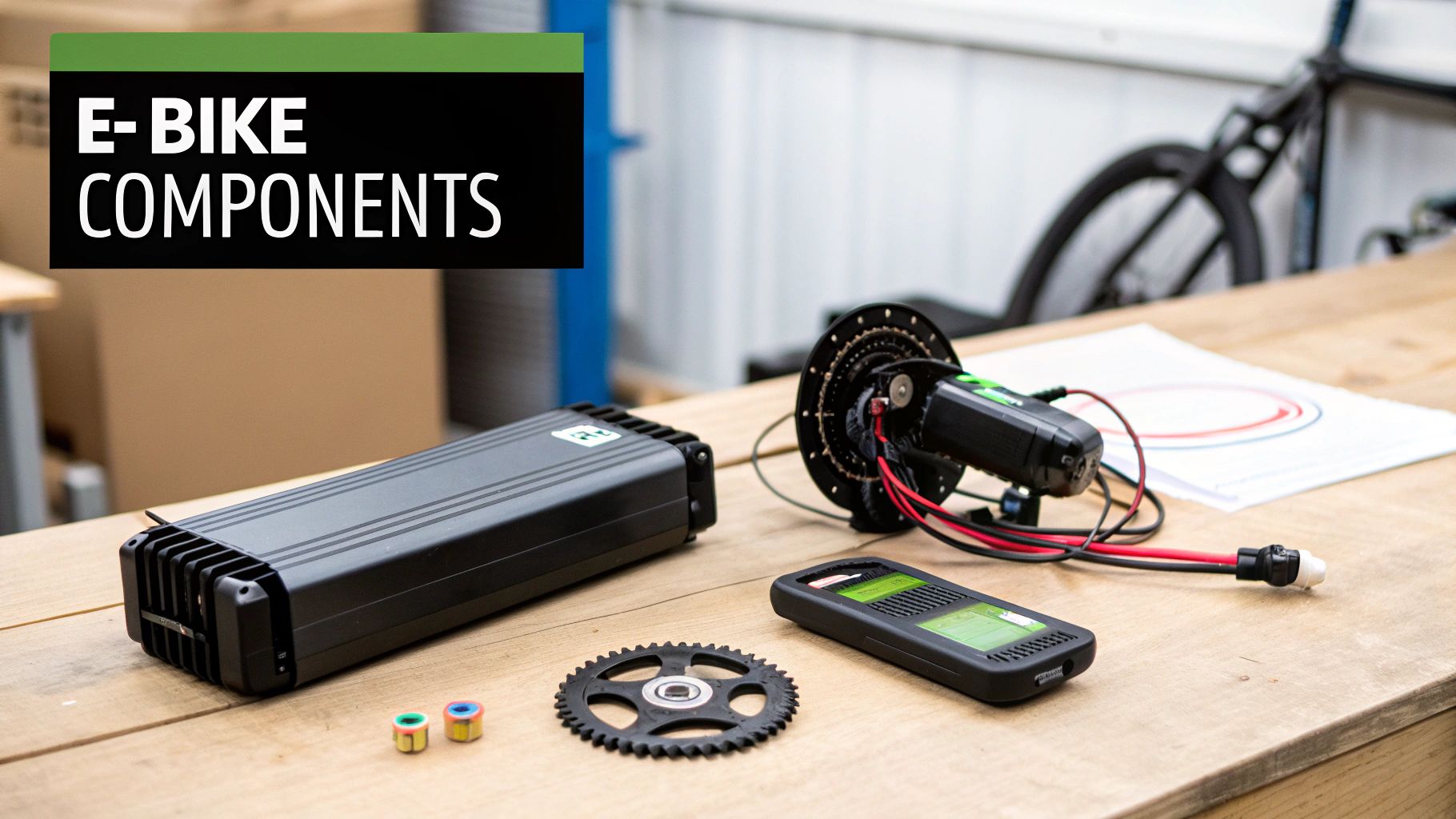
The Heart of the Ride: The Motor
The motor is your secret weapon, that invisible push that makes hills disappear. Its muscle is measured in watts (W). For a beginner, a bigger watt number usually means more power to get you up to speed and cruise up climbs you used to dread.
Here in the U.S., the most popular e-bikes hit a real sweet spot. Models with 250W-750W motors made up over 62% of the market. This range gives you a meaningful boost that makes riding a joy, but it's not so powerful that it feels like you're riding a motorcycle.
You’ll generally find two types of motors out there:
- Hub-Drive Motors: These are built right into the center of the front or rear wheel. They're the simple, reliable workhorses of the e-bike world and give you a sensation of being "pushed" or "pulled" along. They are absolutely brilliant for commuting on flatter ground.
- Mid-Drive Motors: You'll find these in the middle of the frame, right where your pedals are. They send power through the bike's gears, just like your legs do. This gives you a super natural, balanced feel—almost like your own legs just became superhuman. They are the undisputed champs on hilly terrain.
Beginner's Takeaway: For most city riding and general use, a hub-drive motor is a fantastic and budget-friendly choice. If your routes involve a lot of hills or you want the most intuitive ride possible, a mid-drive is definitely worth considering.
Your Fuel Tank: The Battery
If the motor is the engine, the battery is the gas tank. Its capacity is measured in watt-hours (Wh). The concept is simple: a bigger Wh number means a bigger "tank," which gives you more range on a single charge. This is easily one of the most important numbers to check when comparing e bikes for beginners.
For instance, a 500Wh battery will get you a lot farther down the road than a 300Wh one will, all other things being equal. But remember, your real-world range can change based on a bunch of factors:
- How much assistance you're using (eco vs. turbo mode).
- How hilly your ride is.
- Your weight and how much gear you're carrying.
- Even a strong headwind can make a difference.
Most e-bikes today can realistically get you somewhere between 30-70 miles per charge, which is plenty for a few days' worth of commuting for most people. The way that power is delivered is also a huge part of the experience. To get a feel for it, check out our explainer on how e-bike pedal assist works.
Essential Stopping Power: Brakes and Frame
Having power is great, but being able to stop on a dime is non-negotiable. E-bikes are heavier and can carry more speed than regular bikes, so they need beefier brakes to keep you safe. You’ll mainly see two kinds.
Disc Brakes vs. Rim Brakes
| Brake Type | How It Works | Best For |
|---|---|---|
| Disc Brakes | Pads grab onto a metal rotor at the wheel's hub. | Unbeatable, consistent stopping power in all weather—rain or shine. |
| Rim Brakes | Pads squeeze the rim of the wheel itself. | Dry conditions and more basic, budget-friendly bikes. They lose a lot of power when wet. |
Honestly, for the extra safety and control an e-bike requires, disc brakes are strongly recommended. That extra bit of reliable stopping power, especially on a steep hill or a slick road, is a huge confidence-booster for any rider, new or old.
Finally, a quick word on the frame. Aluminium is the go-to material for a reason—it’s light, strong, and won’t rust. It hits the perfect sweet spot between performance and price, making it an ideal choice for your first e-bike.
E-Bike Rules of the Road: Understanding the US Class System
Alright, let's talk about the legal stuff. It might sound boring, but getting your head around the rules is super important. In the United States and Australia, e-bike laws can vary from state to state, but many have adopted a three-class system to keep things clear.
This system is designed to define what an e-bike is and where you can ride it, separating them from more powerful vehicles like mopeds.
The Three Classes of E-Bikes Explained
Most e-bikes you'll find for sale in the US fall into one of these three categories. Understanding them is key to picking the right bike and riding legally.
- Class 1: The motor provides pedal-assist only (no throttle) and stops assisting once you hit 20 mph. These are the most widely accepted e-bikes and are often allowed on bike paths and multi-use trails where regular bikes can go.
- Class 2: These e-bikes have a throttle that can power the bike without you pedaling, but the motor still cuts out at 20 mph. They offer great flexibility but may have more restrictions on certain trails.
- Class 3: The motor provides pedal-assist up to 28 mph. These are the fastest e-bikes and are generally restricted to roads and on-street bike lanes. They are often not allowed on multi-use paths.
For most beginners, a Class 1 or Class 2 e-bike is the perfect starting point. They offer all the benefits of an electric boost while being welcome in the most places. Always check your local state and city regulations, as rules can differ.
In Australia, the rules are simpler and more like the EU. E-bikes are limited to a 250W motor that cuts out at 25 km/h (about 15.5 mph) to be considered a standard bicycle. More powerful bikes are classified as motor vehicles and require registration.
Do I Need a License or Insurance?
For standard Class 1, 2, or 3 e-bikes in the United States, the answer is generally no. You typically don't need a special license, registration, or insurance to ride them, as they are treated more like bicycles than motor vehicles.
This is a huge advantage, making it incredibly easy to get started. Just buy your bike, charge it up, and you're ready to ride.
This table breaks down the main differences at a glance.
E-Bike Classes at a Glance (US & Australia)
| Region | Class/Type | Max Power | Max Assisted Speed | Throttle Allowed? |
|---|---|---|---|---|
| US | Class 1 | 750W (typical) | 20 mph | No |
| US | Class 2 | 750W (typical) | 20 mph | Yes |
| US | Class 3 | 750W (typical) | 28 mph (pedal assist only) | No |
| Australia | Pedelec | 250W | 25 km/h (15.5 mph) | No |
As you can see, the US framework offers more power and speed options. This flexibility is great, but it also means it's crucial to check your local laws to ensure you're riding your e-bike where it's legally allowed.
Your First Ride and Essential Safety Tips
Alright, you've got your shiny new e-bike, and the urge to just hop on and go is real. I get it! This is where the fun begins. But before you take off, a little prep work can make all the difference between a great first ride and a frustrating one.
Think of it as a quick pre-flight check. It takes less than a minute and is a fantastic habit to get into before every single ride.
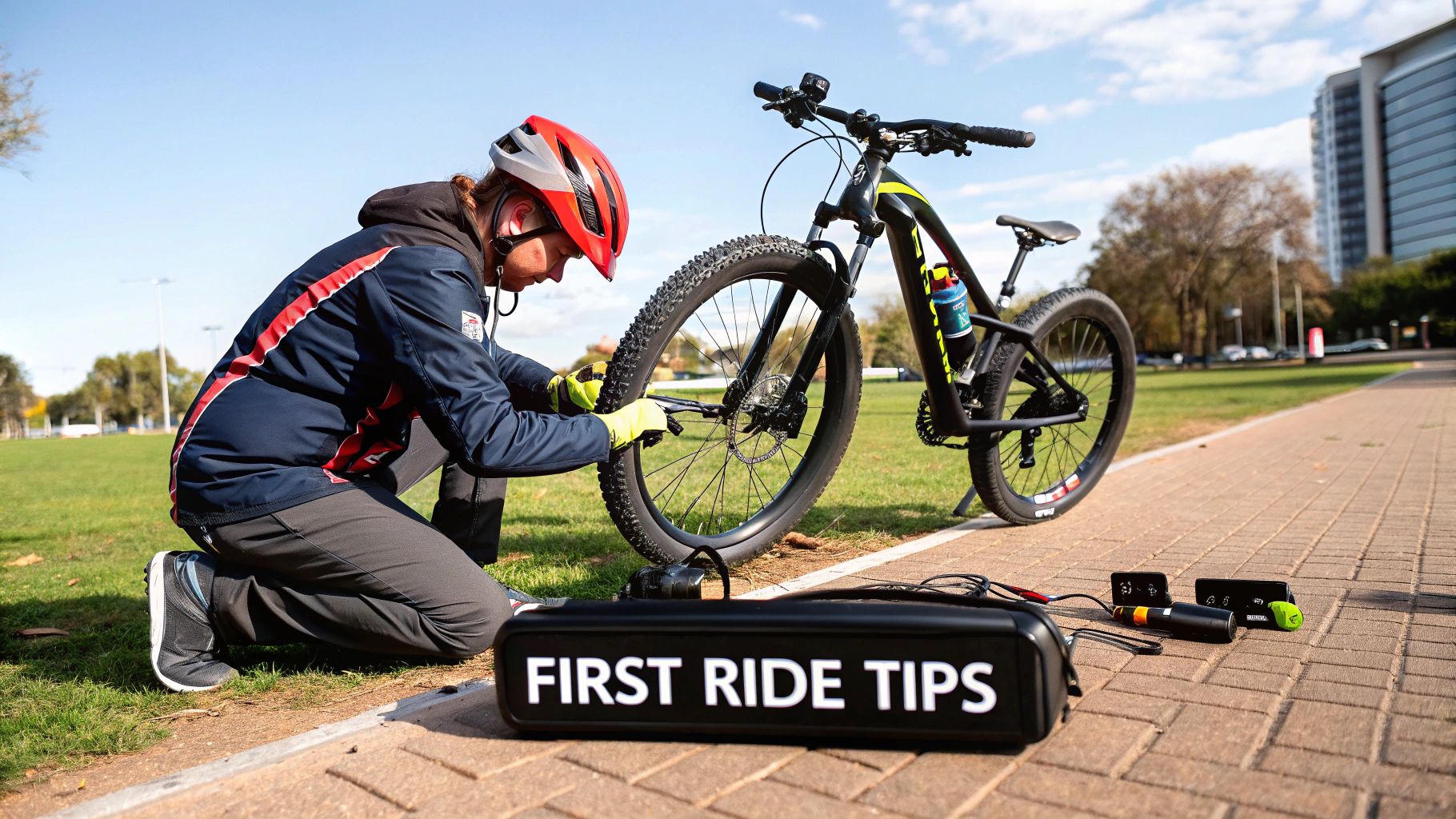
Your Pre-Ride Checklist
Before you head out, just give these things a quick once-over. Trust me, it's worth it.
- Tires: Give them a firm squeeze. They should feel solid, not squishy. Properly inflated tires are your best defense against flats and they make your battery last way longer.
- Brakes: Pull both brake levers. Do they feel firm? They shouldn’t feel spongy or pull all the way to the handlebar. You want to know you can stop on a dime.
- Battery: Is it actually charged? A quick look at the display will tell you. Also, give it a little jiggle to make sure it’s locked securely into the frame.
- Chain: Just a quick visual check is fine. You’re looking for any nasty rust or built-up gunk. A clean chain means a happy, quiet ride.
Once your bike gets the all-clear, it's time to get a feel for how this thing actually moves. Don't head straight for a busy street. Find a big, empty parking lot or a quiet park path for your maiden voyage.
Getting a Feel for the Power
Start with the pedal-assist set to its lowest level. As you start pedaling, you'll feel the motor kick in with a gentle nudge. It’s a cool feeling, but it can be a little surprising at first!
Just cruise around for a bit. Practice starting and stopping. Make some easy turns. The goal here is just to get acquainted with how the power comes on and off.
Your first ride isn't a race. It's about building a relationship with your bike. Get a feel for how it accelerates and how the different assist levels change the vibe. Nailing this down now builds a ton of confidence for later.
Non-Negotiable Safety Habits
Being a safe rider is more than just knowing how your bike works. It's about building smart habits from day one that become second nature.
- Always Wear a Helmet: This is the big one. Seriously. E-bikes help you maintain higher speeds, so protecting your head is absolutely critical. We've got a whole guide on how to pick the best helmet for your e-bike if you need some pointers.
- See and Be Seen: Use your lights. Yes, even in broad daylight. A bright, flashing light makes you way more visible to cars, and that’s a huge plus for staying safe.
- Ride Defensively: My personal motto is: assume they don't see you. Try to make eye contact with drivers, use clear hand signals when you turn, and do your best to stay out of their blind spots.
On top of learning your e-bike's quirks, building up your own riding skills is a game-changer. Following something like a cycling training plan for beginners can give you a great foundation. When you combine bike knowledge with smart riding habits, you’ll be ready to explore with total confidence.
Keeping Your E-Bike in Top Shape
Just like a car, your e-bike needs a little TLC to keep it running smoothly. The good news? You don't need a full workshop or a mechanic's license. A few simple habits are all it takes to keep your ride in prime condition for years to come.
Think of it as preventative care. A few minutes a week can save you a ton of headaches and keep you safe on the road.
This is especially true with so many new riders hitting the streets. E-bikes are exploding in popularity, with the market expected to rocket past USD 90 billion as more people look for alternatives to paying at the pump. Since the vast majority of these bikes—around 88.9%—rely on a classic chain drive, simple things like keeping your chain clean can make a huge difference. If you're curious, you can dive deeper into the e-bike market's massive growth in Technavio's detailed industry analysis.
Your Simple Maintenance Checklist
You really don't have to be an expert to handle the basics. By making a few quick checks part of your routine, you can spot small issues before they snowball into big, expensive problems.
Here’s what to keep an eye on:
- Battery Best Practices: To maximize your battery's lifespan, try not to leave it sitting at 100% or 0% for long stretches. The sweet spot for storage is somewhere between 20% and 80%.
- Keep Your Chain Happy: Your chain does a lot of work! Wipe it down with a rag every so often and apply a bike-specific lubricant every hundred miles or so. This keeps your ride smooth, quiet, and efficient.
- Tire Pressure is Key: Get in the habit of checking your tires at least once a week. Properly inflated tires roll faster, give you better battery range, and help prevent pesky flats. The right pressure (PSI) is always printed on the side of the tire itself.
- Brake Pad Check: Squeeze your brake levers and take a quick look at the pads. Most have wear indicator lines. If you start hearing any squealing or grinding, that’s your bike telling you it’s time for a closer look.
Think of these tasks like brushing your teeth—a small daily habit that prevents major issues down the line. A few minutes a week is a tiny price to pay for a reliable and safe e-bike.
Knowing When to Call a Pro
While you can easily handle the day-to-day stuff, some jobs are best left to the experts.
If you run into any weirdness with the motor, the electrical system, or a battery that just won't hold its charge, it's time to visit your local bike shop. Trying to DIY a fix on these complex systems can be risky, and you might accidentally void your warranty. A smart e-bike owner knows their limits and isn't afraid to let a professional take over.
E-Bike FAQs: Your Questions, Answered
Alright, so you've got the basics down. But even so, a few nagging questions always seem to come up right before you're ready to hit the road. Let's tackle some of the most common things I hear from new riders and give you the straightforward answers you need.
How Far Can I Really Go on One Charge?
This is the big one, isn't it? The million-dollar question. You'll see manufacturers throw around impressive range numbers, but it's best to think of those as a "perfect conditions" estimate.
The truth is, your actual range depends on a bunch of things: the battery's capacity (look for the Wh number), how hilly your route is, how much you weigh, and—most importantly—how much you rely on that pedal assist. For most modern e-bikes, you can realistically expect to get somewhere between 30 and 70 miles (50-110 km) on a single charge. For the average commuter, that's easily enough juice for a few days' worth of riding.
Can I Ride My E-Bike in the Rain?
Absolutely! Getting caught in a downpour or splashing through a few puddles is no big deal. Quality e-bikes are designed to be water-resistant, with the important bits like the motor and battery sealed up tight to keep them safe from moisture.
That said, they aren't submarines. You definitely want to avoid fully submerging your bike in deep water. A good habit to get into is giving your bike a quick wipe-down with a dry cloth after a wet ride. It just takes a minute and goes a long way in preventing rust and keeping everything running smoothly.
A lot of people think an e-bike is cheating the workout. It's not. It’s about making the ride better. You still pedal, but the assist lets you conquer that hill you always dreaded or extend your ride by a few miles, which means you end up riding more often and for longer.
Will I Still Get a Good Workout?
You bet. This is probably the biggest misconception about e-bikes. An e-bike doesn't do all the work for you; it assists you. You're always in the driver's seat, deciding how much power you want. Feel like a challenge? Dial the assist down. Need a little help getting up a steep incline? Crank it up.
What's funny is that many people find they get more exercise with an e-bike. They ride more frequently, go on longer adventures, and aren't afraid to tackle routes they would have skipped on a regular bike. It’s an incredible way to get fit without putting a ton of stress on your body.
How Do I Keep My Expensive New Bike from Getting Stolen?
Okay, this is super important. You just made a big investment, and you want to protect it. A few simple habits can make a huge difference. First thing's first: invest in a really good lock. Don't cheap out here. A top-notch D-lock or a heavy-duty chain is your best friend.
When you're locking up, always, always, always secure the frame of the bike to something that can't be moved, like a proper bike rack or a sturdy pole. If you want to be extra safe, run a secondary cable lock through your wheels. And here’s a pro tip: if you’re leaving it for a while, pop the battery off and take it with you. An e-bike without its battery is a much less tempting target for thieves.
Ready to start your own e-bike adventure? At Punk Ride LLC, we offer a curated selection of top-tier electric bikes perfect for every beginner. Explore our collection and find your perfect ride today at https://www.punkride.com.
Share:
Your Ultimate Guide to the Best Step Through Ebike
What Is a Step Through Bike and Why You Might Want One