


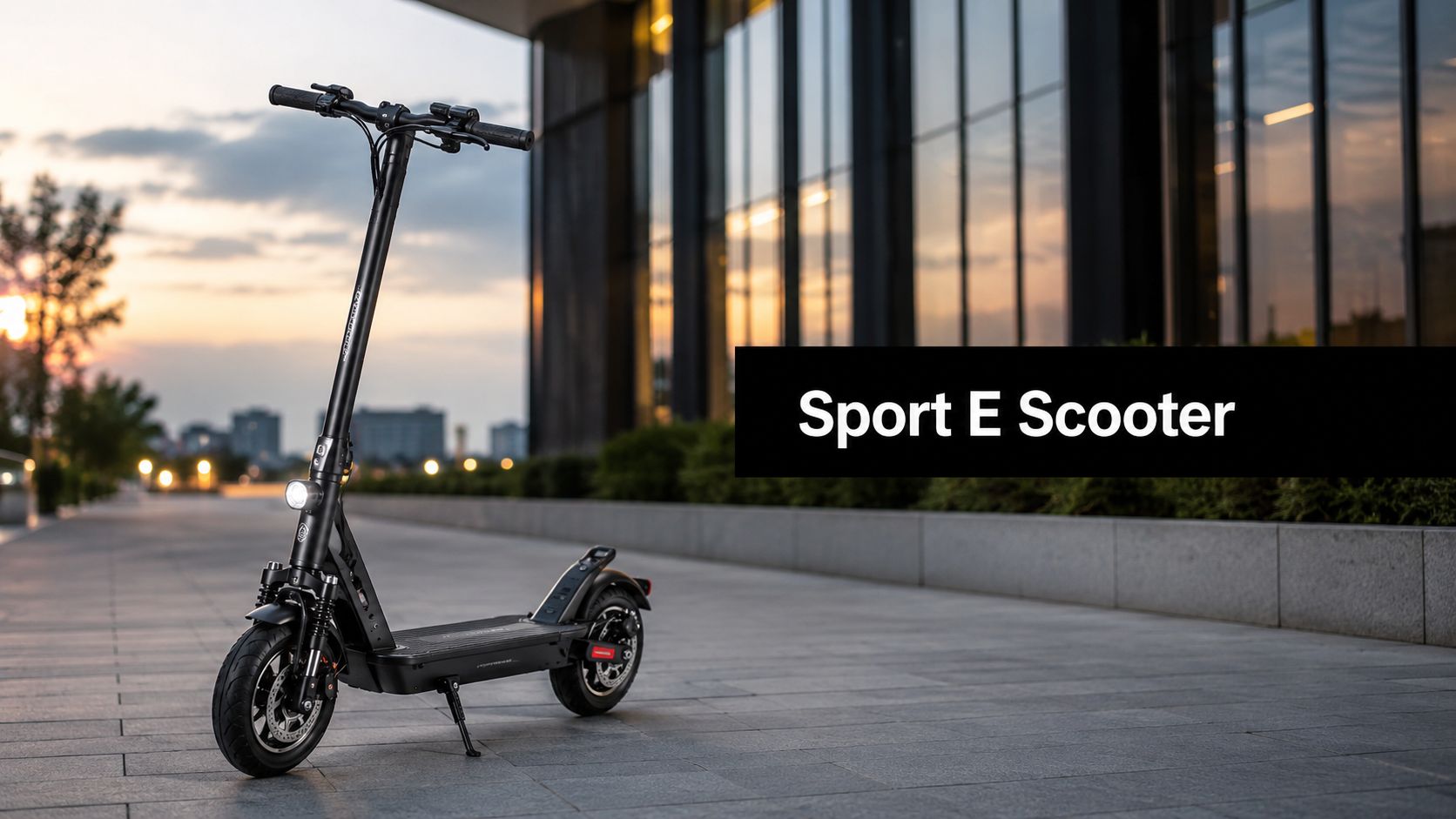
Most advice on a sport e scooter starts in the wrong place. People obsess over top speed, then act surprised when the ride feels twitchy, the battery drops faster than expected, or the scooter isn't legal where they want to use it.
A better way to think about the category is as an energy budget. If a scooter carries more power, it can feel more capable, but that capability has to be paid for in battery size, braking confidence, rider skill, and local rules. That's why the smartest buyers stop treating “sport” as a style label and start treating it as a set of trade-offs.
What Actually Makes a Scooter a Sport E Scooter
A sport e scooter isn't defined by aggressive graphics or a bigger deck. It's defined by the parts that let it sustain higher effort for longer, especially when the road gets uneven, the rider is heavier, or the route includes hills and stop-start traffic.
The clearest signals are motor output, battery capacity, braking hardware, and a chassis that doesn't feel nervous at speed. RiderGuide's review of a compact performance model notes a 24.3 mph tested top speed and 11.8 miles of range for one ultra-portable scooter, while another similar-class review describes a 500W motor, a 36V 10.5Ah battery, and about 20 miles of range (RiderGuide). Those figures show why the label “sport” is about measurable performance, not just branding.
Practical rule: if a scooter only looks fast, but doesn't have the battery or brakes to back it up, it's a styling exercise, not a sport model.
What changes in real riding
A casual commuter scooter can feel fine on short, flat trips. A sport model is built for more demanding use, but that extra output changes the ride character. Acceleration feels sharper, braking needs more attention, and your route choice starts to matter more because speed amplifies every pothole, curb, and blind corner.
That's also where people get confused. They assume a stronger motor automatically makes a scooter more useful. In city traffic, that's only true if the rest of the platform keeps up, especially the battery and brake setup.
The legal context matters too. The same scooter can be a practical private-park ride in one place and a prohibited road vehicle in another. So the category is best understood as a performance envelope first, then a legal object second. If you want to compare product types side by side, a structured product comparison like this electric scooter comparison guide is easier to scan than a marketing page full of buzzwords.
Reading the Spec Sheet Without Getting Lost

A spec sheet can look busy, but most of the numbers are doing a small number of jobs. The trick is to read them in the order that matches real riding, because a scooter that looks impressive on paper can still feel dull, twitchy, or short-legged in a city.
Motor wattage is the clearest clue to how strongly the scooter can push. Higher wattage usually means more punch off the line and less strain on hills, but the actual feel still depends on the controller, the battery, and how the scooter manages that power.
Voltage and amp-hours describe the battery setup, while watt-hours show how much energy is stored overall. Wh is the figure to watch first, because it gives you a better sense of how much riding the scooter can do before it needs a charge. A higher number can matter more than a louder top-speed claim if your route includes stops, hills, or a heavier rider.
Quick decoder for sport e scooter spec sheets
| Spec term | Plain English meaning | Why it matters on a sport model |
|---|---|---|
| Motor wattage | How hard the scooter can push | Affects takeoff feel and hill performance |
| Voltage | The battery system's electrical pressure | Helps you compare battery setups, not just sticker range |
| Amp-hours | How much charge the battery holds | Higher Ah can mean more usable energy, depending on voltage |
| Watt-hours | Total stored energy | The best early clue for practical range |
| Range claim | The maker's best-case distance | Often assumes ideal conditions that real riding rarely matches |
| Top speed | The fastest the scooter is set to go | Important, but not the same as real-world usefulness |
| IP rating | How well it resists dust and water | Matters if you ride in mixed weather |
| Weight limit | The load the scooter is built to carry | Influences durability, stability, and hill behavior |
A spec sheet rarely tells the whole story on its own. Two scooters can share similar headline numbers and still feel completely different once you ride them through rough pavement, stop-start traffic, wind, and quick turns. Tire size, frame stiffness, rider weight, and braking setup all change how the numbers translate into motion.
That is why reading a comparison side by side helps more than scanning a marketing page. A structured electric scooter comparison guide makes it easier to spot where a scooter is strong and where the claims are just surface level.
A good habit is simple. Start with Wh, then check motor output, braking, and weight, and only after that look at the advertised range and top speed. Those last two numbers matter, but they make more sense once you know how much energy the scooter carries and how much control it has when things get busy.
Motor Power Battery Range and Top Speed Trade-Offs
The common mistake with a sport e scooter is treating power, range, and speed like separate buying points. They sit in the same energy budget. Ask for more launch, more climbing strength, or more top-end pace, and you usually spend battery faster and shorten the usable ride.
A stronger motor makes the scooter feel eager, especially from a stop and on hills. That feeling has a cost. Hard acceleration, repeated starts, and steep roads pull more from the battery, so range slips sooner than a brochure would suggest. A practical way to judge the setup is to focus on stored energy and how you ride, not just the motor label on the box.

Why top speed is the least honest number on the page
Top speed is easy to market because it is easy to measure on ideal ground. A smooth, straight, empty stretch can make a scooter look faster than it will feel in traffic, on rough asphalt, or in a headwind. In real use, braking confidence, battery size, and the quality of your route matter more.
The energy budget view makes this easier to understand. Fast riding burns through stored energy the way a wide-open tap empties a sink. A scooter with a small battery can still feel exciting on a short run, but the same setup can become frustrating on a commute if you are watching the battery gauge instead of riding with confidence. That is why a sport scooter should be chosen for the ride you take, not the fastest number in the listing.
Bottom line: buy for the ride you take, not the fastest number in the listing.
Motor power also affects more than acceleration. A scooter that encourages harder starts and higher cruising speeds puts more demand on brakes and tires, so wear tends to arrive sooner. Higher speed also means longer stopping distance, which matters in wet streets, crowded cycle lanes, and stop-start urban riding. In the UK and much of the EU, speed limits for legal use are far below the numbers often used in marketing, so an overpowered scooter may be harder to use legally even if it feels impressive on paper. In parts of the US and Australia, local rules can vary by state or city, so the safer choice is the scooter that fits the speed cap where you ride, not the one with the biggest claim.
Weight belongs in the same conversation. A heavier sport e scooter can feel planted and steady, but it is harder to carry, fold, and store. It also takes more effort to stop and redirect, which is another reason speed and power need to be balanced against control. The best question is simple: how much energy do you need for your real route, with your hills, your traffic, and your local limits?
Real Rider Profiles and Use Cases
Maya uses a sport model for a mixed urban commute. Her route includes some flat sections, a few rough patches, and traffic lights that force repeated starts. She cares less about a flashy top speed and more about whether the scooter still feels composed by the end of her ride.
Tom is the weekend rider with a small apartment and a love of paths, short detours, and occasional rough ground. He wants something more capable than a basic commuter scooter, but he also has to carry it upstairs and tuck it out of the way. For him, portability and storage often beat raw speed.
Aisha is the student who wants short, practical hops between campus, the train station, and home. She needs a scooter that doesn't feel flimsy, but she also doesn't want a machine that dominates her room or makes every trip a battery-management exercise.
Three questions each rider asks differently
- Maya asks: Will it hold up in traffic, and does the battery survive a full workday rhythm?
- Tom asks: Can I store it easily, and is the ride stable enough to be fun outside the city?
- Aisha asks: Is it light enough to live with every day, and does it suit short repeated trips?
The same sport scooter can make all three riders happy, but not for the same reasons. That's why shopping by “best scooter” usually fails. Shopping by use case works better because it forces you to admit what matters most.
One useful shortcut is to be honest about where the scooter spends its life. If it lives in a flat with stairs, weight suddenly becomes a daily issue. If it lives on long urban routes, Wh becomes more important than the number on the speedometer. If it lives on campus, foldability and low fuss matter more than bragging rights.
Safety Riding Habits and Maintenance That Actually Matter
Sport scooters are less forgiving than casual ones because speed eats your margin for error. The OECD's safer micromobility work points toward technical safeguards like lower default speed caps, larger wheels, and detection of tandem riding or alcohol use, which says a lot about the risks that rise as performance rises (OECD safer micromobility report). UK technical research also emphasizes lighting, retro-reflectors, and audible warning devices, which is a good reminder that conspicuity isn't optional at speed.
Practical rule: if you ride faster, you need more visibility, more braking margin, and a better route choice. The motor can't fix a bad blind spot.
Riding habits that reduce risk
Start with your body position. Scan for opening car doors, merge only after checking blind spots, and don't hug parked cars. Keep your hands ready for progressive braking, because grabbing too hard can unsettle the scooter when the road surface is bad.
Night riding deserves extra care. Use front and rear lights, and add reflective elements if your route has dark sections or side streets. The same goes for wet paint, metal grates, and loose leaves, because higher speeds leave less room to recover once the wheels lose grip.
Maintenance should be boring and repeatable. Check tyres, bolts, and the folding mechanism regularly. Inspect brake pads and tyre pressure on a routine schedule, and look at the battery health every so often rather than waiting for a problem.

For a practical checklist approach, these electric scooter safety tips are a useful companion read if you want to build better habits before you ride faster.
A simple storage habit helps too. Keep the battery in a sensible temperature range, avoid treating zero charge like a normal resting state, and don't leave charging as an afterthought. A sport scooter can feel thrilling, but the safest owners treat it like a machine that rewards consistency.
UK EU US and Australian Rules You Need to Know
Legal fit matters as much as technical fit, and it is where many buyers get tripped up. A scooter can look perfect on a spec sheet and still be the wrong machine for the roads, paths, and local rules you face.
In the UK, private e-scooters are still tied to private land unless they are part of an approved rental trial. They cannot be used on public roads, pavements, cycle lanes, or other public land in the normal way, while trial rental scooters are limited to 15.5 mph (25 km/h) and require at least a provisional car, motorcycle, or moped licence. For a plain-English overview of how that framework is commonly explained, this electric scooter legality guide is a useful companion read, and healthychildren.org summary of UK rules gives a broad summary of the same restrictions.
EU rules are not one-size-fits-all. Germany allows e-scooters on roads, cycle paths, and cycle lanes if they meet the technical requirements, with a 20 km/h maximum design speed and a minimum rider age of 14. France allows them on cycle paths and roads with a 25 km/h cap and generally keeps them off pavements unless local rules allow it. A sport scooter that feels modest in a showroom can still be too quick for local use if the legal ceiling is lower than the scooter's advertised pace.
The US is even more fragmented, because state and city rules can differ sharply. Safety concerns show up in the injury trend, with U.S. e-scooter injuries rising from 29,344 in 2020 to 115,713 in 2024, an 80% rise over four years. Princeton University also banned personal electric vehicles, including e-scooters, on campus effective January 25, 2024 after reviewing the safety profile tied to this category. If you want a state-level starting point, understand Florida scooter laws is a practical place to begin for one market riders often ask about, and it helps show how local rules can change the picture fast.
Australia deserves the same caution. Rules vary by state, and many sport-spec models will outrun local caps, which means a scooter can look ideal on paper and still be unsuitable for public use. Before buying, ask three things, where can it be ridden, how fast is it allowed to go, and do you need a licence, helmet, or other equipment under local law?
Great Britain now publishes an annual e-scooter factsheet as part of its reported road casualties statistics, which shows how firmly the category has moved into official road-safety monitoring. That kind of tracking is a reminder that legal limits are not a side issue. They are part of the energy budget too, because the faster a scooter can go, the more often the rider runs into a rule, a curb, or a stopping-distance problem before the battery even feels the strain.
Your Sport E Scooter Decision Checklist
A good purchase starts with fit, not hype. If the scooter doesn't match your body, your storage space, and your usual route, it won't feel like an upgrade for long.

Rider fit
- Height and weight: Make sure the deck, handlebar height, and max load suit you.
- Inseam and reach: If you feel cramped, you'll ride tense and lose comfort fast.
- Storage space: Measure where it lives at home before you fall in love with the specs.
Performance needs
- Daily distance: Choose Wh for your real route, not for a brochure promise.
- Terrain: Hills and rough roads ask for more battery buffer and better braking.
- Speed versus range: Decide which matters more before you compare model pages.
Ownership fit
- Accessories and helmet: Budget for the gear that makes fast riding safer.
- Local rules: Check the road class, speed cap, and whether your area allows public use.
- Service and warranty: A strong scooter is easier to keep if parts and support are available.
Maya's best scooter won't be Tom's best scooter. Aisha's won't be either. That's the point. A sport e scooter is fun when it matches your route, your storage, and your local laws, and it becomes annoying fast when it doesn't.
Punk Ride LLC curates electric rides that fit real city use, not just showroom language, which makes this topic a natural match for the kind of buyer who wants performance with fewer surprises. If you're comparing a sport e scooter for commuting, weekend rides, or mixed urban use, visit Punk Ride LLC to explore options and see how the right setup can make daily travel feel smoother.
Share:
Scooter Tire Replacement Cost: What You Will Actually Pay
Best Value Commuter Electric Bike: A Smart Buyer's Guide