


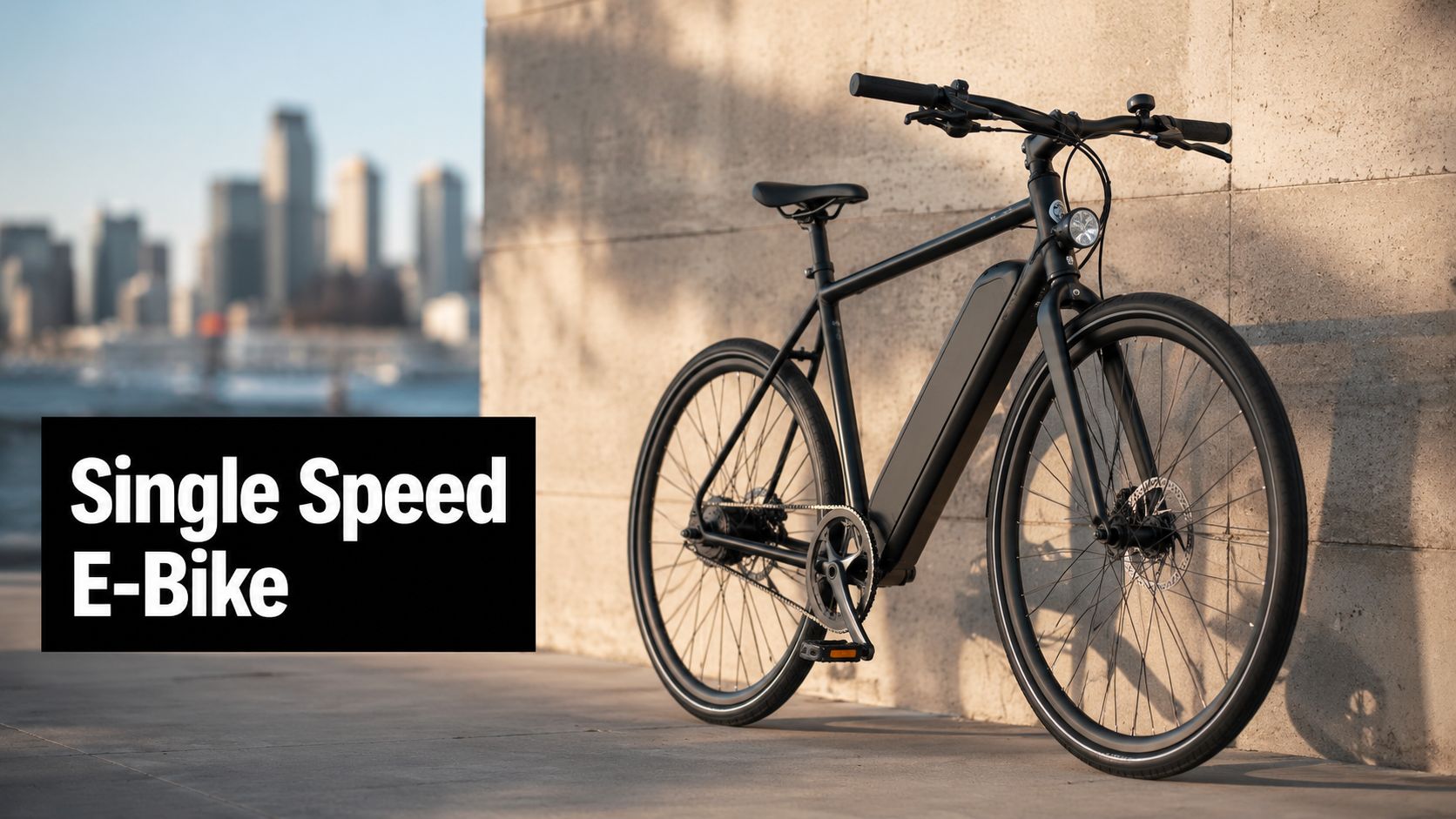
Most advice says a single speed electric bike is the smart, easy answer for city riding. That's only true if your route is flat, your legs are willing, and you're not asking the bike to carry much more than you and a backpack. Once hills, cargo, or a tired commute enter the picture, the “simple” bike can become the one that makes every ride feel harder than it should.
The core question isn't whether fewer gears look cleaner. It's whether one gear ratio fits your commute, your fitness, and your local streets. In the UK and EU, e-bike adoption has clearly moved into the mainstream, with the EU noting that one in every five bicycles sold in 2020 was an e-bike, and e-bike sales later exceeding 5 million units in 2023. Projections in the same briefing suggest e-bikes could reach one in two bicycle sales by 2030. That growth helps explain why riders keep looking at simpler commuter setups, but it doesn't make every simple setup a good buy. EU e-bike trends, risks, and solutions briefing
Is a Single Speed Electric Bike Right for You
A single speed electric bike is a good buy for the right rider, and a frustrating one for the wrong rider. If your route is predictable, mostly flat, and you want a bike that keeps the ride simple, it makes sense. If your commute changes day to day, carries real cargo, or includes long climbs, one gear starts to feel like a limit instead of a convenience.

Who benefits most
City riders who want fewer parts to worry about usually get the most out of a single-speed setup. That includes people commuting on level streets, stopping often in traffic, and preferring a quieter, cleaner-looking bike that does not ask for much attention. In that use case, the bike feels direct and low-drama, which is exactly the point.
The catch is simple. One ratio forces a trade between easier hill starts and comfortable cruising at speed. On a short, flat route, that trade is easy to accept. On a route with headwinds, grocery loads, or a last-mile climb after work, the same choice starts to feel like a bad one.
Practical rule: buy single speed for a flat commute and low drama, not because you think it makes you a stronger cyclist.
Who should walk away
Riders in hilly cities should look elsewhere if they expect to stay comfortable. The same goes for anyone carrying a child seat, hauling work gear, or riding home when fatigue is already in the picture. A single speed setup can still move you, but you end up doing more of the work your drivetrain could have handled for you. That is a trade-off, not a perk.
Safety and judgment matter too. The League of American Bicyclists federal low-speed e-bike definition and safety context League of American Bicyclists federal low-speed e-bike definition and safety context is a useful reminder that e-bikes are not toy bikes, and they deserve the same honest matching of bike to rider and route. If your first thought is about looks or simplicity, slow down and choose the bike that fits your streets, your legs, and your cargo.
How Single Speed E-Bikes Work and Why They Are Simpler
A single speed electric bike uses one chainring up front and one rear sprocket out back. That means no shifters, no derailleur hanger, no cable indexing, and no hunting for the right gear when traffic lights keep interrupting your rhythm. Fewer moving parts usually means fewer things to knock out of alignment in everyday city use.

The mechanical advantage
Think of the drivetrain like a simple sentence instead of a paragraph. A geared bike gives you multiple verbs and tenses. A single speed gives you one clean line, so the motor and your legs do more of the heavy lifting together. That simplicity makes city maintenance easier because there's less to tune, less to wear, and less to damage if the bike gets tipped, bumped, or parked tightly.
That said, simplicity doesn't mean the bike is “doing less.” The assist system still matters a lot, because one gear ratio has to cover every situation. That's why torque and assist tuning become more important than they are on a multi-speed bike. If the motor is weak or the gearing is badly chosen, you feel it immediately at starts and on slight climbs.
For a plain-language overview of pedal-assist behavior, see this pedal-assist guide. It's useful because it shows how the motor changes the feel of a ride without turning the bike into a scooter.
What the good ones feel like
Commercial city models often keep the setup modest, with 250 W assist systems and speed caps around 25 km/h / 15.5 mph, which suits commuting rather than sprinting. Some single-speed performance variants go harder. One guide describes single-speed S-Pedelec models with motors of up to 500 watts and top assisted speeds of up to 45 km/h. So no, single speed does not automatically mean weak. It means the bike is asking the motor to do more of the work of gearing. Single-speed e-bike mechanics and performance patterns Single-speed S-Pedelec example range
The cleanest bikes are often the least forgiving if you buy them for the wrong terrain.
Single Speed vs Multi-Speed E-Bikes for City Riding
The right comparison isn't “which is better overall.” It's “which one makes your commute easier in real life.” A single-speed city e-bike wins when the route is calm and predictable. A multi-speed bike wins when the route keeps changing under you, because you can drop to an easier gear instead of forcing the motor and your knees to absorb every hill.
| Feature | Single Speed E-Bike | Multi-Speed E-Bike |
|---|---|---|
| Hill climbing | Better only on mild grades and with decent motor support | Better on steeper or longer climbs because you can shift down |
| Stop-and-go traffic | Very good, simple and easy to ride | Good, but you're managing more parts |
| Maintenance | Lower routine drivetrain attention | More adjustment points, more parts to wear |
| Pedaling feel | One fixed ratio, so cadence matters more | More flexible, easier to keep a natural cadence |
| Weight and complexity | Usually simpler and cleaner | Usually heavier and more mechanically involved |
| Cargo tolerance | Fine for light loads | Better when you regularly carry more weight |
Where single speed really shines
On flat urban routes, a single-speed electric bike can be the better commuter. You don't think about shifting in traffic, and the bike stays visually clean and mechanically straightforward. For a lot of riders, that's the entire appeal. The ride feels tidy, not fussy.
It also makes sense for people who want a bike they can park, lock, and ride again without worrying about a drivetrain that needs constant attention. In the city, that matters. A bike that stays in tune is a bike you'll use more often.
Where the extra gears earn their keep
Hills change the math fast. So do headwinds, cargo, and a rider who's not especially fit yet. In those situations, the extra gear range is not a luxury, it's the thing that keeps the ride comfortable enough to repeat tomorrow. If you're climbing often, the multi-speed bike is usually the smarter purchase.
A lot of riders try to save money by removing complexity, then spend that savings in fatigue. That's a bad trade. If your commute has gradients or you plan to haul groceries, a geared bike may look less elegant, but it will likely feel far better after week two.
Key Specs to Check Before You Buy
Specs matter more on a single speed electric bike because the bike has fewer mechanical ways to hide a poor setup. If the ratio is wrong, the motor is weak, or the battery is too small, you'll feel it every day. The trick is to read the sheet like a commuter, not like a spec collector.

Motor and gearing first
A fixed gear ratio like 48 x 16 or 55 x 20 tells you the bike's pedaling character before you even sit on it. Lower ratios feel easier off the line, higher ratios feel faster once you're rolling, and one setup has to do both jobs. That's why torque matters so much here. A stronger motor and smarter assist programming help cover the gaps that gears would normally solve. Example single-speed configurations and battery ranges
Battery and range
Battery capacity is the spec that keeps commuters honest. Product listings show batteries from about 418 Wh to 500 Wh, with reported ranges of roughly 55-120 km depending on assist level and conditions. Treat those numbers as context, not promises, because hills, wind, rider weight, and stop frequency all change what you get. Bigger batteries help, but they don't rescue a bad gear choice.
A real-world spec example
One commuter model lists a 48V 350W motor, a 19.6 mph top speed, up to 45-mile range, 3.5-hour charge time, and 275 lb max load. That's the kind of spec sheet I trust more than vague marketing copy because it tells you what the bike is trying to be. It's a practical city machine, not a toy built for the showroom. Sole e-commuter specifications
If you want a broader buying framework, this e-bike selection guide is useful for matching motor, battery, and fit to your commute.
My advice: ignore fancy slogans and read the battery, motor, and load limit first.
For city buyers, I'd also pay close attention to brake quality and total bike weight. A minimalist drivetrain doesn't matter much if the bike feels sketchy when you need to stop hard or lift it up a step. In practical terms, confidence beats clever branding every time.
Legal Rules and Maintenance Realities
The legal side decides whether the bike you buy belongs on your commute or gets you into trouble. Start with the class system, because that is what most riders will run into first. A Class 1 e-bike is the cleanest fit for many city riders, and you can read the basics in this Class 1 e-bike definition guide. In the U.S., the federal low-speed e-bike framework cited by the League of American Bicyclists uses fully operable pedals, a motor of less than 750 watts, and motor-only top speed of under 20 mph on level ground with a 170-pound rider. That definition is why buyers now talk about classes instead of treating every electric bike the same. U.S. low-speed e-bike framework and legal context
For riders in the UK and EU, the common commuter benchmark is the lower-power, speed-limited category used for bicycle-style e-bikes. That matters because a bike that crosses the local power or speed line can change how it's treated on roads and paths. Don't guess here. Check the local rule before you buy, especially if you plan to ride on mixed-use paths or want the bike to stay in the same legal category everywhere you use it.
Battery safety is not optional
Battery quality is the part many shoppers skip, and that is a mistake. ITDP's 2024 report pushes for stronger quality and safety standards for e-bikes and batteries, plus clearer definitions around weight, speed, and power limits. That direction makes sense. Cheap e-bikes can look fine online and still cause ownership problems if the battery, charger, or paperwork is weak. ITDP 2024 e-bikes charging toward compact cycle cities report
I'd ask about the battery, the charger, and the warranty before I ask about color. If the seller cannot give a straight answer on compliance paperwork, move on. A commuter bike should come with clear documentation, not a shrug.
The maintenance you really need
Single-speed ownership is simple, but it still needs attention. You need to keep an eye on chain tension, brake wear, tire pressure, and wheel alignment. Because there's no derailleur taking up slack, a sloppy chain setup shows up fast as noise, poor pedaling feel, or premature wear. The upside is that the job list stays short and predictable. The downside is just as plain, if you ignore the basics, the bike will punish you with more noise, worse efficiency, and faster wear than a geared setup.
That simplicity is helpful for a city commuter who wants fewer moving parts and fewer shop visits. It is a liability if you ride hilly streets, carry cargo, or depend on the bike to cover a lot of rough, stop-and-go miles while staying quiet and clean.
I'd also mention a practical market option here. Punk Ride LLC carries a curated range of electric bikes from multiple brands, which helps if you want to compare commuter setups without bouncing between a dozen different shops.
Your Practical Buying Checklist for City Commuting
Start with the route, not the bike. If your commute is flat, short, and mostly protected from traffic chaos, a single-speed electric bike is a smart fit. If you're climbing, hauling, or riding tired most days, pick a geared bike and don't apologize for it. The point is to make commuting easier, not to win a minimalism contest.

Use this before you hand over money
- Map your route: Count hills, not just miles.
- Check the motor and battery together: One without the other is where disappointment starts.
- Look at the load rating: If you carry groceries, work kit, or a child seat, the bike has to prove it can handle that life.
- Test the fit in traffic posture: You want easy starts, quick stops, and stable handling.
- Verify compliance and battery paperwork: A clean legal setup is part of the product.
- Budget for accessories: A solid lock, lights, and proper racks matter more than a flashy frame.
A good single-speed commuter should feel calm from the first block. It should roll off lights without drama, hold speed without constant effort, and keep your hands and shoulders relaxed. If it feels like you're pushing a compromise uphill, you're probably on the wrong bike.
The safest buy is the one that matches the city you live in. Flat route, light load, sensible battery, clear compliance, that's the recipe. Anything else is a shortcut that usually costs more later in frustration, maintenance, or resale value.
If you want help choosing a commuter e-bike that fits your route instead of just your taste, visit Punk Ride LLC and compare the available urban options with your hills, cargo, and budget in mind. If you're stuck between single speed and geared, start with the commute first and let the bike follow the job.
Share:
Electric Bicycle Regenerative Braking Explained
Fast Electric Bike Under 1000: A Practical Buyer's Guide