


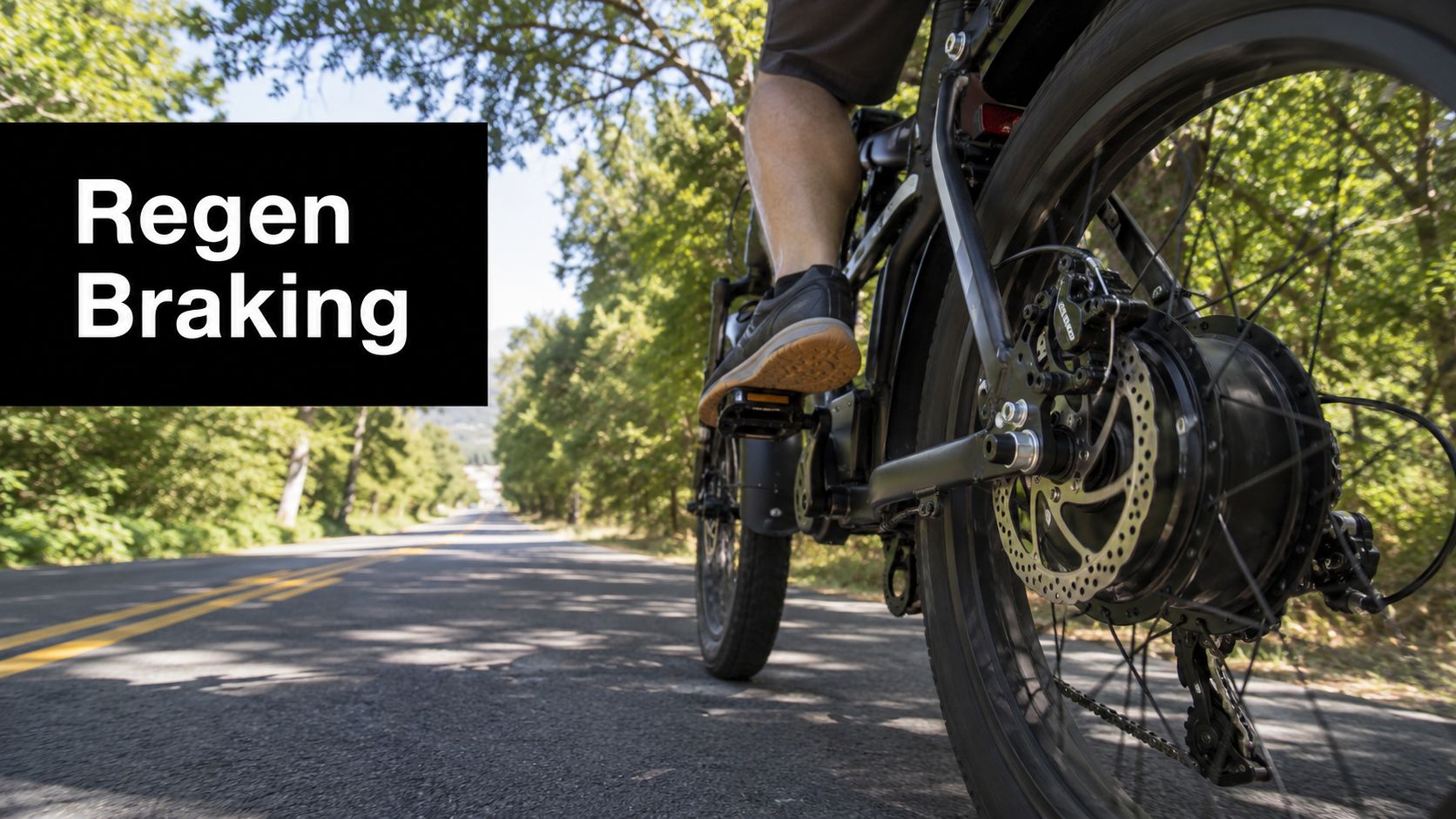
Most advice about regenerative braking sounds like free range hiding in the brake lever. On an e-bike, that's too generous. Electric bicycle regenerative braking only recovers part of your speed, and the actual payoff depends on your motor type, your hills, and how often you slow down.
If your commute is flat and steady, regen won't transform your battery life. If you ride through hills, traffic lights, or long descents, it can be useful in a quieter, more practical way, by softening stops and reducing brake wear. That's the honest version, and it's a better place to start than any marketing claim.
What Regenerative Braking Really Does on an E-Bike
Most riders first hear about regen and assume it works like a hidden battery booster. It doesn't. Regenerative braking turns some of the bike's kinetic energy into electricity, sends that energy back to the battery, and leaves the rest to be lost as heat, wind resistance, and rolling drag.

The part people feel first
The rider usually notices two things before they notice any battery gain. The bike slows more smoothly, and the brake pads do less work. That's because the motor helps create the stopping force instead of turning all the energy into friction at the pads and rotor.
Practical rule: if the ride feels calmer on descents and your pads last longer, regen is doing useful work even when the battery gain is small.
The catch is simple. A bicycle doesn't carry anywhere near the mass of a car, so it has less momentum to harvest, and braking events are short. You can't recover energy that never had time to build up, and you can't get back all the energy you spent climbing, accelerating, and pushing through air.
What actually matters to a commuter
For a commuter, regen is less about “free miles” and more about control. It can make a long downhill feel less twitchy and can reduce how often you reach for hard mechanical braking. That matters on wet UK roads, on steep European city streets, and on busy stop-start routes where little speed changes happen all the time.
The cleanest way to think about it is this. Regenerative braking is a brake system upgrade with a battery bonus, not a battery upgrade with brakes attached. If you remember that, the rest of the topic gets a lot less confusing.
How the Technology Works Step by Step
The simplest way to understand electric bicycle regenerative braking is to start with the parts you already know. The motor and generator are often the same hardware. When the wheel spins the motor in the right setup, that same unit can send current back instead of drawing current from the battery.

Video:
What happens at the brake lever
Pull the brake lever, and the controller reads that signal and changes the motor's job. Instead of helping the wheel turn forward, it adds resistance to rotation. The moving wheel then drives current back through the system and toward the battery.
A hand-crank generator works on the same principle. Turn the crank, and it makes electricity. On an e-bike, the wheel becomes the crank during braking, and the motor becomes the generator for that moment.
The feel depends on how the controller is tuned. Some bikes let the lever move through a light dead zone before regen comes in, then increase the braking effect as you squeeze harder. Others blend electrical braking with mechanical braking more sharply, which is why one bike can feel controlled and another can feel clumsy.
The hardware has to be ready for it
The feature only works if the bike is built for it. Regen needs a motor that can be back-driven, a controller that accepts a regen signal, and a drivetrain layout with no freewheel between the wheel and the motor. If one of those parts is missing, the current has nowhere to go in the right direction.
That is why the idea sounds universal, but is not. A bike has to be designed around regeneration from the start, or converted with the correct parts. A display screen or firmware change on its own cannot alter the mechanical layout. For battery life context, see electric bike battery life tips and care, because the way you charge and store the pack affects how useful regen feels over time.
For a commuter, regen is less about free miles and more about control
On a daily ride, regen matters most when the route gives the motor something to work with. Long descents, repeated slowing, and stop-start traffic give the system more chances to harvest energy and reduce brake wear. On flatter routes, there is less motion to recover.
That is the part that gets lost in hype. electric bicycle regenerative braking is a control tool first, and an energy recovery tool second. It can make a downhill feel calmer and reduce how often you depend on the pads, but the size of the benefit depends on your terrain, your speed changes, and the type of motor under the frame.
How Much Energy You Recover in the Real World
The numbers are where hype usually breaks down. In controlled testing, one e-bike regenerative braking study reported 30.9% efficiency, with 792 Wh captured and net energy use reduced from 2,516 Wh to 1,724 Wh. That is a meaningful result, but it came from favorable test conditions, not an ordinary flat commute. The source is useful because it shows the ceiling, not the daily average. For context on battery size and what those watt-hours mean in a broader vehicle discussion, a background read on EV battery capacity and range is helpful.
Lab figures and street figures are not the same thing
A 2015 transport-engineering paper found regen between 6% and 14% depending on riding conditions and street slope, with one Ruse city test measuring 5.5% over 215 km. The same paper described a downhill run at 25 km/h for 60 seconds on a 420 m slope that regenerated about 0.17 Ah into a 9 Ah battery. That is a useful reminder that slope, speed, and stop-and-go riding matter much more than slogans do. The paper is here.
Another engineering paper reported braking-energy recovery efficiencies of 25.7% under Chinese driving conditions, 22.9% under European ECE conditions, and 19.0% under Japan's 10.15 cycle, plus a test result of 28.4% at a 20 A control current. Those results came from controlled testing, but they still reinforce the same point. Regen can be substantial when the setup and route are favorable. The paper is here.
| Source / condition | Reported regen efficiency | Notes |
|---|---|---|
| 2015 transport-engineering paper, variable riding conditions | 6% to 14% | Depends on slope and ride profile |
| 2015 Ruse city test | 5.5% | Over 215 km |
| 2015 downhill case | 0.17 Ah recovered | 25 km/h, 60 seconds, 420 m slope, 9 Ah battery |
| Controlled e-bike study | 30.9% | 792 Wh captured, net use dropped from 2,516 Wh to 1,724 Wh |
| 2018 engineering paper, Chinese cycle | 25.7% | Controlled driving condition |
| 2018 engineering paper, European ECE cycle | 22.9% | Controlled driving condition |
| 2018 engineering paper, Japan 10.15 cycle | 19.0% | Controlled driving condition |
| 2018 engineering paper, 20 A control current | 28.4% | Test result |
The practical takeaway is simple. Flat, steady riding gives you little to recover. Hilly routes and stop-start riding give regen more chances to matter. A commuter who spends time descending or easing into traffic lights will see more benefit than someone rolling along a level bike path.
Battery habits also shape how useful regen feels over time. If the pack is already near empty, or if charging and storage habits are poor, the extra energy you recover will not change the ride very much. A useful companion read is this e-bike battery resource, which fits the same question from the battery side. The motor choice matters too, so riders comparing drivetrain hardware may also want to read up on the best motor type for power tools, since brushed and brushless designs help explain why some motors back-drive cleanly while others do not.
Motor Types That Support Regeneration and Those That Don't
Compatibility is where many riders get tripped up. Regenerative braking depends on the motor layout, so the first question is not whether a bike has regen in general, but whether that specific motor can send energy back through the controller. Direct-drive hub motors are the straightforward yes, geared hub motors are usually no, and mid-drive systems almost always sit in the no column.
Why direct-drive hubs are the cleanest fit
A direct-drive hub motor does not use an internal clutch that disconnects the wheel from the motor. That matters because regen needs that mechanical connection. When the wheel spins the motor during braking, the controller can route some of that motion back into charging current. EBikes.ca explains that regen is available in principle on direct-drive hub motors, and only on some geared hubs if they do not freewheel. See their regen overview here.
Geared hubs usually include a freewheel clutch. That design helps when you are pedaling or cruising because it reduces drag, but it also breaks the link regen needs. Mid-drives sit in a different part of the drivetrain, and their chain and clutch arrangement normally keep them from back-driving in the way regen requires.
What retrofit really means
If a bike was not designed for regen, a menu setting will not usually add it later. You need the right motor and a controller that accepts regen input. A controller can only do so much if the motor layout cannot send energy back.
If a dealer says “it can probably be enabled later,” ask whether the motor is direct-drive, whether it freewheels, and whether the controller has regen input. If those answers aren't clear, assume no.
For readers comparing motor families more broadly, this overview pairs well with electric bike motor types. And if you want a simple mechanical comparison from another field, best motor type for power tools shows the same basic trade-offs between control, efficiency, and how directly the motor connects to the load.
Riding Technique to Get the Most From Regen
Riders often over-brake or under-use regen because the lever feel is unfamiliar. The useful habit is to squeeze gently first, then let the system add braking progressively. On a long descent, that gives you smoother control and avoids the stop-start grab that wastes momentum.
Use regen like a speed governor, not an emergency stop
If the road is wet, rough, or crowded, combine regen with your mechanical brakes instead of leaning on regen alone. Regen helps with deceleration, but mechanical brakes still give you the final authority, especially when you need to stop quickly or finish the stop at very low speed. That low-speed fade is normal, not a fault.
Battery charge level matters too. One technical demonstration states that regen generally doesn't work when the battery is fully charged because it could overcharge and damage the battery, and that it works properly when the battery is only around 80% to 90% charged. That upper-charge window is easy to miss, but it explains why a bike may feel different after a full top-up. The demonstration is here.
What good technique feels like
On a hill, the best move is usually to feather the brake early instead of waiting until speed builds too much. That keeps the controller in a useful range and gives the bike time to convert more of the downhill energy instead of dumping it all into heat at the last second. When the controller cuts back near a full battery, that's a safety choice, not a failure.
A rider who manages regen well doesn't chase the strongest decel. They aim for the longest useful decel.
The underlying physics is simple enough to remember. The motor changes into a generator during braking, and the bike's motion becomes electrical energy instead of heat. Multiple technical sources describe that conversion directly, including a clear explanation in this video on the motor-to-generator transition.
Real Benefits and Honest Limitations
The biggest mistake is treating regen like a battery miracle. It's not that. It's a braking feature with some energy recovery built in, and the useful gains are usually smaller than people hope. The wins are smoother downhill control, less heat in the brake system, and less pad wear in traffic.

What makes it worth having
On the right route, regen adds a calm, controlled feel on descents. It also means fewer mechanical brake inputs, which can reduce maintenance on pads and give you better long-hill confidence. Riders who spend a lot of time in urban stop-and-go traffic usually notice that benefit before they notice the battery gain.
The range upside exists, but it's modest. Independent coverage commonly puts the gain around 5% to 10% in favorable use cases, while some real-world accounts describe around 1% on a downhill segment or only a slight recharge during normal riding. Those figures line up with the engineering papers above and with the simple fact that bicycles don't have much kinetic energy to harvest compared with larger vehicles.
Where it falls short
Regen adds complexity and often adds weight, especially on bikes built around direct-drive hubs. It also does little on flat routes where most riding is steady cruising. Once speed is low, regen's usefulness drops off fast, which is why mechanical brakes still do the stopping.
There's another practical limit: not every e-bike can support it, and not every rider wants the feel. Some people prefer the clean simplicity of a regular brake system and a larger battery instead. That's a rational choice, not a missed opportunity.
For a commuter in the UK or EU, the decision usually comes down to terrain, not ideology. If your route has hills and frequent stops, regen earns its keep. If it doesn't, you should treat it as a nice extra, not a buying priority.
Troubleshooting and Maintenance Essentials
When regen suddenly stops feeling present, the problem is usually simple. Check the battery state first, then the brake signal, then the controller and connectors. A full battery can disable regen by design, and a misaligned brake switch can make the controller think you're not asking for braking at all.
A short checklist that saves time
- Battery near full: regen may be limited or disabled to protect the pack.
- Brake switch alignment: if the lever sensor isn't triggering, the controller won't enter regen mode.
- Controller temperature cutoff: some systems reduce braking support if the controller gets too hot.
- Loose phase or signal connector: a weak connection can make regen intermittent.
Mechanical wear still matters even with regen. Pads and rotors need inspection because regen doesn't replace the brake system, it shares the job with it. Before winter rides, check for contamination from road salt and grit, because regen can make the bike feel fine while the hardware underneath is still wearing.
For repair questions that go beyond the brake system, this e-bike repair guide is a sensible companion read.
Don't mistake a display change for a hardware fix
A software update or a new display won't add regen to a bike that can't back-drive in the first place. If the motor freewheels or the controller has no regen input, the practical fixes are motor replacement, controller replacement, or accepting the setup as it is. That's the point where a dealer conversation matters more than a settings menu.
Is Regenerative Braking Worth It for Your Daily Ride
Start with your route, then match the technology to it. A motor that supports regeneration can make sense on a bike that spends time climbing, descending, or stopping often. On a flat commute with few slowdowns, the battery recovery may be so small that it is hard to notice day to day.
The best way to judge it is to ask what you want the system to do. If you want a little extra range on a hilly ride, regen may earn its keep. If you want lighter brake wear on long descents, it can help there too. If you are hoping it will turn a normal commute into a much longer one, that is where expectations need to stay grounded.
Motor type matters just as much as terrain. A compatible direct-drive setup can use regenerative braking, while many geared hub motors and other systems cannot. That means two bikes that look similar on a showroom floor can behave very differently once you start braking into a downhill or a traffic light.
The route itself gives you the clearest clue. A rider who climbs one side of town and rolls down the other has more chances to recover energy than someone on a steady, level path. Stop-and-go city riding also gives regen more opportunities to work, though the benefit still depends on the controller, the battery, and how the bike is set up.
Check the owner's manual for motor type, ask the dealer whether the controller supports regen input, and look closely at your local terrain and commute pattern. Those three checks tell you whether regen is a meaningful feature for you or just a spec sheet line that sounds better than it performs.
If the bike already fits your route, regen is a nice tool. If the bike is wrong for the route, regen will not fix that, and it should not be the reason you choose the setup.
If you want straightforward help choosing an e-bike setup that fits real-world riding, Punk Ride LLC curates electric rides for commuters who care about practicality as much as style. Visit Punk Ride LLC to compare options, ask the right compatibility questions, and find a ride that matches your route instead of chasing hype.
Share:
Electric Scooter Dealers: How to Choose the Right One
Single Speed Electric Bike: The Complete Urban Rider's Guide