


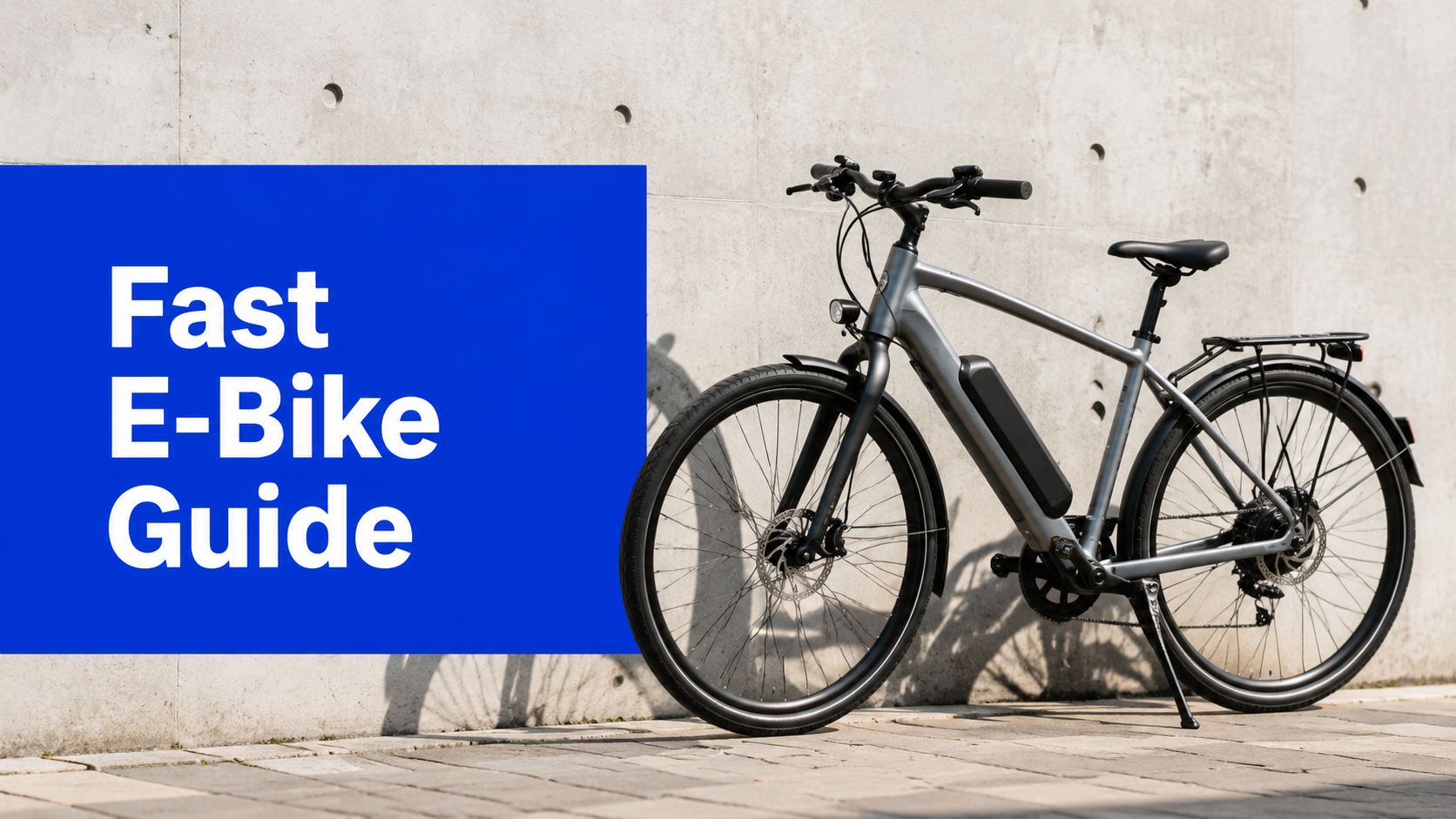
The usual advice says to chase the biggest watt number you can find, then call the bike “fast.” That's a neat shortcut, but it can lead you straight into a weak battery, sloppy brakes, and a bike that feels quick for ten minutes and annoying for the rest of the commute. A fast electric bike under 1000 is really about usable speed, not just a headline figure, and that's where smart buyers save themselves a lot of regret.
In practice, “fast” has three layers. There's the legal speed your local rules allow, the real-world usable speed you can hold through traffic and hills, and the marketing speed printed on a product page. Those layers don't always line up, especially once rider weight, wind, and battery load start doing their thing.

What "Fast" Really Means on a Budget E-Bike
A big motor number can be useful, but it isn't the whole story. A bike that claims a high top speed can still feel sluggish if the battery sags, the controller is conservative, or the frame flexes when you push it. That's why I look at three speed layers before I believe any budget e-bike claim, legal speed, usable speed, and marketing speed.
Legal speed is the first filter
Modern e-bike classes are usually built around 20 mph for Class 1 and Class 2, and 28 mph for Class 3, which is why “fast” means something different in different places. In recent testing of sub-$1,000 models, reviewers found average real-world ranges of 31 to 60 miles on batteries averaging 651 Wh, plus hill-test times around 1 minute 35 seconds on throttle and 1 minute 28 seconds with pedal assist at one location, and 2 minutes 3 seconds on throttle and 2 minutes 2 seconds while pedaling at another testing overview. That's a better reminder than any spec sheet that entry-level bikes have grown up.
A bike can be fast enough for a commute and still not be the right legal fit. In the U.S., that often means choosing between the class label and the route you ride. In the UK and EU, the legal ceiling is tighter, so the same “fast” claim can mean something very different once you hit public roads.
Practical rule: if the bike's top number matters more than its legal fit, you're already shopping in the wrong order.
Usable speed is what you feel every day
Usable speed is the pace you can keep without draining the battery too fast or feeling unstable in traffic. A bike that can briefly touch a flashy number doesn't automatically commute better than a steadier machine that holds a legal class speed smoothly. That's why I care about how the bike starts, how it climbs, and how it brakes more than the number printed in the ad.
The question is simple. Will it keep up with your route, not just your curiosity? If the answer is yes, then you've found a fast bike in the only sense that matters.
Speed Classes and Legal Limits in the US, UK, EU and Australia
A lot of shopping mistakes happen because people compare bikes before they compare laws. That's backwards. The legal framework decides whether your “fast” bike is a commuter tool, a grey-area machine, or a model that needs to stay off certain roads and paths.

The U.S. class system in plain English
The U.S. often uses a 3-class system, and that matters more than motor wattage alone. Class 1 and Class 2 are commonly capped at 20 mph, while Class 3 goes up to 28 mph e-bike class overview. If you want a budget bike that feels legitimately quick on city streets, Class 3 is usually the headline you notice first.
The catch is access rules. A Class 3 bike can make sense for a fast commute, but local rules can affect where you're allowed to ride it and what you need to wear. So the better question isn't “What's the fastest model?” It's “What's the fastest model I can legally use on my route?”
UK and EU riders need a different filter
In the UK and EU, EAPCs must assist only while you pedal, stop assistance at 25 km/h, and use a motor with a maximum continuous rated power of 250W. That's the core line between a road-legal e-bike and a faster powered vehicle in those markets. For commuters there, a “fast” budget bike usually means strong acceleration, good hill support, and efficient tuning, not huge top-end speed.
That's why a 1,000W peak claim can be almost meaningless for a UK buyer. If the bike doesn't fit the EAPC definition, the number just becomes a marketing soundbite.
Australia needs local checking, not assumptions
Australia doesn't reward copy-pasting U.S. expectations. Rules can vary by state and use case, so buyers need to map the bike to the route, not to an imported spec sheet. If you want a clean legal ride, use your longest regular route as the deciding factor, not the fastest stretch of road.
For a quick visual on class rules, the Punk Ride classes of electric bikes guide is a useful reference point. Once you know the legal bucket, the rest of the search gets much easier.
Motor, Battery and Controller Trade-Offs That Set Real Speed
Watt numbers get all the attention, but real speed comes from a system, not a single part. A motor is the nozzle, a battery is water pressure, and a controller decides how much flow gets through at once. A wide nozzle helps, but if the pressure is weak, the result still feels underwhelming.
Why peak watts don't tell the full story
Cheap e-bike motors are often rated around 250W to 750W, with 300W to 500W usually being enough for flat commuting and 500W to 750W being more comfortable for hills or heavier riders motor rating guidance. That range is more useful than chasing inflated peak claims. One review specifically warns that anything much above 750W at this price is often marketing inflation rather than durable real power motor rating guidance.
The battery matters just as much. In this budget zone, reviewers often point to 48V systems paired with 500W to 1,000W peak motors as a common sweet spot budget market roundup. A 48V battery can make a bike feel livelier than a weaker setup with a bigger-looking motor label, because the bike has more usable push behind it.
Controller tuning changes how fast the bike feels
The controller is where the bike decides how aggressively to deliver power. That's why two bikes with similar wattage can feel very different off the line. A well-tuned pedal assist and a clean throttle response can make a midrange motor feel sharp, while a poorly tuned system can feel delayed or dull even if the spec sheet looks promising.
A bike that accelerates smoothly usually feels faster in traffic than one that only posts a high number on paper.
Range decides how long speed stays useful
Budget buyers often overlook battery capacity until the bike starts fading early in the ride. Recent testing of sub-$1,000 models found average real-world ranges of 31 to 60 miles on batteries averaging 651 Wh testing overview. That doesn't just describe distance, it tells you how long the bike can keep its pace before the assist starts feeling thin.
If you're comparing options, a helpful external reference is the Sheng Milo e-bike options page from Nutrition Geeks, because it shows how budget buyers often weigh motor, battery, and ride style together. You should still judge the bike by your route, not by a spec sheet fantasy.
For motor types and the difference between hub setups and other layouts, the Punk Ride motor types guide is a sensible follow-up read.
Brakes, Tires and Frame Choices That Make Speed Safe
A fast bike with weak brakes is like sports-car brakes bolted onto a hatchback that wasn't built for them. The parts have to work together. Once speed rises, stopping control, tire grip, and frame stiffness stop being side details and start being the whole game.
Brake choice comes before bragging rights
In budget e-bikes, mechanical or hydraulic disc brakes are the practical sweet spot because they give you better control when the bike is moving quickly. That matters most in wet weather, on rough streets, and in stop-and-go traffic where every second counts. A bike that can accelerate fast but can't stop predictably is not a good buy.
I'd also pay attention to pad feel and rotor setup before obsessing over motor watts. If a bike is chasing speed, the brakes should look like they belong on the same machine, not on a cheaper cousin.
Tire width gives you confidence, not just comfort
Review roundups in this price band often show 20" x 3" to 26" x 4" tires paired with 48V batteries and higher-powered motors budget component guidance. That wider rubber helps with potholes, loose surfaces, and the little steering corrections that happen at speed. It also raises rolling resistance, which is the trade-off buyers need to accept for better control.
Best mental shortcut: wider tires usually make a budget speed bike calmer, not just softer.
Frame shape changes how speed feels
Folding frames, fat-tire builds, and moped-style layouts all show up more often under $1,000 now budget market roundup. That's good news, but not every frame style handles fast riding the same way. A stable geometry matters when the motor cuts out and the bike suddenly asks you to do the balancing.
If you want raw pace, don't buy the lightest-looking frame by default. Buy the one that looks planted, has disc brakes, and doesn't wobble when you imagine it hitting a pothole at commuting speed.
Reading Speed and Range Tests the Smart Way
A product page can be technically honest and still be misleading. The trick is that a bike may hit a speed number under one setup, then feel far slower under real use. That's why I trust test conditions more than the ad copy.
What the numbers mean in practice
Recent sub-$1,000 testing found average real-world ranges of 31 to 60 miles and hill-test times from 1 minute 28 seconds to 2 minutes 3 seconds, depending on the test location and riding mode testing overview. Those hill numbers matter because a bike that holds speed on an incline is usually more useful than one that briefly sprints on flat pavement.
A lot of shoppers fixate on top speed alone, but top speed is often the least informative number on a budget bike. Throttle-only performance and pedal-assist performance tell different stories, and the hill test shows which story is closer to your daily ride.
| Assist Mode | Typical Top Speed | Typical Range | Test Condition Notes |
|---|---|---|---|
| Throttle use | Around class-limited speeds | Often enough for urban commuting | Hill performance and battery drop matter more than headline pace |
| Pedal assist | Around class-limited speeds | Can stretch farther with steady cadence | Rider input and terrain change the result fast |
| Mixed riding | Depends on tuning and route | Usually sits between the two | Best for buyers who split time between traffic and open roads |
The three questions that cut through marketing
Before trusting a speed claim, ask these:
- What was the rider weight? Heavier riders usually see less zip and less range.
- Was the test on hills or flat ground? Hill figures tell you more about daily usefulness.
- How big is the battery in watt-hours? That number often says more about commute reality than motor wattage alone.
If a seller won't answer those clearly, treat the top speed as a rough clue, not a promise. That habit alone saves a lot of disappointment.
Matching Speed to Your Use Case Without Overbuying
The smartest fast-bike purchase is usually the one that fits your life, not your ego. A commuter, a weekend rider, and a multimodal traveler all want different kinds of speed, even if they say they want the same thing on paper.

Three rider profiles, three different priorities
An urban commuter usually wants predictable speed more than brute force. A bike that holds a legal class speed smoothly, has a battery that survives the round trip, and brakes cleanly in traffic tends to beat a flashy oversized setup. For that rider, the useful questions are about consistency and control.
A neighborhood explorer often values easy handling, lower stress, and comfort over outright pace. For that person, a more modest motor and a friendlier frame can be smarter than chasing the fastest possible model. A workout rider is different again, because pedal assist quality and cadence feel matter a lot more than throttle bragging rights.
What to pay for and what to skip
If you ride mixed routes, pay for the battery, brakes, and a well-tuned assist system first. If you're mostly doing short local trips, don't overspend on a peak watt number you'll never use. If you're riding for exercise, a smooth torque sensor and responsive assist often matter more than the biggest motor sticker.
For anyone who rides in casual shoes or sneakers, cycling insoles for foot pain relief can be a practical comfort add-on, especially on longer commutes or more upright bikes. That sort of accessory only helps, though, once the bike itself fits the ride you do.
A simple buyer profile to keep in mind
A good shortlist usually sounds like this, “I need a bike that legally fits my route, keeps a steady pace, brakes confidently, and doesn't run out of steam before the day is done.” If a model can't meet that sentence, it's not really fast in the way most riders need.
Upgrade and Maintenance Habits That Keep a Fast E-Bike Safe
A budget speed bike doesn't stay safe by accident. It stays safe because the owner checks the parts that wear first. That's the unglamorous side of buying fast on a budget, and it's where a lot of cheap bikes become expensive.
The parts that deserve regular attention
Brake pads wear faster on faster bikes, so rotor and pad checks should be part of the routine, not a rescue mission after the fact. Tire pressure matters too, because underinflated tires make the bike feel slow, vague, and less stable. Battery charging discipline matters for the same reason, especially if you're trying to protect range over the long haul.
Chain care or belt care also matters, depending on the drivetrain. A neglected drivetrain makes assist feel rougher and can turn a smooth commuter into a noisy, inefficient mess. Controller firmware awareness is useful too, because some brands tune performance in ways riders don't notice until something feels off.
Hidden ownership costs add up fast
The purchase price is only the start. A spare charger, replacement brake pads, tires, and periodic service can easily change how cheap a “cheap” bike feels over time. That's why buying from a brand with local support is worth more than it looks on paper, especially once you're riding at higher speeds and need parts that arrive.
If you want a deeper look at tuning and practical performance habits, the Punk Ride speed-up guide is worth a read. Use it as a maintenance-minded reference, not as an excuse to ignore the limits of the frame, brakes, and battery.
Don't spend your first-year budget on cosmetic accessories before you've covered brakes, tires, lights, and a reliable charger.
Good upgrades versus vanity upgrades
Better pedals, better tires, and better brake pads usually make sense. A louder horn or flashy add-ons don't change whether the bike can stop in time or hold speed up a hill. The safest budget bike is the one whose owner invests in control before style.
Pulling It All Together for a Confident Purchase
A fast budget e-bike is a balancing act. The right answer starts with your legal class, then moves to the speed you need, then ends with the frame, brakes, battery, and assist tuning that make that speed usable every day. That order matters because a bike that's legally awkward, unstable, or short on range isn't fast, it's just noisy on a spec sheet.

The mental checklist that works
Start with your legal class, because that decides what “fast” can even mean on your roads. Then set a realistic speed target, whether that's 20 mph, 25 km/h, or 28 mph, depending on where you live and how you ride. After that, match the bike to your use case, commuter, explorer, or workout rider, and only then look at motor wattage and battery size.
Safety gear belongs in the decision too. A helmet, lights, and a bike that stops predictably matter more once the bike starts moving quickly enough to feel exciting. If the chassis looks flimsy, the brakes are weak, or the battery is undersized, the bike is not a bargain.
The strongest value in this category is usually the model that feels fast every day, not the one that only looks fast in a thumbnail. If you keep the three layers of speed in mind, you'll spot the difference immediately.
Punk Ride LLC curates electric bikes for urban riders who want practical speed, clean design, and easier city travel. If you're comparing fast electric bike under 1000 options and want to browse a dedicated electric-bike collection, visit Punk Ride LLC and match the bike to your route before you buy.
Share:
Single Speed Electric Bike: The Complete Urban Rider's Guide
Servicing a Scooter the Right Way for Longer Rides