


Thinking about getting a new bike? The biggest question you'll face is whether to go electric or stick with a classic. It really boils down to one thing: motorized assistance versus your own pedal power. E-bikes are fantastic for making hills disappear and stretching how far you can go, which is a game-changer for long commutes or if you just want a little help. On the flip side, a normal bike gives you a much better workout, is simpler to take care of, and is usually easier on the wallet, making it the top choice for fitness buffs and budget-minded riders.
Core Differences at a Glance
Picking the right bike is all about matching it to your life and how you plan to ride. The whole "e-bike vs normal bike" debate isn't just about a motor; it’s about what you want out of your cycling experience. An electric bike takes the frame we all know and love and adds a motor and battery. This simple addition completely changes the ride from a pure physical test to a fun, assisted journey. Suddenly, cycling becomes a real option for more people and for trips you might have otherwise taken the car for.
Of course, the good old-fashioned bicycle is still the champion of simplicity and fitness. It's light, has no complex electronics, and is a breeze to carry, store, or fix. Whether you’re looking for a sweat-free commute across Los Angeles or a tough workout in the Aussie bush, your daily needs will point you to the right choice. Let’s break it down to see which bike fits you best.
Quick Comparison E-Bike vs Normal Bike
To make things crystal clear, here’s a quick table laying out the key differences between an electric bike and a traditional one. It’s a great starting point for figuring out which one aligns with your goals.
| Feature | E-Bike (Electric Bike) | Normal Bike (Conventional Bike) |
|---|---|---|
| Riding Effort | A lot less effort needed. The motor makes hills and headwinds feel almost flat. | All you. Your legs do the work, making hills and long distances a real challenge. |
| Speed & Range | You'll have a higher average speed (up to 20-28 mph / 32-45 km/h with assist in the US) and can go much further, typically 30-70 miles. | Your speed and range are totally up to your fitness level and the terrain you're on. |
| Initial Cost | Definitely a bigger upfront investment because of the motor, battery, and electronics. | Much cheaper to buy. You can find tons of great options that won't break the bank. |
| Weight | They're heavy, usually weighing 40-70 lbs / 18-32 kg. This can make carrying one up stairs or onto a bike rack a real workout. | Nice and light, typically 20-35 lbs / 9-16 kg. Super easy to pick up, carry, and handle. |
| Primary Use Case | Perfect for commuting, replacing the car, carrying groceries, or for anyone who wants to get out and ride without overdoing it. | Best for pure exercise, sport, fun weekend rides, and getting around town on shorter trips. |
| Maintenance | All the usual bike stuff, plus you'll need to look after the battery and motor. It can be a bit more complex. | Way simpler and cheaper to maintain since you only have to worry about the mechanical parts. |
This side-by-side view should give you a gut feeling for which direction to lean. Now, let's dive deeper into what these differences mean for you in the real world.
Breaking Down On-Road Performance
When the rubber meets the road, the difference between an e-bike and a regular bike becomes crystal clear. It's not just about who's faster in a straight line. It’s about how you get up to speed, how you handle hills, and just how far you can realistically go before you call it a day. Let's dig into the real-world dynamics that separate these two types of rides.
This performance shift is completely changing how people get around cities. Think about places like New York or Melbourne, where e-bikes are exploding in popularity for both personal use and delivery services. This isn't just a fleeting trend; it's a fundamental change in how we move. Some projections even show the global e-bike market hitting a staggering $33.4 billion by 2032.
Speed: Cruising vs. Sprinting
Lots of people think e-bikes are just plain faster, but that's not the whole story. In the US, a Class 1 or 2 e-bike provides motor assistance up to 20 mph (32 km/h), while a Class 3 can take you up to 28 mph (45 km/h). A fit rider on a decent road bike can absolutely smoke 20 mph on a flat stretch of road, but holding 28 mph takes serious athletic ability.
The real difference is the average cruising speed. Holding 20 mph on a regular bike takes a solid, consistent effort. On an e-bike, getting to that speed and just sitting there is basically effortless. You can cruise along comfortably without even breaking a sweat.
Key Insight: An e-bike won't necessarily have a higher top speed than a pro cyclist, but it lets you maintain a much higher average speed with way less effort. This is a game-changer in stop-and-go city traffic.
This makes a massive difference in your commute time. Pulling away from a traffic light is quick and easy, and you won't feel completely gassed after just a few miles. For a closer look, you can check out our guide on how fast electric bikes go.
Conquering Hills with Ease
Hills. They're the great equalizer for cyclists, the things that make you rethink your route or even your decision to ride at all. This is where the gap between an e-bike and a normal bike becomes a massive chasm.
Picture a steep hill on your daily commute.
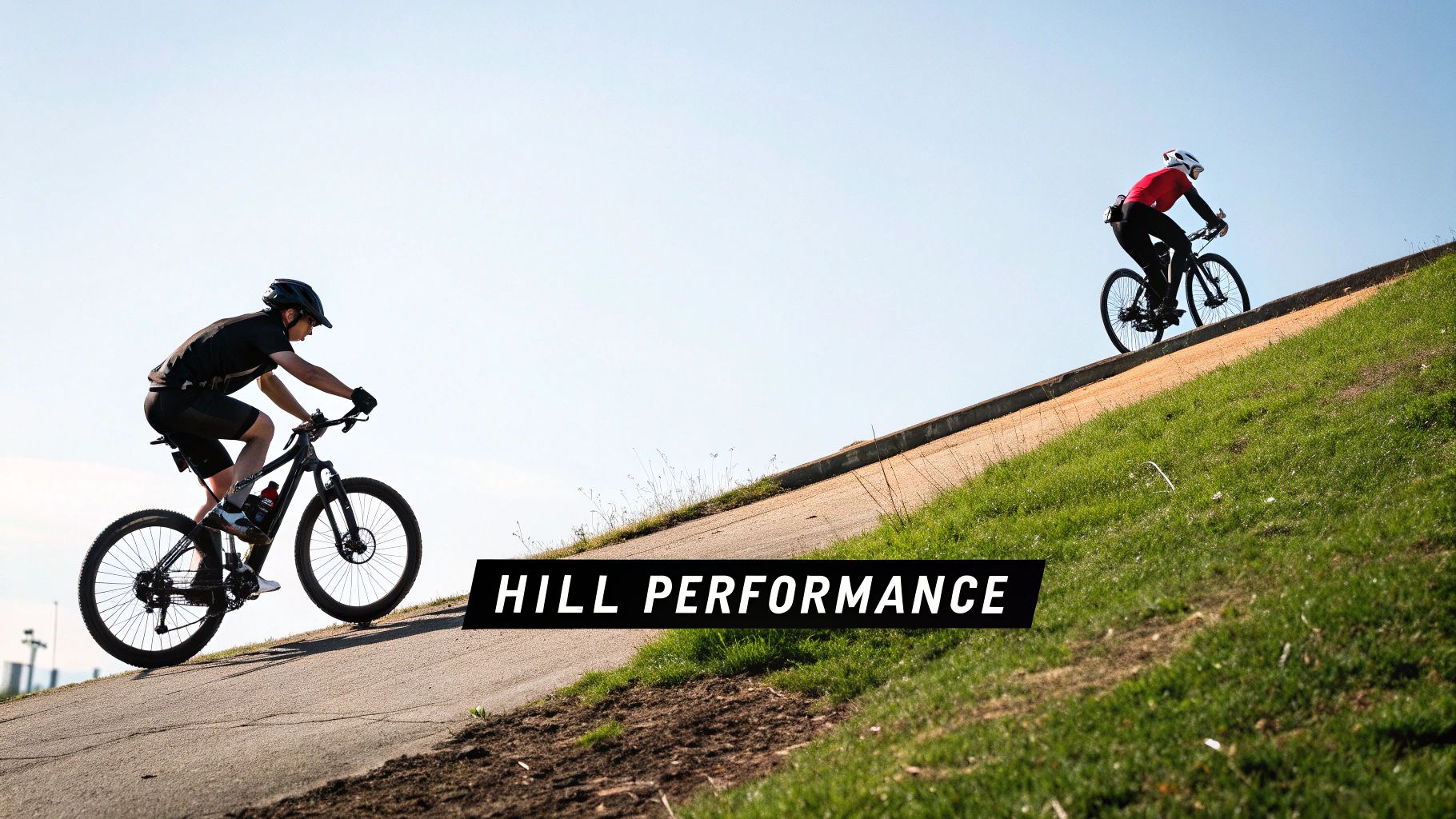
- On a Normal Bike: That climb is a gut check. It means getting out of the saddle, grinding the pedals, and showing up at the top breathing hard and covered in sweat. It's a fantastic workout, sure, but it can be a real barrier to using your bike for daily transport.
- On an E-Bike: The same hill is suddenly no big deal. The motor kicks in, giving you the boost you need to pedal smoothly all the way up. What used to be a grueling challenge is now just a steady, manageable climb. You arrive feeling fresh, not like you just finished a major race.
The ability to flatten hills opens up a world of new routes and makes cycling a viable option for so many more people, no matter their fitness level.
Redefining Your Riding Range
So, how far can you actually go? On a traditional bike, the answer is all about you: your stamina, the terrain, and the wind. A 20-mile ride might be a casual spin for a seasoned cyclist, but for a beginner, it could feel like an epic journey. Your body is the limiting factor.
E-bikes completely rewrite that equation. An electric bike’s range is all about its battery capacity, the assist level you choose, and the terrain you're on. It's not uncommon for modern e-bikes to cover anywhere from 30 to 70 miles (50 to 110 km) on just one charge.
This expanded range has some huge implications:
- Longer Commutes: That trip to the office on the other side of town? Suddenly, it’s not out of the question.
- Weekend Adventures: You can explore new trails and scenic backroads without constantly worrying if you have enough gas in the tank to get home.
- Carrying Cargo: The extra weight from a week's worth of groceries or a child seat barely makes a dent in your effort, thanks to that motor.
At the end of the day, an e-bike’s performance isn't just about speed or distance. It's about giving you the freedom and confidence to ride more often, in more places, without the physical roadblocks a normal bike can put in your way.
Calculating the True Cost of Ownership
It’s easy to get hung up on the initial price tag when comparing an e-bike vs a normal bike. And yes, e-bikes definitely cost more right out of the box. But if you want the real story, you have to look past that first day and think about what each bike will actually cost you over the long haul.
Once you start tallying up the numbers for commuting, maintenance, and all the money you won't be spending, that "expensive" e-bike often starts to look like the smartest financial move, especially if it means leaving the car in the driveway more often.
The Upfront Investment
Let's not beat around the bush: an e-bike's initial cost is higher. The motor, battery, and all the electronic wizardry easily add several hundred to a few thousand dollars to the price compared to a conventional bike of similar quality. You can snag a decent entry-level normal bike for around $400-$600, but a reliable e-bike will likely start closer to $1,500-$2,000.
That initial sticker shock can be a bit much, but it starts to make sense when you reframe the e-bike not as a weekend toy but as a legitimate vehicle. Stacked up against the cost of a car, a yearly public transport pass, or a serious Uber habit, the e-bike’s price suddenly seems a lot more palatable. We dive deeper into this in our breakdown of whether electric bikes are worth it.
Operational Costs and Long-Term Savings
This is where things get really interesting and where the e-bike starts to pull ahead. The day-to-day running costs are so low it's almost funny, building a killer case for its long-term value.
Here’s a quick look at the running costs:
- Charging an E-Bike: Fuelling up your e-bike is dirt cheap. In the US, a full battery charge will set you back a measly 5 to 15 cents, depending on your electricity rate. Over a full year of daily commuting, that’s less than what you’d spend on a couple of fancy coffees.
- Fuel Savings: This is the big one. Every single time you grab your e-bike keys instead of your car keys, you're saving money. With gas prices being what they are, those savings pile up incredibly fast.
- Parking and Public Transport: If you live in a city, you know the pain of expensive parking permits and monthly transit passes. An e-bike just wipes those costs off the board completely.
When you do the maths, e-bikes can lead to some seriously impressive savings—we’re talking anywhere from $2,500 to $7,000 a year by replacing car journeys. A regular bike is fantastic, but for those longer commutes where driving is the only other real option, an e-bike’s power and range make all the difference.
A Real-World Commuting Scenario
To really see how this plays out, let's crunch the numbers for a daily 10-mile (16 km) commute over five years. This includes everything: the initial purchase, fuel/electricity, maintenance, insurance, and the inevitable depreciation.
Here's a look at how the costs stack up for someone doing a 10-mile daily commute.
5-Year Commuting Cost Scenario: Car vs E-Bike vs Normal Bike
| Cost Category | Car (Mid-size Sedan) | E-Bike | Normal Bike |
|---|---|---|---|
| Initial Purchase | $25,000 | $2,000 | $600 |
| Fuel / Electricity | $6,000 | $150 | $0 |
| Insurance | $7,500 | $400 | $250 |
| Maintenance | $3,500 | $800 | $500 |
| Depreciation | $12,500 | $1,000 | $300 |
| Total 5-Year Cost | $54,500 | $4,350 | $1,650 |
Disclaimer: These are just estimates, and your actual costs will vary based on where you live, the models you choose, and how you use them.
The table makes it crystal clear. While the humble normal bike is still the undisputed king of cheap transport, the e-bike carves out a compelling middle ground. It saves you a staggering amount of money compared to a car and makes that 10-mile ride a practical, sweat-free option for just about anyone.
Ultimately, the total cost of ownership shows that an e-bike isn't just another purchase—it's an investment that can pay for itself many times over by completely changing the way you get around.
Health & Environmental Impact: Is It Cheating?
Let's get right to it—is riding an e-bike "cheating" your workout? That's the million-dollar question in the e-bike vs. normal bike debate. We'll tackle that head-on and then look at how each one stacks up environmentally. The answers aren't as simple as you might think.
The popular myth is that e-biking is for lazy people, but the numbers tell a completely different story. Sure, a ride on a normal bike is a more intense, sweat-inducing workout minute-for-minute. But the gentle push from an e-bike's motor encourages people to ride way more often and for much longer distances. It’s this accessibility that’s fueling a massive cycling boom.
In fact, e-bikes are the engine driving the entire industry's revival, accounting for a staggering 63% of all bicycle sales growth in dollar terms from 2019 to 2023. In the US alone, ridership has tripled since 2021. It's clear the assistance from an e-bike is getting more people on two wheels, more often. You can see more data behind this trend in Upway's deep dive into the e-bike boom.
The Fitness Debate: Workout vs. Consistency
Instead of thinking about it as "hard work" versus "no work," it's better to see them as two different fitness philosophies. Each one has its own set of benefits, depending on what you're trying to achieve.
-
Normal Bike: The High-Intensity Interval Trainer. Hopping on a conventional bike is like hitting the gym. Every single hill spikes your heart rate, and every sprint builds raw cardiovascular power. It’s an unfiltered, pure workout that torches calories.
-
E-Bike: The Consistent Cardio Coach. An e-bike, on the other hand, delivers a steady, moderate-intensity workout. By taking the sting out of steep hills and long distances, it removes the excuses. You're far more likely to grab it for a daily commute or a weekend cruise you’d otherwise skip, leading to more total exercise over time.
The real takeaway here is that e-bikes don't get rid of the exercise; they just change what it feels like. For a lot of people, this turns physical activity into a daily habit instead of a punishing event saved for the weekend.
Unpacking the Environmental Footprint
When it comes to being green, both bikes are light-years ahead of taking the car. Any kind of cycling cuts down on traffic, noise pollution, and nasty emissions. But when you look at how they're made, a clear difference emerges.
Manufacturing and Materials
A normal bike is pretty simple. It's mostly metal for the frame and rubber for the tires, so its manufacturing footprint is relatively small and straightforward.
An e-bike has a more complicated backstory. You've got a lithium-ion battery, a motor, and a bunch of electronics to account for. That means a larger footprint right out of the gate. The mining of materials like lithium and cobalt for those batteries comes with its own set of serious environmental and ethical baggage.
The Car Replacement Effect
This is where the e-bike completely changes the game and often comes out ahead in its overall positive impact. While you can replace car trips with either bike, the e-bike’s range and ease of use make it a practical substitute for a much wider range of journeys.
Think about it:
- That hilly, 15-mile commute might seem impossible on a normal bike, so you grab the car keys. On an e-bike? It's a totally doable daily ride.
- Hauling a week's worth of groceries is a serious slog on a standard bike, but it's almost effortless with a little help from a motor.
- For older riders, people with physical limitations, or folks just getting into cycling, an e-bike makes it possible to ditch the car for trips that would be out of the question otherwise.
Because an e-bike empowers so many more people to leave their cars parked for more types of trips, its potential to slash carbon emissions in our cities is huge. So, while it takes more resources to build one, its real-world ability to get cars off the road often results in a much bigger win for our air and our planet.
Navigating Local Rules and Road Safety
So, you're trying to decide between an e-bike and a regular bike. It's not just about pedals vs. power; you've also got to think about the rules of the road. A traditional bike is pretty straightforward—the laws are almost universal. But once you add a motor, things get a little more complicated.
The regulations for e-bikes can change dramatically depending on where you are, whether it's the US or Australia. Knowing the law is your first step to a safe and legal ride. Beyond the rulebook, though, the practical side of safety also shifts. The higher average speeds and extra weight of an e-bike mean you really need to adjust your riding style and get serious about your gear.
E-Bike Laws Around the World
One of the biggest differences in the e bike vs normal bike discussion comes down to the legal stuff. A regular bike is just a bike, no matter where you go. E-bikes, on the other hand, are often classified based on their power and speed, and those classifications matter.
-
United States: The US sorts e-bikes into a three-class system. Class 1 is pedal-assist only, cutting off at 20 mph. Class 2 bikes have a throttle and also top out at 20 mph. Then you have Class 3, which gives you pedal-assist up to a zippy 28 mph. Each state decides where you can ride these different classes, with some places like California having detailed laws, while others are more relaxed.
-
Australia: In Australia, the rules are more unified nationwide. A legal e-bike (or "pedelec") must have a motor of 250 watts or less that provides assistance only when you're pedaling. The power must cut out at 25 km/h (15.5 mph). Some states allow "throttle-based" e-bikes with a maximum power of 200 watts that can be used without pedaling. Anything faster or more powerful is considered a motor vehicle and needs registration and a license. For a solid overview of cycling laws and safety practices, resources like the Ultimate Kentucky Bicycle Safety Guide can be incredibly useful, no matter where you ride.
The bottom line is simple: with greater speed comes greater responsibility. Figuring out your local e-bike classification is the first thing you should do to be a safe, smart rider.
Practical Safety for E-Bike Riders
That extra speed and weight on an e-bike isn't just for fun—it demands a whole new level of awareness. You’re moving faster and carrying more momentum, and that completely changes how you need to interact with traffic, people, and the road itself.
Take braking, for example. Your stopping distance is way longer. On a regular bike, you can often stop on a dime. But on a 60 lb e-bike cruising at 20 mph, you have to think ahead and start braking much, much earlier to avoid a collision. This is especially critical in the rain or on crowded city streets.
If you want to dive deeper into the legal side, our guide on whether electric bikes are street legal breaks down all the specifics you need to know.
Essential Gear and Riding Techniques
A helmet is a no-brainer for any cyclist, but if you're riding an e-bike, it's worth thinking about an upgrade. Given the higher speeds, a helmet with better protection, like MIPS technology, is a really smart investment. Being seen is just as important.
Here are a few safety upgrades to consider:
- Bright, Integrated Lights: A lot of e-bikes come with powerful, built-in lights. Don't just save them for the dark—run them during the day so drivers can see you coming.
- Reflective Gear: Throw on some bright clothing or reflective accessories, especially if you're commuting when the sun is low.
- A Quality Lock: E-bikes are expensive, which makes them a tempting target for thieves. Do yourself a favor and invest in a serious U-lock or a heavy-duty chain lock to keep your ride safe.
You'll also need to tweak your riding technique. Always be hyper-aware of what's happening around you, give pedestrians plenty of room, and use your bell to give a friendly heads-up when you're coming up behind someone. These small habits make a massive difference in keeping every ride a safe one.
Choosing the Right Bike for Your Lifestyle
Okay, we've gone deep on performance, costs, and health benefits. Now it's time to get personal. The whole "e-bike vs. normal bike" debate really boils down to one simple question: what does your life look like?
The best bike isn't about stats on a page; it's the one that seamlessly fits into your routine, your fitness goals, and even your personal vibe. So, let's stop talking in generalities and start looking at how these bikes perform in the real world for different kinds of people.
Find the profile below that sounds the most like you, and let's figure out your perfect match.
The Daily Urban Commuter
You're trying to get to work or class on time, and showing up looking like you just ran a marathon isn't an option. Your route might have a few sneaky hills, and you're usually lugging a laptop, a change of clothes, or a bag of groceries.
-
Normal Bike: Absolutely a great choice for shorter, flatter commutes. It's light, a breeze to carry up apartment stairs, and pretty straightforward. The downside? That surprise headwind or that one steep hill can instantly turn a pleasant ride into a serious grind, leaving you desperate for a shower.
-
E-Bike: For the urban commuter, this is a total game-changer. An e-bike makes hills disappear and lets you cruise at a consistent speed, so you arrive fresh and on schedule, every single time. That heavy backpack or pannier bag? You'll barely notice it with the pedal assist engaged. It genuinely becomes a car replacement for city life.
Recommendation: For any commute over three miles or a route with any real hills, the e-bike is the hands-down winner. The ability to guarantee a sweat-free, reliable journey makes it the ultimate tool for practical, everyday transport.
The Weekend Fitness Enthusiast
For you, it's all about the workout. You live for that feeling of pushing your limits, getting your heart rate soaring, and conquering a tough climb. Your bike is basically your gym on wheels.
This flowchart gives you a good idea of how e-bike rules differ between the US and the UK, breaking down speed limits and how the bikes are classified.
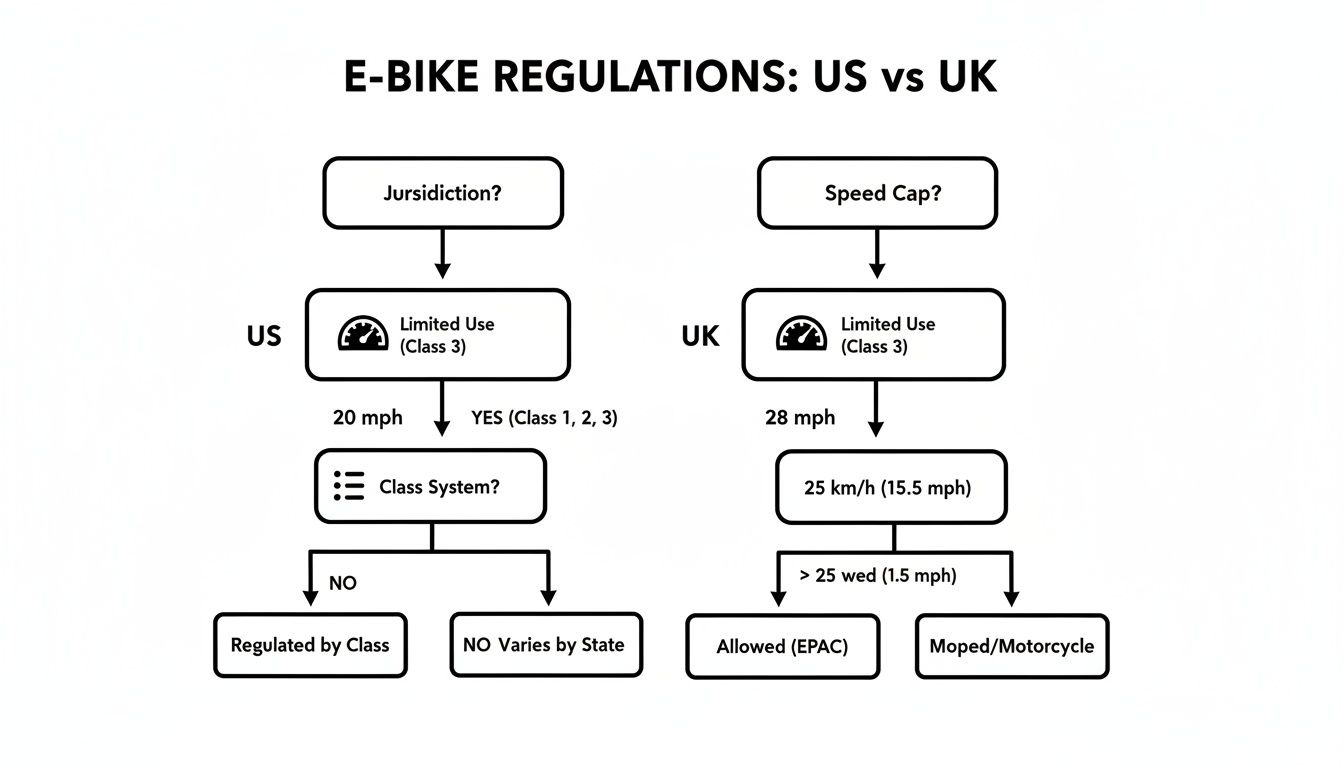
You can clearly see the more complex, class-based system in the US, which contrasts with the straightforward, power-based rules you find in the UK and Europe.
-
Normal Bike: This is your bread and butter for a pure, no-frills workout. Every single pedal stroke is 100% you, delivering unfiltered cardio and strength training. It’s also lighter, more nimble, and gives you that direct, connected-to-the-road feeling that a lot of fitness purists are after.
-
E-Bike: I know what you're thinking—it sounds like "cheating." But an e-bike can actually open up your fitness world. It lets you tackle much longer routes, explore gnarly, hilly terrain you'd normally avoid, and even get a ride in on days when you’re feeling a bit too tired for your conventional bike. You can keep the assist low for a tough workout or use it as a safety net to get you home if you bite off more than you can chew.
Recommendation: If your number one goal is maximum physical effort and raw, human-powered performance, stick with a high-quality normal bike. But if you want to ride more often, go farther, and still get an amazing workout, an e-bike is an incredible tool to have in your fitness arsenal.
The Cargo Hauler and Parent
You're the family grocery-getter, the school-run taxi, or maybe you're a small business owner doing local deliveries. Your bike isn't just for you—it's a workhorse, a utility vehicle meant to carry some serious weight.
-
Normal Bike: It's doable, but man, is it tough. Hauling 30 lbs of groceries or a toddler in a bike seat can turn even a gentle slope into a mountain. It takes a serious level of fitness and can make the whole trip slow and exhausting.
-
E-Bike: This is precisely what e-bikes were born to do. The motor's assistance completely cancels out the extra weight, making it feel like you're just riding by yourself. Modern cargo e-bikes are built with super-sturdy frames and integrated racks to safely carry kids, groceries, and packages, making them a fantastic and green alternative to a second car.
Recommendation: For anyone who regularly carries a heavy load, an e-bike isn't just a nice-to-have—it's a necessity. It transforms hauling from a grueling chore into a simple, even joyful, ride.
Got Questions? We've Got Answers
Choosing between an e-bike and a regular bike can bring up a few last-minute questions. It's totally normal. Let's clear up some of the most common ones so you can feel good about your final decision.
Are E-Bikes a Hassle to Maintain?
You might think adding a motor and battery turns a simple bike into a complex machine, but the day-to-day reality is pretty straightforward. Most of the upkeep is exactly the same as any other bike: you’ll still be looking after the tyres, brakes, chain, and gears.
The electrical parts—the motor and battery—are where things differ. These components are built to last and don't require much tinkering. Your main job is to take care of the battery by following good charging habits to maximize its lifespan. If something does go wrong with the electronics, you'll probably need a specialist instead of just any local bike mechanic.
An e-bike's core maintenance is identical to a normal bike's. The added electrical parts need occasional care and potential specialist service, but they don't add significant day-to-day work for the owner.
The biggest extra cost you'll face down the road is replacing the battery. A good one will give you years of service and hundreds of charge cycles, but it won't last forever. When the time comes, it's a significant but predictable expense.
Can You Actually Get Fit on an E-Bike?
Yes, one hundred percent! It's a huge misconception that riding an e-bike is cheating or doesn't count as exercise. You're always the one in charge of the effort level.
Think of the pedal-assist as a workout dial. Want to get your heart rate up? Keep the assistance low or turn it off entirely on flat ground. In the US, many e-bikes will assist up to 20 or even 28 mph, but you'll still be pedaling on your own above that speed limit.
When you're faced with a monster hill or just feel wiped out after a long day, you can crank up the power. The real magic of an e-bike is that it gets you riding more often and for longer. All those extra rides add up, meaning you might end up getting more total exercise than you would with a regular bike that only gets used on sunny weekends.
Can I Ride an E-Bike Wherever I Can Ride a Normal Bike?
This is a big one: not always. While a standard bike can go just about anywhere, e-bikes sometimes have restrictions because they have a motor.
On public roads and in most city bike lanes, a legally compliant e-bike is treated just like a bicycle. No problem there. The rules can get a bit fuzzy on other trails, though.
Some parks, national forests, or nature trails might ban all motorized vehicles, and that can include e-bikes. In the US, this is often specific to the class of e-bike, with Class 1 sometimes allowed where Class 2 (with a throttle) is not. Before you hit the trail, it's always smart to double-check the local rules for where you plan to ride.
Ready to discover the perfect electric ride for your lifestyle? At Punk Ride LLC, we offer a massive selection of top-tier e-bikes and e-scooters from leading brands. Whether you're commuting in the city or exploring new trails, find your ideal match and change the way you move. Explore our collection at https://www.punkride.com.
Share:
The Best E Bike Accessories for Smarter, Safer Rides
A Rider's Guide to the Different Types of Ebikes