


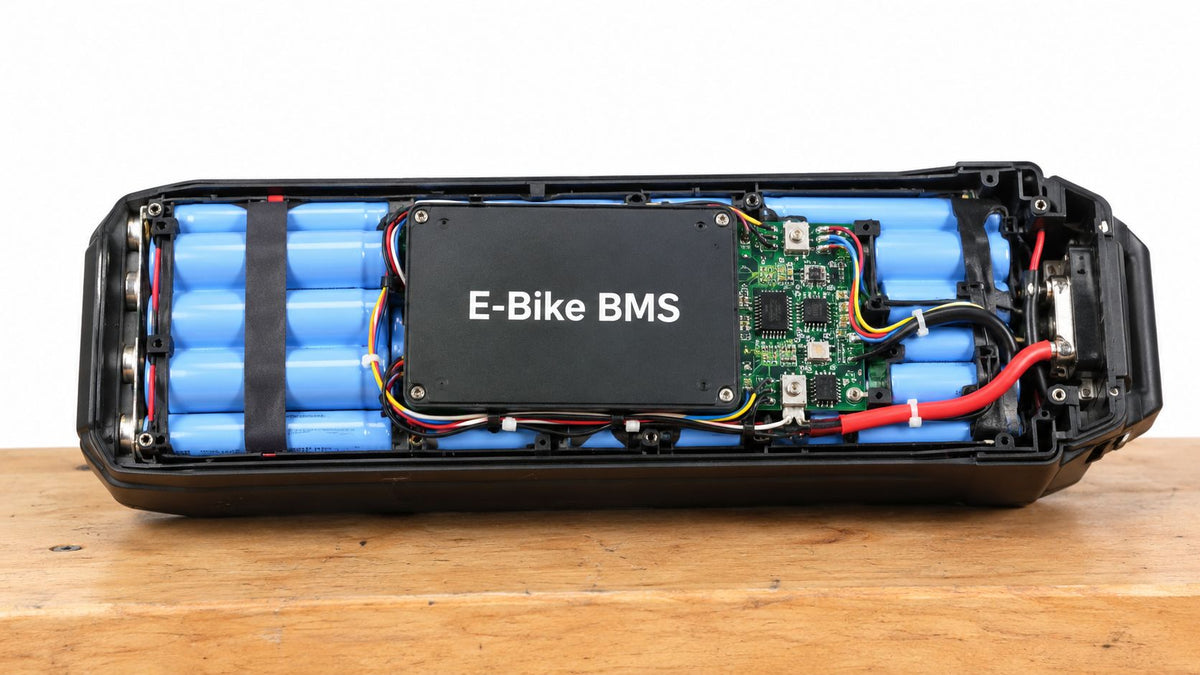
You leave your e-bike charging overnight, hurry out into a cold, wet morning, and pull away from the kerb before the traffic lights change. The battery case looks like a simple black box, but inside it a small circuit board is checking voltage, current, temperature, and the condition of individual cell groups. That board is the e-bike battery management system, usually shortened to BMS.
A BMS won't make a poor battery good, and it can't repair damaged cells. What it can do is disconnect, limit, balance, and report the battery before an electrical problem becomes a dead pack or a serious safety event. For commuters across the UK and EU, and for riders in the US and Australia dealing with different product standards and support networks, understanding that quiet guardian makes battery faults much easier to interpret.
Why Your E-Bike Battery Needs a Smart Guardian
On a cold morning, your e-bike may show a healthy charge, then cut out as you pull away. The battery case looks simple, but lithium-ion cells can react badly to charging, discharging, heat, and uneven ageing. The e-bike battery management system, or BMS, monitors those conditions and decides when the pack must limit or stop operation.
Lithium-ion cells make a removable down-tube battery practical for city riding because they store useful energy without the bulk of older chemistries. They are less forgiving, though. Charging beyond a cell's permitted voltage, riding the pack too low, or building heat on a long climb can cause damage. If one cell group ages faster, it may reach its cutoff during acceleration while the display still shows a reasonable percentage.
Mechanic's rule: A battery that suddenly looks dead may be protecting itself. Treat the shutdown as a warning, not proof that the pack is empty.
The BMS sits between the cells, charger, controller, and rider. It watches internal electrical conditions and can interrupt charging or discharging outside the permitted range. UK statutory guidance says an e-bike or conversion-kit lithium-ion battery must include safety mechanisms, such as a BMS or equivalent features, capable of preventing thermal runaway during normal use and reasonably foreseeable misuse during both charging and discharging. UK statutory e-bike battery safety guidance
That makes the BMS more than a label on a product page. Its settings affect whether cold-weather charging is allowed, how much power the bike can deliver, and how much of an ageing pack remains usable. A basic board may provide emergency cutoffs. A more capable design can also measure cell groups, balance their drift, estimate charge and health, and share information with a display or app.
Real use exposes differences that specifications can hide. A pack left unused for a long pause, charged with different habits, or ridden on a freezing morning may behave differently from one used regularly in mild weather. Riders in the UK, EU, US, and Australia should check that the BMS, charger, controller, and regional safety requirements match, rather than trusting a claimed capacity alone.
The market reflects the hardware's growing role. The electric two-wheeler BMS market was estimated at USD 2.24 billion in 2025 and projected to reach USD 3.70 billion by 2030, implying a 10.58% CAGR, according to electric two-wheeler BMS market analysis. E-mopeds and e-scooters represented 56.62% of revenue in 2024, while factory-fitted units held 81.29% share. An integrated, factory-matched BMS is more likely to communicate correctly with the charger, controller, display, and firmware.
What a Battery Management System Actually Does
A freezing morning commute can reveal more about a battery management system than a product page does. The BMS works like four workshop tools on one board: a referee for electrical limits, a thermostat for heat, a balancer for cell groups, and a fuel-gauge computer for the display.
Voltage protection comes first
A lithium-ion pack contains cells arranged in series and parallel groups. The BMS measures those groups and opens charging or discharge switches when a group crosses its programmed boundary. Many designs use an upper limit near 4.2 volts per cell and a lower limit near 2.7 volts per cell, although the exact settings depend on the cell chemistry and manufacturer. These reference limits appear in the 13-cell balancing study.
A full reading does not prove that every group is equally healthy. One group may reach its upper limit first during charging, or drop to its lower limit first while the motor is working hard on a hill.
Current protection controls demand
The BMS measures charge and discharge current as well. If a controller demands abnormal current, a motor stalls, or a wiring fault creates a short circuit, the board can disconnect the output. A steep start with cargo may cause a brief spike. A long climb can reveal a weak group that seemed normal on level roads.
The BMS limits the result of an electrical fault. It does not make an incorrectly matched controller, charger, or fuse safe.
Temperature changes the rules
Sensors placed near the cell groups tell the BMS when charging or riding should be reduced or stopped. Cold charging deserves particular attention because a pack can look normal outside while low-temperature charging harms its cells. The UK and international safety discussion around BMS regulation describes limits or interruptions for charging and discharging outside permissible temperature ranges, as outlined in this review of BMS regulations and safety frameworks.
That matters for riders across the UK, EU, US, and Australia. Before trusting a pack, check that its BMS, charger, controller, temperature limits, and regional safety requirements are intended to work together. Mixed charging habits, long storage pauses, and cold starts can expose differences that a claimed capacity does not show.
Balancing and estimation make the system smarter
Balancing corrects small voltage differences between cell groups. State of charge, or SOC, is the fuel-gauge estimate. State of health, or SOH, estimates how much capability the pack has lost. More capable systems combine voltage, current, and temperature readings with model-based estimation rather than relying on voltage alone. The effect of estimator choice in light electric vehicles is examined in this e-bike SOC and SOH design research.
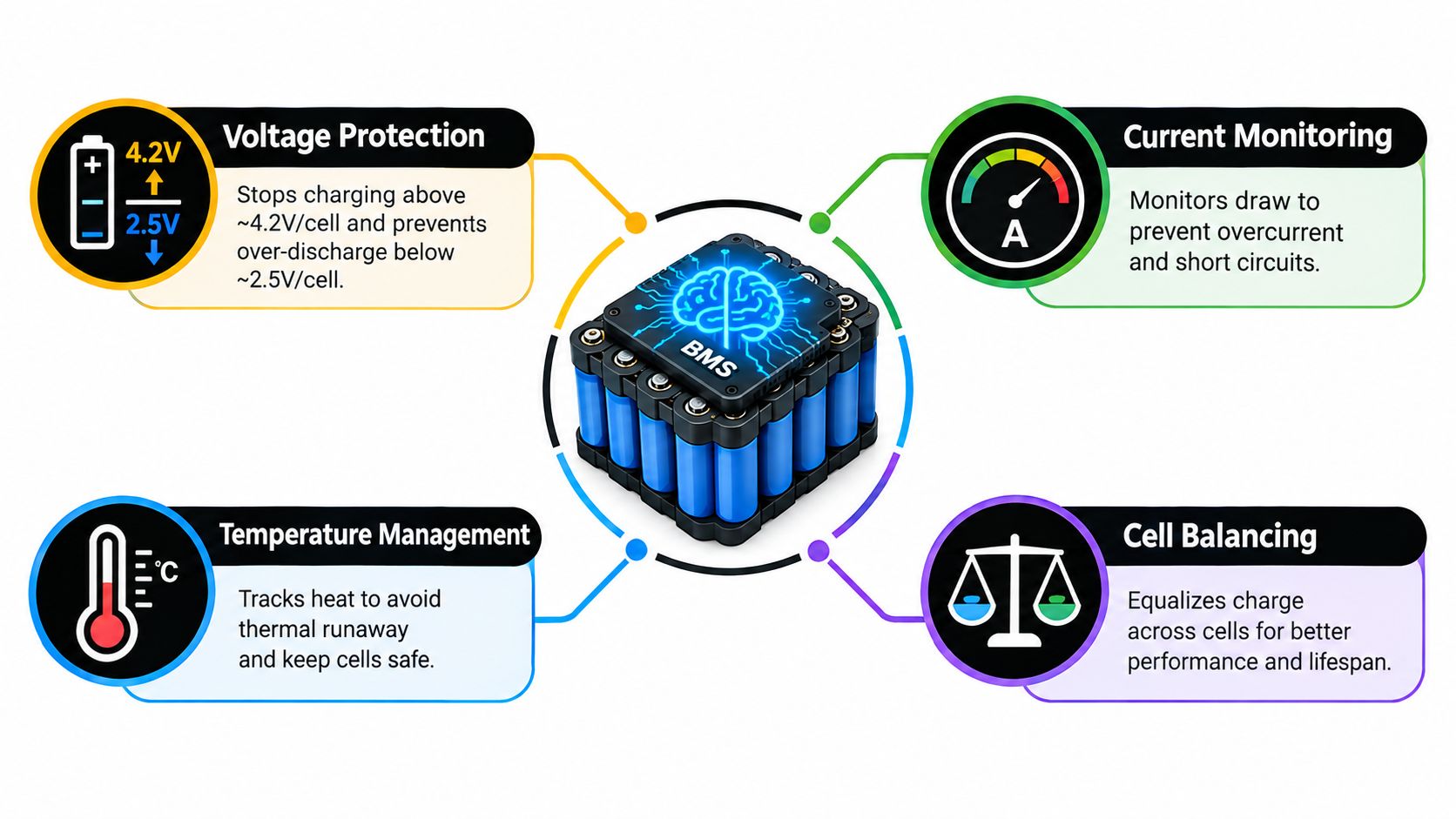
Finally, the BMS may communicate through UART, CAN bus, SMBus, or Bluetooth. The display or app can then receive charge estimates, error codes, temperature warnings, and service information. Good protection hardware still causes problems if its communication protocol does not match the bike's charger, controller, display, or firmware.
BMS Topologies and Types Worth Knowing
A BMS describes a job, not one fixed circuit. Designers choose its layout according to the battery's size, shape, service needs, and cost. For a commuter who rides through cold mornings, leaves the bike unused for weeks, or charges with different habits, the layout affects how easily the pack can be monitored and serviced.
A centralized BMS uses one PCB for every cell group. Its wiring is relatively simple, making it practical for compact urban packs. A modular, or master-slave, BMS divides monitoring among smaller boards, while a master board gathers their readings. A distributed BMS places electronics near separate cell groups and connects them through a communication bus. This can suit a long or irregularly shaped pack, but it introduces more communication points to check.
Balancing creates another design choice. Passive balancing bleeds a small amount of energy from fuller groups through resistors and releases it as heat. Active balancing transfers energy from a fuller group to a lower group with capacitors, inductors, or related circuits. It can waste less energy during balancing, but costs more and adds control hardware that must work reliably.
| Topology / Type | How It Works | Typical Pack Size | Best Fit |
|---|---|---|---|
| Centralized | One board monitors and protects all cell groups | Compact urban packs | Everyday e-bikes where space and cost matter |
| Modular | Slave boards monitor sections and report to a master | Larger or physically spread packs | Long-range scooters and frame-integrated packs |
| Distributed | Local electronics communicate across a bus | Complex, high-capacity designs | Systems needing flexible placement and detailed monitoring |
| Passive balancing | Resistors bleed excess energy as heat | Common commuter configurations | Simple, cost-conscious battery packs |
| Active balancing | Transfers energy between cell groups | Higher-capacity configurations | Packs where balancing efficiency justifies added complexity |
A small commuter battery does not automatically need active balancing. Matched cells, sensible current demand, and a correctly configured passive BMS may be enough for its intended use. A larger range-focused scooter may gain more from active balancing because small differences between groups matter more during longer, harder use.
Chemistry must match the design as well. NMC/NCM is widely used in urban electric mobility, but that does not make it a drop-in replacement for another chemistry. The charger's voltage profile, BMS thresholds, cell specifications, and temperature limits must all suit the cells inside the pack. A UK, EU, US, or Australian rider should verify those details rather than choosing a board from the battery label alone. The earlier Market chemistry and BMS data provides market context, not permission to change chemistry casually.
Specifications That Actually Matter When Choosing One
A BMS board can look impressive on a product page and still be wrong for a 48V or 52V commuter pack. Check the battery's series count, cell chemistry, controller demand, charger voltage, operating temperature, and communication requirements together. The board must suit the whole electrical system, not merely fit inside the enclosure.
Prioritise electrical headroom
Match the continuous discharge rating to the controller's expected draw, then allow for higher demand during starts, hills, heavy loads, and hot conditions. A rating that only matches the controller on paper leaves little margin for heat, cell ageing, or a motor working hard. Check the permitted charge current as well, since the BMS must manage the pack while the charger is connected.
Cell-count support matters just as much. E-bike packs may use configurations from 10S through 14S, depending on the design. A 36V, 48V, or 52V label does not identify the series count by itself. Confirm the number of series groups and the permitted full-charge voltage before connecting a replacement board.
Look closely at balancing and sensing
Balancing current indicates how strongly the board can correct differences between cell groups. Passive balancing around 60 to 100 mA is common in basic designs, while active systems may transfer 1 to 5 A. These figures come from the specification framework in the supplied technical brief, not a universal performance promise. A higher rating helps only when the cells, thermal design, wiring, and firmware are matched.
The 13-cell implementation in the e-bike BMS measurement study reported individual cell-voltage, current, and temperature measurement errors of 0.032 V, 0.04 A, and 1.21 °C, respectively. It also triggered undervoltage, overvoltage, overheat, and overcurrent protection. Use those results as a benchmark for measurement quality, not as a guarantee for every 13-cell board.
Cold mornings deserve attention here. Temperature sensing should reflect the cells, not merely the circuit board, because charging behaviour can become unsafe when the pack is too cold. Long pauses, mixed charging habits, and repeated high-current rides also make clear thresholds and predictable protection more useful than a long feature list.
Check the information layer
A practical buyer should ask:
- Sensors: How many temperature sensors are supplied, and are they placed near the cell groups or only on the PCB?
- Estimation: Does the firmware calculate SOC and SOH from current and voltage, or show a rough voltage-based gauge?
- Communication: Does it support the bike's UART, CAN, SMBus, or Bluetooth connection?
- Firmware: Can a technician update settings and firmware without replacing the board?
- Protection: Is the enclosure resistant to moisture and vibration, with suitable sealing or potting?
- Compliance: Can the supplier provide relevant testing and certification documents?
Regional labels need careful reading. For EU e-bikes, ask about EN 15194 compatibility. For North American products, ask about UL 2849 documentation. UN 38.3 concerns lithium-battery transport testing, so it should not be treated as complete vehicle safety certification. UK and Australian riders should also request the applicable local documentation rather than assuming an EU or US marking covers the complete bike.
| Specification | City Commuter, 10S to 13S, 10 to 15Ah | Weekend Tourer, 13S to 14S, 15 to 20Ah |
|---|---|---|
| Current rating | Match controller demand with sensible headroom | Allow for sustained climbs and heavier loads |
| Balancing | Reliable passive balancing may be sufficient | Active balancing can be useful in a demanding pack |
| Temperature sensing | Confirm sensor placement near cell groups | Prefer broader monitoring and clear derating behaviour |
| SOC and SOH | Accurate enough to avoid surprise cutoffs | Model-based estimates are more valuable over long rides |
| Communication | Display compatibility may be all you need | App, CAN, or service diagnostics can add value |
| Protection | Sealed case and secure connectors matter | Vibration, moisture, and service access deserve extra attention |
Before choosing a replacement or upgraded board, compare the battery specifications with practical guidance on how long e-bike batteries last. A larger nominal capacity cannot compensate for incorrect cutoff settings, unsuitable temperature limits, or a controller that regularly exceeds the BMS rating.
Installation and Compatibility Without the Headaches
Replacing a BMS inside an existing enclosure isn't a plug-and-play upgrade. The board must match the pack's series count, chemistry, voltage window, current requirements, sensor arrangement, charger, controller, and communication system. A connector that fits physically can still have a different pinout or polarity.
Start by identifying the pack configuration and labelling every connection before removal. Common external connector families include JST, XT60, and Anderson Powerpole, but the connector name alone doesn't tell you how the wires are assigned. Charge-port wiring, discharge wiring, the fuse, shunt, cell taps, and temperature sensors all need to return to the correct locations.
A careful fitting sequence
A qualified technician should check the pack's condition before opening it. If the casing is swollen, cracked, wet, unusually hot, or physically damaged, replacing the board isn't a sensible first step.
For a serviceable, healthy pack:
- Confirm the voltage window. The BMS, charger, and controller must agree about the pack's series count and charge limits.
- Map the wiring. Identify cell-group taps, positive and negative power paths, charge leads, sensor leads, and communication wires.
- Check the protection path. The fuse and current shunt must sit where the design expects them, with secure insulation and no accidental bypass.
- Route sensors properly. Place temperature sensors against representative cell areas, not loose in an air gap or pressed against a heat-generating component.
- Secure the board. Down-tube and rear-rack cases experience vibration, moisture, and movement. Use suitable insulation and strain relief.
- Test before sealing. Check polarity, charger behaviour, output, display communication, and fault reporting before closing the case.
Compatibility warning: Bosch, Shimano, Yamaha, and Bafang systems may expect proprietary firmware or communication behaviour. A generic BMS can produce error codes or fail to communicate even when its voltage rating appears correct.
UKCA and CE marks should be treated as part of the product documentation, not as decoration on a listing. The EU and UK market also needs careful attention to second-life battery requirements, including the developing EN 50604 series discussion. In the US, product teams should consider applicable CPSC expectations and obtain technical evidence rather than relying on a marketplace description.
Bluetooth modules need a clear radio path and secure mounting. Put one inside a heavily shielded metal enclosure and phone pairing may become unreliable. Before touching the battery, read guidance on electric bike chargers, then use only a charger approved for that exact pack.
Real-World Examples for Urban Riders
On a cold morning in Manchester, a commuter takes a 48V 14Ah pack from a shed at 2°C, connects a 2A charger, and expects to leave quickly. The charger light may remain green or the BMS may refuse to pass charging current until the cells move into their permitted charging temperature range. That's a protective response, not necessarily a failed charger.
Some premium systems may include controlled warming or can reduce permitted current, but riders shouldn't assume every battery has an internal heater. The safe response is to bring the pack indoors and let it warm gradually. Don't use a hair dryer, heat gun, radiator, or improvised external heater.
After the ride, the same battery may behave differently on an icy route. Regenerative braking, where fitted, pushes current back into the pack. The BMS can limit that charge current in cold conditions or when the battery is already near its upper limit. On the climb home, it may reduce available assist if temperature or current reaches a protection boundary.
A partial-charge weekend scooter
A Barcelona rider leaves an electric scooter at about 80% charge for ten days before a Saturday errand. A Melbourne rider may make the same choice during a pause between weekend rides. A BMS doesn't necessarily enter a special storage mode, balance continuously, or deliberately hold the battery at a preferred level. Those behaviours depend on the battery's firmware and the vehicle's charger and control system.
The useful rider habit is simpler. Avoid assuming that a dashboard percentage is a laboratory measurement, and check whether the manufacturer specifies a storage level or periodic inspection. The BMS may balance during charging, but it can't correct a damaged cell group or guarantee the same range after a long pause.
If the scooter cuts out below 20%, check the basics before booking a repair:
- Check the temperature: Let a cold pack warm naturally before charging.
- Check the connectors: Look for moisture, corrosion, bent pins, or a loose mount.
- Check the charger: A green light can mean full charge, no electrical connection, or disabled charging.
- Note the pattern: Record whether shutdown happens on hills, acceleration, or near the same displayed level.
- Stop for damage: Swelling, smoke, hissing, leaking, strong odour, or unusual heat means don't ride or charge.
A repeated cutoff under load often points toward cell imbalance, a weak group, excessive controller demand, or a wiring problem. The BMS is reporting a condition through its action, even when the display gives you little detail.
Maintenance Safety and Troubleshooting Essentials
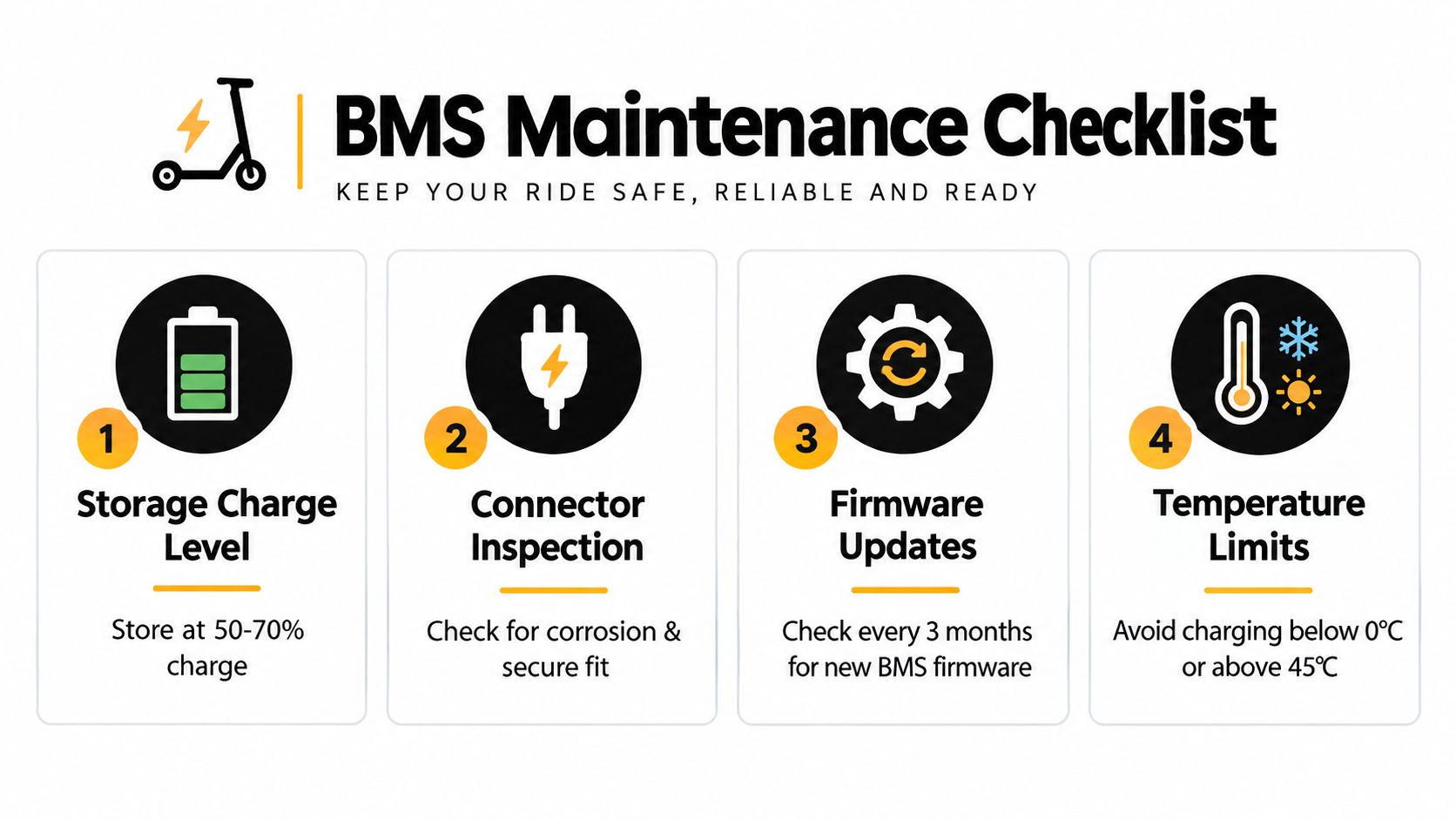
A BMS reduces risk, but it doesn't replace sensible charging and inspection. Once a month, look at the case, rails, terminals, charge port, and visible wiring. Before seasonal storage, clean and dry the outside, follow the manufacturer's storage-charge advice, and keep the pack indoors in a dry, ventilated location away from heat and combustible materials.
The checklist below uses the practical maintenance points supplied for this guide. Storage guidance varies by manufacturer, so the pack manual takes priority.
- Storage charge: Store around 50% to 70% when the manufacturer permits that range, rather than leaving the pack completely empty or permanently full.
- Connector inspection: Look for corrosion, heat marks, looseness, cracked plastic, or water around the charge port.
- Firmware review: Check the manufacturer's app or dealer service channel for BMS and system updates.
- Temperature awareness: Don't charge a pack below 0°C or above 45°C unless the manufacturer gives different approved limits.
- Charging location: Use the correct charger on a stable, non-flammable surface, and don't charge a suspect battery.
- Service records: Write down error codes, sudden range changes, and the conditions that trigger a cutoff.
Read the symptom before touching the pack
A sudden range drop can indicate ageing cells, imbalance, a loose connection, or a change in riding conditions. A charger that refuses to start may reflect cold temperature, a charging-path fault, an incorrect charger, a port problem, or a BMS protection state.
Blink codes are manufacturer-specific, so photograph the pattern and read the manual instead of guessing. Inconsistent cutoffs during acceleration or hills deserve a proper load test. A swollen pack, burned terminal, leaking case, smoke, hissing, or unusual heat means stop using it immediately and don't attempt a reset or force-charge.
For a broader safety reference, read how to prevent battery fires before setting up a charging area. The UK government also says damaged or end-of-life e-cycle lithium-ion batteries shouldn't go into household waste or normal recycling. UK battery safety guidance for e-cycle users points riders toward controlled disposal rather than ordinary bins.
Regional checks matter
In the UK and EU, look for relevant certification documentation, including EN 15194 where applicable, and keep insurance records accurate if your policy asks about modifications. In the US, ask about UL 2849 documentation and use an established battery recycling route. Australian riders should also check local council, dealer, and insurer requirements because disposal and product compliance arrangements can differ by state and territory.
Dealer take-back schemes, municipal collections, and established programmes such as Call2Recycle-style services may offer routes for intact end-of-life packs. A visibly damaged pack needs specialist instructions before transport. For storage-specific habits, use this guide on how to store lithium batteries safely.
Putting It All Together for Confident Riding
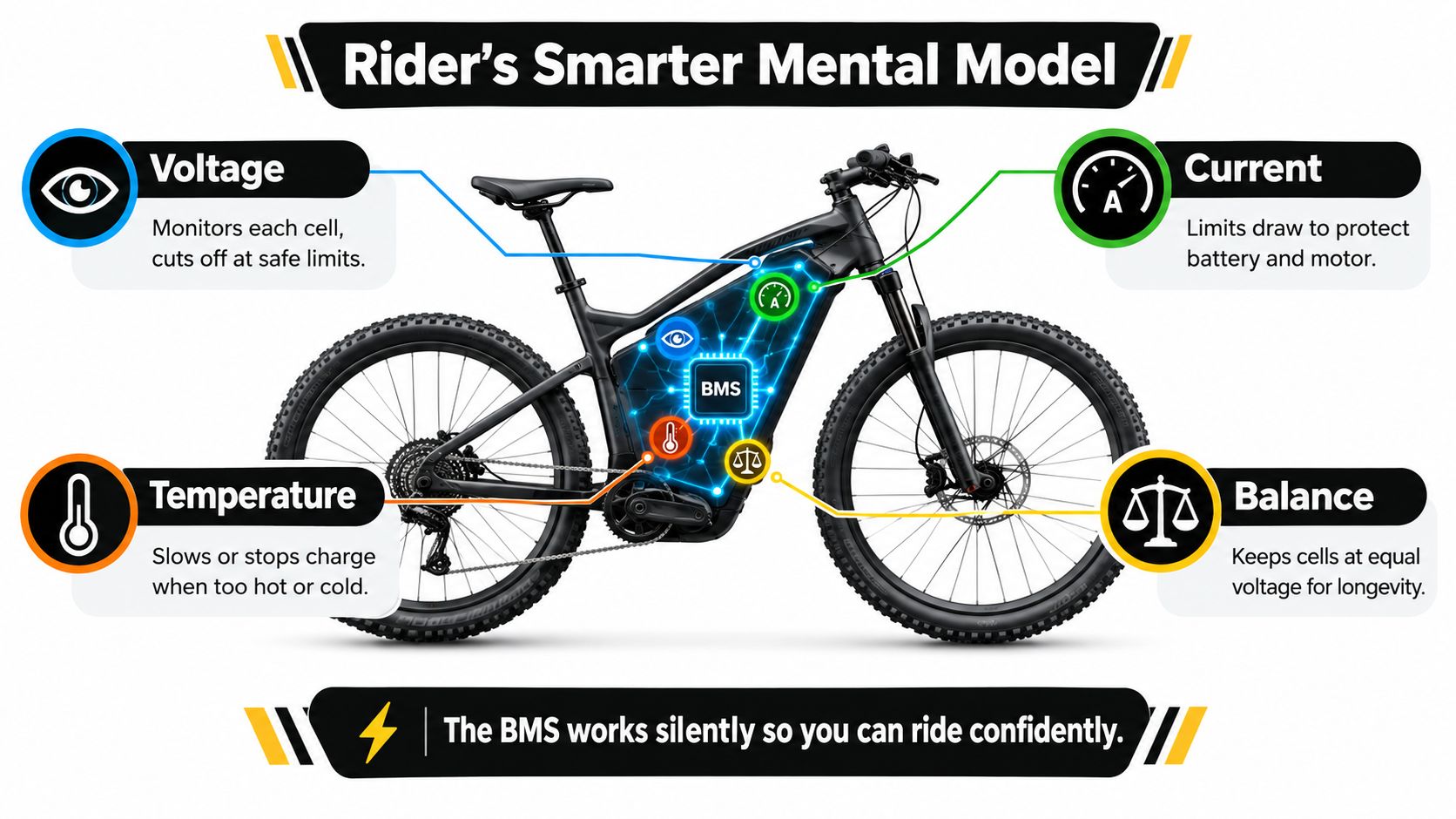
Your working mental model can stay simple. The BMS is a team of sensors, switches, balancing circuits, and software that watches voltage, current, and temperature so you don't have to monitor every cell while riding. It protects the pack by limiting or interrupting unsafe conditions, while its estimates help the bike predict usable energy.
A sensible buyer reads the complete specification before choosing a replacement board. Check cell count, chemistry, current rating, charger compatibility, sensor placement, communication protocol, balancing method, firmware support, and certification evidence. A low-cost board with the wrong firmware can create more trouble than an older but correctly matched factory system.
Three habits prevent many avoidable surprises:
- Read before buying. Compare the BMS with the controller, charger, display, and actual pack configuration.
- Log odd behaviour early. Note temperature, terrain, displayed charge, error codes, and whether the cutoff happens under load.
- Respect charging and storage. Use the approved charger, avoid extreme conditions, and don't leave a damaged pack in service.
Check for firmware updates through the manufacturer's app or dealer, register the battery for warranty support, and keep a basic riding log as the pack ages. A professional assessment every two to three years can help identify capacity loss, imbalance, connector damage, or communication faults before they interrupt a commute.
Bluetooth diagnostics and predictive maintenance are making BMS information more accessible, but an app reading can't override physical warning signs. If the case is swollen, hot, wet, or damaged, stop using it. As the battery grows older, expect range estimates and peak performance to become less consistent, and treat repeated protection cutoffs as a reason for diagnosis rather than a nuisance to bypass.
Punk Ride LLC offers electric bikes and scooters with documented battery specifications, including removable BMS-equipped options, alongside practical battery-care guidance for riders. Visit Punk Ride LLC to compare compatible electric rides and find support resources before choosing your next pack.
Share:
How to Buy Electric Bike