


Let's get one thing straight: a removable e-bike battery isn't just a feature, it's a total game-changer for how you'll use your bike every single day. Think of it less like a part of the bike and more like a massive, powerful phone charger you can pop off and take with you.
This single design choice unlocks a level of convenience and security that makes e-bike ownership practical for pretty much everyone, especially city dwellers.
The Ultimate Freedom of a Removable E-Bike Battery
When you're picking out an e-bike, you're not just thinking about speed or looks. You're really deciding how this new machine is going to fit into your life. The choice between a removable battery and one that's built into the frame is one of the biggest practical decisions you’ll make.
Picture this: you live in a fourth-floor walk-up in New York or a high-rise apartment in Sydney with no ground-floor storage. Are you really going to lug a heavy 25kg e-bike up all those stairs every night just to plug it in? Absolutely not.
That’s where the simple genius of an electric bike removable battery shines. You just lock your bike securely downstairs, pop the battery out, and carry that small, manageable part inside to charge overnight. Problem solved.
Why This Feature Matters More Than Ever
This flexibility is so much more than a nice-to-have perk. For millions of people, it’s the one thing that makes owning an e-bike possible. It knocks down two of the biggest barriers for would-be riders: finding a convenient place to charge and worrying about theft. When you take the most valuable component with you, your bike suddenly becomes a much less tempting target.
The market has caught on in a big way. The global electric bicycle batteries market is seeing some wild growth, projected to jump from USD 3.6 billion to a staggering USD 12.1 billion by 2034. This boom shows just how important removable batteries are, especially for brands like ISCOOTER and ENGWE, which have built their city commuter models around them. If you're curious, you can explore more data on this incredible growth trend and see how e-bikes are reshaping our cities.
So, let's break down what you really get with a removable battery:
- Unmatched Convenience: Charge it at your desk, in a coffee shop, or at home. No need to find an outlet near your bike.
- Smarter Security: By taking the battery with you, you're removing the heart—and most expensive part—of the e-bike.
- Longer Battery Life: Keeping your battery indoors protects it from extreme hot or cold weather, which is one of the best ways to extend its overall lifespan.
Whether you're in Australia or the US, getting to grips with what a removable battery offers is your first step toward finding an e-bike that actually fits your lifestyle.
So, How Do Removable E-Bike Batteries Actually Work?
What exactly is a removable e-bike battery, and why is it such a game-changer for so many riders? Let’s skip the dense technical manual and get straight to it. At its heart, it's a brilliantly simple idea that solves some very common, very real headaches.
Think of it like the battery in your laptop or an old-school phone, just super-sized to get you up that next hill. It's a self-contained power pack that clicks securely onto your bike's frame to drive the motor. When you need to take it off, you just use a key to unlock it and slide it out. This "lock and release" system is what makes it so incredibly useful.
This design lets you think about the bike and its power source as two separate things, and that completely opens up how you can live with an e-bike day-to-day. It’s less about fancy engineering and more about just plain smart, practical design.
The Power of Portability in Your Daily Grind
To really get a feel for this, picture a common scenario. Imagine someone living in a third-floor apartment in Melbourne or Chicago, with no elevator. Hauling a whole e-bike up several flights of stairs every night isn't just a pain—it's often a total non-starter.
With a removable battery, the whole process becomes a breeze. They can lock their bike up securely to a rack on the street, give a key a quick turn, and pop the battery off. All they have to carry upstairs is that one, relatively light component. The battery—the most valuable and vital part of the bike—gets to charge up safely inside their apartment, ready to go for the morning commute.
This simple act of separating the battery from the bike tackles two of the biggest barriers for city dwellers wanting to go electric: easy charging and theft. Without it, e-bikes would probably still be something only people with garages could own.
This everyday situation really shows why a removable battery isn't just a nice-to-have, but an absolute must for a huge number of riders. The convenience is the first thing you notice, but the benefits go way deeper, affecting everything from security to how long your bike's most expensive part will last.
The Big Wins of a Detachable System
This design isn't just about making life easier; it's about making e-bikes a genuinely practical and sustainable option for more people, especially those navigating busy American and Australian cities.
Here’s a quick rundown of the main perks:
- Charge It Literally Anywhere: You're no longer chained to finding a power outlet next to your bike. Charge it at your desk, in a café while you grab a coffee, or on your kitchen counter. It’s total freedom.
- A Massive Anti-Theft Move: An e-bike without a battery is a far less tempting prize for a thief. That battery can easily be worth over $500, so when you take it with you, you’re removing the most valuable part of the bike.
- Keeps Your Battery Healthy: Lithium-ion batteries are a bit like us—they don't like extreme hot or cold. By bringing your battery inside, you shield it from freezing winters and scorching summers, both of which can seriously shorten its life and reduce how far it can take you.
This is a world away from the alternative: the integrated battery. Sure, integrated batteries give a bike a sleek, clean look by hiding the power source inside the frame, but they trade away all of this everyday practicality. With an integrated setup, the entire bike has to go wherever the power outlet is, and that just doesn't work for a lot of people's living situations. For most riders, the practical upsides of an electric bike removable battery are just too good to pass up.
Removable Vs Integrated Batteries: Choosing Your Power Source
Alright, let's talk about one of the biggest decisions you'll make when buying an e-bike: removable versus integrated batteries. This isn't just a minor detail; it’s a choice that shapes your entire experience, from how you charge your bike to where you can safely leave it.
Think of it like choosing between a laptop and a desktop computer. One gives you incredible portability, while the other offers a seamless, all-in-one design. There's no single "best" answer, only what's best for you. Let's break down the real-world differences so you can figure out which one fits your life.
The Head-to-Head Breakdown
When it comes to e-bike batteries, what you gain in one area, you often trade off in another. An integrated battery might win on looks, but a removable one often wins on pure, day-to-day practicality.
To make this crystal clear, I've put together a side-by-side comparison. This table cuts through the marketing fluff and lays out the core differences that will actually matter to you as a rider.
Removable vs Integrated E-Bike Battery Comparison
Here’s a simple breakdown of the key features, pros, and cons of each battery type. This should help you quickly see which style aligns with your riding needs and lifestyle.
| Feature | Removable Battery | Integrated Battery |
|---|---|---|
| Charging Flexibility | Excellent. You can charge the battery anywhere—at your desk, in your apartment, or in a café. The bike can stay locked up outside. | Limited. You have to bring the entire bike to a power outlet, which is a real pain without a garage or ground-floor access. |
| Security | Superior. You can remove the most valuable part of the bike (often worth $500+) and take it with you. This makes the bike a much less tempting target for thieves. | Good. The battery is harder for a thief to snatch since it's built into the frame, but the whole bike is still a high-value item. |
| Replacement | Easier. When your battery eventually wears out, swapping it is usually a simple click-and-slide job you can do yourself in seconds. | Complex & Costly. Replacement is a job for a specialist. It’s often much more expensive because of the custom design and labor involved. |
| Handling & Balance | Variable. The battery's placement can sometimes create a higher center of gravity, which might slightly affect how the bike feels on tight turns. | Often Better. The battery weight is usually positioned low and central in the frame, which generally improves balance and gives a more natural ride feel. |
| Aesthetics | Functional. The battery is clearly visible on the frame. It has a more utilitarian, "this-is-an-e-bike" look. | Sleek. Hiding the battery inside the frame creates a clean, streamlined look that many people love. It's often hard to tell it's an e-bike at first glance. |
As you can see, there’s a clear give-and-take. Brands like DUOTTS often focus on rugged, practical models with removable batteries, while others chase that super-clean aesthetic you get with an integrated system. Neither is wrong, they just serve different riders.
Practicality Versus Polish
At its core, this choice boils down to a classic dilemma: everyday convenience versus sleek design. An integrated battery makes an e-bike look incredible, almost exactly like a regular acoustic bike. The lines are clean, the tech is hidden—it’s just plain beautiful.
But that beauty comes with a practical price.
If you live in a third-floor apartment in a city in the US or Australia, the idea of hauling your entire bike inside every night just to charge it is a non-starter. This is where the electric bike removable battery isn't just a feature; it's a lifesaver.
For most city-dwellers and commuters, the ability to lock the bike up downstairs and carry just the battery inside is the single most important feature. It turns owning an e-bike from a logistical headache into a seamless part of your daily routine.
This simple flowchart really sums up the key decision point for most riders.
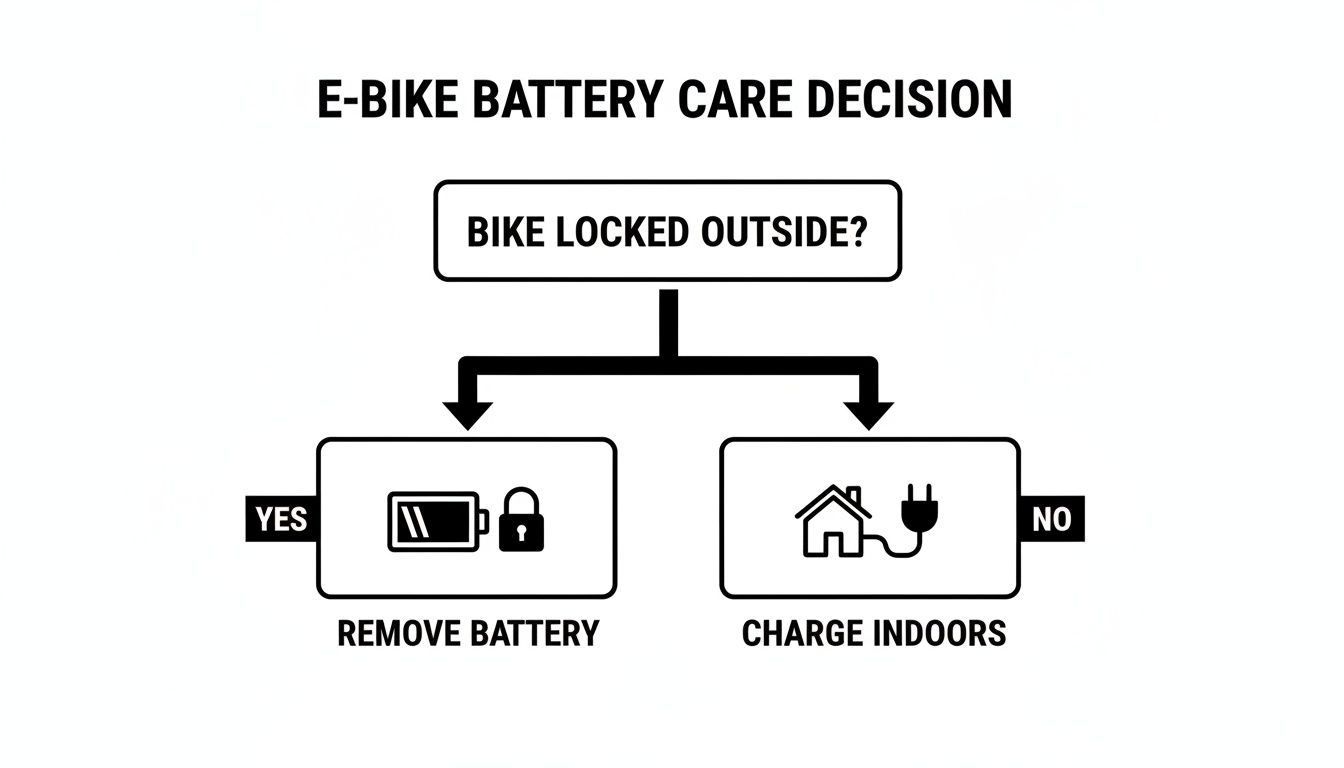
It perfectly captures that central conflict: where you park and how you charge will almost always point you to the right battery type.
Making the Right Choice for Your Ride
So, how do you decide? Just be honest about how you'll use the bike. Ask yourself these final questions:
- Where will you park and charge? Got a secure garage with a power outlet? An integrated battery could be a fantastic, hassle-free choice. Parking on the street or in a communal bike room? A removable battery is pretty much a must-have.
- How important is security? If you live or work in a high-theft area, popping the battery out is your single best defense. A bike with no battery is a powerful signal to thieves to just keep walking.
- What’s your budget for future maintenance? Removable batteries are generally much easier and cheaper to replace down the line. An integrated battery replacement can be a surprisingly big and complicated bill.
By thinking through these real-world scenarios, you can confidently pick an e-bike—whether it's from a brand like CYSUM or any other—that has the right power system to actually work for your life.
Best Practices for Charging and Battery Care
Your electric bike removable battery is the heart of your ride, and treating it right is the single best way to protect your investment. Think of it less like some mysterious black box and more like the battery in your laptop or phone—a little smart handling goes a long way.
Getting into good habits from day one will maximize its lifespan, keep you riding safely, and ensure it delivers reliable power for years to come. This isn't about complicated technical maintenance, just simple, repeatable steps anyone can follow.
The Golden Rules of Safe Charging
Safety always comes first. Lithium-ion batteries pack a serious punch, and while they're incredibly efficient, they demand respect. Following a few non-negotiable rules is key to preventing accidents and protecting both your battery and your home.
Here are the essential checks to run through every single time you plug in:
- Use the Original Charger: Stick with the charger that came with your e-bike, period. It’s specifically designed to talk to your battery's management system. Using a knock-off or a charger from another device is a huge gamble that can lead to overheating, overcharging, and serious damage. We dive deeper into this in our guide on electric bike chargers.
- Charge on a Hard, Flat Surface: Never, ever charge your battery on a flammable surface like a sofa, bed, or carpet. Find a hard, non-flammable spot like a concrete garage floor or a tiled kitchen floor. This simple step minimizes risk in the unlikely event that something overheats.
- Don't Leave It Unattended: Ideally, you should be home and awake while the battery is charging. Try to avoid plugging it in overnight while you sleep or right before you leave the house for hours. This way, you can unplug it as soon as it’s full and keep an eye on things.
These habits are your first line of defense. Make them second nature.
Boosting Longevity with Smart Habits
Beyond just being safe, how you charge and store your battery directly impacts how long it will last. A well-cared-for battery can give you 800-1,200 charge cycles, which for most commuters in the US and Australia translates to a solid three to five years of regular use.
Want to hit that upper range? Adopt these pro-level care tips:
- Avoid Extreme Temperatures: Lithium-ion cells absolutely hate extreme heat and cold. Never leave your battery cooking in a hot car during an Australian summer or shivering in a freezing garage during a northern US winter. When you're not riding, bring it inside and store it at a comfortable room temperature.
- Don't Drain it to Zero: Try to avoid running your battery completely dead on a regular basis. Deep discharges put a lot of stress on the cells. It’s much healthier to top it up after each ride, even if you only used a little bit of power.
- The 40-80% Storage Rule: If you know you won't be using your bike for a few weeks or more, don't leave the battery fully charged or totally empty. The sweet spot for long-term storage is somewhere between a 40% and 80% charge. This neutral state is like putting the battery into a relaxed hibernation mode, reducing stress on its internal components.
Your battery has a secret weapon: its internal Battery Management System (BMS). Think of the BMS as a tiny, dedicated bodyguard living inside the battery pack. It’s constantly monitoring cell voltage, temperature, and current to prevent nasty stuff like overcharging, overheating, and short-circuiting. It’s a huge layer of built-in protection.
Modern battery innovation is what makes today’s e-bikes so great. Lithium-ion tech is king, thanks to its high energy density, lighter weight (often 20-40% less than older types), and long lifespans of over 1,000 cycles. This is what makes removable packs on high-performance rides from brands like MOTORAD and EVERCROSS possible.
The North American e-bike market, for example, is experiencing explosive growth, projected to surpass USD 2.6 billion by 2028, largely driven by these battery advancements and a consumer shift towards more practical urban transport.
Understanding proper storage is a game-changer for battery health. Getting familiar with concepts like LiPo Battery Storage Voltage can really help you get the most out of your battery. By embracing these simple charging and care habits, you're not just maintaining equipment—you're making sure your e-bike is always ready for the next adventure.
Finding the Right Replacement Battery
Sooner or later, every e-bike battery runs out of juice—for good. Even with the best care, they all have a limited lifespan. When you start noticing your ride isn’t what it used to be, you’ll inevitably face the big question: what now? It's a normal part of owning an e-bike, and luckily, finding a replacement for your electric bike removable battery is pretty simple once you know the rules of the game.
The first thing to get straight is that e-bike batteries are definitely not one-size-fits-all. It’s like trying to use your car key to open your front door; it just won’t work. Your bike's motor, controller, and display are all part of a finely tuned system designed for one specific battery. Getting the right match is absolutely critical for performance and, more importantly, for safety.
Matching the Key Specifications
When shopping for a replacement, you can't just eyeball it and pick one that looks about right. You have to play matchmaker and find a new battery with the exact same technical DNA as your old one. A mismatch isn’t just a minor hassle—it can fry your motor or create a dangerous situation.
Pay close attention to these three specs:
- Voltage (V): This is the golden rule. The voltage of your new battery must be identical to the original. If your bike has a 36V system, you need a 36V battery. A 48V system needs a 48V battery. No exceptions. Using the wrong voltage is a surefire way to cause serious damage.
- Amp-hours (Ah): This number dictates how far you can go on a single charge. You can sometimes upgrade to a battery with a higher Ah rating to get more range, but check with your e-bike’s manufacturer first. They’ll tell you if the bike’s frame and electrical system can safely handle a potentially larger and heavier battery.
- Physical Connector: The plug that connects the battery to your bike needs to be an exact match. There are dozens of connector types out there, so take a close look at yours and make sure the new one is identical.
Knowing When It's Time for a Change
A good quality lithium-ion battery will typically give you between 800 and 1,200 full charge cycles. For someone who rides daily, that usually works out to about three to five years of reliable service. You can dive deeper into this topic in our guide on how long e-bike batteries last.
But stats don't tell the whole story. The most obvious sign your battery is on its way out is a significant drop in range. If you used to finish your commute with half a charge to spare and now you’re coasting home on fumes, that’s your battery telling you it’s time. It won't just stop working overnight; it's more of a slow fade.
When you buy a new battery, stick with official replacements from your bike's brand or a certified battery from a well-known, reputable seller. Cheap, uncertified batteries from sketchy online marketplaces are the leading cause of e-bike fires because they often skip essential safety features. It's just not a risk worth taking.
Once you’ve got your new battery installed, you need to dispose of the old one responsibly. These things are packed with heavy metals and complex electronics, so they can’t just be tossed in the trash. Learning about the benefits of e-waste recycling helps you see why it's so important for the environment. Look for a local recycling center or a bike shop that accepts old batteries to make sure it's handled properly.
How Swappable Batteries Are Powering a Transportation Shift

The incredible convenience of an electric bike removable battery goes way beyond personal use. This simple concept is actually the engine driving the entire shared mobility industry, keeping cities from Los Angeles to Melbourne moving around the clock.
Ever wonder how those fleets of e-bikes from companies like Lime, Bird, or Jump are always charged and ready to go? They don't drag thousands of bikes back to a warehouse every night—that would be a logistical nightmare.
The secret is a system built completely around swappable batteries.
The Magic of the "Hot-Swap"
The whole operation is brilliantly simple and effective. Fleets of gig workers, often called "juicers," cruise the city and pinpoint bikes with low battery levels. They just unlock the drained battery, pop in a fresh one, and are on their way.
The entire exchange takes less than a minute.
This "hot-swapping" model is what makes large-scale e-bike sharing possible. It keeps each bike on the street and available for riders as much as possible, which means you can almost always find a charged bike when you need one.
This on-the-spot battery exchange is what transforms a simple bike rental into a reliable and scalable piece of public transport infrastructure. It’s a core component of modern urban mobility, making cities greener and more accessible.
The removable battery has truly sparked a shared mobility boom, with e-bike programs popping up all over the globe. This trend is fueling a massive demand for durable, high-capacity swappable packs, a market expected to grow from USD 18.90 billion to an incredible USD 55.04 billion by 2034.
In major cities from New York to Sydney, services like Lime often use rear-carrier mounted removable batteries. These have a huge market share because they provide great weight distribution for the kinds of e-bikes used for commuting. For a deeper dive, you can explore more about the E-Bike Battery Packs Market Report to see just how fast this sector is growing.
A Greener Vision for Getting Around the City
This efficiency is about more than just keeping the business running; it's about building a more sustainable way to live. By keeping fleets active on the street, companies cut down on the number of service vans needed to haul bikes around, reducing both emissions and operating costs.
It’s what makes e-bike sharing a genuinely green alternative to jumping in a car.
The swappable battery model is a perfect example of how smart design can solve complex city problems. It’s what allows these services to be a reliable, on-demand part of our transportation network, changing how we navigate our cities one ride at a time.
Got Questions About Your E-Bike Battery? We've Got Answers.
We've gone through a ton of info, but you might still have a few questions bouncing around. Let's tackle some of the most common things riders ask about their electric bike removable battery. Think of this as the final, no-nonsense cheat sheet.
Can I Just Slap on a Bigger Battery for More Range?
It's a great thought—just pop on a bigger battery and ride forever, right? But it's not quite that simple. While it's sometimes possible, you have to be incredibly careful about what you choose. The new battery absolutely must have the identical voltage and the same physical connectors as the one that came with your bike.
You can often find a battery with more Amp-hours (Ah) to extend your range, but you really need to talk to your e-bike's manufacturer or a pro bike shop first. Mismatching a battery can fry your motor, cook the controller, or even worse, become a major safety hazard.
How Much Is a New E-Bike Battery Going to Cost Me?
Let's be real: replacing your battery is the single biggest expense you'll have as an e-bike owner. In the US and Australia, a good-quality replacement lithium-ion battery will typically run you somewhere between $400 and $1,000. The final price tag depends on the brand, its capacity (the Ah number), and the tech packed inside.
It feels like a big chunk of change, but remember, the battery is the heart of your bike. Paying for a certified battery from a brand you trust means you get better performance, a longer life, and crucial safety features that those cheap, no-name batteries always leave out.
Is It Safe to Lock My E-Bike Outside Without the Battery?
Absolutely, and it's one of the smartest security moves you can make! The battery is easily the most expensive and tempting part of your e-bike for a thief. When you take it with you, the bike becomes a far less appealing target. Just don't forget to still lock the frame up tight with a solid D-lock or chain.
How Long Until I Have to Replace My Removable Battery?
A well-made lithium-ion e-bike battery should give you 800 to 1,200 full charge cycles. That number might sound a bit abstract, but for someone who commutes regularly, it translates to roughly 3 to 5 years of solid, everyday performance.
And you can definitely stretch that lifespan by following the good habits we talked about earlier. Little things, like not letting it drain to zero all the time and keeping it out of extreme hot or cold, will help you get every last mile out of your investment.
Ready to feel the freedom that only an e-bike can offer? At Punk Ride LLC, we've got an awesome lineup of electric bikes from top brands like ENGWE, DUOTTS, and HITWAY, all built for the city grind.
Share:
Your Guide to Electric Scooter Top Speed
Your Guide to the Electric Bicycle 500w