


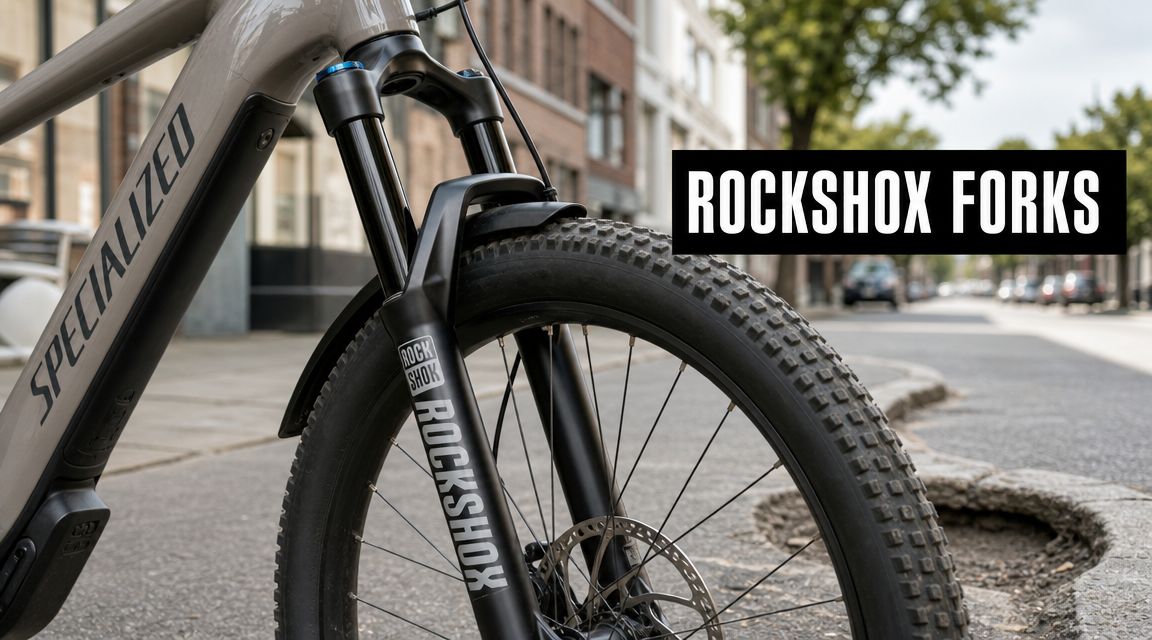
You roll off the kerb, cross a patched bit of tarmac, and hit a pothole you never saw. The bars kick upward. Your wrists sting. The front wheel chatters for a second, and if you're carrying a bag, child seat, or shopping on the bike, the whole front end can feel unsettled.
That moment is why riders start paying attention to forks.
A lot of people think suspension talk is only for mountain bikers arguing over trail settings. It isn't. If you ride an e-bike through town, over broken roads, drain covers, speed bumps, brick paths, and curb ramps, your front fork affects comfort, steering, braking feel, and how confident you are when the street gets rough. That matters in busy UK and EU city riding, and it matters just as much in car-heavy US and Australian streets where rough pavement and bigger impacts are common.
That Jarring Feeling Why Your Fork Matters
An e-bike can hide bad roads right up until it can't. The motor helps you hold speed, so you arrive at bumps faster than you might on a regular bike. Then the front fork has to deal with the hit.

Think of the fork like the front suspension on a car. Its job isn't just to make the ride softer. It helps keep the tyre in contact with the ground, stops the bike from feeling skittish on rough surfaces, and controls how the front end behaves when you brake hard or turn over uneven ground.
What a fork is really doing
A fork handles three jobs at once:
- Absorbing impacts: It takes the sting out of potholes, curb drops, and broken pavement.
- Controlling motion: It stops the front end from bouncing back like a pogo stick after a hit.
- Supporting the bike: It holds up a heavier e-bike and rider while staying predictable.
That last part gets overlooked. On an e-bike, the fork isn't only cushioning bumps. It's supporting extra mass from the bike itself, plus whatever you've added to it.
A fork that feels fine on a lighter bike can feel vague, harsh, or overwhelmed once you add motor weight, battery weight, and everyday cargo.
Why new e-bike owners get confused
Most fork guides talk like everyone rides steep natural trails. Urban riders have different problems. You're more likely to deal with potholes, curb transitions, tram lines, speed humps, wet streets, and loaded front racks than repeated downhill rock gardens.
That's why RockShox ebike forks are worth understanding in plain language. You don't need to become a suspension engineer. You just need to know what the fork is trying to do, what the key models are, and which adjustments change how your bike feels on the street.
Why Your eBike Needs a Specific Fork
A regular bike fork and an e-bike fork do the same basic job. They're not dealing with the same workload.

Think about a small hatchback versus a loaded van. Both use suspension. The van's suspension has to cope with more weight, more momentum, and bigger forces when braking or turning. An e-bike fork faces the same kind of challenge compared with a lighter non-electric bike.
More weight changes everything
Your e-bike usually carries more system weight before you even get on it. Add a rider, maybe a backpack or panniers, and the fork sees higher front-end loads than many standard bikes do.
That affects the ride in obvious ways:
- Under braking: The fork dives more if it isn't supported well.
- In corners: The front wheel can feel less precise if the chassis flexes.
- Over repeated impacts: The fork has to recover and stay controlled, not get overwhelmed.
RockShox's modern lineup is built around models such as SID, Pike, Lyrik, and Zeb, each aimed at different stiffness and travel needs, as outlined in The Pro's Closet RockShox fork buyer's guide. That matters because heavier e-bikes need a platform that scales from lighter-duty riding to hard-use applications, not a one-size-fits-all fork.
Stiffness is not a buzzword
When mechanics talk about chassis stiffness, they mean how well the fork resists twisting and deflection. On the road, that shows up as steering that feels more planted and braking that feels less vague.
If a fork is too light-duty for the bike, riders often notice things like:
- Brake rub after hits or hard turns
- A wandering front wheel line
- A vague feeling at the handlebar
- Extra movement when the bike is loaded
This doesn't mean every commuter needs a huge long-travel enduro fork. It means the fork has to match the bike's weight, speed, and use.
Why urban riders should care
A city rider might not be dropping into steep descents, but they often hit sharp-edged impacts that are brutal in a different way. Potholes, curb lips, and rough paving send short, hard shocks through the fork. If you ride daily, those hits add up.
Practical rule: The right fork for an e-bike isn't just about comfort. It's about keeping the front tyre calm and predictable when the bike is heavier and moving faster than a typical pedal bike.
That's also why mountain bike language can be misleading for commuter riders. A trail fork may be described around descending performance, but what you might feel first is improved control in traffic, more stable braking, and less hand fatigue on broken roads.
Decoding RockShox eBike Fork Models and Tech
RockShox model names can feel like bike-shop shorthand. A simpler way to read them is to sort each fork by the job it is built to do.
For an urban or commuter e-bike rider, that job is often different from what mountain bike marketing talks about. You may care less about downhill race speed and more about how the fork handles potholes, curb drops, wet braking, a front rack, or the extra mass of groceries and a battery. The model name matters because it gives you a clue about chassis size, travel range, and how much adjustment you are getting.
The main families
RockShox forks roughly step up in size and intent as you move from the 35 to Pike, then Lyrik, then ZEB. The easiest way to picture it is like car suspension. A small hatchback, an SUV, and a heavy van all use the same basic idea, but the parts are sized for different loads and road abuse.
| Model | Best For | Travel Range | Key Tech |
|---|---|---|---|
| 35 Gold RL E-MTB | Demanding commuting, rough mixed-use riding, heavier everyday e-bikes | Longer-travel versions are common on some e-MTB and crossover builds | Air spring, Motion Control damping |
| Pike | Lighter trail e-bikes, fast mixed terrain, riders who want a lively feel | Short- to mid-travel trail range | Lighter, more responsive chassis feel, higher-end damper options in newer versions |
| Lyrik | Harder trail riding, loaded adventure use, riders who want more support at the front | Mid- to longer-travel range | Stouter chassis with more support for repeated bigger hits |
| ZEB | Very heavy builds, aggressive e-MTB use, riders who want maximum front-end precision | Long-travel enduro range | Bigger chassis and premium damper options |
How to think about each model
The 35 Gold RL E-MTB makes sense for riders who want a fork that is easier to understand and easier on the budget. It is often the practical choice on bikes that see rough streets, canal paths, broken pavement, and the occasional curb. If your e-bike is used every day and sometimes carries extra weight, this kind of fork can be a better match than a lighter trail fork chosen only for low grams.
The Pike is the quick-handling option in the family. It suits riders who want a more responsive front end and do not need the extra bulk of the bigger chassis forks. On a lighter e-bike or a fast fitness-oriented commuter that also sees gravel and towpaths, that can feel more natural.
The Lyrik sits in the middle. Many riders land here because it balances steering accuracy, bump control, and a more substantial chassis without going all the way to full enduro hardware. If your rides mix city streets with rougher off-road sections, or you regularly carry bags and still want the front wheel to stay calm under braking, Lyrik starts to make a lot of sense.
The ZEB is the big unit in the lineup. It is built for riders who put huge loads through the fork, whether that comes from aggressive descending or from a very heavy e-bike ridden hard on rough ground. If you want to see what that top end looks like in practice, this Rockshox Zeb Ultimate fork is a useful example.
The two parts that shape fork feel
Two terms show up on RockShox spec sheets again and again. Damper and air spring.
The air spring holds the bike up, like the main spring in a car suspension. Add more air pressure and the fork rides higher and resists diving more. Reduce pressure and it feels softer, but too little can make the front end sink too easily when you brake hard or hit a square-edged pothole.
The damper controls the speed of that movement. It works like the shock absorber on a car. Without enough damping, the fork can bounce back too quickly and feel nervous. With better damping, the wheel tracks the ground more calmly and the handlebar feels less busy over repeated hits.
That matters for commuters more than many guides admit. A fork that feels controlled over patched asphalt and drain covers can reduce hand fatigue and make panic braking feel more settled, especially on heavier bikes. If you are also improving stopping power, this guide to e-bike hydraulic brakes helps explain why fork control and brake performance work together.
What labels on a spec sheet really mean
A RockShox spec sheet throws out a lot of names, but a few labels do most of the work.
- Model family: 35, Pike, Lyrik, or ZEB tells you the fork's general size and intended use.
- Damper name: This hints at ride feel and how much adjustment you get.
- Air spring: This tells you the fork uses adjustable air pressure rather than a fixed coil spring.
- E-MTB label: This usually signals a build intended for the higher loads and braking forces common on e-bikes.
The useful question is simple. Does this fork match how your bike is used?
For a city rider, “best” does not always mean the most expensive trail fork. The better choice is often the one with the right chassis, enough support for extra bike weight, and damping that keeps the front wheel composed on rough streets instead of turning every pothole into a jolt through your hands.
Essential Specs You Actually Need to Understand
You roll off a curb with a bag of groceries on the rear rack, hit a patched section of pavement, and the front of the bike feels either calm or awkward. A lot of that comes down to three fork specs that shape how the bike sits, steers, and fits your wheel. For everyday e-bike use, the ones to focus on are travel, axle standard, and offset.

A spec sheet can make these sound abstract. They are not. They affect how your bike handles potholes, front-end dive under braking, and whether a fork upgrade even fits in the first place.
Travel is how much the fork can move
Travel is the amount of suspension movement the fork has available when it compresses. It works like suspension travel in a car. More movement can absorb a bigger hit, but it also changes ride height and how the vehicle responds.
On an e-bike, that matters because the bike is already heavier, and many commuter riders also add cargo, a child seat, or a basket. Too little travel can feel harsh on broken pavement. Too much can lift the front end, slow the steering, and leave the bike feeling a bit tall for stop-start city riding.
A simple way to read it:
- Less travel: lower front end, quicker steering, firmer feel on rough surfaces
- More travel: more room to absorb bigger hits, more comfort margin, slower steering if you go too far
For urban and utility riding, the goal is balance. You want enough travel to blunt potholes, curb cuts, and expansion joints without changing the bike's geometry so much that it feels awkward in traffic or while carrying load.
Axle standard tells you whether the front end will fit and feel solid
This is the spec that saves a lot of frustration at the workshop bench.
Many modern RockShox e-bike forks use a 15x110 mm Boost thru-axle. That tells you the axle diameter and hub spacing the fork is built around. If your current front wheel uses a different standard, the fork and wheel may not work together.
The axle and chassis also affect steering precision. A thru-axle front end resists twisting better than older quick-release setups, which helps on heavy e-bikes under braking and through rough corners. If you ride streets with potholes, tram tracks, or broken edges near drains, that extra stiffness can make the front wheel feel more planted instead of vague.
Before you get distracted by damper names or fancy coatings, check fit first. Wheel size, hub spacing, brake mount, and axle standard need to match.
Offset changes how quickly the bike wants to turn
Offset is the distance the front axle sits ahead of the steering axis. It sounds minor. On the road, it changes the bike's personality.
A useful way to understand it is to picture the front wheel as the shopping cart wheel you are trying to keep pointed straight. Offset affects how the wheel centers itself and how quickly the bike responds when you turn the bar. Small differences can make one fork feel calm and steady, while another feels quicker at low speed.
For commuter and urban riders, this matters in a different way than it does for trail riders. You may spend more time threading through bollards, turning across traffic, riding one-handed to signal, or balancing a loaded bike at slow speed. A very stability-focused setup can feel sluggish there. A quicker-steering setup can feel easier in tight spaces, but less settled on fast descents or rough surfaces.
Three practical questions to ask when reading specs
- Will this travel suit the frame and how I ride? A city e-bike used on roads, paths, curbs, and rough pavement usually benefits more from sensible travel than maximum travel.
-
Will my wheel and brake setup fit this fork?
Check wheel size, hub spacing, axle type, and brake mount before anything else. -
Do I want calmer steering or quicker steering?
Daily route, cargo weight, and riding speed all matter here. A fork that feels great on an e-MTB can feel slower than ideal on a commuter that spends its life in tight urban spaces.
Tuning Your Fork for the Urban Jungle
The biggest mistake riders make is treating suspension setup like a mountain bike ritual that doesn't apply to commuting. It absolutely applies. It just needs different priorities.
Urban tuning is less about smashing repeated trail hits and more about balancing comfort, braking support, and efficiency. You want the fork active enough to take the edge off potholes, but not so soft that it wallows every time you pedal, brake, or shift your weight.
Start with sag, but think about real use
Sag is how much the fork compresses under your normal riding weight. Normal means you, your usual clothes, and the gear you carry.
With e-bike-specific forks such as the RockShox 35 Gold RL E-MTB, the air spring and damping adjustments are there to manage extra mass. Trek's listing for that model highlights the role of air-spring and damping adjustments, noting that a firmer mid-stroke and controlled rebound help reduce brake dive and maintain traction, while low-speed compression settings improve efficiency on climbs and pavement in the RockShox 35 Gold RL E-MTB product page.
For city riding, don't chase the softest setup. If the fork sinks too easily, the bike will pitch forward when braking and feel vague when loaded.
A good practical method:
- Put on your usual gear: Backpack, lock, work bag, whatever you normally carry.
- Set pressure for support first: The fork should move into its travel when you get on, but it shouldn't feel like it collapses.
- Test a real obstacle: A curb cut, broken tarmac seam, or speed hump tells you more than bouncing in the driveway.
Rebound is the anti-pogo control
Rebound controls how fast the fork returns after compressing.
Too fast, and the front end pops back and feels springy. Too slow, and the fork can stay packed down after repeated hits, leaving it harsh and low in its travel.
For urban riding, aim for a fork that returns calmly after one impact without kicking the bar upward. Ride over a familiar bump at your normal speed. If the fork feels like it punches back, slow rebound a little. If it feels dead and reluctant to recover, speed it up a little.
A commuter fork should feel settled, not sleepy. You want one clean recovery after a hit, not bounce and not drag.
Compression is your pavement lever
Compression damping affects how easily the fork compresses. On many commuter and mixed-use e-bikes, this adjustment is where comfort and efficiency meet.
Use it to shape the bike for how you ride:
- More open: Better on broken roads, paving joints, and rough mixed surfaces
- More support: Better for smooth pavement, standing efforts, and reducing bob
- Middle ground: Usually best for riders who mix city streets with poor surfaces every day
If your route includes smooth cycle paths and then sudden potholes, don't lock the fork out completely unless the surface is consistently smooth. A locked fork can feel sharp and unforgiving the second the road gets ugly.
One setup trick most commuters miss
Tune the fork for your worst normal road, not your best one.
If your setup feels perfect on fresh asphalt but nasty on the patched road you use every day, it isn't really tuned for your commute. E-bike riders often spend more time on imperfect surfaces than suspension guides assume. Your fork should reflect that.
Basic Maintenance and Service Guidance
A fork can only ride well if it's clean, lubricated, and serviced before wear turns into damage. E-bikes make this more important because riders often cover ground faster and under higher load.

What you can do at home
Most good fork care is simple and doesn't require special skill.
- Wipe the stanchions after rides: Clean upper tubes help keep grit away from the seals.
- Check air pressure regularly: If you run an air fork, pressure drift changes sag and ride feel.
- Look at the seals: Cracks, grime buildup, or oily residue can point to trouble.
- Listen and feel: A healthy fork feels smooth. Grinding, sticking, or odd noises usually mean it wants attention.
These checks matter even more on commuter e-bikes because road grime, winter filth, and constant stop-start riding are hard on moving parts.
When service matters more than riders expect
A lot of setup advice online stays focused on initial tuning. Long-term wear gets less attention, even though that's what catches many riders out.
RockShox setup guidance emphasizes sag, pressure, rebound, and compression as the baseline. But e-bike riders still run into practical questions around added air pressure for heavier system weight and faster wear from motor-assisted mileage, which is exactly the gap highlighted in this RockShox setup discussion on YouTube.
That's the big maintenance mindset shift. A fork on an e-bike may not need different care in theory, but it often needs more disciplined care in practice.
To get a feel for what a workshop service looks like, this video gives a useful visual overview:
DIY versus workshop jobs
Here's a simple split.
| Task | Usually fine at home | Better for a workshop |
|---|---|---|
| Cleaning stanchions and lowers | Yes | No |
| Checking pressure and basic setup | Yes | No |
| Visual seal inspection | Yes | No |
| Lower-leg service | If you know the procedure and have the right supplies | Often yes |
| Damper and air spring internal service | Usually no for beginners | Yes |
If you're also trying to get the whole bike in shape, this broader guide to electric bike repair helps you build a sensible maintenance routine around the rest of the machine too.
Workshop cue: If the fork feels gritty, leaks visibly, loses support quickly, or clunks through its travel, stop guessing and get it checked.
About those service intervals
Riders hear terms like lower-leg service and full service all the time. The exact interval advice depends on the fork and use, but the key idea is simple. E-bikes often pile on miles and impacts fast. That means waiting until the fork feels bad is a poor strategy.
A little regular attention is cheaper than worn bushings, damaged stanchions, or a fork that never feels right again.
Buying and Compatibility A Practical Checklist
You find a good deal on a RockShox fork, the photos look right, and the travel sounds close enough. Then the box arrives and one detail is wrong. The steerer will not fit your frame, the axle does not match your wheel, or the fork lifts the front of the bike more than you expected. That is how an upgrade turns into an expensive detour.
Start with fit. Brand, model, and damping features come after that.
Start With These Checks
Before you buy any RockShox fork, compare it with your current bike in five places:
- Wheel size: The fork must match your front wheel size.
- Axle standard: Your hub spacing and axle type must match the fork.
- Steerer type: Many e-bikes use a tapered steerer, but some commuter and older models do not.
- Brake fit: Check brake mount type and the rotor size the fork is designed to support.
- Travel compatibility: The fork needs to suit the frame's intended front-end height and handling.
Travel is the one many new owners underestimate. A fork is part of the bike's geometry, not just a bolt-on comfort part. Add too much length at the front and the bike can feel slower to steer, harder to weight in turns, and awkward when stopping with cargo or a child seat.
That matters even more on commuter and utility e-bikes. A trail rider may accept slower steering for more descending stability. A city rider usually needs a front end that stays calm over potholes but still threads through curbs, traffic islands, and tight bike-lane bends without feeling like a shopping trolley with a loose wheel.
Geometry matters on heavier e-bikes
Fork height and offset both shape how the bike feels. Fork height changes the bike's front-end position. Offset changes where the front wheel sits relative to the steering axis. It works a bit like adjusting the caster feel in a car. Small changes can make the steering feel steadier or quicker.
RockShox and SRAM discuss fork height and reduced-offset options in their SRAM suspension documentation. For urban and cargo-leaning e-bikes, a more stable front end can be welcome, especially at speed or with extra weight on the bike. The tradeoff is that low-speed steering can feel slower. That can be a good fit for a fast commuter. It can feel clumsy if your route is full of sharp turns and stop-start obstacles.
A quick buyer checklist
Use these questions before you click buy:
-
What problem am I trying to solve?
Harsh hits from potholes, brake dive, vague steering, and front-end flex point to different fork needs. -
Is my current fork poorly set up, or is it the wrong fork for the bike?
Air pressure and rebound setup can improve a lot. A basic fork with limited stiffness or damping still has limits. -
Will this fork suit daily e-bike use, not just weekend trail riding?
Urban riders often need comfort, predictable steering, and strength for extra system weight, bags, or racks. -
Have I checked the whole front end?
Fork, wheel, brake, tyre volume, and riding position all shape comfort and control. -
Can my frame and headset accept this fork without adapters or guesswork?
If the answer is “maybe,” pause and confirm before buying.
One good habit is to write down your current fork's wheel size, axle, steerer, travel, and brake mount before you shop. Treat it like checking tyre size before ordering a car tyre. Close is not good enough.
If you are still deciding which kind of bike makes sense for your riding, this guide on how to choose an e-bike helps you match the platform to your daily use.
If you're comparing urban e-bikes, commuter-ready upgrades, or just trying to make your ride smoother and safer, Punk Ride LLC is worth a look. They focus on practical electric mobility for real-world riding, with options for riders across the US, UK, and Europe who want gear that fits daily use, not just showroom specs.
Share:
Ebike Rear Rack: Your Complete Buying & Install Guide
Choose Your Best Rack for Scooter: 2026 Buyer's Guide