


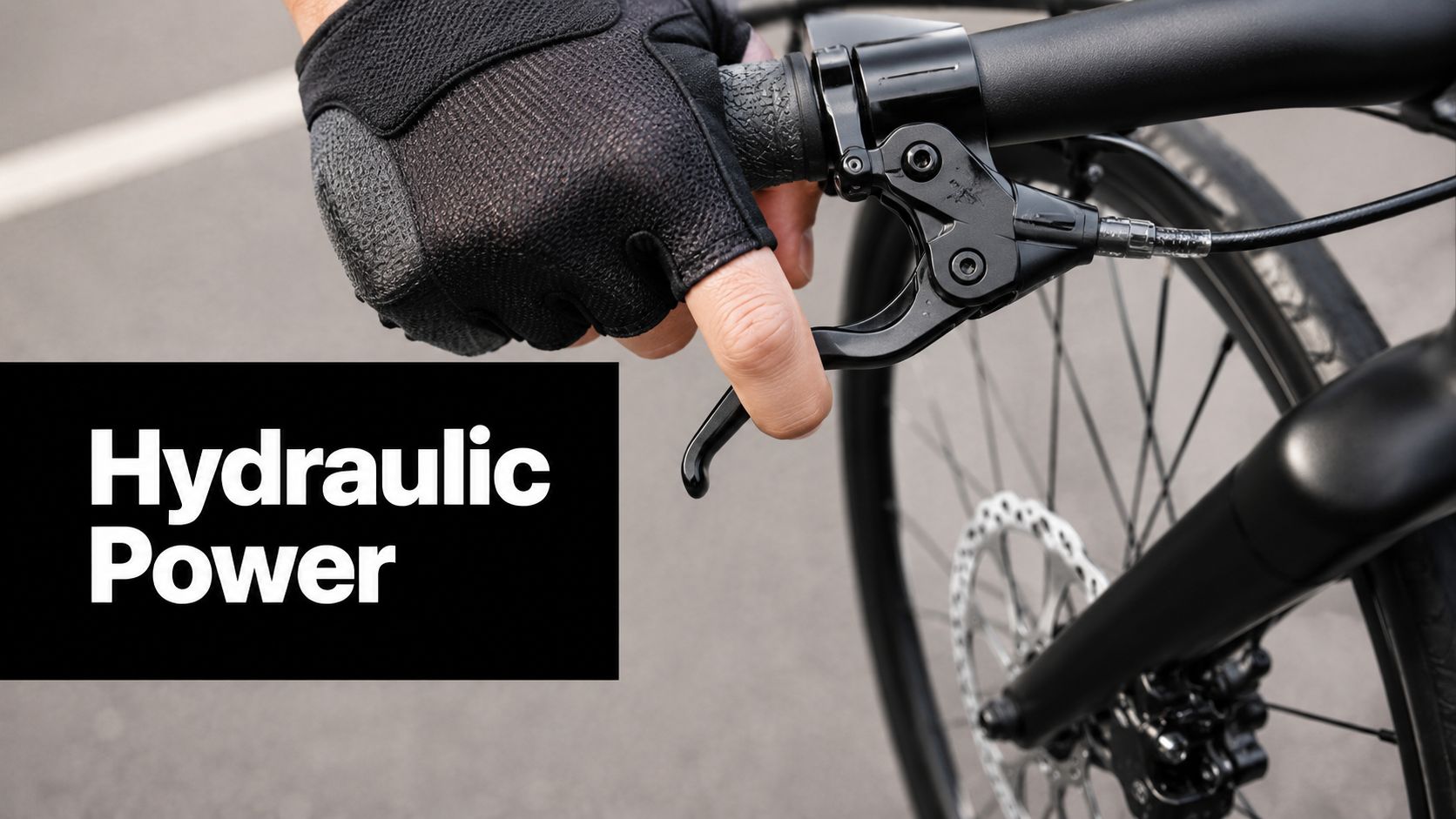
You're in traffic, one finger on the lever, a wet car lane beside you, and you want the bike to slow down now without your hand cramping halfway through the squeeze. That's the promise of hydraulic brakes on a bike, they turn a small hand movement into strong, controlled stopping through fluid pressure instead of a steel cable. If you've ever wondered why some brakes feel smooth and powerful while others feel vague or demanding, the answer usually starts inside the lever, then travels through a sealed line to the caliper.
The good news is that the system makes sense once you break it into parts. Hydraulics turn muscle into pressure, then pressure into friction. That's the whole story, and it's the reason so many riders in the UK and EU, especially commuters, e-bike riders, and people riding in mixed weather, end up choosing them.
The Moment You Squeeze the Lever
Your hand closes around the lever, the bike is still moving, and the front wheel needs to lose speed without drama. Inside a hydraulic setup, that tiny squeeze pushes a piston in the lever body, and the force travels through brake fluid to the caliper at the wheel. Shimano's service documentation describes that as a sealed hydraulic circuit, and the point of the seal is simple, the pressure you create at the lever has to reach the caliper without getting lost in a stretchy cable or an open gap in the system, as explained in MA Hydraulics UK systems guide.
Why the feel is so different
A cable brake can flex, stretch, and rub through housing. A hydraulic brake uses fluid that doesn't compress much, so the movement at the lever feels more direct and more even. That's why the same amount of finger effort can feel calmer on a hydraulic setup, especially when you're riding in traffic or slowing repeatedly through town.
Practical rule: if the lever feels firm, the pads bite cleanly, and the braking comes on in a smooth curve, the system is doing its job.
The important mental model is this. Your hand doesn't “push the wheel” in some vague way. It moves fluid, the fluid moves pistons, and the pistons clamp pads onto the rotor to create friction.
What riders usually want to know next
Most people end up asking the same four things.
- How does it work inside? The lever, hose, fluid, and caliper each have a job.
- Why does it feel better? Because fluid transmission is more direct than a cable.
- How do I keep it healthy? By watching pad wear, fluid condition, and seal integrity.
- Do I need it? That depends on terrain, load, weather, and how much maintenance you'll tolerate.
If you're still comparing braking systems, that's normal. The next step is learning how this setup got here in the first place, because the history explains why hydraulics stuck around.
How Hydraulic Bike Brakes Came to Dominate
Hydraulic bicycle braking didn't appear as a finished modern product. The early trail starts in 1904, when Frederick George Heath in Redditch, England devised and fitted a hydraulic, water-and-glycerine brake system to a cycle using a handlebar lever and piston, and he also obtained GB190403651A for improvements in hydraulic-actuated brakes for cycles and motors. That's an early sign that riders and inventors were already chasing smoother stopping long before disc brakes became normal.
The modern era took shape in stages
A later milestone came in 1969, when Shimano released POWER BRAKE, a hydraulic system that used one brake lever to operate front and rear calipers with stable power distribution. Shimano said it offered powerful braking with little force, but it didn't spread widely because of cost and technical reasons. That matters because it shows the idea was sound, even if the market wasn't ready yet.
Then 1987 changed the story for real-world riders. MAGURA pioneered the first hydraulic bicycle brake, the Hydro-Stop (HS), which marked the move from cable-actuated braking toward fluid-based systems on bicycles. MAGURA later introduced the GUSTAV M in 1996 as its first hydraulic disc brake.
By the latter half of the 1990s, mountain-bike disc brakes had become widespread, and that's when hydraulic systems really found their home. Riders wanted stronger braking, better modulation, and more confidence in wet or muddy conditions, not just a clever mechanism. Hydraulic brakes won because they solved real riding problems, not because the packaging looked nice.
The modern hydraulic brake is less a sudden invention and more a long answer to the same question, how do you stop harder with less hand fatigue?
That historical arc still shows up on today's bikes. The more speed, weight, and bad weather you add, the more that smooth fluid system starts to make sense.
The Four Parts That Make Hydraulic Brakes Work
Think of the system like a sealed straw filled with water. If you squeeze one end, the pressure shows up at the other end almost immediately because the fluid can carry force without behaving like a spring. That's the basic reason a hydraulic brake feels so different from a cable brake.

The lever and master cylinder
The brake lever houses the master cylinder, which is where your hand force gets turned into hydraulic pressure. When the lever feels crisp and predictable, that usually means the piston is moving freely and the seals are doing their job. If the feel turns spongy, the problem is often air or fluid issues, not some mysterious loss of braking power.
The sealed hose and the fluid
The hose carries the pressurized fluid from lever to caliper. Brake systems rely on an incompressible fluid and a sealed line, because if the hose expands, leaks, or lets air in, force transfer gets inefficient. That's why modern setups use closed hoses with reservoirs and cylinders rather than anything loose or cable-like.
The fluid itself can be mineral oil or DOT fluid, depending on the brand and platform. You can't mix that choice casually, because the system is built around the manufacturer's specification.
The caliper and the opposing pistons
At the wheel end, the caliper holds pistons on both sides. When the lever is squeezed, fluid pressure pushes those pistons outward together, and the pads clamp the rotor evenly. That even pad movement is a big part of why hydraulic brakes feel smooth and predictable, especially when you're feathering speed instead of slamming to a stop.
Healthy-brake cue: when both pads move together and the lever returns cleanly, the system feels calm, not grabby.
What can go wrong
Each part has its own failure mode. The lever can feel soft if air gets in. A hose can leak or swell. Fluid can become contaminated. The caliper can move unevenly if one piston sticks. Once you know those four pieces, you stop treating the brake as a black box and start reading the symptoms correctly.
Hydraulic vs Mechanical and Rim Brakes
A lot of riders ask for a simple winner. The better question is which brake type matches the way you ride. Hydraulic disc brakes, mechanical disc brakes, and rim brakes each solve a different problem, and the best choice depends on weather, service access, and how hard you ask the bike to slow down.
| Criteria | Hydraulic Disc | Mechanical Disc | Rim Brake |
|---|---|---|---|
| Lever feel | Smooth, light, easy to modulate | More direct, but usually requires more hand force | Simple feel, less refined under load |
| Wet-weather use | Strong and consistent | Good, but more dependent on setup and cable condition | Falls off more in wet or dirty conditions |
| Maintenance style | Less frequent, but more technical | Easier at home with basic tools | Simple, but wheel and rim condition matter a lot |
| Repairability | Best when you have the right parts and bleeding kit | Strong for roadside or home repairs | Straightforward, but limited by rim wear |
| Best fit | Commuters, e-bikes, hilly routes, riders who want less hand effort | Riders who want simpler field service and lower complexity | Budget builds and riders in dry, light-duty use |
Where hydraulics win
Hydraulic brakes shine on modulation and hand effort. You can trim speed with more control, and you don't have to squeeze as hard to get useful braking. That makes them a better fit for traffic-heavy commuting, winter riding, and bikes that carry extra mass.
Where mechanical discs still make sense
Mechanical discs appeal because they're simpler to adjust and easier to repair with basic tools. If you travel a lot, ride far from shops, or want something you can bodge back into service with common parts, that simplicity matters. The tradeoff is that the feel can change more as cables stretch and housings wear.
Where rim brakes still fit
Rim brakes are cheap and familiar, and they can work well on lighter bikes in dry conditions. The downside is that they rely on the rim surface itself, so dirty or wet conditions can hurt performance quickly. For riders in the UK and EU who face frequent rain, that's a real limitation.
Maintenance Routines That Actually Keep Brakes Safe
Hydraulic brakes are not “fit and forget.” They're low-maintenance compared with cable systems, but only if you stay ahead of wear, contamination, and air in the line. A technical guide recommends bleeding the brakes annually, or whenever the lever feels spongy, and doing a full overhaul every 2–3 years to replace seals and pistons. Those are the kinds of service intervals that keep the system feeling like itself, instead of slowly drifting into a mushy lever and weak bite.

Three jobs that prevent most problems
- Annual Fluid Bleed: If the lever feels soft or inconsistent, bleeding removes trapped air and restores a firm feel. You'll need the correct bleed kit for your brand, clean fluid, and patience more than brute force.
- Pad Inspection and Replacement: Worn pads reduce power and can damage the rotor if you wait too long. Check them before they get thin enough to look “fine” at a glance but fail under load.
- Caliper Alignment Check: If the pads don't meet the rotor evenly, you'll hear rub, feel drag, or get uneven wear. A clean alignment check saves a lot of false troubleshooting later.
What to look for before the ride
A good hydraulic brake feels firm, returns cleanly, and bites predictably. If the lever travels farther than usual, if the bike squeals after a hard stop, or if one wheel suddenly feels weaker than the other, don't assume the whole system is failing. Often, the issue is pad wear, contamination, or alignment.
If the lever changes feel suddenly, inspect first. Don't just reach for the bleed kit and hope.
The key is to treat brake care like chain care. A quick check before a commute or weekend ride catches most issues early, and a proper annual bleed keeps the system from going soft.
For riders building a broader service routine, the accessories and upkeep ideas in Punk Ride's e-bike accessories guide can help you think about brake care alongside the rest of the bike.
Why E-Bikes and Cargo Bikes Push Brakes Harder
A heavier bike changes the whole braking conversation. BikeLab Studio gives a concrete example, on a 10% descent at 30 km/h, a 95 kg system has to dissipate about 770 W continuously, which is why heat builds so fast on long downhill runs and why fade shows up when the brake can't shed heat fast enough. That isn't a niche physics fact, it's the reason e-bikes and cargo bikes need more brake than a light commuter on flat roads, especially when the load is constant.

Rotor size changes the job the brake can do
Rotor diameter is one of the biggest setup choices because it changes braking torque and heat handling. Common MTB guidance points to 160–180 mm for XC or light trail, 180–203 mm for all-mountain or enduro, and 203 mm+ for downhill use. Bigger rotors give the brake more mechanical advantage and more surface to shed heat, which is why they show up on heavier e-bikes and cargo bikes.
Why 4-piston calipers appear on heavy bikes
A 4-piston caliper usually makes more sense when stopping force and fade resistance matter more than saving a little weight. That's why you see them on e-bikes and mountain bikes rather than race setups. More piston area and more pad contact help the system stay calm when the bike is carrying speed, weight, or both.
The route matters as much as the parts
A flat city route and a long hill descent don't ask the brake to do the same job. If you ride short commutes in town, a smaller rotor may be fine. If you carry cargo, ride in hilly areas, or descend for long stretches, you want the brake system sized for that heat load instead of hoping a stock setup will cope.
For delivery riders and frequent urban haulers, the practical angle in Punk Ride's electric bicycle for delivery guide lines up with the same reality, weight and route length change what “good brakes” means.
Simple test: if the bike feels fine on the first stop but fades after repeated hard braking, heat, not just lever force, is the problem.
That's why “upgrade the brakes” is too vague to be useful. Rotor size, caliper type, pad compound, rider weight, and descent length all need to match.
Troubleshooting the Five Common Brake Complaints
A lot of “my hydraulics are weak” complaints aren't really hydraulic failures. They're usually contamination, wear, air, or alignment problems wearing a hydraulic badge. That's good news, because it means you can often diagnose the issue before paying for a full service.
Spongy lever
A lever that feels soft or has extra travel usually points to air in the system or low fluid. Check whether the feel changed suddenly, then look for recent service, transport issues, or any visible seepage. If the lever stays mushy after a proper check, it's bleed time.
Weak braking
If the lever feels normal but the bike still stops poorly, the pads may be contaminated or the rotor may be glazed. A quick look for shiny pad surfaces, oily residue, or reduced bite after wet chain lube overspray can tell you a lot. Clean or replace what's contaminated, then bed the pads in again.
Squeal
Noise often comes from pad compound choice, rotor contamination, or poor bedding-in rather than a broken brake. If the brake is powerful but loud, the system may need a proper bed-in procedure or a pad material that suits your riding conditions better.
Pulling to one side
If one brake arm or one side of the caliper seems to do more work, uneven piston movement may be the cause. Check that the caliper is centered and that the pads contact the rotor evenly. A sticky piston often shows up as one pad moving later or not moving back cleanly.
Dripping fluid
If you see fluid near the lever or caliper, stop riding. That is a real leak, not a normal quirk. Leaks can compromise braking fast, and they need repair before the bike goes back on the road.
After you've ruled out the obvious, ask one simple question, did the brake lose feel, or did the stopping surface lose grip? That distinction saves a lot of needless bleeding. For a clear service workflow, the basic maintenance overview in this section pairs well with a short repair check at the bike stand.
Buying and Compatibility Checklist
The three decisions that matter most are brake type, fluid system, and rotor size. If you want light hand effort, firm modulation, and better control in traffic or on hills, hydraulic discs usually make more sense. If you want simpler roadside service and lower complexity, mechanical discs still have a place.
Check the fluid before you buy
Fluid choice is determined per brand. Some systems use mineral oil, others use DOT fluid, and you need to buy within the platform you're choosing. Mixing those worlds is not a casual DIY experiment.
Match rotor and caliper to your riding
Rotor size should follow rider weight, cargo load, and terrain. A commuter on flatter ground doesn't need the same setup as an e-bike rider hauling groceries through a hilly city. Caliper choice matters too, because the system has to match the heat and force the bike will see.
Check the practical stuff that saves headaches
- Adapter fit: Make sure your fork and frame can take the rotor size you want.
- Lever feel: Some riders like a firmer bite point, others prefer a smoother ramp.
- Local service: If your nearest shop doesn't work on the brand, the “best” brake can become annoying fast.
For a broader purchase lens, the Punk Ride electric bike buying guide is a useful companion if you're also choosing the bike around the brake, not just the brake around the bike.
Hydraulics make the most sense for regular commuters, e-bike riders, cargo riders, and anyone in wet climates who wants stronger stopping with less hand effort. They're less necessary for occasional fair-weather riders on a tight budget, especially if easy field repair matters more than ultimate feel.
If you're comparing e-bikes or scooters and want help choosing a setup that fits real roads, real weather, and the way you ride, visit Punk Ride LLC. They curate electric rides for commuting and everyday mobility, and they can help you narrow down options that make brake choice, comfort, and maintenance feel a lot more manageable.
Share:
Best Rated Motor Scooter Buying Guide 2026
Tubeless Scooter Tires: Complete Setup & Maintenance Guide