


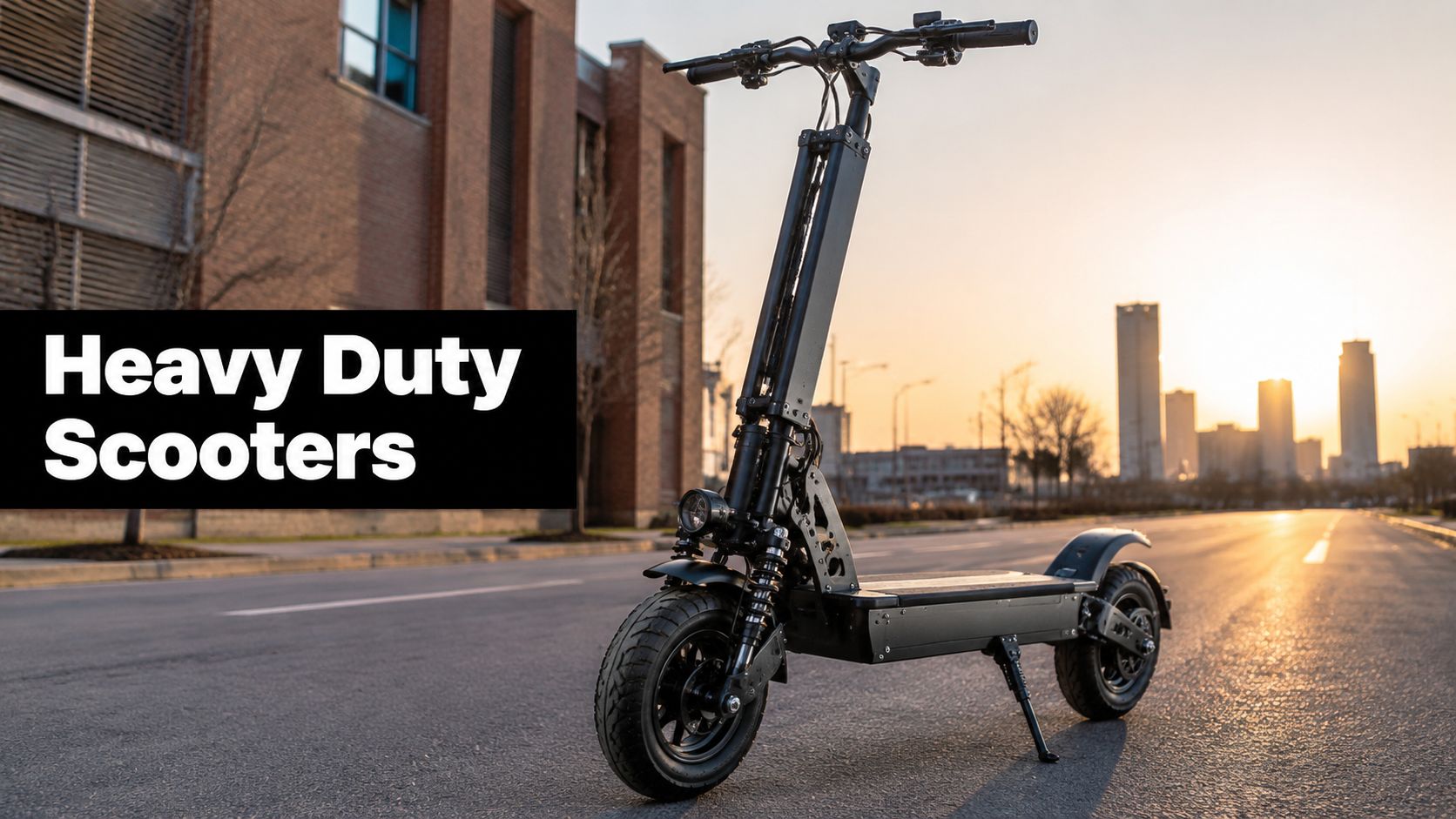
You're probably here because you've outgrown the average e-scooter.
Maybe your commute includes cracked pavement, a steep bridge, wet tram tracks, or a long stretch where a flimsy rental scooter feels like a shopping trolley with a battery. Maybe you're a bigger rider and you've noticed that a lot of product pages say “max load” without saying what happens when you ride right at that limit every day. Or maybe you want one machine that can handle weekday city runs and weekend paths without feeling sketchy.
That's where heavy duty electric scooters for adults make sense. They aren't just regular scooters with a bigger number on the spec sheet. A proper heavy-duty model is built around stronger load support, better braking, more stable geometry, and components that cope with daily stress instead of just surviving a test ride.
Most coverage in this space leans toward the UK and EU e-scooter and e-bike market, because that's where many buyers compare commuter practicality, storage limits, and urban riding rules. Still, every week there's good reason to look at the Australian and US market too, especially because riding patterns, distances, and local road design often push buyers toward more heavy-duty scooters.
Introduction to Heavy Duty Electric Scooters
The morning starts badly. You're late, traffic is crawling, and the road to the station has potholes deep enough to rattle your teeth. On a light commuter scooter, that trip feels nervous. The deck flexes, the motor strains on hills, and every rough patch makes you wonder what's going to loosen next.
On a heavy-duty scooter, the ride feels different right away. The frame stays planted. The brakes feel less like a suggestion and more like an actual control system. You roll over rougher ground without feeling like the scooter is being asked to do a job it was never built for.

Who usually needs one
Heavy-duty doesn't only mean “for very heavy riders.” It often suits adults who deal with one or more of these:
- Longer daily rides: A stronger scooter usually carries speed and stability better over distance.
- Hills and bridges: More power and better thermal tolerance matter when the route isn't flat.
- Rough surfaces: Broken tarmac, cobbles, gravelly edges, and patchwork bike lanes expose weak suspension fast.
- Cargo and gear: A backpack, laptop, lock, groceries, or work kit all add real load.
- Outdoor use: Park trails, mixed surfaces, and damp paths call for more tire grip and sturdier construction.
A lot of first-time buyers get stuck on the wrong question. They ask, “What's the top speed?” The better question is, “Will this scooter still feel solid after months of real riding?”
Heavy-duty scooters earn their keep in the boring moments. Daily starts, repeated braking, uneven roads, and carrying an adult rider without feeling stressed.
What separates a serious scooter from a flashy one
Some scooters look aggressive but are still built like oversized toys. Others look plain but have the details that matter: a rigid frame, quality brakes, sensible tire width, and a battery setup that supports repeat use instead of just a headline range figure.
The biggest beginner mistake is reading specs as if every number has equal value. It doesn't. A strong motor matters, but not if the frame flexes. A large battery sounds great, but not if the scooter is overloaded every day. A high load rating sounds reassuring, but not if you treat that number like your normal operating weight.
That last point matters more than most buyers realize, especially for adults shopping near the upper end of a scooter's stated capacity. We'll come back to that with the 85% load rule, because it changes how you judge durability in real life.
Core Characteristics That Define Heavy Duty Scooters
A heavy-duty scooter is best understood as a compact vehicle. The motor is the engine. The chassis is the frame. The battery is the fuel tank. The suspension, brakes, and tires decide whether the whole package feels controlled or chaotic.
The market itself shows why this category keeps getting attention. The global adult electric scooter market for heavy-duty models was valued at approximately $1.315 billion in 2025 and is projected to expand at a CAGR of 13.2% through 2033, reflecting demand for stronger adult-focused transport, according to adult electric scooter market data.

The six parts that matter most
- Motor: This is your torque source. It decides how confidently the scooter pulls away, climbs, and copes with rider weight.
- Chassis: Think of this like the structure of a car. A weak frame can spoil a powerful setup.
- Battery: Capacity affects how much usable ride time you get before charging.
- Suspension: Good suspension doesn't just improve comfort. It helps the tires stay in contact with the ground.
- Brakes: More mass requires better stopping control.
- Tires: Width, diameter, and tread all influence grip, stability, and ride feel.
What buyers often miss
A high weight rating alone doesn't make a scooter heavy-duty. A scooter can claim a generous maximum load and still feel underbuilt if the stem wobbles, the deck is narrow, or the braking system feels overwhelmed.
That's why it helps to read specs in clusters instead of isolation:
| Feature | What to look for |
|---|---|
| Load support | A rating that leaves room above your real riding weight |
| Frame feel | Low flex, stable stem, wide enough deck |
| Braking | Disc or hydraulic setups with predictable bite |
| Ride quality | Suspension matched to your roads or paths |
| Tires | Enough width and grip for your most common surface |
If you're comparing broader performance classes, this guide to high-powered electric scooters helps frame how power and build quality fit together.
Evaluating Motor and Power Output
Power specs confuse a lot of buyers because they look precise but don't always explain the riding experience. A scooter with more output usually climbs better and responds faster, but power only helps if the rest of the machine can use it well.
One useful market signal is this: models with 3.6–7.2 kW power output held a 39.45% share of the global electric scooter market in 2024, while units above 10 kW are growing at an 11.66% CAGR through 2030, based on global electric scooter power segment data. That tells you buyers aren't only chasing basic commuter machines. There's clear interest in stronger platforms.
Continuous feel versus headline punch
A beginner often sees a big power number and assumes the scooter will feel strong in every situation. Not always.
A practical way to think about motor output:
- Lower power within the heavy-duty category suits flatter city riding and moderate rider weight.
- Mid-range power tends to fit mixed urban use, bridges, and stop-start commutes.
- Higher power is more relevant for steep terrain, outdoor routes, and riders who need extra torque under load.
Top speed gets attention, but torque is what you notice first at a traffic light or on an incline. If your route includes ramps, rough surfaces, or repeated starts with a backpack, you'll care more about shove than bragging rights.
Motor Power Output Comparison
| Power Output (kW) | Recommended Use Case |
|---|---|
| 3.6–7.2 | Urban commuting, heavier adult riders, mixed city terrain |
| Above 10 | Outdoor riding, steep hills, high-load use, demanding acceleration |
Practical rule: Buy power for your hardest normal ride, not your easiest one. Flat-test performance can hide how a scooter behaves under stress.
Urban rider versus outdoor rider
An urban commuter usually wants smooth takeoff, enough power for mild hills, and efficient use of battery. An outdoor rider is asking more from the scooter. Loose ground, repeated climbs, and rougher paths create resistance that weak systems can't hide.
That doesn't mean everyone needs the biggest motor available. It means power should match the route, the rider, and the scooter's overall build. A well-balanced scooter often feels better than an overpowered one with average brakes and basic tires.
Assessing Battery Capacity Range and Charging
Battery shopping goes wrong when buyers treat the listed range like a promise. It's better to think of battery capacity as your energy budget, then ask how quickly your real-world riding spends that budget.
The easiest starting point is watt-hours, usually written as Wh. More Wh generally means more stored energy. But your actual range still changes with rider weight, terrain, wind, temperature, and how aggressively you accelerate.

A simple way to estimate usable range
Start with your route, not the battery.
- Map your normal ride: Work, station, school run, errands, and any hills.
- Add real load: Include your body weight, clothing, bag, lock, and anything you carry often.
- Assume imperfect conditions: Cold weather, stop-start traffic, and rough pavement all eat into range.
- Leave a comfort buffer: Most riders prefer not to arrive nearly empty every day.
If you want a deeper walkthrough, this guide on electric scooter range is useful for translating spec-sheet battery numbers into realistic expectations.
A short video can also help make the battery side less abstract:
Charging at home and on your schedule
Charging setup matters more than many first-time buyers expect.
- On-board charging: Convenient if you can bring the scooter near a socket. It usually suits overnight charging routines.
- External charging setup: Useful when you want a dedicated home charging area or faster turnaround, depending on the system.
- Routine fit: The right option depends on where you store the scooter and whether you ride daily or occasionally.
Battery care that actually helps
Battery care doesn't need to be obsessive. It just needs to be consistent.
- Avoid deep drain: Running the battery completely flat too often can be hard on long-term health.
- Skip heat extremes: Don't leave the scooter baking in direct heat for long periods if you can avoid it.
- Charge with a plan: Many riders get the best long-term convenience by topping up regularly rather than waiting for near-empty.
And when a battery finally reaches end of life, disposal matters. For readers looking into Responsible e-waste battery management, that resource offers useful context on safe battery recycling and why casual disposal is a bad idea.
A battery isn't just a range figure. It's the part that decides whether your scooter fits your week without constant planning.
Analyzing Frame Load Capacity Suspension and Tires
Here, heavy-duty scooters either prove themselves or fall apart on paper.
A scooter can have strong motor output and still be the wrong choice if the frame, suspension, and tires don't match your weight and terrain. For adults, especially larger riders, these parts decide whether the ride feels planted or stressed.
Frame and load capacity
Frame material shapes both feel and trade-offs. Aluminum alloy designs are common because they keep weight manageable while offering good rigidity. Steel can feel tougher and more planted, but it usually adds heft, which can matter if you carry the scooter upstairs or lift it into storage.
The bigger issue is how you interpret load capacity. The 85% load rule says riders should choose a scooter rated for at least 15% more than their weight to reduce battery drain, overheating, and frame stress, according to guidance on the 85% load rule for heavy adults.
If you weigh close to a scooter's maximum stated capacity, that doesn't mean you've found a perfect match. It often means you're right at the edge of what the scooter can tolerate, not where it will stay happy over time.
Suspension and tire choices
A rough comparison helps:
| Component | Option | Trade-off |
|---|---|---|
| Frame | Aluminum alloy | Lighter, easier to handle, still sturdy when well designed |
| Frame | Steel | Strong feel, but heavier to move and store |
| Suspension | Spring | Simpler, often adequate for city streets |
| Suspension | Hydraulic | Better control and comfort on broken or mixed surfaces |
| Tires | Solid | Lower puncture risk, firmer ride |
| Tires | Pneumatic | Better comfort and grip, more upkeep |
If your route is rough enough to shake your wrists on a bicycle, don't cheap out on suspension and tires.
The real-world fit test
For urban riders, a balanced setup often means a rigid frame, decent suspension, and road-friendly tires that won't feel twitchy on wet paint or rough patches.
For outdoor riders, the priorities shift. Tire grip, suspension quality, and enough load headroom become more important than portability. The scooter has to stay composed when the surface stops being predictable.
Safety Legal Compliance and Maintenance Essentials
A heavy-duty scooter can feel reassuringly solid, but that doesn't remove the basics. Adult riders still need to treat these machines like serious vehicles, especially in dense urban areas across the UK and EU, and in places like the US and Australia where route lengths and road design can change the risk profile fast.
One useful clue about how established scooter use has become comes from the US: shared e-scooter trips stabilized at 55–65 million annually from 2021 to 2023, according to U.S. e-scooter usage data. Stable usage doesn't mean rules are simple. It means riders are operating in places where infrastructure and enforcement are evolving.
Know the rules before the ride
Local law is not a minor detail. It changes what counts as a legal scooter, where you can ride, and whether features like speed modes become a compliance issue.
Check these points before buying:
- Road legality: Some regions limit where privately owned scooters can be used.
- Speed restrictions: Local limits may be lower than what the scooter can technically do.
- Helmet expectations: Some jurisdictions require them. Others strongly encourage them.
- Lighting and visibility: Front and rear lighting may be mandatory for certain conditions.
For a practical starting point, this summary of electric scooter laws helps riders compare the legal side before committing to a model.
Safety kit that matters on day one
A lot of buyers spend all their energy comparing motors and almost none thinking about control.
Focus on:
- Braking confidence: Dual brakes and predictable lever feel matter more than fancy styling.
- Lighting: You want to be seen early, not only when a driver is already close.
- Tire condition: Grip is a safety feature. Worn tires diminish your margin.
- Helmet and gloves: The most common crashes are low-speed spills and surprise surface changes.
Maintenance that prevents expensive problems
A heavy-duty scooter rewards small checks. Ignore them, and wear compounds fast.
- Weekly glance: Check tire condition, brake response, lights, and any new wobble in the stem.
- Monthly once-over: Inspect fasteners, look for cable wear, and check whether suspension feels uneven.
- After wet rides: Dry the scooter and pay attention to braking feel and connectors.
Most reliability problems don't arrive dramatically. They start as a new sound, a softer brake lever, or a tire that loses confidence before it loses air.
Choosing the Right Model for Commuters vs Outdoor Use with Buying Checklist
The best heavy duty electric scooters for adults aren't the same for everyone. A commuter and an outdoor rider can both need a “heavy-duty” machine, but for different reasons.
For commuters
Choose a scooter that makes daily repetition easy. That usually means a sensible balance of range, manageable size, stable tires, and braking you trust in traffic. If your route is mostly paved, you don't need an extreme off-road setup. You need something that feels calm in bike lanes, at junctions, and over patchy city surfaces.
For outdoor riders
Bias the shortlist toward stronger suspension, more tire grip, higher power tolerance, and generous load headroom. The ride matters more than portability once you leave clean urban pavement behind. A model built for rougher paths should feel composed, not merely capable on a good day.
One factual example in the “option among many” category is Punk Ride LLC's Punk Rider Pro, which uses dual 600W motors with peak power listed at 2300W plus a 52V 18Ah battery, making it the sort of setup buyers may compare when looking at adult-oriented commuting and recreation scooters.
Buying checklist
- Start with your weight: Apply the 85% load rule before anything else.
- Match power to terrain: Flat city routes and mixed outdoor riding don't need the same motor class.
- Judge the frame realistically: If it looks compact and lightly built, don't expect miracles under load.
- Look at brakes before speed: Fast is optional. Stopping isn't.
- Check charging fit: Your storage space and socket access matter every week.
- Verify legal use: Make sure the model fits your local rules.
- Ask about service: Parts access, tires, brakes, and warranty support matter after the sale.
A good shortlist is usually short for a reason. Once you remove underbuilt models, flashy claims, and scooters that don't fit your route, the right choice becomes much clearer.
If you're comparing heavy-duty scooters for city travel, mixed terrain, or higher rider loads, Punk Ride LLC is a practical place to browse current models, specs, and adult-focused electric ride options across the UK, Germany, and the US.
Share:
Smart Electric Scooters: The Ultimate 2026 Rider's Guide
How to Use Bike Lock on E-Bikes & Scooters in 2026