


Most riders fixate on one habit and miss the one that does the damage. They obsess over whether the battery stopped charging at 80%, then leave the pack sitting full in a warm hallway, a shed, or the boot of a car. That's backwards.
Good bike battery maintenance isn't about chasing perfect percentages all day. It's about reducing the stress that ages lithium-ion packs in normal ownership. In UK and EU commuting, where bikes and scooters often get charged frequently and then parked indoors for long stretches, storage habits matter as much as ride habits. For readers in the US and Australia, the same rule applies, but hot garages and summer car storage are even bigger traps.
The Maintenance Rule Most Riders Get Backwards
The popular advice says keep your battery between 20% and 80%. That rule is useful, but on its own it's incomplete. A widely cited battery-care guide supports that range for daily charging and also recommends storage around 40% to 60% in cool conditions near 10°C to 20°C (50°F to 68°F) because heat and high state of charge speed up degradation (SloHi Bike battery care guidance).
That's the part many riders skip. They hear “20 to 80” and treat it like a magic shield. It isn't. If the battery spends long periods hot and full, the damage still piles up.
What actually shortens pack life
In workshop terms, the killers are boring:
- Charging a hot pack: You finish a ride, the battery is still warm, and it goes straight onto the charger.
- Parking at full charge: The bike is ready for a morning ride, but then it sits all day or all weekend topped off.
- Warm storage: Loft spaces, conservatories, garages with poor ventilation, and car interiors all raise battery stress.
Most riders would get a bigger payoff from fixing those three habits than from micromanaging every last percentage point on the display.
Practical rule: If you want one low-effort habit that matters, keep the battery cool and partly charged when it's not being used.
This is the same logic maintenance teams use in other equipment. They don't wait for failure. They watch condition, catch harmful patterns early, and intervene before wear turns expensive. That's the whole point behind Forge Reliability's condition-based maintenance, and it maps well to e-bike ownership. Stop treating the battery as either “fine” or “dead.” Treat it like a component that gives warning before it gives up.
The habit that pays back fastest
If you commute every day, you don't need to baby the pack. You need to avoid dumb heat exposure and stop leaving it full for no reason. The riders who get the longest useful life usually aren't the ones checking the app every hour. They're the ones who charge with some restraint, unplug when done, and store the battery like it's electronics, not garden gear.
Building a Charging Routine That Fits Real Life
A charging routine has to survive normal life or it won't last a week. Commutes run late. Weekend rides go longer than planned. Somebody else in the house pinches the charger. Good bike battery maintenance works around that.
A commuter routine that's actually workable
For a typical weekday rider, a simple pattern works well:
- Start the week with a partial top-up: If Monday's ride is a normal commute, charge to a moderate level instead of reflexively filling it.
- Midweek charge after the pack cools: After a harder ride home, let the battery sit before plugging it in.
- Use full charge when you'll use it: If Saturday includes a long route, charging fully before that ride is fine when the pack won't sit at the top for ages.
That's the key trade-off. Full charges aren't poison. Leaving a full battery sitting around is the problem.
UK government guidance for e-cycle users also says to unplug the charger once the battery is charged, never cover the charger or battery while charging, and let a hot battery cool before charging (UK battery safety for e-cycle users). That lines up with what I'd tell any customer at the bench. Don't leave the charger brick cooking overnight under a coat rack and call it maintenance.
Charger choice matters more than clever habits
This is one place where cheaping out causes trouble. Use the charger supplied by the bike or one approved for that system. If you're sorting out replacements, connector type, output match, and compatibility matter more than saving a little money. A practical reference is this guide to electric bike chargers, which walks through the compatibility side without turning it into guesswork.
A few charging habits that work in real households:
- Keep one charging spot in a dry, ventilated area.
- Label shared chargers if there's more than one bike or scooter in the house.
- Charge after the battery has settled from the ride, especially after hills, cargo loads, or summer heat.
- Unplug when finished rather than leaving the pack on the charger out of habit.
A battery doesn't care whether you meant to leave it on charge all night. It only sees time, temperature, and state of charge.
Cold weather and daily friction
Winter catches people out. A pack brought in from freezing conditions may show poor performance at first, and it shouldn't be rushed straight into charging while it's still cold-soaked. Let it come back toward room temperature first. The same goes for packs pulled from an unheated shed.
And don't overcomplicate this. If your routine is “ride, bring battery inside, let it cool or warm naturally, then charge only as much as the next ride needs,” you're already doing better than most.
How Temperature and Charge Level Quietly Age Your Battery
Lithium-ion batteries don't wear out only from riding. They also age while sitting still. That's where a lot of range disappears, especially on commuter bikes that spend more time parked than moving.
Why storage state matters
Most riders know the battery dislikes extremes. Fewer understand why. At high charge and high temperature, the internal chemistry ages faster. One of the wear mechanisms is growth of the solid electrolyte interphase, usually shortened to SEI. That layer is part of normal battery life, but when it thickens too much it ties up lithium and drags down usable capacity.
A recent degradation review found that long-term storage at 55°C and 90% state of charge caused severe damage, including SEI thickness above 300 nm and conductivity loss greater than 20% after 36 months (AAU degradation analysis review). The practical lesson isn't academic. Heat and high charge don't act like separate annoyances. They amplify each other.
What the shorter-term aging data shows
Another e-bike charging guide reports that Bosch PowerPack tests cited there found batteries charged at 35°C lost 15% capacity after 300 cycles, compared with 8% loss at 20°C. The same source says around 25°C is associated with only 3% capacity loss after one year, while 40°C can cause about 18% loss in one year (A1 eBikes charging guidance).
That's why a battery stored half-full in a cool utility room generally ages better than one left fully charged in a warm garage, even if both seem “well cared for.”
Estimated Capacity Loss Over 12 Months by Storage Conditions
| Storage Temperature | Stored at 40–60% SoC | Stored at 80% SoC | Stored at 100% SoC |
|---|---|---|---|
| Around 25°C | Lower aging risk. Guidance in one source associates around 25°C with about 3% capacity loss after one year in favourable conditions (A1 eBikes charging guidance) | Higher than moderate storage charge | Higher than moderate storage charge |
| Around 40°C | Heat raises aging risk sharply. The same source associates 40°C with about 18% loss in one year (A1 eBikes charging guidance) | Worse than moderate storage charge in the same heat | Worst combination in normal consumer use |
| Extreme long-term heat | Severe risk when combined with high charge | Severe risk increases as SoC rises | 55°C and 90% SoC caused severe damage and more than 20% conductivity loss after 36 months (AAU degradation analysis review) |
For a plain-English companion to lifespan expectations, this overview of how long e-bike batteries last is useful because it frames battery life as both cycle wear and calendar aging, which is exactly how packs die in the world.
The storage rule that matters
For any layup longer than a couple of weeks, store the battery cool, dry, and roughly half charged. A separate maintenance guide also points to 20% to 80% for daily use and 40% to 60% for longer storage, noting that cells stored at 25°C and low charge lost about 2.5% conductivity over the same period where very hot, high-charge storage caused much heavier loss (BikeFair battery storage guide).
That's not chasing perfect numbers on every commute. Getting storage right over months.
Cleaning and Inspecting the Battery Without Damaging It
Most batteries don't get ruined by dirt alone. They get ruined when dirt mixes with water, salt, neglect, and a rider who attacks the bike with a hose.
A muddy commuter is the classic example. The downtube slot fills with road grit, the latch area gets gritty, and the battery starts feeling rough going in and out. The right move is boring. Power the bike off, remove the battery if the system allows it, brush away loose grit first, then wipe the casing with a barely damp microfibre cloth.
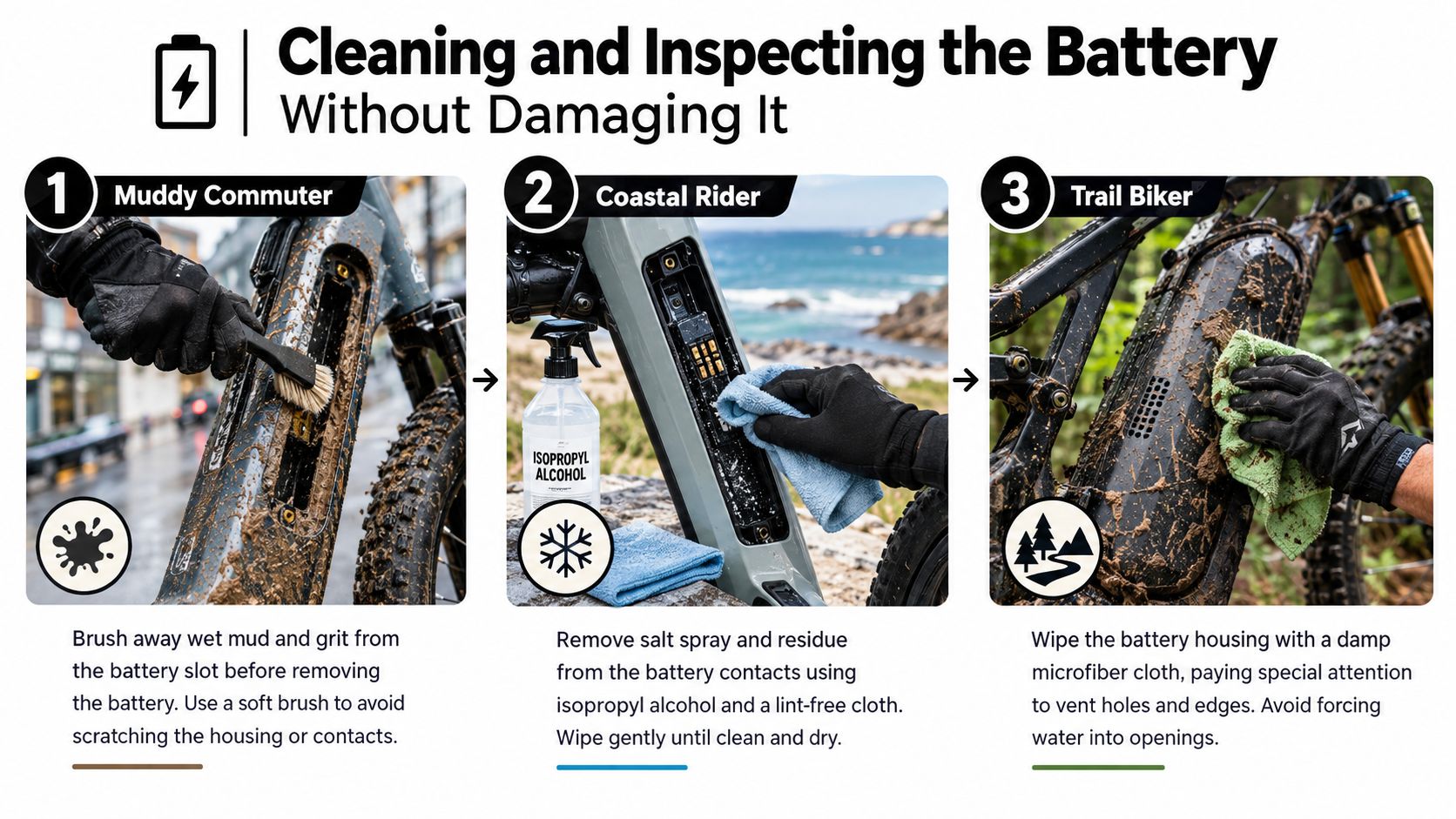
Three situations that need different handling
A coastal rider has a different problem. Salt air leaves a film on contacts and exposed metal, and that's where light corrosion starts. Dry the area fully after wiping and inspect the charge port cover carefully. If a seal no longer sits flat, fix that before the next wet ride.
A dusty trail bike looks dramatic but is usually the easiest of the lot. Fine dust on the casing isn't a crisis. Packed grime around seams, mounts, and terminals is the issue. Use a soft brush on the housing and around the mount, not a pressure washer and not a garden hose blasted into every seam.
What to check while you're cleaning
Bike battery maintenance stops being cosmetic and starts being useful.
- Casing condition: Look for cracks, warping, or corners that no longer sit flush.
- Contacts and port area: Watch for corrosion, grime buildup, or bent pins.
- Mount and latch fit: The battery should click in positively. If it shifts, rattles, or needs force, inspect the mount.
- Smell: A sweet solvent smell is a bad sign. Treat it like a fault, not a curiosity.
Water around contacts and charging ports causes more trouble than a dusty casing ever will.
For winter road grime, inspect weekly. After wet or salty rides, inspect the same day. If the bike is mostly stored indoors and ridden in clean conditions, a monthly once-over usually catches problems early enough.
Diagnosing Battery Problems Before They Get Worse
A healthy battery tends to fail gradually before it fails obviously. Riders miss the clues because they only look for total failure. The better approach is to read the battery the same way you'd read brake rub or a worn chain. Small changes tell a story.
Start with behaviour, not panic
If range feels shorter, don't assume the pack is dying on the spot. Check the easy stuff first. Tyre pressure, stronger assist use, colder weather, hills, cargo weight, and stop-start riding all change what the bike delivers.
What matters is the pattern. A slow, steady drop points one way. A sudden collapse points another.
Battery Warning Signs and Likely Causes
| Symptom | Likely Cause | Recommended Action |
|---|---|---|
| Gradual reduction in range over time | Normal aging, heavier assist use, colder weather, rolling resistance changes | Keep riding, log the pattern, check tyres and riding mode |
| Battery gets unusually warm during charging | Charger issue, poor ventilation, internal resistance rising | Stop charging, let it cool, test with approved charger, book service |
| Battery no longer seats firmly in mount | Latch wear, mount damage, casing distortion after impact | Stop using if fit is insecure, inspect mount and casing |
| Corrosion around contacts or charge port | Moisture ingress, salty environment, poor storage conditions | Clean carefully, dry thoroughly, inspect seals |
| Sweet chemical smell, leaking, bulging, or hissing | Internal battery damage | Stop using immediately and isolate the battery safely |
| Charger appears normal but battery won't take charge | Charger fault, BMS lockout, connection issue, internal fault | Check with approved charger and seek qualified diagnosis |
The physical warning signs that matter most
The UK's statutory guidance says e-bike batteries and conversion-kit batteries should include safety mechanisms such as a battery management system capable of preventing thermal runaway during normal use and reasonably foreseeable misuse. The same guidance says visibly damaged, bulging, smelly, or leaking packs pose an extremely high fire risk and should not be permitted in premises or vehicles (UK statutory lithium-ion battery safety guidance).
That should reset how riders think about symptoms. Swelling isn't a “keep an eye on it” issue. A cracked shell after a drop isn't “probably cosmetic” until proven otherwise. Heat spots during charging, a chemical smell, or a battery that has stopped fitting cleanly all move the problem out of the normal-maintenance category.
A simple workshop decision tree
Use this rough filter:
- Keep riding if the battery behaves normally and the only issue is ordinary dirt or predictable seasonal range variation.
- Monitor closely if range has changed gradually but there's no heat, smell, fit issue, or visible damage.
- Service soon if charging becomes erratic, the battery runs warmer than usual, or the mount and contacts show wear.
- Stop and replace or isolate if there's swelling, leaking, smoke, hissing, or impact damage that affects the case.
Most packs give some warning. The expensive mistakes happen when riders ignore the warning because the bike still turns on.
End-of-Life Care, Damage Response, and Safe Recycling
End-of-life care isn't housekeeping. It's part of ownership. Riders in the UK and EU are hearing more about battery fire risk for a reason, and the same conversation is growing in the US and Australia as more batteries circulate through garages, flats, offices, and shared charging spaces.
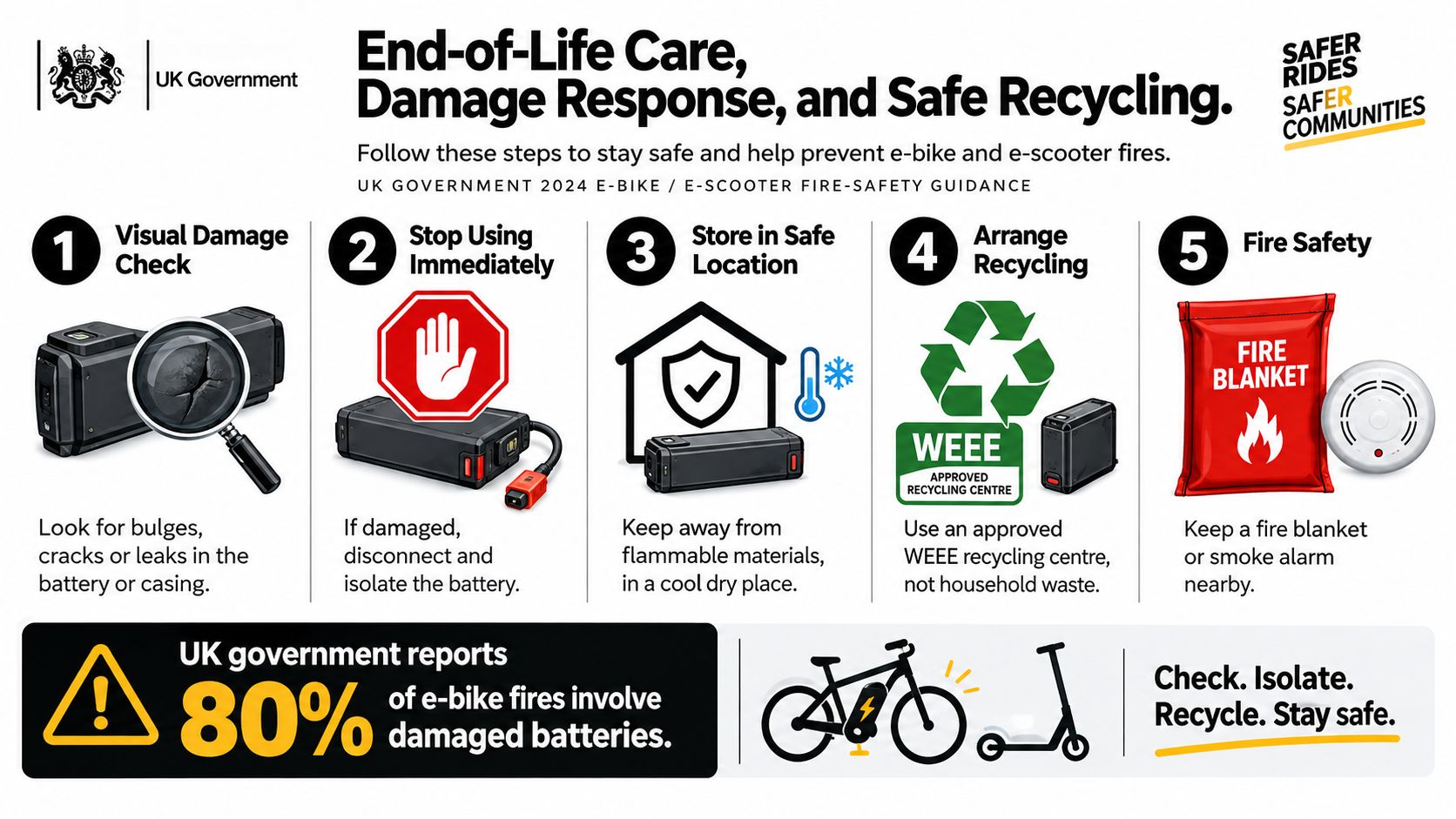
The UK government published new independent research into e-bike and e-scooter lithium-ion batteries, chargers, and conversion kits in 2025, reflecting increased attention on product safety and real-world fire risk (UK government battery safety research announcement). That doesn't mean every old battery is a fire waiting to happen. It does mean damaged, modified, and badly handled packs deserve a lot more respect than they usually get.
What to do after impact or visible damage
If a battery has been dropped hard, punctured, soaked beyond what the system was designed to handle, or starts swelling, stop using it. Don't “just see if it still charges.” Put it somewhere non-combustible and away from flammable materials if you can do that safely, then contact the manufacturer or a qualified battery technician.
That same common-sense rule applies to packs with cracks, leaks, or odd smells. The battery may still power the bike. That does not make it safe.
If a damaged pack still works, that only proves it can still move current. It doesn't prove the inside is stable.
A quick visual guide helps, especially for households sharing one garage or hallway.
Disposal routes that make sense
Don't put a lithium-ion bike battery in household rubbish. Don't toss it into a generic curbside recycling stream. Don't strip the casing and start handling cells unless you know exactly what you're doing.
Better options include:
- Manufacturer take-back schemes when available
- Local authority household waste recycling centres
- Approved battery or electronics recyclers
- Qualified bike or e-mobility workshops that handle battery disposal pathways
Tern's Bosch battery guidance also recommends storing a battery at approximately 30% to 60% before storage and keeping it in a dry, ventilated place away from heat sources or flammable materials (Tern Bosch battery care guidance). That's sensible while you arrange recycling too. You're trying to reduce stress and reduce risk, not keep the battery “ready to ride.”
Premature replacement costs money. Safe handling still wins. A tired but stable battery can be managed. A damaged one needs action.
Your Weekly and Seasonal Battery Care Checklist
The best bike battery maintenance routine is the one you'll still do in February, in the rain, after work. Forget elaborate rituals. Use a short weekly baseline and a seasonal reset.
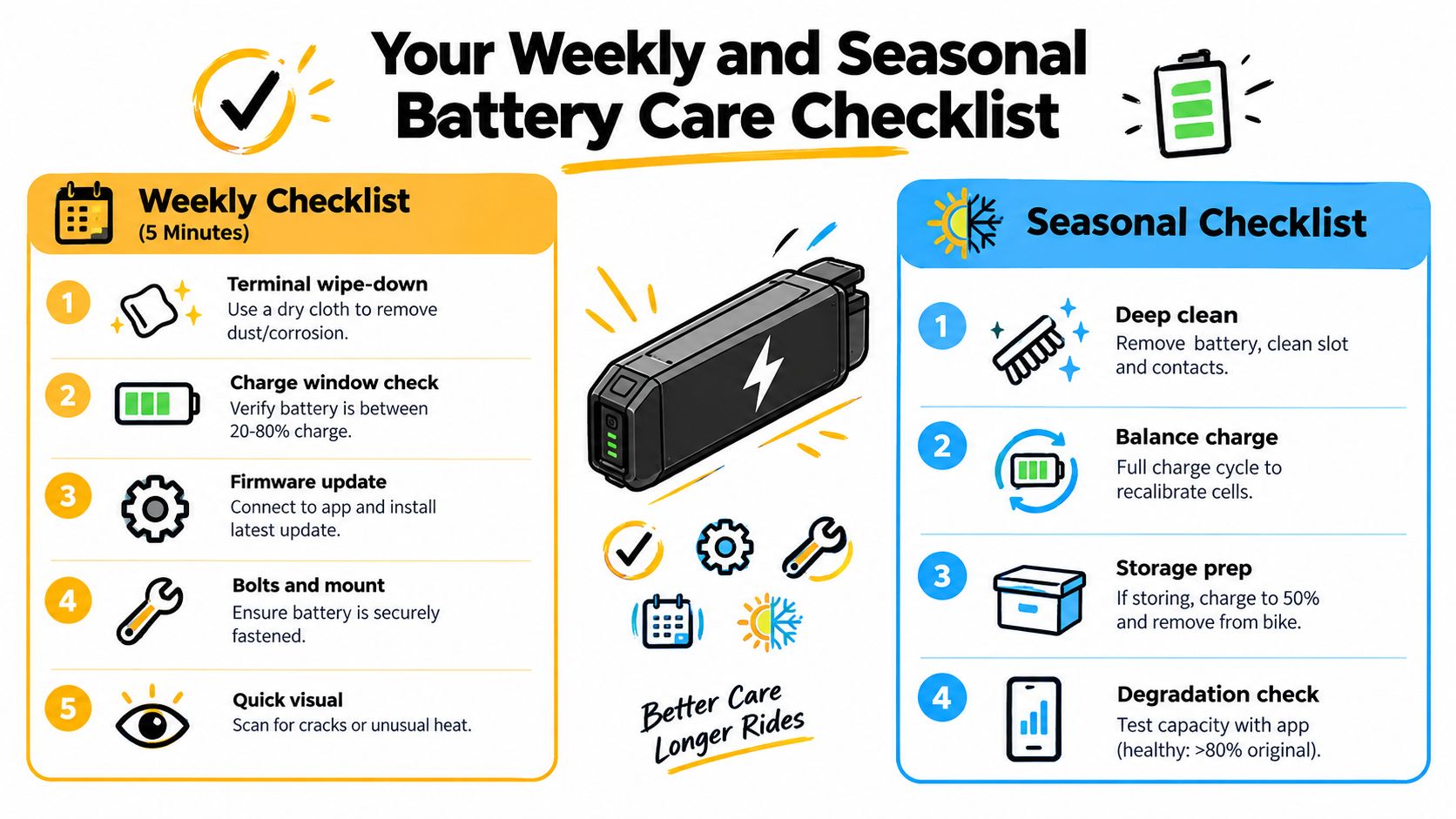
Weekly five-minute baseline
Do these once a week if the bike sees regular use:
- Wipe the terminals and mount area: Dry cloth first. If there's grime, clean gently and make sure everything is dry before refitting.
- Check how you've been charging: Not obsessively. Just make sure you're not repeatedly leaving the battery full for long periods.
- Look at the charge port cover and seals: If they're loose or not seating properly, moisture gets an easy entry point.
- Review recent behaviour: Has range changed suddenly, has charging become hotter, or has the battery started fitting differently?
- Confirm secure fit: The pack should mount cleanly and lock without slop.
If you're storing the bike or battery between rides, this guide to electric bike battery storage is a useful practical reference because it focuses on the stuff owners forget, especially charge level and storage location.
Seasonal habits that do the heavy lifting
The larger gains come from a few timed jobs each year.
In late winter or after a salty season, remove the battery and clean the slot, latch area, and casing properly. Salt and road filth don't need much time to start trouble around metal parts and seals.
In spring, pay attention to real-world range on a familiar route. You're not hunting for perfect lab data. You're trying to notice whether the bike feels broadly the same as it did before.
Summer is when heat discipline matters most. Don't leave the battery cooking in a car or hot garage. Don't charge it while it's still warm from a hard ride if you can avoid it.
Autumn is storage season for a lot of riders. A separate battery-care reference recommends moderate storage charge in the 30% to 60% band, and multiple guides converge around 40% to 60% for longer layups rather than full or empty storage (SloHi Bike battery care guidance).
The short version worth remembering
Here's the rule I'd put on the workshop wall:
Store it cool. Don't leave it full unless you're about to ride. Stop using it the moment swelling, leaking, or impact damage enters the picture.
If you only do one thing this month, cool the pack before charging and store it half-full.
Punk Ride LLC offers electric bikes, scooters, chargers, and practical ownership guides for riders who want their gear to last, not just work on day one. If you're comparing battery-friendly charging setups, replacement accessories, or everyday urban mobility options across the UK, EU, and US markets, visit Punk Ride LLC.
Share:
Electric Bike Charging Rate Explained Simply
Electric Scooter Handlebar Replacement: A Practical Guide