


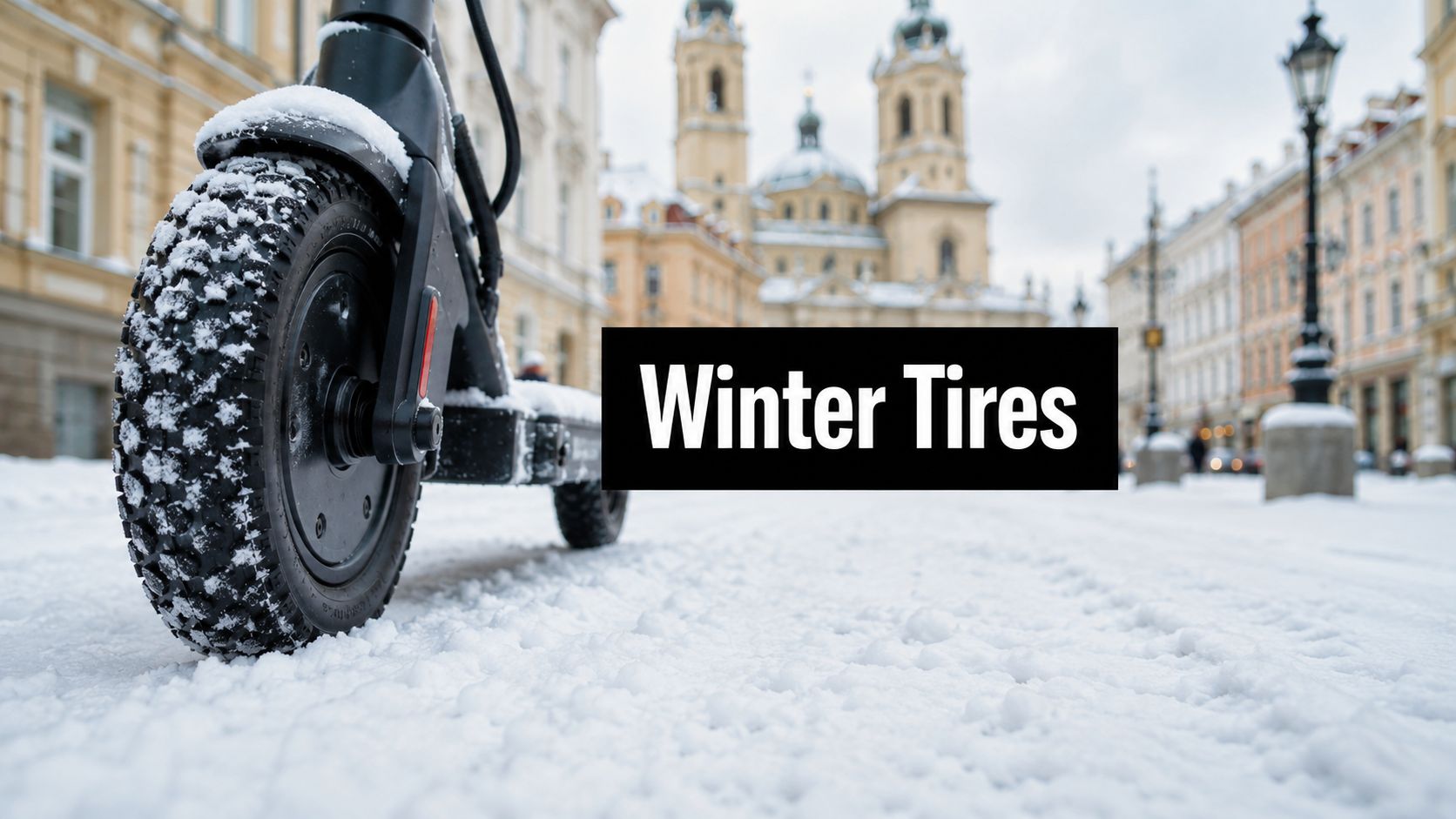
For most personal e-scooters, true winter tires don't exist, and in freezing weather braking sensitivity can drop by up to 30 to 40% while the safest setup is often limiting power to 50% in ECO mode. That's the hard answer most riders don't get when they search for winter tires for scooters and get fed a page full of aggressive tread patterns and vague promises.
A lot of winter advice online starts from the wrong assumption. It assumes there's a tyre upgrade that turns a small-wheel e-scooter into a cold-weather commuter in the same way proper winter rubber transforms a car. That isn't how this market works, especially for the UK and EU e-scooter and e-bike crowd riding compact urban machines on wet roads, drain covers, painted lanes, greasy roundabouts, and the odd patch of black ice.
The useful question isn't “Which winter tire fixes winter?” It's “What's the least bad option for my scooter, my roads, and my legal situation?” That's a much better place to start.
The Cold Hard Truth About Scooter Winter Tires
Most riders looking for winter tires for scooters are really looking for reassurance. They want a product category that says, “Fit these and carry on.” For the majority of electric standing scooters, that category isn't there.
According to rider consensus discussed in the electric scooter community, no dedicated winter tire product category exists for electric scooters, and off-road or knobby tires do not improve traction on snow or ice. Listings marketed as winter scooter tyres are often generic off-road variants with no validated performance data for winter use, and experienced riders state plainly that “there are no winter tires for scooters” in this class of vehicle (discussion on electric scooter winter tire claims).

What riders get sold instead
Search any marketplace in winter and you'll see the same pattern:
- Knobby tyres relabelled as winter-ready because the tread looks more aggressive
- Generic off-road rubber described with snow language but no proper winter validation
- Moped-style products that may be real winter tyres, but not for the wheel sizes most e-scooters use
That's why the usual advice goes wrong. Big tread blocks can help in loose dirt or soft ground. Ice and compacted snow are a different problem. On those surfaces, a small e-scooter wheel with limited contact patch doesn't get rescued by marketing copy.
Practical rule: If a seller's main proof is “looks chunky,” treat it as an off-road tyre, not a winter solution.
Why this matters more in the UK and EU
Urban winter riding in places like Manchester, Amsterdam, Brussels, or Berlin is rarely deep-snow adventure riding. It's more often cold rain, slush, grit, painted crossings, steel plates, polished paving, leaves, and surprise ice. A tyre that feels more stable on a muddy path can still be sketchy on a frosty bike lane.
The hard truth is simple. Winter riding safety comes more from restraint than from tread. If your route includes untreated surfaces, shaded corners, canal paths, bridge decks, or early-morning commutes before gritters have done their job, the right answer may be to slow right down or leave the scooter at home.
That sounds less exciting than buying “snow tyres” online. It's also more honest.
What Passes for Winter Tires Today
If proper winter tires for scooters are mostly absent, riders still end up choosing between three broad categories. Think of them like footwear. All-season tyres are your trainers, fine most days but not built for serious winter. Knobby tyres are hiking boots, useful on rough surfaces but not magic on ice. Specialised scooter or moped winter tyres are the insulated snow boots, but they usually fit a different class of machine.

The three real-world options
| Type | What it does well | What it does badly | Best use case |
|---|---|---|---|
| All-season scooter tyres | Predictable road feel on cold wet tarmac | Limited help on snow or ice | Urban commuting on cleared roads |
| Off-road or knobby tyres | Better bite on loose debris, rough paths, some slush | No reliable fix for ice or compacted snow | Mixed surfaces where mud and loose grit matter |
| Specialised moped-style winter tyres | Built specifically for cold-weather grip in the sizes they serve | Usually won't fit standard standing e-scooters | Larger seated scooters and small-displacement scooter platforms |
Specialised winter tyres do exist in adjacent categories. For small-displacement scooters and motor scooters, products such as Anlas Winter Grip 2 and IRC SN-23 URBAN SNOW are recognised winter solutions, and winter tyre products like 125/65-12 are built with deep lugs and micro-sipes for snow and slush use (overview of scooter and motor scooter winter tyre options). That matters because it proves winter-specific design is real. It just doesn't meaningfully exist for most modern standing e-scooters.
What to choose if you ride through a UK or EU winter
For most riders, the choice is a compromise, not an upgrade to invincibility.
- Stay with a good road tyre if your route is mostly wet tarmac, cycle lanes, and treated streets.
- Use a knobby pattern carefully if your route includes towpaths, park links, construction dust, wet leaves, or uneven surfaces where extra tread can help with texture.
- Don't assume “M+S” style language means true winter performance on a compact e-scooter wheel.
One thing the wider market makes obvious is that demand exists. The Europe Winter Tire Market reached USD 6.56 billion in 2024 and is projected to grow to USD 9.46 billion by 2030 with a CAGR of 6.35%, driven by regulation and safety demand (Europe winter tire market projection). Cars and larger vehicles have a mature winter tyre ecosystem. E-scooters largely don't.
If you want a clearer sense of baseline tyre types before you buy anything, this guide to electric scooter tyre options and trade-offs is worth a look.
A tyre can be the best compromise available and still be the wrong tool for sheet ice.
Legal and Safety Realities in the UK and EU
Tyres aren't just a grip decision. They're also a compliance decision.
That catches riders out because winter tyre rules were mostly written for cars, vans, and motorcycles. E-scooters sit in an awkward corner of the law. In the UK, the legal status of private e-scooter use on public roads is already restrictive. Across the EU, the picture changes country by country, and tyre obligations don't always map neatly onto micromobility.
Where the legal confusion starts
A good example is Bulgaria. Winter tires are legally mandatory for all vehicles between November 15 and March 1, which creates a clear seasonal window for compliance in that market (European consumer guidance on winter tyre rules in Bulgaria). That's straightforward on paper for conventional vehicles. It gets messy fast once you ask how local enforcement or classification applies to specific e-scooters, e-bikes, or seated micro-mobility machines.
Riders need to stop guessing.
A practical legal check before you ride
Run through these checks before fitting anything marketed as a winter tyre:
-
Check vehicle classification first
Don't start with the tyre. Start with how your machine is classified locally. A private e-scooter, rental e-scooter, speed-pedelec, seated scooter, and low-power e-bike can all sit under different rules. -
Read local winter tyre wording carefully
Some laws specify vehicle type. Others specify road conditions. Others focus on approved markings or certified standards. -
Ask the insurance question early
If your area requires approved tyre categories or specific road legality, a tyre that helps physically but fails legally can become a bigger problem after a crash. -
Check municipal rules as well as national rules
City-level enforcement can be stricter in practice than riders expect, especially in dense urban centres.
Better grip doesn't automatically mean road legal.
For riders outside the UK and EU, especially in the US and Australia, the same principle applies. Winter gear and winter legality are not the same thing. That matters even more when parts are imported, relabelled, or sold across markets with different standards.
Does Your Electric Scooter Even Fit Winter-Ready Tires
Before you spend money, check whether the tyre will physically fit your scooter. This stage is often where many winter experiments fail. The tyre may be sold as compatible “enough,” but once mounted it rubs the fender, fouls the mudguard stay, clips the suspension, or leaves too little clearance for grit and slush.
Read the tyre you already have
Start with the sidewall. You'll usually see a size marking such as 10x2.5, 10x3, or something like 85/65-6.5. Those numbers tell you the wheel format and tyre dimensions that your scooter was built around.
Then check three things:
- Width clearance between tyre and fork or swingarm
- Height clearance under the fender
- Valve access once the tyre is mounted
A winter-leaning off-road tyre often ends up wider and taller than the smooth road tyre it replaces, even when the labelled size looks similar.
Tubed, tubeless, and practical fit
The next question is construction. Some scooters use tubed tyres, some use tubeless, and some riders convert setups with mixed success. In cold, wet conditions, simple maintenance matters more than theory. A tyre that's a pain to seat properly or service on your rim isn't helping you.
If you need a refresher on the fitting side, this walkthrough on installing scooter tyres on rims is useful before you order parts.
Here's the other wrinkle. Many scooter winter tyres are not certified to car tyre standards and may be illegal in parts of the US or Canada where non-certified compounds are prohibited on public roads (discussion of scooter winter tyre legality and certification issues). Even if you find a tyre from the scooter or moped world that looks promising, fit and legality are separate checks. You need both.
A mechanic's shortlist before buying
- Measure the current setup, don't rely on memory
- Check the manufacturer's maximum supported tyre size
- Inspect for mudguard and cable clearance
- Confirm whether the rim profile matches the tyre type
- Think about puncture repair in winter gloves and cold rain
If the answer is “it might fit,” assume it won't until proven otherwise.
Beyond Tires Essential Winter Riding Adjustments
Tyres matter. Rider input matters more.
All scooters get worse in winter conditions. One winter riding review notes statistically significant reduced mobility on snow- and ice-covered slopes and corners, and says braking sensitivity decreases by up to 30 to 40% in freezing temperatures, which is why riders are advised to limit power to 50% in ECO mode for safety (winter riding safety findings for electric scooters).

The settings that actually help
If your scooter has ride modes, winter is not the day for max output. Lower power delivery makes the rear wheel less likely to break traction when you roll on the throttle over painted lines, metal covers, or greasy tarmac.
Use this as your base setup:
- Power mode set to ECO or the lowest sensible output
- Acceleration on the softest setting available
- Regenerative braking reduced if your scooter allows it and if aggressive regen unsettles the rear wheel
- Mechanical brakes checked and adjusted before cold-weather use
For a broader cold-weather prep routine, this article on riding a scooter in winter covers the non-tyre side well.
Riding style is the real winter safety system
The riders who stay upright in winter usually don't look dramatic. They look boring. That's the point.
-
Brake earlier than feels necessary
Cold roads punish late decisions. Roll off sooner and squeeze the brakes progressively. -
Stand looser and lower
A rigid stance makes every slip worse. Keep your knees soft and let the scooter move a little underneath you. -
Avoid abrupt steering inputs
Most cold-weather losses happen during combined inputs. Turning while braking hard on a wet painted surface is a classic one. -
Choose your lane position carefully
Avoid shiny patches, road markings, manhole covers, leaf piles, and the polished centre of busy junctions.
On ice, even winter tyres are far from a silver bullet. Slow speed is still the main safety tool.
That point gets missed often. Guidance on icy road safety notes that winter tyres still slide significantly on slick road icing and don't make a rider immune to accidents (winter tyre limits on icy roads).
A good visual refresher helps. Watch this before your first frosty commute.
When to call it off
Don't ride when the route is visibly icy, untreated, or covered in frozen slush. Don't ride if your hands are too cold to brake properly. Don't ride if you're relying on a tyre change to overcome bad conditions.
That decision saves more crashes than any tread pattern ever will.
Your Practical Pre-Winter Scooter Checklist
A winter setup works when small decisions stack up in your favour. Skip a few, and the whole thing gets fragile. This checklist is the one I'd want on the wall of a workshop or pinned in a rider group chat before the first proper cold snap.

Machine checks
-
Inspect tyre condition
Look for cracking, squared-off tread, puncture plugs that are no longer trustworthy, and any sidewall damage. If a tyre already feels vague in autumn rain, it won't become trustworthy in January. -
Set tyre pressure cold
Check pressure when the scooter has been sitting, not right after a ride. Cold weather changes feel quickly, and underinflation can make handling sluggish and vague. -
Dial in the brakes
Test lever feel, pad bite, cable smoothness, rotor rub, and stopping balance front to rear. If the brakes feel just acceptable in the garage, they'll feel worse on a damp commute.
Rider checks
-
Upgrade visibility
Clean the lights, charge what needs charging, and add reflective kit if your route includes dark cycle infrastructure or busy roads at dusk. -
Practice in a safe wet area
Use an empty, low-risk space to feel how the scooter accelerates, turns, and slows in the cold. That practice matters more than reading product packaging.
Legal and route checks
| Check | Why it matters |
|---|---|
| Local road legality | Your scooter may already sit in a grey area depending on country or city |
| Tyre compliance | A product sold as winter-ready might not be approved for your road use case |
| Route surface quality | Canal paths, bridges, cobbles, and painted lanes can be worse than the temperature suggests |
| Plan B transport | The safest winter commuter has a backup option |
If your commute depends on “it'll probably be fine,” your setup isn't ready yet.
Ride Smart Not Hard This Winter
The best advice on winter tires for scooters is less exciting than the adverts. There isn't a miracle tyre waiting to enable carefree riding through frost, slush, and black ice on a small-wheel e-scooter.
What works is a realistic mix of decent tyres, proper fitment, legal awareness, lower power, sharper maintenance, and much calmer riding. For most UK and EU riders, that means treating winter as a season for compromise, not confidence. If the roads are cold and wet, ride as if grip is limited. If the roads are frozen, assume your options are limited too.
That's not defeatist. It's competent.
A scooter can still be useful through winter, especially on cleared urban routes and milder days. But the riders who make it through the season safely are the ones who stop chasing marketing myths and start managing risk like adults. Slow down, check your machine, know your local rules, and don't ask a tyre to solve a weather problem.
If you're comparing scooters, tyres, and practical commuter gear for real-world riding, Punk Ride LLC is a solid place to browse current electric mobility options across the UK, EU, and US. They stock a wide mix of e-scooters and e-bikes from brands riders already know, with UK and Germany warehousing that makes support and delivery more straightforward for European buyers.
Share:
Uncovering if Are E Bikes Good for Fitness: The Full Guide
How to Bleed Hydraulic Brakes on E-Bikes & Scooters