


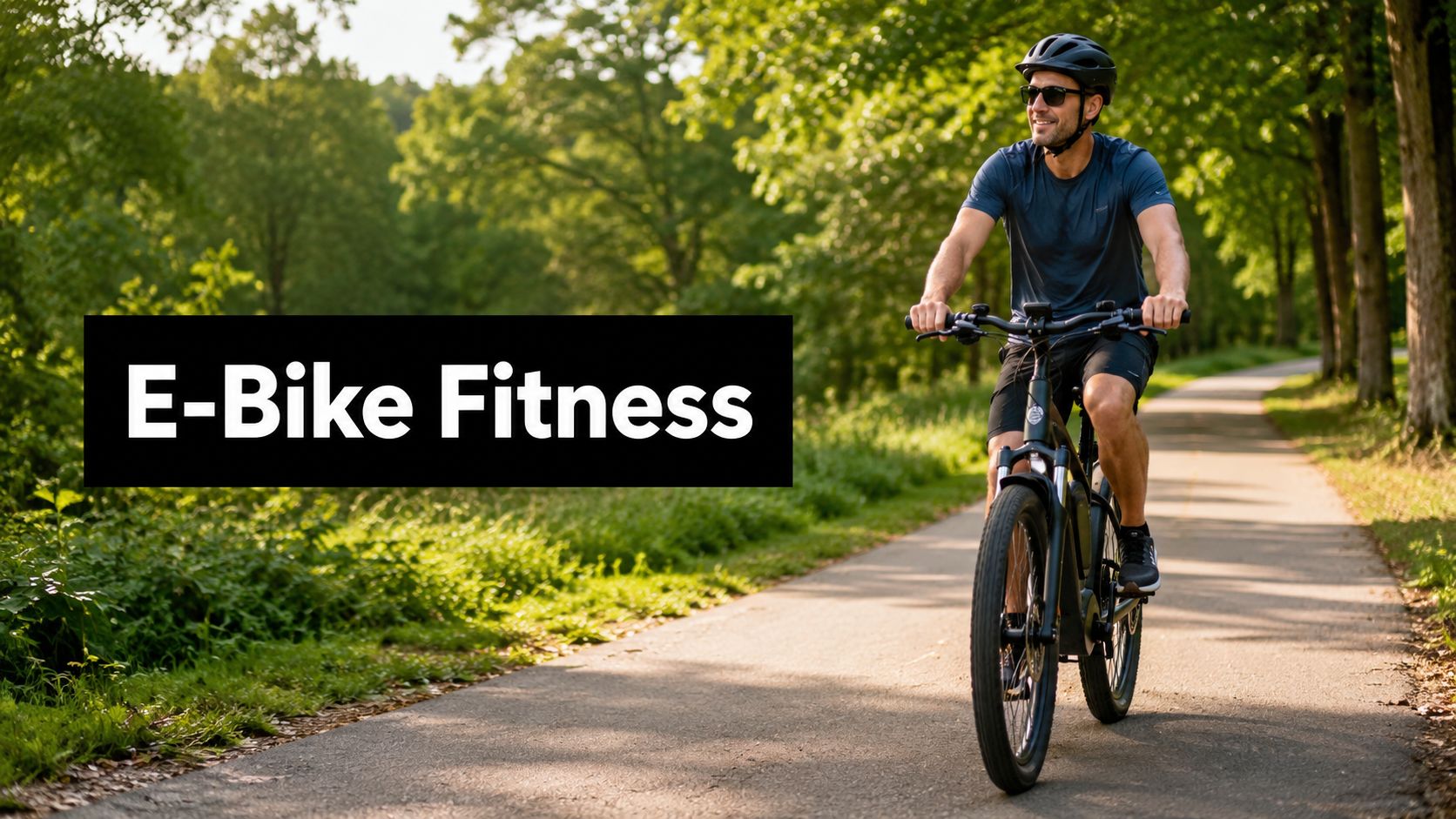
Most advice on this topic starts with the wrong comparison. It asks whether one e-bike ride is harder than one regular bike ride. That's not the question to focus on.
The better question is simpler. Will this bike help you ride often enough to get fitter? For a lot of commuters, casual riders, and people who've been put off by hills, traffic, sore knees, or low confidence, the answer is yes. That matters more than gym-bro debates about whether a motor makes it “count.”
If you've been wondering are e-bikes good for fitness, the short answer is yes. The longer answer is more interesting, because the biggest benefit isn't just what happens in a single ride. It's what happens when a bike becomes easy enough, fun enough, and practical enough that you keep using it.
So You Think E-Bikes Are Cheating
You know the moment. You're riding home, you see the hill ahead, and your motivation falls apart before your speed does. On a regular bike, that hill can end the ride. On an e-bike, it often becomes the reason the ride still happens.
That's why the “cheating” argument misses the point. Individuals don't quit exercise because they hate movement. They quit because the barrier to doing it regularly is too high. E-bikes lower that barrier without removing the physical effort completely.
In the UK, that practical side is already shaping how people think about e-bikes. 30% of users in the UK e-bike market say health benefits are a primary reason for buying one, and riders see e-bikes as a way to combine exercise with convenience and fit physical activity into everyday life without the strain of traditional cycling, according to UK e-bike market research.
Why the cheating label confuses people
The word “cheating” makes it sound like the motor does all the work. That's not how riders typically use them. Pedal assist helps you keep moving, especially when the ride would otherwise get cut short by wind, distance, or fatigue.
A useful way to think about it is this:
- A regular bike tests your peak effort. You feel every climb, every restart, every tired leg day.
- An e-bike supports your repeat effort. You can still push, but you're less likely to skip the ride altogether.
- Fitness rewards consistency. Bodies adapt to activity you repeat, not workouts you only talk about doing.
The best workout isn't always the hardest one. It's the one you'll still be doing next month.
Across the UK and much of Europe, that idea lands well because everyday cycling matters more than one-off hero rides. If your bike helps you commute, run errands, or go out after work when you'd usually choose the car, it's doing something powerful for your health.
A different way to judge fitness value
If two riders burn different amounts on one trip, that doesn't settle the argument. What matters is total weekly activity, not just suffering per mile.
That's why so many skeptical riders change their minds after using an e-bike for a while. They realise they're riding on tired days, riding farther than planned, and saying yes to routes they would've avoided before. That isn't cheating. That's a smarter path to building a habit.
The Science Behind Your E-Bike Ride
What surprises skeptics is not that e-bikes require effort. It is how often they keep that effort happening.
A regular bike can feel like sprint intervals disguised as transport. You push hard up a hill, recover at a light, then grind into a headwind. Pedal assist smooths those spikes. Your body still works, but the effort is steadier, which is often better for building a repeatable habit.
Researchers at Brigham Young University found that e-bike commuters still exercised at a meaningful intensity during their rides, as described in this summary of the BYU e-bike fitness study. That matters because fitness does not come only from occasional all-out sessions. It comes from enough cardiovascular work, repeated often enough, that your heart, lungs, and muscles adapt.

What pedal assist really changes
Pedal assist works like a dimmer switch, not a scooter throttle. You still have to pedal. The motor reduces how punishing each surge feels.
If you are new to the mechanics, this guide to e-bike pedal assist modes shows why a ride can feel more manageable without turning into a free ride.
That change affects your workout in a few useful ways:
- Your heart rate stays up for longer: steady effort counts, even if the ride feels less dramatic
- You spend less time recovering from hard spikes: that leaves more room for continuous aerobic work
- You are more likely to finish the route and ride again soon: that is where the fitness payoff grows
The simplest analogy is walking uphill on a trail with a handrail nearby. Holding the rail a little does not mean your legs stopped working. It means you can keep climbing instead of turning around halfway.
VO2 max, explained like a normal person
VO2 max sounds technical, but the idea is simple. It is a measure of how well your body uses oxygen during exercise. Better oxygen use usually means better endurance and stronger cardiovascular fitness.
A systematic review in Frontiers in Sports and Active Living found that e-cycling can improve cardiorespiratory fitness in physically inactive adults. That is the part many riders miss. The benefit is not only what happens during one ride. The bigger effect comes from making riding accessible enough to happen again and again.
So yes, an e-bike may lower the hardest moments of a ride. It also lowers the odds that you skip the ride entirely.
For fitness, that trade is often a win.
E-Bikes vs Regular Bikes A Fitness Showdown
Let's be honest. If your only measuring stick is “which ride feels tougher minute by minute,” the regular bike usually wins. That still doesn't mean it wins for everyone.
The more useful comparison is side by side.

What the body experiences on each bike
A study summary on e-bike exercise reports that riders on e-bikes reached 94% of the target heart rate seen in conventional cycling, with 145 bpm versus 155 bpm, which still places them in the vigorous intensity zone despite lower perceived strain, according to this review of e-bike and regular bike fitness differences.
That's the key distinction. The regular bike often feels harder. The e-bike often gets surprisingly close in physiological terms.
You can frame it like this:
| Ride type | What it tends to feel like | What it often supports |
|---|---|---|
| Regular bike | Higher strain, especially on climbs and stop-start urban routes | Strong single-session effort |
| E-bike | Smoother effort with less brutal peaks | Sustainable cardiovascular work |
If you want a broader rider-focused breakdown, this guide to e-bike vs normal bike differences is useful for comparing how the two feel in everyday use.
The calorie question people always ask
Yes, conventional bikes usually demand more from you in a single ride. No, that doesn't automatically make them the better fitness tool for every rider.
The trap is treating fitness like a contest between two perfect rides on the same day, with the same rider, on the same route. Real life doesn't work that way. One bike may give you a harder workout. The other may get used on Monday, Wednesday, Friday, and the weekend.
- Choose a regular bike if you want higher unassisted effort and enjoy that challenge.
- Choose an e-bike if you want a ride you're more likely to repeat in traffic, wind, hills, or after a long day.
- Choose either without guilt if the result is more time moving.
A hard ride you avoid doesn't build much fitness. A manageable ride you repeat absolutely does.
So if you're asking are e bikes good for fitness, the fairest answer is this: they may ask a bit less from each pedal stroke, but they often ask more from your week because you keep riding.
The Unseen Fitness Advantage Accessibility and Consistency
Fitness doesn't usually fail because people don't know what to do. It fails because the routine is too hard to keep alive. That's where e-bikes have a hidden edge.
A 2021 study by epidemiological researchers at Colorado State University found that e-bike users more than double their cycling frequency compared with traditional cyclists, even though they burn about 30% fewer calories per individual ride, according to this summary of the Colorado State University e-bike frequency findings.
Why weekly volume beats one heroic ride
The body responds better to regular training than occasional all-out efforts. That's true in cycling, strength work, and almost every other form of exercise.
That's also why ideas like Strive's approach to progression make sense here. Progress works best when the load is manageable enough to repeat, then gradually increase. An e-bike fits that pattern well because you can lower assistance, extend rides, or add hills as your fitness improves.
Think about three common riders:
- The commuter: They wouldn't cycle to work on a standard bike five days a week, but they'll do it on an e-bike.
- The returning rider: They stopped riding because hills and fatigue made every outing feel like a test.
- The weekend rider: They finally say yes to longer routes because getting home doesn't feel daunting.
Accessibility is a fitness feature
People often talk about accessibility as if it's separate from exercise. It isn't. Accessibility is what lets many riders participate often enough for exercise to happen in the first place.
A separate summary focused on the “frequency multiplier” argues that e-bikes make healthy activity easier to maintain because they reduce barriers like fatigue and discomfort while supporting longer and more frequent rides, as described in this look at health benefits of electric cycling and scootering.
Here's the simple version:
- Less intimidation means more starts
- Less exhaustion means more repeat rides
- More repeat rides means more total activity over time
That's the consistency multiplier. It doesn't sound dramatic, but it's how people get fitter in practice outside a lab. Not from one savage effort. From showing up again and again.
How to Maximize Your E-Bike Workout
An e-bike can be a lazy cruise machine if you want it to be. It can also be a very flexible training tool. The difference usually comes down to how you use the assist levels.

Workout one the interval blaster
Use this when you want a shorter ride that still feels punchy.
- Warm up first: Ride easily with higher assist until your legs feel loose.
- Drop the support: Switch to a lower assist level on a flat stretch.
- Push the pace: Pedal hard for a short burst until your breathing rises noticeably.
- Recover with help: Increase assist and spin easily.
- Repeat several rounds: Stop while you still feel strong rather than empty.
This works because you control intensity with both cadence and support level. The motor becomes a training dial.
Workout two the hill crusher
Hills are where many people discover that e-bikes still demand real work.
Try this approach:
- Pick one steady climb: Not your steepest monster. Just something long enough to stay engaged.
- Start with modest assist: Enough to keep your cadence smooth.
- Stay seated at first: Let your legs and glutes do the work.
- Reduce assist over time: As confidence builds, ask more from yourself on the same hill.
For longer sessions, hydration matters more than most riders expect. If you're heading out for repeated climbs or a warm-weather endurance ride, this guide on finding the right bottle for your ride is a practical place to start.
Use assistance as a tool, not a default. If your route feels too easy, lower support before you assume the workout “doesn't count.”
Workout three the endurance explorer
This is the ride that best shows why e-bikes help fitness. The aim isn't to smash yourself. The aim is to stay moving for a long, steady effort.
A good endurance ride usually looks like this:
- Keep the assist moderate: Enough help to stay comfortable, not enough to coast.
- Choose a route you enjoy: Scenery matters because boring routes shorten rides.
- Hold a pace you can maintain: You should feel like you're exercising, not racing.
- Finish wanting a little more: That's how you build repeatable endurance.
A helpful visual demo can make pacing and body position easier to understand:
Small changes that make rides harder in a good way
You don't need a full training plan to get more from your e-bike. A few simple tweaks go a long way.
- Lower assist on flats: Save more support for headwinds and climbs.
- Increase cadence: Smooth, active pedaling often raises the workload without making the ride miserable.
- Extend the route home: Add time, not just difficulty.
- Use errands as bonus rides: Fitness adds up when cycling becomes part of life.
That's a key advantage. You can make the ride as easy or as challenging as you need on the day.
Common E-Bike Fitness Myths Busted
The biggest mistake in the e-bike debate is judging one ride instead of a whole month of riding.
That framing misses the key fitness question. A bike that gets used four or five times a week will usually do more for your health than a harder bike ride that keeps getting postponed. Researchers reviewing e-cycling studies found that people can reach moderate physical activity levels on e-bikes and improve fitness markers over time, as reported in the systematic review on electrically assisted cycling and health outcomes.

Myth one you don't get real exercise
Reality: you still pedal, your heart rate still rises, and your legs still do work. The motor reduces the barrier. It does not replace your body.
A good way to picture it is hiking with a lighter backpack. The effort changes, but you are still moving, breathing harder, and training your system.
Myth two you don't burn enough to matter
Reality: fitness is not only about the hardest possible session. It is about total work across days and weeks.
E-bikes offer a surprising advantage to skeptical riders. A manageable ride is easier to repeat, and repeatable exercise is what builds habits. Three enjoyable rides plus an errand trip often beat one brutal weekend effort followed by six sedentary days.
Myth three e-bikes are only for unfit riders
Reality: e-bikes help a wide range of cyclists. New riders use them to make cycling feel possible. Older riders use them to stay active without getting discouraged by hills or joint pain. Experienced cyclists use them for recovery days, longer commutes, or extra saddle time.
The common thread is consistency. Different riders use the same tool to remove different obstacles.
E-bikes don't reduce fitness to zero. They lower the friction that stops people from riding often enough to get fitter.
Myth four walking is basically the same
Reality: walking is excellent, but e-biking often lets people cover more ground, spend more time exercising, and choose riding in situations where they would otherwise drive.
That matters in real life. If an e-bike turns a skipped workout into 40 minutes of steady movement, or replaces a car trip with active travel, the fitness benefit is no longer theoretical. It is part of your weekly routine.
The simplest myth-buster is this. Fitness comes from what you can keep doing. E-bikes help many people keep doing more.
Your Guide to Getting Started Safely
Starting is easy. Starting smart is better.
First, wear a properly fitted helmet every ride and give yourself time to learn the bike's acceleration and braking feel. E-bikes can carry speed more easily than many people expect, especially when you're fresh and the route is open. Keep your first few rides short, quiet, and low-pressure.
A simple setup checklist
- Check the assist settings: Begin in a lower or middle mode so the bike feels predictable.
- Practice braking early: E-bikes are heavier than many standard bikes, so stopping can feel different.
- Watch battery range: A fitness ride gets less fun if the last stretch turns into an unexpected slog.
- Stay visible: Lights and reflective details matter if you commute in mixed traffic or low light.
What to look for in a fitness-friendly e-bike
Not every e-bike suits the same rider. For fitness use, focus on a bike that encourages regular riding rather than one loaded with features you won't use.
A good starting shortlist:
- Comfortable fit: If the bike doesn't feel good, you won't ride it often.
- Useful battery range: More range gives you freedom to extend rides when you're feeling strong.
- Natural-feeling assist: Smooth support helps you pedal actively instead of relying on jerky bursts.
- Reliable brakes and tyres: Confidence matters, especially in urban UK, EU, and US riding conditions.
Maintenance is basic but important. Keep tyres inflated, brakes checked, and the battery charged sensibly. A well-kept e-bike is easier to trust, and trusted bikes get ridden more.
If you're ready to turn everyday travel into regular movement, Punk Ride LLC is a practical place to start. With warehouses in the UK and Germany, headquarters in Florida, and a wide range of electric rides for urban commuters and outdoor riders, Punk Ride makes it easier to find an e-bike that fits real life in the UK, EU, and US.
Share:
Electric Scooter Pick Up Today: A Complete 2026 Guide
Winter Tires for Scooters: The 2026 UK & EU Guide