


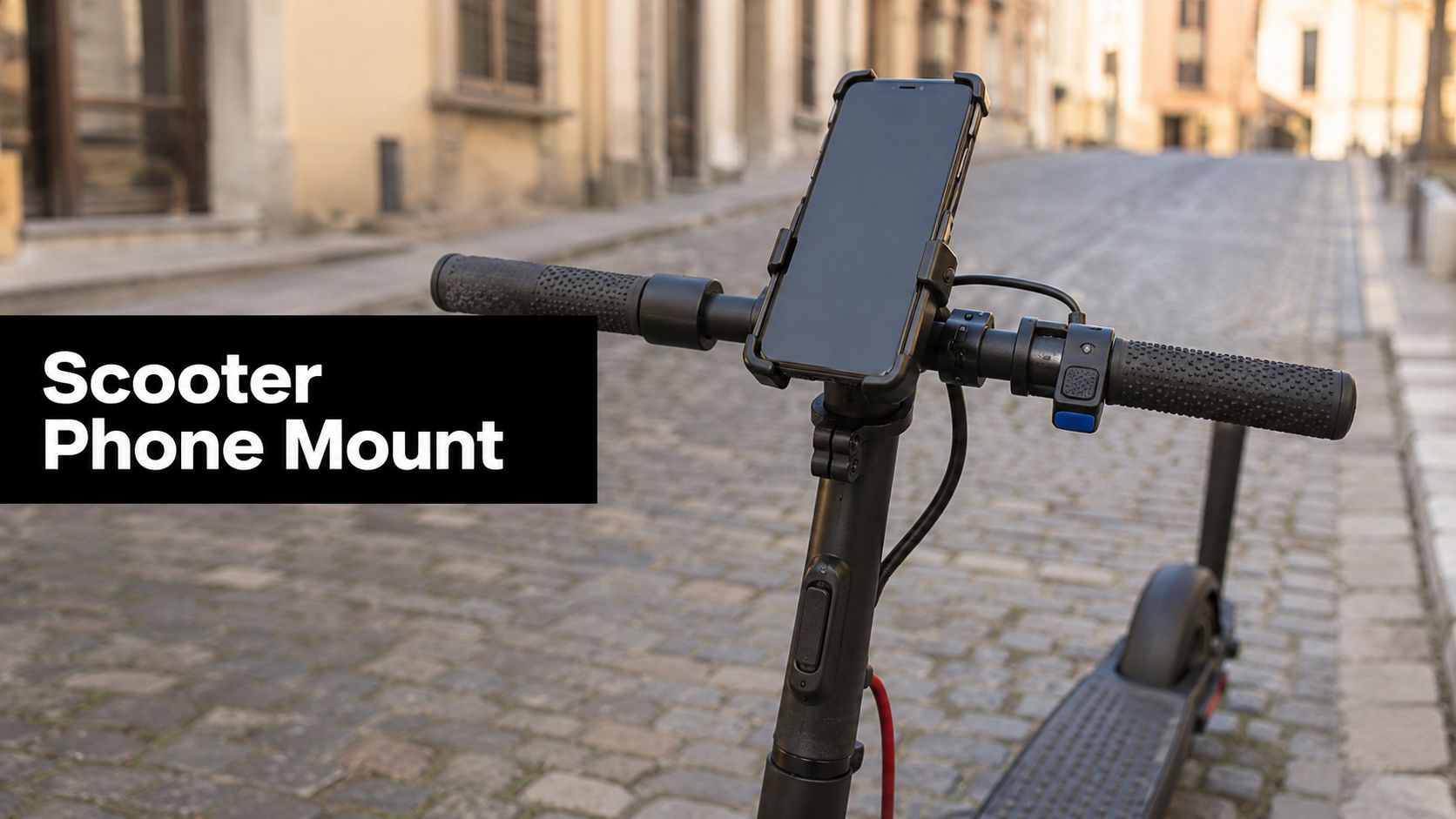
You're usually looking for an electric scooter phone holder right after the same moment everyone has. You miss a turn, your navigation reroutes, rain starts misting the screen, and suddenly you're trying to glance at your phone while keeping one hand steady on a twitchy handlebar. In central London, Manchester tram corridors, older streets in Prague, or slick bike lanes in Amsterdam, that goes from annoying to sketchy fast.
A good mount fixes more than convenience. It gives you a stable reference point for maps, ride tracking, and quick checks while stopped. It also stops the bad habit of pulling a phone from a pocket at lights, then fumbling to put it away before moving again.
The catch is that many mounts look similar online and behave very differently once they meet cobblestones, wet roads, cold mornings, and the sharp vibration of a small-wheeled scooter. That's where most buyers get burned. The best choice isn't the one with the flashiest cradle. It's the one that matches your bar, holds your phone without creep, and stays readable when the weather turns.
Why a Phone Holder Is a Scooter Game Changer
If you commute by scooter in a busy city, you already know how quickly a simple route check can become a distraction. A left turn appears, the lane narrows, a van stops half in the cycle path, and your phone is in your jacket pocket buzzing with directions you can't safely see. That's exactly where a proper electric scooter phone holder earns its keep.

It changes how you ride in traffic
Mounted correctly, your phone sits in your natural line of sight. You're not staring down at your hands or stopping every few streets to confirm the next turn. In UK and EU city riding, that matters because the environment changes constantly. Painted lanes disappear. Surfaces go from smooth tarmac to patched asphalt to brick. You need your attention on the road first, not on digging a handset out of a pocket.
A holder also cleans up routine tasks:
- Navigation use: You can follow maps with short glances instead of repeated stops.
- Ride data: Speed, route, and battery apps are easier to check while stationary.
- Hands-free convenience: Where local rules allow it, calls and prompts are easier to manage without physically handling the phone.
It isn't a niche accessory anymore
This isn't some fringe add-on for hobby riders. A market scan of the category tracked 120 products and found the top 10 average sales were 7,200 units, with an average price of $15.59 and an average rating of 4.6 stars. The same snapshot showed the leading listing reaching about 20,000 monthly sales, with other top listings at 10,000 and 9,000 monthly sales, which is a strong sign that scooter phone holders have become a mainstream commuting accessory rather than a novelty, according to this phone holder for electric scooter market scan.
Practical rule: If thousands of riders keep buying the same type of accessory month after month, it usually solves a real riding problem.
More scooters on the road changed accessory demand
Phone holders became more common as scooters themselves moved into daily urban transport. In the United States, e-scooter trips were estimated at about 65 million in 2018 and 86 million in 2019, while shared scooters and bikes expanded from 35,000 in 2018 to 85,000 in 2019 across surveyed cities, as noted in this overview of scooter phone holder adoption and ridership growth. The exact market is different in Europe, but the pattern is familiar. Once riders start using scooters for real journeys instead of short novelty trips, they want visible navigation and a less chaotic cockpit.
Choosing Your Mount Style
The easiest mistake is buying by appearance. Mounts are more like bags than gadgets. A slim briefcase, a hiking backpack, and a waterproof roll-top all carry your stuff, but each suits a different trip. Phone holders work the same way.

Handlebar mounts
This is the classic option, and for most riders it's still the safest default. It clamps to the bar, gives plenty of adjustment, and usually fits the widest range of scooters.
Handlebar mounts suit commuters who want flexibility. If your scooter has a busy cockpit with a display, throttle, bell, and brake levers fighting for space, a bar mount can usually be nudged into a workable position without much drama. The trade-off is clutter. On narrow bars, they can make everything feel cramped.
Stem mounts
Stem mounts place the phone more centrally. They tend to look cleaner and can feel more balanced because the screen sits near the scooter's centre line rather than hanging off one side.
They work best on scooters with limited bar space or riders who hate a crowded setup. The downside is compatibility. Some stems don't offer a good clamp area, and folding mechanisms can limit where you can place the mount. A neat look doesn't help if the mount interferes with the latch or wiring.
A central position often feels tidier, but only if it doesn't block the display or force the phone too low to read quickly.
Mirror mounts and magnetic mounts
Mirror mounts make sense on machines that already have mirror stems. They put the phone higher, which can improve sightlines, especially for riders using a seated setup or a wider cockpit. On scooters without mirrors, they're irrelevant.
Magnetic mounts are the quickest to live with. Snap on, snap off, done. They're convenient for delivery riders, short errand hops, or anyone who removes the phone often. But convenience comes with a question mark on rough streets. If your daily route includes old paving, dropped kerbs, or broken tarmac, many riders prefer a physical clamp over a magnet.
Waterproof case style mounts
These surround the phone in a weather-resistant shell. They're useful if you ride through frequent rain or winter spray and want one accessory to handle both retention and basic weather shielding.
The compromise is usability. Some case-style holders make screens less responsive, add glare, or trap heat during navigation. They're practical in bad weather, but they rarely feel as slick as an open cradle.
Which style fits your riding
A quick shorthand helps:
| Riding pattern | Best fit |
|---|---|
| Daily commuter in mixed weather | Handlebar mount or waterproof case mount |
| Minimalist cockpit | Stem mount |
| Scooter with mirrors and upright posture | Mirror mount |
| Frequent stops and quick phone removal | Magnetic mount |
If you also ride an e-bike and want a wider comparison before buying, this guide to an e-bike mount helps show where scooter and bike needs overlap, and where they don't.
Decoding Compatibility and A Perfect Fit
Most returns happen for one simple reason. The phone fits, but the scooter doesn't. Or the clamp fits the bar, but the phone in its case is too wide, too thick, or too awkwardly shaped to sit securely.
Measure the scooter first
A reliable fit starts at the clamp. One buyer guide recommends matching the holder to your handlebar diameter and confirms that many mounts target bars around 17 to 30 mm while accommodating phones roughly 5.1 to 6.8 inches, with clamp geometry being more important than looks for resisting vibration and braking loads, according to this electric scooter phone mount fit guide.
If you don't own callipers, use a strip of paper or string:
- Wrap it around the handlebar where the mount will sit.
- Mark the overlap point.
- Lay it flat and compare the circumference against the mount's stated clamp range.
- Check for nearby obstacles like brake reservoirs, display pods, folding hooks, or cable bundles.
That last step matters more than people expect. Plenty of bars are technically the right diameter but don't have enough clean clamping space.
Measure your phone with the case on
Don't measure the naked handset if you ride with a case every day. Measure the actual setup you'll use. Include width and thickness, and pay attention to camera bump shape if the holder grips near the corners.
This is especially relevant if you've bought a larger device or something with a rugged case. If you're using a replacement handset such as a refurbished iPhone 14, check its dimensions with the case fitted before assuming a “universal” cradle will hold it tightly enough on rough pavement.
Buy for the phone you actually ride with, not the phone you hold at home without a case.
Common fit mistakes
A few failure points come up again and again:
- Clamp padding mismatch: Rubber inserts can help on slightly smaller bars, but too much packing material can create wobble instead of grip.
- Overconfident “universal” claims: A cradle may open wide enough for the phone and still fail at the scooter clamp.
- Bad placement: If the holder sits too close to the brake lever or display, you'll either knock it during use or stop checking the screen because it's annoying to see.
A good fit should feel boring. No twisting by hand. No slipping when you press the side of the cradle. No contact with cables when the bar turns.
Must-Have Features for Real World Riding
Specs only matter if they solve a real riding problem. On UK and EU streets, the problem usually isn't a dramatic crash. It's repeated small punishment. Cobblestones, utility covers, broken joins in cycle lanes, drainage channels, and constant stop-start braking all work the mount harder than a smooth test ride in a car park.
Vibration control matters more than most people think
The key feature I'd never skip is vibration management. A 2024 analysis found that 68% of reported phone mount failures on urban e-scooters stem from micro-fractures in the handlebar mount point caused by unmitigated high-frequency oscillations. That matters if you ride a premium frame or any scooter that sees daily rough-road use.
A mount can look secure in the cradle and still be slowly stressing the attachment point underneath. That's why stiff metal alone isn't enough. You want a design that grips firmly but doesn't pass every tiny road shock straight into the same point on the bar day after day.
Strong clamping beats flashy design
Lots of cheap holders advertise style first. In practice, the winners tend to have a very plain trait. They clamp hard and stay put. On rough streets, the enemy isn't just vertical bounce. It's rotation, lateral creep, and gradual loosening.
Look for:
- Mechanical grip: Corner arms, side clamps, or locking mechanisms that resist movement from multiple directions.
- Stable base shape: A broad clamp contact area generally behaves better than a tiny contact patch.
- Hardware you can retighten: Fasteners and joints should feel serviceable, not disposable.
If a mount can be twisted easily by hand after installation, it won't improve once you hit paving stones.
A useful walkthrough of mounting hardware and ride use sits below.
Material and weight affect steering feel
A quality holder built from aluminum alloy and stainless steel can weigh as little as 6 ounces, combining low handlebar mass with better corrosion resistance and clamp strength than softer plastic designs, as shown in this scooter phone holder specification example.
That doesn't mean every metal mount is automatically better. A badly designed heavy mount can make the front end feel top-heavy, especially on scooters with narrow bars or twitchy steering geometry. But when the design is good, low mass plus rigid materials usually feels more planted over time than cheap plastic joints that soften, flex, or crack.
Features worth paying for
Some extras are useful in everyday riding:
- 360-degree adjustment: Handy for reducing glare and switching between portrait and horizontal orientation.
- Water resistance: Not every mount needs a sealed case, but daily commuters benefit from splash tolerance.
- Quick release: Excellent if you remove the phone at every stop.
- Tool-free adjustment: Convenient only if it doesn't compromise clamp security.
The feature that sounds good but often disappoints is “universal fit.” Real-world riding rewards precise fit, not broad promises.
Installation and Safe Riding Tips
A solid mount can still perform badly if it's installed carelessly. Most issues start with either under-tightening, which causes creep, or over-tightening, which can mark bars, crush shims, or create stress at the clamp point.
A clean install
Start with a dry, clean bar or stem section. Dirt trapped under the clamp can make a mount feel tight at first, then settle and loosen later. If your holder uses rubber pads, seat them evenly before tightening anything.
Then work in this order:
- Position first: Sit on the scooter and find a location you can glance at without blocking the display.
- Tighten gradually: Alternate sides if the clamp uses two bolts.
- Test by hand: Try to rotate the mount and rock the cradle before you add the phone.
- Road-test on a short route: Don't discover a bad angle halfway through traffic.
Set the screen for weather, not just comfort
A 2025 European study reported that 72% of e-scooter riders experience screen obscuration from mount wobble in wind or rain, and linked it to a 30% higher rate of minor accidents during turns. The same study suggests setting the phone's tilt angle to around 15 to 20° to better counter those forces.
That matches what many city riders learn on their own. A flat, upright screen often looks fine when stationary, then becomes reflective, shaky, or unreadable once wind and drizzle hit. Tilting slightly can improve readability and reduce the feeling that the phone is acting like a small sail.
In wet weather, set the phone a little lower and slightly angled. It usually cuts glare and makes the screen feel steadier.
Ride legally and don't chase the screen
A holder helps you find your way. It doesn't make constant screen interaction safe. Use voice prompts where possible, pause to make route changes, and keep visual checks brief. That's especially important in dense urban riding where a second of distraction is enough to miss a pedestrian, bollard, opening car door, or a rider filtering past.
Protective kit matters too, because the same roads that shake a mount also punish riders when things go wrong. If you're updating your setup, this guide to electric scooter safety gear is worth reading alongside your mount choice.
Maintenance and Your Questions Answered
A phone holder isn't a fit-and-forget accessory. Daily vibration, weather, and repeated removal all loosen parts over time. The good news is that basic upkeep takes minutes.
A simple maintenance routine
Check the mount regularly, especially after rough rides or wet weeks.
- Retighten fasteners: Bolts and pivots can back off gradually with vibration.
- Clean the clamp area: Grit under the mount can wear finishes and reduce grip.
- Inspect rubber parts: Pads and sleeves harden, compress, or split with age.
- Watch moving joints: Rotation heads and quick-release parts often show wear first.
If your holder uses metal hardware, that can help long term. A quality model made from aluminum alloy and stainless steel can weigh as little as 6 ounces, which helps preserve steering feel while also offering better corrosion resistance and clamp strength than many plastic-heavy alternatives, based on this phone holder product specification.
Common questions
Can I use the same holder on an e-bike too
Sometimes, yes. The main issue isn't whether the listing says “bike” or “scooter.” It's whether the clamp range, available bar space, and vibration pattern suit both machines. Scooters often produce harsher high-frequency buzz through smaller wheels, so a holder that feels fine on an e-bike may be less stable on a scooter.
What if my handlebar is unusually thick or thin
Look for a mount that publishes an actual clamp range rather than broad “universal” wording. If you need shims, use the ones intended for the mount. Improvised padding can create a soft interface that slips under load.
Will navigation drain the battery faster
Yes, usually. Brightness, GPS, mobile data, and screen-on time all increase battery use. For longer rides, lower the brightness as far as practical, preload routes when you can, and carry a power bank if your journey depends on the phone.
How often should I replace a mount
Replace it when the joints won't hold tension, the clamp develops movement, or the cradle no longer grips the phone securely. With commuting gear, “still attached” isn't the same as “still trustworthy.”
For the rest of your scooter upkeep, this broader guide to electric scooter maintenance pairs well with regular mount checks.
If you're upgrading your ride setup and want parts, accessories, and electric scooters selected for everyday urban use, take a look at Punk Ride LLC. They serve riders across the UK, Germany, the EU, the US, and beyond with a wide range of micromobility gear built around real commuting needs.
Share:
Electric Bike Motor Types a Practical US & AU Guide
Electric Scooter Yellow: Yellow Electric Scooters