


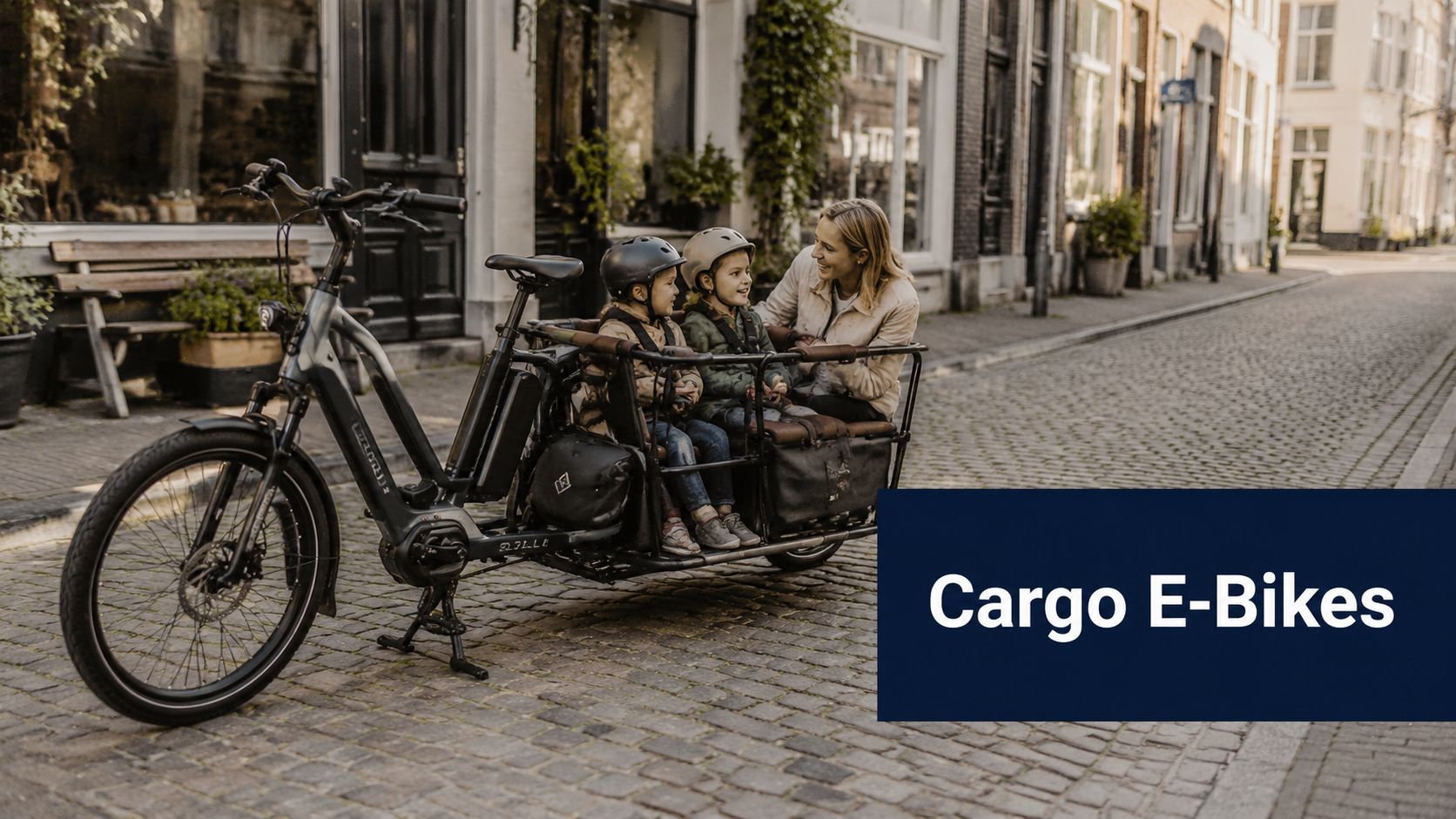
You're standing outside school with two children, a week's groceries, and a car trapped behind a line of traffic. Or you're running a small delivery business where the van spends more time searching for legal loading space than moving parcels. A cargo e-bike looks like an obvious answer, but the main question isn't whether it can carry cargo. It's whether it can carry your cargo, on your routes, while stopping and cornering safely.
That distinction matters. Marketing pages often highlight a maximum payload without explaining whether the figure includes the rider, how the load should be distributed, or how the bike behaves when the box is full. This guide treats cargo e bikes as working vehicles, not oversized bicycles. You'll find practical advice on formats, payload math, braking, family use, fleet operations, and the situations where a cargo bike should complement a car or van rather than replace it.
Why Cargo E Bikes Are Taking Over Urban Streets
A parent choosing a cargo e-bike usually starts with one trip, not a transport strategy. The school run becomes a grocery stop, the grocery stop becomes a pharmacy visit, and suddenly a short urban journey requires a car, a parking space, and patience. A delivery operator faces the same problem from another angle. The van carries plenty, but congestion, restricted access, and curbside parking turn each stop into an operational delay.
Cargo e-bikes solve that mismatch by carrying a useful load while remaining small enough for dense streets and cycle infrastructure. They can move goods through places where vans struggle to enter, park, or turn. That makes them particularly suitable for short urban routes, school runs, service calls, food deliveries, and parcel distribution.

A market moving beyond the niche
The global cargo e-bike market has crossed the multi-billion-dollar threshold, and major market outlooks project continued expansion through the 2030s. One estimate places the market at USD 2.43 billion in 2025, rising to USD 4.52 billion by 2035, while another forecasts growth from USD 2.5 billion in 2025 to USD 5.5 billion by 2034. A third estimate is higher, at USD 4.10 billion in 2025 and USD 8.97 billion by 2032. These projections differ because market definitions and research methods vary, but they point in the same direction, cargo e-bikes have moved into mainstream logistics and mobility. Global cargo e-bike market outlook
Europe remains a leading region in those market reports, with estimates ranging from just over 40% to about 51% of global revenue in 2025. Dense cities, established cycling cultures, and restrictions on conventional vehicles give European operators a strong reason to test smaller freight vehicles.
Commercial demand already dominates the category. One market breakdown attributes 58.41% of the e-cargo bike market in 2025 to commercial delivery fleets, while another estimates that commercial use held about 83.1% of the electric cargo bike market in the same year. Commercial cargo e-bike market analysis
Belgium offers a useful real-world signal. Cargo bikes delivered 5.2 million parcels in 2024, up from 3 million in 2023, according to the Bicycle Logistics Federation. The lesson for families and fleet managers is straightforward: the technology is no longer experimental, but choosing the right format and loading it correctly still requires care.
The Main Types of Cargo E Bikes Explained
Cargo e-bikes fall into four practical formats. The right choice depends less on the number of seats or the size of the battery than on where the load sits, how often you'll turn at low speed, and whether you need a compact machine or a stable platform.
Longtails
A longtail extends the rear rack and wheelbase behind the rider. Children, panniers, shopping bags, and work equipment sit over or beside the rear wheel. It feels closest to a conventional bicycle, which makes it approachable for experienced riders and useful for families who need to park in tighter spaces.
Its weakness is rear loading. Too much weight high or far behind the axle can make steering feel light and amplify movement from passengers. Keep heavy bags low, use proper footboards and handholds, and avoid treating the rear rack as an unlimited shelf.
Front-loaders and bakfiets bikes
A front-loader, often called a bakfiets, places the cargo box between the rider and the front wheel. The low, central position gives the rider a clear view of children or goods and usually creates a more predictable load platform.
Front-loaders are strong choices for school runs, groceries, and mixed household errands. Their longer frame needs more room when turning, and the steering linkage can feel unfamiliar at first. A proper test ride matters, especially if the route includes narrow gates, steep ramps, or crowded junctions.
Box bikes
A box bike is a front-loader with an enclosed or semi-enclosed cargo compartment. Businesses use them for parcels, tools, catering equipment, and service work because the box can be secured, branded, weather-protected, or fitted for a particular task.
The enclosed body adds practical value but also adds mass and wind resistance. For commercial work, assess the loading height, internal dimensions, access method, and whether the box works with your delivery containers. A large box that's difficult to load quickly can undermine the benefit of the bike.
Trikes
A three-wheel cargo bike offers a broad, stable platform when stationary and in straight-line travel. It suits heavier grocery loads, commercial delivery work, and riders who prioritize low-speed stability over bicycle-like agility.
The tradeoff appears in corners. A trike can reach dynamic limits during tight bends or abrupt direction changes, with tip-over risk becoming more important than simple steering balance. It should be ridden conservatively when loaded, particularly on cambered roads and uneven surfaces.
| Type | Best For | Cargo Position | Handling When Loaded | Typical Payload |
|---|---|---|---|---|
| Longtail | School runs and compact family trips | Extended rear rack | Familiar, but rear-heavy loads affect steering | Varies by model |
| Front-loader | Groceries, children, and mixed errands | Low box between rider and front wheel | Predictable, with a longer turning profile | Varies by model |
| Box bike | Parcels, tools, and protected commercial loads | Enclosed front compartment | Stable and practical, but heavier | Varies by model |
| Trike | Dense-city deliveries and large platform loads | Front box or rear platform | Stable in straight travel, less forgiving in tight bends | Varies by model |
Manufacturers publish different limits, so don't use the format alone to estimate capacity. Use the model's total permissible weight, rider limit, axle limits, and cargo-box or rack limit as separate checks.
Key Specs That Actually Matter When Buying
A cargo e-bike listing can look impressive while hiding the details that determine whether it works on your street. Start with total gross weight, not cargo volume. The relevant calculation is:
rider + cargo + accessories + battery + bike = total loaded weight
Transport for London lists one Urban Arrow XL configuration with a recommended gross weight capacity of 275 kg including the bike, rider, and load, while the Vok XL is listed with a 200 kg payload. Those figures show why buyers must distinguish gross capacity from cargo capacity. Transport for London cargo-bike guidance
Motor placement and battery use
A mid-drive motor applies assistance through the bicycle's drivetrain and generally handles hills more effectively when the bike is loaded, provided the rider uses the gears correctly. It also keeps mass near the centre of the frame. A hub motor is simpler in operation and can suit flatter routes, but the motor's position changes weight balance and may complicate wheel or tyre servicing.
Battery capacity matters, but advertised range won't tell you how the bike behaves with children, groceries, hills, cold weather, or frequent starts. Ask whether the battery is removable, whether a second battery is supported, and where the charging point sits. A fleet should also plan charging space and safe storage. For broader depot planning, warehouse EV infrastructure advice offers useful context, even though cargo-bike charging has different power requirements from larger vehicles.
Frame, brakes, and cargo hardware
The frame should resist flex under load, especially around the head tube, rear stays, steering linkage, and rack mounts. A bike that feels lively when empty may feel vague when loaded. Test it with representative weight, not just a showroom spin.
Hydraulic disc brakes provide strong modulation and heat management, but the system still needs suitable rotor size, quality tyres, and correct adjustment. Heavy cargo raises the demands on every part of the braking system. Punk Ride's guide to e-bike hydraulic brakes is a useful primer before you compare component lists.

Finally, inspect the cargo ecosystem. Integrated rails, child seats, weather covers, panniers, locks, and modular platforms are safer and more useful than improvised add-ons. Check replacement availability before buying, because a cargo bike becomes a long-term tool only when its wear parts and accessories remain serviceable.
The Truth About Payload Limits and Braking Safety
A maximum payload is not a permission slip to load the bike however you like. It's a limit that assumes the manufacturer's approved configuration, correct tyre pressure, suitable accessories, and competent handling. The same number can feel safe with a low, centred load and unstable with heavy items stacked high at the rear.
A peer-reviewed study on bicycle geometry and cargo loading recommends that retrofitted cargo bikes carry no more than 15 kg on the rear rack, because a rear hub motor, short wheelbase, and small wheels can reduce structural margin and increase instability under load. The study's practical lesson is broader than that specific limit. Rear-rack loading should be treated as a control variable, particularly on converted bikes. Peer-reviewed study on bicycle geometry and cargo loading
Load low, central, and secured
Put dense items low in the box or on the platform, close to the bike's centre. Use straps or fitted restraints so the load can't slide during braking. Don't let a child seat, battery, trailer, or delivery container push the bike beyond its axle-specific limit even when the total weight appears acceptable.
A family load also moves. A child shifts position, reaches sideways, or climbs aboard while the bike is stationary. That changes the handling equation more than a fixed box of groceries. Fit approved seating, foot protection, restraints, and weather equipment, then practice starts, stops, and slow turns away from traffic.
Practical loading rule: If the bike feels noticeably light at the front, vague through the steering, or difficult to hold upright at a stop, reduce or relocate the load before riding farther.
Braking and cornering are different problems
DEKRA's cargo-bike braking tests found that braking performance generally remained good as load increased, but the load significantly influenced braking behaviour. More mass increases heat, tyre-grip demands, and weight transfer, so a powerful brake system doesn't erase the need for slower speeds and larger following gaps. DEKRA cargo-bike braking tests
A separate child-transport safety study found three-wheeled cargo bicycles were the most stable of the tested transport methods and achieved braking distances similar to a conventional bicycle without a child passenger. The same research identified dynamic limits in tight bends and abrupt direction changes because of tip-over risk.
Two-wheel cargo bikes lean and remain agile, but their balance depends on the rider. Trikes feel secure at rest, yet they demand deliberate cornering. Brake before the bend, keep the load low, and don't make sudden steering inputs. For a deeper discussion of weight ratings across electric bikes, see Punk Ride's e-bike weight-limit guide.
Cargo E Bikes vs Cars and Vans for Real-World Use
Cargo e-bikes can replace a car for many short urban journeys, but they won't replace every vehicle. The winning use case has a dense destination pattern, limited parking, moderate payload, and routes where traffic makes driving inefficient. School runs, local shopping, small service calls, and parcel drops often fit that profile.
They fall short when the route is long, the weather is severe, the road network lacks safe cycling access, or the load needs substantial volume and protection. A family that regularly carries several adults, bulky furniture, or equipment over long distances still needs a car or van. A delivery operator with regional routes needs a larger vehicle, even if a cargo bike can handle the final urban leg.
UK policy material frames the distinction clearly. E-cargo cycles can carry loads of 100 to 300 kg, compared with about 600 kg for a small van, so they cover a substantial share of urban freight without replacing vans one for one. UK cargo-bike law and payload comparison
Where the economics make sense
A cargo e-bike avoids fuel, congestion exposure, and much of the parking friction associated with a van. It also allows riders to use suitable cycle routes and stop close to destinations. Those advantages are strongest when deliveries are frequent, local, and spread through congested streets.
Commercial operators should calculate route fit rather than asking whether the bike can replace the entire fleet. Keep a van for heavy trunk movement, bad-weather contingency, or routes outside the practical range of the cargo bike. Use cargo e-bikes for the final distribution pattern where their smaller footprint has operational value.
For businesses comparing urban cargo-bike work with larger vehicle operations, a middle-mile van delivery guide can help clarify where vans remain the better tool. The sensible fleet is often mixed, not ideological.
Consumer willingness also matters. Research on e-cargo-bike delivery found 42.8% of respondents wouldn't pay more, while 20.6% would pay extra, and businesses identified scalability, cost, infrastructure, and training gaps. Research on e-cargo-bike delivery adoption Operators should therefore build the business case around efficiency and route economics, not assume customers will fund the transition through higher delivery charges.
For delivery-specific purchasing criteria, this guide to electric bikes for delivery adds a useful operational perspective. It's also important to check local rules. In the UK, cargo bikes and trailers currently have no legal limits on wheel count, weight, or size, while regulators have indicated that a future dividing line may align with a European cargo-bike standard around 600 kg gross vehicle weight. The position is evolving, so commercial operators should verify current requirements before scaling.
How to Choose and Maintain Your Cargo E Bike
Choose the route before choosing the bike. Write down the heaviest regular load, the longest routine trip, the steepest section, storage location, charging access, and the people or goods you'll carry. A school-run bike has different priorities from a parcel platform, even if both are marketed as cargo e-bikes.
A practical buying sequence
- Define the primary job. Select a longtail for compact family transport, a front-loader for children and groceries, a box bike for protected commercial goods, or a trike for a broad, stable delivery platform.
- Calculate the loaded weight. Add rider, children, cargo, accessories, battery, and bike. Compare that total with gross capacity, then check front, rear, rack, and box limits separately.
- Test the position. Ride with ballast placed where your actual cargo will sit. Practice starting uphill, braking firmly, turning slowly, reversing, and dismounting while the bike is loaded.
- Inspect support. Ask about parts, servicing, battery replacement, brake adjustment, tyres, racks, child seats, covers, and warranty handling. A low purchase price is irrelevant if the bike sits unused while waiting for a proprietary component.
Punk Ride LLC lists cargo models such as the ENGWE LE20 Cargo Electric Bike and the ENGWE LE20 Cargo Dual-Battery Electric Bike, alongside a wider selection of electric rides. Treat any listing as a starting point, then verify the model's exact capacity and accessory compatibility.
Maintenance that protects the payload system
Heavy loads accelerate wear through the drivetrain, tyres, wheels, steering components, and brakes. Check tyre pressure before loaded rides, inspect spokes and rack fasteners, and look for play in the headset, wheel bearings, and steering linkage. Clean and lubricate the chain according to the drivetrain manufacturer's guidance, especially after wet or gritty winter trips.
Use this short checklist:
- Before every loaded ride: Check tyres, brake feel, restraints, lights, and cargo fasteners.
- Regularly: Inspect pads, rotors, chain, cassette, wheel tension, and rack mounts.
- During wet seasons: Clean road contamination promptly and dry electrical connectors.
- For the battery: Store it in a suitable dry environment, use the approved charger, and avoid leaving a high-drain work battery neglected for long periods.
- For fleets: Record inspections, faults, charging, and component replacements for each bike.
A cargo e-bike earns its keep when maintenance is planned, not when repairs become emergencies.
Your Next Steps Toward Cargo E Bike Ownership
Start with one repeatable journey. If you're a parent, test the school run with the children, bags, and the route's steepest section. If you're a trader or courier, map the stops, loading time, parking conditions, and return trip before ordering a fleet.
Choose the format around the load. Longtails suit compact family use, front-loaders handle children and groceries naturally, box bikes protect commercial goods, and trikes provide a broad platform with more cornering discipline required. Verify total gross weight, axle limits, motor placement, battery access, tyre capacity, steering feel, and braking performance.
Load heavy items low and near the centre. Keep rear-rack weight conservative on converted bikes, secure children and equipment properly, and brake before corners rather than entering them quickly with a full box. Check UK or EU rules for commercial operation because classification and standards are still developing.
Book a dealer test ride with representative ballast, compare the service network, and decide whether the bike replaces a car, complements a van, or just handles one expensive, inconvenient route. That decision is more useful than any headline payload figure.
Punk Ride LLC offers a curated selection of electric rides, including cargo-focused options such as ENGWE models, with warehouses in the UK and Germany and headquarters in Florida. Visit Punk Ride LLC to compare available models and start with the cargo e-bike that matches your actual routes, load, and riding conditions.
Share:
Best E Bikes Under $2000 Worth Buying in 2026
Best Electric Bikes for Tall Riders: Fit, Frame & Buying