


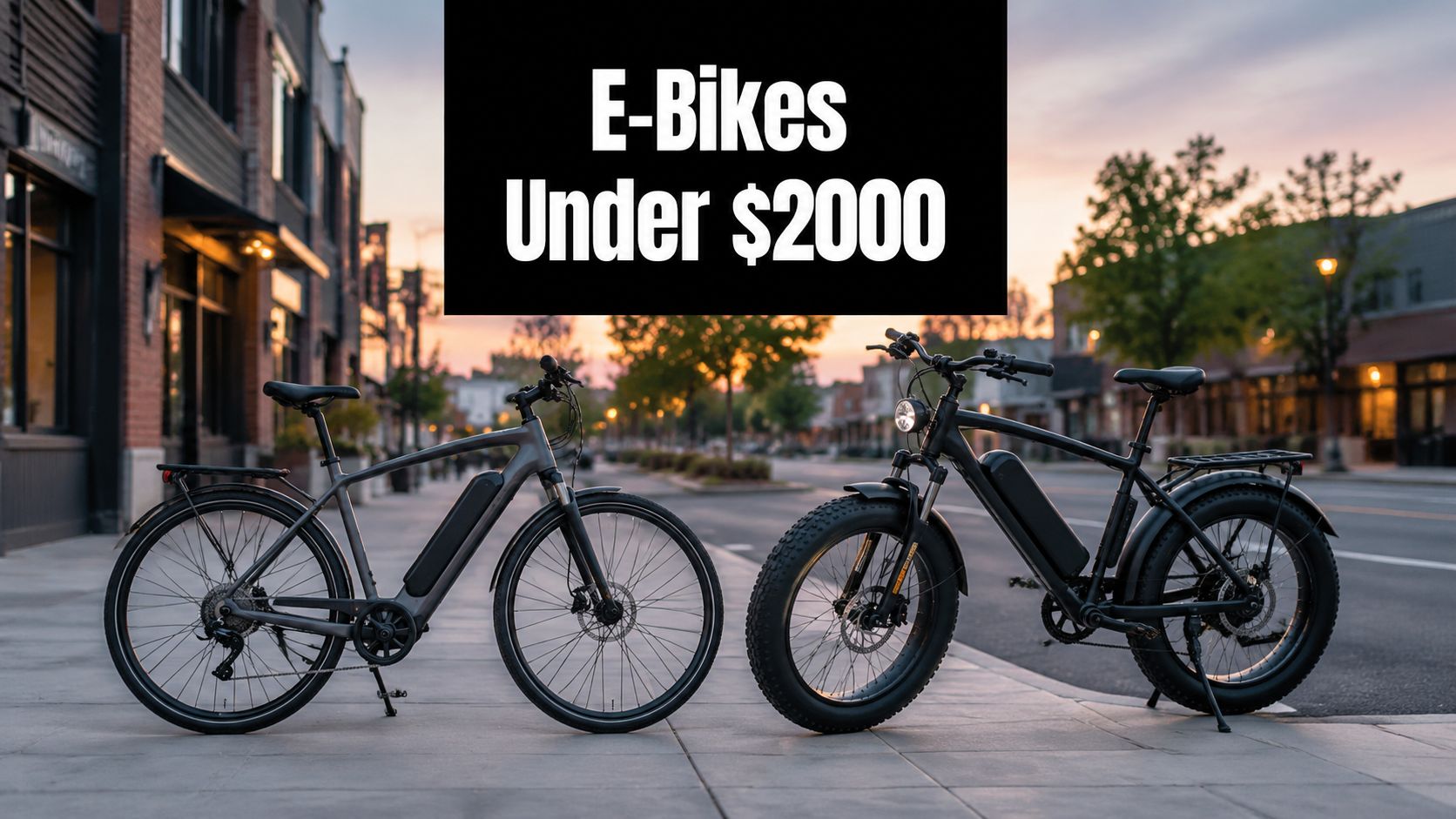
You're staring at a dozen e bikes under $2000, each promising long range, powerful motors, and “premium” parts. One has fat tyres, another has a sleek integrated battery, and a third claims it can travel farther than you'll realistically ride in a week. The difficult part isn't finding an affordable e-bike. It's finding one that remains useful, legal, serviceable, and safe after the first month.
The right choice depends on where you ride, how far you carry the bike, and whether local support matters when something fails. A 750W fat-tyre machine may look like a bargain in the United States, but it can be the wrong purchase for public-road use in the UK or EU. A lighter 500W commuter may be far more practical, even if its headline range looks less impressive.
Why the Sub-$2000 E-Bike Market Matters Right Now
Walk into a bike shop or scroll through an online marketplace and the under-$2000 category is where most first-time buyers now spend their time. You can find compact commuters, folding bikes, step-through city models, and heavy utility machines in the same broad price band. That variety is useful, but it also makes specification shopping dangerous. A larger motor number doesn't automatically mean a better commuter, and a bigger battery doesn't fix poor support or an illegal road configuration.
The category has earned serious attention because e-bikes are no longer a niche corner of cycling. PeopleForBikes reports that e-bikes accounted for 63% of the growth in dollar sales of all bicycles between 2019 and 2023, representing 20% of dollar sales and 4% of unit sales in 2023 across its measured market (industry data on e-bike market growth). That mix tells you something important. E-bikes may sell fewer units than conventional bicycles in the measured market, but they're contributing disproportionately to market expansion.
Historical scale reinforces the point. Statista's market data records approximately 47 million e-bikes sold worldwide in 2022 (worldwide electric bicycle sales data). Affordable models sit inside a category large enough to shape the wider bicycle industry. They aren't experimental toys anymore.
Shop-floor reality: The cheapest bike isn't necessarily the best value. The best value is the bike you can legally ride, charge safely, and get repaired without turning a small fault into a major expense.
For buyers in North America, this price range often targets everyday transport rather than racing. In the UK and EU, the same budget has to be filtered through power and speed rules before you compare motors. That's why the rest of this guide focuses on three things marketing pages often bury: usable range, road status, and ownership support.
Two Paths Inside the Under-$2000 Category
Under-$2000 e-bikes split into two very different families. Choose the family first, then compare models inside it.

The lightweight commuter path
Lightweight commuters prioritise pedal feel, manageable handling, and easy storage. They generally use a 500W motor in the North American market, though a UK or EU version may use a lower-rated system to meet local rules. Battery capacity varies widely, and the frame usually carries narrower tyres and less hardware than a fat-tyre utility bike.
This is the sensible path for a city rider who needs to carry the bike upstairs, fit it into a train routine, or lock it at a public rack. The compromise is straightforward. A lighter bike gives up some climbing force, cargo capacity, and rough-surface stability. You'll notice that loss on steep hills, loose gravel, or when carrying a heavy load.
A torque sensor can make this style feel more natural because the motor responds to how hard you pedal. A cadence-only system can still work well for simple commuting, but it tends to feel more like an on-off assist switch. Don't buy the lightest commuter purely because it's easy to lift. Check whether its riding position, brakes, lights, and battery access suit your daily route.
The 750W fat-tyre utility path
Fat-tyre utility bikes typically use a 750W motor and a 48V electrical system in US-focused versions. Their larger batteries and thick tyres are designed for cargo, hills, mixed surfaces, and riders who want a planted ride. The price is weight. Some are awkward to manoeuvre without power and unpleasant to carry up stairs.
This branch also creates a legal problem in the UK, EU, and Australia. A US-market 750W bike may be perfectly usable on private land, yet fall outside the local definition of a compliant pedal cycle on public roads. You must check the exact regional version, not just the brand name.
Quick decision: Choose the commuter path if you'll carry the bike or ride mostly on pavement. Choose the utility path if traction, load capacity, and rough terrain matter more than portability.
Top Picks Worth Your Money in 2026
The table below is an editorial comparison, not a promise that every regional version has the same equipment. Manufacturers change batteries, motor ratings, and prices by market, so confirm the local specification before ordering.
Top Sub-$2000 E-Bikes Compared
| Model | Motor | Battery | Real-World Range | Weight | Price (USD) |
|---|---|---|---|---|---|
| Lectric XP 3.0 | 500W | Varies by configuration | 35 to 55 miles | Varies by configuration | Under $2000 |
| Aventon Level 3 | Varies by configuration | Varies by configuration | 35 to 55 miles | Varies by configuration | Under $2000 |
| Ride1Up Turris | Varies by configuration | Varies by configuration | 35 to 55 miles | Varies by configuration | Under $2000 |
| Rad Power RadCity 5 Plus | Varies by configuration | Varies by configuration | 35 to 55 miles | Varies by configuration | Under $2000 |
| Fiido Titan | 750W class | Larger-capacity battery configuration | 35 to 55 miles | Heavy utility build | Under $2000 |
Lectric XP 3.0 is the value benchmark for US buyers who want a folding utility bike without spending premium money. It's compact when folded and practical for storage, but its weight and fat tyres make it less pleasant to carry than a genuine lightweight commuter. For a 180 lb rider, plan around the general real-world range benchmark rather than the most optimistic claim. Warranty value depends on whether you can handle basic diagnosis and shipping logistics yourself.
Aventon Level 3 is the commuter upgrade for riders who care about smoother assistance. Its torque-sensor approach is more natural than the abrupt feel found on many inexpensive cadence-sensor bikes. The weakness is that it's less of a compact, carry-anywhere machine than a folding model. A dealer-supported purchase can matter more than a small specification difference when the bike is your daily transport.
Ride1Up Turris suits riders who want a hybrid feel, with enough capability for commuting and occasional unpaved routes. It's a stronger choice than a pure city bike if your route changes frequently, but it isn't the answer for serious cargo hauling. Treat its claimed range as a best-case figure and judge the warranty by the actual repair process, including who pays for shipping and who performs the work.
Rad Power RadCity 5 Plus makes sense for buyers who value practical carrying capacity and access to an established support network. Its drawback is the same one many utility commuters face, more equipment means more weight and more parts to maintain. The warranty is useful only if the regional service channel can supply parts and diagnose faults without sending the whole bike across a border.
Fiido Titan, or a similar fat-tyre utility model, is the rough-terrain choice. It offers the grunt and stability that make gravel, uneven paths, and heavier loads less frustrating. The marketing glosses over portability and regional legality. US buyers should verify the exact warranty procedure, while UK and EU buyers should not assume a high-output version is road legal.
The Lectric, Ride1Up, and many Fiido configurations are primarily US-oriented. Aventon and Rad Power availability depends on the market and model year. EU buyers should prioritise an officially compliant regional version, not an imported US specification.
Real-World Range vs the Numbers on the Box
A range claim is a laboratory-style ceiling, not a route plan. Independent review coverage puts typical real-world range for sub-$2000 e-bikes at 35 to 55 miles with moderate assist on mixed terrain and an average 180 lb rider (real-world range guidance for e-bikes under $2000). Hills, wind, and heavier loads can reduce that figure by 20% to 30%, according to the same coverage.
A bike advertised at 60 miles may therefore be perfectly useful, but you shouldn't plan a demanding mixed-terrain commute around the headline number. Assist mode is the largest everyday lever. Eco mode preserves energy, while high assist and throttle use draw more power, especially during repeated starts and climbs.
Tyre pressure matters too. Wide 2.4-inch-plus tyres create comfort and grip, but they also add rolling resistance when underinflated. Cold batteries can deliver less useful energy than they do in mild conditions, so storing and charging the battery in a suitable indoor location matters during colder weather.

Use battery watt-hours as your first sanity check. Divide battery watt-hours by roughly 15 to 20 watt-hours per mile for a basic estimate, then reduce the result for hills, wind, cold, heavy cargo, and aggressive assist. This isn't a guarantee, but it quickly exposes a range claim that doesn't match the battery size.
Hub motors are common in this price category and work well on flatter routes. Mid-drive systems can use the bicycle's gears more effectively on climbs, but they're less common at this budget and can bring different service requirements. Regenerative braking claims deserve little weight in this price band. Focus on battery capacity, riding conditions, and service access instead.
For a deeper explanation of what affects battery longevity and usable capacity, read this guide to electric bike battery life.
Road-Legal Rules in the UK, EU, and Australia
A powerful e-bike can be a poor purchase if you need to ride it on public roads. In the UK, an Electrically Assisted Pedal Cycle, or EAPC, must have working pedals, a motor with no more than 250 watts maximum continuous rated power, and assistance that cuts off at 15.5 mph, or 25 km/h (UK government e-bike rules). Compliant bikes are treated like conventional bicycles under UK law.
That classification is the key. A throttle that provides full motor power without pedalling, an unrestricted controller, or a motor above the permitted continuous rating can move the bike outside EAPC treatment. The manufacturer label and regional documentation also matter, so don't rely on a sales listing that only displays peak power.
EU rules vary in detail, but compliant pedal-assist e-bikes generally sit around the same 250W and 25 km/h framework. Australia also centres its federal-style framework on 250W continuous power and assistance cut-off at 25 km/h, with the rider allowed to pedal faster under their own power (Australia and UK e-bike law overview).
| Region | Max Continuous Power | Speed Cut-off | Throttle Allowed | Helmet Required |
|---|---|---|---|---|
| UK | 250W | 15.5 mph, 25 km/h | Full-power throttle can affect classification | Check local cycling rules |
| EU | Commonly 250W for compliant pedal-assist models | Commonly 20 to 25 km/h by country and device class | Depends on national classification | Check national rules |
| Australia | 250W | 25 km/h | Check state and territory rules | Check local rules |
European e-scooter rules are fragmented, although a European Parliament comparison notes that many countries use speed limits around 20 to 25 km/h and commonly don't require a driving licence, insurance, or registration for compliant devices (European comparison of e-scooter regulation). That's why you should check the country and device category before buying.
An over-spec bike can create problems with insurance, enforcement, and liability after a crash. Read the practical guide to whether electric bikes are street legal before importing a US-focused 750W model.
The Hidden Ownership Costs Nobody Talks About
A cheap e-bike becomes expensive through neglected maintenance, difficult repairs, unavailable parts, and weak warranty support. Battery care, charging setup, tyres, brakes, software, and service logistics deserve the same scrutiny as motor power and display features.
A safety survey found that 50% of e-mobility owners who charge at home place the bike where it blocks their exit, while only 36% regularly inspect batteries or electrical components (ULSE e-mobility safety insights). Decide where the bike will live and charge before ordering it. Keep exits clear, inspect the battery and connectors, and stop using any component that shows damage, swelling, or unusual heat.

Repair logistics can erase the saving
Direct-to-consumer brands often handle faults through email troubleshooting, replacement parts, or a full-bike return. That process becomes a serious burden if you depend on the bike for work. A local dealer can usually identify a brake, connector, or display fault faster, even if the bike costs slightly more at checkout.
Before ordering, check whether a workshop near you will service the electrical system. Confirm that replacement tyres, brake pads, cables, displays, and batteries are available in your market. A proprietary part that must cross a border can keep the bike off the road longer than the repair itself.
Maintenance still needs a human
Hydraulic brakes may need bleeding. Mechanical brakes require adjustment as pads and cables wear. Check axle and handlebar hardware, inspect controller connectors, keep the firmware instructions, and record the model and battery details for future support.
Ask these questions before paying:
- Battery replacement: Can you buy a replacement pack directly, and does the company still support older models?
- Warranty labour: Does the warranty cover diagnosis and labour, or only replacement parts?
- Shipping responsibility: Who pays if the bike or battery must travel for service?
- Regional compliance: Is the exact model road legal where you'll ride?
- Charger approval: Is the supplied charger the correct approved unit for that battery?
- Local support: Is there a dealer or qualified workshop familiar with the electrical system?
Insurance may affect both ownership cost and eligibility. Review this guide to electric bike insurance cost before assuming a policy covers an imported or modified bike. A warranty also cannot fix an excluded modification or an unavailable replacement part.
Which Sub-$2000 E-Bike Should You Actually Buy
Stop comparing every model and choose according to the job. A commuter who carries a bike into a flat doesn't need the same machine as a weekend trail rider hauling gear over loose ground.
| Rider Profile | Recommended Pick | Best For | Skip If |
|---|---|---|---|
| Daily city commuter | Aventon Level 3 or a compliant 250W regional equivalent | Smooth assistance and paved routes | You need to carry the bike frequently |
| Value-focused US buyer | Lectric XP 3.0 | Folding utility and everyday errands | You want a light bike |
| Mixed-route rider | Ride1Up Turris | Pavement with occasional rough paths | You need substantial cargo capacity |
| Dealer-focused owner | Rad Power RadCity 5 Plus | Practical commuting and support access | Your local service network is limited |
| Trail and rough-terrain rider | Fiido Titan or similar fat-tyre model | Stability, cargo, and uneven surfaces | You ride public roads in a market with 250W limits |
For a daily city rider covering a short paved round trip, I'd choose the 500W commuter style with an integrated battery in the US, or the compliant 250W version in the UK and EU. It's easier to lock, less cumbersome around traffic, and better suited to ordinary roads than a heavy fat-tyre bike. My US pick is the Aventon Level 3 when smooth pedal response matters. My value pick is the Lectric XP 3.0 when folding storage matters more.
Weekend trail riders should choose the Fiido Titan or a comparable fat-tyre utility model, provided the bike's legal status matches the land and roads where it will be used. The extra mass is a disadvantage in a stairwell, but it becomes an advantage when the surface is loose or the load is heavy. Riders above 200 lb should pay particular attention to the manufacturer's total load rating and braking equipment, rather than treating motor wattage as the only measure of capability.
First-time owners with no mechanical experience should prioritise a local dealer. Direct-to-consumer pricing looks attractive until a fault requires diagnosis, parts ordering, and shipping. A dealer-supported Rad Power model can make more sense than a cheaper online alternative if you need someone nearby to handle setup and warranty work.
For UK and EU readers, my recommendation is simple: buy the 250W pedal-assist regional model, verify the 25 km/h or UK 15.5 mph cut-off, and ignore higher-output bargains unless you understand the separate legal classification. If you're deciding whether to preserve cash or spread out a purchase, this guide on should you lease or finance can help frame the broader payment decision.
Punk Ride LLC offers electric bikes and scooters from brands including Hidoes, KOOLUX, Engwe, and others, with warehouses in the UK and Germany as well as headquarters in Florida. Visit Punk Ride LLC to compare available models under $2000, then confirm the local power rating, road status, battery support, and warranty process before you order.
Share:
Electric Scooter Regenerative Braking Explained Simply
Cargo E Bikes: The Complete Guide to Choosing and Riding