


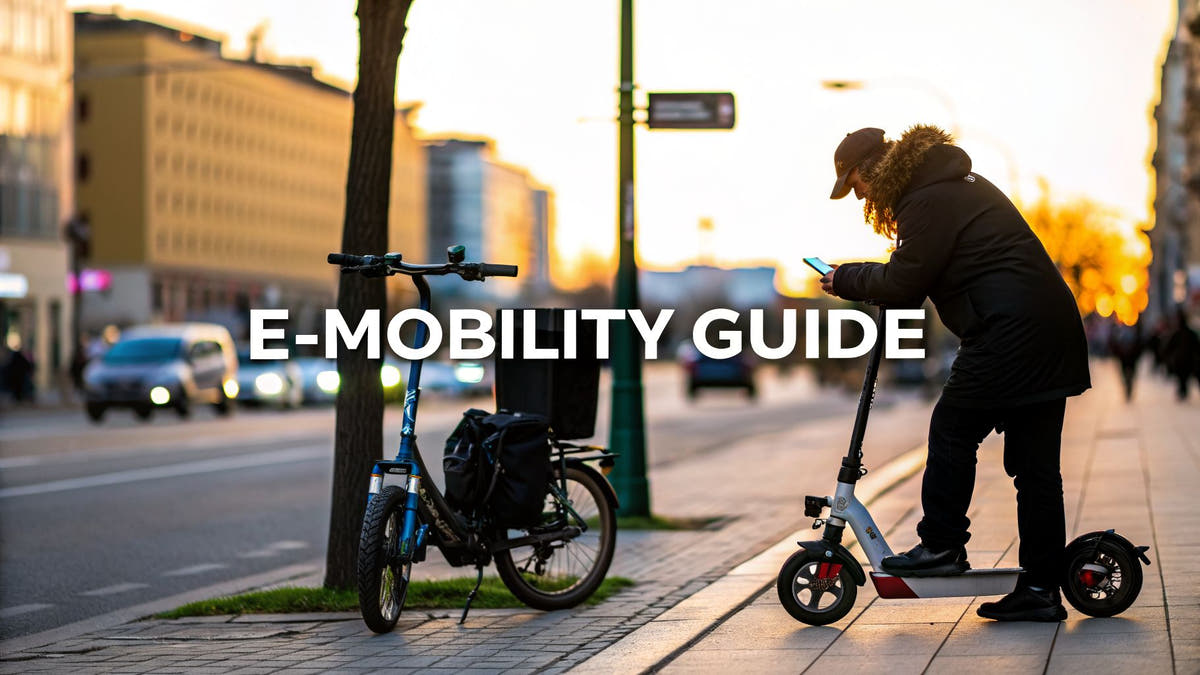
Tired of being stuck in traffic? Fed up with the ever-climbing cost of gas? You're definitely not alone. For a growing number of people, the answer is making the switch to an electric bike or scooter, and it's completely changing how they get around town. This guide is your starting point for figuring it all out, with a special focus on the US and Australian markets.
Your Guide to Modern Urban Freedom
Look around on your next commute. You'll see more and more people breezing past gridlocked cars, saving a ton on fuel, and cutting down their carbon footprint—all before their first cup of coffee. This isn't some sci-fi movie scene; it's the daily reality for people in the US, Australia, and all over the world who have discovered electric mobility.
The appeal is pretty straightforward: you get to take back your time and actually enjoy your trip. Whether you live in a sprawling city like Los Angeles or a bustling metro area like Sydney, an electric ride can turn a stressful daily chore into one of the best parts of your day. It’s not just about getting from A to B anymore. It’s about finding a new kind of freedom.
The Electric Mobility Boom
This surge in popularity isn't just a vibe—it's a real, measurable trend. As our cities get more congested and everyone looks for greener ways to live, the market for personal electric vehicles is absolutely exploding.
The global electric scooter market was valued at USD 48.90 billion in 2025 and is projected to skyrocket to USD 364.24 billion by 2035. This incredible growth is fueled by rapid urbanization, soaring fuel prices, and a worldwide shift towards low-emission personal mobility solutions. You can read the full market analysis from Precedence Research to dig deeper into these trends.
What we're seeing is a fundamental change in how we think about moving around. It’s all part of a bigger movement toward smarter, more sustainable cities. A quiet revolution is happening on our streets, powered by batteries and the simple desire for a better commute.
What This Guide Will Cover
Picking the right ride can feel like a huge task, but we’re here to break it down for you. This guide will walk you through everything you need to know about electric bikes and scooters for adults.
We’ll help you:
- Decide between an e-bike and an e-scooter: We'll compare them head-to-head in real-world situations, not just by listing a bunch of specs.
- Understand the core technology: You'll learn what actually matters—like motor power and battery range—without all the confusing jargon.
- Navigate the rules: We'll give you a clear picture of the current laws in the US and Australia so you can ride legally and safely.
Our goal is to give you the confidence to pick the perfect ride that fits your lifestyle, budget, and daily routine. If this whole world is new to you, you might also want to check out our article that explains the concept of modern urban mobility in more detail.
Alright, let's get you ready to join the movement and find your ideal set of wheels.
E-Bike vs. E-Scooter: Which Ride Is Right for You?
Trying to pick between an electric bike and an electric scooter can feel like a tough call. They’re the two most popular ways to get around town, but the best one for you really just depends on your day-to-day life. Let's break down this classic showdown to help you figure out which one fits you best.
Think of an e-bike as your trusty, all-around workhorse. It’s perfect for longer commutes, letting you get some exercise by pedaling while the motor smooths out the hills and fights back against headwinds. Thanks to their bigger wheels and solid frames, they feel way more stable, especially when the pavement gets a little rough or you're in for a longer ride.
An e-scooter, on the other hand, is the ultimate urban specialist. It’s a master at slicing through city traffic and closing that annoying "last mile" gap between the bus stop and your front door. If you need something you can fold up, carry into the office, and tuck under your desk, the e-scooter is your champion of convenience.
The Commuter's Choice
If you're buying one mainly for your commute, the choice gets a bit clearer.
For any trip longer than three miles, an e-bike is usually the way to go. The seated position and larger wheels just make for a more comfortable and less jarring ride, which you'll really appreciate on a 30-minute journey. Plus, with options for racks and panniers, you can haul your laptop, a change of clothes, or your lunch without getting a sweaty back from a backpack.
E-scooters absolutely own the multi-part commute. You know the drill: train into the city, then a 15-minute walk to the office. A scooter turns that walk into a breezy two-minute glide. Their lightweight and foldable design is their superpower, making them a piece of cake to bring on a train or into a building.
This decision tree can help you visualize whether an e-ride makes sense for your commute.

As you can see, an electric ride often wins out for city travel. The next step is figuring out which one.
To make it even simpler, here’s a quick rundown of how they stack up side-by-side.
E-Bike vs. E-Scooter At a Glance
| Feature | Electric Bike | Electric Scooter |
|---|---|---|
| Best For | Longer commutes (3+ miles), exercise, carrying cargo | Short trips, "last-mile" travel, portability |
| Comfort | High (seated, suspension, large wheels) | Moderate (standing, smaller wheels) |
| Portability | Low (heavy, bulky) | High (lightweight, often foldable) |
| Exercise | Yes, you're always pedaling | No, it's a pure motor-powered ride |
| Cargo Capacity | Excellent (racks, baskets, panniers) | Limited (backpack or small bag) |
| Terrain | Versatile, can handle hills and some trails | Best on smooth, paved surfaces |
This table should give you a good gut feeling for which one aligns with your needs, but let's talk about what happens outside the 9-to-5.
Exercise, Errands, and Everything in Between
Your lifestyle outside of work is a huge factor. If you want to sneak some fitness into your travels, the e-bike is the hands-down winner. You’re still pedaling and getting your heart rate up—you just have a helpful boost on demand. This makes it a fantastic choice for weekend explorers hitting park trails or country roads where a scooter would be out of its element.
E-scooters are the undisputed champs of spontaneous, quick trips. Need to pop over to a local coffee shop or run a quick errand? The grab-and-go simplicity of a scooter can't be beaten. You don’t have to stress about finding a pole to lock it to; often, you can just fold it up and bring it inside with you.
It really boils down to this: E-bikes offer engagement. You're part of the ride, you're getting exercise, and you have more versatility. E-scooters, on the other hand, offer maximum convenience for getting from point A to B in the city with zero fuss.
Still on the fence? We've got an even more detailed comparison that digs deeper into the electric bike vs. scooter for commuting to help you finalize your decision.
In the end, there’s no "best" choice—only the one that’s best for you. Think about what you’ll use it for most, whether that’s long-distance comfort or ultimate portability, and you’ll find the perfect ride to make your daily life a whole lot better.
Decoding the Tech Without the Headaches
Let's pop the hood on electric bikes and scooters for adults, but in a way that actually makes sense. You really don't need an engineering degree to figure out what makes a great electric ride. We'll break down the key specs so you can see exactly how they translate into a better—or worse—daily journey.

Think of it like this: buying an electric ride is a bit like choosing a new phone. You don't need to know how the processor is built, but you absolutely need to know if it's fast enough to run your apps and if the battery will last all day. We're applying that same logic here—focusing on what the numbers mean for your actual ride.
The Engine Room: Motor Power and Why Watts Matter
The motor is the heart of your e-bike or e-scooter, giving you that push to get moving. Its power is measured in Watts (W), and getting a handle on this number is your first big step to picking the right machine.
Think of watts like the size of a car's engine. A lower-wattage motor, say around 250W, is like a small, efficient city car. It’s perfect for cruising on flat ground and helping you along without breaking a sweat. In many parts of Australia, this is the legal limit for road-legal e-bikes.
But what if your route involves steep hills, or you're a heavier rider? That's where more watts come into play, especially in the US where regulations are more permissive. A 500W or 750W motor is like having a bigger engine with extra muscle for the tough stuff. It won't struggle on inclines and gets you up to speed much quicker from a dead stop. For e-scooters, a higher wattage can be the difference between crawling up a hill and conquering it with confidence.
The Fuel Tank: Battery Capacity and Your Real-World Range
If the motor is the engine, the battery is your fuel tank. Its capacity is all about how far you can go on a single charge. You'll see this measured in two key ways: Amp-hours (Ah) and Watt-hours (Wh).
- Amp-hours (Ah): This is basically the size of the fuel tank. A higher number like 15Ah just means the tank is bigger than one that's 10Ah.
- Watt-hours (Wh): This is the gold standard, telling you the total energy stored in the battery. Think of it as knowing exactly how many gallons are in the tank. It’s a simple calculation: Voltage (V) multiplied by Amp-hours (Ah). For instance, a 48V, 10Ah battery has 480Wh of juice.
A bigger "fuel tank" (higher Wh) means more miles before you need to "refuel" by plugging in. For an average commuter, a battery around 350-500Wh is a great sweet spot, usually delivering 20-40 miles of range depending on your weight, the terrain, and how you ride.
Of course, a bigger battery adds weight and cost, so the trick is finding the right balance. There's no point in paying for a massive battery if your daily round trip is only five miles. And while you're getting to know the tech, it's smart to be aware of the safety side. For example, understanding the causes and prevention of rare but serious events like lithium battery explosions can be genuinely life-saving.
Brakes, Suspension, and Tires: Your Connection to the Road
Power and range are the fun specs, but how your ride actually connects with the ground is what really defines its safety and comfort. These three components are absolutely non-negotiable.
Brakes: The Most Important Safety Feature
You’ll generally find two main types of brakes out there:
- Mechanical Disc Brakes: These are the reliable standard. They use a steel cable to squeeze the brake pads against the disc, offering solid stopping power. Plus, they're pretty easy to maintain yourself.
- Hydraulic Disc Brakes: These are a serious upgrade. Instead of a cable, they use fluid, which gives you much stronger, more controlled stopping power with less hand effort. They're a game-changer in wet weather and a must-have for faster, heavier e-bikes or anyone riding in hilly areas.
Suspension: Smoothing Out the Bumps
Suspension acts just like the shock absorbers in your car, soaking up rough patches for a much smoother ride. On e-scooters, even a simple front spring can make a world of difference on cracked city pavement. E-bikes often come with a front suspension fork, while full-suspension models (with shocks in the front and back) are built for rugged trails but can make a city commute feel unbelievably plush.
Tires: The Right Grip for Your Trip
Finally, don't sleep on the tires. They matter more than you think.
- Slick/Road Tires: Best for smooth pavement, these have minimal tread for low rolling resistance, helping you maintain speed and efficiency.
- Pneumatic (Air-Filled) Tires: The most common type, these offer natural cushioning for a comfortable ride. The only downside is the potential for a flat.
- Fat Tires: These extra-wide tires (4 inches or more) are awesome. They provide incredible stability and grip on all sorts of surfaces, from bumpy trails to sand and even snow. They create such a cushioned ride it almost feels like having extra suspension.
By getting a feel for how these core parts work together, you're in a much stronger position to pick a ride that’s a perfect fit. To see how these concepts apply to real models, you can dive deeper with our guide on how to choose an e-bike.
Matching Your Ride to Your Daily Life

Let's be real—the "best" electric vehicle isn't just about the biggest motor or the longest-lasting battery. It's the one that feels like it was made just for you and your daily grind. So, let’s ditch the generic advice and talk about how different electric bikes and scooters for adults actually fit into real-world routines.
By figuring out which of these scenarios sounds most like you, you’ll be able to zero in on a ride that makes your life easier, not more complicated.
The Daily Urban Commuter
Navigating a packed city like Sydney or Chicago every day? If your commute is a mash-up of busy streets and hopping on public transit, your world revolves around two things: portability and agility.
A lightweight, foldable e-scooter is going to be your best friend. Its superpower is its ability to shrink down in seconds, letting you carry it onto a crowded train or tuck it neatly under your desk. It’s the perfect solution for that "first and last mile" problem, turning a 15-minute walk from the station into a breezy two-minute glide. For this kind of use, a massive range isn't the priority; portability is everything.
The Weekend Adventurer
If your idea of a perfect Saturday involves exploring national park trails, cruising down scenic highways, or following coastal paths, you need something tougher than a simple pavement-pounder. This is where a sturdy e-bike, especially one with beefier tires, really comes into its own.
You’ll want to look for a model with:
- Reliable Suspension: A front suspension fork is a must. It’ll soak up all those bumps and ruts, keeping your ride smooth and comfortable when the terrain gets choppy.
- Chunky or Fat Tires: These give you far better grip and stability on loose stuff like gravel or dirt paths. You’ll feel much more confident when you venture off the tarmac.
- A Solid Battery: Aim for at least 500Wh. This gives you enough juice for a full day of exploring without that dreaded range anxiety creeping in.
A powerful folding bike with fat tires, like the Engwe Engine Pro, can be a fantastic compromise here. It gives you all those adventure-ready features but still folds up to fit in the trunk of your car for trips to the trailhead.
The Eco-Conscious Errand Runner
Find yourself jumping in the car for quick trips to the local shop or post office? An electric ride with some cargo space can easily take over those short journeys, saving you a bundle on fuel and cutting down your carbon footprint.
The undisputed champion here is an e-bike built for utility. Cargo e-bikes or commuter models with strong front and rear racks let you haul a week's worth of groceries, a few packages, or even your gym bag without breaking a sweat.
For the errand runner, practicality always trumps raw power. You'll appreciate features like a low step-through frame for easy hopping on and off, integrated lights for safety, and a solid kickstand that keeps the bike steady while you're loading it up.
The Power Commuter in the US or Australia
In places like the US and Australia, where commutes can be longer and the rules are often a bit looser, your options open up quite a bit. A "power commuter" here needs something that can handle longer distances at higher speeds.
This is the playground for the more powerful electric bikes and scooters for adults. An e-bike with a 500W or even a 750W motor will help you keep pace with traffic and flatten out steep hills. Likewise, high-performance e-scooters with dual motors and serious suspension can be legitimate car replacements for many suburban commutes.
No matter which profile fits you best, the goal is always the same: find a ride that slots into your routine without any friction. When you match the vehicle’s strengths to your daily needs, you end up with a machine you'll genuinely love using every single day.
Know the Rules of the Road in the US and Australia
Staying on the right side of the law is just as important as staying safe on your ride. But let's be honest, the rules for electric bikes and scooters for adults can feel like a tangled mess, especially since they vary so widely across the United States and Australia. Let's untangle that confusion so you can ride with total confidence.
The world of personal electric vehicles is exploding, and lawmakers are hustling to keep up. This boom is especially noticeable in North America and Oceania, where a growing number of cities are embracing greener transport solutions.
Electric kick scooters, in particular, are carving out a massive niche for themselves. The global market hit a staggering USD 4.2 billion in 2025 and is on track to more than double to USD 8.9 billion by 2034. A big reason for this is the increasing acceptance in markets like the US, with cities adding hundreds of miles of new bike lanes. It’s a shift that’s making a real difference, with some studies showing e-scooters can slash peak-hour traffic jams by up to 15% in crowded cities. If you want to dive deeper, you can discover more insights about the electric kick scooter market.
A Patchwork of Laws: The US and Australia
Unlike the more unified regulations in Europe, laws in the United States and Australia are a real patchwork, varying from state to state and even city to city. What’s legal in California might get you a ticket in New York.
-
United States: Many states have embraced electric bikes and scooters for adults with open arms, often with more relaxed rules. The popular three-class system for e-bikes is a great example:
- Class 1: Pedal-assist only, up to 20 mph.
- Class 2: Throttle-powered, up to 20 mph.
- Class 3: Pedal-assist only, up to 28 mph. However, helmet laws, age limits, and rules about riding on sidewalks can be completely different everywhere. Always check the local ordinances of your specific city and state.
-
Australia: It's a similar story down under. Each state and territory makes its own rules. For example, Queensland has recently updated its regulations to allow for faster speeds and more powerful devices than New South Wales, which still has stricter limits. Generally, e-bikes are limited to 250W and a 25 km/h assist cutoff, but e-scooter rules are in constant flux. It is crucial to check the specific regulations for your state or territory.
General Guidelines to Follow
While the specifics change, a few pieces of advice hold true no matter where you're riding in the US or Australia:
- Wear a Helmet: Even if it's not legally required, just do it. It’s the single most important piece of safety gear you own.
- Use Lights at Night: Most jurisdictions require a white front light and a red rear light after dark. Good visibility is non-negotiable.
- Stay Off Footpaths (Sidewalks): Unless explicitly allowed by local signs, assume that footpaths are for pedestrians only. Stick to bike lanes and roads where possible.
- Ride Responsibly: Obey traffic signals, yield to pedestrians, and be a predictable and courteous rider.
This jumble of regulations means that if you're riding in the US or Australia, your first step should always be a quick search for "[your city] + e-scooter laws" or "[your state] + e-bike laws." It’ll save you a lot of headaches.
Your Top Questions Answered
Alright, let's get into the nitty-gritty. You’ve done the homework on the tech, thought about how you’ll use your ride, and even waded through the local rules. Now, let’s tackle the most common questions we hear every day. These are the final hurdles, and I’ll give you the straight answers to help you pull the trigger with confidence.
How Much Should I Actually Budget for a Good Electric Ride?
The honest answer? It really, really depends on what you need it for.
If you’re just looking for something to cover short, simple trips on smooth paths, you can find a solid entry-level e-scooter for around $300 to $500. These are perfect for that "last mile" from the train station to the office and are incredibly handy to have around.
Looking for a bit more? Maybe you want to go further on a charge, get a smoother ride with some basic suspension, or just have something that feels more robust. In that case, you should probably budget between $500 and $900 for a mid-tier scooter. This is the sweet spot where most daily urban riders find exactly what they need.
E-bikes, on the other hand, start at a higher price. You can get a reliable, no-frills commuter e-bike for $700 to $1,200. These will have a durable frame, a decent battery, and components that will get you from A to B without a fuss. If you want a more premium experience—think bigger batteries, punchier motors, and upgrades like hydraulic brakes—you’ll be looking in the $1,200 to $2,500 range.
Here's the bottom line: match your budget to your reality. Don't shell out for a monster battery if you're only zipping to the shops, but don't cheap out if you need a ride that's safe and dependable for your daily commute.
What Kind of Maintenance Am I Looking At?
You'll be pleasantly surprised. It's way less intimidating than most people think and a lot like taking care of a regular, non-electric bike. A few simple checks are all it takes to keep your ride in fantastic shape.
Here are the big ones:
- Tire Pressure: Check it weekly. Seriously. Keeping tires properly inflated is the number one way to prevent flats and squeeze every last drop of range out of your battery.
- Brakes: Before every single ride, give the levers a quick squeeze. They should feel firm, not spongy. It takes two seconds and is a massive safety check.
- Chain Care (E-Bikes only): If you have an e-bike, keep that chain clean and lubed. It'll prevent rust and make your gear shifts feel silky smooth.
The battery is your most important electric part, and keeping it happy is simple. Try not to run it down to 0% all the time. Store it somewhere cool and dry (not in a freezing garage or a hot car trunk). And once it’s fully charged, unplug it. A little TLC every few months will keep your electric ride humming along for years.
How Long Does It Take to Fully Charge the Battery?
This really depends on the battery's size (its Watt-hour rating) and the charger you’re using. But as a general rule of thumb, most electric bikes and scooters take somewhere between 4 to 8 hours to go from totally empty to 100%.
Smaller batteries on those zippy little scooters might be good to go in just 3-4 hours. At the other end of the scale, a massive, long-range e-bike battery could take up to 10 hours if you’ve run it completely flat.
But let's be realistic—most people don't drain their battery to zero. A much more common habit is just topping it off after your daily ride. That kind of partial charge, say from 40% back to full, might only take a couple of hours. It’s also a great habit for long-term battery health.
Are Private E-Scooters Legal on Public Roads?
This is probably the most important question for anyone thinking about buying an e-scooter, and the answer depends entirely on where you live.
- In the United States: In most states, yes, e-scooters are legal on public roads, often with a speed limit (e.g., 15 or 20 mph). They are usually expected to be ridden in bike lanes where available. However, some cities or states may have different rules, so you must check your local regulations.
- In Australia: The legality varies significantly by state. Some states like Queensland have legalized private e-scooters on public paths and local roads with specific rules. Other states, like New South Wales, still heavily restrict their use to private property only. Again, it is essential to check the current rules for your specific state or territory.
Always check the latest government guidance for your area before you ride.
Ready to find the electric ride that just fits? At Punk Ride LLC, we’ve hand-picked an awesome selection of electric bikes and scooters from top brands like Engwe, AOVO, and DUOTTS. Whether you need a nimble scooter for city living or a beast of an e-bike for off-road fun, we've got the ride that will set you free.


Share:
Your Ultimate Guide to Chargers for Segways and E-Scooters
Electric Scooter vs Gas Scooter: 2026 Guide to Cost, Performance & Maintenance