


Your bus is late again, the train app says cancelled, and the car beside you hasn't moved in ten minutes, even though work isn't far. That's exactly where a commuter electric scooter for adults can make sense. It won't replace every journey, and it shouldn't be bought on top speed alone. Start with your route, your surface, your brakes and your local rules. Once those boxes are ticked, range and weight become much easier decisions.
Why Short Commutes Suit an Electric Scooter
You're standing outside a station with a short walk at each end, or driving the same few kilometres to work and spending much of it stopped. A commuter scooter fits that gap. It's built for short urban trips, errands near home and the first or last mile between your door and public transport, not for long journeys that belong on a train or in a car.
That pattern is more common than it feels. The U.S. National Household Travel Survey data from 2017 on urban car trip lengths found that 30.8% of urban automobile trips were shorter than 2 miles, and another 23.1% were between 2 and 4 miles. In plain terms, a lot of car trips aren't really long trips at all. They're short legs where traffic, parking and waiting eat the time, not distance.
Start With Your Own Trip, Not a Spec Sheet
Before you look at a single model, map what you do on a normal weekday.
- Write down your round trip: Door to station, door to office, or both, in kilometres or miles.
- Note how you'll chain it: Will you carry it onto a train, lift it up stairs, or roll it into a hall?
- Pick one test trip: The journey you'd repeat most often is the only benchmark that matters.
Choosing a scooter is like choosing shoes. You don't buy hiking boots for a walk to the corner shop, and you don't buy slip ons for a muddy trail. A scooter that suits a flat neighbourhood ride to the station may be a poor fit for a hilly cross town route with broken tarmac, even if both claim a similar range.
Choose for the trip you make five days a week, not the longest ride you might make once.
Ask yourself two simple questions. How far is it, really, and what does the route feel like underfoot? If the distance is short and the surface is mostly smooth, you've found the natural home ground for a commuter scooter. Your next job is understanding why the range on the box rarely matches the ride to work.
How Range, Speed and Weight Really Work
Think of range like a fuel gauge in an old car. The size of the tank matters, but how you drive decides how far you get. Ride fast, accelerate hard at every light, or climb hills into a headwind, and the needle drops faster. Ride gently on the flat, and it lasts longer.
Battery size is measured in watt hours. That's your tank size, and it's a useful starting point, but it isn't a promise. The experimental work on battery capacity as a poor predictor of usable electric scooter range makes the point clearly. Battery capacity alone is a poor range predictor because usable range depends on speed, drivetrain efficiency, rider mass, acceleration, terrain and regenerative braking, and a practical commuter design should keep roughly 20% of nominal capacity in reserve.
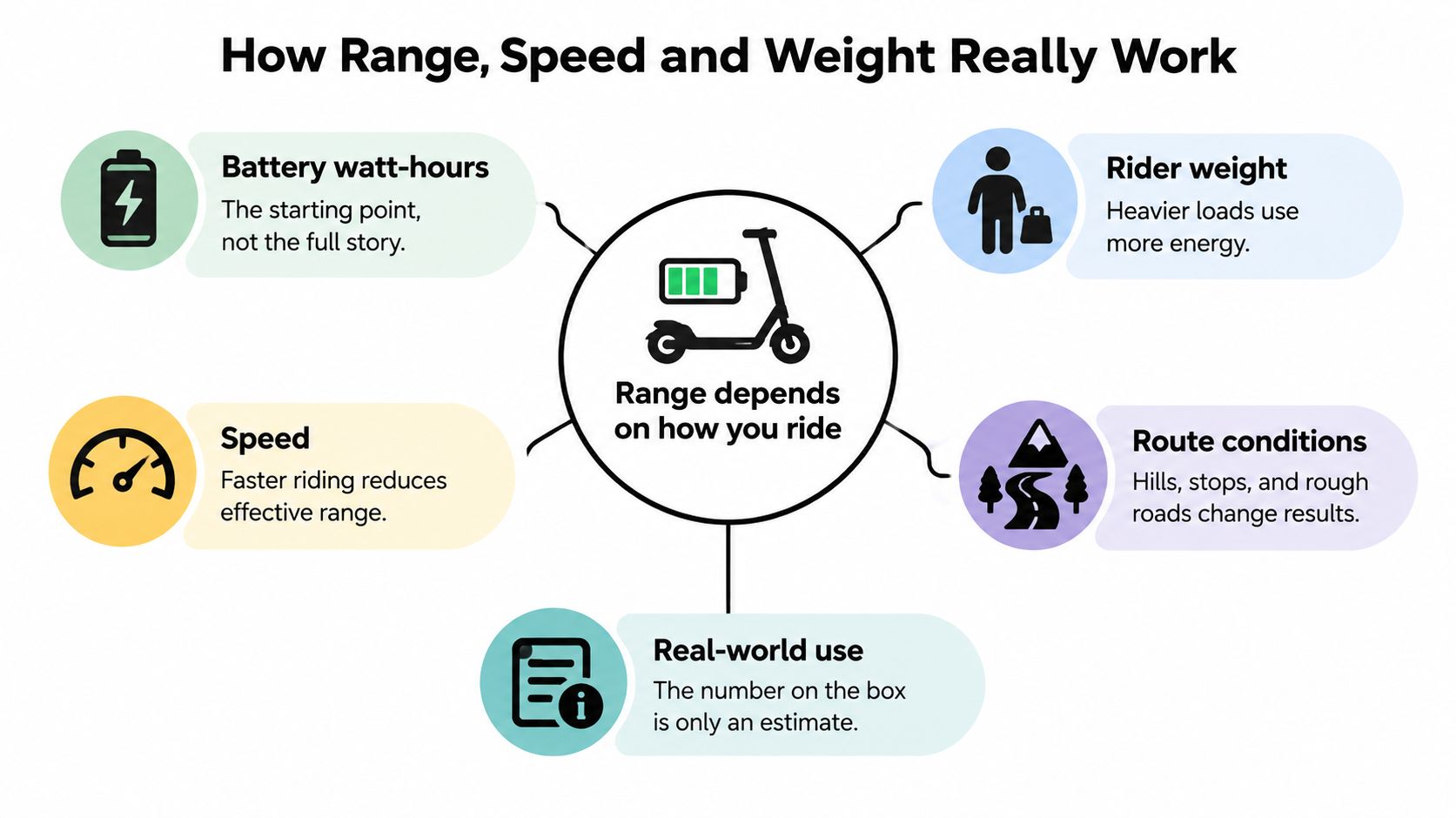
That reserve matters for everyday reasons. Cold mornings reduce what you get from a pack, batteries age, wind picks up, and sometimes you take a detour. If you plan to use every last bit of charge on a normal day, you're planning to push it home on a bad one.
Why Your Weight and Speed Change the Answer
A heavier rider, plus a backpack, asks the motor to move more mass every time you set off. It's like carrying a full shopping bag up stairs instead of an empty one. The effort isn't just at the top, it's in every start.
Speed works the same way. Your everyday cruising speed isn't the same as an advertised maximum, and riding near the top of what a scooter can do typically uses energy faster than easing along. Stop start streets add another cost, because each acceleration asks for a burst of power. Regenerative braking can return some energy when you slow, but it doesn't cancel out those costs.
- Check the test conditions: Look for rider weight, average speed and route type behind a range claim.
- Compare like with like: Two claims tested at different speeds aren't telling you the same story.
- Ask about gradients and temperature: A flat, warm test won't match a hilly winter commute.
If a listing only gives one big number and no conditions, treat it as marketing, not measurement. Our guide to how electric scooter range is tested and stated walks through what to look for when brands describe distance. The simple rule is to compare scooters under the same conditions, then keep that reserve in hand.
Ideal Specs for Urban Commuting
You can turn your route into a buying target with one worked example. Independent urban testing estimated real world consumption at about 2.15 kWh per 100 km with a measured range near 60.1 km, implying a 500 Wh battery could support about 23 km under comparable conditions before reserve or degradation. Don't treat that as a guarantee for your streets. Treat it as a reality check you can repeat.
From Round Trip to Battery Target
Here's the step by step.
- Measure your round trip: Use the distance you'll ride between charges, not just one way.
- Estimate energy use: Compare battery watt hours against a real world consumption figure, then ask if your route is hillier, colder or more stop start.
- Keep the reserve: Don't size the battery so tight that a normal day leaves you empty.
- Check charging reality: Can you charge at work, or must the scooter do the whole return leg on one charge?
If that worked example suggests your trip sits close to the limit, that's a warning, not a green light. Pick more capacity, plan a charge at the other end, or accept that the scooter suits only one leg of the day.
| Spec | Commuter target | Why it matters |
|---|---|---|
| Battery watt hours | Enough for your round trip plus reserve | Sets the starting energy you have to work with |
| Range claim | Stated with test speed and conditions | Lets you judge if the claim matches your route |
| Weight and folding | Light enough for your stairs, train or boot | A scooter you can't carry won't work in a mixed commute |
| Cruising speed | Comfortable within local limits | Everyday pace matters more than a headline maximum |
| Tyres and suspension | Suited to your actual surface | Rough streets punish small wheels and stiff setups |
| Brakes and lights | Strong, visible and easy to use every day | Control and being seen protect you on repeat trips |
Weight deserves the same honesty as range. Pick it up, fold it, and imagine doing that when you're tired. A model that feels fine in a shop can feel very different on a platform or in a narrow hallway.
Practical rule: If you can't lift it calmly and carry it a short way, it isn't a transit friendly commuter for you.
Speed is the last piece people overbuy. A higher figure won't help if your route is full of crossings or local limits keep you slower anyway. Match the scooter to the pace your streets allow.
Keeping Safe on Imperfect City Streets
Most commutes don't fail because a scooter was too slow. They get stressful because the street is cracked, wet, dark or shared with bigger vehicles, and the scooter doesn't give you enough control.
This photo shows the situation many commuters face on a damp city street.
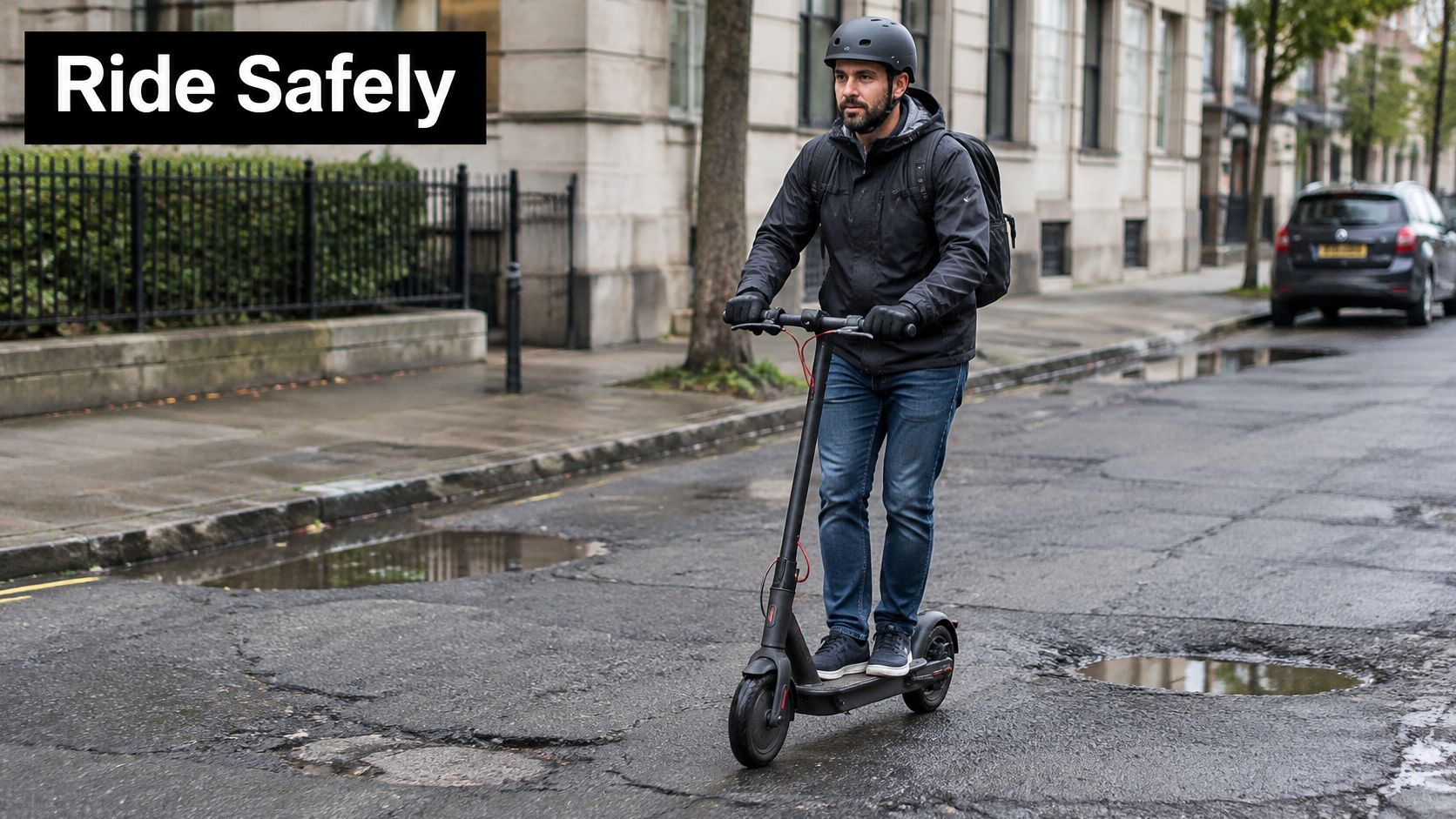
Independent evidence finds injured e-scooter users are not inherently more likely to suffer severe injuries than injured cyclists or e-bike users, with severity more strongly associated with older age, motor vehicle involvement, and alcohol or substance use. That shifts the question. Instead of asking only how fast it goes, ask how often you'll mix with cars, how you'll ride after dark, and whether you'd ever ride tired or after drinking. Those choices shape risk more than a spec sheet headline.
Score Your Route Before You Buy
Walk or cycle your route once and look at it through commuter eyes.
- Surface quality: Potholes, pavement cracks, raised drain covers and curbs that could catch a small wheel.
- Vehicle interaction: Busy junctions, parked cars and places where bike lanes merge with traffic.
- Lighting and drainage: Dark stretches, puddles hiding holes and slopes that get slick when wet.
- Separation: Protected lanes, quiet side streets or shared roads with fast traffic.
Now match features to what you found. Dual brakes you can use smoothly, tyres with grip for your surface, a stable deck where your feet feel planted, and credible water resistance for wet roads will help every single day. Extra wattage won't fix a grate across a dark lane.
Visibility is part of that control. Bright, well positioned lights help drivers judge where you are and where you're going, and our guide to LED lights for scooters and night visibility explains the options in plain terms. A helmet matters too, and fit and standard are worth checking before you buy, so it helps to compare scooter helmet safety standards rather than choosing on colour alone.
This video is useful for seeing how braking and body position change how a scooter stops on real streets.
A slower scooter with better brakes, lights and stability can be the safer commuter. That's not settling. That's buying for the streets you have.
Legal Rules for Commuter Scooters in the UK and EU
Legal status is where commuters get caught out most often. A scooter that's fine in one place can be restricted in another, and a product page won't always explain the difference.
In England, the current framework people see most is rental trials. The official UK guidance on rental e-scooter trial conditions and where trial scooters may be used sets a national maximum design speed of 15.5 mph, with a single rider and a motor of no more than 500 W. Trial scooters can be used on roads other than motorways and in cycle lanes or tracks where permitted, with a valid driving licence and insurance arranged by the operator. Those permissions don't create a general nationwide legal route for privately owned e-scooters, so don't assume a model you buy online inherits trial rights.
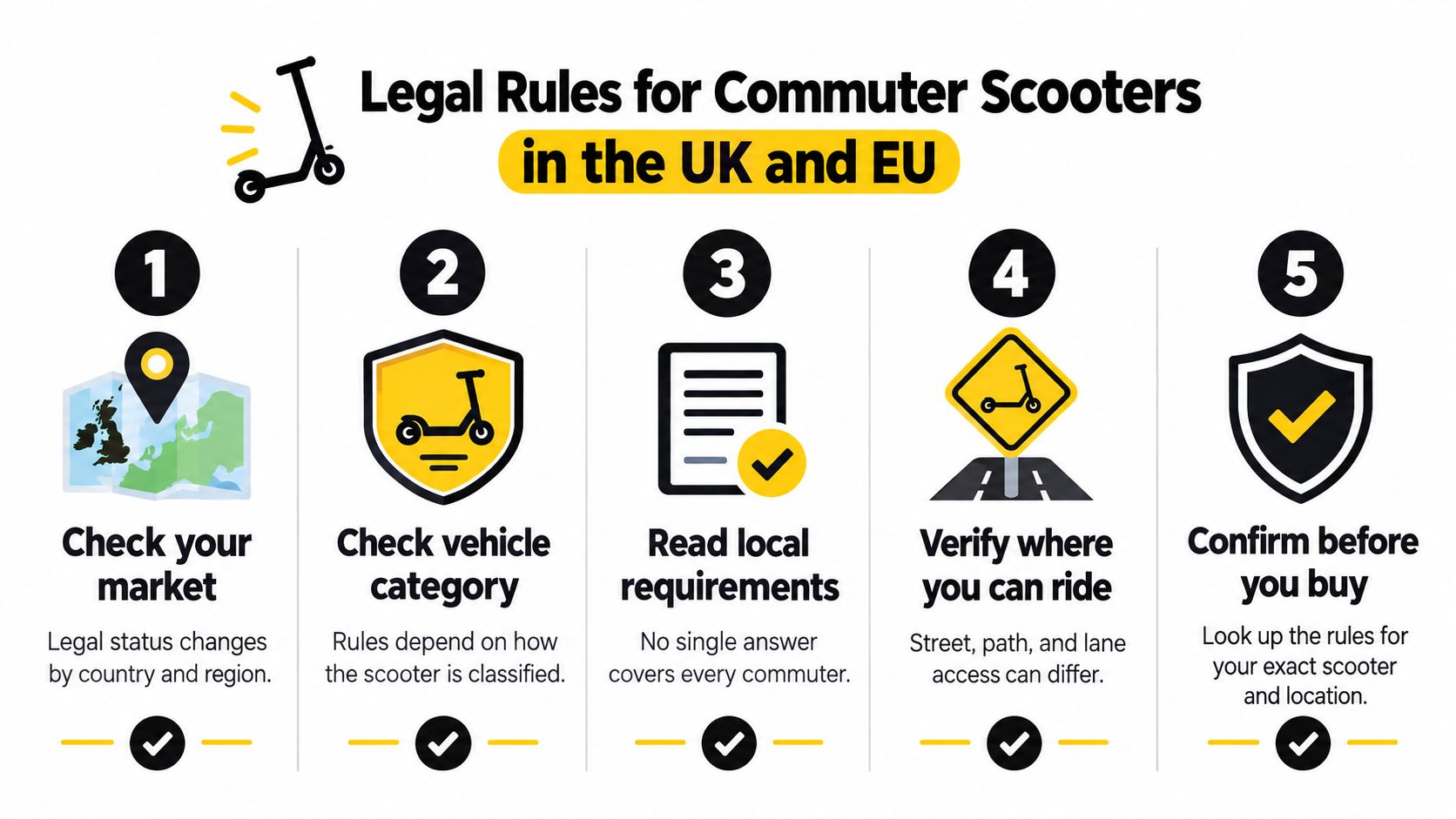
The EU line most buyers confuse with scooters is the e-bike one. For EU electric bicycles, the guidance on pedelec limits under Regulation (EU) No 168/2013 says a conventional pedelec is limited to assistance up to 25 km/h and a maximum continuous rated motor power of 250 W, and bikes exceeding either threshold generally fall under type approval requirements. That's an e-bike category, not a scooter shortcut. Exceeding a threshold can change registration, insurance and where you may ride.
Your Pre Purchase Checklist
- Check vehicle category: Scooter, pedelec or moped class are not interchangeable labels.
- Check where you may ride: Roads, cycle lanes, tracks and sidewalks are treated differently.
- Check documents: Licence, registration and insurance requirements for your exact place.
- Check equipment and age rules: Helmets and other kit may be required locally.
- Separate advertised from permitted speed: California caps e-scooters at 15 mph, a useful reminder outside Europe too that top speed on a box isn't legal speed on a street.
If you're in the UK or EU, make this your first filter, not your last. A faster or longer range model is no bargain if you can't use it on the infrastructure your commute depends on.
Comparing Commuter Scooter Options and Where Punk Ride Fits
With range, safety and legality clear, comparison gets simpler. You're not hunting for the most powerful commuter electric scooter for adults. You're looking for the one that fits five everyday tests.
A Simple Shortlist Framework
Score each candidate against the same questions. Does its realistic range cover your round trip with reserve? Can you carry and fold it where you need to? Does its speed and category fit your local rules? Do brakes, lights and tyres suit your surface? Can you get parts and service without a long search?
A lighter, slower commuter often suits a mixed trip with stairs, a train and a short ride at each end. You give up some pace and range, but you gain a scooter you'll take with you. That's like picking a light jacket you wear daily over a heavy coat you leave at home.
A heavier, faster model makes more sense when you ride door to door, store it at ground level and face hills or rougher roads. The trade off is obvious the first time you meet a flight of steps. It can also push you into a different legal conversation, so performance claims need the local check first.
When browsing wider ranges for comparison, looking at how other retailers present a model, such as Battery Charged's X3 model, can help you see which details a listing emphasises and which test conditions it leaves out. Use that habit everywhere. Look for battery watt hours, weight, braking setup and tyre type, not just a range slogan.
Punk Ride LLC fits as a curated online place to run that comparison. It stocks electric rides from brands including ISCOOTER, AOVO, DUOTTS, HITWAY and RCB, with headquarters in Florida and warehouses in the UK and Germany. That mix is relevant for UK and EU commuters who want to browse adult commuter models in one place and then check service and availability for their region.
Shortlist three models that pass your legal and carrying test first, then compare range. Deleting unsuitable models early saves more money than chasing a small spec win.
Write your five tests at the top of a page and be strict. If a model fails on weight or legality, it doesn't matter how good the rest looks. The best commuter is the one you'll use confidently on Monday, not just admire on delivery day.
Maintenance Routine and Your Next Step
A commuter scooter earns its keep by working on ordinary mornings. Small checks protect both range and safety, because under inflated tyres, weak brakes and loose fixings make you slower and less in control at the same time.
A Short Weekly Routine
Pick a set time, perhaps Sunday evening, and run the same loop. It takes minutes once it's a habit.
- Tyres and wheels: Check pressure if your tyres use air, look for cuts and wear, and spin each wheel for rubbing or wobble.
- Brakes: Squeeze each lever before you ride, check response feels firm and even, and listen for scraping.
- Lights and bell or horn: Turn them on in a dim hall so you notice a weak light before a dark ride.
- Deck and folding fixings: Wiggle the stem, check the latch locks cleanly and tighten accessible fixings to the maker's guidance.
- Connectors and cables: Look for damage, loose plugs and cables catching when you steer or fold.
Tyres are easy to ignore until a puncture ends a commute. If wear or damage makes a change necessary, our guide to scooter tyre replacement and checking fit before you buy explains the compatibility points to confirm, such as size and valve type.
Battery habits are just as simple. Don't make a routine of running the pack fully flat, charge in line with the maker's instructions, and store the scooter somewhere moderate in temperature rather than in intense heat or cold. Wipe road grime off after wet rides and dry it before charging. Use proper battery management protection where fitted and don't leave a damaged cable or connector for later.
Think of maintenance like brushing your teeth. It's boring because it's small, frequent and preventive. Skipping it doesn't cause a problem every time, but commuters rely on repetition, and small faults love repetition.
Your next step is now a clear one. Write down your round trip distance, your route type and surface, whether you must carry the scooter, and your local legal category. Take those four lines to any shortlist and delete models that don't fit before you compare price or styling.
Then browse with that list beside you and pick two or three candidates that pass every line. Check battery watt hours with reserve, test the fold and lift if you can, and confirm brakes and lights suit your darkest, wettest version of the route. If a model passes on your worst normal day, it'll feel easy on a good one.
Ready to put your route, reserve and legal checks to work, browse the commuter electric scooter for adults options at Punk Ride LLC and shortlist two or three models against your round trip, carrying needs and street surface. Punk Ride LLC offers a curated selection of electric scooters and e-bikes for UK, EU and wider commuters, so you can compare practical specs in one place before you buy.

Distribuie:
Geantă pentru bateria bicicletei electrice: tipuri, siguranță și sfaturi de cumpărare