


You're on the way to work, one hand on the handlebar and a hill waiting at the next junction. With a throttle-only electric bike, you can twist a control, keep your feet still, and let the motor move you forward. That convenience feels perfect for short urban trips, but the legal answer can change as soon as you cross a border, enter a different state, or leave the road for a shared path.
A throttle isn't merely a comfort feature. It can affect how the bike is classified, where you can ride it, how quickly the battery is used, and whether the bike qualifies as an ordinary e-bike in your market. Understanding those differences before buying is far more useful than relying on a generic class chart.
What Makes a Throttle Only Electric Bike Different
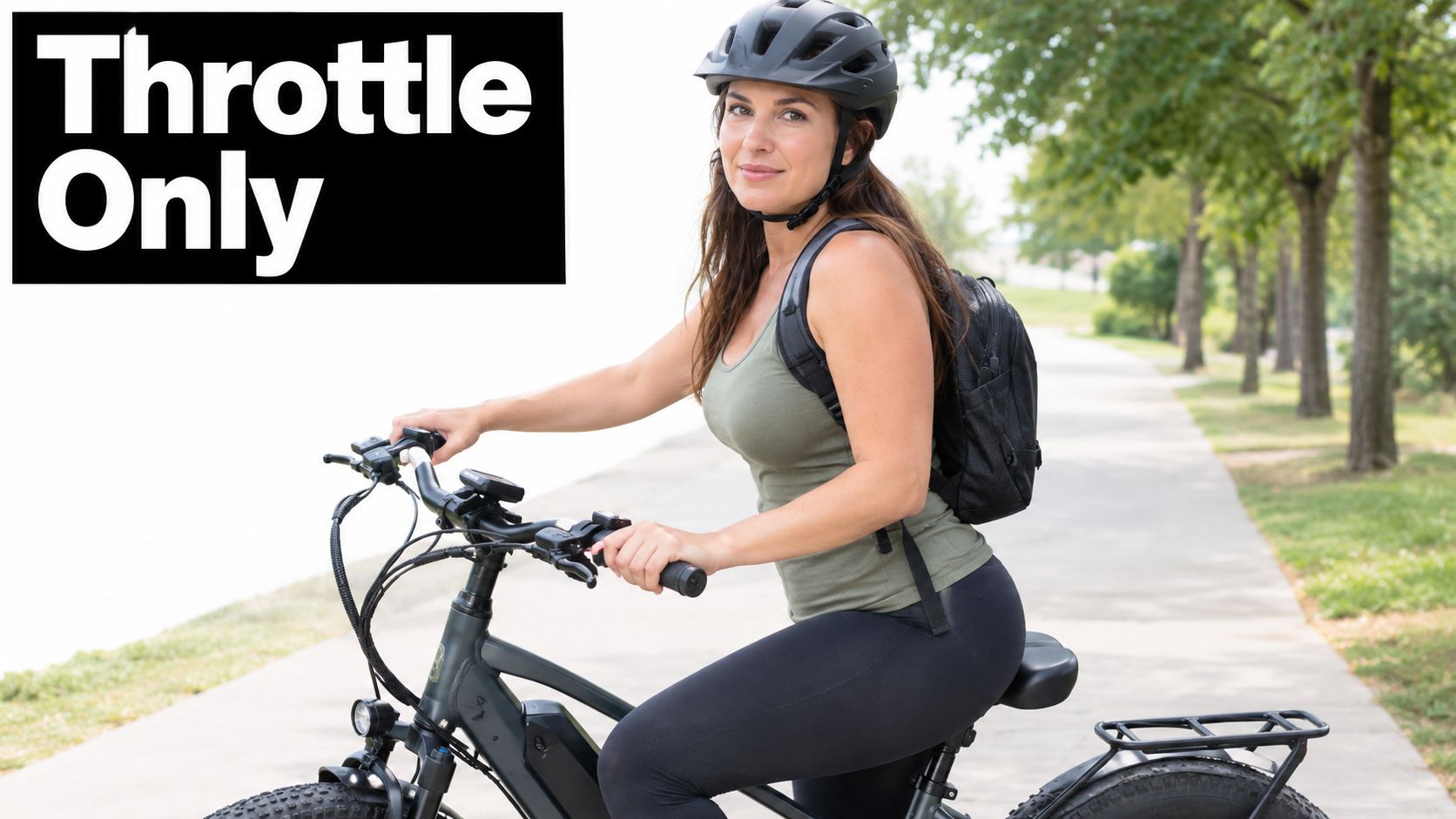
You're stopped at a traffic light with a bag on the rear rack. A pedal-assist bike waits for you to begin pedalling before it adds power. A throttle-only electric bike lets you press a thumb control or twist a grip and move away without pedalling. That direct response is the defining difference.
Pedal assist supports your effort. Sensors detect pedal movement, then the motor adds assistance. A throttle controls the motor directly, so the bike can propel itself even when your legs aren't turning the cranks. The result feels closer to a quiet scooter than to a conventional bicycle, especially during starts, tight manoeuvres, or moments when you need a short rest.
Why commuters notice the difference
The throttle is useful when a route includes repeated stops, steep starts, heavy cargo, or physical fatigue. You don't have to coordinate a gear, a pedal stroke, and balance at the same instant. A controlled touch of the throttle can get the bike rolling, after which you may continue using the motor or begin pedalling.
That ease creates a trade-off. The motor is doing more of the work, so throttle-heavy riding normally places greater demand on the battery than shared-power riding. It also changes your responsibilities as a rider. Because power arrives directly from your hand, a careless movement can produce a faster launch than expected.
Riding habit: Keep the throttle relaxed when mounting, dismounting, or moving through pedestrians. Treat it like a propulsion control, not a hand rest.
A throttle-only bike may suit someone who wants minimal physical effort for short journeys, has difficulty starting from a stop, or regularly carries a load. A pedal-assist bike may feel better for someone who wants exercise and a more familiar cycling rhythm. Some models offer both, but the presence of a throttle can still change the legal category.
The key question isn't whether the bike has enough power. It's whether the bike's throttle behaviour, speed cutoff, motor rating, pedals, and intended riding location match your daily needs and local rules.
Legal Rules Around Throttle Only E-Bikes by Region
The same control can have very different consequences in the UK, the EU, the United States, and Australia. Before ordering an imported model, check the rules that apply where you'll ride, not only the specifications printed by the seller.
UK requirements
In the UK, an electrically assisted pedal cycle can retain its ordinary bicycle status when a throttle works only as a low-speed starting aid. Guidance from the Electric Travel Association's throttle overview says the throttle must cut out at about 4 mph, or 3.7 mph / 6 km/h. Above that speed, motor assistance must operate while the rider is pedalling. A throttle-only bike that continues driving without pedalling can instead be treated as a moped or motorcycle, bringing different requirements.
EU-linked rules
Standard EU-linked e-bike rules limit continuous rated power to 250 watts and require assistance to stop at 25 km/h, or 15.5 mph, according to Cycling UK's EAPC regulations guidance. The same guidance describes the L1e-A powered-cycle category, which can allow up to 1,000 watts while still cutting assistance at 25 km/h. That category isn't interchangeable with an ordinary pedelec, so buyers should confirm the vehicle's legal classification before riding.
United States requirements
In the United States, the federal low-speed electric bicycle framework generally requires functional pedals, a motor under 750W, and a maximum motor-only speed of 20 mph with a 170 lb rider, as explained in this throttle e-bike legal guide. In roughly 40 states using the three-class system, throttle-equipped bikes generally fall into Class 2 when motor-only operation is capped at 20 mph.
State and city rules can still narrow access. Washington distinguishes Class 2 throttle-assist bikes from Class 1 and Class 3 pedal-assist bikes. New York City applies a 15 mph cap regardless of rated speed, while New Jersey requires licensing, registration, insurance, and helmet rules for throttle-equipped models, according to this transportation safety update.
Australia and Queensland
Queensland permits throttle control only up to 6 km/h to help the rider start moving. The Queensland Government also distinguishes that arrangement from a bike powered only by a throttle without pedalling, as set out in its electric bicycle rules.
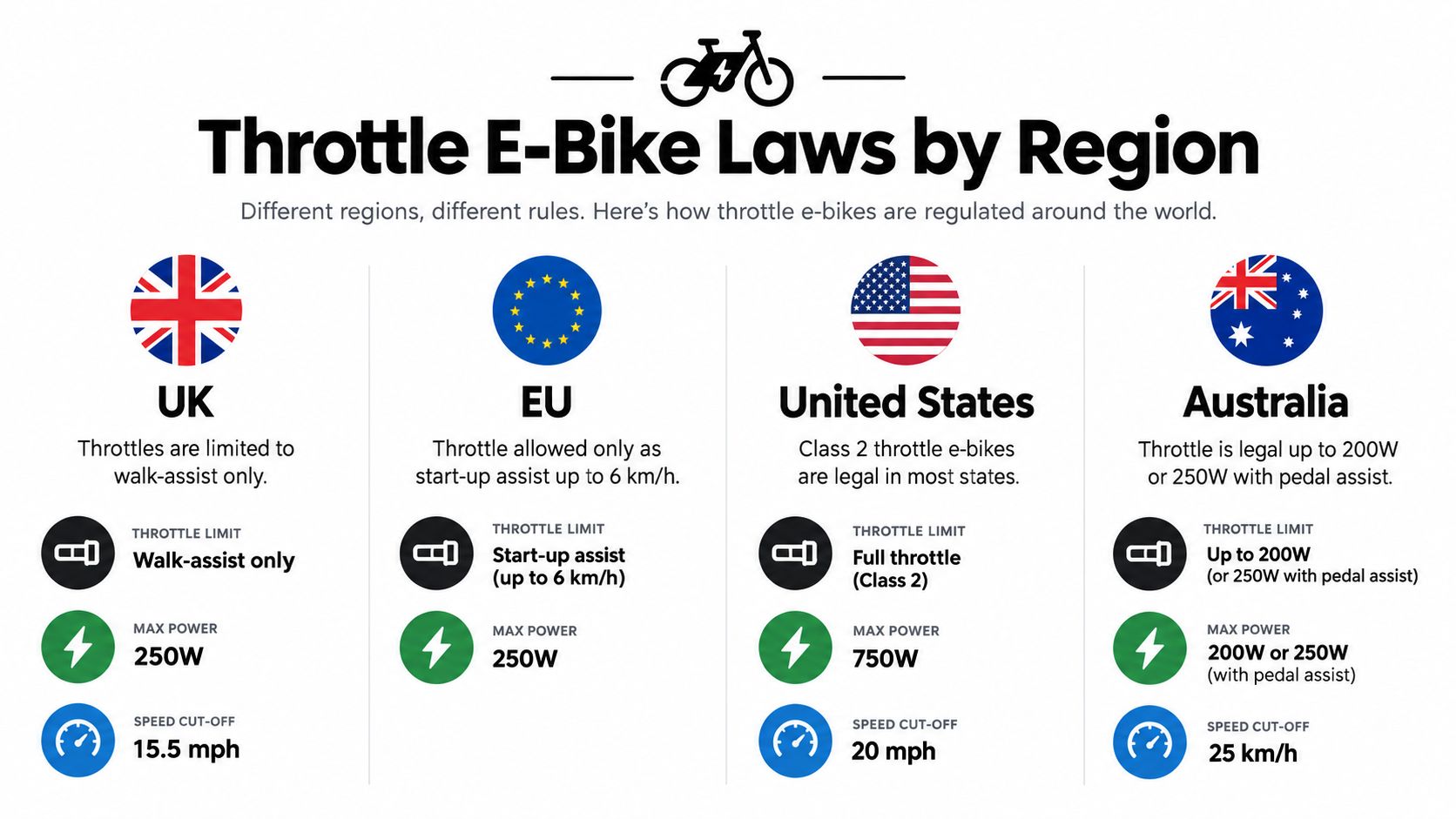
The practical lesson is simple: don't assume a US Class 2 bike is legal as an ordinary e-bike in Europe, the UK, or Queensland. Confirm the local category, not just the motor's advertised speed.
A state-by-state starting point is available in Punk Ride's electric bike laws guide, but city, trail, and path rules may still need separate checking.
Throttle Only versus Pedal Assist Performance and Range Trade-offs
A commuter leaving a busy junction may want instant power, especially with a loaded rack or tired legs. A throttle-only bike supplies nearly all forward motion through the motor and battery. Pedal assist divides that work between rider and motor, which changes the experience on hills, into headwinds, and during repeated acceleration.
Throttle control feels immediate. You can start without finding the right pedal position and keep moving when your legs need a break. Pedal assist feels more connected because the motor responds to your effort instead of replacing it. For many routes, throttle control suits short starts while pedal assist supports steady cruising.
Safety evidence does not support sweeping claims about either system. A European and North American review found no definitive positive or negative safety impact from e-bikes overall. It also found no published data specifically examining the safety or wider implications of throttles, as reported in this e-bike safety review.
A practical comparison
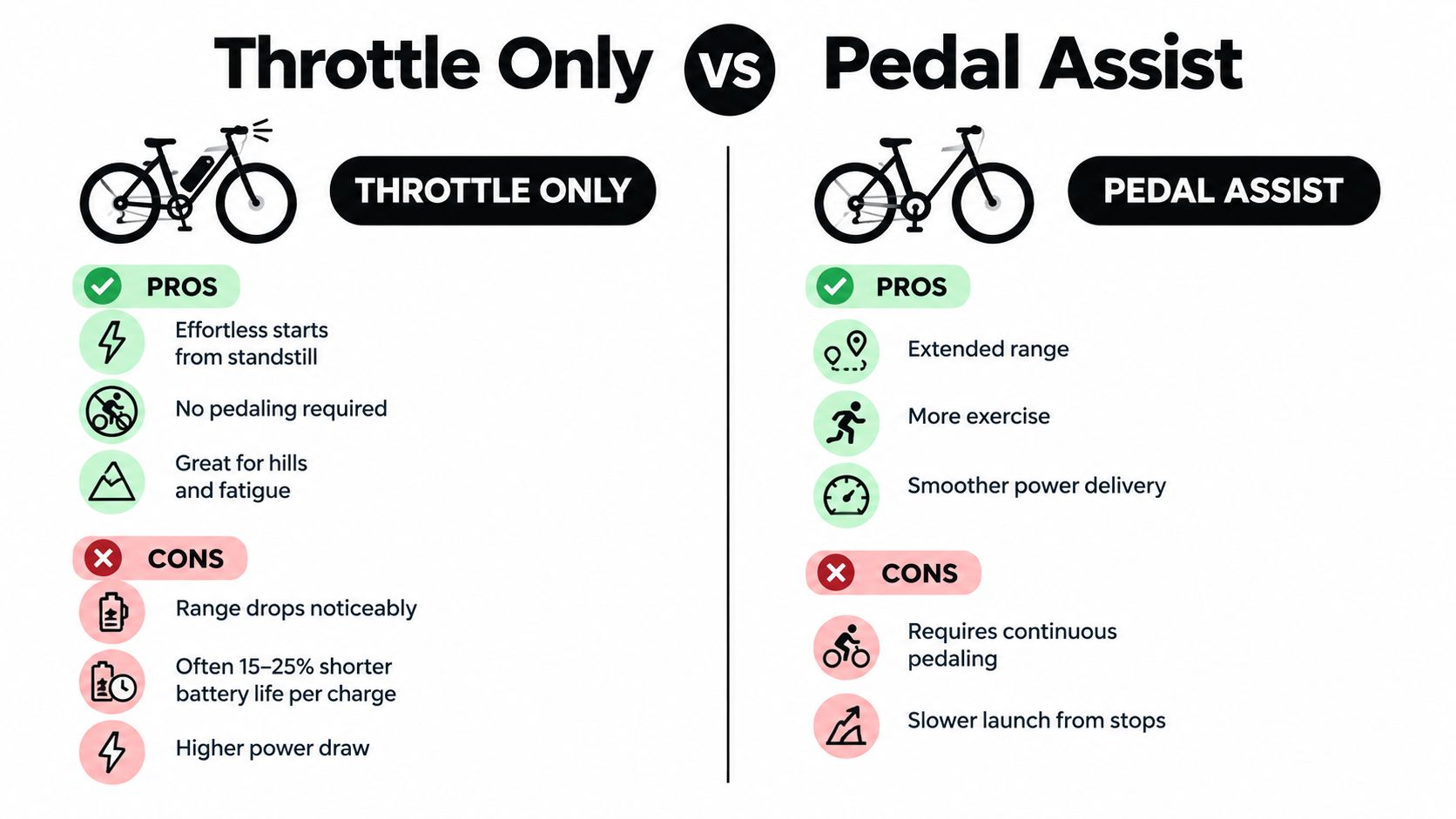
| Riding style | Main advantage | Main compromise |
|---|---|---|
| Throttle only | Motor operation requires no pedalling, helping with starts, fatigue, hills, and cargo | Extended use can drain the battery faster and may create more access and classification questions |
| Pedal assist | The rider shares the workload, creating a more active feel and potentially conserving battery use | You must keep pedalling, and starts may feel less immediate |
| Both systems | Direct power is available for awkward moments, while pedal support suits normal cruising | The bike must still meet local throttle requirements |
Market demand appears substantial, but estimates differ sharply. One US estimate placed throttle e-bikes at 54.6% share in 2025, while another placed them at 33.1%, both drawn from the safety and market review cited above. That gap makes the figures useful as estimates, not as one settled measurement.
Match the mode to the route
A short, stop-start city trip may favour throttle convenience. Longer rides often benefit from rider input, particularly when recharging is unavailable before the return journey. Hills and cargo increase demand in either mode, so compare battery capacity, torque delivery, braking, tyre grip, and the conditions behind the manufacturer's range claim rather than focusing only on advertised speed.
For a plain-language explanation of the complementary system, read Punk Ride's pedal-assist e-bike guide.
How to Choose a Compliant Throttle Electric Bike
Start with the place where you'll ride. A model that is acceptable for a US Class 2 market may need different settings or a different legal category in the UK, EU, or Australia. Ask the retailer for written specifications rather than relying on a product title such as “unrestricted” or “street legal.”
Use this buyer checklist
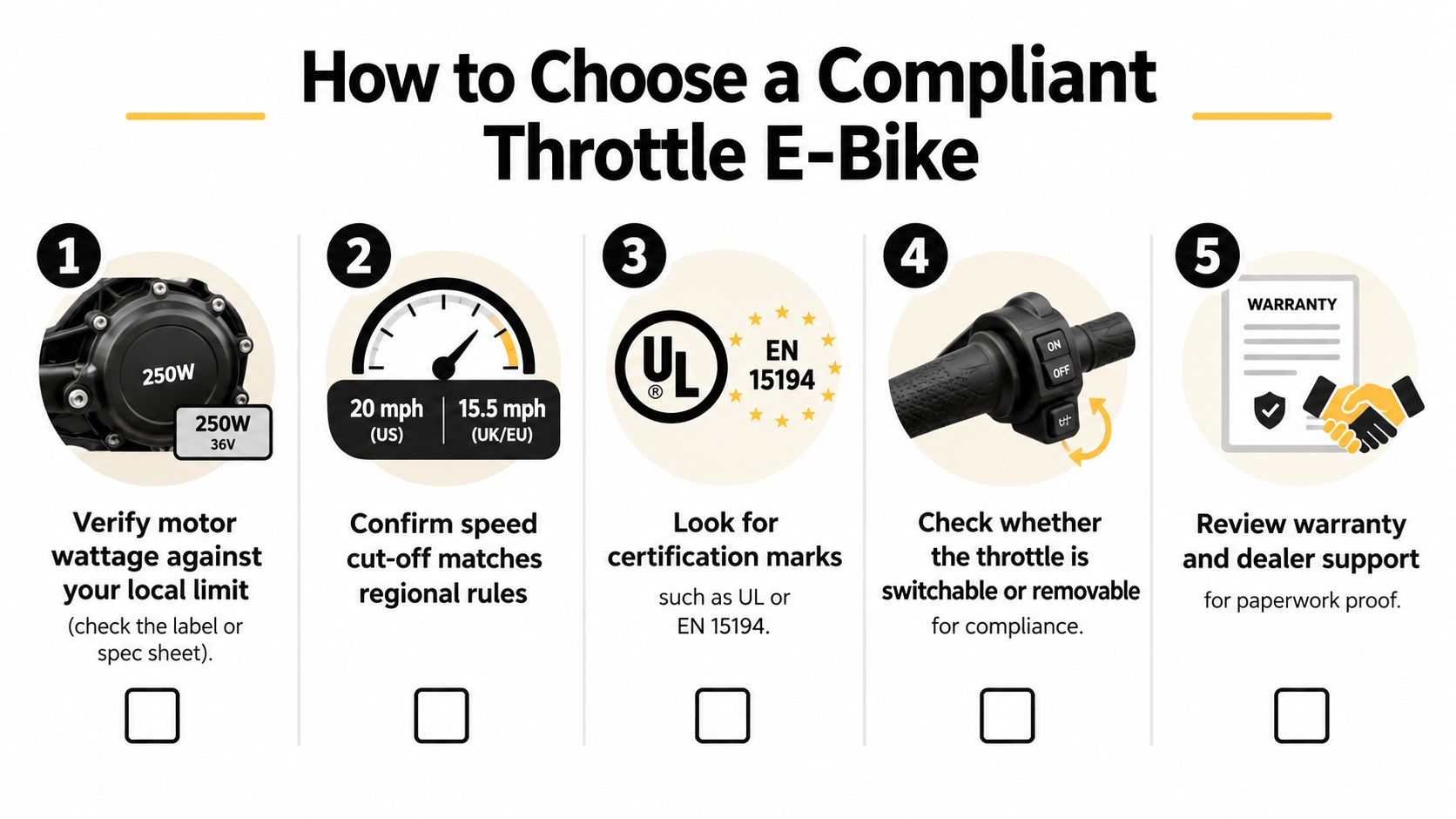
- Identify the local category. Confirm whether your area recognises throttle-equipped bikes as ordinary e-bikes, limits throttle use to starting assistance, or treats the vehicle as a moped or motorcycle.
- Check the motor rating. Compare the stated continuous or rated power with the rule that applies in your jurisdiction. In the US framework, the relevant federal threshold is a motor under 750W. EU-linked standard e-bikes use 250 watts continuous rated power. Those figures come from different regulatory systems, so don't transfer one market's limit to another.
- Verify the cutoff behaviour. Ask at what speed motor-only operation ends and whether assistance stops when you stop pedalling. US Class 2 discussions centre on 20 mph, while standard UK and EU e-bike rules use 25 km/h assistance limits or the UK's low-speed start-assist condition, depending on the legal category.
- Confirm the pedals work. Functional pedals are part of the US federal low-speed electric bicycle definition. A bike that looks like a bicycle but cannot be pedalled may not qualify under that framework.
- Check the controller. A switchable or removable throttle can help only if the resulting configuration meets local rules. A software setting isn't proof of compliance unless the seller explains the setting and provides supporting documentation.
- Request paperwork. Ask for the specification sheet, conformity information, warranty terms, and details of who supports the bike in your region. Certification marks such as UL or EN 15194 may be useful indicators, but they don't replace checking the law that governs your road or path.
Retailer question: “Can you show me the exact speed cutoff, motor rating, pedal requirement, and legal category for the country and city where I'll ride?”
Be cautious with overseas listings that advertise a high-power motor, a disabled limiter, or a throttle that works at all speeds. Importing the bike doesn't import the seller's legal status into your jurisdiction. If the listing is vague about the controller, serial number, battery certification, or support after delivery, choose a seller that can answer in writing.
For a broader pre-purchase process, use Punk Ride's e-bike buying guide, then verify the throttle-specific points above with your local authority.
Safety Practices and Maintenance for Throttle E-Bike Riders
Direct motor power rewards smooth hands. Before riding in traffic, practise gentle starts in an open area. Learn how quickly the bike accelerates, how the brakes respond, and how the throttle behaves when you release it. Keep both hands ready for steering and braking, especially on wet surfaces, loose gravel, crowded paths, and narrow entrances.
Your daily safety routine should be short enough to follow every time:
- Check the tyres: Correct pressure supports predictable handling and reduces unnecessary rolling resistance.
- Test the brakes: Squeeze both levers before leaving. Look for sponginess, scraping, uneven braking, or excessive lever travel.
- Inspect the throttle: Confirm it returns to neutral when released and doesn't stick against a grip, cable, or accessory.
- Secure the battery: Make sure the battery is locked into place and its contacts are dry and clean.
- Increase visibility: Use lights and reflective clothing when conditions make you harder for drivers or pedestrians to see.
- Ride defensively: Assume a turning driver hasn't noticed you, reduce speed near crossings, and leave room to stop.
Brake checks matter particularly when you use the motor for frequent starts. Extra momentum and repeated acceleration place more importance on working pads, aligned callipers, sound cables, and tyres with usable tread. Have a qualified technician inspect the system if the bike pulls to one side, the brake lever reaches the handlebar, or the motor continues running after the control is released.
Battery care starts with the manufacturer's charging instructions. Use the supplied charger, keep the battery away from visible damage and moisture, and stop using it if you notice swelling, unusual heat, smoke, or a strong chemical smell. Don't carry a damaged battery into a building or attempt a repair with improvised parts.
A helmet remains sensible protection, but it doesn't make an otherwise illegal bike legal. Follow the helmet, lighting, insurance, registration, and road-access rules that apply in your area.
Common Myths About Throttle Only Electric Bikes Debunked
Myth 1: Throttle Bikes Are Illegal Everywhere
A throttle is not illegal in every market. In the US, a throttle-equipped e-bike may fit the Class 2 category when it meets the relevant definition and 20 mph motor-only limit. The UK, EU, and Australia apply tighter rules to ordinary e-bike status, often permitting only low-speed start assistance or placing the bike in another vehicle category.
The answer depends on the region and sometimes the city. Washington, New York City, New Jersey, and Queensland show how state, city, or territory rules can add requirements or reduce practical road access, even where a wider national framework exists.
Check the bike's classification before buying, not after riding it home.
Myth 2: A Throttle Automatically Makes a Bike Unsafe
A throttle can cause an unexpected launch when a rider squeezes or twists it carelessly. Hand control, braking skill, training, and awareness of nearby traffic therefore matter. The presence of a throttle alone does not establish that every such bike is more dangerous by its very nature.
The available review evidence is inconclusive about e-bike safety overall, and published data specifically about throttles remains limited, as the safety review cited earlier notes. A narrower conclusion is more useful: throttle behaviour changes the bike's response, so riders should practise that response before entering traffic.
Myth 3: Throttle-Only Riding Is Always Better for Commuting
A throttle may suit short trips, repeated stops, cargo, or riders managing physical fatigue. Pedal assist often suits longer commutes because it can reduce battery demand and make it easier to finish the journey with charge remaining.
Route conditions matter too. Hills, traffic, starts at junctions, storage, and local access rules can change the balance between the two systems. Neither removes the need to choose a bike with suitable brakes, tyres, lighting, and control settings.
Myth 4: Throttle Bikes Have No Useful Performance
Throttle-only bikes can offer direct acceleration, controlled low-speed movement, and help when continuous pedalling is difficult. Performance includes more than top speed. Handling, braking, battery management, motor response, and legal access all affect whether the bike works for a real commute.
Choose one when its control style suits your body, route, and local rules. Confirm the specification before riding, practise the response away from traffic, and apply the throttle deliberately rather than continuously.
Punk Ride LLC offers electric bikes and other electric rides for urban commuting and outdoor use, with availability supported through its Florida headquarters and UK and Germany warehouses. Visit Punk Ride LLC to compare throttle-equipped and pedal-assist options for your region, route, and riding style.
Share:
Adult Scooter Commuting: The Real-World Survival Guide