


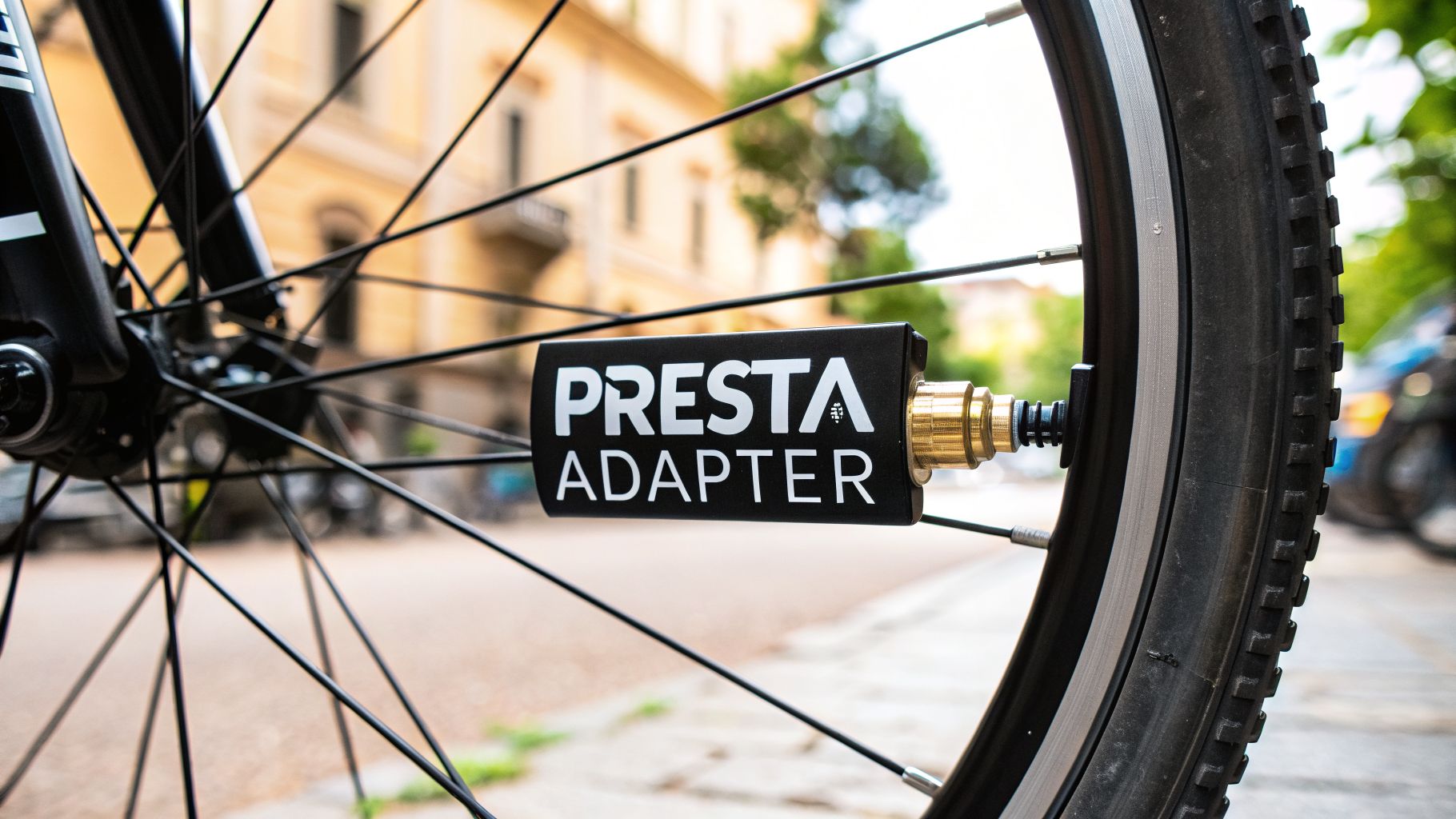
So, what exactly is a Presta valve adapter? Put simply, it’s a tiny, screw-on metal cap that turns your bike’s skinny Presta valve into a fatter Schrader valve. This little gadget is the key that unlocks a world of easy inflation, letting you use the common pumps you find everywhere on your high-performance tires. It's the simple bridge between two totally different worlds.
The Tiny Tool That Solves a Big Problem

You've been there, right? You get a flat on your e-bike or scooter, limp to the nearest service station, and discover the air pump won’t fit your tire valve. It's a classic, frustrating moment. Many modern e-rides, like popular models from ENGWE and ONESPORT, use sleek, high-pressure Presta valves, but the pumps we see everywhere in Australia and the US are made for the chunkier Schrader valves on cars.
This is where the bike Presta valve adapter swoops in to save the day. Think of it as a universal translator for your tires. This small, cheap gadget screws right onto your Presta valve, instantly making it compatible with any Schrader pump head. All of a sudden, the servo air compressor, your car's emergency pump, or a friend’s standard bike pump is back on the table.
Your Ticket to Inflation Freedom
The best part about this adapter is how brilliantly simple it is. It's just a tiny, durable piece of brass that costs next to nothing, yet it completely eliminates a massive headache for commuters and trail riders. For the price of a coffee, you get the freedom to pump up your tires pretty much anywhere.
An adapter gives you access to a much wider range of inflation options, from roadside assistance to borrowing a pump from a fellow cyclist, ensuring you're never left stranded by a simple valve mismatch.
It's one of those things you don't think you need... until you really need it. Along with other useful cycling accessories, a Presta valve adapter is a must-have. Tossing one in your saddlebag or repair kit is a tiny move that brings huge peace of mind, guaranteeing you're ready for a quick top-up no matter where you are. It’s a tiny investment for avoiding a big problem.
Presta Vs Schrader: Unpacking the Valve Difference
Ever wondered why your shiny new e-bike or scooter doesn't use the same tire valve you see on cars? It’s a great question, and one that trips up a lot of riders. It all comes down to the two main players in the tire valve game: Presta and Schrader. Getting to know them is the first step to becoming a pro at your own e-ride maintenance.
You’re probably already familiar with the Schrader valve. It’s that chunky, rugged valve on car tires and most everyday bikes. It's built like a tank, has a little spring-loaded pin in the middle, and is designed to be super straightforward and durable.
The Presta valve, however, is the more modern, high-performance specialist. It's noticeably slimmer and has a small locknut on the tip that you have to unscrew before you can pump any air in. This design is key, as it allows Presta valves to handle much higher air pressures—a must-have for the skinnier tires found on many e-bikes and performance road bikes. For a deeper dive into general tire care, check out our guide on inflating your bike tires properly.
The Specialist Vs. The Universal Standard
So, why the shift to Presta? It's all about performance. Because Presta valves are skinnier, the hole drilled into the wheel's rim is also smaller. This helps keep the rim stronger and more structurally sound, which is a huge benefit for e-bikes that handle higher speeds and heavier loads.
Think of it like this: Schrader is the trusty adjustable wrench that gets most jobs done. Presta is the precision torque wrench, made for a specific, high-stakes task where accuracy and strength are everything.
This isn't just a niche trend, either. With the e-bike market exploding—projected to hit 40 million units in 2025—more and more high-end models are rolling off the line with Presta valves. In fact, you can see the full data on presta valve growth for yourself. For our Punk Ride customers in Florida, California, or New South Wales, knowing your way around both valve types means you'll never be stuck with a flat tire and the wrong pump.
Presta Vs Schrader: A Head-to-Head Comparison
To make it even easier to tell them apart at a glance, we've put together a simple comparison chart. Knowing these key differences will help you instantly identify what’s on your e-ride and understand why a bike Presta valve adapter is such a game-changing little tool.
| Feature | Presta Valve | Schrader Valve |
|---|---|---|
| Appearance | Slim, with a small locknut on top that must be unscrewed to inflate. | Wider and stubbier, with a spring-loaded pin in the center. |
| Typical Use | High-pressure road bikes, performance e-bikes, and modern mountain bikes. | Cars, motorcycles, and most standard or budget-friendly bicycles. |
| Pump Compatibility | Requires a Presta-specific pump head or a bike Presta valve adapter. | Fits the standard pump head found at service stations and on most universal pumps. |
| Pressure Handling | Excellent for holding high pressures (often over 100 PSI). | Good for lower to medium pressures, less common on high-PSI tires. |
Once you can spot the difference, you'll know exactly what kind of pump you need—or when it's time to grab that handy adapter to make any pump work.
Alright, let's get you sorted. Using a Presta valve adapter is one of those simple little tricks that every rider should know. Honestly, once you do it one time, you'll have it down for life. It takes less than a minute.
First things first, find the Presta valve on your e-bike or scooter tire. Pop off that little plastic dust cap and pocket it so it doesn't roll away. You’re looking at a skinny valve stem with a tiny little nut at the very tip.
Prepping the Valve
Before you can attach anything, you need to open the valve.
- Gently twist that little nut at the tip counter-clockwise. You only need to unscrew it a few turns until it stops spinning freely. Don't try to take it all the way off—it’s not supposed to be removed.
- Once it's loose, give the tip a quick press with your finger. You'll hear a satisfying psst! of air. That's how you know the valve is open and ready for action.
Attaching the Adapter and Pumping Up
Now for the magic. Grab your adapter and simply screw it onto the Presta valve where the dust cap used to be. Turn it clockwise until it's hand-tight. No need to go crazy with it; just snug is perfect. Just like that, you've temporarily turned your skinny Presta into a beefier Schrader valve.
At this point, you can use pretty much any standard pump. Whether you’re at a service station, borrowing a mate's floor pump, or using the basic one in your garage, the pump head will now fit perfectly. Go ahead and inflate your tire to the recommended PSI, which is almost always printed right on the tire's sidewall.
This diagram is a great visual for seeing exactly what we're talking about with these two different valve types.

As you can see, the Presta is much narrower, which is why this little adapter is the key to bridging that size gap.
Finishing Up: The Final Steps
Once you're at the right pressure, pull the pump head off. You'll need to be quick here: unscrew the adapter (counter-clockwise), and you'll hear another tiny hiss of air as you take it off.
This next step is the most important one for preventing slow leaks: immediately re-tighten the Presta valve's little locknut by hand. A firm twist is all it takes to lock the valve core and keep your tire pressure from dropping.
Finally, put the plastic dust cap back on. And for goodness sake, find a safe home for that adapter! I keep mine in a tiny zip-top bag in my saddle pack, but screwing it onto a spare valve cap holder works great, too. That little piece of metal is your get-out-of-jail-free card, so don't lose it
When You Absolutely Need a Presta Valve Adapter
So, when does this tiny brass fitting go from a 'maybe' to a 'must-have'? It’s the moment you’re staring at a flat tire with the wrong pump in your hand. Let's be real, a bike Presta valve adapter isn't just another accessory—it's your ticket out of a very long walk home.
Picture this: you’re cruising through Miami or winding along the Sydney coast when you feel it—that sinking, squishy feeling of a tire going soft. The only air you can find is at a gas station or servo. You grab the hose, but the nozzle is for a car tire (a Schrader). Without an adapter, your ride is done. With one? You're aired up and gone in less than two minutes.
That's not just convenience; that's the difference between a minor hiccup and a ruined afternoon.
Scenarios Where an Adapter is a Lifesaver
Valve mix-ups happen more often than you'd think. For anyone on an e-bike or e-scooter in places like the US and Australia, here are the moments you'll be glad you have one stashed away.
-
At the Gas Station or Servo: This is the big one. Almost every air compressor at every service station is built for Schrader valves. For us, that makes a Presta adapter the universal key to a massive, free network of air pumps.
-
Borrowing a Friend's Pump: Your buddy probably isn't a pro cyclist. Their pump is likely a standard one they bought for the family's bikes, which almost always means it’s Schrader-only. An adapter lets you borrow their gear without any fuss.
-
Using an Old Floor Pump: Many of us have that one trusty old pump in the garage that just won't quit. If it’s from before Presta valves became common on everyday bikes, it’s probably only set up for Schraders. The adapter instantly makes that old pump useful again for your modern ride.
The Urban Rider's Insurance Policy
For daily commuters, getting stranded is more than just an annoyance—it can throw off your entire day. This is why thinking ahead is so critical, especially as more of us rely on electric rides to get around.
Think of the bike Presta valve adapter as your personal get-out-of-jail-free card. It’s a tiny piece of metal that gives you the power to fix a common problem on the spot, with no help needed.
The numbers back this up. A 2026 survey found a whopping 45% of city riders had dealt with inflation problems because of mismatched valves. That number plummeted to under 10% for those who simply carried an adapter. For Punk Ride fans on their ISCOOTER or RCB models, this little piece of gear means you’re always ready.
With e-bike use jumping 15% in major US and Australian cities in 2025, the need for simple, no-brainer solutions like this is bigger than ever. You can learn more about how suppliers are meeting this demand to keep us all rolling.
Choosing the Right Adapter for Your Ride

Let's be honest—at first glance, a bike Presta valve adapter doesn't seem like a big deal. They're tiny, simple, and usually cost next to nothing. But when you're stuck with a flat and that little piece of metal is your only ticket home, you’ll be glad you picked a good one.
Whether you're cruising on a CYSUM e-bike in Florida or navigating the streets of New South Wales on an ONESPORT scooter, a reliable adapter is a must-have. So, let's break down what separates a trusty tool from a piece of junk.
Material Matters: Brass vs. Aluminum
You'll mostly find these adapters made from two materials: brass or aluminum. While the colorful aluminum ones might catch your eye, brass is the hands-down winner when it comes to durability.
Think about it—you're going to be screwing this thing on and off your valve stem countless times. Brass is a much tougher metal that can handle that repeated use. Aluminum threads, on the other hand, are softer and can easily strip or get deformed over time. That's a discovery you definitely don't want to make when you're miles from anywhere.
For long-term peace of mind, always go with a brass adapter. Its sturdy build means the threads won’t give out on you when you need them most, making it a smart, tiny investment for any rider.
The Secret to a Perfect Seal
Now for the real insider tip. Beyond the metal itself, there’s one tiny component that makes all the difference: the rubber O-ring.
Peer inside the adapter's opening. If you spot a small black rubber ring nestled in there, you've got a winner. This little O-ring is what creates an airtight seal against the Presta valve, stopping any annoying leaks. Without it, you'll often hear that frustrating hissing sound as you pump, with half your effort escaping into the air instead of your tire.
Sure, new valve technologies are always on the horizon, but for most of us, a simple, well-made adapter is all we need. Riders on TOUROLL or MOTORAD e-bikes don't need some futuristic gadget; they just need a solid brass adapter to bridge the gap. With the accessories market projected to grow by $3.68B by 2029, a quality adapter is still one of the best bang-for-your-buck items you can own.
A good adapter is a cornerstone of any smart rider's toolkit. For more ideas on what to pack for your rides, take a look at our guide to the best electric bike accessories.
Fixing Common Adapter Glitches on the Go
So you're on the side of the road, ready for a quick air top-up, but your little Presta valve adapter is giving you grief. It happens. Even the simplest gear can act up, but don’t sweat it—most of these hiccups are a breeze to fix. Let's walk through the common culprits so you can get back to your ride in no time.
That frustrating hissing sound of air escaping as you pump is by far the most common issue. You're putting air in, but it feels like it's coming right back out. This almost always signals a bad seal somewhere between the valve, the adapter, and your pump head.
Solving Annoying Air Leaks
If you hear that dreaded hiss, stop pumping and take a closer look. The problem usually boils down to one of three things: a loose connection, a worn-out seal, or a Presta valve that isn't quite ready for action.
- Check the Presta Locknut: Did you remember to unscrew that tiny nut at the tip of the Presta valve? It needs to be fully loosened, or it will block air from getting in and cause leaks around the base.
- Tighten the Adapter: Make sure the adapter is screwed on nice and snug. You want it hand-tight, but don't crank on it so hard you strip the delicate valve threads. A loose adapter is a leaky adapter.
- Inspect the O-Ring: Peer inside the adapter and find that tiny rubber ring. That little O-ring is the key to an airtight seal. If it’s missing, cracked, or has grit on it, you've found your problem.
If you think a bad seal is the issue, our guide on e-bike tire repair has even more tips for keeping your tires and valves in top shape for a perfect seal every time.
When the Adapter Gets Stuck
The other classic headache is an adapter that refuses to come off. You've finished pumping, but when you try to unscrew it, the whole thing just spins in place. This usually means you’ve overtightened it, causing the Presta valve's inner core to unthread right along with the adapter.
The fix is simple: gently grip the base of the Presta valve stem with your fingers (or a small pair of pliers if you have them). This stops the valve core from spinning, allowing you to easily unscrew the adapter. A little counter-pressure is all it takes.
And finally, if your pump head won't lock on securely, make sure you've screwed the bike Presta valve adapter on far enough. The pump's clamp needs enough surface area to grab onto. Knowing these quick fixes will let you handle any little snag and keep your electric ride rolling smoothly.
Got More Questions About Presta Valve Adapters?
Alright, so we've covered the basics, but you probably still have a few questions rattling around. That's totally normal. Let's tackle some of the most common things people wonder about when using a bike Presta valve adapter so you can ride without a single worry.
Can I Just Leave the Adapter on My Valve All the Time?
It’s tempting, I get it. Just screw it on and forget about it, right? But honestly, that's not a great move.
Leaving the adapter on full-time exposes it to all the gunk on the road—dirt, water, and whatever else your tires kick up. You also risk losing the original plastic dust cap, and that little cap is what really protects the delicate Presta valve core from getting gummed up or damaged.
Think of it this way: use the adapter when you need to air up, then unscrew it and toss it back in your repair kit. It takes two seconds and keeps your valve safe.
Are All Presta Valve Adapters Basically the Same?
For the most part, yeah. They're standardized, so one should fit any Presta valve. But the quality can be all over the map.
- Material: My advice? Always go for brass over aluminum. Brass is just tougher and the threads won't strip out after a few uses, which is a common problem with the cheaper aluminum ones.
- Seal: The good ones have a tiny rubber O-ring inside. This little gasket makes a huge difference, creating a tight seal so you're not hissing air all over the place while you're trying to pump.
Splurging an extra buck on a quality brass adapter with an O-ring means you have a tool that’s going to work when you actually need it.
Think of the adapter as a temporary key, not a permanent lock. You use it to get access to Schrader pumps, then you put it away for safekeeping.
Will This Adapter Work with Any Old Bike Pump?
Yep! The whole point of this little gadget is to make your Presta valve act just like a Schrader valve.
That means it will work with virtually any pump head designed for Schrader valves—the kind you find at every gas station or servo, on most floor pumps in people's garages, and on plenty of standard hand pumps. It’s the perfect little bridge connecting your modern e-ride to the most common inflation tools on the planet.
Ready to ride stress-free? Grab a reliable adapter that won't let you down. Check out our collection of essential e-bike and e-scooter accessories over at Punk Ride by visiting us at https://www.punkride.com.
Share:
Demystifying Electric Bikes: The HIDOES C1 Explained
Efficient Urban Mobility: Compact Electric Scooters