


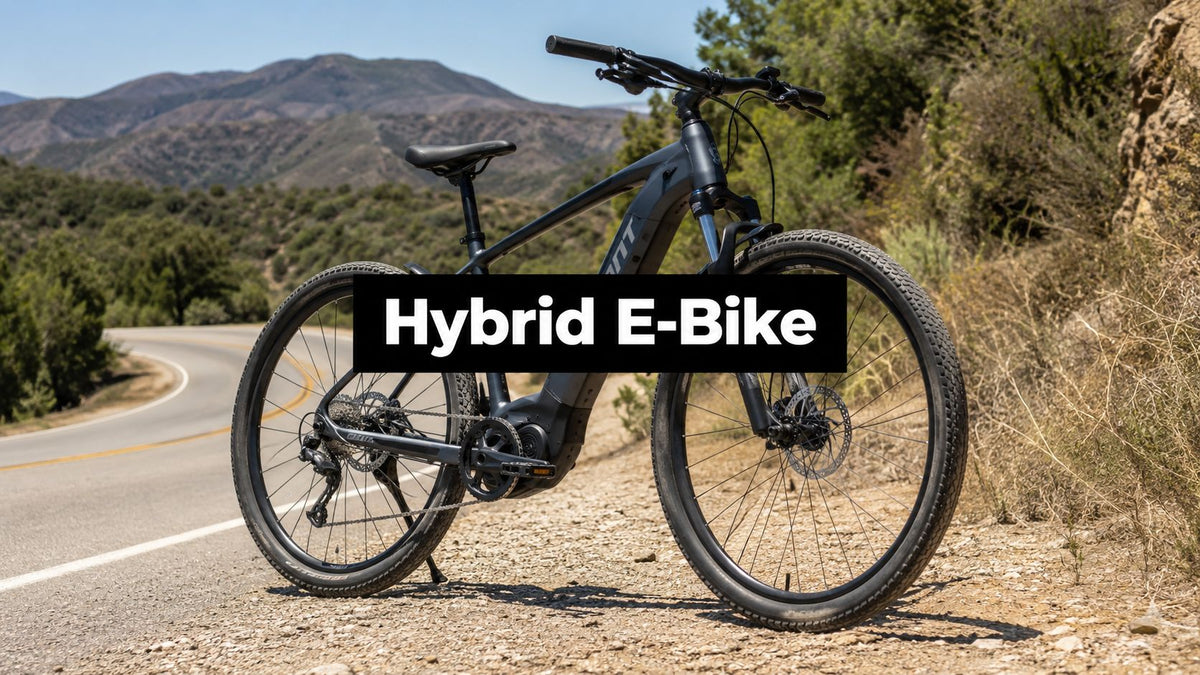
You're halfway through your commute when the smooth cycle lane turns into rough gravel, the wind picks up, and the final hill appears ahead. A normal hybrid bicycle can handle the route, but you may arrive sweaty and tired. A road e-bike may feel quick on the tarmac, yet less comfortable once the surface deteriorates. A hybrid electric bike aims for the useful middle ground, giving you a practical daily machine that can manage pavement, light trails, luggage, hills, and stop-start traffic.
The important question isn't whether a bike has an impressive motor or a large advertised range. It's whether the bike can complete your real round-trip commute, remain legal where you ride, and still be manageable when you need to carry it upstairs or service the drivetrain. This guide focuses on those trade-offs, especially for riders in the UK and EU, with relevant comparisons for Australia and the US.
What a Hybrid Electric Bike Actually Does on Your Commute
You leave home with a full bag, meet a headwind at the bridge, and still have a rough lane before work. A hybrid electric bike does not make those conditions disappear. It adds motor assistance while you pedal, so the same route demands less effort and leaves more energy for the rest of the day.
You control the steering, braking, balance, and line choice. The motor responds to the selected assistance mode and, on more advanced systems, to the force you apply at the cranks. It works more like a tailwind that you can adjust than a small motorcycle.
That distinction matters. A hybrid e-bike still requires pedalling, while an electric motorcycle or unrestricted throttle bike can move without the same input. Assistance can help maintain speed, climb, carry a bag, or resist wind, yet you still get useful exercise without arriving at work exhausted.
The usual design combines a semi-upright riding position, flat or swept-back handlebars, and tires wider than those on a fast road bike. You gain a clearer view in traffic and steadier control when smooth pavement changes to broken tarmac, a towpath, or light gravel. For a daily commute, a rack, mudguards, lights, and a dependable kickstand may matter more than a headline motor figure.
Why the mixed-route design works
A mixed route can change several times in one trip. Smooth streets may lead to a park, a bridge approach, and a shop stop on the way home. Stable geometry helps the bike feel predictable, while assistance reduces the fatigue created by those repeated small demands.
Range and weight still affect the choice. A battery advertised for a certain distance may deliver less on hills, in wind, with luggage, or after drivetrain losses. Judge it against your real round-trip commute, then check whether you can lift and store the bike.
Assistance commonly stops at the applicable legal speed limit, so you must pedal normally above that point. For route planning and everyday equipment choices, this e-bike commuting guide keeps attention on the complete journey rather than treating the motor as the whole bike.
Practical rule: Choose the hybrid category when your route changes often enough that a specialist road, mountain, or city bike would create a daily compromise.
A hybrid electric bike is not automatically the fastest or lightest option. Its value is practical: it can replace a car for many ordinary journeys while staying comfortable on pavement, towpaths, and light trails.
How the Hybrid Electric Bike Category Grew So Fast
Early hybrid e-bike projects often looked like ordinary bicycles carrying a battery and a basic hub motor. These conversions showed how assistance could make a daily ride easier, but the weight could sit awkwardly, controls were limited, and servicing was not always straightforward. For a commuter, that difference mattered: a bike that helped on a hill still had to be practical at the start and end of every round trip.
Better batteries, sensors, and motor packaging changed the category. Removable lithium-ion batteries made charging more convenient, while integrated lights, racks, and improved pedal-assist controls made e-bikes more useful for weekday travel. Mid-drive systems also let some designs keep the motor's weight nearer the rider and use the bicycle's gears more effectively on climbs. Those changes did not remove trade-offs. They made it easier to build a bike that felt closer to a conventional hybrid, while weight, range, and serviceability still needed checking against the route.

Electric bicycles became a modern transport category in the late 1990s. One market tracker reports about 47 million e-bikes were sold worldwide in 2022, according to Statista's worldwide electric bicycle market overview. The same overview also gives an estimate of 142 million e-bikes sold globally in 2023 and roughly 300 million e-bikes in use worldwide by 2024.
Those figures cover the entire e-bike market, not hybrid models alone. They still help explain why hybrid bikes are now easier to find, repair, and equip for commuting. Urban cycling, last-mile travel, and interest in lower-emission transport grew alongside adoption, particularly across Asia, Europe, and North America.
Why hybrids reached ordinary commuters
A daily rider may want motor assistance on hills without giving up pedalling. They may also want exercise without arriving exhausted, comfort for repeated weekday trips, and tires and handling suited to imperfect roads. The hybrid format meets that combination without the sharp posture of a road bike or the aggressive tires and suspension commonly associated with a mountain e-bike.
European adoption also expanded the category. Approximately 68% of electric bicycle sales in 2023 were in Asia-Pacific, Germany sold 2.1 million e-bikes in 2023, and the Netherlands reached a point where e-bikes overtook traditional bicycles in 2020, according to the electric bicycle industry overview from World Metrics.
That scale affects a commuter's buying decision. It supports a broader parts ecosystem and gives riders more equipment choices, while local rules still determine which motor, firmware setting, and equipment package can legally be used. A bike that suits a real round-trip commute must therefore fit both the route and the law.
Frame Geometry, Motor Assistance and Tires Explained
A hybrid electric bike feels right on a commute because three mechanical decisions work together. The frame sets your position, the motor changes the effort required, and the tires decide how confidently the bike meets the surface.
Frame geometry comes first
Most hybrids use an upright or semi-upright position. The handlebars sit higher than they would on a road bike, helping you look through traffic rather than down at the front wheel. A longer wheelbase and calmer steering can make potholes, wet roads, and loose gravel easier to manage, although that stability usually feels less sharp than a flat-bar road bike.
Look for comfortable mounting in real clothing, enough clearance for mudguards, and a frame that lets you place both feet securely when stopped. A low-step frame can be especially useful in stop-start traffic, but the best choice depends on the frame's stiffness, battery position, and how easily you can lift the bike.
Motor assistance should feel predictable
A rear-hub motor is often straightforward and can suit flatter commutes. A front-hub motor can also be simple, but it needs careful handling on slippery surfaces because power reaches the front wheel. A mid-drive motor places the motor around the crank area and can work through the bicycle's gears, which is helpful on repeated climbs.
The sensor system matters as much as the motor label. A technical review explains that sensors in the bottom bracket can measure pedaling torque and crank cadence, allowing the controller to adjust assistance to the rider's input through Power Management for Lightweight Vehicles. Torque sensing generally feels more natural because assistance rises as you push harder, while cadence-only systems are simpler and can continue assisting more strongly than necessary at low load.

Tires control comfort and confidence
A tire around 35 to 45 mm wide can offer a useful compromise for pavement, poor cycle lanes, and light gravel. Semi-slick tread rolls efficiently on smooth roads, while modest shoulder tread gives extra confidence when the route becomes loose or damp. Puncture protection is valuable for commuters because a flat tire can turn a convenient ride into a long walk.
Lower pressure can improve comfort on rough surfaces, while higher pressure can reduce rolling resistance on smooth tarmac. Don't copy the maximum pressure printed on the sidewall without considering rider weight, luggage, and route conditions.
For a more detailed buying framework, this guide to choosing an e-bike offers useful context before you compare individual models.
The video below gives a visual introduction to how these systems work in practice.
Hybrid vs Commuter vs Mountain vs City E-Bikes
The label matters less than the route. A hybrid electric bike suits mixed surfaces and varied distances, while the other categories make stronger commitments to one type of riding.
| Category | Frame Style | Tire Width | Motor Torque (Nm) | Suspension | Best-Fit Use Case |
|---|---|---|---|---|---|
| Hybrid | Semi-upright, stable | 38 to 45 mm | Varies by model | Rigid or light fork | Mixed-surface commuting and light trails |
| Commuter | Efficient, rack-focused | Medium, road-oriented | Varies by model | Usually rigid | Mostly paved daily transport |
| Mountain | Longer, reinforced trail geometry | Wide, knobby | Varies by model | 60 to 120 mm | Technical trails and rough off-road riding |
| City | Upright or step-through | Comfort-focused | Varies by model | Light comfort suspension or rigid | Stop-start errands and urban streets |
A hybrid is the practical choice for a commute that combines tarmac, a towpath, a rough shortcut, and an occasional hill. It won't have the trail control of a mountain bike, but its tires and position are usually more comfortable than a pure road-focused commuter on broken surfaces.
A commuter e-bike makes more sense when nearly every mile is paved and you value built-in racks, lights, mudguards, and efficient handling. For a daily trip of 12 km, the commuter can feel quicker and easier to store, especially if you never leave the road. The hybrid earns its extra versatility when the route changes with weather, construction, or route planning.
Where the other categories fit
A mountain e-bike is the right tool for repeated trail riding, steep off-road descents, and terrain that needs suspension and aggressive tread. Its added hardware can make ordinary commuting feel unnecessarily heavy and slow.
A city e-bike prioritizes easy mounting, relaxed posture, and low-speed control. It works well for short errands and dense urban riding, but it may feel less composed when you regularly leave smooth streets.
Route test: If your normal journey includes light gravel but no technical trail, a hybrid usually gives you the right balance without paying for capability you won't use.
Real-World Range vs the Brochure Number

A brochure range comes from controlled conditions, so it cannot predict every Tuesday commute. Your usable distance changes with terrain, rider weight, weather, assist level, stop frequency, battery condition, and drivetrain maintenance. A daily round trip should therefore be planned around reserve, not the most optimistic figure on the display.
A peer-reviewed performance study measured chain-drive efficiency between 70% and 98%, depending on chain tension, while battery efficiency ranged from 88% to 97%. The charger reached 85.7% total efficiency, as documented in this peer-reviewed e-bike performance paper. Energy is lost through the chain, gears, battery, and charging process before it reaches the tire, much like water lost through several narrow sections of pipe.
Four variables change the result
Drivetrain condition affects how consistently the motor's energy becomes forward motion. A dry, dirty, or poorly tensioned chain adds mechanical loss. Cleaning and correctly lubricating it, then replacing worn components, can improve consistency more reliably than selecting a bike with a larger display range.
Battery state of charge changes your reserve. Starting with a partly charged battery may cover a short trip, yet leave little margin for wind, hills, or an unexpected detour.
Assist selection is your main riding control. Lower assistance asks more from your legs and usually saves energy. Higher assistance makes climbs easier and reduces fatigue, while using the battery faster.
Rider and load mass also affect the work required to accelerate and climb. A backpack, panniers, groceries, and wet clothing all add weight. Published practical estimates for hybrid e-bikes commonly span roughly 20 to 80 miles per charge, but this hybrid e-bike range overview explains why terrain, rider weight, weather, and assistance level can shift the result substantially.
For a real commute, test the route and record battery use. Until that evidence is available, plan from the lower end of the advertised range. A battery that completes the round trip with reserve is more useful than a headline figure that depends on ideal conditions.
Legal Rules Across the UK, EU, US and Australia
A hybrid electric bike isn't automatically legal everywhere just because it has pedals. Motor power, assistance speed, throttle behavior, labeling, and certification can change between markets, and local enforcement may apply different rules to cycle paths, roads, and restricted areas.
| Region | Max Continuous Power | Assist Cut-Off | Throttle Allowed | Certification |
|---|---|---|---|---|
| Great Britain | 250 W | 15.5 mph | Not under the EAPC definition | EAPC requirements |
| EU common EPAC baseline | 250 W nominal | 25 km/h | Generally not under EPAC rules | Applicable EPAC compliance |
| United States | Varies by state and class | Class-dependent | Class-dependent | State and local requirements |
| Australia | 250 W continuous | 25 km/h | Depends on approval and model | State and territory requirements |
In Great Britain, an electrically assisted pedal cycle must have pedals that can propel it, a motor with maximum continuous rated power of 250 watts, and assistance that cuts off at 15.5 mph, according to the UK government's electric bike rules. A bike outside those limits isn't treated as an EAPC under that rule.
EU-facing guidance commonly describes EPAC compliance around 250 watts nominal power and assistance ending at 25 km/h. A 2024 revision described in this EU e-bike compliance guide requires speed sensors to trigger cutoff within 0.5 seconds of reaching the threshold.
Australia and the United States need extra checking
Australia commonly uses a 250 W continuous-rated motor with assistance cutting out at 25 km/h as the road-legal baseline across states and territories, according to this Australian e-bike law guide. Individual models and throttle systems can face additional approval requirements.
The US uses a state-by-state framework built around e-bike classes. Class 1 and Class 2 commonly use a 20 mph limit, while Class 3 commonly reaches 28 mph, but local access rules still determine where each class may operate. Don't assume a model sold for Portland can be used under the same conditions in Manchester, Berlin, or Melbourne.
Before crossing a border, check the destination's current rules and the bike's firmware setting, label, charger, and warranty terms. This guide to street-legal electric bikes is a useful starting point, but local government guidance should decide your final choice.
Practical Buying Checklist Before You Spend
A good shortlist starts with your commute, not the product page. Write down the round-trip distance, the steepest climb, the roughest surface, where you'll store the bike, and whether you'll need to carry it. Those answers will expose unsuitable models before you get distracted by motor displays and oversized range claims.
Weight changes the daily experience
Hybrid e-bikes commonly weigh 45 to 65 pounds, or roughly 15 to 25 pounds more than non-electric hybrids, according to this hybrid electric bike ownership guide. That difference is manageable while riding, but it becomes obvious on stairs, train platforms, repair stands, and car racks.
If you lift the bike every day, prioritize a total system weight under 23 kg. Accepting 25 kg can make sense if battery capacity and range matter more than easy handling, but test the lifting position rather than relying on a catalog figure.
Match the motor to the route
A mid-drive motor is usually the better fit for repeated hills because it can use the bike's gears. A rear-hub motor often works well on flatter commutes and may reduce the purchase price. Neither choice guarantees a good ride, so pay attention to how smoothly assistance starts and stops.
Ask the shop to let you ride the bike with assistance off. A well-balanced hybrid should remain controllable and reasonably natural when the battery is empty.
Compare battery capacity honestly
Battery capacity is expressed in watt-hours, or Wh. More Wh generally gives you more energy reserve, but it also tends to add weight and cost. Don't translate Wh directly into miles without considering assist level, gradient, rider mass, weather, and drivetrain losses.
For a practical planning method, measure your round-trip distance, multiply it by 1.3, and use that result as your minimum real-world range target. The number is a planning buffer, not a universal conversion from distance to watt-hours. Ask the retailer what route and assist setting produced its range claim.
The best UK e-bike for commuting can be a useful additional resource when you're comparing battery placement, equipment, and commuting priorities in the UK market.
Don't compromise on stopping power
Hydraulic disc brakes are a sensible minimum for a bike over 20 kg or for regular wet-weather riding. They offer strong control with less hand effort, which matters when a loaded bike reaches a junction in the rain.
Mechanical disc brakes can work well when adjusted properly, but they may need more frequent cable and pad attention. Check that replacement pads are easy to obtain and that the levers feel comfortable with your gloves.
Read the warranty like a mechanic
Look separately at the battery warranty and the frame warranty. They may have different coverage, exclusions, and replacement conditions. Confirm who handles diagnostics, whether the battery is removable, and whether the shop stocks compatible chargers, sensors, brake pads, and drivetrain parts.
A short test ride should cover more than a car park. Ride uphill, brake firmly, turn slowly, stand on the pedals, and check whether the saddle and handlebar position suit your actual posture.
Shortlist rule: Pick two non-negotiables, such as manageable weight and legal compliance. Treat motor type, accessories, color, display, and extra range as negotiation points until the first two are satisfied.
A hybrid electric bike fits best when your commute combines tarmac, light gravel, an occasional hill, and a need for one practical bike instead of two. Your final filter should be simple: Does it fit the route, has it got enough honest range, and is it legal where you'll ride?

Measure your commute today, apply the 1.3 planning factor, and use that result when comparing batteries. Then book a test ride at a local shop. No specification sheet can tell you whether the frame geometry, reach, saddle, and lifting weight suit your body and routine.
Frequently Asked Questions About Hybrid Electric Bikes
How far can a 500 Wh battery take you?
A 500 Wh battery does not promise one fixed distance. Assistance level, hills, rider weight, wind, tire pressure, and drivetrain condition all affect energy use. Treat the maker's maximum as an ideal reference, then plan around a broader real-world range of roughly 20 to 80 miles per charge, as noted in this hybrid e-bike guide. For a daily round trip, keep capacity in reserve for headwinds, climbs, and a missed charging opportunity.
Can a hybrid e-bike handle hills?
Yes, if the motor, gearing, and your input match the climb. A mid-drive works through the bicycle's gears, while a hub motor can feel weaker as gradients continue. Wattage alone does not predict hill performance. Ride the steepest part of your route and check whether assistance stays controlled instead of surging.
How efficient is the drivetrain?
Energy is lost through both the electrical system and the mechanical drive. The published performance study reports chain-drive efficiency between 70% and 98%, battery efficiency between 88% and 97%, and charger efficiency at 85.7% total. Those losses help explain why brochure range rarely matches a loaded commute. A clean, correctly tensioned chain is one practical way to protect range.
Is a hybrid electric bike worth choosing over a normal hybrid?
It can be, particularly when hills, headwinds, luggage, or fatigue make regular riding difficult. The useful measure is how many journeys you complete by bike, not how powerful the motor sounds on paper. Compare charging, maintenance, storage, insurance, and whether the bike can replace car or public-transport trips.
Punk Ride LLC offers electric rides and e-bike options for commuters and outdoor riders, with operations supported from Florida and warehouses in the UK and Germany. Visit Punk Ride LLC to compare models against your route, range needs, and local riding rules.
Share:
Best Cargo E Bikes for Families in 2026
Affordable Electric Bike for Commuting: Smart Buyer's Guide