


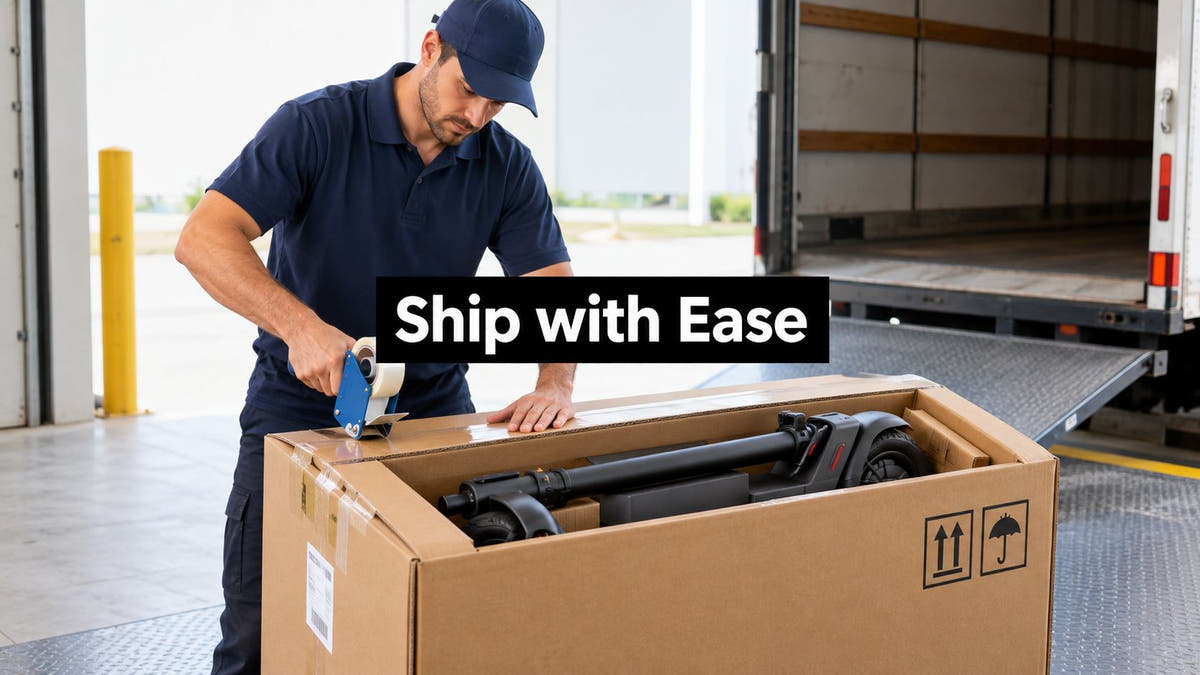
Riders start shipping an electric scooter by finding a box, weighing it, and comparing courier quotes. That's backwards. The first decision is dangerous-goods classification, because the battery configuration, watt-hour rating, and transport mode determine whether a carrier can accept the shipment at all.
I've seen sellers protect a scooter perfectly, print what looked like a reasonable label, and then watch the consignment sit in a warehouse for two weeks because it was declared as ordinary freight. The box wasn't the problem. The paperwork and classification were.
Why Shipping an Electric Scooter Is Not Just a Heavy Parcel
An electric scooter is a lithium-powered vehicle, so shipping starts with dangerous-goods classification, not with finding a large carton. Aviation, road, sea, postal, and dangerous-goods rules can all affect the shipment. A courier's oversized-parcel page cannot tell you whether the consignment is acceptable.
That classification determines whether the carrier accepts the shipment, what documents it needs, and how much handling it requires. Common rejection triggers include a missing declaration, an excessive watt-hour rating, exposed terminals, or the wrong UN number. Better shrink-wrap will not correct any of them.
Classify the shipment before you pack the carton.
The applicable classification depends on the battery's position and the transport mode. A battery installed in the scooter is treated differently from one packed beside it, while a battery shipped alone faces tighter controls. Air transport also brings configuration, watt-hour rating, packaging, marks, labels, and documentation into the decision. IATA's lithium-battery guidance explains why a standalone battery receives more restrictive treatment than one installed in equipment.
The mistake that causes the most trouble is treating the whole scooter like a generic small lithium battery. FedEx's dangerous-goods guidance classifies small lithium-powered vehicles such as e-scooters as UN 3171, Battery-Powered Vehicle, with no under-100-Wh exception for that vehicle classification. FedEx's battery-shipping guidance is a useful warning against applying a battery rule to the complete vehicle.
Carriers apply the baseline rules differently, so confirm the accepted classification in writing before you book. For Punk Ride's cross-border fulfillment model, consider the scooter, battery, packaging, destination, and transport mode together before creating a label.
A replacement battery does not automatically qualify under the conditions for a complete scooter. Removing it can make the shipment more restricted, not safer. That is why the UN number, especially UN 3481, UN 3171, or UN 3480, must be settled before packing or pricing the shipment.
The Classification Check You Must Do Before Anything Else
The first mistake is choosing a box or carrier before choosing the shipment's dangerous-goods classification. Settle the battery's configuration, watt-hour rating, and transport mode first. The correct UN number, whether UN 3481, UN 3171, or UN 3480, determines which services can accept the scooter and what handling it needs.
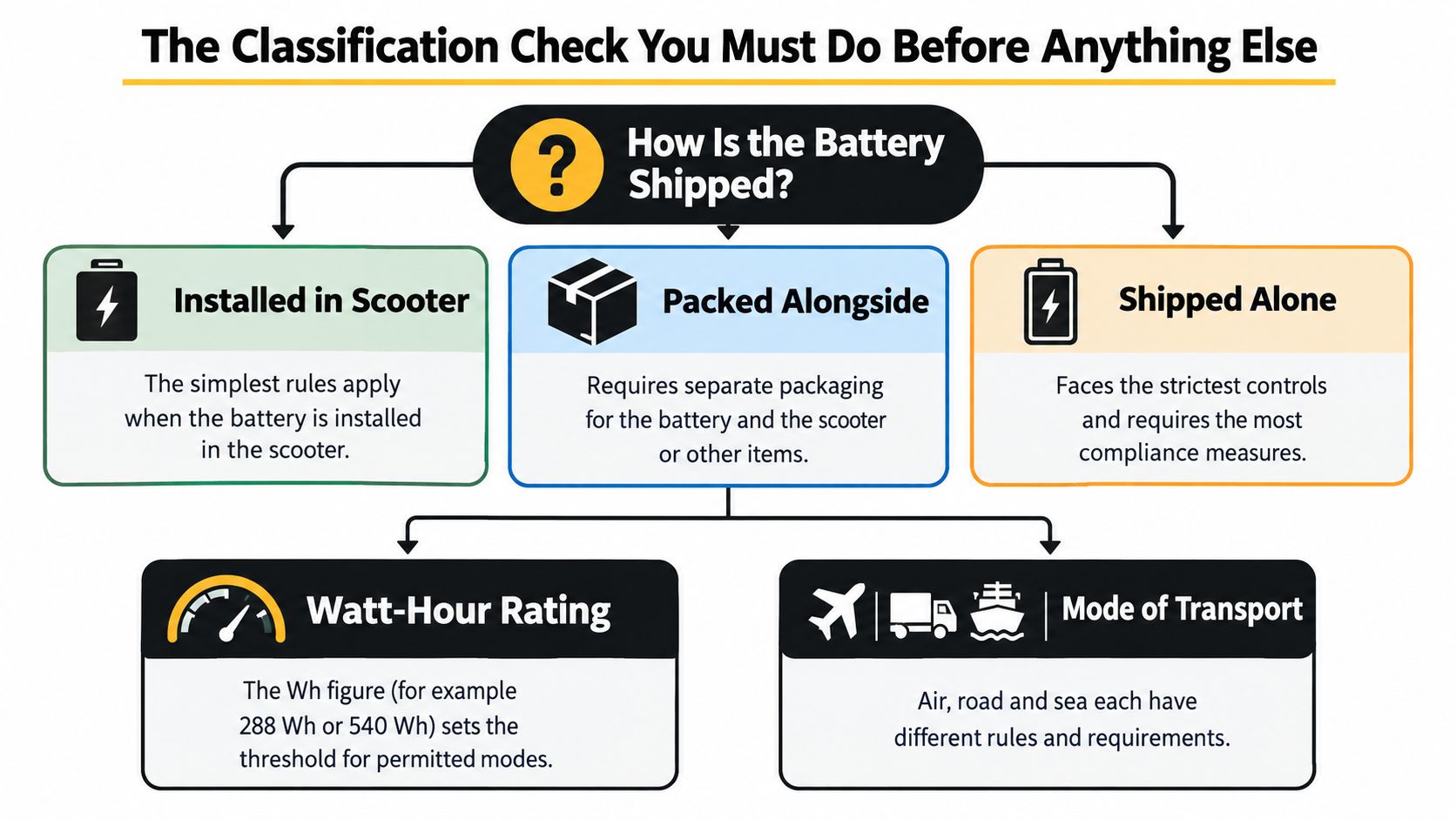
Start with the battery's position
Record the physical arrangement before requesting a quote. The carrier needs to know whether the battery is installed, packed with the scooter, or shipped alone. A battery installed in the scooter can fall under vehicle or equipment rules. A battery beside the scooter requires separate protection, while a standalone battery faces tighter air restrictions and its own packaging requirements.
“Battery included” tells the carrier too little. Removing a replacement battery can create a more restricted shipment rather than a safer one. A removable-battery design guide, such as this guide to electric bikes with removable batteries, helps explain the physical setup, but carrier confirmation still controls the booking.
Calculate watt-hours correctly
Use this formula:
Nominal volts × amp-hours = watt-hours
A 36-volt battery rated at 8 amp-hours has a nominal energy rating of 288 Wh. A 48-volt battery rated at 11.25 amp-hours has a rating of 540 Wh. These are calculation examples, not universal scooter specifications.
The watt-hour figure matters because postal routes often impose a 100 Wh battery limit. UK postal guidance sets limits of 20 Wh per cell and 100 Wh per battery, plus a maximum net quantity of 5 kg of cells or batteries per package. It also states that most electric-scooter and e-bike traction batteries exceed 100 Wh, excluding them from the ordinary small-battery postal route. Check The UK postal requirements before considering Royal Mail or another postal service.
For US shipments, a separately shipped lithium-ion battery above 300 Wh cannot use the small-cell-and-battery exception under 49 CFR §173.185(c). It must move as fully regulated Class 9 hazardous material under the applicable rules. A battery installed in and powering the vehicle has no watt-hour limit under the cited PHMSA guidance. PHMSA's interpretation of the US rules shows why removing a large battery can increase the regulatory burden.
Confirm air, road, or sea
Air transport follows IATA and ICAO dangerous-goods requirements. Road shipments may fall under ADR in Europe, and sea freight uses IMDG requirements. Postal operators add acceptance rules, while individual carriers may set stricter conditions.
Confirm the classification and transport mode in writing before booking. An air quote is useless if the carrier has approved the shipment only for surface transport, and a rule accepted on a UK road network may not cover a transatlantic air consignment. Classification, UN number, and mode must match.
Installed, Packed With, or Shipped Alone
The battery's position determines the shipment's dangerous-goods classification, not just the parcel's weight. A scooter with its battery installed may move as a battery-powered vehicle. A battery packed in the same outer package can fall under a different configuration. A battery shipped separately is usually the most restricted option.
| Configuration | Typical UN number | Air treatment | Practical note |
|---|---|---|---|
| Battery installed in the scooter | UN 3481 or UN 3171, depending on carrier classification | Carrier-specific vehicle or equipment rules apply | Often the simplest configuration, but confirm the carrier's classification |
| Battery packed with the scooter | Often UN 3481 | More restrictive packaging and documentation can apply | Separate the battery from conductive material and secure it inside the outer package |
| Battery shipped alone | UN 3480 | Forbidden as cargo on passenger aircraft and generally requires an approved cargo-aircraft route | Most likely to require specialist handling |
These UN numbers are working classifications, not automatic approvals. A lithium-ion battery installed in or packed with equipment is generally treated as UN 3481, while a removed or replacement battery is treated as UN 3480. For small lithium-powered vehicles, FedEx identifies the vehicle itself as UN 3171. The carrier's dangerous-goods team decides which classification applies to the service you are booking.
A standalone lithium-ion battery is forbidden as cargo on passenger aircraft, regardless of how small the scooter it powers is. Commercial air freight must use an approved cargo-aircraft route and follow the applicable packing instruction. Ask the carrier to confirm that route before accepting an air quote.
Removing the battery doesn't automatically make shipping easier. It can turn the shipment into a more restricted standalone-battery consignment.
That makes “take the battery out” poor blanket advice. Removing it may reduce the scooter's weight, while creating a separate regulated shipment with its own UN number, packing instruction, labels, and carrier approval. In some cases, keeping the battery installed is the cleaner way to ship the complete vehicle.
For passenger luggage or personal air travel, this explanation of taking a scooter on a plane addresses the practical restrictions. Commercial shipping follows a different process. Give the carrier the battery's exact configuration, UN number, destination, and transport mode, then get approval in writing before booking.
Packing the Scooter So a Carrier Will Actually Accept It
Packing begins with inspection, not foam. Turn the scooter completely off, disable any app-based activation or other mechanism that could start it during handling, and record the battery's serial number, condition, watt-hour rating, and state of charge.
Reject the shipment if the battery is swollen, leaking, crushed, overheated, damaged, defective, or recalled. Don't charge or test a suspect battery just to prove that it still powers on. A functioning display doesn't make a damaged battery safe to ship.
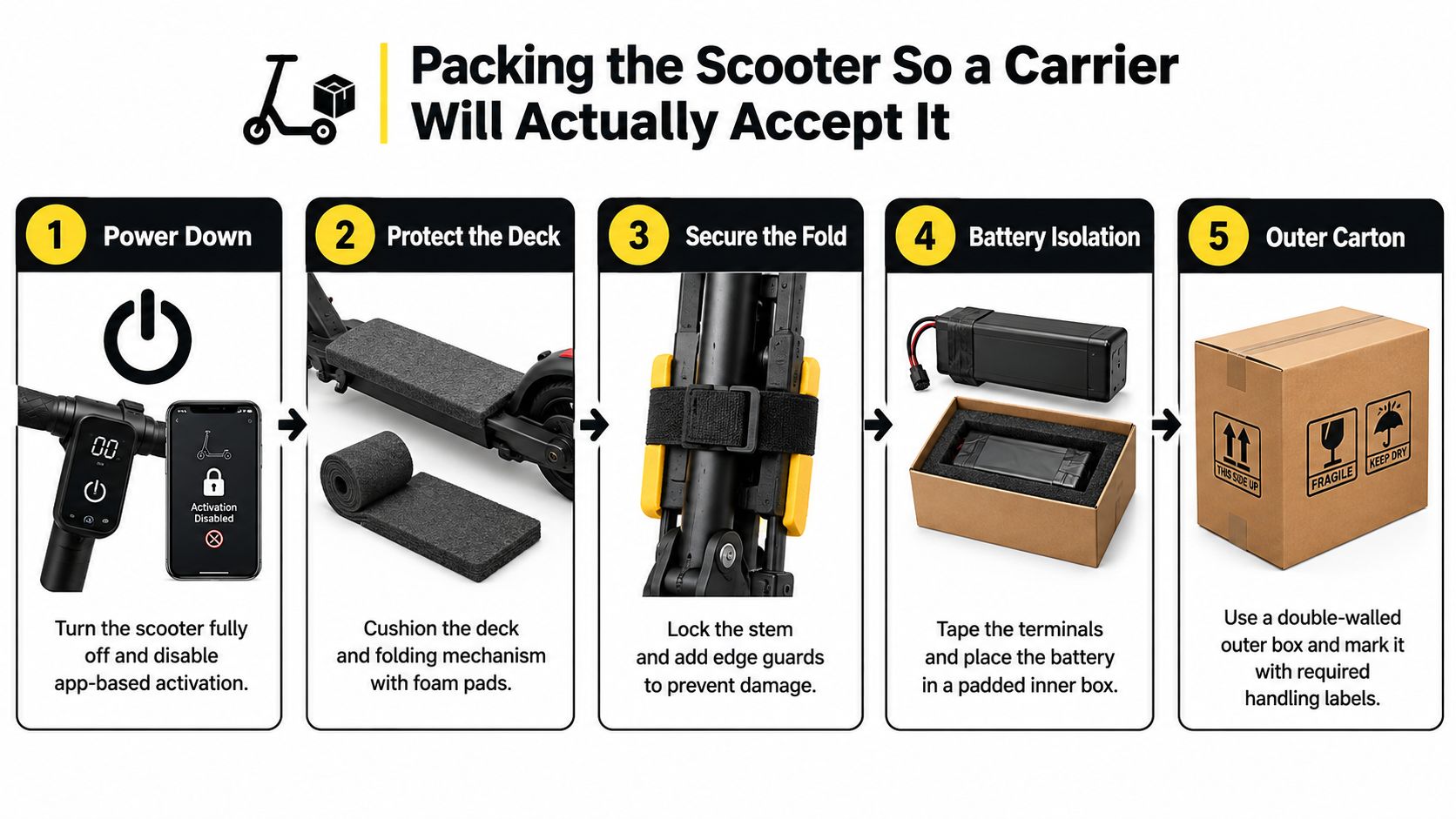
Build the package around movement control
Use a double-wall or otherwise rigid outer carton. Cushion the deck, handlebar stem, display, throttle, brake levers, and charging port. These parts take abuse when a box is dropped or pushed against another shipment.
Prevent the wheels and folding mechanism from moving. Secure the stem, isolate metal accessories, and keep the battery away from conductive material. Fill empty space with cushioning so the scooter can't slide inside the carton.
You're not trying to make the parcel look neat. You're preventing impact, accidental activation, terminal contact, and movement that can damage the battery or pierce the carton.
Learn how to fold an electric scooter before measuring the final package. A folded scooter often fits a more manageable carton, but the folded mechanism still needs to be immobilized rather than left under tension.
Protect the battery and finish the paperwork
Protect exposed battery terminals against short circuits. If a battery is shipped separately, use suitable inner packaging or dividers and keep it from contacting metal parts or other batteries.
For air shipments where the rule applies, lithium-ion batteries shipped alone should be discharged to no more than 30% state of charge. The complete scooter doesn't automatically receive the same treatment, so don't apply the standalone-battery rule without confirming the classification.
The package may require lithium-battery marks, orientation markings, dangerous-goods labels, and documentation. Fully regulated consignments may also need a shipper's declaration. IATA's practical battery-shipping guidance identifies terminal protection, compliant packaging, packaging limits, labels, and documentation as mandatory control points. DHL guidance also recommends a strong outer package, prevention of accidental activation, and a 1.2-meter drop-test benchmark in certain road-shipping provisions.
Use this video as a visual reminder of the physical packing sequence, then verify the dangerous-goods requirements with the carrier:
Choosing a Carrier and What It Will Actually Cost
The cheapest quote is often built on the wrong classification. A carrier may price the shipment as an oversized parcel, then reject it or reprice it after learning that the scooter contains a lithium battery. Confirm the battery's UN number, configuration, and route before comparing rates. UN 3481, UN 3171, and UN 3480 can lead to different acceptance rules and costs.
DHL, FedEx, and UPS are reasonable starting points for international door-to-door service, provided they approve the dangerous-goods details. Use a specialist freight forwarder for a high-value scooter, a large traction battery, a replacement battery, or a route involving several regions and handoffs.
For domestic moves in the UK and EU, regional parcel networks such as Royal Mail, Parcelforce, DPD, and similar services may handle the scooter itself, while excluding its battery. In the United States, USPS restrictions affect domestic options. Australia Post and local couriers apply their own limits and acceptance procedures.
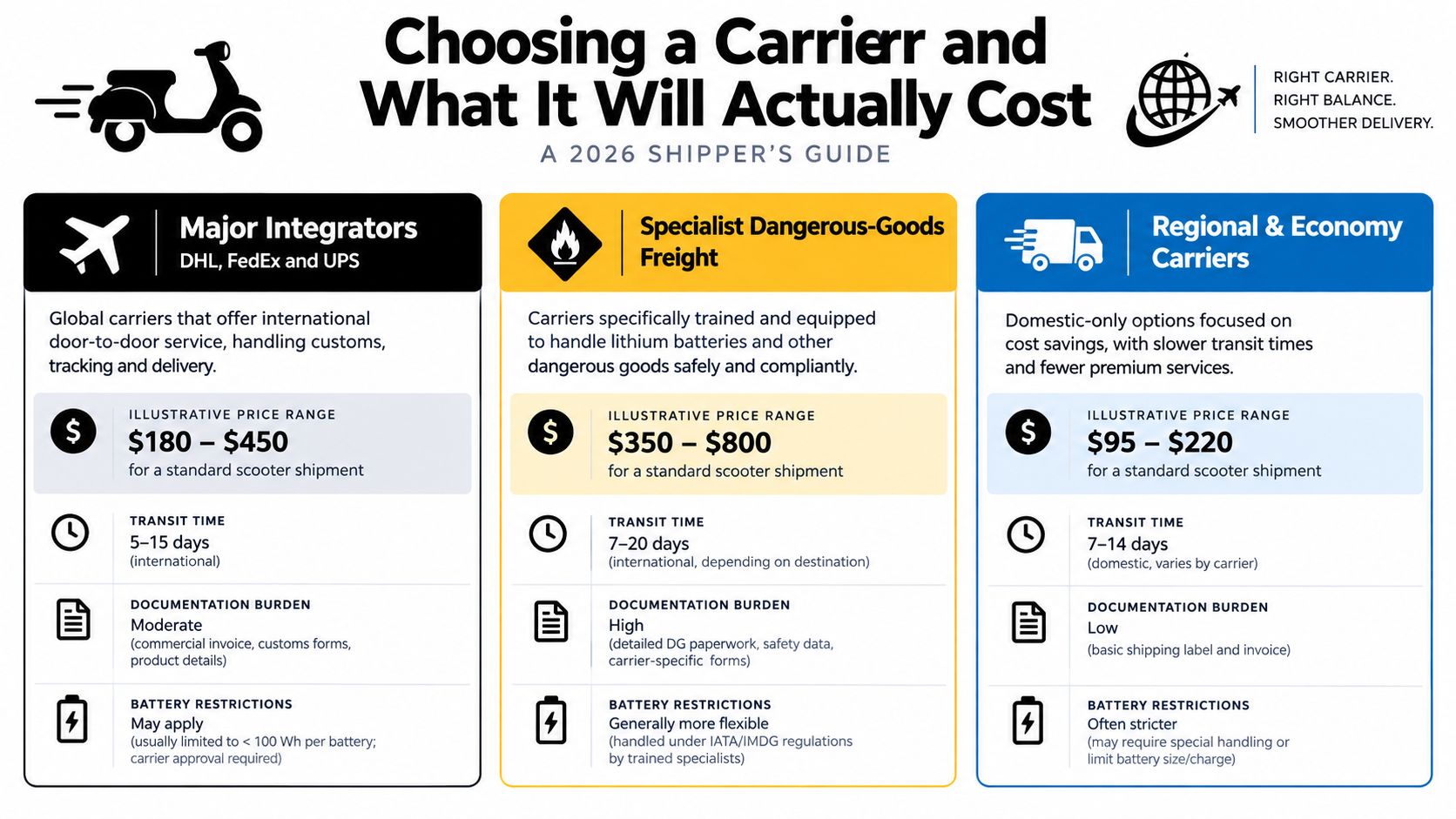
Match the service to the shipment
A 25 kg scooter with a 500 Wh installed battery may receive a domestic oversized-parcel quote of about £40-60. Dangerous-goods acceptance can push an international door-to-door shipment into the £150-300 range. Treat those figures as a comparison example, not a guaranteed rate. The route, packaging, service level, and battery classification change the final price. Get acceptance in writing before choosing the cheapest carrier.
UK postal services generally limit lithium-ion batteries to 20 Wh per cell, 100 Wh per battery, and 5 kg net per package. Since scooter traction batteries commonly exceed 100 Wh, ordinary postal service is usually the wrong option. Check the carrier's prohibited-items guidance rather than relying on a standard parcel label.
Australia Post permits lithium-ion batteries through eligible postal services within limits of 20 Wh per cell and 100 Wh per battery. For international transport by air or sea, and for domestic air transport, the battery generally must be installed in the device. Australia Post lists electric bikes and scooters among devices whose batteries may exceed 100 Wh, requiring a different dangerous-goods route. Australia Post's dangerous and prohibited items guidance sets out the relevant acceptance conditions.
For US domestic transport, a large battery does not become acceptable just because it remains inside the scooter. Its condition, watt-hour rating, configuration, markings, and surface route all affect the decision.
The middle-mile leg can change the total cost. For freight moving between warehouses or depots, this guide to middle-mile box-truck operations helps assess equipment, handoffs, and route planning.
Ask for acceptance before you pay
Send the carrier:
- Vehicle type: electric scooter, make, and model.
- Battery arrangement: installed, packed with the scooter, or separate.
- Battery data: chemistry, nominal volts, amp-hours, watt-hours, serial number, and UN 38.3 evidence.
- Package information: outer dimensions, gross weight, and package count.
- Route: origin, destination, and air, road, or sea movement.
- Condition: new, used, returned, recalled, damaged, or defective.
Choose a specialist forwarder when the carrier will not confirm acceptance in writing. A general parcel network works only when it approves the exact scooter, battery configuration, packaging, and route.
Returns, Recalls, and Damaged Batteries
A warranty return is where casual shipping advice becomes dangerous. Suppose a scooter still powers on, but the battery is slightly swollen. Don't charge it, test it repeatedly, or send it back in the original retail carton. Isolate the scooter and contact the manufacturer or a qualified hazardous-materials professional.
USPS guidance says used, damaged, or defective devices containing lithium batteries are restricted to domestic surface transportation with proper markings, while lithium-ion batteries over 100 Wh are prohibited in the mail. That covers many e-bike and e-scooter traction batteries. The USPS lithium-battery guidance makes the safe response clear: triage the condition before discussing postage.
Now take a normal relocation. Someone moving from Berlin to Florida with a working scooter needs to establish the battery arrangement, watt-hour rating, UN 38.3 status, labels, and route before booking transport. A standalone lithium-ion battery can't travel as cargo on a passenger aircraft, so the realistic options may involve approved cargo-aircraft transport, surface movement, or sea freight, subject to carrier acceptance.
New UN numbers and proper shipping names were being adopted from January 1, 2025 for lithium- and sodium-ion battery-powered vehicles, including e-scooters and e-bikes. In 2026, that means labels and paperwork should be checked against current carrier and modal requirements rather than copied from an old shipment.
If you wouldn't sell the scooter in its current condition to a stranger on a classifieds site, don't ship it yourself without professional advice.
A recall, crash, water intrusion, swelling, overheating, or battery fault changes the problem from routine fulfillment to safety triage. The carrier may refuse the shipment, and that refusal is preferable to placing a suspect battery into an uncontrolled transport chain.
Your Pre-Ship Checklist for the Next Electric Scooter
Use this as a release gate. Don't book the collection until every item has an answer.
Classification
- Confirm the configuration: Identify whether the battery is installed, packed with the scooter, or shipped alone.
- Calculate watt-hours: Multiply nominal volts by amp-hours and record the result.
- Choose the mode: Confirm whether the movement is by air, road, or sea.
- Verify the UN number: Ask the carrier whether the shipment is being handled as UN 3480, UN 3481, or UN 3171.
Battery records
- Gather UN 38.3 evidence: Keep the test documentation available before booking.
- Record identity: Write down the battery serial number, chemistry, condition, watt-hours, and state of charge.
- Reject unsafe units: Don't ship a battery that's swollen, leaking, crushed, overheated, damaged, defective, or recalled.
Physical preparation
- Power down completely: Disable app-based activation and prevent accidental startup.
- Immobilize the scooter: Secure the wheels, stem, folding mechanism, and loose accessories.
- Protect vulnerable parts: Cushion the deck, handlebar, display, throttle, brake levers, and charging port.
- Use a rigid carton: Choose a strong outer box and fill empty space so the scooter can't shift.
Release documentation
- Protect the terminals: Prevent contact with conductive material and short circuits.
- Apply required marks: Use lithium-battery marks, orientation markings, and Class 9 labels where required.
- Prepare declarations: Include the commercial invoice, accurate product description, battery chemistry, UN number, watt-hour data, and any shipper's declaration requested by the carrier.
- Confirm acceptance: Get carrier approval for the exact configuration, package, route, and transport mode.
Most common rejection reasons: wrong UN number, missing UN 38.3 evidence, or a battery above the carrier's watt-hour ceiling.
Shipping an electric scooter isn't hard once you stop treating it like an ordinary parcel. Classify it first, pack it second, and use a carrier that has explicitly accepted the configuration.
Punk Ride LLC offers electric scooters through its website and ships orders across regions including the United States, United Kingdom, Australia, Canada, and EU countries, with Economy Standard Delivery and FastTrack Express Delivery options available after dispatch. Visit Punk Ride LLC to choose a scooter and review the delivery option that fits your destination.
Share:
Ride on Scooters for Adults: The Complete 2026 Guide